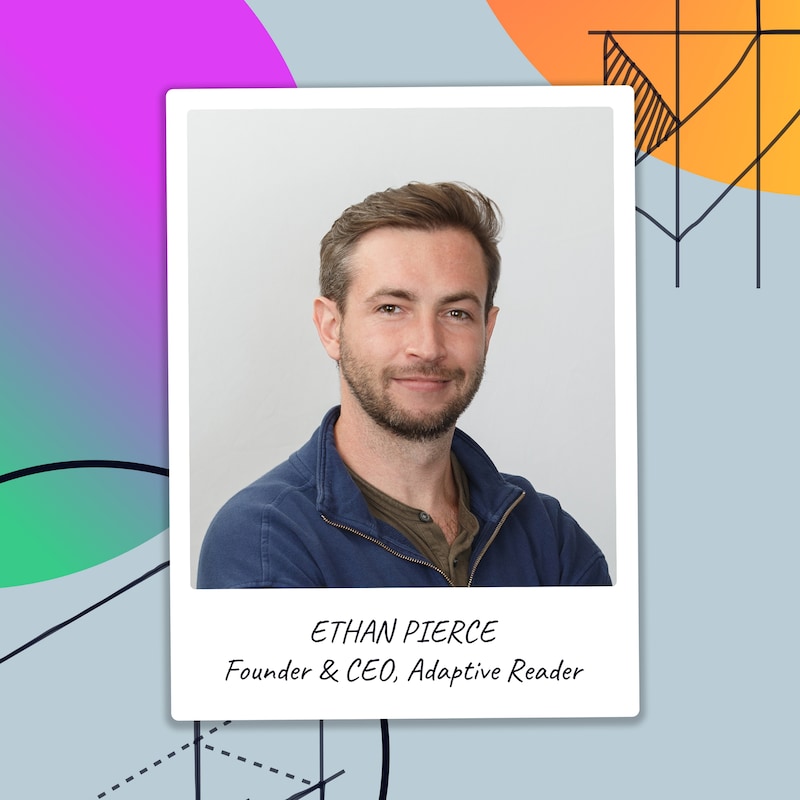
Shownotes
*** Help shape the future of Made For Us! Take our 4-minute listener survey for the chance to win a $25 Amazon Gift Card and get instant access to our curated reading list of every book ever recommended on the show: https://forms.gle/pNyrCooa23oYsaVk7
---
In this episode:
Ethan Pierce couldn't read when he finished third grade, but years later went on to win a full scholarship to Harvard. Recognising that not all students have the support he had, he founded Adaptive Reader, an AI-powered platform that adapts classic literature and other books to different reading levels and languages.
In this episode, Ethan talks about building a product around the learners the education system leaves behind, why your first startup idea is probably wrong (and why that's a good thing), and how listening to teachers changed everything he thought he knew about edtech design.
We discuss:
- How Ethan's own struggles with reading in school inspired Adaptive Reader’s mission
- Why 130 user research interviews convinced him that print was a non-negotiable equity need
- How Adaptive Reader designs for learners across neurological differences, physical disabilities, and languages
About Ethan Pierce
Ethan Pierce is the Founder and CEO of Adaptive Reader, an AI-powered accessibility platform that makes any text accessible to any reader—across languages, reading levels, and formats. A former struggling reader who went on to earn a full scholarship to Harvard, Ethan is passionate about using technology to break down barriers to literacy and learning.
Adaptive Reader has been recognized globally for advancing accessibility and inclusive learning, winning the Harvard President’s Innovation Challenge and the MIT Solve E Ink Prize.
Learn more about Adaptive Reader: https://adaptivereader.com/
Follow Ethan Pierce on LinkedIn: https://www.linkedin.com/in/ethanpierce13/
Follow Adaptive Reader on LinkedIn: https://www.linkedin.com/company/adaptive-reader/
---
If you enjoyed this episode, please leave a rating or review on Apple Podcasts or Spotify. Send questions for our guests or any feedback to: [email protected]
Other episodes you might like:
Speechify CEO Cliff Weitzman on building the 'voice of the internet'
---
Connect with Made for Us
- Show notes and transcripts: https://made-for-us.captivate.fm/
- LinkedIn: https://www.linkedin.com/company/madeforuspodcast
- Instagram: https://www.instagram.com/madeforuspodcast/
- Newsletter: https://madeforuspodcast.beehiiv.com/
Transcripts
If you have an idea right now, your idea is probably wrong, and that's a good thing. And your job as a founder is actually to disprove your idea as quickly as possible.
TS:Welcome to Made For Us, the show where we explore how intentional design can help create a world that works better for everyone. I'm Tosin Sulaiman.
When Ethan Pierce came up with the idea for Adaptive Reader, an AI platform that adapts books to different reading levels and languages, it seemed obvious to him that it would be a fully digital product. But during more than a hundred interviews with teachers, he kept hearing the same word - print.
In this conversation, Ethan talks about how those early insights shaped the product he eventually built. He's also candid about what he learned from the failure of his first startup and how his own struggles with reading in school informed many of Adaptive Reader’s design choices. Here's our conversation.
EP:I'm Ethan Pierce, the founder and CEO of Adaptive Reader. And we're looking at making every book accessible to any reader.
TS:So you started Adaptive Reader back in 2023. What's the problem that you're trying to solve and how are you approaching it?
EP:I was one of those kids who really struggled learning reading growing up. I hadn't learned to read when I got to fourth grade. I was using really early speech to text in middle school. I got the lowest score you could get on the SAT writing section because when I write, when I look at the words, the words don't look wrong to me. And I was so incredibly lucky that I had some folks lean in throughout my educational career, some amazing teachers.
And I went from that struggling student to getting a full scholarship to Harvard for undergrad. Thankfully, they threw out that SAT writing score or just ignored it, I guess.
EP:But I watched other folks in my family really struggle and not get that support and have very different educational outcomes. And so the core driver for me has been and continues to be, how do we make sure that every student, every learner, every reader is able to access the material they're developmentally ready for, irrespective of neurological differences, physical disabilities, or the language that they speak at home, whatever it is that's impeding them from accessing that content. And so that's really what Adaptive Reader is at its core, is an accessibility engine across language, format, medium to make content accessible for anyone who needs access to it.
TS:So we hear a lot about the literacy crisis in the US where you’re based, I think two thirds of students can't read at grade level. Obviously these statistics can feel a little bit abstract. What does that actually look like in the classroom?
EP:I had another literacy company before this called Readlee. I was the chief product officer there. And we listened to students read aloud and then performed diagnostics on their reading ability using AI. And I just remember a few conversations with educators. I remember one high school teacher in particular, she was a 10th grade teacher. She said, it seems like almost cruel and unusual punishment to be sending one of my sophomores home with grade level material when they're reading at a fourth grade level. How am I supposed to do that? When you have such a stark gap between a student's current ability to read and decode and understand a text and the content that they were being asked to work with within the classroom, then it can be really damaging to a student.
EP:We forget sometimes how much of education is psychological. They defensively, and I went through this a bit as well, start to say, I'm just not a reader. And from an identity perspective, that becomes really central and necessary to say, I'm just not an academic, I'm not a reader, my value is elsewhere. And so that's been the big question for me, right?
We have two different problems, actually. One, how do we improve that student’s reading ability to get them reading at grade level. And two, that student has stopped reading. It's not that they're taking the 10th grade text home and working through that. They have stopped trying because that gap is too hard.
EP:So how do we re-engage that student and make sure that while they're building that reading skill, they're not missing out on all of the other developmental milestones for the content that they're learning through that reading. We really put accessibility first and what does it take to make sure that every student is able to understand that content and fully participate within the classroom and get back on that journey.
TS:And on your website, I thought it was interesting. You used the term equity gap rather than say achievement gap. How come?
EP:To me, it is an equity gap because at the end of the day, at least in my experience, so many students have not had the resources to help identify these challenges or overcome these challenges. And so how do we acknowledge that piece of that? It's not a failing of the student. And that's something that I always try and reinforce in any of these conversations.
We so closely couple reading ability with intellectual ability, whether or not we do that consciously or not, but that gets internalized for students as well. And so when they're not reading at grade level, it's not just, I'm not reading at grade level, I'm not smart. And so you talk about an achievement gap, right? Like again, it comes back to that fundamental psychological and identity question. Whereas, framed from an equity perspective, the student hasn't had the resources that they needed to be able to build the skills or overcome the challenges to enable them to show their own brilliance.
TS:So I want to talk a little bit more about your own experience and go back to fourth grade. I think you were about eight or nine years old. You've talked about the psychological impact of that struggle to read. What was your experience during that time?
EP:Yeah, I still remember failing every spelling test I ever took. And I would spend so much time studying for those spelling tests. I just, I couldn't. I went to college still undiagnosed with anything. I think that it finally actually hit me when I got fired from my first job working in a library in college. I was reshelving books. And when we were being trained, we would put the book sideways so somebody could come back through and check after.
And I tried so hard to get the books in the right spots on the shelf. It wasn't like an intellectual gap of understanding what the system should be. And then I kept putting the books in the wrong place because my mind was just the way it was processing those numbers and letters was a little bit differently. But throughout these phases, those failures, I was very lucky to still have some supportive folks around me particularly some incredible teachers who believed in me. And so, yeah, I'm intensely grateful for that. And I wonder how we can make that be the experience of more students.
TS:And it's interesting, you said you got a job at a library in college. So I assume you still love books, even though you had this struggle.
EP:I love books so much. I love the design of books. I love going to a bookstore or a library. I love the ideas inside books. I'm still an avid reader, but I almost exclusively listen to books. And it's funny, I still love the book. And maybe this is a quirk of mine, but I'll listen to the audio book and get the audio book from the library and the books that I really, really love that I want to come back to again and again, I'll get a physical copy of for my little library because I really treasure being able to have that reminder, have that that I can look back at.
TS:That's amazing. So let's talk about the journey from struggling with reading to ending up at Harvard. This didn't happen overnight. You have talked about the teachers that supported you, but I'm wondering if there was a particular turning point.
EP:Yeah, I think in middle school, my grandmother was incredibly supportive in my reading efforts. She also bribed me for each chapter book I struggled through. She understood me psychologically pretty well on how to push through some of those things. And then I remember I had one teacher in high school, and I know you can't do this anymore, but she brought me home every Friday night and made me dinner and worked with me. And wow, like what a precious and magical thing to have educators who care so much that they're able to lean in to different students. And I also know very few people get those extra supports in the levels they need.
TS:Yeah, you mentioned that you had family members who faced similar struggles in school, but didn't have the same outcome that you had.
EP:Yeah, I ha efamily members who didn't graduate from high school. And I look at the difference in our outcomes. I had an incredible academic opportunity and that has allowed me to, this is my sixth time bringing a new company, a new product into the market. And wow, like how amazing and how cool to get to build things that people need and bring them into the world. But my story could have been very, very different if I hadn't had the right people lean in at the right times.
TS:So you talked about bringing six products to life. Tell us about your first startup attempt.
EP:Gosh, yeah, I raised some money out of my, it's almost cliche, out of my dorm room at Harvard for my first company, which was in the art finance space. And we started with this question of what would it look like if we allowed you to own a piece of a Van Gogh or a Picasso? What does it look like from an emotional perspective, from a financial perspective, to think about that work as an equity, as a share, and being able to give your grandchild $50 in a Picasso and change that relationship with art. And I won't go into the sort of financial details or implications of that within the fine art market and everything, which I found really interesting.
EP:But that was my first company. And first really big failure as a company, we ended up closing that down because we were too early for the market. There's another company that started about six years ago that took that model and has done really, really well with it. And so for listeners out there that are thinking about bringing something into the world, a powerful lesson that I learned was how important timing is. And that timing, when you bring that innovation to the world, when the world is ready for that innovation, is really important.
TS:So moving on to Adaptive Reader, walk me through the moment you got the idea for Adaptive Reader. What sparked it?
EP:Yeah, there's a great product out there called Newsela that folks might be interested in. It’s very popular here in the US and they take news articles and they rewrite them to four or five different reading levels. So these are 800 to 1200-word articles and they've been really successful with this. And I thought to myself with AI, wow, we could do that with any book. We could take Frankenstein and we could simplify the dense vocabulary and sentence structure.
Frankenstein Original:I am already far north of London, and as I walk in the streets of Petersburg, I feel a cold northern breeze play upon my cheeks, which braces my nerves and fills me with delight. Do you understand this feeling? This breeze, which has traveled from the regions towards which I am advancing, gives me a foretaste of those icy climbs. Inspired by this wind of promise, my daydreams become more fervent and vivid.
I try in vain to be persuaded that the pole is the seat of frost and desolation. It ever presents itself to my imagination as the region of beauty and delight. There, Margaret, the sun is forever visible, its broad disc just skirting the horizon and diffusing a perpetual splendour.
EP:To make a version of that text that maintains the whole original meaning, but offers a bridge for students to be able to practice decoding independently, to be able to understand what's going on, to be able to confidently engage in class, and maybe most importantly, to say, maybe I am a reader.
Frankenstein Adaptation:I am already very far north of London. As I walk in the streets of Petersburg, I feel a chilly breeze on my face. It makes me feel strong and happy. Can you imagine this feeling? The breeze comes from the places I'm going to, so it gives me a taste of the cold climate there. This makes me even more excited and hopeful about my plans. I can't help but imagine the North Pole as a beautiful and wonderful place, even though people say it's frozen and desolate. In my mind, it's a land of beauty and happiness. In that place, Margaret, the sun never sets. It's always shining on the horizon, giving everything a bright glow.
EP:And so the very first idea that kind of went off the first light bulb was Newsela for novels. And what does it look like to apply that methodology to long form content?
TS:And so you had this idea, what's the first thing you did with it?
EP:So I'm a big fan of user research. The first thing I did was go out and anonymously recruit seven high school educators from the internet. And I paid each one of them to participate in a short 30-minute user research interview. I wasn't like, hi, I'm Ethan, founder of Adaptive Reader. No, it was really just a conversation to understand what they were doing today in our classrooms, how they were supporting these students.
And then towards the end, introduced, I had mocked up a version of Frankenstein in Chat GPT had gone through and rewritten it, a couple of different reading models. And so I showed them that at the end.
EP:And it was so funny. I could have totally ignored it, but every one of them asked if they were going to be available in paperback. And that was such an eye-opening moment and such a pivotal moment for me in this journey. I had totally thought this was a digital product. And then they brought that up and we did about 130 user research interviews all together in these different phases and clicked into that and found how critical print was within this context and how print was a first class equity and access need. And so that's something that's become very built into the fiber of adaptive reader.
TS:Can you say a little bit more about that? Why print? Why did people see this as an equity issue?
EP:So we ended up doing a bunch of follow-up user research interviews because I was so intrigued, like, why? And immediately, think as an edtech founder, or within a community of edtech founders, we're like, it's because teachers just haven't caught on with, they're daunted by technology, right? Like, once they see the magic of technology, once they become familiar and comfortable with it, obviously, you know, they're gonna choose technology.
But that didn't ring quite true because every one of these educators had gone through the pandemic fully remote. They had used these tools digitally. The only question that was really illuminating in these user research interviews, I asked them if they had used Newsela, and then I asked, how had you implemented that? And every educator who had implemented it had printed the articles out and handed them out in print.
EP:And for listeners who don't know, Newsela is a fully digital product. It was never intended that you would print out these articles. And so we did the five why's, right? We kept asking why, why, why, why are you doing this? What's the meaning behind it? And if I were to sort of summarize the insights, I think we found five miniature buckets that teachers will point to about why print was critical for them.
EP:One, about 35 % of educators cited research that reading comprehension and retention is significantly higher with print. Two, equity and access at home. So their most vulnerable students still frequently did not have consistent internet access or device access at home. Interesting one that was really illuminating as well. If you have a 45 minute class, you're using computers. They consistently said the first three to seven minutes of every class was dealing with a student who couldn't get logged in, who had forgotten their battery charger, whose laptop was left at home. And if you have a 45-minute class, that's actually 10 to 20 percent of your total instructional time. That's huge as an educator.
And finally, a few really important things about focus. One that stuck out to me in Google Chrome, you know, if you're not connected to the internet, that little dinosaur shows up.
EP:Apparently, that dinosaur is actually a video game. You can use your space bar and the little dinosaur will jump and you have to avoid cactuses and everything. Like, no matter how confined you made internet access and all of this stuff, they would just turn off the Wi-Fi and start playing their dinosaur game. They're so inventive, they're so creative. And so with print, you know, maybe they're not reading Frankenstein if you have the printed packet or physical book in front of them. But you do know that they're not playing the dinosaur game.
TS:Those are all great reasons. It's fascinating, actually. So in 2024, you launched Adaptive Reader with classic literature. Describe that first version of the product and how it's evolved since then.
EP:Our very first product was physical print books, written at multiple reading levels. We launched a digital product to go along with that. Our thesis has been from very early that different students need access to these materials in different formats, whether that's print, audio, or a digital reading experience. And so some of the things that have become really central within that and that we discovered from these user research interviews.
I remember conversations with teachers as we created leveled versions of Frankenstein. And they were like, this is amazing, but you've actually made more work for me. Because when you're differentiating, differentiating is such a big thing within EdTech right now, now the teacher also needs to context switch between each of these different versions. Like, do we need to create separate question sets for each one?
EP:So we developed a patented system where we break the original text into these small numbered chunks. And so now today we take that book, we can rewrite it at multiple reading levels in 200 languages. So think 600 different versions of Frankenstein right there. And we can print that on demand. We can generate multilingual audio for you.
And you can view it side by side in the digital reader. So you can see the original text with a paraphrased or translated adaptation. But those little passage markers, you can say go to passage 144 and the student reading in Pashto online is at the same point as the student who's listening to passage 144, the original English audio, and the same with the print books.
TS:And also, I believe all the books look the same regardless of how they've been adapted.
EP:Yeah, I think we talk about dignified differentiation a lot. And it comes back to that question about shame at the end of the day. We continued to hear teachers talk about how what they were doing today was handing out a set of pink sheets to students for the IET with different materials. And immediately, everyone in the class knew that they were different.
And so that was something that became really important for us was these books look and feel like real books. They have a cover that looks just like every other students. It doesn't say, hey, this is the version adapted to the fifth grade reading level or translated into Latin American Spanish. It's just that book, just like every other student, but with accessibility features built in that help them to fully engage with the content.
TS:So interestingly, we were talking about your first startup. You said timing wasn't on your side. Does Adaptive Reader feel different either of its time or not too far ahead?
EP:Yeah, I think you start to build some intuition around timing, but maybe more importantly, you start to really listen in a different way. So print is an example of this. We listened when teachers asked for paperbacks. I totally could have just ignored that and made this a fully digital product. But by listening and hearing that not only were teachers not ready for digital only, they actually had the really strong logical reasons for returning to print. We were able to understand that and understand that this is also a moment where the stars had aligned, where AI can do these text transformations, leveled adaptations. We can do print on demand to create one printed book translated to a fifth grade reading level, translated into Pashto to print it on demand.
TS:So can you walk us through how the idea of achieving accessibility across different reading levels works? So what are the levels and what's AI doing to the text?
EP:Absolutely. And I think this is also a good moment to share that with any scaffold, it's a double-edged sword. I think this is such a critical piece in any accessibility conversation because any scaffold when relied upon too consistently can actually impede a student's growth. So a couple of things that are really critical for us when it comes to creating these paraphrased versions. One, we know that it's critical for students to build background knowledge in order to understand a text. And then from that, and this was a design decision that we've made with that passage marker system, they can always access the original version of that text and see it side by side exactly where they're at.
EP:And so when we're teaching schools about how to use these materials effectively. We talk about, one, offering multiple levels where you have a gradation. We typically recommend reducing text complexity by about two grade levels for each step, but allowing the student to practice independently, whether in their home language, a leveled adaptation, or listening, and then drawing it back to the original grade level material for whole class instruction so that even if the student is getting an accommodation, you're also ensuring that they're getting exposure to grade-level vocabulary, grade-level sentence structure, and the authenticity of the original text.
TS:And I imagine you hear the criticism a lot that you're dumbing down the classics by doing this. What's your response to that?
EP:I think that there is often a false binary here that if we don't offer these leveled adaptations, the student is going to read the original. The student is not reading the original. The student is not reading. And I don't remember the exact stats off the top of my head, but a very large percentage of Americans never read another book after high school. So this might be the last book that they ever read, which is pretty wild.
EP:And so in my mind, we don't keep reading Frankenstein just because the writing is great. Mary Shelley wrote it over a weekend. I do really treasure the language personally. I love art and I love the artistry of it. But we also read these books because they challenge the way we think about the world. They force us to think about things differently and to step in the shoes of others. And so how do we make sure that the students who want to build these skills, who want to engage with the content have a thoughtfully created on-ramp that allows them to build skills, build background knowledge, and how do we make sure that they have access from there to the original text. Because you think of the Greek Gatsby or something, right? Like we want them to come to love that language, but they have to have understanding and comprehension before they can really appreciate that beauty.
TS:I mean, just to push you further on this, what about the author's voice? How do you preserve what makes each author distinctive? So Dickens doesn't end up sounding like Hemingway, for example.
EP:We make it very clear that something is lost in these adaptations. But you also think about translations like the Odyssey. How many hundreds of times has the Odyssey been translated into different languages, into English at different times? We don't say that you have to learn to read ancient Greek in order to read the Odyssey. We are about making sure that everyone has the capacity to engage with the materials they're developmentally ready for, that they're interested in, in a meaningful way, and saying very clearly that, you know, this is a tool to help you come to the author's original language and be able to understand what's happening there and be able to appreciate that.
TS:And you do have educators who are verifying these adaptations as well, don't you?
EP:Yeah. So for the novels that we publish, we do have educators going through working on those adaptations. We now have a school self-serve upload feature. So teachers can upload their own content materials, the worksheets that they're working from and create translations or adaptations of those. And those are AI first to make sure that those teachers are able to access the material they're working with today. I think quality is so critical here, and how do we find the balance of quality and accessibility.
TS:And what's on the roadmap that you're excited about? Is there anything on your wishlist that maybe the technology isn't quite ready for yet?
EP:We've just started doing dialect specific translations, audio as well. We now have a Spain Spanish and a Latin American Spanish, both in terms of translation quality and in terms of audio. I look at Arabic as a great example where I think there are around 15 or 16 different major dialects of Arabic. And so what does the world look like where - there are over 7,000 languages out there and there are dialects beyond that - where we're able to generate in a really high quality and fidelity any material in not only the language but also the authentic dialect of a speaker.
TS:If someone's thinking about starting a company, what's your advice on how to find an idea that's worth pursuing?
EP:I started doing a lot of teaching at Harvard and MIT and early entrepreneurship courses. And this is the thing that we always sort of come back to. If you have an idea right now, your idea is probably wrong and that's a good thing. And your job as a founder is actually to disprove your idea as quickly as possible. My initial idea that this was just Newsela for novels, that it was digital. There's still a core of that in what we've built, but we've gone so far beyond that.
I've learned things that disproved part of that core thesis, that it was going to be digital. And so find something that you wish were different in the world. Like for me, I really wish that my family members had been able to access this content in a way that allowed them to fully participate. I imagine what different outcomes they might have had.
EP:So find that thing that you care about, the thing that you wish could be changed in the world. And then think about it, talk to ChatGPT about it, ask what problem am I really looking to solve? And then what are all of the different ways that I could approach this? And finally, and something that I share with all founders, think of yourself as the product that you're building rather than the tool or the company.
This is my sixth time doing this and I have gotten so much better at it each time. And so as you're going through this process, keep that in the back of your mind that maybe this is just the first one. Maybe this isn't the one that will be the breakout success or solve what it is that you care about, but you're building real skills that you're going to take with you everywhere you go in your life.
TS:That's fantastic advice. How can people learn more about Adaptive Reader? How can they follow you?
EP:adaptivereader.com and I think I'm most active on LinkedIn. So you can look up Ethan Pierce with Adaptive Reader. I always love hearing from folks. I say that I'm always on a listening tour to understand how we could be making content even more accessible, how we could be doing this even better and what challenges folks are experiencing. So please connect, reach out and looking forward to hearing your ideas and feedback.
TS:Well, Ethan, it's been wonderful chatting with you. Thank you so much for coming on the show.
EP:Thank you so much for having me.
TS:Thank you to Ethan Pierce, founder and CEO of Adaptive Reader. If someone came to mind while you were listening, why not text this episode to them? And you can also let us know what you thought by leaving a rating or review on Apple Podcasts or Spotify. I'm Tosin Sulaiman, see you next time on Made For Us.
EP:Gosh, so many books. I think one that I come back to over and over again is How will you measure your life? It's one of the few books that I read again and again every couple of years because I think it's so helpful as an anchor to reframe what are our values, what do we care about, and are we putting in time in alignment with what we value?







