Shownotes
This is your go-to Podcast, where we help parents navigate the complexities of family life. Hosted by Ali Kessler of Greyson’s Choice, we’ll cover everything from understanding domestic violence to navigating the legal system, finding the right therapists, life hacks, family law, mental health, custody battles, and how to protect children in dangerous situations.
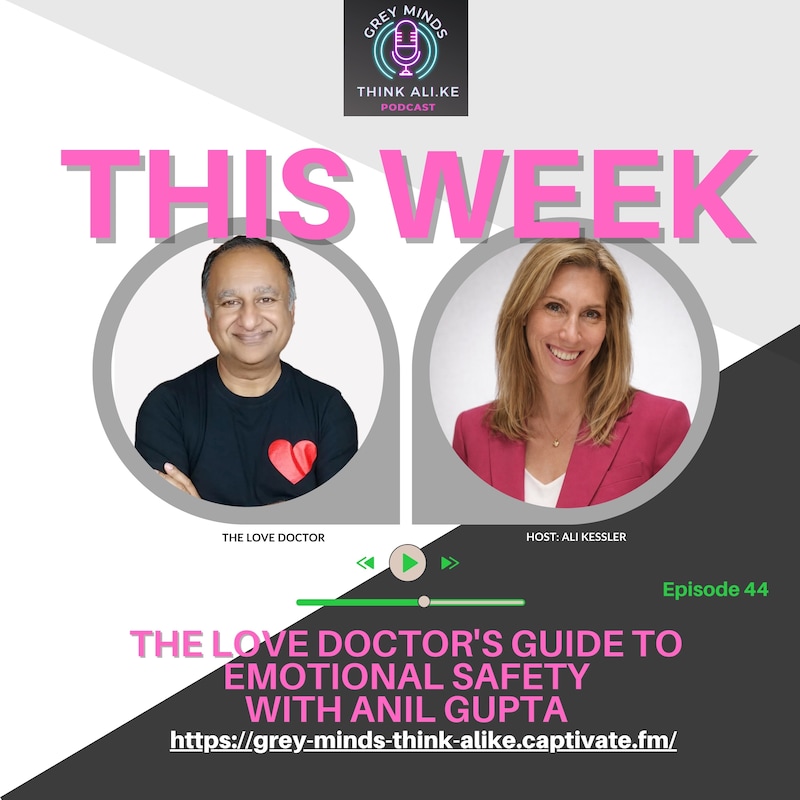
On Grey Minds Think Alike, host Ali interviews “Love Doctor” Anil Gupta, a relationship and mindset mentor and author of Immediate Happiness, about practical tools for navigating conflict, grief, and toxic relationship patterns. Gupta explains how people create suffering by assigning meanings to events, and shares his “happiness = G x G x G” formula—Give, Gratitude, and Growth—along with examples from a serious hand injury and his past suicidal thoughts. He outlines criteria for a healthy partner (integrity, loving, and healthy) and advises seeking help or leaving when safety is at risk. For parents, he offers a dinner-table exercise using gratitude, kindness, and communication prompts to build emotional safety and confidence in children. He also discusses choosing fulfillment, reframing language, and how singles can “collect data” before dating.
About Anil Gupta
Anil Gupta, widely known as The Love Doctor, is a TEDx and Harvard speaker, relationship and mindset mentor, and author of Immediate Happiness (meetanil.com/happiness-book). For over 20 years, he has guided individuals and families through grief, trauma, and toxic relationships, helping them build resilience, emotional safety, and hope. Featured on iHeartRadio and Fox News, Anil has shared stages with Richard Branson, Les Brown, and other world-renowned leaders. Through his teachings at meetanil.com, he empowers people to transform pain into purpose and reclaim joy in their lives.
About Ali Kessler
Ali Kessler is a writer, marketing professional, passionate parent advocate, and founder of Greyson’s Choice, a 501(c)(3) created to raise awareness about the risk of domestic abuse on children. Greyson’s Choice was founded by Ali Kessler in memory of her sweet, vibrant, and fearless 4.5-year-old son, Greyson, who was murdered by his biological father in a murder-suicide during an unsupervised, court-approved visit in Ft. Lauderdale, FL, in 2021. This came just hours after her petition for a domestic violence injunction was denied by a Broward County judge, citing that the “petitioner has failed to allege any overt acts by the respondent which would constitute domestic violence under Florida Statute.”
Ali’s advocacy efforts culminated in the successful passage of Greyson’s Law during the 2023 legislative session. This bill now requires the court to consider threats against ex-partners or spouses when making child visitation and custody determinations in the court, expanding to include the following factors: evidence of domestic violence, whether a parent in the past or currently has reasonable cause to believe that they or a minor child is, or has been in imminent danger of becoming the victim of domestic/sexual violence by the other parent, even if no other legal action has been brought or is currently pending in court.
Contact Ali:
Subscribe, donate, listen, learn.
Transcripts
Anil Gupta Podcast
Ali Kessler: [00:00:00] Welcome back to Grey Minds Think Alike, where we dive deep into the conversations that matter most with experts who enlighten, inspire, and empower. Today I'm joined by someone known as the Love Doctor. Anil Gupta is a TEDx and Harvard speaker, relationship and mindset mentor and author of the book, immediate Happiness.
For more than two decades, Anil has helped individuals and families heal from grief, trauma, and toxic relationships while showing them how to create emotional safety, build resilience, and reclaim hope. His work has been featured on iHeartRadio and Fox News, and he has shared stages with other thought leaders.
Anil's mission is to help people transform pain into purpose without losing themselves in the process. O Neil has performed his relationship and mindset workshops in over 18 countries, and we are so happy to have him here today. So, hello there. Thank you for coming on Grey Minds. If you would just wanna give a brief intro into who you are and what you do, we'll go from there.
Anil Gupta: Yeah, no, thank you for a great introduction. I'm known as a love doctor. I help people [00:01:00] overcome the struggles that we're all facing in our lives so that we can lead bridger for our happier lives. We were never given a toolbox. When we were born, or when we got married, or when we have a relationship. And the more tools that you have, the easier your life will become.
We're gonna share some of those tools today.
Ali Kessler: Absolutely. So just before we even continue, how did the name the Love Doctor come about?
Anil Gupta: It was pure, purely by Charles Sandy. I'm a member of certain masterminds and one person call me Love Doctor, then someone else call me. Then you know, then another person because they heard the first person call me.
And I thought, I kind of like that. And I thought, alright, let me see. And then another mastermind started calling me that. So I thought there must be something in it. And that's exactly what I do.
Ali Kessler: That sounds fantastic. So your book, Immediate Happiness, it offers practical tools, you said, for people who feel just stuck in relationships conflict.
I guess just give us a little intro into the book. Yeah.
Anil Gupta: The book is a manual on human behavior. Why we get upset. The cost of getting upset, forgiveness, letting go the past doesn't equal the future. It's not what you say, it's how you say it. And we were never taught this stuff. So for example, in a relationship, we need to know what the other partner wants.
Men want to be respected. Women want to be loved. And tone languaging. The words that we use mean everything. The meaning we [00:02:00] put behind things. So for example. I used to think when my wife didn't return my call, she doesn't love me, she doesn't care for me, she doesn't honor me, she doesn't respect me. And then she'll come home and say, honey, I'm so sorry.
The battery went out. And I'd make up all this story. And then as human beings, we'd love to be right about being right. Then I would find other areas of our relationship that she's done that. And then I would put it all together. Then I'd make a story. You know, we have to break down what actually happened.
What did I make it mean? And that way that will take a lot of pain and suffering from any relationship.
Ali Kessler: Does that have to do at all with attachment styles?
Anil Gupta: It has and it hasn't because it's just human nature to make something mean something, something happens. We make it mean, oh, I'm so stupid, I'm so clumsy.
I'm this, I'm that. And we try and put ourselves into buckets, but all that happened, we spilled some milk. It's not a big thing, but we like to make meaning behind it.
Ali Kessler: Yeah, absolutely. I just know that with different attachment styles, if you're anxious, like you said, not texting back, it kind of puts you in that mental head space, whereas someone who's in a secure, probably wouldn't jump to those conclusions right off the bat.
Anil Gupta: Yeah. And going back on that if that's the case. We love to be right about being right and because we are anxious, we wanna prove that [00:03:00] we're right and we wanna be in that box in that label. So we'll find other times that will confirm and then we make a big story out of it and then, it leads to problems.
Ali Kessler: Absolutely. Alright, so what can our listeners do to apply these tools that you're gonna talk about into their everyday life? I mean, you said it's, it's not just about relationships, it's pretty much. Navigating anything in their life that's grief or toxic patterns.
Anil Gupta: Yeah. Let, let's start with the formula that I've developed for happiness, which equals happiness is equal to G times G, okay?
So the first G's to give I was never good at
Ali Kessler: math. So
Anil Gupta: the first G, you have to give your time, energy, you love your commitment, your joy, your gift and money. Give it away without wanting anything back. When you give, you receive endorphins. You feel good. The person receiving the gift receives endorphins.
They feel good. Person observing the gift gets to feel good by receiving endorphins, and when they share that gift, they person they're sharing with feels good. And it goes on and on and on. And we never know what other people are going through. There may be cancer. I just had a recent friend who has been diagnosed with [00:04:00] prostate cancer and I didn't know, so we never know.
The second G is you have to be grateful for what you have and don't focus on what you don't have. And if you look at your hands, okay. When was the last time you thanked them?
Ali Kessler: Probably never.
Anil Gupta: Yeah. And what have they done for you?
Ali Kessler: I guess they, they do a lot considering I'm a writer.
Anil Gupta: They do so much. So 25th of August, 2025, I slipped and fell on the pickleball court and I fractured my left hand dislocated it.
Nine fractures, titanium plate. Two pins. I was very upset, but for 10 seconds, all of a sudden I felt gratitude. Do you know why?
Ali Kessler: Because you're thankful that you have hands.
Anil Gupta: I'm thankful. It was my left hand. I'm right-handed. That's my pickleball hand.
Ali Kessler: Right, right.
Anil Gupta: And I just bought a new pickleball pad.
Got it. That wasn't damaged. So it's the muscle. Now I can't pick up much. I can maybe pick up a pen. A week ago, I couldn't do anything, right. I couldn't even press the key on a keyboard, even on my phone, you know, you, you've got touch sensors. I couldn't do that. Just doing this is a big thing, but I never thought of that being a big thing, and they asked me to do this.
I thought, yeah, that's easy peasy. That's as far as I, you can see my hand shaking.
Ali Kessler: Yeah,
Anil Gupta: that's as far as I, I can mean it's not even close. It is getting close. So be thankful for what you've got. Your heart. Your heart. Ali has [00:05:00] beaten 1 billion times. You're about 30 years old. Your heart is beaten up a billion times.
Your heartless four chambers each in perfect sync. Your liver, your kidneys, your eyes, your brain is magnificent, but we take it for granted now. The third G, you have to grow emotionally, physically, spiritually, mentally, and financially. Now when I had the accident before that 30 minutes before my happiness score was a 9 9 9.
Which is 729. Okay. Soon as I fell, I looked at my hand, it was mashed up. It fell to 1, 1, 1, 1 forgive, one for gratitude, one for growth. So my score went from 7 29 to one. That's a big jump,
Ali Kessler: right?
Anil Gupta: 10 seconds later, my, my gratitude went up from one to a five, so my score went to five. Then I thought, how can I give.
So I, I thank the people around me. I had a medical crew. I had to point ECG, I had the stretcher. Everything was on court. Seven, eight people around me. I blacked out. I was in shock, all sorts of things. I thought, let me thank the people around me. So I thanked everybody. My score went up to 25 because five times five, it was a five.
Then I thought, how can I [00:06:00] grow? So I thought, let me make this a lesson. Let me teach people. About the formula. Let me teach people how to overcome adversity. Let me grow mentally. Let me stop beating myself up. Why did I do that? Why am I so stupid? I could have done something different. Why didn't I take a rest?
All of that stuff. So then that went up to a five. So it went up to 125.
Ali Kessler: Okay?
Anil Gupta: So by using this formula, always work on the lowest level of g, give, grow, gratitude, and then everything rises. So this is where your listeners can use this formula to live a lead, a richer, fuller, happier life.
Ali Kessler: Okay, and this is for anyone, for any type of situation.
Anil Gupta: Anytime if say something happens and you get upset, think, oh wow, I feel upset, which of those 3G has just dropped? Is it give, is it grows it. Gratitude. If you've got bad news, it's normally emotional. If, if you haven't given for a while, obviously it's good, but if you're not grateful for what you have and you're focusing on what you don't have.
And it's a gratitude and it just takes away the overwhelm.
Ali Kessler: All right. I know that a lot of my listeners are parents who are navigating some sort of, conflict or grief, or it could just be about divorce or children. How would you recommend that they [00:07:00] begin healing process without feeling like they're failing?
How can they use these gs?
Anil Gupta: Okay, so the first thing they can say, what am I grateful for? You
Ali Kessler: know,
Anil Gupta: I still have my kids, I still have a house to live in. I still have my hands and write down 50 things you're grateful for. At first you're gonna say, well, I, I didn't have 50 things, but you know, your teeth, your hand, your skin, your eyes, your feet, your nails, it's painful.
Not having nails, um
Ali Kessler: Right.
Anil Gupta: It's painful having a mouth ulcer or, or tooth teeth ache. Yeah. So you'd be amazed, grateful for having a house, a bed to sleep in warmth, electricity. Water. Then write down things that you've accomplished in life. So you walked, you talked, you peeped, you pooped, you graduated, you went to school, you got some awards, all sorts of things.
And notice how you feel. So that's gratitude. And then okay, give, start. Complimenting a friend. Thank a friend, a parent, thank a teacher. Do something for someone else in the moment you give. All your pain and suffering disappears. Now, in 2008, I was on the verge of suicide and what I started to do was to give, as soon as I gave my thoughts of suicide disappeared, and I started doing that.
I spoke on stages 5, 10, 15, 20, 30, 50, a hundred, [00:08:00] 500, 10,000 people because I started to serve. It's one of the greatest things when you change someone's life. It's such a beautiful feeling. Yes. So perform five acts of kindness and notice how you feel. Notice how it affects the other person.
Ali Kessler: Yeah,
Anil Gupta: absolutely.
And the third thing you, yeah, just ask yourself, how can I grow? What do I need to let go of? Um, I have something called the right shoulder rule ally. So if I said to you, ally, rip off your right shoulder and give it to me, know you would die. You would never do it, correct?
Ali Kessler: No, probably not.
Anil Gupta: No. It's a hell no.
It's a, you're never gonna do it. You're gonna die. No. A rule, keep rule. What if you had the same rule for your happiness? Under no circumstance will I give my happiness away, and as mother's, father's parents, just make that decision. You are not gonna give your happiness away. You are not gonna rent out space in your head to other people who depriving you of the joy you deserve,
Ali Kessler: right?
Well, unfortunately, in my life, happiness was ripped from me. My son was murdered, goodness, by his father. So that's why I do this podcast. My goodness. I give back to the community because they want answers, you know, how to navigate difficult relationships as I did. And unfortunately, the sole [00:09:00] reason of him killing my child was to make me suffer and really take my happiness away.
So for someone like me, yes, I, I looked to find meaning and to do things and give, like you said, but I don't think that I will truly ever be happy. Fully,
Anil Gupta: I mean, that, that's really very painful. I'm sorry to hear that. There is, for the listeners out there, how do you know you're in the right relationship?
If you're thinking whether you're in the right relationship or not, there's, there is another formula, okay? Any partner that you're, you're with must have these three criteria. Number one, they have to have integrity. Number two, they must be loving. And number three, they have to be healthy emotionally, physically, spiritually, mentally, and financially.
Ali Kessler: And what if they're not?
Anil Gupta: If they're not, you have to make a choice. Otherwise you're gonna just be in a relationship that you're just staying in for the sake of staying in. And you could be in a beautiful relationship and it, and it will prevent a lot of pain and suffering in the future.
Ali Kessler: How do you break maybe toxic relationships if, if you know your partner or someone your, spouse is.
Maybe has some red flags. Is there something other than just leaving?
Anil Gupta: Well, you could seek help, get coaching, get mentoring, [00:10:00] see if there's a way to communicate with your partner. But if, if your life's in danger or you think it's not something that can be addressed, you need to make that decision. And don't, don't stay in a relationship just for the kids.
Don't stay in a relationship because your parents want it. Don't stay in a relationship because you don't want other people to know. You have to do what's right for you. You have to do what's right for the family. It's a difficult situation. Ali, I, I really, really empathize. It's such a tough one.
Ali Kessler: You know, what, what can parents do like day to create an emotional safety and stability for their children?
Anil Gupta: So I have this beautiful exercise that will help a lot. So we would sit around the dinner table. My son was seven, my daughter was five at the time.
Ali Kessler: Okay.
Anil Gupta: And we would, I would ask my wife, what have you done today that you have not been acknowledged or thanked for? So she said, I made this meal.
No one thanked me. So my son would thank her and my daughter would thank her. I would thank her. Then I would ask the same question to my son, what have you done today? Said, I dad, I did this homework and no one, said anything. So I would thank her, my daughter would thank her, my wife would thank him.
So that's the first question. We go round the table. Next question [00:11:00] is, what act of kindness did you perform today? Not did you perform act of kindness? What did you perform? Go round the table. Next question is, what act of kindness did you see today? Mom? I saw, uh, uh, my, my brother do this. I saw this. I saw this.
Next question is, what was fun, exciting, magical about today? Next question, what are you grateful for? Next question is, what did you see? What did you notice today? He said, dad, I noticed you picked me up from school. You gave me a hug and a kiss. Not every parent wants to come. Not every child wants to be even seen with their parents.
Ali Kessler: True.
Anil Gupta: I said, son, if anyone ever says anything to you, just let them know. My dad loves me because they need to know what to say. Because they wanna feel that they belong. They need to know the answers. And the last question is anything on your mind? One day my daughter said, dad, I'm having a problem at school.
I said, great. I said, dad, you don't even know what the problem is. I said, honey, whatever it is, it's always a way. It's always a way. So, I mean, instilling in them to communicate and then I'm gonna support them. Now the great thing about this exercise, Ali, is this my son next day would be the leader. He would be in charge.
So he has public speaking skills, confidence. Their [00:12:00] levels of awareness are increased because they're looking for these things every single day. They have to be respectful, confident, kind. So it really made a difference. He's been a public speaker. He is done over a thousand talks for Tony Robbins. He's, uh, a philanthropist.
He's helping people all over the world. My daughter has spoken in front of 10,000 people. But they're very nice, humankind, gentle, loving people, and, and have the skill of public speaking. This one exercise will change their dynamic. 'cause one day the kids are gonna have a problem and they need to come to you, not to someone else who doesn't have their best intentions At heart, it's a game changer.
Ali Kessler: Yeah, for sure. Now, I know one of your quotes in the book it's happiness is not something you chase. It's something you choose every single day. Is that what you hope that people get out of this book?
Anil Gupta: Everything's a choice. You can use a white shoulder rule, you can give your happiness away, or you can ask yourself, what what's the goodness in this?
The goodness in me in fracturing my arm, is that I wrote two bestseller books in the last six weeks. I've been doing almost a podcast a day because I have four extra hours a day. I play pickleball for four hours a day, so I have four extra hours a day to get more things done. I'm here with my daughter in Detroit, just [00:13:00] spending time with her and just chilling with her.
So ask yourself better quality questions and happiness. People think we're seeking happiness, we're actually not seeking happiness. See, happiness is external. What we are seeking is a feeling. Everything we do as human beings we are looking for is a feeling of security, the feeling of a nice meal, warmth, a nice car, a nice house.
So what we're seeking is a feeling of fulfillment. Fulfillment is internal. Happiness is external. Inspiration is internal. Motivation is external. So a lot of parents try and motivate their kids. That's only temporary if you can inspire them. So an example is I see a lot of parents have chores for their kids.
The word chore to me is painful. Why not say, Hey kids, what would you like to contribute to the family? Would you like to mow the lawn, wash the dishes? So rather than a chore, it's a contribution. Who would love to walk the dog and contribute to the family? Who would love to contribute to Bozo our favorite dog?
Right. That that changes everything. It's the same situation, but it's a different format.
Ali Kessler: It's [00:14:00] changing their perspective and saying it's an activity. Not something you have to do, but something yes you want to do. Perhaps. Now, if pain is inevitable, but suffering is optional, someone like me, it's really not optional.
I will suffer. I don't have my child here. He was four years old. Yes, I do choose to get out of bed. Yes, I do choose to not give anyone else more power over me, by doing so and getting outta bed. But it's hard. I mean, pain is inevitable. So for someone that is truly suffering, how do you sort of choose the love and the gratitude?
Anil Gupta: That's really hard. Um, I'll tell you the definition I have for pain suffering. So I, I fractured my left wrist and is in tremendous pain, but I wasn't suffering because I knew it was gonna heal. So suffering is when something is never ending, it's never gonna finish. What people can do is ask themselves, how long is this going to last?
Is it gonna be for the rest of my life? And if it is, how can I mitigate that? What can I do? It's not something I can forget or let go of, but how can I use something that will inspire others? Save someone else's life, [00:15:00] give something back, help some other people. And by, by you giving, by you, dedicating your life to something more beautiful will help.
So many people in so many ways, it, it will never take the pain away, but it can absolutely reduce it.
Ali Kessler: Yeah. I started the nonprofit for that specific reason. And I got a law passed here in Florida called Greyson's Law named after my son, that will, that has been helping other families protect their children.
And I have gotten responses from parents that said your child has saved my child's life. You know, I hear things like that and I, you know, I'm happy that Greyson's name lives on, and it wasn't maybe in, in vain, but you know, it's sort of. How come you get to be happy, but I didn't ask for this.
Anil Gupta: No.
Ali Kessler: So it's a little bitter sweet.
Anil Gupta: I'm sorry. I'm so sorry. Yeah.
Ali Kessler: But so what other services do you provide? Like someone who would contact you and
Anil Gupta: So my ideal avatar, that would be someone who's single.
Ali Kessler: Okay.
Anil Gupta: Trying to find a partner.
Ali Kessler: Sure.
Anil Gupta: I have a program, it's called the Smart Select System, how to find your ideal partner without dating because dating doesn't work.
Ali Kessler: Yeah. Sure.
Anil Gupta: [00:16:00] And if you're in a relationship and that you're not as happy as you should be, I can give you tools, methodologies, a system, and a protocol by one-to-one coaching that will help you overcome and get clarity on any struggle that you may have. Okay. I was doing a coaching the other day with a lady and she said 50 pounds of weight just lifted to offer just in one session.
Ali Kessler: Wow.
Anil Gupta: And that allows you to be the best version of you.
Ali Kessler: Okay. And what are, can you give us a sample of something that one would do if they were in a relationship that they were unsure about?
Anil Gupta: What I would do is ask your partner this. So men want respect, women want love. So ask your partner if he's a male, what can I do to make you feel more respected?
If it's a female, what can I do to make you feel more loved? And notice if you are doing those things, and if you're not, start doing them and see if it makes a difference in the relationship. Look at what you used to do when you were dating. What have you stopped doing? Are you giving your attention to your partner?
Are you being present with them? Are you giving your time? Are you having eye contact? Are you touching them and edifying [00:17:00] them and affirming them? It's so easy to get distracted at work. At business, you're tired. It's a long day, but it's important that you look after yourself. Do you feel worthy? Do you feel loved for yourself?
Ali Kessler: Sure.
Anil Gupta: Work on yourself. If the oxygen mask are down, you need to work on yourself. You're not being selfish, so that if you become the stronger version. You can help other people.
Ali Kessler: So what do you do if maybe your partner and you have a different, want, different things in the end, do you talk about how you can maybe see a future or do you try to maybe realize that maybe you are not intended to be with that person?
Anil Gupta: So remember, it's the three-way test, integrity, loving, and healthy. My wife and I have totally different, uh. Pastimes. I play a lot of sports, right? She doesn't, she's more family orientated, so we make it work. A yin and a yang. If she wants to do this, I don't want to do that. Say, that's fine.
Let's do that. But in fact, that's quite healthy so that she can do her thing. I can do my thing. When we meet, we're both filled. Ask yourself, where can I compromise? How can we make this work? What do we need to change?
Ali Kessler: Okay? So [00:18:00] if compromise can happen, that's the way to go. But if it can't, then maybe reevaluate.
Anil Gupta: Yeah, reevaluate. And ask yourself what what's the best solution? Without getting emotional, without pointing fingers, without blaming and say, you know what? I don't think this is working. Why don't we try amongst separation? Why don't we do this? Why don't we try that? A great question is, how committed are you to this relationship?
If they say it's a two, they're not really very well committed, but if they say, look, I'm totally committed, then you know, there's hope.
Ali Kessler: Right Now, if you're dealing with someone that has been involved in domestic violence, obviously you want that person to go and end the relationship. But what if there is fear?
Anil Gupta: The fear is gonna really diminish your quality of life and then what if something serious happens? If that's the case, you've gotta do something. Seek help, seek professional help. And when you have someone beside you and and guiding you and protecting you, the fear will tend to dissipate. But at the end of the day, it's something you have to do because you can't live in fear.
Ali Kessler: No, I know that firsthand, but sometimes it's a scary world [00:19:00] out there. So I guess for the singles that wanna contact you, and you said without dating, what is something that, you know, I know a lot of people I know for me, it took me a long time to meet my partner. You know, a lot of people are looking for their soulmate.
I guess you can say what is the first thing that they should do? Is it stop looking.
Anil Gupta: The first thing you've gotta do is stop dating and I'll tell you why. Right. I call it the dating facade. Boy meets girl. They. They, uh, you know, talk and they get on well and think, oh, he's the one. She's the one.
But if you were to buy a house that you wouldn't just buy it, you would look at it. Condition, location, appraisal, schools, the roads, everything. Most people don't do that. They say yes to a relationship until it becomes a no. But it has to be a no until a yes. So I call it the A, B, C, D. Always be collecting data.
Collect your data first. Assess them through integrity, loving, and healthy. And if they pass that test, then you can start dating them. Don't just date people wanting to get to know them. That doesn't make sense because when you date, the person on the other side is trying their very best to get to the next date, and you are being the best version of [00:20:00] you.
It's not really authentic.
Ali Kessler: The best place to meet someone,
Anil Gupta: If you go fishing, you would go where the fish are. Okay. So where would someone. You would like to be a, A partner with? Go. So one would be somewhere like a social club.
Ali Kessler: Okay.
Anil Gupta: Tennis Club. Pickleball. Sports Club. Golf club. Country Club.
Church.
Ali Kessler: Okay.
So basically people with hobbies have a better chance of meeting someone, because I can tell you, for me, I don't do any of those things. I sat home and watched Netflix, so I'm not gonna meet that person unless they just entered my door.
So do you believe dating apps for that
Anil Gupta: purpose they can be useful, but the thing is, how do you know the other person has the right intention? Most of our friendships occur because of proximity. So I'm a firm believer in going out. And meeting people. And it could be a church event, a fair, a local event, hiking, walking meetup groups.
It doesn't have to be a large group, but you have to really get to know people outside. And in, in life situations. So go for a coffee, go for a walk, go for a hike, and observe them and collect the data.
Ali Kessler: Alright, I always heard the best place to meet them is at the grocery store. I don't know if that's true, but I do go there [00:21:00] quite often.
Anil Gupta: Yeah. But you can meet someone anywhere. It could be, uh,
Ali Kessler: you can
Anil Gupta: uh, at the airport.
Ali Kessler: Yeah.
Anil Gupta: One of my best friends I met on a plane. I was sitting across him and his daughter was there and I used to carry a red nose. His daughter was about three years old. So I put my red nose on and she laughed and I laughed and we became friends.
And that was like 12 years ago and we've been best friends ever since. So you never know where you're gonna meet someone. You never
Ali Kessler: know. I met my partner, I hired him to teach my son how to swim. He's a swim instructor and my son was three years old. And you know, I was trying to get, we live in Florida, so swimming is obviously an everyday activity and that's how we met.
So I always feel like Greyson. Brought us together.
Anil Gupta: Yeah. Yeah. That's so sweet. Yeah.
Ali Kessler: Yeah. And it swimming, it's helpful that
Anil Gupta: he's a master kids.
Ali Kessler: He knew him. Yeah, for sure.
Anil Gupta: Yeah,
Ali Kessler: for sure. Uh, yeah, my, my partner's very busy here. Okay, so how, what is the best way for someone to get in touch with you?
Anil Gupta: My website is meet anil.com. You'll find a lot of free content there. You can download my book. Okay. I'm also on Facebook, Instagram, LinkedIn, and, uh, YouTube. And I'm sure, uh, Ali will add those to the show notes. Yep,
Ali Kessler: absolutely.
Anil Gupta: You'll find life enhancing content on my website.
Ali Kessler: Okay, sounds good. And the book, you can download it from your website.
Is it available, on Amazon?
Anil Gupta: It's available on [00:22:00] Amazon. It's on Audible, it's on Kindle, and you can get a free download on my website.
Ali Kessler: Even better.
Anil Gupta: There you go.
Ali Kessler: Yeah. So is there anything else you'd love to share with our audience?
Anil Gupta: So there's one sentence that changed my life. Okay. And this is the sentence be so amazing.
You cannot be ignored. And if you are ignored, it doesn't matter. Be the best version of you and your life will change.
Ali Kessler: Alright, well I guess that's something that I strive for every day because that's all I,
Anil Gupta: You,
Ali Kessler: it can do.
Anil Gupta: You made such a big difference in so many lives and we never know how many lives we've impacted.
Ali Kessler: No, we, we certainly do not. I appreciate you talking to us and, you know, sharing those tools and tips and I'm actually going to download your book so I can incorporate some of that into my life because I could use all the help that I can get and I'm sure my listeners can too.
Anil Gupta: Okay. And if you want, I can send you the PDF of the um, uh, dinner exercise that you can share with the audience too.
Ali Kessler: Oh, great. Yep. That would be amazing. I will put all of that in the show notes.
Anil Gupta: Fantastic. Thank you for,
Ali Kessler: well,
Anil Gupta: an amazing interview.
Ali Kessler: Yeah. Thank you so much. I, I appreciate everything and we'll be in touch.
Anil Gupta: Thanks.

