Shownotes
Ever wondered why sleep seems to elude us as we age? Well, grab your coffee, or maybe some herbal tea, because this week’s episode of Boomer Banter is all about sleep style and how it impacts our later years.
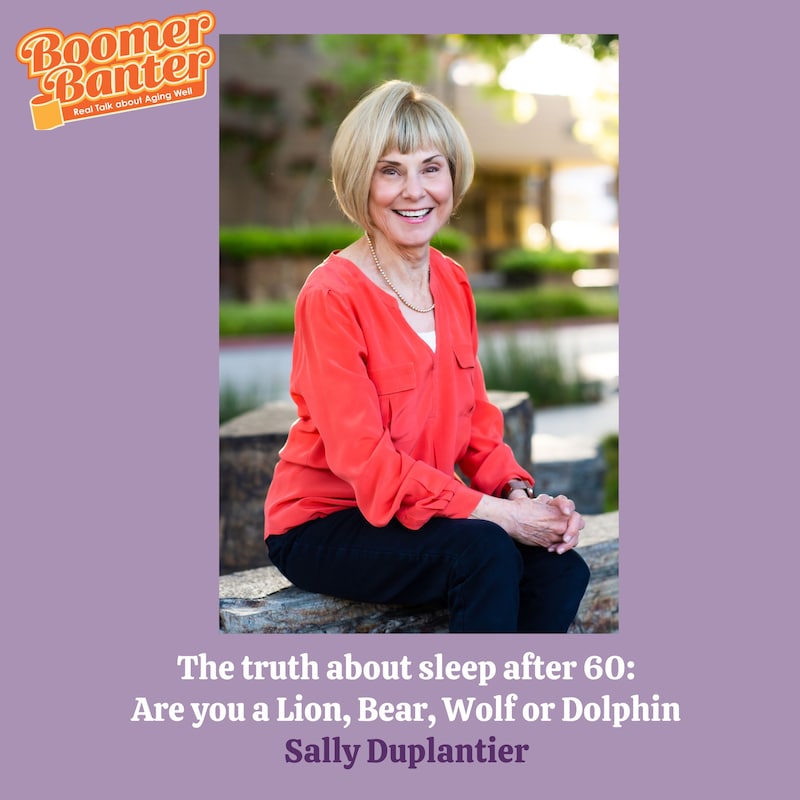
I had a fabulous chat with Sally Duplantier, a super smart gerontologist who’s here to sprinkle some wisdom on our sleep struggles. We explored the fascinating world of sleep chronotypes – we’re talking Lions, Bears, Wolves, and Dolphins! Each one has its unique quirks and styles that can help us understand our sleep patterns better.
Sally broke down the science behind sleep and aging, explaining how our bodies change and adapt. She effortlessly debunked common myths about aging and sleep, reminding us that it's completely normal to experience shifts in our sleep patterns as we grow older. We also talked about the importance of good sleep hygiene, like establishing a calming bedtime routine, and why it’s crucial for our mental and physical health.
We delved into the importance of understanding our individual sleep needs and how to create an optimal sleep environment. Sally’s tips were practical, relatable, and sprinkled with a bit of humor that made the whole topic feel less daunting.
So, if you’ve been tossing and turning at night or just want to learn how to better embrace sleep as a part of aging well, this episode is packed with all the insights you need to hit the hay with a smile!
Links referenced in this episode:
- Join the Boomer Banter Circle community
- Take the quiz to find out your sleep animal
- Women Over 50 Entrepreneurs: Make More, Work Less, Do what you Love
- Wellness Wednesday
Mentioned in this episode:
greenwoodcapital.com
Transcripts
Welcome to Boomer Banter where we have real talk about aging well. I am your host, Wendy Green, and every week we talk about the challenges, the changes and the possibilities that come with this season of life.
And one way that I continue this conversation is through what I call the Banter Circle. So each month the Banter Circle community comes together for a virtual gathering.
We build friendships, we share stories and we build community in this Banter circle. And in March we are going to be talking about who you are becoming when you have left the role of work. It's a monthly meeting.
It's with people that are like minded, that really want to age well. There is a membership fee. It's $25 a month. And the value of what happens in the Banter circle is far beyond the cost that you would pay.
But the exchange matters. It allows the circle to exist and it honors the time, care and experience that go into creating it.
at buymeacoffee.com/hey boomer:Or maybe you wake up almost every day at 4:42 on the dot, like an internal alarm clock is going off. And here's the thing. We talk a lot about aging well. We talk about relationships, we talk about purpose, we talk about movement and nutrition.
But sleep, that's not something we've talked much about. And it's really foundational to part of our aging well.
And yet so many of us in our 60s, 70s, 80s and beyond quietly think, well, I guess this wakeful sleep, wakeful sleep is what happens when we get older. Or maybe I just don't need as much sleep as I used to. Or hmm, I wish I could sleep like I used to sleep.
Well, today we are going to remove some of your worries, disrupt some of the myths with my guest, Sally Duplantier.
Sally is a nationally recognized gerontologist, a researcher, and someone recently named by MSN as one of the top inspiring women to watch for the way she's changing about how we think about aging. Sally speaks at places like Stanford and the American College of Lifestyle Medicine, and today she's here with us to talk about something fun.
You might be a Lion or a bear or a wolf or maybe a dolphin. And this is not a personality quiz. This is, this is a sleep style that you are going to have fun learning about and it is based on science.
So let's welcome Sally to Boomer Banter.
Sally Duplantier:Hello, Wendy. I am so excited to be here. I loved that intro. Yes, I already know what kind of animal I am.
Wendy Green:Well, I am so glad to have you here. I have had fun talking to you about so many different things because you are in our age wise collective group, which is super fun also.
But I want to brag on you for a minute first, Sally.
Sally Duplantier:Okay. Okay.
Wendy Green:You've had a couple of successful businesses that you've sold you later in life, you went on to become a gerontologist and now you're studying for your PhD. Can you give us a brief intro because this is such an example of aging well and lifelong learning.
Sally Duplantier:I'll make it short. I started my first startup when I was 28 and it was in technology training and business process change, totally different field.
Sold it after 25 years, said I was never going to work again. And then, okay, I went back to work in leadership development, which is different than technology training. And that was for about eight years.
And I retired the second time. And you know, one day I have like great pictures of that retirement party I was set. And then at age 66, I started my current company, Zing.
And I really started it with a mission to help older adults live their best lives longer because I saw how I was aging and at 66, which was pretty good, but around me were aging very differently. The fun part was I had no real background in this. I had a passion but no background. So.
So then I went on to get my education certificate in nutrition science at Stanford, Master's of science in gerontology at usc. I have a graduate degree in qualitative research from Indiana U. And I am now in a doctorate program in public health at Indiana U.
And I will be 75 when I get my doctorate, but I figure I'll be 75 anyway, so thank you.
Wendy Green:Exactly, exactly.
And you know, I followed you up until the 66 and I wanted to do something to help people age well because I did the technology, I did the training and started my show at 66. But I, I have not gotten on for my advanced degrees. So you never know.
Sally Duplantier:And I love it. And you know, if I didn't love it, I wouldn't do it, but I really love it.
Wendy Green:I know, I know you do. And you know, you bring so much wisdom to us.
So I want to talk about the sleep styles, the animal sleep styles, but before we get there, I think there are a couple of terms that we need to define and those are chronotype and circadian rhythm. So can you kind of help simplify those terms for us?
Sally Duplantier:So I think we've all heard of circadian rhythm. Okay. So we all have a circadian rhythm. There's actually multiple rhythms, quite honestly, but the circadian rhythms are based on a 24 hour clock.
And they control things like hormones, they control things like body temperature, they control when we're hungry, and they're most commonly associated with sleep. And interestingly enough, even though our clocks are on a 24 hour schedule, our circadian rhythm is about 23 hours and 56 seconds. So.
Yeah, or 56 minutes. You know, it's not quite exact. Yeah, but we need to. That's funny.
Wendy Green:Okay.
Sally Duplantier:That's a circadian rhythm that, that applies to every being. Now chronotypes are interesting.
Chronotypes have been studied since the 70s and it's more like your individual wiring or, or your individual preference. So if you think, Wendy, like 24 hours is a big amount of time.
And you and I and people listening may have different preferences for kind of waking and sleeping, for example. And these preferences are mostly genetic, but they can also be environmental. And there are some changes at certain life stages.
So little kids, for example, tend to be like early, early, early risers. But early to bed, where we know what happens to teenagers.
They're up, you know, to midnight or 1 1am but then trying to get them out of bed in the morning is really tough.
Wendy Green:Yeah, so that was interesting because I was going to ask you if your chronotype is kind of set because it's more genetic or does it change as we age? But I think you said it does change, right?
Sally Duplantier:It changes a little bit. But you know, we're going to get into the four different chronotype types.
If you are lion, like a really early rising riser, you're never going to change into a wolf, which is the late riser, you know, the late riser, the, you know, the, the person who stays up till 1 or 2am you're not going to do that fundamental of a change. As we get older, though, we may have a small preference for getting to bed a little bit earlier.
Wendy Green:Okay, all right, so let's have a little fun. You mentioned the lion and the wolf. Tell us about the different animal sleep style type and how that relates to us.
Sally Duplantier:So this is so interesting because as I mentioned, Wendy, the sleep chronotypes or the chronotypes have been researched since the 70s. But there was a clinical psychologist and sleep medicine specialist, Michael Bruce.
Bruce, and he wrote a book in:And when I say chronotype, we think about it as our best, like when we sleep, but it's also when we do our best thinking, when we are most productive. And so I'll give you an overview of the four of them and then we can dive deep into them. So the lion and I tend to be a lion and I think you're.
Wendy Green:A lion, I'm a lion.
Sally Duplantier:We are the, we are the early wakers. It's easy for me to talk about the line because I understand it. We will probably wake up before the sun rises.
You know, this morning I was awake at 10 to 6. It's a holiday. It was dark up, like, yeah, I'm awake. Okay.
Wendy Green:That's right, you're awake.
Sally Duplantier:We will be our most productive between about 7 in the morning and 11, maybe noon. And we kind of, we kind of go downhill after that. That's our best, it's not only our best energy level, but it's our best thinking time.
Wendy Green:Absolutely.
Sally Duplantier: the late side with that, with: Wendy Green:Go on, yes.
Sally Duplantier:Oh, so then, then there's the bear. I should, I should mention lions are about 10 to 10 to 20%.
And Dr. Bruce had created this whole quiz around this, which you can get in his book, but we're going to share one in the show notes, like you go to, you know, one of the websites and you can find a quick quiz. So the bear is about 50 to 55% of people.
Wendy Green:Oh, most people, okay.
Sally Duplantier:Most people are bears and they are more attuned to the sunrise, sunset. So they are more likely to wake up when the sun rises.
And their best kind of productive time is between about 10am and 2pm so these are people who are kind of well suited for the nine to five work day. They kind of wake up, have their coffee, whatever, and they're most productive in that period.
Wendy Green:And so when the winter darkness starts and the shorter Days, does that really impact them?
Sally Duplantier:They may be more attuned to the light cues than, than somebody like you or me who. We just, will just wake up.
Wendy Green:We just wake up. Yeah, exactly.
Sally Duplantier:Yeah. Then there's the wolf and, you know, the wolf, they used to call him the night owl.
But the, the thing is the, the early bird and the night owl, it doesn't really describe this whole kind of spectrum. So the wolf is about 10 to 20% of the people. It's our opposite. And sometimes it's hard for us to understand that.
It's people who may wake up at 7:30 or 8:00am but wish they could sleep longer. Now their most productive time, it could be a big window from like noon to 9, but it could be like 4pm to midnight.
They do their best work later, much later, and they tend to go to bed much later. Midnight, 1 or 2am and they wake up later. The challenge with being a wolf is in our society, we don't really reward that.
You know, we kind of reward like, you know, getting to work at a certain time and, you know, not necessarily staying up. You know, what are you still doing up?
Wendy Green:Well, maybe they do better on second and third shift, kinds of.
Sally Duplantier:Well, they might.
And I think I'm guessing here, this is not like I haven't researched this, but I know I worked in technology training and I worked with a lot of engineers and they were notorious for coming in at like 10 in the morning and then staying late to do their, their best work.
Wendy Green:Yeah.
Sally Duplantier:And then there's the dolphin. The Dolphin is about 10% of people and the dolphin is at that particular chronotype is kind of erratic.
Like they might wake up at 8am Something like that. They might be productive between 10 and 12, but it's, it's more erratic, it's less regular, it's less predictable.
They tend to be lighter sleepers and it doesn't follow quite as much of the same pattern or same preference.
Wendy Green:Yeah. And. And they wake up frequently too, right? The dolphins, because they're light sleepers.
Sally Duplantier:They are light sleepers now, waking up frequently. That also comes with aging.
Wendy Green:Okay, tell me more about that. I want to, I want to share the link for the chronotype quiz and I will put this in the show notes.
But in case you all want to have a fun conversation with your friends or significant other Today, go to sleepopolis.comchronotypes-quiz and find out if you're a lion, a bear, a wolf or a dolphin.
Sally Duplantier:Yeah, and it's kind of fun. It's like the old, like Cosmo quizzes. And I think most of us have a sense of what we are. But now let's talk about age related sleep changes.
And this really fascinates me because this is my work as a gerontologist. What I study is I study what's normal aging and what's abnormal. And what's normal aging is not sleeping quite as well.
I would say that people over 60, probably 40 to 50%, describe some kind of sleep challenges. Now, there is normal age related sleep challenges, and then there is true insomnia or obstructive sleep apnea. So I'll get to that.
But let's just talk about what happens as we age. Okay. So the first thing is the sleep architecture changes.
And the sleep architecture, it's these waves, like you've probably seen them, where we're in a light sleep, we go into a deep sleep, then we go to remember, and then we come back out of it. And there are. There's kind of a rhythm to the night. And in younger people and middle aged people, it's pretty regular, it's pretty predictable.
But now as we age, that becomes a lot more fragmented, and so we have a lot more nocturnal awakenings. So, like, in some ways, we have a little dolphin tendency. No. So some of what happens, dolphins live with, but it happens to us as we age.
So there's these micro awakenings. And once we. We might not even know we're awake. But once we're awake, oh, my gosh. Then it's harder to get back to sleep.
But then, Wendy, there's a few other things. There's nocturia, which is frequent urination. Well, that's going to wake us up. Okay.
Wendy Green:Yeah.
Sally Duplantier:There can be medications that we take and even supplements that make it hard to either fall asleep or stay asleep. So these are some of the challenges.
And then on top of it, there are physical disorders like obstructive sleep apnea, which tends to happen more towards older adults. And it's when we have difficulty breathing, we don't even realize it.
We might not, you know, we might not realize it, but it can be serious because it can lead to high blood pressure and also dementia.
Wendy Green:Mm. And yet we hear how important sleep is for us. Right. Like it. It affects our immune system and it affects our cognitive ability.
I know if I don't get enough sleep, I'm all foggy in the morning. So how do we manage that? You know, if we're constantly. Not constantly, but, you know, those small little awake cycles.
Sally Duplantier:Yeah. So this is such an interesting question, Wendy.
And I've been talking about sleep probably as long as I've been a gerontologist, which is about seven years. And I will tell you that I'm changing my messaging. I am. I may even say I was wrong. I'm not quite sure if I'm going to say that or not.
But I think that people like myself and people who kind of represent public health, we talk so much about the importance of at least seven hours of sleep a night.
Wendy Green:We hear it all the time.
Sally Duplantier:We hear it all the time. And there is scientific evidence about this. And it's the recommendation of the National Sleep foundation, the cdc, Mayo Clinic.
There's a lot of evidence about this. The challenge is that if we keep preaching, you need seven hours. You need seven hours of sleep, and people don't get it. What happens?
Wendy Green:Anxiety, shame.
Sally Duplantier:They feel bad. They feel bad. And so I feel that kind of all of us, I'm going to put us in that boat, but I'm going to admit it myself as well.
When we talk about, you have to get seven hours of sleep. We just make people feel bad if they don't, and we create more anxiety.
Because here's the interesting thing, Wendy, is that, you know, we can control exercise and we can control food. I mean, you know, we make bad choices. We don't feel like exercise, but it's in our power. We can't control sleep. We can control our environment.
We can. We can set up the optimal conditions to sleep, but we can't really make ourselves sleep.
So let's stop making people feel bad if they didn't get seven hours of sleep a night.
Wendy Green:Yeah. And, you know, I mean, so much talk about why, like, what happens when we sleep, you know, like, does it affect our blood sugar regulation?
Does it affect muscle repair? Like, why is it. Why have we been told all these years how important it is?
Sally Duplantier:Well, it is important. So I realize I'm saying two different things. Things. It really is important. And it's kind of like I describe sleep as nature's garbage truck.
And unfortunately, the truck only comes at night. So, like, napping is good. You know, we can feel refreshed. It's good. But the garbage truck only comes at night. It's the glymphatic system.
But sleep has an amazing benefit of removing wastes and toxins from our bloodstream. And a lot of my research has been around brain health. And so in particular, it's extremely important for brain health.
And yet we can't make ourselves sleep. We can set ourselves up. And I have tips for that. I have many tips, but I think we should just stop feeling so bad if we didn't get seven hours.
Wendy Green:And I'm glad you mentioned brain health, Sally, because you talk about that a lot on your Wellness Wednesdays. So, so tell the listeners what Wellness Wednesday is and then we'll talk about how maybe sleep affects our brain health.
Sally Duplantier:Okay, so Wellness Wednesdays, it's a free program. It's monthly, usually the middle of the month. And I have experts on topics related to healthy aging. I've been running this for seven years.
We've had more than 15,000 registered participants from 15 from 57 countries. And it's on things like sleep, nutrition, movement, internalized ageism, our attitudes about aging. And it's free and recorded.
So I hope people come and you.
Wendy Green:Can find it on myzinglife.com, we'll talk about that. But tell me about the, you know, you had mentioned insomnia as opposed to maybe some sleep interruption. So what, what is the difference?
Sally Duplantier:Yes, so the difference. So what I've described really so far is kind of like normal aging insomnia. We talk about the rule of threes.
Are you sleepless for 30 minutes or more, three days a week for at least three months? That's true.
Wendy Green:Say that again. 30 minutes or more.
Sally Duplantier:30 minutes or more, you're awake at least three times a week and for three months or more.
Wendy Green:So that would be that, that's clinical.
Sally Duplantier:More of a clinical definition of insomnia. That's right.
You know, so like last night, it's so funny, I, I think I was thinking about today's podcast and I'm like, I, I had a little trouble sleeping, but that's, I might say, oh, I had insomnia. No, insomnia. It goes on for a while and that's when it's time to actually see someone. Now, insomnia can be caused by a couple of things.
One, I would say just this kind of hyper vigilant mind that we have, the monkey mind. I think you described it in you at the beginning of the show where we just can't, we just can't turn it off. You know, we just can't turn it off.
But then again, especially in older adults, I mentioned this earlier, it's obstructive, the sleep apnea. And you might actually have both and not even realize it. My feedback, I can give people tips for if they just have some normal problems sleeping.
But if you really suspect insomnia or sleep apnea and I'm going to come back and define that more. See your primary care physician. You can get a sleep study done. You can do them at home.
Now, for people with insomnia, there is something called cognitive behavior therapy for insomnia, which is more around setting up those conditions or the environment to help you sleep. But if insomnia is going on for three months or more, you should get some professional help.
Wendy Green:Okay. And would they then. So you said cognitive behavioral therapy. So that's not where they would be giving you sleeping pills or sleep aids like that?
Sally Duplantier:No. Oh, no. So if. Okay. So you might start with your primary care physician. CBTI is what it's called, cognitive behavior therapy for insomnia.
It's really the gold standard now for treating sleep disorders. I think most physicians are trying to get away from sleeping pills. Sleeping pills have improved a little bit over the years.
There may be less dangerous, something like Ambien. The problem with Ambien, though, is it creates at least a psychological addiction, not a physical one.
And your sleep waves are not actually the same as natural sleep.
Wendy Green:So you're not getting the garbage truck.
Sally Duplantier:The garbage truck is probably a little faulty. And the other problem with Ambien is people sleepwalk. They sleep drive. I mean, how dangerous is that?
Yeah, I'm not a big recommender of sleep sleeping pills. I do want to talk a little bit about obstructive sleep apnea.
Wendy Green:Yeah, that's pretty. You hear a lot about that.
Sally Duplantier:It's common and part of the reason it increases as we age. It's a breathing problem.
If you think about the fact that our muscles may not be quite like what they used to be, even the muscles in the throat tend to relax, and that can obstruct the airway. We think of obstructive sleep apnea as somebody stops breathing, you know, so you know, your. Your partner is snoring, and then they stop breathing.
It doesn't always turn out that way. So first of all, people can snore, and it's not sleep apnea. May or may not be.
Secondly, you might not even notice that they stop breathing, but they're really tired in the morning or they have to have a nap every day after lunch. You know, there's some. There's some additional signs that they're not sleeping well. And so it's good to have it checked out.
Wendy Green:So I know that I'm going to turn this into a question, but I know that sometimes when I lie down on my back, I will feel like my throat kind of closes up. You Know, like I can't get that breath down there, but if I turn on my side, I'm okay.
So the question is, can sleep apnea be affected by the way you're lying and sleeping or is it generally a problem that you should have checked out?
Sally Duplantier:Yeah, so it's a good question. I would say probably, but I'm not an md, so I don't know for sure. I think it's, you know, we have like, what, Medicare wellness checks.
I think it's always a good question to ask the doctor when you see the doctor.
Wendy Green:Yeah, I know. We have too many things to ask our doctor all the time, right?
Sally Duplantier:Here's our list.
Wendy Green:I know, I know. So, so talk to me, Sally, about some of the things that we can do. Like say you're a dolphin, right? And, and you've been a dolphin your whole life.
You always are like trying to go to sleep, you can't shut your brain down, then you finally fall asleep, then you wake up, blah, blah, blah, blah. So what are some good like habits or wind down techniques that people that are experiencing that can use?
Sally Duplantier:So I have, I have quite a few of them and all of my tips are based on the scientific literature.
I've read dozens of papers and it's what I've also found from people in the community, which I think is, you know, sometimes they're the same, sometimes they're different. So I, I have, I have a number of them. Okay, so.
And this is true for a dolphin or it's true for anyone who, who has some trouble sleeping every once in a while. Okay. The first one I'm going to give you is to relax and stop beating yourself up.
One of the things that I have learned to do when I'm laying in bed and I, either I can't go to sleep or I wake up and I can't go back to sleep, is I remind myself, your body is at rest. This is good. You're still resting. This is good. It's that simple. You can make it more of a mantra. But instead of going, why can't I sleep?
I'm going to be worthless in the morning. I'll never get through that meeting. All the rumination that happens, just telling ourselves we're good and our bodies at rest, that's one thing.
Wendy Green:Okay, so that's interesting because that's. My mother used to tell me that when I was young.
Sally Duplantier:What did she say?
Wendy Green:Because I was always panicked that I would be the last one asleep in the house. I know. And she used to tell me just as long as you're resting, just lie there quietly and rest. That's as good as sleeping.
Sally Duplantier:Yeah. And you know, see, here's the thing, Wendy. Technically no, because there's like the garbage truck isn't coming. Right. It is still beneficial.
And oftentimes if we tell ourselves that if we just kind of calm our mind and tell ourselves we're good, we're in a safe place. Sometimes I'm like, oh my God, this pillow feels so good. Or last night is listening to the brain. The brain is so good. It's just so good.
You get into a different place. It helps activate the parasympathetic nervous system, which can calm us down. So that's the main thing. Stop beating yourselves up.
Okay, but I've got lots more.
nteresting meta analysis from: am till:And one of the things that happens in our culture is that we tend to want to, we short sleep during the week and then, oh my God, I need 10 or 11 hours of sleep on the weekend. And again, what you're trying to do is support your circadian rhythm.
You're trying to get your body used to a certain pattern of this is when we sleep and this is when we wake up. And I will tell you, Wendy, true confession here. I had so much trouble doing this that I finally got a buddy. My buddy's name is Joan.
ectation that we're in bed by: Wendy Green:Interesting. Okay.
Sally Duplantier:And I've totally, totally changed that habit. So that's, that's really good. So sleep regularity, okay? A wind down routine. I call it, I call it the unpower half hour.
I used to call it the unpower hour, but it was not popular. So here's the thing. We assume that we can be busy, busy, busy. You know, maybe watching tv, but maybe cleaning up the kitchen.
Like whatever we're, you know, we're churning like this and then we hit the bed and we're supposed to go to sleep.
Wendy Green:Yeah.
Sally Duplantier:Work that way. We have to give our body some cues that it's, it's bedtime. And so whatever your routine is.
I like to put my fluffy robe on, I brush my teeth, I have, you know, the whole face thing and. Right. Cream and stuff like that. At, at this time of year, I heat up a little like heating pad in the microwave so I can have it on my stomach.
I love that. Nice. I get my cup of water. You know, it's like there's a routine.
So these are things that people can do that set up the environment and then I think everybody knows. But a cool dark room, you know, that you don't want to be hot, you don't want light coming in. That's going to help.
Wendy Green:So I like that idea of routine. You know, we've talked a lot about, or not on this show, but we talk a lot about a morning routine.
You know, maybe because I'm a lion, I talk about it. But you know, I like to get up in the morning, have my coffee, maybe read maybe journal. It's like my quiet time to enter the day. Right.
And I think what you're describing at night is, it's a way to program your mind that this is my quiet time to wind down for the evening. Whatever it is, whether it's, you know, the facial routine and brushing your teeth.
I like to read in bed at night, which means I read a page and a half before my eyes are closed. But it, you know, whatever your wind down routine is, I think it's, it's again a way of programming your mind that this is the time to be quiet.
Sally Duplantier:Right. Right. And so again what we're doing is we can't make ourselves sleep, but we can give ourselves a fighting chance.
You mentioned something important, Wendy, about morning.
So this is a little, kind of a little known fact is that getting morning sunlight outside, ideally like stand on your balcony versus looking out the window or go outside within about the first hour of waking helps reset your clock. It helps with sleep because remember that circadian rhythm. I said it's a little bit off. It's 23 hours, 56 minutes and some seconds.
Wendy Green:You know how they figure that out?
Sally Duplantier:Sunlight first thing in the morning helps like reset it. It's like, okay, well now we're back to 24 hours. So people don't realize that, you know, get a dog.
If you get a dog, you're going to be going out first thing in the morning and some sun. And even on a cloudy day or A foggy day, there's still sun out there. So yeah, that's something good to know.
Wendy Green:Because I don't do that. So that, that is interesting.
Sally Duplantier:It's an interesting tip, I think, you know, you've talked on this show a lot about the benefit of exercise for so many things. There is a bi directional relationship between exercise and sleep. So at least 30 minutes of walking a day will help you sleep better.
And if you sleep better, you're more likely to do that walk.
Wendy Green:So is there a better time like exercise in the morning or at night?
Sally Duplantier:Well, this is, this is so interesting because remember those chronotypes?
Wendy Green:Yes.
Sally Duplantier:Like most people find that their most productive time for thinking is also their best time for exercise. I don't know about you. Are you?
Wendy Green:Yes, absolutely.
Sally Duplantier:And if I wait too long, I'll never do it.
Wendy Green:That's right.
Sally Duplantier:So then I'm faced with, oh my gosh, I have to do my best thinking and my workout in this.
I know, but, but what I've learned is like not to just answer email during my 7 to 11 time because that doesn't take that much brain power and that could be done later.
Wendy Green:Yeah, yeah. And that's another good tip. Like to pay attention to your chronotype, your lion, bear, wolf, Dolph. So.
And I know that when, even when I was in college, you know, like people would be pulling all nighters studying for a test. There was no way I was going to pull an all nighter and then be good on a test. Yeah, I, I had to study regularly during the day and that was that.
If I knew it, I knew it. If I didn't, I didn't.
Sally Duplantier:Yeah. And I think, I think you and I would both be hard pressed to pull an all nighter now. Oh my God.
Wendy Green:It would never happen. I know. Sally, what about dreaming? Have you ever done any kind of studies on dreaming and how that affects us?
Sally Duplantier:I am so interested in dreaming. I really have not read enough like scientific papers on it. I would say, you know, everybody, every, every creature dreams.
Wendy Green:Like most of us don't remember it.
Sally Duplantier:We mostly don't remember it. There was an Aborigine tree tribe that they did, they practiced lucid dreaming. Have you ever heard of lucid dreaming?
Wendy Green:No.
Sally Duplantier:So lucid dreaming is when you're dreaming but you're aware you're dreaming. And, and it was part of this culture where like the parents taught the kids to go back into a dream and fight someone or do something.
So some people, maybe 5% of people can lucid dream Most, most of us can't.
But one of the best explanations I've heard for why we dream is that from an evolutionary perspective, it gave us a chance to kind of try things out, you know, like the video simulation to see, you know, what would, what would happen. We don't know exactly why we dream. I'm fascinated by it. And are you aware that you dream, you don't remember your dreams?
Wendy Green:But I, you know, it's funny, most of the time I have no recollection of dreams, but lately I've had a couple of, like, presentations I'm preparing for and trainings that I'm going to do.
And it's the same dream that I would have in college, you know, like, oh, my gosh, it's the end of the semester, and there was this class I never attended, you know, so it's this dream of I'm gonna fail.
Sally Duplantier:I still have those. It's so funny. Yeah, right.
Wendy Green:And so I think that the anxiety of what's coming is so much more present that even though I'm sleeping, the garbage truck is trying to clean it out. It's like, no, no, no, I'm not letting go. I'm still gonna feel that anxiety.
But yeah, I think I, I, I think a lot of people spend a lot of time trying to write down their dreams and pay attention to them, but I don't think they interrupt our sleep, do you?
Sally Duplantier:No. And I tried that for a while. This was a long time ago. And it's kind of exhausting. It's really kind of exhausting.
You know, I want to give your listeners one more good tip about if you can't sleep good.
I was going to ask you, because this one, this one, there's a lot of scientific evidence, and then there's some really funny things I've heard in the community.
So what sleep psychologists will say is if you're laying in bed for more than 20 minutes, like, let's say you got up, you went to the bathroom, you came back to bed, and you're just laying there. Like, don't just lay there. Get up and do something else.
Now, the reason they say get up and go somewhere else is that there can be kind of this psychological association when you see your bed and you start to think, every time I see the bed, oh, I can't sleep, you know, because I just toss and turn and toss and turn. And so, so there's a negative association with bed. So that's why they tell you to get up and do something else.
So what they might Recommend is go somewhere where it's kind of dark. Maybe there's a, like a. Like a task lamp. Something soft, quiet, light. Read a book or do it on a sofa.
So if you get tired, you could just kind of, you know, like. Like lay down and fall asleep or listen to music. But you get the idea. It's like low light, low stimulation. And I think that works for some people.
But I have shared this at community centers and different places where I've spoken, and I'll tell you what, some people have said. It's a great idea. They say what I do. I thought this was a really good one.
They take sticky notes and a pencil and they just write anything that's on their mind. Sticky, sticky, sticky. They don't even look at what they're writing, but they. They write things down if they're. If they have that monkey mind going.
So then somebody said, yeah, I know exactly what you mean. I get up and I load my dishwasher. Really? That's pretty. My dishwasher. And then I can go back to sleep. I just thought that was so funny.
Then, then somebody said, they get up, they go outside and do jumping jacks. They said, just 10. And then they go back to sleep. And then I will. I will tell you what I do.
So, you know, we always say, oh, my God, don't use your iPad or don't use your phone. The blue light, the blue light.
Wendy Green:The tv.
Sally Duplantier:Don't turn on the tv, but I get my iPad. I do. I use it in dark mode. I keep it in dark mode. And I look at Bella's dog pictures. My dog is five. I have thousands of pictures of my dog Wendy.
just pick a year and a month.: Wendy Green:Makes you happy.
Sally Duplantier:And it does. See, you can. It puts me in a different place.
Wendy Green:Yeah.
Sally Duplantier:And so the reason I'm sharing this, it kind of gets back to chronotypes and bio individuality is that if something works for you, it works for you. Find what helps you go back to sleep. I know if I really can't sleep, I'm going to just look at dog pictures.
Wendy Green:That's amazing because I know that. I mean, I'm. I know I would think if I went out and did jumping jacks, I would be awake. There's no way I'd go back to sleep. So. That's right.
Sally Duplantier:And usually when I share this in, like, again, in live speaking events, people go, I know exactly what you mean. Here's what I did. It's nothing like what I said, but it works for them.
Wendy Green:Yes. And it's like if you. If it works for you to go back to sleep, if jumping jacks are going to wake you up, don't do that.
Sally Duplantier:Don't do that.
Wendy Green:Sally, I have loved this conversation, and the fact that you were helping take away some of the shame and the worry and the anxiety about, you know, what's wrong with me? Why can't I sleep? And you kind of normalize this for all of us. So thank you so much for that.
Sally Duplantier:I had so much fun being on your program. As you know, with Wellness Wednesday, I'm usually interviewing people. It's actually fun to get interviewed. How fun is that? Good, good, good, good.
Wendy Green:Yes. And so I want to show people where they can find you on Wellness Wednesday, Sally. And I didn't ask you about my Zing Life.
How did you come up with this name for your. For your website?
Sally Duplantier:In our couple minutes, so I needed a company name, and my attorney said to trademark it. It couldn't be Wellness this or Health that. It had to be something different.
So my friend and I, I don't know, we were having sushi one night, and we came up with this idea of Zing. You know, I always think of that's how the name was born. But then I couldn't get Zing.com. the website was taken.
And I'm like, well, you know, I could have bought it for, like, that, tens of thousands.
Wendy Green:Right, right, right. Don't eat that bad.
Sally Duplantier:So, I don't know, friend. Another friend of mine came up with My Zing Life, but it's kind of. It's kind of easy to remember.
Wendy Green:Yeah.
Sally Duplantier:And if people go to My Zing Life, they'll. They'll see a banner there for Wellness Wednesdays. I would love for people to join me for Wellness Wednesdays. It would be great.
Wendy Green:Yeah, you do a great job on those. I've listened in on a few. I also want to give a shout out to another woman podcaster who is in our Agewise collective.
Her name is Patricia Drain, and she [email protected] and the cool thing is, I was on Patricia's show this past week, and her show is called women entrepreneurs over 50, making more, working less, and doing what you love. And so Patricia started something called We Talks. W e We Talks, which are like TED Talks, except we as for women Entrepreneurs.
And so I listened to the episode that we did where I did a We Talk. Oh, my gosh, Sally, I was so impressed. You know, I don't mean to, like.
Sally Duplantier:Be bragging, but you should. How cool is that?
Wendy Green:Oh, my gosh, it was so good. So please go to patriciadrain.com and listen to my we talk on there. That was fun. And to everyone listening, thank you, Sally, for this.
This has been so much fun. And thank you. And take care of your brain, Take care of your body, Take care of your sleep. Remember, we're not done yet. My name is Wendy Green.
This is Boomer Banter, and I will see you all next week.
Sally Duplantier:Sam.



