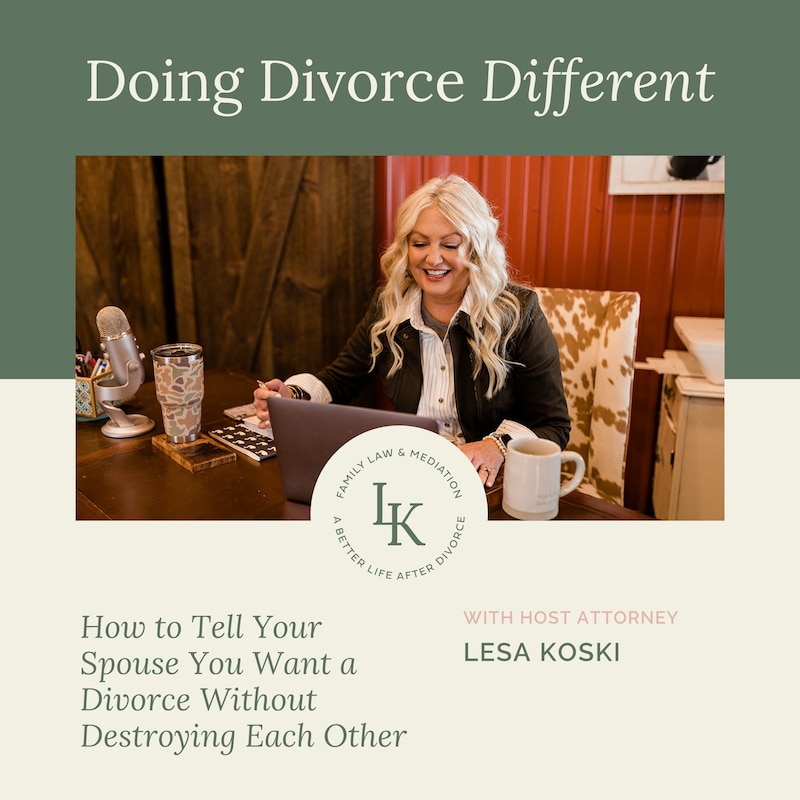
Shownotes
How to tell your spouse you want a divorce is one of the hardest conversations a person may ever face. In this episode, Lesa Koski shares compassionate, practical guidance on how to tell your spouse you want a divorce with honesty, emotional maturity, and less unnecessary trauma.
If you are considering divorce, preparing for difficult conversations, or trying to navigate divorce in a healthier way, this episode will help you approach this life-changing moment with more clarity and humanity.
Lesa discusses:
- why timing matters
- how to avoid escalating conflict
- why your spouse may need time to process
- how to communicate clearly without cruelty
- and how to protect children emotionally during divorce
This episode also addresses situations involving abuse, control, addiction, or fear for safety and why those situations require additional support and planning.
If you want to do divorce differently—with less destruction and more emotional awareness—this conversation is for you.
Timestamps:
(00:00) Introduction to one of the hardest divorce conversations
(02:10) Why you should never bring up divorce during a fight
(04:15) Understanding that you’ve had a “head start” emotionally
(06:50) Giving your spouse time to process the conversation
(09:05) Why over-explaining and unloading years of pain can backfire
(11:20) How to be clear without being cruel
(14:00) Why emotional regulation matters during divorce conversations
(16:15) Protecting children emotionally during divorce
(18:30) Abuse, addiction, fear, and when safety planning is necessary
(21:10) How to reduce trauma and lifelong damage during divorce
(23:00) Final encouragement and support for listeners
Key Takeaways:
- Timing and emotional regulation matter during difficult divorce conversations
- Your spouse may be hearing this for the first time while you’ve processed it for months or years
- Clarity is important, but cruelty is not necessary
- Children benefit when parents approach divorce with emotional maturity and less conflict
- Abuse or safety concerns require a completely different approach and professional support
Guest Bio:
In this solo episode, Lesa Koski—a divorce attorney, mediator, coach, and host of Doing Divorce Different—shares practical and compassionate guidance for navigating one of the most emotionally difficult conversations in marriage. Lesa is passionate about helping people move through divorce with less trauma, more clarity, and emotional integrity.
Resource Links:
- Work with Lesa Koski: LesaKoski.com
- Learn About Divorce Mediation: Doing Divorce Different Podcast
Tags/Keywords:
how to tell your spouse you want a divorce, divorce conversations, divorce coaching, divorce support, mediation, co-parenting, emotional regulation, healthy divorce, marriage ending, divorce recovery, doing divorce different, divorce advice for women, divorce podcast
Transcripts
Welcome.
2
:I'm so glad you're here today.
3
:Today is gonna kinda be a tough, a
tough one, because today we're talking
4
:about one of the hardest conversations
a person may ever have, and it's how do
5
:you tell your spouse you want a divorce?
6
:And when I'm coaching clients,
this comes up a lot, and so I
7
:just thought, you know what?
8
:I'm gonna deal with this on an episode.
9
:And, you know, it takes such a long
time to learn, um, if you're really
10
:ready for a divorce, and then once
you learn that, then it's like,
11
:"Ooh, how do I approach this?"
12
:So what I wanna say is that
there's no perfect way to do this.
13
:There's no script that's gonna remove
the pain, but there are ways to handle
14
:this conversation with more compassion
and clarity and emotional maturity,
15
:and honestly, that really matters.
16
:So, um, one of the first things I like
to tell my clients is, don't have this
17
:conversation in the heat of a fight.
18
:So, like, when you're, you know,
arguing about the groceries or how
19
:much you've spent or whatever s- like,
child schedule, that is not the time.
20
:That might be the time where
you get triggered and you
21
:wanna throw it out there.
22
:That is not the time to
talk about a divorce.
23
:So it should never happen
during an argument.
24
:It should never happen through a
text, because that just doesn't work.
25
:Even though, like, I think,
"Oh, I can text something.
26
:I am, like, I can really p- take my
time and do my words right," I am not
27
:kidding when I do that, people can take
it the wrong way, so don't use it as
28
:a threat or as emotional punishment.
29
:So if possible, it should happen, like,
in a calm moment where both people can
30
:emotionally process what's being said.
31
:And so the next point that I need to
make, and this is really important, is
32
:to understand you've had a head start.
33
:You've been thinking about this for a
long time, and this is really important,
34
:because often the person bringing up
divorce has been thinking about it for
35
:months or even years, and the other spouse
may be hearing it for the first time.
36
:So while you may already be
in problem-solving mode, they
37
:may be still stuck in shock,
so give them time to process.
38
:One of the kindest things you can do is
to give the other person time to process.
39
:Don't pressure them.
40
:Don't force immediate decisions.
41
:Don't expect to- them to respond calmly.
42
:Like, be ready.
43
:Imagine it could get hard, and just-
You have control over how you respond.
44
:So just, people just need time
for their brain and body to
45
:kep up- catch up emotionally.
46
:So, um, be ready for that.
47
:Don't over-explain or dump years of pain.
48
:I've found that's another thing.
49
:That's the fourth thing.
50
:Don't over-explain it, um, and
don't dump years of pain because
51
:that's not gonna help you at all.
52
:This conversation is not the
moment to unload every resentment
53
:from the last 20 years.
54
:You don't need a courtroom presentation,
a character assassination, or a
55
:list of everything they've ever done
wrong, because sometimes less is
56
:actually kinder, and at this point,
that's really important, and you
57
:want them to be able to hear you.
58
:So the fifth thing Is be
clear without being cruel.
59
:And sometimes that's really hard
when we are, you know, so kind.
60
:Sometimes it's hard to say something,
and sometimes we get so angry.
61
:So there's a difference.
62
:Remember this, there's a difference
between being honest and being hurtful.
63
:So you can say, "I don't think we can
continue, can continue this marriage,"
64
:without attacking, without shaming,
without humiliating, and without blaming.
65
:And I'm telling you, if you take the
time to coach yourself through this,
66
:and you can contact me if you need help
getting coached and prepared for this
67
:conversha- conversation, you will be more
intentional, and you will do a better job.
68
:It's not gonna be easy.
69
:It's gonna be painful.
70
:It's gonna be painful no matter
what, but you can feel good about
71
:how you handle the situation.
72
:And then just the sixth thing is
if children are involved, remember,
73
:your spouse is still your child's
parent, and it's so imp- important
74
:because you are going to be
connected for the rest of your lives.
75
:And, you know, if you can do mediation
and co-parent well, there's less conflict,
76
:and then your kids feel emotionally safe.
77
:And that's the number one thing
when you have kids, you want
78
:them to thrive through this.
79
:Okay.
80
:I wanna bring this up because
I did have, um, someone that
81
:I spoke to about abuse today.
82
:And so if that is an
issue, that's something...
83
:that's a podcast that's coming up.
84
:If that's an issue in your marriage,
then you need to be very clear
85
:that you're gonna need professional
guidan- guidance through this.
86
:You are going to need to have a plan.
87
:The woman that I talked
to had a plan of escape.
88
:So that's a very different story.
89
:If there's abuse, if there's threats,
if there's addiction, if there's any
90
:kind of control, if there's any fear
for your safety, this doesn't all apply.
91
:You need to get help, and you need
to make sure that you have a plan.
92
:You, you can talk to a therapist.
93
:You can get the police involved.
94
:Make sure that you have a safe plan
So, and then just, you know, number
95
:eight, what people actually need most
at the end of the day, most people
96
:don't need like a perfect little speech.
97
:They need emotional regulation,
compassion, clarity, and support.
98
:If you can do that for the person that
you're asking for a divorce, if you
99
:can be prepared to intentionally give
some clarity and support, I'm telling
100
:you, it is going to go so much better.
101
:So, and this is one reason I just, I care
so deeply about doing divorce differently
102
:because while it's painful, I've also
seen people create less destructive, less
103
:trauma, and less lifelong damage in the
way they handle this first conversation.
104
:So if you are facing this conversation
right now, take a deep breath.
105
:You don't have to navigate,
navigate this alone.
106
:I'm here.
107
:And remember, you can move
through hard things with honesty
108
:and humanity at the same time.
109
:Thanks so much for being
110
:here.