Shownotes
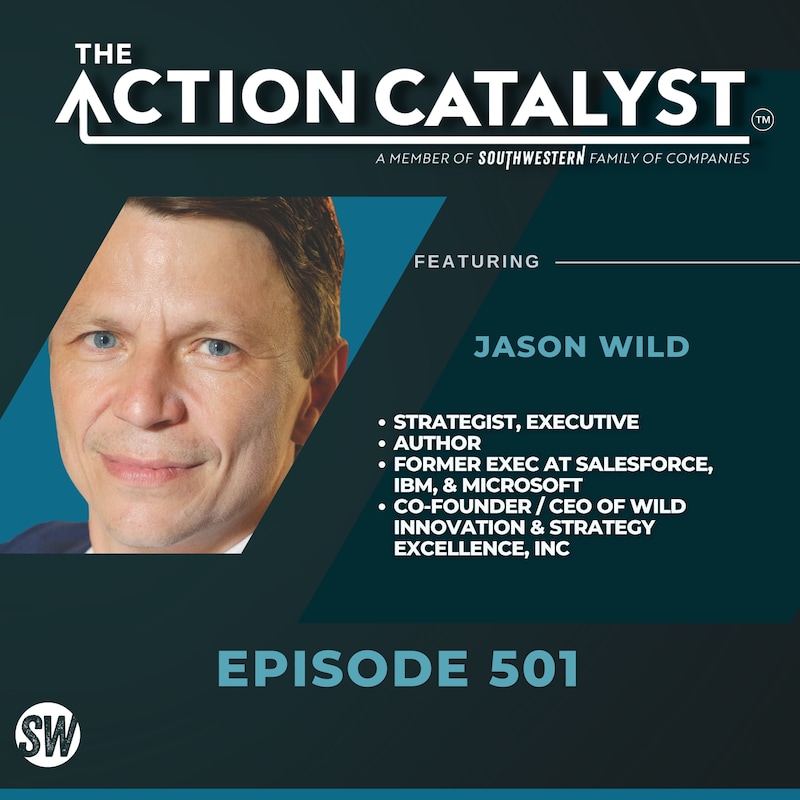
Jason Wild, an author, strategist, and former leader at Salesforce, IBM, and Microsoft, addresses misconceptions around what innovation is and isn't and the way leadership can help or hinder it, creating culture, the as-of-yet unmet promise of AI, the ABC's inside of organizations, how a creative intern at the Waldorf Astoria saved a ton of money and time with a creative solution to an abstract problem, identifying who the customer REALLY is and what you're REALLY selling, and the strangely important lessons he learned from being a child actor.
Transcripts
Okay, so I have got good news and bad news about our time together. What would you like first?
Jason Wild:I'm an optimist. Let's start with the good news.
Stephanie Maas:The good news is, I hope we're going to have some fun together. You ready for the bad news?
Jason Wild:I think so.
Stephanie Maas:I have to be candid. I am an insult to my generation when it comes to technology. I have read your bio. I was trying to do some prep work. I understood about every third word, and just so you know that third word was like, and, the, at. So I am going to completely disappoint.
Jason Wild:Well, I don't know about that, and I've got some good news too. I'm not really a technologist, even though I've spent like 30 years of my career working for technology companies. I have a Liberal Arts Undergraduate degree, an MBA. I was a child actor, so in many situations, my role was to be the person dropped into the pool of technologists and help people make sense of what really matters to world, the world work and life. So we could talk about lots of things, Stephanie, but don't worry. And one of the first pieces of advice and coaching I got was you're self deprecating to a fault, Jason. So Stephanie, don't be like me.
Stephanie Maas:You may think it's self deprecation, and then you're like, Oh no, she's just got a lot of self awareness. Okay, so let's start with walk me through what you do.
Jason Wild:Well, thanks. Thanks for asking. And my mom has been asking me that for years, too, and the fact that she keeps asking me, clearly I'm not giving a good enough answer, I actually feel like I've been really blessed. I've been fortunate and privileged to have one of the best jobs in the tech industry for many, many years. And what has been that it's been leading embedded strategy and innovation teams, first at IBM, then at Salesforce, and then eventually at Microsoft, where in total, I spent almost 20 years leading projects on the ground around innovation in 40 countries. So from Uganda to Washington, DC, from NATO to Disney, really trying to help leaders and innovation teams think and work differently and focus on the what and how of whatever matters to them. Because I think one of the things that I learned the hard way was, when people think of innovation, they immediately jump to ideas. What's the next killer app? What's the acquisition what is the cool AI
Jason Wild:tool? But what we've learned is that innovation is less about ideas and more about leadership, and it's really how do you go from whiteboard to reality and and where do great great ideas come from, and how do you scale those ideas? So I kind of really dedicated my career to that in different forms, so helping to build cultures of innovation inside of large organizations, or advising and leading teams working on some strategic questions of the board, or the C suite, where they thought it was important to collaborate with some other people and get a different perspective, to hopefully co create the future, and probably done at least 350 of those innovation projects in my career.
Stephanie Maas:So in your experience, in your time, what would you say were some of the misnomers about working with the folks that you've worked with, like, for example, I think of, when I'm working with an innovation team, that's exactly what I think of. I think of the Doc Browns from Back to the Future, the wild ideas, you know, constantly thinking outside the box. I think of the leadership piece is more of like a reigning in herding cats thing. But I think that's, I don't think that's actually true.
Jason Wild:Yeah. And part of the reason that we wrote the book, there were, you know, some personal and professional kind of sparks and triggers. And, you know, one of them is, I'm a parent, and one of my kids absolutely admires one of these tech bro CEOs, you know, and they're a part of a club and a community who is not shy about bragging how their style is top down, how difficult it is to work with them, almost as like a, you know, badge of pride and badge of courage. And we really wanted to write a love letter to a different leadership style, where. Leadership is really more about using leadership authority to empower enable others, and not use leadership authority to be authoritarian and mandate innovation. And I think that's one of the big misnomers, is that leadership believes that they can mandate or dictate innovation. And the reality is, is that innovation is very much a social process. People have to be willing and able, and they have to be
Jason Wild:invited to want to co create. So I think that's a big one. I think the second one is a maniacal focus on the what, and it's understandable, right? Because it's tangible, right? We can sleep at night understanding kind of what it is, what we're developing. But the reality is, from our research over 10 plus years of my work, you know, as a practitioner, is really the formula is the reverse, really having clarity around why, why you exist, and focusing on the how. And I think we believe this strongly before covid, before the arrival of AI, and our belief has just been taken to another level because of the pace of change that's coming, predicting where value will be created and the what that's going to capture that good luck. But if you get world class at how and constantly understanding where the world is going, how to create value and morph your value proposition as a large organization, much like startups have to do, because they're working day to day, week to week,
Jason Wild:bootstrapped and and if they don't deliver on that promise, right? It's existential where large organizations, I think, are starting to, you know, behave the same way, and the how and the why, and really getting world class of that, the result becomes a prescriptive, kind of reliable stream of what to innovate so. And I think ultimately, you know, of all the things that I've learned, Stephanie, the one that I've learned the hardest and have many scars, is that we've got many challenges on this planet, but ultimately, the greatest challenge is changing human behavior. And so many leaders in the organizations are, you know what I say, trying to tech their way to the future. Seeing AI as a tech challenge or innovation is a tech challenge, but it's really a leadership and human and culture challenge. And that's the thing about culture, right? When you talk about it, it's abstract. It's conceptual. If people can't relate to it, it literally puts people to sleep. You can
Jason Wild:copy products and services, you can buy talent, you can poach talent, but it's almost impossible to copy culture. And really, culture trumps everything, and you have to be intentional about how you create that culture.
Stephanie Maas:Oh, I love to hear that the leadership component of all this is driving human behavioral change.
Jason Wild:Yeah. And I was actually looking, you know, this morning, at some data Stephanie, that was really interesting to me. It was published around AI adoption among working age people by country. The US is ranked 24th in the world. Number one in the world is the UAE, the United Arab Emirates, Abu Dhabi Dubai, where 64% of working age adult people are actively using AI in Singapore a second so we're already lagging. And to me, that's a function of leadership. And one of the roles is the role of the architect. We define essentially, the role of an architect is people and leaders who create environments where people are willing and able to co create and innovate leadership. I think when you look at organizations which are ultimately just containers of people. It's really the role of leadership to create those conditions where people feel comfortable and have the incentives to use AI. And there was another study that showed AI adoption C suite versus workers. And not
Jason Wild:surprisingly, you know, C suite executives are touting that. You know, Gen AI is saving more than 12 hours, 20% of them said that it's saving 12 hours or more per week, where, like, less than 2% of the workers said that it's saved anywhere near that. Now you ask yourself, why on the surface, number one, the senior executives have economic incentives, the equity, it's their job, right, to manage change and get the whole organization and ecosystem to adapt. And hopefully, you know, be bleeding edge and world class, and whatever it is that they're doing, the workers are responding differently. Workers are feeling threatened. The workers feel like, what's in it for me and you know, and I think it goes back to the real responsibility of leadership to provide clarity, the right amount of transparency to be very proactive in role based AI training, so that people can really understand the. And feel a little bit more control over what they can do with these tools, versus, hey, go do
Jason Wild:this and we're going to track it, which, to me is at best, neutral and mostly negative and condescending in a way of saying, Do this or else, when I think most employees are looking for a partnership and our book, each chapter is the story of a different leader or leaders in different organizations around the world. They're all my favorites, and one of them is absolutely Proctor and Gamble. And Kathy fish, who was the chief R and D officer, the head of R and D globally for Procter and Gamble, she said, because of the pace of change that's going on in the world, it's time for P and G to innovate on how it innovates. Think about that P and G a hallmark of innovation and branding and attracting the top talent for decades, recognizing that it needs to innovate and how it's been doing it will not serve where it wants to go. If P&G is saying that, what is, what does that mean to the rest of the world, and Kathy, as a leader, saying it's really her responsibility to
Jason Wild:create those conditions, and one of the things that png did, that I thought was fascinating, was reframe success between their products and customers, before they had defined it as being functionally superior, winning on performance, being better than any other alternatives that are out there. And Kathy and team's reframe was, hey, humans make decisions based on emotion, and if you really design that into a culture of innovation, P and G reframes success as being Hey. We want to be irresistibly superior, not just functionally better, but have an emotional connection that creates experiences where customers want to buy and Buy and buy again and get really good at that. So I think, to me, that's a great example of the role of leadership, to provide clarity around what success looks like, and then to create the underlying capabilities, infrastructure and tools that enable people, employees, and even the ecosystem, to then deliver against that promise.
Stephanie Maas:That is so interesting. Okay, and you've kind of taken us into reflections on the book, so let me dive in there. How do we get to the book?
Jason Wild:So the story about the book, believe it or not, started more than 10 years ago, when I was leading innovation at IBM. I was introduced to Linda because I was doing some work for IBM and developing economies, helping the mayor of Rio de Janeiro get ready for the World Cup of the Olympics, healthcare work last mile in East Africa, got introduced to Linda and hit it off from the first conversation, it was the first time that I had met someone that I felt really understood what me and my team were doing, and that innovation can be really messy and is non linear, and that there's a glamorous side of innovation, but there's also a really soul sucking, difficult, challenging part, emotionally, intellectually about innovation. So in Linda's words, I was an unnamed contributor to her previous book. It was called collective genius, and published hard to believe in 2014 and then a couple of years after that, I had moved to Salesforce, and Linda rang me
Jason Wild:up and said, Hey, Jason, thinking about my next book. Do you want to write it with me? And we hit off very, very quickly, because part of the reason for the book was, you know, she and I had agreed many books on innovation, also many books on leadership. But when you think about it like no books at all on how do you actually lead innovation? How do you create the conditions for innovation to thrive and do it in a way that's not too academic, too many frameworks, right? Because leading workshops, C suite, I realized, yeah, the content has to be spot on, right? It has to be provocative. But in this world of war for attention, it has to be entertaining too.
Stephanie Maas:Let me ask you this, what did you notice from your background, really was like, wow, those were some home run moments that I didn't even know it was a home run. What were some of those kind of moments for you?
Jason Wild:Yeah, I think there were several moments. And I think with the book, one of the moments was when we uncovered, you know, the predominant framework, the ABCs, the architect, the bridges and the catalyst, these are interconnected roles that we saw as kind of patterns in these organizations that, over time, you know, could routinely innovate and innovate and innovate again, and obviously had created a threat. Being, you know, culture of innovation. And when we came up with this framework of ABCs, the power of the simplicity of it, first principles of what leadership really, really means. And behind that, you know, we talk about the ABCs are really mindsets and behaviors. But I think one of the serendipitous surprises, especially as we were starting to test the framework, giving speeches, right workshops that was really, really interesting, especially with my tech background. In the middle of this AI stuff was getting into conversations around, hmm, this
Jason Wild:framework could be a really interesting organizational model, operating model that could represent the future of org design, right, especially for medium and large size companies. I mean, think about the needle you have to thread in, like org design of bigger companies on the one hand, right? You need structure. You need predictability, because of just the volume, the size, the risk and what's at stake, but literally, like the world is shifting underneath our feet, you know, by like yards every week or two, so you need some breathability and flexibility to that structure, right? And it's almost an inherent paradox. So I think the big surprise was that, unintentionally, the ABCs are representing more than just mindsets and behaviors that represent leadership styles and traits, but also in a very interesting framework around the future of the enterprise, in terms of what that means in terms of organizing resources, especially around ecosystems, which are increasingly
Jason Wild:becoming important as A conversation in the board and C suite level around who, how do we create an ecosystem with a moat? What we learned was, well, create a movement around something, and as a result, the companies who form that movement then have an opportunity to create value around that. But the big surprise was the ABCs is this really interesting framework that we're now starting to apply with some large companies, and some of the work that we're doing
Stephanie Maas:That is super fascinating. It reminds me, back in the day, you know, the generation before me, it was the corporate ladder, and then my generation, it kind of became this idea of this corporate lattice, where it wasn't just about going up, it was all the different ways you could develop professionally, across, over, diagonally, all kinds of things. And I feel like, based on what you just said this, we're like, on the cusp of what our kids are going to be studying, as like you said, this whole different way of looking at org charts because of the innovation that is out there that we're capable of all the different things that, in itself, is fascinating.
Jason Wild:Well, thank you. Yeah. I mean, we think so too, right? It's just a little bit of like the irony of the serendipity of innovation in action. It's kind of the flow of the conversation and the almost the collective subconscious of this community, that we were engaging around this, the knew that there was something different and better, but not sure what it was, led us to that destination. So we're still at the beginning of it. And I think something that's related to it is, you know, I mentioned I'm a parent, right? So whether I'm like, meeting with CEO or, like, local public school, one of the questions I get, and I get a lot, especially having worked at Microsoft and IBM, is, what are the jobs of the future? What advice can you give and and I really, I take that to heart, because, you know, I've, I've personally benefited from tech automation and being a part of these companies, and I feel a deep responsibility. I do think that we're generally
Jason Wild:underestimating the amount of change that's coming. In other words, as much hype as there is, there's even more change then I think warrants the hype. Believe it or not, and I could be wrong, but the advice I give is this, the world will always have problems. We may not know what those problems are, so get great at problem solving. And I think, you know, it's like, okay, well, how do I do that? Well, I think one of the disciplines that's been a bit battered and bruised is, you know, the world of design thinking, right? Design thinking, right? There's fatigue. I think it's kind of one of those, been there and done that. But if you strip away kind of a language and get to the core of what design thinking is all about, it's being world class. It's solving problems and the right problems that matter to humanity and business in the world, right? So the likes of IDEO and McKinsey and Stanford d school, right over the years, have developed capabilities to teach all sorts of
Jason Wild:people right design thinking. And so to me. I think we may not see and have clarity of what those problems are, but the world will have problems. And look at Gen AI. Gen AI is a powerful, almost magical tool, but if you're not focusing it on the right problems, then you're wasting a lot of energy and resources working on things that honestly don't matter. So one of my favorite stories of this, you know, living the New York area is the Waldorf Astoria Hotel, powerful but brief story. Every couple of decades, Waldorf goes through massive renovation, but when they went through the last renovation, right, they open it up to the public first week, very, very, very important. Entire leadership team is tracking all of the customer feedback and input. There's a problem, uh oh. What's the problem? A spike in complaints from customers about something. What is it? Well, they're saying the elevators are too slow. Let's organize an emergency meeting, get all of our bright minds. All
Jason Wild:these ideas are thrown on the table. Right? Million dollars for this multi million dollars to change the algorithm, change the staff elevator, an intern, who was there just to take notes, raises her hand and says, Hey, can I have a few 1000 bucks for a couple of experiments, like, Yeah, whatever, few $1,000 this is a big problem. Go do it. Week later, all of the complaints disappear. What happened? Well, the intern did a couple of experiments. What did she do? Well, she put some mirrors around the elevators, because the problem was that the elevator wasn't too slow. The problem was the weight was too boring. So get good at problem solving, and humans will always be the best at picking out what the right problems and how it frames
Stephanie Maas:That's a fantastic story. Okay, I know we're getting a little long on time, so I'm going to completely shift gears ask you a silly question. But before I do, you've done a lot of work with companies in co creation, in all your 20 years of experience, what's one of your favorites?
Jason Wild:Yeah, I'm a big believer in the power of questions, and it puts the focus on the customer, the person that you're talking to. Well, hopefully, if it's if it's a good question, it can demonstrate it a little bit of intelligence, while not making it about yourself, you're making it about the other person. But one of my favorite questions, especially around kind of designing business model and business model innovation, is keeping it really, really simple. Who is the customer? What are you selling? And how are they buying? And they seem like the most obvious basic questions, but the power is in how deeply you think about them. Think about the customer. It's like, oh, the customer is obvious. Well, there was a startup many years ago called specter yield in Kansas City that basically had a business model of doing, what if you're a farmer, at certain commodities, they would give away tractors and combines for free. The catch was that spectra yield owned the
Jason Wild:data, so basically they would turn around and sell that data to Wall Street brokers looking for near real time information about the condition of those commodities being pulled out of the ground. So they were basically commoditizing John Deere and caterpillar and others business by reframing who the customer was.
Stephanie Maas:Genius.
Jason Wild:But it's a great example of we live in a world where you know, you can give away millions of dollars of capital on the promise of monetizing data. So specter yield changed how they viewed the customer. Second one, what are you selling? Like Amazon? You know, literally, you could say Amazon is selling millions of SKUs of products, but what they're really selling is convenience. Well, Amazon said, let's create an experience right end to end, where people in their pajamas can order what they want, it can be delivered within hours. So what they're selling is convenience. So when people talk about bots in the warehouses of Amazon, yeah, that's true, but they're missing the bigger point, which is this integrated logistics system that enables our preferences to be delivered within a day or two in the way that we want to meeting us on our terms, and how we're buying is about, who do we believe? Where does trust come from? Word of mouth right now we're seeing kind of
Jason Wild:commerce being integrated into Gen AI, as searches dying a quick death. So those are the three questions that I think are relevant to anybody that you can look at, look at yourself in the mirror and say, who is our customer, and is that really the customer? And should it be a different customer? What are we really selling? And when we talk about a partnership or a new product, does that align with and support what we're selling, or does it do. Something that could be a distraction or something else. So that's one of the things, the power of questions. And that's just one example, to really deeply inspect who you are, and then it should make every other decision much easier in that context.
Stephanie Maas:Okay, so I have two more questions you mentioned earlier in the call about being a child actor.
Jason Wild:Yes.
Stephanie Maas:What?!
Jason Wild:Yes, believe it or not, I co starred in movies with Mr. T Jane Fonda, Chris Christopherson, I'm dating myself, clearly.
Stephanie Maas:Absolutely, I love it. These are names I know.
Jason Wild:I mean, up until my teenage years, my brother and I were both child actors. My brother actually was in Overboard with Goldie Hawn and Kurt Russell, which is one of the TBS superstation favorites. Many people that I need to have seen it more than me and my brother, and once we got out of that, we got very, very close to making it a full career. And I learned so much. But one of the things, when you're rejected, like 300 times before you're 15, it kind of prepares you really well for the corporate world. I think number two, really valuing authenticity. You know, Holly is kind of the capital of fakeness, but not everybody's fake. And one of the things that was interesting to me is the best actors, the best actresses don't come across as actors. The best salespeople don't come across as salespeople. The best technologists don't come across as technologists. So there's something really human about that. And you know, you think about like the core of acting is
Jason Wild:emotionally connecting with an audience and storytelling. So once I embraced that, in the mid part of my career, I put my teams through improv training and did all sorts of things that I thought would be useful to helping us be more present, more focused on our audience, which is our customer. The first half of my career, I ignored it, thought it was irrelevant, but the more that I kind of embraced it, I realized that many of those things were a big part of why I've been successful in what I do. So I guess what I'd say is, is that we've all been in those, like, big meetings and conventions where somebody gets up on stage and they talk about something and literally, like, the hair on the back of your neck stands up, and then somebody else who, like, talks about the same thing, and you're like, checking your phone and falling asleep. What's the difference between those two people? They're great at storytelling and you know, but storytelling is a science. You have to
Jason Wild:pick the right moments if you're in the middle of a crisis, mission critical. So like, let me tell you a story you should get fired. You have to have the right emotional intelligence and the right dosage of when, where and what stories to tell. But when you get good at that, there's a reason that stories have gone viral across humanity, because we're programmed to be moved by great stories.
Stephanie Maas:Absolutely. Okay, quick question, if somehow, for some reason, you could no longer do what you're doing, and economics didn't matter. If you could have any other job in the world. What would it be?
Jason Wild:Probably be a tour guide of the Baseball Hall of Fame, because I love stories. I love baseball. My grandparents met at Wrigley Field in 1935 so Chicago Cubs are in my blood. Baseball is a part of me, and I play on an old man baseball team, believe it or not, of over 40 league so my dream job would be the little tour guy in Cooperstown.
Stephanie Maas:I love it. Jason, this has been awesome for me. It has been really fun talking with you. Thank you, and educational too.
Jason Wild:Oh, it's been awesome as well Stephanie, they were great questions and enjoy the conversation. Thanks for what you're doing to help your community think differently about what we can do to unlock innovation in our communities. Appreciate that. Thanks for the trust.






