Shownotes
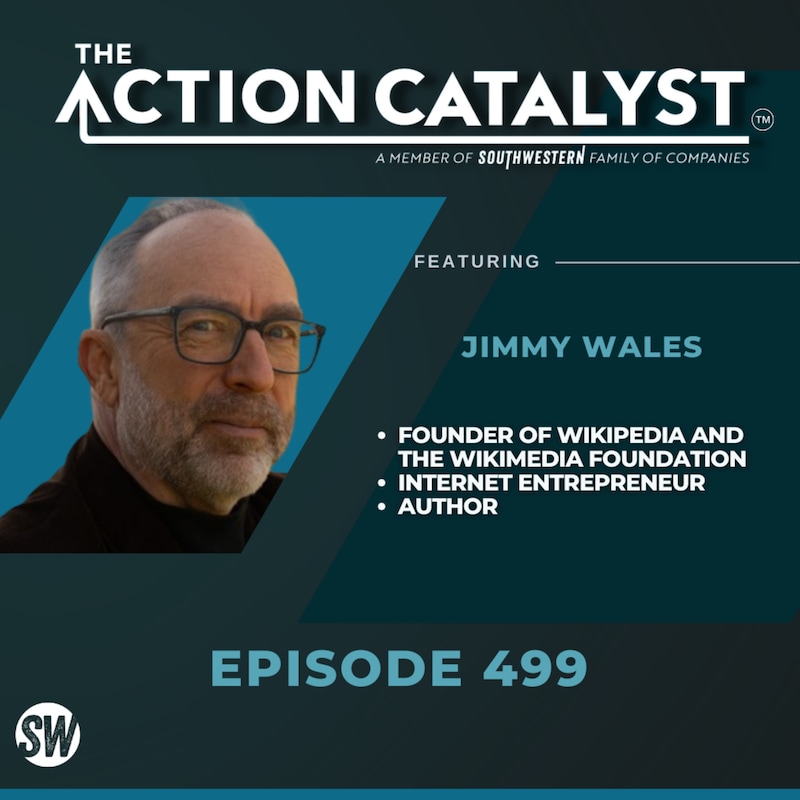
Jimmy Wales, Founder of Wikipedia and the Wikimedia Foundation, replays the origins of Wikipedia and the unique challenges it faced, examines the emotional and practical implications of trust, and chats about working with for-profit vs non-profit stakeholders, his issues with large language models and the way they work, the polarization of societal and business interests, and why he remains a “pathological optimist”.
Mentioned in this episode:
Learn more at SouthwesternConsulting.com/Coaching/Students
Transcripts
Today's guest is Jimmy Wales, Internet entrepreneur and the founder of Wikipedia and the Wikimedia Foundation. Named one of Time's 100 most influential people. His book titled The Seven Rules of Trust: A Blueprint for Building Things That Last, is out now. Jimmy, hi.
Jimmy Wales:Hello.
Adam Outland:Where are you calling in from today?
Jimmy Wales:I live in London now, since 2010 so 15 years, 16 years.
Adam Outland:Yeah, it's rubbing off on you, isn't it, Jimmy?
Jimmy Wales:I mean, I'm trying not to, but the children tease me if I say zebra instead of zebra and that sort of thing.
Adam Outland:So growing up near Huntsville, did you? Did you ever have a little bit of a country accent as a kid?
Jimmy Wales:Oh, I definitely had a southern accent. Yeah, as a kid, I lost it. As a teenager, I would say I went to a school where Huntsville is a funny place. Huntsville grew from about 20,000 people in 1960 to about 200,000 in 1980 so it was a real boom town. When I got to high school, most of the kids didn't have a southern accent, so I lost it then, well, my wife says I sound like Bill Clinton when I'm on the phone to my mom.
Adam Outland:So that's what I was gonna ask. I love it. So we, I don't know if Jimmy, if you realize there's kind of a unique connection here, but you read the encyclopedia that was sold to you and your family by a door to door encyclopedia salesman, right?
Jimmy Wales:Yeah.
Adam Outland:So I, in the 21st Century as an 18 year old, signed up to sell the modern day version encyclopedia is a student handbook, basically a reorganized encyclopedia for academics that I sold door to door.
Jimmy Wales:Wow.
Adam Outland:I did it every summer I was in college, and my my favorite thing to hear at a doorstep is that someone had really bad internet connection, because that usually meant I could make a sale.
Jimmy Wales:That's great. I love that.
Adam Outland:You get this World Book, encyclopedia, and how old were you when you're thumbing through this thing?
Jimmy Wales:I mean, my mom bought it when I was three, as I understand. I mean, I don't remember, because I was three, but as soon as I learned to read, probably, which was I was four when I started reading, but probably, you know, five, six, because the world book was actually very interesting. The way they edited it was very clever, actually. So the World Book was an encyclopedia for children, but children is a wide range, and so they would make sure, like an article about Tiger, would have a reading level that was much lower, like a first grade, second grade reading level, because they knew kids at that age are interested in tigers, and they're gonna look that up. But they would also have an article on physics, or quantum physics, that would be more suited for a 13 year old. I've always thought that's very clever. Obviously, Wikipedia doesn't do that. We can't do that, but I always thought that was pretty cool. You know, I only tied these two things together as
Jimmy Wales:an adult, right? I didn't think, Oh, I always loved encyclopedias when I was a kid. It is true, I would say the original inspiration for Wikipedia came from watching the growth of free software, open source software, and seeing programmers coming together to collaborate in new ways, and realizing that that kind of collaboration on the internet, where people could work together and share their work sort of remotely and so forth, I realized that could be extended beyond just software to all kinds of products. And so, you know, it makes sense that it would start with software, because programmers could create the tools they needed to share code and so forth. But the rest of us needed, sort of to have the tools built in order to be able to share so that was that was my initial thinking. And realized that the encyclopedia would be something that people could collaborate on, simply because everybody understands what an encyclopedia article should be like,
Jimmy Wales:like, if I say encyclopedia article about the Eiffel Tower, everybody instantly knows more or less what that's going to be. So it makes it possible to collaborate. That's one of the reasons, like you do see some collaboration on fiction and things like that, but it's much harder, because fiction can be anything.
Adam Outland:So there is objectivity to describing the true historical whatever. But history is also a little subjective.
Jimmy Wales:Yeah, there's a few techniques that we use that make sense to me, you know, early on, which is, we call it going meta, stepping up one level. So rather than trying to decide in a controversial area, like, what is the truth with a capital T, instead you characterize the debate. You explain like, oh, you know this. This is one view. Here's another view. I always give the example. If you imagine a kind and thoughtful Catholic priest and a kind and thoughtful Planned Parenthood activist, they're never going to agree about abortion. But because I've said they're kind and thoughtful, they can work together to say, well, let's explain the debate to people. And so let's, let's sort of talk about it in a way that that different people can understand. And in fact, the Wikipedia entry on this is quite good, and it's very balanced. And you can sort of say, oh, okay, like, here's the different perspectives. And you know, it's, it's very, you know, the Catholic
Jimmy Wales:Church position is this, and the Pope has said that, and critics have responded to us, and it starts to. Like a Wikipedia entry, but that's really when we're at our best. That's how we're doing it. You know, that's always been one of the things that I always say. It has two purposes. One is the epistemological, or knowledge purpose, ie, when I go to encyclopedia, I don't want to hear just one side of the story. I want to understand all the sides and what's, what's the debate about. But also, from a social perspective. It makes it possible for people who strongly disagree to work together like you can go, Okay, right? I understand it's not going to take my view, but we can work together in a fair way, and when we forget that, or when we don't live up to that, everything gets a lot harder.
Adam Outland:You went from, you know, taking kind of the technicians perspective of building what is today Wikipedia. But you started it as this project, and being kind of almost a technician of it, but quickly you also ended up, and you can tell me if I'm incorrect here, but leading people in a sense, I mean that, yeah, they could have been volunteers, giving their time, but you were coordinating. And to me, I feel like there's, there must have been a point of transition where you were the pie maker, and then all of a sudden you're operating a little bit of a pie factory, right?
Jimmy Wales:I mean, maybe I've never really thought of it in those terms. I mean, it's not like I'm a programmer who accidentally started running a thing. I'm actually I can't program. I'm not very good. I'm an entrepreneur more than anything else. So I was always thinking of it from that organizational how do we get people involved? How do we lead people? How do we excite, motivate people? All of that was always a piece of it and just that on the side, I was also able to do some of the actual practical tech myself. Just made it easier. You know, the original software for Wikipedia, I downloaded a use modwiki, which was a great, but very, very simple Perl script that you just like. You could install it very quickly and get it up and running, but it was so simplistic that you could create a user account and log in, except there were no passwords, so anybody could create the same name as you like, so we could both be using the same name, which would obviously be
Jimmy Wales:a disaster, you know, like, you can't build trust, you can't build a reputation, and all of that without that. And it was the only reason it was like that is because the guy who was making it was just making a little thing, like, it was like, maybe a group of three people could use it right then. It wasn't thinking about big public thing. And so quickly I was, I added passwords. It was a real from scratch process. And then it was just a couple of years, I'm not sure exactly when we scrapped that software entirely. And just like one of our volunteers, who was actually a biology PhD student at the time, but he programmed the first database driven. I mean, before that, all the articles were stored in check text files on the server. It was very rudimentary, but it allowed us to get started. And that was kind of the important thing, is just getting started and learning as we went.
Adam Outland:What's the early walls that you ran into? I mean, usually it's human related. You know, like so many of your adages in the book that you've published speak to is about how you run a team or an organization on a certain set of principles, right? Where did you start running into walls where you needed to start generating principles for how the business itself needed to be run different?
Jimmy Wales:Yeah, I mean, it's hard to say. I always say I'm a pathological optimist, so I never think of things as walls. I'm just like, oh, that's we got to do something here. And we got to do that, you know. But, you know, some of the kinds of challenges I'm just my mind is immediately drawn to a little bit of a later period, because once we got started, the traffic to the site was doubling every three to four months. You know, the nature of the mathematics of doubling is the first two or three. You know, it's like, oh, wow, this is interesting. And then it gets hairy, because going from one server to two, fine, two to four, oh, now it's 8, 16, 32 like, Oh, my goodness, that's like. And so there was a real challenge to scramble. I mean, in the early days we would, I would buy new servers because the site was starting to feel a little slow, and then we would get new servers, and we would have a traffic growth because the site was more responsive, you know. And that was, that
Jimmy Wales:was our big constraint, was getting the technology in order for the growth. And that actually led to, you know, when I realized, like, you know, I'm funding this out of my little, tiny company, and like, this isn't like we got to find a way. And so put it into the nonprofit, and did our first fundraiser, and we needed to buy some servers. We wanted to buy eight servers, and we were hoping to raise $20,000 in one month's time, and we ended up with 30,000 in about two weeks time. So it was a big success. And so we were able to buy the servers and have a little money left over to buy some other stuff. But that was a big moment of relief, because before then, I was like, I don't know how we're gonna keep funding this, and maybe we have to put ads on. And, you know, I don't really want to, but, like, and so suddenly it was like, Oh, actually, this could work, like this volunteer model and donation based. Uh, hmm, maybe this is going to work. You know, that was exciting. And I would
Jimmy Wales:say, like the the Wikimedia Foundation, which is the charity that I set up, that owns and operates the site, it obviously also has had a lot of growth over the years. And I would say there was a period of time when the growth of the website and the growth of the community was very successful, but the Wikimedia Foundation had a lot of growing pains, so as we started to grow there were a lot of challenges there, and becoming more professional and so forth. Unfortunately, we made it through all that, and everything's good today.
Adam Outland:So many of our listeners run small businesses themselves. Like you said, when you're getting things off the ground, you often run into people problems, right? And I was curious, you know, what are some of the people problems that you, that you've seen and run into that you had to maybe either you didn't expect and you had to navigate?
Jimmy Wales:I mean, yeah, it's a good question. I mean, I probably, I'll just point to myself, like I had to learn that I'm not a good manager. And that's actually really important, and it's something that founders often struggle with. I found it out pretty quickly. I mean, my management style is basically, this is awesome. Let's do this. Everybody go do some good stuff, right? Not really that great. Not it not a very good matter, very easy boss to work for, but not, not the structure that a lot of people need. I do think that a lot of entrepreneurs, a lot of founders, you know, a lot of successful founders, have done a good job of this. I would say, for example, the Google founders, they brought in Eric Schmidt at a crucial moment, because they realized, like, we're engineers and geeks. And later Larry did become Larry Page became CEO, but he was much older and more mature and had, by that time, he had worked in a big organization, and had learned a lot about how to do it.
Jimmy Wales:So, you know, I think there's a lot of that sort of thing that is really important, and I think it's this is where you know the book, the seven rules of trust. A big part of the book is thinking about, okay, inside an organization, you have to have a lot of trust. People have to trust each other. And one of the stories we talk about in the book is the story of Uber, which went through a real crisis of trust, both internally externally, the different executives were kind of at each other's throats and didn't trust each other. And you know, they had the problem of they would the decision making wasn't uniform. So we interviewed Frances fry, who's a professor at Harvard, but who came into Uber to help them during this moment of crisis, moment of trust, the company was in turmoil, and they had to figure out how to trust each other. And one of the things she talks about is, you know, she basically took everybody for an away retreat, and said, We're not leaving this room until we agree
Jimmy Wales:on what we're doing, like, what is our strategy? Because what was happening before this is one person would come to Travis with a great idea, convince him. He would say yes, somebody would come the next day. Convince him of the opposite, and he would say yes, that kind of uncertainty is worse in most cases, than making a decision that's slightly suboptimal, you know, like, like, completely whipsawing back and forth. So the book is really a lot about that. Like, what are the principles that you need, you know, in order to build trust, it's fundamental to relationship, and in business, it's fundamental to actually getting things done. And I mean, I think most of us have worked at some point in our life in a in a workplace environment that was in some ways toxic, and there was a low amount of trust, both trust between maybe rank and file and the management, trust between different equals in the company and things like that. And it's terrible. I mean, I some aspects of grad school
Jimmy Wales:were like that, you know, there were, you know, stories about people, you know, and in order to answer this question, you needed to find this one research paper, and one guy hid the book it was in in the library so nobody else could find it. And it was like, Oh my God. Like, what is this backstabbing nightmare? Like, we can't tolerate this and so, yeah, yeah. So you want, you want healthy culture in order to get anything done
Adam Outland:Well, so speaking to that, like, what, what did you learn in this process about building trust from zero?
Jimmy Wales:Yeah, I mean, I think, you know, I think one of the rules, I think, is rule number three that I always think is really kind of where I begin in thinking is have a good purpose and have a clear purpose. So with Wikipedia, is very simple. You know, we're building a free, high quality, neutral encyclopedia like that's the basic purpose of Wikipedia. And it really that purpose runs through everything we do, every decision we make, all the policies, all of like, what the organization does. And without that, you end up going in circles, like if you don't quite know what you're doing, and in many cases, you know, like a lot of business so like Airbnb, they had a clear purpose. Purpose, like they knew what they were doing, and that really helps a lot. And then other organizations sometimes lack a clear focus and lack a clear purpose. I mean, a lot of times, older, bigger companies that end up in like a conglomerate type of structure, they end up doing so many
Jimmy Wales:different things, and nobody's quite sure what the point of the company is. And sometimes that works, takes a hell of a lot of effort to make something like that work. And oftentimes what, what actually works is spin out the division that's successful but has nothing to do with anything else in the company, because it's just distracting everybody. But I think that that's one of the things, because once you have a clear purpose, then you start to have a metric by which you can make decisions. You know, it's like, what should we do? Actually? It's one of the things I think, is very interesting in my personal experience, for profit company boards versus nonprofit organization boards. For Profit profit company boards are much easier and much clearer in many cases, because usually in a for profit, you have strategic questions, all of that, but there is something that you all share, and there is an objective, which is, we need to be profitable, like the company has to be
Jimmy Wales:sustainable. We, you know, we want to be successful. And that clarifies a lot of questions, whereas in a nonprofit, it's like, oh, well, we're we're trying to share free knowledge with the world. But there's a lot of different ways to do that. And it gets a little more complicated, even though I do think we've got a good purpose and all that. It still is often quite complicated, but every time you can come together on a simple purpose, then you begin to be able to make better decisions, but also you begin to be trustworthy, like people know what you're going to do.
Adam Outland:You're predictable as a company, and that's huge for trust, right?
Jimmy Wales:Yeah, exactly so.
Adam Outland:And, you know, this might skip us around a little bit, but, I mean, today you've got AI, you know, all of them have stumbled on the trust factor because of information that has been surfaced that is inaccurate, that also is, I mean, kind of part of the learning curve, right? I mean, did you feel that Wikipedia went through a similar phase?
Jimmy Wales:I would say a little bit of yes and no. So what I always say about it is we were never as bad as they thought we were, and we aren't as good as they think we are. So Wikipedia has always had problems. We've always had errors. That's Part. Part of that is just it's really hard to do good quality reference work. You're always going to have something that's something that's not quite right. We always wanted to be accurate in the early days that we feel like one of the things that was really fun about the early days is you could be the first person to type, Paris, it's a city in France, and hit save, and you're like, Yes, look at my encyclopedia article about Paris. It's amazing. Obviously it's not amazing, but it's kind of fun, but it meant that when people outside Wikipedia would come in, you would sometimes see a really well written article, and sometimes you would see, oh, here's the article about Paris. It's two sentences, like, it's completely ridiculous,
Jimmy Wales:like it's not even real. That was just a matter of growth. It was a matter of getting better over time. It wasn't that that was wrong or inaccurate or crazy, it just wasn't good enough yet. So, you know, that was part of the trajectory is sort of slowly, you know, making the product better. And, you know, getting it to the point where readers could say, oh, actually, I generally anything I look for, I find it in Wikipedia, and generally it's quite good. And sometimes I find something weird, and that's okay, you know, another piece of that, you know, was in the early days, it's kind of like a very easy, lazy journalist thing to do, you know, you spot some error in Wikipedia, and you you write an alarmist article about something's wrong in Wikipedia. After a little while, it was sort of like in the early days of eBay. You would see these sort of scare stories of like, Oh, my God, someone's selling their baby on eBay. This is a terrible thing. And then after a while, you sort of
Jimmy Wales:realize, yeah, but like, there's a link, and if somebody tries to sell their baby, then it gets reported, and eBay takes it down. It's actually not that interesting. It's like, it's an open system, and so, like, whatever, a few weird things are gonna happen. And so there stop being those kind of news stories because the media sort of started to understand of like, oh, okay, well, right. So what like, it's not big deal.
Adam Outland:Yeah. And you have AI's that're also built to create false narrative. How do you even....
Jimmy Wales:Well, you know, I mean, I'm I use large language models a lot. I'm fascinated by it, and I play with it, tinker with it, study it. You know, the truth is, large language models aren't nearly good enough yet to write encyclopedia articles. If you've only played with it a little bit, you might think, Oh my God. Like, this is amazing. Of course, it can write an encyclopedia article. That's quite easy. But once you realize how bad the hallucination problem is of just like making stuff up, then you realize, like, oh, actually, no, I wouldn't, I wouldn't think this is a good idea. And you know, one of the issues there is the way the technology works, is by predicting the next token in a string of text. And it predicts more or less like something plausible, the most plausible thing, but the most. Plausible thing isn't always the true thing. And so oftentimes it can sort of take itself down an alleyway, and then pretty soon it's just making stuff up to support what
Jimmy Wales:it said in the past and so on. And that doesn't really work at all. And so the thing is, where will we be with this technology? Where we'll be in 50 years time, maybe in 50 years time, it's going to be amazing, and the idea of humans writing encyclopedia articles will seem as quaint as candles versus light bulbs, although, I think, as with candles versus light bulbs, I think the Wikipedia community, we just enjoy it as a hobby. And it turns out it's really popular with the readers, and that's great, but that's not why we do it. We do it because we enjoy it as a hobby, like, let's make an encyclopedia. It's fun.
Adam Outland:Yeah, it's interesting that it is, it is more than you know, what you search for when you need something immediately, it's, it's, you've built an entire community around it. But do you feel there's a greater polarity in our lives right now, in general?
Jimmy Wales:I do. I do. I mean, certainly, let's just take as one example like US politics that lack of, you know, bipartisan give and take, which has always been part of what makes the system work, has been breaking down for quite some time. And that divisiveness and that sort of bringing the culture wars into literally everything is kind of toxic, and it's really problematic, and I think there's a lot of a lot of that contributes to but is also caused by a breakdown of trust in society. One of the core starting ideas of the book was watching over the years the Edelman Trust Barometer survey and seeing a steady decline in trust in journalism and politics and business and so forth. Was like, oh, like, that's that's a problem, but it also causes problems. And as the media has become more polarized, it has also become less trusted. And as it has become less trusted, its business model problems worsen, and therefore it becomes more polarized, chasing clicks and chasing
Jimmy Wales:an audience that's more radicalized and so on. None of this is good. It's not how we want to live. I mean, I think we're, we're very happy to say, actually, we don't know all the answers. We're going to muddle through. Some ideas are good, some ideas are bad, but figuring out which are which is a big, complicated societal problem, we probably need to move a little slow and make some compromises and also not assume that anyone who disagrees with this on a little thing is a raving maniac of some sort. And I think both sides are quite guilty of this. You know, on the left there's sort of this view that they're all a bunch of Bible thumping Nazis of some sort, and on the right, and they're all like, pink haired trans activists or something. And it's like, actually, most people aren't either of those things. You know, most people have a belief system, and they're willing to accept that people don't agree about everything, and that probably we need a middle ground approach and and
Jimmy Wales:so on and so forth, and to the extent that the media is not helping, well, that's unfortunate.
Adam Outland:It almost sometimes feels that you are choosing a sports team to beat the other sports team than you are trying to seek truth to an answer of something or civil discourse.
Jimmy Wales:I think that's just deeply unfortunate. It's like a game, and it's like, no, it's not actually a game.
Adam Outland:I think of your rules of trust. It kind of pairs, to me, a little bit with with emotional intelligence, because you talk about empathy a lot, and it seems to be something that's not really taught as much, probably globally.
Jimmy Wales:Probably globally. Yeah, most of these things are most of these things are global issues. Yeah, no, I think that's right. I think that ability to see multiple sides of a question and to understand that people will come with different information, which was guide them to different conclusions, and also to say, actually, I can understand why people believe X, I could see the evidence they're looking at. By the way, I disagree. I think they're wrong, and here's my evidence, and here's what I think, and that's completely fine, but if you immediately jump to the conclusion, like, if you disagree with me, you basically want to kill everybody like me. What like? Probably not like. That's not valid assumption, yeah. And I think in part we we can get that way, because so much of social media has become super toxic. Obviously Twitter, like the number of thoughtful, kind thorough investigations and discussions of a topic by people who disagree with each other on on
Jimmy Wales:Twitter is very low, as compared to the number of people just screaming at each other. And if the purpose of Twitter, as has been said, I think, by Elon, but it's been said lots of times or lots of people, that Twitter is supposed to be like the town square, well, it's a pretty horrible town square, right? I wouldn't, I wouldn't want my mom to wander there at night. It's like mad down there. So maybe Wikipedia is. Town Square, although I don't encourage people to come to Wikipedia to fight about things, that's just not very fun. I have a little side project called trust cafe. Trustcafe.io, it is truly a pilot project. I don't really promote it a lot. The idea is like, what if we had a social network where the content that is promoted is based on the trust that the community has in the person. So there's this whole trust system where you can trust other people, and you can earn trust, you can increase your rank and the trust rankings. It's truly an experiment,
Jimmy Wales:and there's a lot of open questions. It's more of an exploration. But I personally think there's something interesting there. I wouldn't be bothering if I didn't think so, which is, when we have social media where the algorithm just promotes things based on total engagement. You know, a great way to get engagement is to be a jerk and take extreme positions to get attention, you know, like, that's not healthy. And it also leads us, if we participate too much, there, to a pretty dark view of human nature, and it's also very addictive, right? You know, there's the famous comic it depicts, like, there's two characters and and one of them sort of sitting and typing, and the other one's like, Honey, come to bed, and the person says, I can't someone is wrong. On the internet, we've all had that experience of, like, it can be very addictive. Like, ah, hold on. I've got to debate this person like they're getting something wrong, but it's not healthy. And it's not healthy when you
Jimmy Wales:understand that the algorithm is promoting that kind of controversy to keep you on the site longer, that isn't great. And so, yeah, I think, I think it's time to leave behind that type of social media and go with something healthier.
Adam Outland:I agree. Yeah, that's really interesting project. You know, there's a 18 year old boy that you know for part of his life grew up in Huntsville, Alabama. What advice might you provide that version of you knowing everything you know today?
Jimmy Wales:I mean, the really easy one is buy Apple stock. That's my number one. Like, if I could travel back in time and say one citizen myself, I'll be like, buy Apple stock, drop everything else. No. I mean, I think, you know, I do think for young people, I, you know, I think one of the, one of the biggest pieces of advice I would have for people is just get started on whatever it is that you think you'd like to do, and it's sort of like without endorsing it completely, but lean startup methodology, you know, like, give things an experiment, give things a try. And that can be a lot of different things in your life, because the next five years will go by no matter what you do, and when you look back in five years, you'll be happier if you tried something and it didn't work than if you never tried it. I think that's really key. And also you'll probably learn something when you try something and fail. Like, that's great adopting that kind of mindset of like, I'm going to be a
Jimmy Wales:person who's curious and interested in experimenting, yeah, that's great, you know. Like, that's really good. And obviously people have all kinds of changes. All kinds of challenges and things in their life, which makes it harder or easier in particular circumstances. But there is a phenomenon which, you know, in Silicon Valley, is called the wantrepreneur, instead of the entrepreneur. And the wantrepreneur is someone who is constantly writing a business plan but never quite does something and it's like, okay, generally you don't even need a business plan. Like, there's times when you do but generally, putting down some thoughts on a napkin, or let chatgpt Write the business plan. You don't waste your time on that. That's my main advice. I think that's the first thing always do something interesting. Actually, that's another piece of advice for young people, which is, don't do the thing that you think will make you the most money. Do the thing you think is most
Jimmy Wales:interesting. Because probably, if you just do the thing you think will make the most money, but you kind of hate it, you're probably not going to make that much money doing it anyway, because you're going to be bad at it. Money is great, but it's not the only thing.
Adam Outland:Yeah, I agree completely. Jimmy. Appreciate your time. Thank you.
Jimmy Wales:Okay, great.






