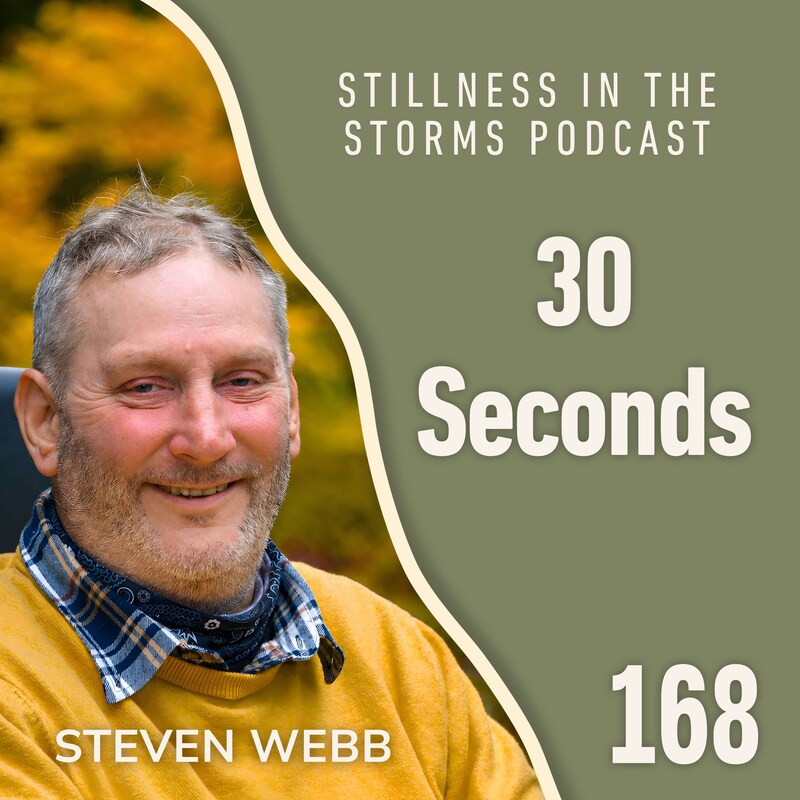
Shownotes
Links to Steven Webb's podcast and how you can support his work.
- Donate paypal.me/stevenwebb or Coffee stevenwebb.uk
- Steven's courses, podcasts and links: stevenwebb.uk
The First 30 Seconds: Why Every Feeling Is a Gift
Your body's fear response is not a fault. It is thirty seconds of something brilliant.
You hear two cars crash outside your door, or a horn behind you, or the word "bear" round a campfire, and before you have thought a single thought your body has already moved. This week I walk through what actually happens in those first thirty seconds, a bit of it borrowed from David Ji's book Destressify. The adrenaline, the heart, the sugar your liver lets go, the hands that go cold so a cut would bleed less. None of it a malfunction. All of it the body doing the most competent, protective thing it knows.
Then I want to go further than the science. Fear is a gift. So is anxiety, alertness, even stress. We are taught to get rid of them, and I once sat on a show whose whole aim was to delete fear for good. I spent every break arguing the other way. The trouble is never the feeling. The trouble is when it takes over, when it runs eight hours a day, when it stops you doing the things you want to do. So we keep the whole stick, the joyful end and the hard end, instead of chopping the bad bits off and ending up with nothing. We hear the feeling, we understand it, we let it be there, and then we decide. Hear it, then decide. That is the whole thing.
Key topics:
- What really happens in the body's first thirty seconds, step by step
- Why none of it is a malfunction, and why the calm ones round the campfire did not survive
- Fear, anxiety, stress and alertness as gifts, and the show that wanted to delete fear
- The healthy and unhealthy version of every feeling, including the misread "everything is just thoughts" version of Zen
- The stick you keep chopping, and why you end up unable to tell the joy from the pain
- Only ever seeing three colours, and what we miss when we numb the spectrum
- The five second gap, and hearing the feeling before you decide what to do
Companion meditation: IPM 104 on Inner Peace Meditations. [insert IPM 104 title]
Listen on Apple Podcasts or Spotify.
If this episode meant something to you, please share it, leave a review, or treat me to a coffee: stevenwebb.uk
With thanks this week to:
A warm welcome to Susan, a brand new monthly supporter.
And a special word for Stuart, who reached two years as a monthly supporter this week. That is not a small thing.
To everyone who supported the show across these past two weeks: Addie, Amy, Barbara, Michael, Karen, Laura, David, Jenna and Mia, and Johnny.
And the kind anonymous souls and everyone on Insight Timer. You keep this podcast advert-free. Thank you.
Transcripts
Hello and welcome to this week's Stillness in the Storms. I'm Steven Webb, your host, and this is the podcast that helps you find a little peace in difficult times.
It's the time when you have it least and you need it most. And this podcast has helped with their wisdom then.
So just before I start this episode is going to be about the first 30 seconds and why every feeling is a gift. I've just been doing my workout and I haven't done my workout for a long time, if not probably 12 months. And this is what my workout looks like.
So you imagine you're at an airport and you look down the Runway and you see these really small people waving their arms around with like, ping pong bats. Yeah, that's my workout for like 10 minutes. But I've.
I've got a challenge coming up I would like to do in September and I need to be a whole lot stronger than I am, especially in my shoulders and my arms. And I've just done over 10 minutes and my. Wow, that was hard. But, yeah, I'm doing it anyway.
Just before we actually get on with today's show, I just want to thank because it's been two weeks, so there's a couple more names. So Addie, Amy, Barbara, Susan, Michael, Karen, Laura, David, Jenna, Amir and Johnny. Thank you. You are all awesome.
And yeah, you guys keep the podcast free from adverts. So on that note, I'm very aware that you don't want me dribbling on early on the podcast. You came here for podcast?
If you want to contact me, you can always go over to stevenwebb.uk find my other links. So what am I talking about? The first 30 seconds.
This comes from a book I read a number of years ago now by David G. He's another meditation teacher and he wrote a book called De Stressify. Really easy read. It's one of those books that just explains the world in the simplest terms.
So in the book, David explains exactly what happens when we get frightened or, you know, we all sat around a campfire and you hear a big grizzly bear. I'm sure you've all experienced it on a regular weekend or you're. Or you hear a car bump.
Like, me and Kemba was just outside of our front door the other day and I heard two cars crash into each other. Like, what's that? Instantly, that fear? Or someone beeps that horn behind you.
Anything that just frightens us, our body goes into this really quick 30 seconds of preparing for the worst. So what happens? David explains that your brain spots a threat before you do. A small alarm in the head. The amygdala flags it and wakes the body.
And it doesn't alert you at this point. And within a second or two, the adrenaline floods in. Your heart speeds up. It drives blood to your big muscles, ready to run or stand your ground.
Your breathing quickens and your airways open, putting in more oxygen. Your liver releases stored sugar into the blood for instant fuel.
Your tiny vessels in your skin and fingers tighten so a wound would bleed a lot less. That is why your hands go cold and a little numb. That's why your feet also do the same thing.
You don't want to feel a cut on your foot if you're running. The blood itself gets readier to clot.
It's the same reason the pupils widen, your hearing sharpens, the world seems to go in high definition and time seems to slow down. The digestive system completely switches off. No point in digesting lunch if you're going to become lunch.
And all of that before you've even decided anything. That's before the fight, flight or freeze. You know, this isn't the body malfunctioning. This is the body with a brilliant response.
You know, we're all seeing about AI and robots. Robots aren't going to have this for way, I don't know, decades, decades yet. Okay, they might need it. So it's a bad example, but you get my point.
But very often we've had ancestors over the years that this has evolved because they needed to.
And we all the people that didn't have these brilliant responses, all the people that the body didn't react with fear and react with all these different evolutionary feelings, just didn't survive. You know, you imagine being in a forest all sat around a campfire and you're all playing music and then suddenly somebody says, shush, what's that?
That bear. And you've got people that are frightened and you've got one person, ah, don't worry about it, it's all going to be fine.
And half you go, nope, we're out of here, we're going to run.
Now, they may run prematurely, they may get it wrong, but they're going to survive over the millions of years with that fear inside of them a lot more often than the people that, ah, don't worry, everything's fine. Now then we can go on about how it's misfiring in a different podcast. That's not what this is going to be about.
What I want to talk about is these feelings are not Malfunctions, the feeling of fear and anxiety and all these feelings that we look at as undesirable because they don't feel comfortable. We're very often taught to get rid of, to reduce.
I went onto a podcast years ago, and the host titled the podcast, today we're going to get rid of fear, kick it out of the park. And during every break, after a segment that we'd be talking about, I'd be like, no, let's not get rid of it.
Let's use it and let's embrace it and listen to it. He would go, anyway, when we come back, we're gonna get rid of the fear. We're gonna totally get rid of it.
You're not gonna feel fear ever again in your life. And I just thought that's totally the wrong way to be. Because fear is good. Anxiety is good, alertness is good, Stress is good.
It's just not good when we're there all the time.
You imagine if your body is constantly doing that 30 seconds, that's where it makes us ill. That's where it makes us not survive quite as long as we probably could, not into old age if we're constantly on that fight or flight. But the balance and the middle way, like I talk about, it's a middle way all the time. It's about the balance. We need some of those feelings.
We need the joys you cannot live in. You know when you fall deeply in love and you have that, Like Mark Twain says, love is blind. Well, it is. Well, lust is blind.
In the first three months, they can literally leave the toilet seat up. They could eat you out your house and home, and you'll be like, ah, it's fine. They're so awesome. It's so nice to have them around.
Three months and two weeks, they leave a toilet seat up. And you're saying to your friend, I can't believe it. He leaves the toilet seat up. And I can't believe he.
He finishes my sentence when I haven't even got halfway through what I'm saying. He cuts me off and vice versa, the other way. So you cannot live from that. Love is blind because that's just adrenaline.
That's just a feeling of euphoria and desire that evolved brilliantly. So we can look past our differences, so we have offspring. So evolution carries on.
So you imagine how humans would have probably died out years ago if it meant that every single time to have children, we had to wait till we got on perfectly and we matched every energy and every feeling. Imagine if you Expected every person to put the Lucy down before there was a chance of evolution continuing. Not going to happen.
So as always, I go off topic. But what I want to talk about really is embrace all of it. None of these feelings are something we need to totally get rid of.
We need to hear them, understand them, embrace them. We shouldn't delete them, we shouldn't try to remove them.
But if they control us, if that stress is there eight hours a day or that fear is stopping us do the everyday things we want to do, then it's taking over.
And the same thing as if that lust and desire is causing us to do things we shouldn't do in a moral society according to virtues and laws, then we shouldn't do that either. That's then the unhealthy version of it. So there's a healthy version of stress, anxiety, fear. There's an unhealthy version of enlightenment.
Some would argue, well, that's not enlightened. Well, maybe, maybe not, I don't know.
But if you're literally, well, nothing is real and the universe doesn't really exist and thoughts are just thoughts and there's no and we can do what we like and we can ignore laws and all that, well, that's a really unhealthy version of Zen Buddhism. It's not really what Zen Buddhism actually says when we connect back in. But I think you get my point.
And I think we try to deny feelings way too much as if they are a problem and we can enlighten it to you.
Imagine getting to the end of your life and someone comes along and says, oh, by the way, you know that your favorite band that you've been listening to, you've only been listening to one of their albums, they had another five albums. You'd be like, what? Why didn't anybody tell me? So my whole life I've only been. I'd be like getting, I don't know, 60.
And someone says to you, oh, by the way, you've only been seeing three colors. We've been seeing in 60. In the same way as just experiencing life, all of these are just experiences. Fear and anxiety.
They're an experience that if we step back and pause, listen, we don't have to know what to do with it. We don't have to be that wise guru that knows exactly what to do with every feeling coming up.
But if we just pause, just stop, you know, find the lay by, stop the car, just take a little time out. And very often when things are arising, you don't have to do anything with it anyway. And nowadays that fear and anxiety is misfiring all the time.
It doesn't know that car horn, you know, 500 yards up the road, isn't a bear gonna eat you? That's the reality. The subconscious mind, that amygdala right at the base of your head has no idea, no idea.
The concept of the world we're living in now, that fear when we walk in the room, when the energy is different than the energy we come in with and we automatically jump to conclusions, you know, that feeling isn't wrong, but we can understand that we're jumping in the story. And that's where it very often goes wrong, I think. And how many times have you been feeling a little stressed or feeling anxious?
And we go to the doctor and we always want to get rid of it. Now, I'm not saying if we suffer from any of these things on a regular basis that we shouldn't go to the doctor and speak to the doctor. Absolutely.
I am not a trained person anyway, so don't take my advice for medical in any way. I'm just saying if it temporarily pops up, we don't always have to listen, we don't always have to allow it to take over our lives.
And I wouldn't like to live a life that I never experienced fear.
I wouldn't like to live a life that I've never experienced a little anxious anxiety or a little jealousy or a little guilt or shame, because I think they're the opposite ends of the same stick that I talk about. You know, we have a stick and one end is the happiest and the wonderful things and the entertainment and the joys we get out of life.
And on the other hand is the horrible experiences we have. And what we do is we keep trying to chop off the end of the stick with the bad bits. And what do we get?
We just get a shorter stick and you don't chop the end off with it, you just bring the stick shorter. That's a tongue twister.
And then you end up with, in the end, you end up with a stick that is so short that the joys in life and the undesirable feelings in life for the same part of the 1 inch stick, and we can't tell the difference anymore and we're just in a mess. You know, keep the stick as long as possible. Stop trying to chop the stick.
I take that 5 seconds gap and I think next week I'm going to do a podcast about when we take that five seconds gap, what can we do? We're very often in that gap. We ask what the world can do for us now.
What do I need help with instead of asking what the world needs from me now to show up? So I think that might be next week's podcast. Let me know by messaging me if that would be helpful in last week's podcast.
Plus it will tell me if you actually listen this far. Very interesting. Look, I think I'm going to stop the podcast. I just want to thank everybody that does donate. You guys are awesome.
You're enabling me to do more podcasts. You're enabling me to do more inner peace meditations on inner peace meditations podcast. And I'm just so grateful to you.
I'm so grateful to you for feeling all your feelings for being here, showing up, sharing, reviewing, leaving comments and just being you. I wouldn't want to change any of you. You're all awesome. Thank you. Don't forget to go over to stevenwebb.uk and sign up to the Weekly Calm.
I'll be sending out the newsletter in about an hour's time because I'm going to go write it now and I just want to end with, your body would do the 30 seconds thing again and it'll do it today and it'll do it tomorrow and it'll do it another day. When it does, know that it's not your fault. It's a gift. It means the body's working. That's fine. Just pause after, you know, do I need to run? Do I?
I really need to fight? Hear it, then decide. And that is the whole thing. Include everything. Take care. Have a wonderful week. And I'm Steven Webb and I love.





