Shownotes
Most AI today is intelligent… but it doesn’t feel human.
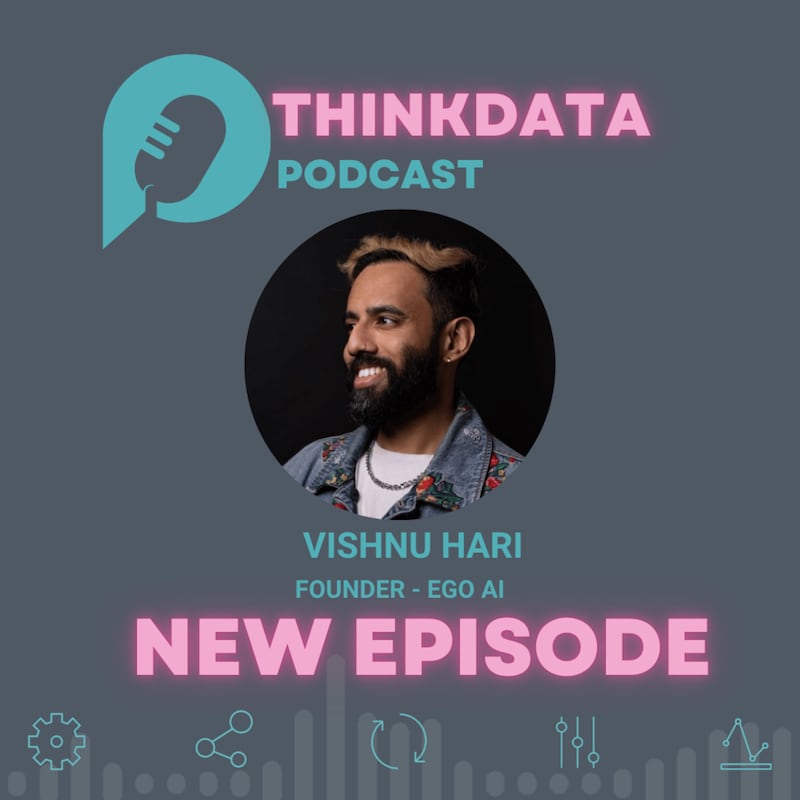
In this episode, I sit down with Vishnu Hari, founder of Ego AI and former AI researcher at Meta, to unpack what’s missing and why “humaneness” might be the biggest unlock in AI.
We cover:
- Why AI still feels robotic
- The gap between intelligence and behaviour
- Why most AI companies are solving the wrong problem
- And where the real opportunity sits
If you think AI is already “good enough”, this will challenge that.
Transcripts
Welcome to the Think Data podcast brought to you in partnership with Mydataworks. If you want to stay up to date with the latest breakthroughs and trends in the world of data and artificial intelligence, and if you're curious about some of the strategies that companies and founders use to launch data and AI products, then you're in the right place. Our aim is to bring together a diverse lineup of fantastic guests from the founders, through to accomplished leaders and product owners at some of the most fascinating data and AI companies worldwide. They will each offer you their own unique insight into what it takes to launch and scale a great data business. Thanks for tuning in, and I hope you enjoy the episode. Welcome to the Think Data podcast, and today's guest is Vishnu Hari. He is the CEO and founder of Ego AI and formerly in AI research from Meta. Ego is a Y Combinator backed startup that is building AI that behaves and talks like human beings in a space where obviously everywhere you look is AI this, AI that. I think I can confidently say Ego and kind of the conversation we've had prior to this has kind of pepped my interest, my curiosity, because I'm really keen to... Drill down on kind of the backstory. I know you had a solid stint at Meta, obviously heavily focused on the AI piece, the research piece as well. But obviously, Ego, what, a couple of years old, Y Combinator backed, gathering a lot of kind of momentum and interest. But I'm interested to kind of take you from big tech to Ego. When was that kind of epiphany and what led you to believe, you know, I'm an entrepreneur, there's a founder of me here?
Speaker:The epiphany happened when I was 15, honestly, 20 years ago, that I've always wanted this to exist. I started my career, I wouldn't even say career, I started my deep interest in tech by being a video game modder. I started modding video games as a teenager, specifically with Grand Theft Auto San Andreas. And in it, I found the potential to create a World of Warcraft-like experience where the NPCs could potentially have internal lives and their own desires, and I could talk to them the way I could talk to my friends in World of Warcraft, but I couldn't do it. And my interest in AI was seeded at that very moment. It only came to reality when I joined university. So it just so happened that the university that I was studying at was where a lot of modern AI was born.
Speaker:Interesting.
Speaker:That's the University of Toronto. Yeah.
Speaker:Yeah, because I was going to say, what was your degree? What did you kind of graduate in?
Speaker:Astrophysics. I was doing an undergrad and eventually a PhD in astrophysics. But I did a lot of work in very early stage AI research to find exoplanets. where we use deep learning models to find exoplanets that how that's how i got into the air research space interesting this is in
Speaker:2014 2013 yeah wow fair enough and as i mentioned at the top kind of ego when we had the initial conversation in terms of what you're building how you're going about and also let's be honest some of your you know being featured in forbes there'll be some really interesting articles about you and your really clear vision about how you see this space. But for people who are listening, what is ego and what problem are you ultimately trying to solve here?
Speaker:We're at Applied Research Lab and we're trying to solve the problem of humanness in AI. When you talk to AI, you know it's an AI. You can feel like it's an AI. It can speak in the language of humans. It can even have maybe minor cadences and stimulate humans. But at a certain point, the mask slips. We're curious to know how we can stop the mask from slipping. That's how ophthalmophysation is innate to every human. We do it to, well, other humans, but definitely Thank you.
Speaker:pets and maybe even pet rocks we want to now take it to ai interesting and how do you even was that born was that idea born off the back of your frustration with that kind of interacting interaction
Speaker:with ai was it something far bigger than that yeah i just started from my frustration with interactions it started with npcs scripted npcs and video games and it's evolved into well one chat gpt launched i was obviously like deeply fascinated but i was like it's still staccato like the conversation that you and i are having the cadence we have the way we can read each other's facial expressions can't do that with it i can't have a true collaborator and that's humanness and that's a problem that i was extremely motivated to solve what underpins humanness then in terms of kind of because as you say like you and i having this conversation that the leaning
Speaker:in leaning out the mirroring but obviously from an ai and actually how people are interacting with ai now is most of it is online they're kind of typing away and actually... We're probably a little way away from having those interactions face to face right now. But what defines humanness then?
Speaker:We have a thousand years of philosophy to read through to even understand, to even scratch the surface. But I... you know, for the context of this conversation, I think humanness is best when it's felt. You can feel it. And it's not something that's objective. You can't build a benchmark for humanness. In fact, we dehumanize each other sometimes. Real humans will dehumanize and we'll do horrible things to one another. So humanness is the continuum. But for us at Ego, we've decided to like bucket it into certain categories. One, for example, is conversation cadence, right? When you talk to an AI model, it's still very... turn-based. I take my turn to ask a query, the AI responds or asks for clarifying questions, and then I clarify or expand upon my question. And then it gives me some sort of output at the end of the day. That's not how humans work. Maybe bureaucrats work like that. Politicians do, but not humans. We like to go back and forth. We like to think with one another. We like to debate. We like to push back. And that brings us to the second category, which is an internal sense of self-worth in life that allows you to push back on things and allows you to go, no, no, that's not what I meant. Let me clarify. Or, no, I don't think that's super correct. Or, oh yeah, I totally agree with you, dude, in the middle of someone talking. That's another example of you have some sort of deep anchored emotion about the topic at hand and that allows you to then interrupt or initiate or steer the conversation in other directions. That's the second thing. Those are the first two things we're looking to solve with our behavior model, the white paper you can read on our website. And there's many more that are more demonstrated in the body environment, specifically in games. And finally, robotics. But that could be another whole topic of conversation. But that's the first two places for starting.
Speaker:And why is it so hard to build in terms of, obviously, you know, for people listening here, their probably main interaction with AI specifically, maybe through a chatbot or, you know, some voice AI when they're trying to get ready to contact center. And that's ultimately their only limiting kind of interaction with an AI of sorts. but why is it so hard to kind of... build what you're building so that real kind of human centered ai the one that actually generally feels like you're speaking to because obviously emotional intelligence that kind of ability to interact and react and have feelings and um you know give you that gut feel about things why how's that why is it so hard to build i
Speaker:split this question into two two responses one it's why it hasn't been built and why why it's hard to build The reason it hasn't been built is actually kind of feeds into why it's hard to build. It's because everyone's focused on intelligence. All the major AI research labs are in the chase towards AGI, the infinite knowledge machine god. That's a very reasonable thing to want to chase, but that's been their focus. So humanness gets lost in the way. The reason why it's hard to build is actually twofold. One, the data you need to have the kind of human-like conversational cadence of extremely hard data to acquire. You see, when you... through all the internet, you can find all kinds of data on people's writings, people's thoughts, even people's videos, them talking to the camera. What you can't do is get conversations like this. Even if you can in podcasts, it's a very structured environment, right? It's not a phone call that you have with your friend. That's hard to get. And even if you did get it, the second question of why it's, the second reason why it's hard to find, hard to build this is because there is no deep intrinsic desire to solve the problem of humanness. And that kind of feeds back into the first point, which is that AI labs are focused on intelligence. But even if they didn't focus on intelligence, most of the business in AI right now, it's kind of B2B SaaS. Does a call center employee really need to have a sense of an internal life or push back on your questions? No, they don't have to. So because they're focused on B2B and not consumer, it just doesn't happen.
Speaker:Interesting. So obviously you're predominantly a research lab and you're heavily in the weeds here, working on what this future state looks like. But if you... projecting you know you get this really like human ai behavior what what sectors what industries do you feel would benefit first and foremost from this are we talking around just generally that this could be benefit any sectors or do you think there's other sectors that might benefit from this human like ai over another for example so
Speaker:this is going to be the controversial statement but it's actually going to be ads. The reason is because if you create the most smart, like human-like behavioral AI possible, that becomes everyone's personal AI, friend, companion, enemy, whatever it is, it becomes the best substrate for you to understand the human behind the picture. And when you understand the human behind the picture, you get to know what they actually care about, what they like, what they're doing. And if that is then true, you get to then serve them up the right ad at the right moment. Like for example, Alex, if you're going to Tokyo, right? I know you as a person. And if you ask me, hey, what do you recommend? If I know that you specifically like yakitori and you don't like fried chicken, I'm not going to recommend you karaage. I'm going to recommend you yakitori places, right? Because I have a theory of mind for what you like and what you care about. That's the... highest tier potential of what we could do and i'd say it's part of the reason why the major labs and tech companies are really fascinated by open claw is that it is its goal is to be the person why yeah it's really interesting i think if you look at all
Speaker:you can touch is very important and valid i think a lot of these companies are challenged that b2b motion right it's kind of like that's where they see those big multipliers and the tag they're targeting enterprises with some form of ai automation or you know chatbots whatever whatever you want to call it But actually the consumers, like you and me, it's not necessarily not being left, but it's not as much of a focus. Why do you think that is? Do you think it's because obviously the bigger ticket value, the multipliers, the exits are all our enterprise stuff? Or do you think that shift is beginning to change now?
Speaker:I think it's just a lack of creativity, frankly.
Speaker:Fair enough.
Speaker:You have to be a little punk rock to want to build something that could be dangerous for everyone. But you can trust that people have their own internal sense of. neuro internal compass to know how to use an entity that could be powerful i don't know it's been confusing to me honestly even within the research labs that this wasn't really pushed that's why i went to push it i'm confused therefore i go found a company well
Speaker:to be fair most entrepreneurs unfortunately some great founders on here they are the ones that want to think outside and challenge the status quo they're not necessarily just following them because all that other companies done this well we're just doing it better is actually the best disruptors are the ones who are exactly that and you touched on something really interesting which i know people always talk to me about is you know they talk about risk you know governance you know you know everyone's very nervous around ai you know people who don't necessarily know it they're kind of very nervous around the implications of it what's your message to people are listening here thinking oh this sounds a bit like i robot to me this sounds like oh we're kind of giving everything. you know, we're giving too much to AI. What's your message to those guys?
Speaker:The message is we actually don't know any new technology. Anyone who claims to know what's going to happen with something as epoch-changing as AI is at worst lying to you and at best a little naive. We just have to deal with it as it comes. It's the same thing. We've seen the same thing with the Industrial Revolution, with radio, with TV, with... the internet even the early internet people had a lot of concerns and i'd say the same thing was echoed at video games like there were so many people in the 2000s and 90s who were like no grand theft auto can't exist it's going to corrupt the youth this has happened again and again and again and i'm honestly like you know as a gamer i'm like yeah sure okay rolls my eyes and just kind of move on yeah and what's driving that because he says a few times over this disrupt
Speaker:to this kind of your you know you kind of your your views are very clear which i think is really important i think it's healthy but equally a lot of people want people just to conform so how do you how do you keep your kind of north star and know that this is the right way in terms of your wider ego team in terms of kind of whether it's the investor community with your advisors how do you are you all pulling together on one mission is there one north star and we're just like that is it we're shooting for it or is it quite a collaborative company you
Speaker:No, it's one North Star. It's to make a model, a framework, and a platform for AI to feel human-like in every single way that is equivalent to you jumping into a World of Warcraft server or a Minecraft server and not caring that those entities might not be human-like because you wouldn't be able to tell the difference. To create these things that can go beyond just entertainment and fun into things to being useful. but in a way the usefulness is understood you know if you look at any agent today whether it's open call whatever the average person has no clue what this thing can do for you and in fact that's kind of what drives the fear but making that very clear to me is actually kind of a video game probably you equip the little characters with skills like this one's really going to make your website that one's really really good at reading your emails it's filtering out spam and pushing up the irs email you got you know that to me is the north star yeah
Speaker:i think it's super important that people understand here. people's reluctance or nervousness typically boils down to lack of education. So on that education piece, obviously you're with Y Combinator, you've obviously got a great network around you, but what is ultimately the message to them around the, you know, the opportunity? Because I know you talked about advertising, talked about kind of, which I get, I completely understand, but what's the kind of broader opportunity for them as investors coming in at this stage?
Speaker:I think YC and most of my investors invest in generally the founder and you know the sort of like leverage you have over the world um yeah and not really the product especially in an early stage i'd say like for me i just have a very clear idea of what i want to do and the product is has gone through many evolutions because it is it started out as a research lab um and now we've gotten the most amount of clarity with the open claw moment it was it is the greatest moment in consumer ai since chat gpt what pete did with open claw has caught the imagination of people around the world. One. Two, created two great exits, not just his exit to open AI, but also the multiple exit to meta. And three, kind of seeded this community of open source evangelists that are just consistently improving the product with no real monetary gain at the end of it. It's just they want this to exist. So the fundamental answer to the question is, you know, in YCDC, it makes something people want. This is something people want. We were a little early to the picture two years ago, I'd say, but now everything's ready. The model's ready, the framework's ready, the genetic systems are ready, things like model context protocols are ready. And now we just want to, we see the exact problem, we're very clear right about it. And we finally can evolve from a research lab into a product oriented company.
Speaker:Yeah, that's the thing, right? Because I think that's that transition where ultimately you become a commercial entity. And obviously, I think your point about open source is really valid where you there were just people out there that are curious. They want to contribute to this space because they just know that's kind of where things are going. But one thing I'm really, I'm fascinated by is where, you know, as a founder, as an entrepreneur of a company that is so unique, where do you take your kind of feedback and direction from? It was obviously the CEO and founder yourself. Is this just intrinsically inside of you where you go, this feels like where we should be going? Or is it, is it, you know,
Speaker:philosophers? I read a lot of philosophy still. And I, I'm a huge fan of Jean Baudrillard and a couple of other French philosophers. René Girard, particularly, on his theory of mimesis is really fascinating to me. But I try to like pick at the edges of the conversation around what it means to be human in human society, how we simulate the artifices of human society really well. I just look at that and that kind of filters out the noise of the broader sort of Twitter stream of consciousness stuff that kind of people put out there. Oh, this is important. That is important. This is important. You can get really distracted as a founder. And some of the distractions are fun, but you learn to filter out signal from noise. And to me, like, there's a lot of noise in AI, but to me, open call was great signal. Everything else, here and there, there's stuff that's cool. It's very cool. It's not to discount any of the awesome work people are doing in the community, but to me, what's important, and to the ego, what's important is everything that's aligned with our mission. And I take some great guidance from some of my investors whom I do talk to quite often. which is why we accepted their funding firstly and secondly to get a pulse on what what people are doing at the edges as well yeah but i did i don't i don't tend to just read um a lot of old work i think we the old work that still people still read and people like it's it's a natural filter right like you know for sure okay if it survives this many years and people still talk about it there's something must be about yeah so it must be right right yeah aristotle you know He's probably on to something.
Speaker:Yeah, I completely agree. And I want to ask this question because you touched on, you talked a lot about kind of what other companies are doing, some good stuff. And, you know, it's interesting to take a look at, but ultimately you're so focused on ego's vision and goal that that's your North Star. But how would you describe the current AI landscape in terms of hype, growth curve, you know, where this, because I get a lot of conversations on here where people aren't really sure where. we are on this curve, you know, because it's happening so quickly. I think about three years ago and where we are now just from a funding standpoint, it's just crazy. Where do you think we are in terms of broader AI, in terms of adoption, in terms of just that, the ecosystem?
Speaker:I'll preface everything by saying this mountaineer can only kind of see what's ahead of him, not the entire curve of the mountain. You're looking to get to the top. That's it. And what you're jumping across is the smaller nooks and crannies to get to the top. At the same place as a founder, you know, you have to think about the broader AI thing. Okay, there's a lot of noise, a lot of funding. Yeah, there's up cycles, down cycles, this, that. You just want to get to the top. You want to get to where you can have a clear idea of where your product and your vision comes to reality and where it stands in those sort of broader landscape. And when you're like a founder in a very early stage, it's just hard to know. If you don't have that many users, if you're just still exploring, you're still figuring that out. Now, that said. My view on it, it's like, oh yeah, it's an exciting time to be a founder because people finally believe AI is a thing. Because, you know, as I mentioned, I started in 2014, 2015, and I felt crazy back then for wanting to do an AI company. But now it's not so crazy anymore, is it? That's a nice feeling. But beyond that, I think the broader conversations that I think everyone's really focused on is compute, it's larger models, it's opening data centers, it's energy even. like powering these models, that's way beyond the scope of a tiny company like ours. And since our focus is in hyperintelligence, it really doesn't matter too much to us. It's exciting. It's good because cheaper intelligence, a united metered rate is good for consumer AI. Some people spend $1,000 a day on their open costs. Most people can't. I think part of it is an architectural problem that we are going to solve. The other part of it is just the actual cost of metered intelligence is higher than it can be. And it's exciting to see that drop. So those are the two threads I follow it on. It's like, what are people doing to spend on tokens? Can we make tokens cheaper, both through architecture and through the eventual broader macro picture of like, yeah, we're going to put more energy to this. It's going to be cheaper.
Speaker:Yeah, it's almost like a badge of honor right now. I see on LinkedIn, everyone with their token receipts and they're saying, look how much money we're spending. But surely that's not sustainable with even with millions of funding. It's like there has to be a point where that comes down to be more accessible.
Speaker:We'll eventually mine the sun, right? We'll just we'll just go right into the sun, get all the energy and then we can truly token max.
Speaker:Yeah, exactly. No, that's a fair point. You've already onto something here. What's been your biggest... your biggest learning is over the last couple of years as a founder especially as a founder in hyper intelligence and such a specific niche that evidently has got legs here but what's been your biggest learning over the last couple of years there's been a learning on sort of the personal side you know the personal journey of the founder and
Speaker:there's been a learning on sort of the company building side which would you like to hear
Speaker:Well, I think the personal journey, people love the humanized founders on this, where they actually think that, you know, it's not just, well, my product's great. My vision's great. It's actually, this is kind of what I personally have taken out of it.
Speaker:Yeah. I think that it kind of roots itself in a very dark incident that you might've heard of that happened to me last year, where I was attacked in the back of my head at the metal pipe in the mission. I lost my, half my vision. And for about half a year, I had most of my cognitive faculties missing. I was like, just, I didn't feel human. It's kind of, it's kind of. darkly poetic how it all roots back into my company in a way but the recovery process going from having a brain bleed and in the hospital completely out of it i don't remember half the year last year to slowly recovering my faculties it's like i felt like i was step function gaining humanness every few weeks which in a dark sense what we're doing ai models to we're giving it vision we're giving it reasoning we're giving it thinking we're giving it a potentially emotion the ability to push back All the things are things that I slowly regained over time in the span of last year, which gave me the strangest perspective on my company ever. I was just like looking at it as like, wow, it's like puppet strings. I could feel the puppet strings on my back as I was like regaining my faculties. And now we're doing it to these machines. I haven't fully processed how all of that kind of fits together in one neat line, but there is a link. and I'm exploring that over time.
Speaker:Yeah, obviously I hate to relate to the fact that what happened to you is horrific, but you know, everything happens for a reason, within reason, I think. I think it's actually tying everything in.
Speaker:I'm still alive.
Speaker:Yeah, wow. And actually you're here to tell the tale. And what's next for you guys? Then obviously deep in research, obviously working on that kind of, the next reiteration of these models, but what's the next big move for you guys? And where's the big opportunity for you next?
Speaker:Yeah, so that's a great question. We finally, carved our company into. We now have a product arm where we're confident the research we've accumulated so far is ready for production. And we're going to be launching what's called SideClaw in May this year in Singapore specifically. As you might know, we have a partnership with the government of Singapore's AI Singapore entity. We've managed to secure quite a bit of compute for our foundation models from that. But we're actually creating a personal claw entity for every single student in a specific university in Singapore in partnership with that university. where they'll have a open call entity, but with its own personality and its own sort of internal life that they can then take to their classrooms to co-work with, to collaborate with, to bounce ideas off of. That's something we're launching. And then we're eventually going to make that available to the broader public in September. And we're just calling that Ego, just made that for a company. That's the product that we're launching. That's on the roadmap. And then the second half of the company, which is more applied research focus, is then going to be taking
Speaker:a sort of pipeline of anonymized user data and user interactions to then make the model better and more human-like over time so that's kind of the what's next exciting times exciting times and i've really enjoyed the conversation i do uh this is very thought-provoking i think people listening here will be probably re-listening and go that's fascinating what you guys are doing but i uh i really appreciate you coming on this morning there's an amazing backstory and equally I'd say 10 years ago came up with this crazy idea but guess what you know it's coming to fruition now so uh yeah huge congrats to you and the team and uh excited to see what's next thank you so much for having me alex it's been appreciate it



