Shownotes
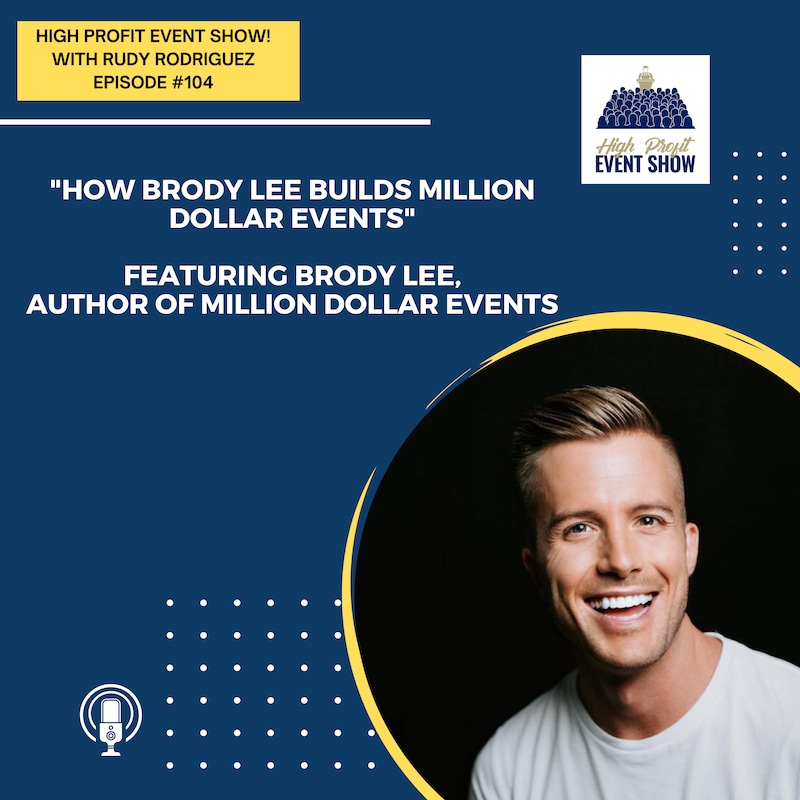
In this powerful episode of The High Profit Event Show, host Rudy Rodriguez sits down with Brody Lee, a seasoned event strategist, former Buddhist monk, and the author of Million Dollar Events. With a resume that includes over 1,400 events and more than $125 million in client revenue, Brody brings a unique blend of spiritual depth and business acumen to the conversation. His approach to events goes far beyond logistics—Brody believes that when done right, events can become platforms for profound change and movement-building.
Brody introduces his signature Five-Step Framework—Set Up, Show Up, Blow Up, Pay Up, and Scale Up—which he’s used to help clients turn their events into profitable, purpose-driven experiences. This system doesn’t just ensure a successful event—it builds a foundation for long-term scalability and deeper transformation for both attendees and hosts. From aligning the event with personal mission and lifestyle to creating world-class experiences that convert with integrity, Brody breaks down the essential steps every event leader must master.
The conversation also explores a paradigm-shifting view on events as catalysts for both business and social impact. Brody challenges event leaders to move away from transactional models and toward immersive experiences that foster connection, community, and change. He discusses how events have historically served as the engine behind every major movement, and how today’s entrepreneurs can harness that same energy in their own work. This episode encourages listeners to rethink what events are really capable of achieving.
Finally, Brody dives into one of the biggest challenges faced by event leaders: filling the room. He explains why outdated tactics no longer work and how integrity-driven strategies—like affiliate partnerships, pre-event nurturing, and AI tools—can attract aligned, qualified attendees. He emphasizes the importance of treating your audience not as ATMs, but as partners in transformation, and offers actionable insights for building trust from the very first touchpoint.
Whether you’re hosting your first event or looking to scale your results, this episode offers a masterclass in designing events that make a difference—and a profit. Don’t miss Brody Lee’s fresh, inspiring, and highly practical take on the future of high-impact events.
Want to connect with Brody Lee?
Website: https://www.brodylee.com/
Million Dollar Events Book: https://www.amazon.com/Million-Dollar-Events-increase-profitable/dp/0645643009
Facebook: https://www.facebook.com/itsbrodylee
Instagram: https://www.instagram.com/brodyleelive/
Transcripts
All right, welcome to today's episode. We have a special guest with us, Mr. Brody Lee. Welcome, sir.
Brody Lee:Thank you so much for having me. It's great to be here.
Rudy Rodriguez:Yeah, great to have you, man. You're someone that doesn't just believe in doing big million dollar events. You believe in doing them better. You're a very purpose-driven person and you love running not just impactful but profitable live events. For our audience who may be hearing you for the first time here, you were the author of Million Dollar Events and How to Increase Your Impact and Income with Insanely Profitable Live Events. You've helped and designed over 1,400 live and virtual events and generated over $125 million in client revenue and nearly five million in measurable impacts tied to global giving. In fact, I recently got to see you in action as an emcee at an event and I saw your ability to hold space, create energy and elevate the room. It was world-class. You really were an anchor for the experience. A couple of fun facts for our audience which I really appreciated is the fact that you were a former Buddhist monk and a time business for good award winner and an optimist with a big dream. Just like me, you have a dream of going to space one day. I would say more than a dream, a goal. Actually hosting a live event from space, from a hotel in space and broadcasting it to the world and raising billions of dollars through that endeavor and today we're gonna get to hear your perspective on how to design, deliver and fill million dollar events and what it takes behind the scenes.
Brody Lee:Beautiful, beautiful. I cannot wait, I cannot wait. I'm sorry about that. Something just crashed next to me. So audience, this is live as you can tell. We're gonna have fun. So man, thanks so much for having me. I think one of the things that I wanted to start with and just let people know is that I have a very, very deep respect for events and the craft of events and the reason why I do is because events have shaped every single critical thing that humans have done throughout human history. If you think about it, just in modern history, for example, we think about the labor movement, the eight hour workday, the suffragette movement, equality for women. We think about the racial justice, Martin Luther King, I have a dream speech. We think about the equality movement. Anything that's kind of happened that's moved the human race forward has happened at an event. We cast our minds back as well. Blood sports at the Coliseum, maybe not like something that most people would think of, but it was an event that people came together for and humans have always come together to connect, to communicate and to engage in commerce with events ever since we've been alive. So I love them as a way to get people to connect with each other. Now, I'm not a religious person. I was raised as a Buddhist and I was ordained as a monk as you kind of shared, but there's a company, an organization in the world that I would say is the best events organization in the world and I might piss a few people off saying this, but the church has been running the same event for 2025 years and they've been running it every Sunday at millions of locations around the world and they get people to donate 10% of their income and the dude that started the whole thing died 20, 25 years ago.
Brody Lee:And the events are still running. So I would say the church is probably the best events organization in the whole world. The reason I'm sharing this is because the craft of events, the art and the science of them, and it really is an art and a science, is something that's deeply fascinating and powerful because with an event, you have the ability to impact more people and the evolution of the human species in one day than most people would in an entire lifetime and that's why I love events so much.
Rudy Rodriguez:Remarkable, man. I appreciate all of that context and you are the author of Million Dollar Events, the book, helping many people create seven-figure events. In fact, you're at an event right now. You're helping your client with their event and the next event will be a target for a million bucks. What inspired you to write the book Million Dollar Events?
Brody Lee:It actually came out of the pandemic, funnily enough. So in 2020, I'll just get a quick, a little bit of backstory. I previously ran large events for Apple. So back in the Steve Jobs days, the iPhone was just starting to gain traction and we would do these big, massive product launches and Steve was a master at selling from stage. I've learned so much from him and we would have millions of people flooding into our stores. Apple is known for one-to-one selling, but we weren't able to do that at these product launches and so I helped train leadership and executive teams. At that point, I had the Canadian market and we would train them on Apple's one-to-many selling process. I rolled out a strategy so that people were, basically, we had team members at the foot of a table facilitating a sales conversation with 40 people at once and I had a Phd style education from Steve on how to sell from stage. So that was in a previous life. I had something happen in my life, a big dramatic thing that got me into the personal development world. I started my business originally out coming off the back of an event, a Tony Robbins event and you were just speaking before the show about a Tony Robbins event that you went to. We started building this business and in my first year in business, my first ever event, I naively boosted a Facebook event because I was so green to the industry and 40 people said that they were coming to this event. I had a venue booked and everything. I was like, great, 40 people, this is going to be amazing and then quarter to seven, no one was there. Seven o'clock, no one was there. 7:15, one person walked in. I wanted to die. I'd been running these large events before and then the first time I'm running my own, one person showed up.
Brody Lee:I had a choice to make at that point. Do I run, which is what I wanted to do, or do I stay and facilitate? And I stayed and facilitated. At the end of three hours, that person became a client and I made $20,000 from that event. So what happened was I made a commitment that I was never going to have an empty room ever again, first of all, and I was going to figure it out in this industry. We built up the business. In my first year, I did $1.3 million in revenue. But in the pandemic, this is something really interesting happened. I'd just come back from a Tony Robbins event at his house in Sun Valley in Idaho and came back and landed in Australia. This is 2020, was supposed to be my breakout year in this industry. I had 36 weeks of travel and stages and events booked around the world. The day after I landed back in Australia from his event, we shut down our borders for two years and Australians were not allowed to leave the country. Now, it was a brilliant decision on the government's behalf because we saved millions of lives. I think only 20,000 people or something like that lost their lives in Australia because of COVID. But what it did for us is that we kept having these lockdowns. So I lost millions of dollars overnight, but then we kept having these lockdowns and even my Australian events kept getting pushed back. So at about, when was it? It was about July, I said to my team, I said, we're going to do a virtual event. Now, at this point, virtual events were not a thing. People were not doing them and my team kind of groaned, they're like, oh, Brody, like virtual events suck, people are still doing them in the kitchen. I'm like, no, no, no, we're going to hold people just like in a live event, just like we planned. We're going to hold them on Zoom for 16 hours a day for three days and people are going to tune in from all over the world and they're going to walk away saying it was the best event that they've ever been to.
Brody Lee:And that's exactly what happened. I had 200 people come to this event. Our stick rate was 96% across the entire three days. At the end of the second day, I kind of, what we did and this is, we're going to talk about this in terms of live events, but we created an experience in that Zoom setting that now you see other people doing with these fabulous studios and whatnot. I believe that we were probably the first ones to do something like that. We had the music and all this sort of stuff and we had, like we were doing philanthropic giving, people would type impact into the chat every time they were touched, moving in spite, all this sort of stuff. At the end of the second day, I kind of was like, oh, maybe I should sell something. I wasn't thinking about that at the time. I was like, let's just give to the community, help them get through this chaos. So I wrote down that offer on the back of a proverbial napkin on a piece of paper, sent it like an offer that I made up, sent it to my team and they did up the slides. The next day I presented the offer and I made a million dollars. I got 42, 43 new clients. I forget what it was. It was a $2,000 offer and we made a million dollars. That started the million dollar event movement. We started looking at it as, okay, well, that was our primary acquisition strategy for that business. Now there was a coach, coaching coaches on how to coach coaches and then we ended up doing live events and virtual events and whatnot, built up a three and a half million dollar business and through like per year business at that time. Through that, we refined the IP and we got it to a really, really, really good point. At that point, I walked away from that business because I was not aligned with my mission of having coach, coaching coaches on how to coach coaches was not the impact that I had set out to achieve originally. So I went all in on events as the primary thing we consulted with people on that we did ourselves and really, really went in and deep on the IP.
Brody Lee:So the book was born out of that and the book was born out of everything that we'd learned during the pandemic and everything we'd learned since then to ensure that people were being able to fill their rooms, that they were able to design incredible content that touched, moved and inspired people. I will flag this that it's not just content but conversion content. When you're designing content, most people just think, oh, I'm just gonna go present and then I might make an offer. But there is an intention between, but like from every word that comes out of your mouth with that sale in mind, and then obviously how to create compelling offers and sell them from stage as well. So that's where it came from.
Rudy Rodriguez:Remarkable, man. Thank you for that background. I was about to ask you a little bit more about the anatomy of a million dollar event and you kind of started to go into it. Are there any other, like the main essential ingredients that you think are required to have a million dollars or what are they? What are the essential ingredients?
Brody Lee:Yeah, so we have a five-step system that we teach around events. It's a set up, show up, blow up, pay up and scale up. So set up is all really about setting up an events ecosystem that fits with your impact, your income and your lifestyle goals. Everyone's different, right? And you can make any event work and be profitable and create a million dollars. But you need to make it work for you and for your audience. But I always say that it's got to come for you first. So we make a decision. Are you doing a one-day event, a two-day event, a virtual event, a live event? Where are you going to do it? All that sort of stuff and figuring that out. How does it like connect with your mission and your vision and everything? The show up piece is all about filling the room with very high qualified bums on seats. So that is about generating demand for the event. So how do we get eyeballs and hands raised? Then once we've generated that demand for the event, we need to build trust with them before they come so that they're red hot and ready to purchase your offer. It's a bit that's missed actually, that nurture piece before people arrive. So that people are kind of like really educated, they're really informed, they know what they're coming into and they're primed to be in the buyer's mindset before they come. Then there's the obviously the driving attendance piece of that as well, making sure people actually follow through on their commitment to come. We know different things like show up rates, different virtual events, in-person events and so on. So that's the show up piece. The blow up piece is all about blowing their minds with inspiring content and delivery so that they're touched, moved and inspired and wanna purchase your offer. So what that looks like is first of all, you have to create an amazing value for people in the room and it needs to be engineered in a way that gets them closer to the buyer's pocket. The second piece of this is around designing an experience that is, and this is what I'm really passionate about.
Brody Lee:I think people do a real, like they do a disservice to people that have invested their time in coming. If you think about it, the costs of people coming, there is a time investment of time out of their business. There's an opportunity cost investment because they're not necessarily doing income generating activities. There is a relational investment as well because they're away from their families and all of those lots of things. So we need to make sure that that experience is worthy of them investing that time with you. So many people do it poorly. I'm talking about creating incredible activations, making sure that you're not just in some boring room and it's just some monotone speaker and all of those sorts of things. The third piece of this puzzle is around your production value, which enhances all of this, making sure that you're paying attention to really, really fine details and that the event runs like a smooth machine. Every single touch point that people have with you, the environment can contribute to conversion. The third piece of the puzzle, sorry, the fourth piece of the puzzle is what we call pay up and pay up is all about getting paid. So we need to create offers that we call them offers that sell themselves. You might have an offer that you're selling on a 45 minute sales call. You cannot present that offer in the same way from stage and you have to engineer the offer in a very different way. It can be the same program and then all that sort of stuff in the same deliverables, but how you communicate it has to be very different. It has to be based on a lot of the stuff that's happened at the event because you're gonna engineer a lot of this thing. The next piece is obviously we need to perfect your pitch and make sure that the art and the science of platform pitching is one of your top skillsets. So many people think about the pitch as being, an event within the event and I'll just present all of this content and then I might present an offer. But the pitch is actually a process.
Brody Lee:I teach that there's only three things that matter at an event. There's one person, one skill and one process. The person is you, you're the most important person at your event because you have the skill of frame control. That's the most important skill that you need at your event to hold the frame and to direct people's attention where you want them to direct it and all that sort of stuff and make sure that your frame is, that you have the most, what I call the most flexible frame. Most people say that, oh, the person with the strongest frame wins in a sales conversation. I actually say that the person with the most flexible frame wins because if you're flexible in your approach and how you communicate something to someone, the likelihood of you helping them to make a decision, a purchasing decision is much, much greater than if you're rigid, which is how they might be in that moment. I don't want to buy this, Rah, Rah, Rah, Rah and then the process, the most important process as an event is the process of pitching. The process of pitching begins in your marketing and your pre-event marketing and it goes all the way through. It's not just an event at the event. So that's the two things of pay up. The third thing of pay up is around how you manage the experience of people once they have purchased and managing the influx of new clients. I often say to people, if I was to give you a hundred new clients today, what would be the first thing to break in your business? And for most people, they say, I would break because they don't have solid systems in place to ensure that people have a beautiful experience when they come in and what happens is you end up seeing churn. You get buyer's remorse. People are not, they're not primed on the entry into your program and then that momentum can be dropped and you can obviously lose clients.
Brody Lee:Then the last piece of the puzzle is all around scaling up and so you nail all that other stuff and then it's about optimization and scale. So we look at things like building an events team around you that support you and as your events grow, how to ensure that you've got a rock solid team around you. The second piece of this is all around operational excellency and ensuring that your operations and your backend and all that sort of stuff operates at a really, really high level to support your event. Then the final piece of the puzzle is driving profitability of the event as well. So we look at things like sponsorships and those sorts of things to ensure that I want the event to be cash positive before the event starts. I hate it when people are cash negative and they're relying on their sale for their event, like the sales of their event to kind of cover the cost of that event. I think that's a really dangerous position to be in. So we leverage things like sponsorships and ticket sales and whatnot and negotiate and make incredible deals with venues and whatnot to ensure that they are cash positive before the event started and that's the five steps of a million dollar event.
Rudy Rodriguez:Remarkable, man. I don't think you've thought of this at all.
Brody Lee:No, never.
Rudy Rodriguez:It's very clear that you have a framework and a model that you've tested and refined and defined, tested, refined and used to help your clients, which is phenomenal. Inside of all this, I know you've worked with a lot of clients with their events. What are some of the most common mistakes event leaders make that cost them the most?
Brody Lee:Yeah, paying too much attention to the stuff that happens after you've got people to register before you've got people to register. So the most important thing is obviously getting quality bums on seats and that should be your primary focus in the lead up to your event. You absolutely need to be focused on that. I think sometimes people work in reverse order. They're like, I'll design the event first and then I'll design my offer and all that sort of stuff and then I will market it once I feel comfortable that I have an event. This is one of those things where you need to build the ship on the way down, meaning that obviously you've got to have the demand there first before you can even do an event. So I really, when we work with our clients, most of the time we spend on marketing and the acquisition strategy of people purchasing tickets to their event because without that, you don't have an event at all. So that would be one mistake. Another mistake I would probably say is treating your audience like a cash machine, like an ATM. I've been to so many events and I know that we've all been to events where it's a pitch fest and it's just offer after offer after offer with no kind of respect for the people in the room. Those multi-speaker events, I think do us a disservice. Like for example, the only person that's allowed to make an offer from my stage is myself and one of my sponsors, if that, and the reason for that is because A, I respect that people have taken time, money, et cetera, et cetera, to be in the room and so we need to deliver value for them. Also I don't want people just to think I want them for their cash. Like, of course I want to make lots of money, absolutely. But the main reason I'm in service of people is because I want to have a genuine impact on their lives.
Brody Lee:I want them to create the type of impact that they dream about, the type of wealth that most people can only dream about and contribute to the world to help other people's dreams kind of come true. So if you come from a place of this is an ATM, the event will not go well at all. Basically people should be extracting from you, your genius. You should be a knowledge ATM for the people there and it will come back. It will come back to you tenfold if you treat it like that. They'd probably be my two biggest ones.
Rudy Rodriguez:Right on. Thank you for helping me understand that. Yeah, don't treat your people like an ATM. That should be, I think people would, everyone would know that, but unfortunately that's not the practice in every event. Lead with value. I love it, man. Thank you for sharing. You mentioned a couple of points about filling a room, which is typically the, to your point, like you got to do that first before you think about everything else. Let's talk about filling the room. That's one of your areas of expertise. What would you say are two or three of your top, or even your number one top strategy that consistently used to attract great people to your event?
Brody Lee:Yeah, the game has changed since the pandemic and it's harder to get people to invest time for in-person experiences, which is very interesting because people are craving connection more than ever. We're in a very polarized world. We've got the rise of tech, these beautiful phones, and the one that just fell down on the floor before, that have the ability to connect us and yet most of us are operating our businesses on Zoom and all that sort of stuff now. So I think people have fallen out of practice of attending these sorts of things. So it's harder to get them to kind of break away from the business, from the family, off Zoom, et cetera, et cetera. So before where we might've even been able to run ads directly to a live event, it's getting harder and harder to do stuff like that and we need to be a lot more creative around how we engage with people. I think if we look at our industry, people say that there is a trust recession at the moment. I believe that there is a trust and experience recession, meaning that people aren't providing great experiences that compel people to wanna come to their events. We know that people need more touch points with you to make purchasing decisions now and so the way to, through that, to get people to your events, I actually, I share this, is that virtual events to sell in-person tickets are an incredible way to do it. The reason why I think they're so effective is because people get to spend time with you, they get to know more of you, and as well as that, they get to see the value of working with you. Now that's if you are directly advertising and directly selling tickets yourself. The other thing that's really, really important on this is leveraging other people's networks to be able to help fill your events.
Brody Lee:So that's having an incredible affiliate system, other people that have got complimentary kind of offers and things like that, where they can either get people to come to your virtual event to send, or you can support them with some sort of a deal to get their audience to your event as well. I think that sort of affiliate relationship is very, very, very, very underutilized because people don't know how to create great affiliate models, and maybe they don't have the right network. Obviously we can, in working with us, we connect people with affiliate managers and stuff like that that can do that for them. I actually got very excited. I'm running some virtual events where we're spinning some stuff. I've just moved to The United States myself and so a year ago, I'm spinning up my business here in the US And I'm very fortunate. I've got about half a million emails that are going out. So like I've got people, affiliates, that are sending to half a million email addresses over the next week for our event. So I'm kind of like partially nervous. That's the most I've ever had sent in one go. But at the same time, it just kind of demonstrates the power of using other people's networks and paying handsomely for it as well. Like we pay out very, very high affiliate commissions because it just saves us so much work in terms of managing ads and all of those sorts of things. The third one that I would say is that not to be afraid of paid advertising, but advertising to a paid event, like a five grand ticket, a 10 grand ticket, unless you've got a lot of cash behind you and you can afford to do all of that split testing and all of that sort of stuff, it can be a money sink hole, especially if you don't have a huge profile. So we generally recommend these days that virtual events are the gateway. The only other thing that I would suggest is if you're running a sales team, that you should think about what offer your sales team are making to people when they're on those calls.
Brody Lee:It might be that the best ascension is actually to get them to come to an event before signing into a program. One of the reasons why I think that events are, well, I know actually we have data to back this up, that people are more likely to stay in your program long-term if they purchase at an event versus a 45 minute sales call and it just makes sense. Like if they're with you for three days versus 45 minutes, there's gonna be so much more no like and trust factor as well. So yeah, they're probably my top tips in terms of filling your event. There's no one size fits all policy though. Every industry, every niche, every market is different. Everyone responds differently. We just need to test and figure out what your market's responding to the best.
Rudy Rodriguez:Yeah, no one size fits all. I couldn't agree more. Every single event, every single market's slightly different and you gotta be willing to test and scale that test. Thank you for sharing your experience and best practice on that. And congratulations on your email broadcast that we're going on.
Brody Lee:Yes, thanks.
Rudy Rodriguez:Your next event. Speaking of your next event, I'd love to hear a little bit more about you have coming up as far as your next event. I'd love to hear more about what you're doing with your business and your event.
Brody Lee:Yeah, yeah. So we're spinning up some virtual events here in the US using our AI powered one day selling system. So this is for virtual. Basically the premise is that you can replace an entire year's worth of sales calls in just one day and reduce your reliance on your sales team. I don't like that. Some people say, oh, you can eliminate your sales team. I think that's a little bit naive because sales teams are really important for the followup, but you can reduce your reliance on them, reduce the amount of commissions you're paying out. A lot of people hustle and struggle to get sales calls in a year, but with the right strategy, you can actually do all of that in one day, four hours, eight hours. So I'm excited about that. We're going to be doing that monthly over the next little while and we've really leaned into AI. We have created an AI called Events Expert, and it's got all of our IP in it, and it's producing some phenomenal results for our clients. A quick example is, I fed some ideal client profile data into the AI mid that we had gathered from the audience at an event, live at the event, about their pains, their fears, their wants, their aspirations, all that sort of stuff. It used our ultimate re-pitch framework to produce a re-pitch script for us to be able to use live at the virtual event. We pulled an extra $75,000 out of that room virtually at that client's first event. We've also done something similar at an in-person event recently, where we changed the process based on feedback from our AI in terms of our re-pitch, and we extracted an extra $300,000 out of that room. So I'm excited about the virtual side of things and how we're integrating AI at every single touch point of the event, from the marketing to the pre-nurture to the event design itself, to the off of the pitch. It's really, really cool.
Brody Lee:But what I'm most excited about is the event that I'm gonna be doing later this year in November called Impact, Revolutions Disguised as Gatherings. So at the start of this, I spoke about how everything that's happened throughout history has started with an event, all of the main revolutions. So this event is actually kind of an iteration of that first million dollar event. We used to call that event Impact as well. I've always wanted to do it live in The United States, but we'd never done it before because I was based in Australia and I didn't really have a following here and those sorts of things. So the premise of the event is all about live events and it's all about how to ensure that you have a really, really, really powerful live event, a live event. I think that live events are done very poorly in the industry. I think that's because a lot of people don't understand the art and science of them and they just think if I plonk people into a room, they'll buy. I wanna, for lack of a better term, I wanna make events great again. I want people when they come into your room to feel like they have entered a different world, that everything strips away behind them and that we respect the fact that they're in the room and we give them an unforgettable experience that they wanna come back year after year after year, that they want to do the promotion for you for the event. When they walk out of that room doing whatever it is that you're selling or whatever your thing is, that they are so empowered that they feel like their success is inevitable, whether or not they choose to work with you at the event or not. This event for us is gonna be us teaching those sorts of things and I'm really excited by it because at the end of day one, everyone's gonna have their marketing for their event built and launched so that they can start selling tickets immediately. At the end of day two, they will have their entire event designed and everything ready to go in order to be able to facilitate the event.
Brody Lee:At the end of day three, they'll have their offer dialed in and their pitch dialed in as well. The impact side of it though, and so that's the baseline of what this event is. But the impact side of it is that I'm really looking to help people to become categories of one in their niche. If you have a look at people like Tony Robbins, he's been doing the same event, Unleash the Power Within for 40 years, same one event. That event, if there's any indication that that's the best acquisition strategy to have a maximum impact on people's lives, the fact that he's been doing the same event for 40 years should tell you that events never fatigue. Most of the strategies that we've been using over the past, like in the internet, like most of the strategies and acquisition strategies, sales calls, all that sort of stuff, sales calls from internet marketing have only been around VSLs, et cetera, for the last 25 years. So if I'm going to bet on a strategy to help me influence and impact as many people as possible, that I want to reach 8 billion people through the space event, I'm going to bet on the strategy that the biggest name in the industry has been using for 40 years. One of the most iconic people throughout history has been doing events have been done in his name for 20, 25 years and the things that have created all of these social movements, I'm going to bet on that live event as the mechanism to help me with my impact. We're going to do a lot of philanthropy through the event as well. That's the core part of my brand. You said the 5 million impacts across The United Nations Sustainable Development Goals. What we're doing is we're taking people to think about events, not just as an event, but as literally a revolution in their industry and in their niche. I can hand on heart say, it's not going to be like any other event you've kind of been to, where the activations that we're designing, the experience that we're designing, I'm holding people in the room for 12 hours.
Brody Lee:Most events, they struggle to keep you engaged for like eight hours, but I know that people are going to be more energized at the end of the day than at the start of the day. So November, it's going to be great.
Rudy Rodriguez:Awesome, man. Yeah, this has been incredible. For those listening here and they want to create their own million dollar events, where should they start?
Brody Lee:Ooh, that's a great question. So they should start by putting on their first event like I did when only one person showed up. I think one of the things that, the fear that people have about events is that, like, I'll be honest, they are not the easiest client acquisition strategy. They're really not. They're probably the most highest risk strategy, but with that risk comes reward. So we normally, when we work with our clients, is we normally say after about three events is when you really start seeing the momentum and the scale. The first three are just kind of you testing the waters, getting your numbers and everything like that and just kind of understanding what your market's responding to. Put on an event. The lowest risk strategy is to put on a virtual event first and just to kind of see how that goes. But I would not shy away from in-person events. In fact, we've seen two of the biggest in-person events drop off the radar this year with traffic and conversions and funnel hacking live. I think that that's leaving a gap for people to really step up and that's why I'm stepping up in terms of creating this impact revolutions disguised as gatherings. But people are often fearful that an event will fail and I kind of say to them, well, there's the fear of the failure of the event failing, or there's the fear of the failure of like you're not fulfilling your mission and impacting as many people's lives as possible. Which fear are you more committed to? So it's simple. You can put on this simplest, easiest event. You can hire an Airbnb. You can put 10 people in the room and that can be your first event. Amazing. You can have something in your house. I've actually had masterminds in this house and I've got a penthouse here in New York City and it looks at all over out of downtown and The East River. I've had masterminds in my houses and stuff like that. So I think sometimes people overcomplicate it a little bit as well.
Brody Lee:They go, I've got to have this big Tony Robbins style event. Start small, just get your feet wet. Then as you build and grow, you can get further and closer to those million dollar rents. By the way, you don't need a ton of people in a room to have a million dollar rent. You can do it with a really, really, really high offer. For example, you can have a $100,000 offer and have 10 people in the room and still obviously make a million dollars when you close all of those people. I had a client that did an in-person event and she closed 100% of the room and made $2 million plus rev share from the people in that room, which is insane. It was a small event. I forget exactly the number of people. It was like 20 people in the room or something like that. So yeah, that's it.
Rudy Rodriguez:Beautiful, man. This has been great. For our audience here listening in, I encourage you to check out the links here around the episode. We're going to have links to Brody's website, his upcoming events, his book. We're going to have all sorts of resources here for you. So I encourage you to go follow Brody, check him out, follow him on social. All this stuff will be here near this interview link. Brody, as we kind of wrap up here today, what would be some final words of advice for our audience that you'd give them?
Brody Lee:Ooh, tough question. Final words of advice is probably around the impact and the mission that you're on. That would be that if you are as committed to the impact in the world that you say that you are, the things that you say, I'm going to do, then events are probably the most effective mechanism for you to do that at scale. The only thing stopping you between having that impact and not is whether or not you take the plunge and trust in yourself and bet on yourself that you can make an event successful. Will it work the first time? Who knows? Maybe, maybe not. But if you're that committed to it, you'll just try something else. You'll try something else. You'll try something else. Also probably get the support, shameless plug, but get the support of someone who's done it before. Even if it's not me, I don't care. I would love for you to work with me, but more so that you're not an island and there's some really good people out there doing some great stuff with teaching events. But yeah, I just, also just do it. Just, just, just do it. Just get it out there. I always say to my clients, get it out, then get it right. So just do one, you'll learn a ton and then you'll do your next one. You'll learn a ton and just keep going from there.
Rudy Rodriguez:Yeah, absolutely. Couldn't agree more. Thank you, Brody. This has been a wonderful interview. Really appreciate you having on with us today.
Brody Lee:Thank you so much for having me. This has been great. Awesome, man.
Rudy Rodriguez:And that's a wrap.



