Shownotes
Criticism and rejection in art can feel a lot like passing a kidney stone—sharp, painful, and definitely not something you want to experience. In this episode, we're diving deep into this rather unique analogy, exploring how those pesky critiques can actually help us grow stronger, just like surviving a kidney stone ordeal. I'll share my personal adventures with these little buggers and how they’ve surprisingly mirrored my creative journey. We’ll also chat about the importance of separating ourselves from our work, because let’s be honest, nobody wants to be called ugly—especially not our artistic babies! So grab a comfy seat, maybe a glass of water (hydration is key, folks!), and let’s tackle the ups and downs of artistic rejection together.
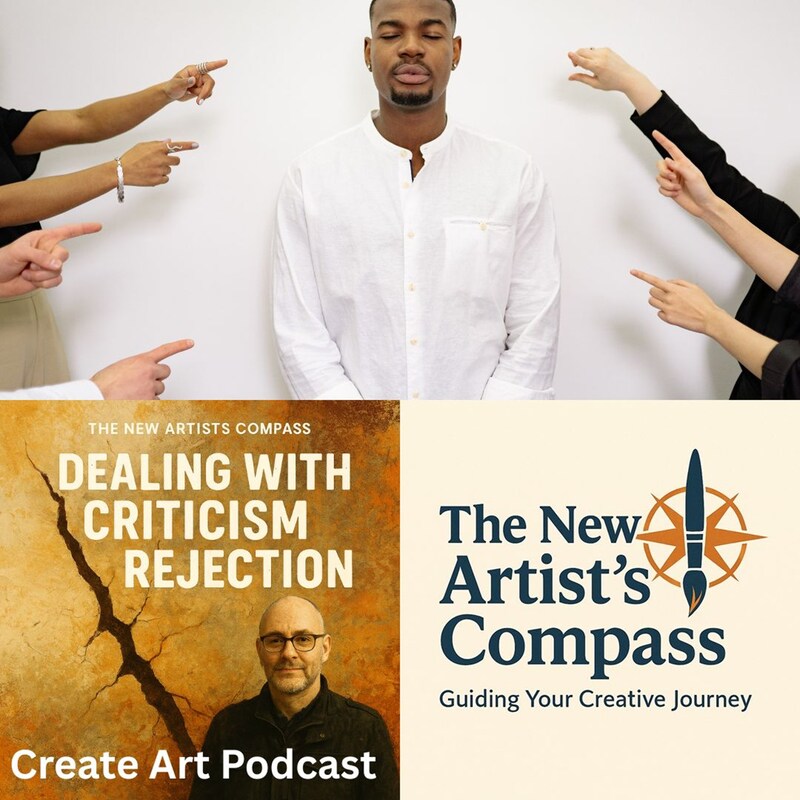
Dealing with Criticism and Rejection
Welcome back to The New Artist’s Compass. Today we’re
getting real about criticism and rejection. Both are as natural in the creative
process as kidney stones are in life—painful, unwelcome, but sometimes
unavoidable. And just like I recently had to pass one of those tiny nightmares,
dealing with rejection can leave you doubled over, questioning your choices,
and wondering why the universe insists on testing your endurance.
Here’s the thing: rejection isn’t a verdict on your worth as
an artist. It’s a kidney stone—sharp, unexpected, and it feels huge in the
moment, but in the grand scheme of things, it’s tiny. Painful, yes.
Life-ending? Not even close.
The Kidney Stone Metaphor
- Criticism can feel sharp and painful, but like a kidney stone, it eventually passes.
- You’re not defined by the pain, but by how you handle it.
Separating Self from Work
- Rejection of your art isn’t rejection of you.
- Learning to detach helps keep creativity flowing.
Constructive vs. Destructive Feedback
- Not all criticism is created equal.
- How to spot the difference and use what actually helps.
Resilience as a Creative Muscle
- Every “no” or negative review is a rep in building creative strength.
- Over time, rejection becomes less personal and more fuel
Finding Humor in the Hurt
- Using levity (like the kidney stone tie-in) to diffuse the sting.
- Humor makes space for growth and healing.
Topics covered in this series
Sharing Your Work Online for the First Time
Dealing With Criticism and Rejection
Finding (or Building) an Artistic Community
Collaboration as a Creative Catalyst
Staying Motivated Long-Term
Art Challenges & Social Media Trends
Mental Health & Creativity
Art Challenges & Social Media Trends
Setting Up a Creative Workspace
Creative Constraints & Prompts
Measuring Growth as an Artist
Why Do You Create?
When to Call Yourself an Artist
Lessons From a Year of Creating
Setting Creative Goals Without Killing the Joy
Takeaways:
- Criticism and rejection are like kidney stones: painful, sharp, and inevitable, but they pass!
- Just like dealing with a kidney stone, facing criticism helps us emerge stronger and wiser in our creative journey.
- It's crucial to separate yourself from your work; the critique is about your piece, not you as a person.
- Analyzing feedback can be beneficial; it’s like examining a kidney stone to prevent future ones from forming!
- Embrace criticism with humor, because getting through it only makes your future work even better!
- When faced with rejection, remember: it's not about you, it's about the art you create, so keep creating!
Links referenced in this episode:
How do I get such great guests?
PodMatch I use Podmatch to get the best guests on the show. Check out PodMatch if you want to guest on other podcasts or if you have a podcast and need guests for your show. Guests from Podmatch
Make Sharing your podcast easier
Use Podcast Beacon for the best NFS products to share your podcast while out and about or at conferences.
Reach Out To The Podcast
To reach out to me, email [email protected] I would love to hear about your journey and what you are working on. If you would like to be on the show or have me discuss a topic that is giving you trouble write in and let's start that conversation.
- Email: [email protected]
- YouTube Channel: Create Art Podcast YT Channel
- IG: @createartpodcast
- Twitter: @createartpod
Create Art Podcast Newsletter
Special Message
If you have found value in this podcast, please share it with a friend as that is the best way to discover new podcasts. I want this to be a 5-star podcast in your eyes so let me know what you would like to see.
Speaking about sharing with a friend, check out my other podcast Find A Podcast About where I help you outsmart the algorithm and find your next binge-worthy podcast. You can find that podcast at findapodcastabout.xyz.
For all of my projects check out my portfolio website TKBPodcaststudio.com where I help my clients through quiet professionalism lead through the noise.
Special Ask
Let me know what you think about the podcast by taking a survey. 2024 Listener Survey yes it is 2025, but hey I am late to the game on this. Thank you ahead of time to help me make this more of what you are wanting to hear.
This podcast uses the following third-party services for analysis:
OP3 - https://op3.dev/privacy
Transcripts
So something I have recently dealt with is I recently passed a kidney stone.
Speaker A:I know, not fun for me.
Speaker A:It definitely wasn't fun.
Speaker A:But you know what?
Speaker A:It got me thinking.
Speaker A:Criticism and rejection in art feel a lot like passing a kidney stone.
Speaker A:You know, it's sharp, it's painful, can't ignore it.
Speaker A:But just like a kidney stone, this too shall pass.
Speaker A:And you're usually stronger afterward.
Speaker A:Welcome to Create Art Podcast.
Speaker A:I'm your host, Timothy Kim O', Brien, and I use my 30 years of experience in the arts and education world to help you tame your inner critic and create more than you consume.
Speaker A: So in: Speaker A:And I'll be tackling a number of topics and sometimes we'll have conversations with different artists.
Speaker A:Other times it'll be like this episode where it'll be a one on one with me and you.
Speaker A:And yeah, I.
Speaker A:This one is very timely because I've had kidney stones in the past and they're not fun.
Speaker A:And criticism and rejection really feel like passing a kidney stone.
Speaker A:So we'll be talking about kidney stones, rejection and criticism, and a lot of the similarities between the two.
Speaker A:But here's the thing.
Speaker A:I'm back here with you.
Speaker A:The kidney stone didn't stop me, and criticism and rejection shouldn't stop you.
Speaker A:As a matter of fact, there's some good things about that, and that's what we're going to talk about on this episode.
Speaker A:So if you've never had a kidney stone, talk to somebody that has.
Speaker A:So far, I've had a grand total of, oh, I don't know, three, six, maybe seven kidney stones.
Speaker A:And I actually just recently passed one, and I have another one that I have to take care of.
Speaker A:And, you know, criticism can feel a lot like that kidney stone.
Speaker A:It's painful, it's sudden, it can be disruptive sometimes, you know, that kind of pain and disruption, that can be rejection.
Speaker A:And criticism can feel a lot like rejection because it's, you know, we, we talk about bringing things into the world.
Speaker A:And I know for me, with my art, I'm always, you know, kind of commenting on what I'm seeing and then saying to my audience, let's compare this, let's compare notes.
Speaker A:And when I hear crickets or when I get critiqued by it, sometimes that can be really painful.
Speaker A:And with criticism and rejection, there's ways to do it.
Speaker A:You know, one of the ways I learned in the military and in, in the art world is to treat it like a sandwich.
Speaker A:You put bread on Both ends.
Speaker A:You put the in the middle.
Speaker A:So good, bad, good.
Speaker A:And then you're done and get out.
Speaker A:That's a good way to give criticism.
Speaker A:But what if you're on the receiving end of it?
Speaker A:You know, realizing somebody's calling your baby ugly.
Speaker A:That's a lot to take.
Speaker A:That's a lot to take.
Speaker A:And you're going to get that in life and with your audience.
Speaker A:And it's unavoidable because you're alive and you're a human being, and you can't really stop it from happening because people are going to have opinions about your work, and that's okay.
Speaker A:Let's turn that on its head.
Speaker A:Let's turn that fear of pain on its head and go, you know what?
Speaker A:They disliked it so much that they made a comment about it.
Speaker A:I'm not hearing crickets.
Speaker A:That's not bad.
Speaker A:They were impacted by it so much that they decided to comment on it.
Speaker A:And if we look at that comment as, you know what, this person is being generous and they're trying to help me grow, what's wrong with that?
Speaker A:So realize it's going to be painful.
Speaker A:Somebody's going to call your baby ugly.
Speaker A:You're a human being.
Speaker A:It's unavoidable, and that's okay.
Speaker A:So now that we know that it's going to happen, we've prepped ourselves for it.
Speaker A:We've, you know, we've put on our armor.
Speaker A:We've got our thick skin on.
Speaker A:We know what's going to happen.
Speaker A:Somebody's going to say something about our work.
Speaker A:They're either going to, you know, really love it, or they're going to tear it apart and say why it's wrong and.
Speaker A:And this and that.
Speaker A:The other thing.
Speaker A:So we're prepared.
Speaker A:And now what we need to do is realize it's not personal.
Speaker A:You're going to separate yourself from the work.
Speaker A:They may be calling your baby ugly, but they're not calling you ugly.
Speaker A:Okay?
Speaker A:It's like a kidney stone.
Speaker A:It.
Speaker A:You're.
Speaker A:You have the kidney stone.
Speaker A:You created the kidney stone.
Speaker A:But the kidney stone does not define who you are.
Speaker A:It's not you.
Speaker A:It's.
Speaker A:Your body has created this and you're passing it and it's out of your system.
Speaker A:And, yeah, it looks like that there's a reason why it's called a kidney stone.
Speaker A:It looks like a stone.
Speaker A:It looks like gravel.
Speaker A:And, well, depending on how big it is.
Speaker A:The one I recently passed was 10 millimeters.
Speaker A:I have a 11 millimeter one and 10 millimeters doesn't seem like a lot.
Speaker A:But I got two calls from the nursing staff at my urologist going, are you okay?
Speaker A:And they were like, that's huge.
Speaker A:You're in pain, you're good.
Speaker A:And yes, I am good.
Speaker A:You know, it happened and all that.
Speaker A:It is out of me.
Speaker A:It looks ugly.
Speaker A:I might even include a picture of the kidney stone at the end of this episode.
Speaker A:So if you're watching it on YouTube, stay tuned, you too can see my kidney stone.
Speaker A:And if you're listening just on a regular podcast app, I'll have it in the show notes there for you.
Speaker A:But it's a rejection of the peace.
Speaker A:It is not a rejection of you.
Speaker A:So separate yourself from that.
Speaker A:Yes, it came from you, but it is not you.
Speaker A:That's the main idea I'm trying to get across to you here.
Speaker A:It is something that you brought into the world, but it is not you because somebody else brought you into the world, namely your mother.
Speaker A:So just remember that it's not you that they're rejecting, it's not you that they're criticizing, it's the piece.
Speaker A:And when we have that distance from it, it kind of softens the blow.
Speaker A:So whatever they're saying about the piece, that's fine.
Speaker A:They can say whatever they want to about the piece.
Speaker A:Maybe they don't understand it, maybe they got the wrong idea of it.
Speaker A:So that's where you got to critique the critique or, you know, really examine the rejection of the piece.
Speaker A:Was it a simple thing that they didn't understand it?
Speaker A:Was it a simple thing that they got the wrong impression of it?
Speaker A:And if that's the case, then that's going to be ammunition for you for your next piece to make it, if you want more relatable, more understandable.
Speaker A:So that way, that kind of rejection, that kind of critique, it doesn't happen again.
Speaker A:So I hinted at this in the previous section.
Speaker A:We want to analyze the criticism and the rejection.
Speaker A:You know, with kidney stones, they always want you to bring them in.
Speaker A:They've always wanted me to bring them in after I've passed them to analyze to see what, what caused that stone to happen, what's it made of, what can we do, diet wise or medical, with medicines that can help prevent those stones?
Speaker A:Same thing with criticism is you need to analyze the criticism and the rejection and some of the critiques, some of the criticism, some of the rejection that you get maybe from people that are not your target audience.
Speaker A:So that, that's, you really need to know who that target audience is.
Speaker A:Who is this work for?
Speaker A:Maybe it's not for the person that received it and critiqued it or rejected it.
Speaker A:Maybe it's for somebody else and it's okay if it's not for everybody.
Speaker A:You know, this kidney stone episode dealing with rejection is not going to be for everybody.
Speaker A:There's going to be some people that have had kidney stones that go, oh, God, I don't ever want to remember that again.
Speaker A:But I think it's important that we take a look at the criticism and the rejection and really analyze where it's coming from.
Speaker A:Is it coming from a place where they want to help us, or is it coming from keyboard cowboys that hate everything?
Speaker A:Back in the day, when I was really into punk rock music, there was people in the scene that, you know, said, oh, these guys have sold out and, you know, we're not going to listen to them again.
Speaker A:And they're, you know, they're trash, they're junk.
Speaker A:And with bands evolving as artists and evolving their sound and, yeah, maybe some of them did sell out because, you know, being a punk, being in a punk rock band is not going to necessarily lead to fame, fortune, and an easier life.
Speaker A:Some of that criticism, you just need to let it go because it's not for those people.
Speaker A:Some of that criticism you really need to take to heart.
Speaker A:Is it coming from the people that are your true fans, that are your true followers, or is it coming from somebody that is just going to poo poo anything?
Speaker A:I mean, they'll look at Michelangelo's David and go, yeah, well, you know, should have put a cod piece on there.
Speaker A:Or, you know, it doesn't look realistic enough to me.
Speaker A:Well, then they should get up there and try it, quite frankly.
Speaker A:So, you know, sometimes when I get criticism of my pieces or I hear crickets, which, you know, sometimes is rejection, sometimes that silence that you hear could be people are really thinking about it too.
Speaker A:Think about that.
Speaker A:You know, if you get.
Speaker A:If you're getting silence, maybe you have struck a chord with somebody that has really reached them down deep in their core and they need to process it.
Speaker A:So getting silence back sometimes not necessarily a bad thing.
Speaker A:If it's, you know, causing people to think sometimes it is a bad thing.
Speaker A:And then you go, wow, this wasn't for them and that's okay.
Speaker A:Or my message wasn't clear enough, so I need to work on, you know, what message I'm trying to send out.
Speaker A:So all these things are going to help you.
Speaker A:So with the kidney stone, you're getting rid of stuff out of your body that doesn't need to be in There, Yeah, it hurts, it's painful.
Speaker A:Sometimes there's blood involved with it.
Speaker A:Not going to sugarcoat it at all for you because nobody sugar coated it for me.
Speaker A:But sometimes it's necessary for you to go, man, I shouldn't drink so many sodas.
Speaker A:Maybe I should cut back to, you know, one a month instead of one a day.
Speaker A:That's a good message to get.
Speaker A:And so that way you can do better.
Speaker A:And so that way I don't have any more kidney stones, so I can do better and, you know, not go through that pain, not go through that.
Speaker A:You know, your body is rejecting this.
Speaker A:Your body is not functioning correctly, so it's adapting and doing something that it doesn't normally do.
Speaker A:Sometimes you need to adapt and do things you don't normally do.
Speaker A:Sometimes this criticism will lead you to do new things, better things, or lead you down different paths.
Speaker A:So don't necessarily be, you know, afraid of that criticism, that rejection.
Speaker A:Embrace it, analyze it, and find out if it's constructive, if it's coming at you from a place of love.
Speaker A:Somebody wants you to be better than what you're doing.
Speaker A:Fantastic.
Speaker A:Recently with a former student of mine, I've been shooting him some music that I've been creating and he's been giving me his ideas on it.
Speaker A:Like some of it, hate some of it.
Speaker A:And that's okay.
Speaker A:I. I just.
Speaker A: s and early: Speaker A:He likes that stuff.
Speaker A:So I know if I make something that is in that vein and pass it on to him, he's going to enjoy it.
Speaker A:But some of the stuff that I've been doing lately is very extra abstract.
Speaker A:Not a huge fan of it because he can't relate to it as well.
Speaker A:Likes the sound of it, but just can't really pull the story out of it.
Speaker A:So that tells me that I need to work more on my storytelling aspect with abstract art so that way more people can understand it.
Speaker A:If that's what I'm going for right now, I'm, you know, enjoying a new instrument that I'm using and a new digital audio workstation that is helping me mold this stuff.
Speaker A:So it's at its very early stage.
Speaker A:And is it going to.
Speaker A:Is it going to produce ugly babies?
Speaker A:Absolutely.
Speaker A:And it's going to produce some moments of genius.
Speaker A:We're going for more of those moments of genius and connection and, you know, figuring things out.
Speaker A:So analyze the rejection, analyze to critique and make sure that it is constructive versus destructive.
Speaker A:Don't let it be destructive.
Speaker A:Don't let it stop you.
Speaker A:Let it fire you up.
Speaker A:And make that piece of.
Speaker A:Make that next project even better.
Speaker A:All right, so let's look at the criticism and rejection as, you know, a just a rep in the gym.
Speaker A:So you're lifting weights, and it's just helping you get stronger.
Speaker A:It's a stress test, basically, on your creative kidneys.
Speaker A:So think of your kidneys as the source of your creation.
Speaker A:Please don't.
Speaker A:Oh, my God.
Speaker A:No.
Speaker A:Your kidneys help, you know, filter out impurities.
Speaker A:Maybe that's what your art does.
Speaker A:Maybe your art, you know, filters out the impurities and gives us a picture of what the world really is.
Speaker A:But here's the thing.
Speaker A:The more you face it and the less fear you have of it, the better it's going to be.
Speaker A:This whole episode is based on me passing a kidney stone.
Speaker A:That's funny.
Speaker A:That's.
Speaker A:For me, that's hilarious.
Speaker A:And I have to laugh when I have a kidney stone because, yes, it can hurt a lot in places you really don't want it to hurt.
Speaker A:But we gotta come at this with humor.
Speaker A:We gotta come at this with, this is only gonna make me better.
Speaker A:So bring it on.
Speaker A:Definitely bring it on.
Speaker A:Let me know what you think about this piece.
Speaker A:And, you know, sometimes you're going to need to set up the criticism as, okay, I really want feedback on this part of it.
Speaker A:The rest of it I got.
Speaker A:But this part seems weak to me.
Speaker A:And then, you know, if you're looking for criticism like that, then you need to be specific on what you want, and then realize it's going to help you in that area that you want it in.
Speaker A:And then you're going to reject everything else and have some humor with it, because let me tell you, kidney stones are not fun.
Speaker A:Getting rejection is not fun.
Speaker A:Having people tell you, yeah, no, not so much.
Speaker A:Not going to pay for this.
Speaker A:Not ideal.
Speaker A:It hurts.
Speaker A:It stings.
Speaker A:But then you look at it and go, okay, I got through that.
Speaker A:You know, I didn't lose an arm or a leg.
Speaker A:Maybe I lost a kidney stone.
Speaker A:Yay.
Speaker A:And then you move on and you do better the next time.
Speaker A:And then you get more criticism and you do better than next time until you get to a point where you're like, nobody criticizes you anymore because it's always perfect.
Speaker A:That point never happens.
Speaker A:It doesn't happen.
Speaker A:I'm sorry.
Speaker A:But you know what?
Speaker A:It would be nice if it did so, you know, have some resilience with it, have some humor with it and you know, a little, you know, this is going to, you know, make my work in the future perfect.
Speaker A:Delude yourself a little bit.
Speaker A:Very little bit, though.
Speaker A:Okay?
Speaker A:Not a whole lot, but a very little bit.
Speaker A:If that gets you through the night, great, then do it that way.
Speaker A:But have fun with it.
Speaker A:Let it build you up.
Speaker A:All right.
Speaker A:I want to thank you for taking a listen here today.
Speaker A:I thank you.
Speaker A:My kidney stone thanks you.
Speaker A:We named him Big John because he was so big.
Speaker A:10 millimeters big boy.
Speaker A:He's gaining weight.
Speaker A:But seriously, folks, with criticism and rejection, we've all faced it.
Speaker A:We're all going to face it.
Speaker A:I'm probably going to face some criticism for this episode because I'm talking about my kidney stones, so dang much.
Speaker A:But the fact of the matter is, is this, you want to realize it's going to happen.
Speaker A:Somebody's going to call your baby ugly.
Speaker A:Prep yourself for that.
Speaker A:Learn from it.
Speaker A:Analyze where that criticism and that rejection is coming from.
Speaker A:So that way the stuff that, the projects that you make in the future are going to benefit from those lessons learned and then realize that this is only going to, this criticism, this rejection is only going to make you better and have some humor with it.
Speaker A:So if you got something out of it, let me know.
Speaker A:Shoot your criticism my way.
Speaker A:Timothy.
Speaker A:Create art podcast.com.
Speaker A:i'd love to hear what you think about the show.
Speaker A:If you would like different topics on the show or if you'd like to appear on the show, email me.
Speaker A:Pop on over and let's have that conversation.
Speaker A:Let's start it up now.
Speaker A:If you got something out of the show, feel free to share it with a friend.
Speaker A:Whatever podcast app or YouTube channel that you're watching this on, there's usually a share button there.
Speaker A:So feel free to share this with friends.
Speaker A:I'm not going to give you a kidney stone for doing it yet.
Speaker A:Okay.
Speaker A:But definitely share it with your friends and share it with somebody that needs to to hear this.
Speaker A:Speaking about sharing things with friends, I run another podcast called Find a Podcast about and that's where I help you find your next binge worthy podcast and outsmart the algorithm.
Speaker A:Find it at Find a Podcast about dot x, y z and let me help you find your next binge worthy podcast.
Speaker A:Something else I've started.
Speaker A:Something else I have started this year is my own business.
Speaker A:It's called TKB Podcast Studio and you can go to tkbpodcaststudio.com and that's where I have my portfolio of all the shows that I'm working on.
Speaker A:And basically, I'm here to help lead you through the noise with quiet professionalism and get your podcast out there, whether it be production or.
Speaker A:Or consulting.
Speaker A:Maybe you know how to do all the podcast stuff, but you need somebody to tap you on the shoulder with good criticism and get you to that next level.
Speaker A:Pop on my website, email me over there, and let's see what we can do together.
Speaker A:All right, that's all I have for you today.
Speaker A:Thank you so very much for joining me here today.
Speaker A:Going to show you a picture of my kidney stone at this moment.
Speaker A:I know a lot of you have been waiting for it, so here is my kidney stone.
Speaker A:All right, that second or two of silence that you just heard.
Speaker A:For those of you on the YouTube channel, you just get to see my kidney stone.
Speaker A:For those of you listening, go to the show notes.
Speaker A:I've got a picture of my kidney stone right there for you.
Speaker A:So enjoy, enjoy.
Speaker A:And was that painful, you know, passing?
Speaker A:Yeah.
Speaker A:Not as bad as some others that I've had, but yeah, I could feel it coming out the whole way.
Speaker A:So if that's the thing that you need for criticism, rejection, if that's the picture that you need for it, I'm happy to.
Speaker A:I'm doing what I can for you to get my point across.
Speaker A:So go out there, tame that inner critic.
Speaker A:Create more than you consume.
Speaker A:Drink more water.
Speaker A:It helps with the kidney stones.
Speaker A:And go out there and make smart for somebody you love, yourself.
Speaker A:I'll talk to you next time.
Speaker A:It.
