Shownotes
We've all been in that meeting. Someone proposes a solution, someone else proposes a different one, and within minutes the room has split into camps. People stop listening and start waiting for their turn to argue. Whatever decision comes out feels less like a conclusion and more like whoever had the most stamina won.
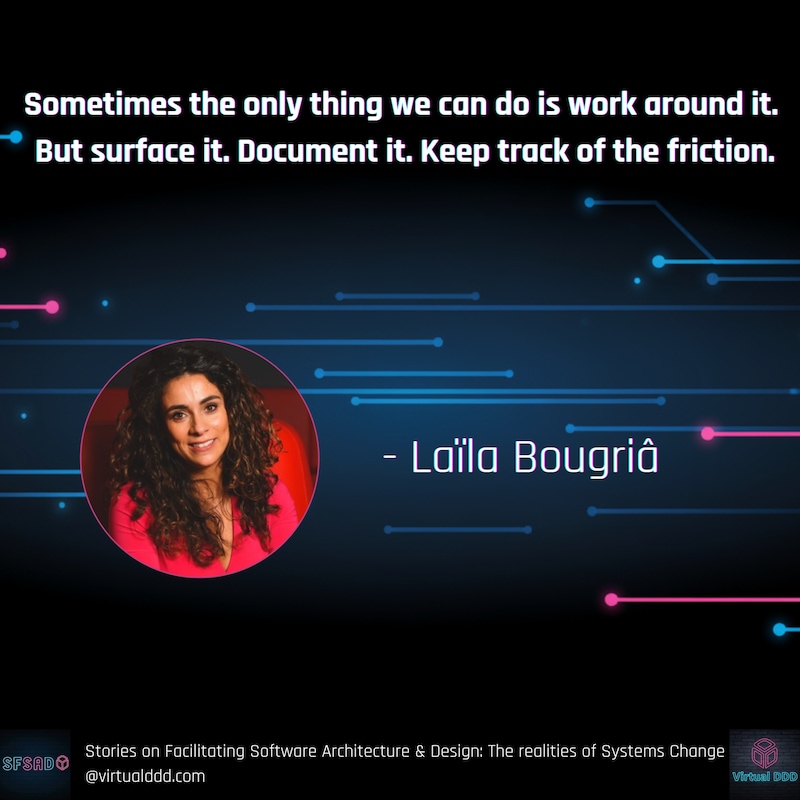
Laïla Bougria has spent over two decades in software engineering, much of it working in messaging and event-driven systems at Particular Software. Her story isn't a single incident — it's a pattern she's seen repeat across teams, companies, and years: smart people in a room, a decision to make, and a conversation that quickly becomes "my opinion versus yours." At Particular, Laïla learned to break this cycle through an RFC process that forces a different question before solutions are even compared: what problem are we solving, and for whom? That reframing removes a surprising amount of conflict before it starts. But what happens when two teams share a decision and neither is technically wrong? Or when you're convinced something is a mistake, and the team moves on without you?
This conversation digs into the emotional weight of architectural decisions — the gut reactions we dress up as rational analysis, the perfectionism that makes letting go feel like losing, and the personal practices that help you stay honest with yourself over time. Laïla shares how she builds evidence instead of winning arguments, why she runs personal retrospectives every six to twelve weeks, and what it taught her when she gathered evidence against a decision and found… nothing.
Key Discussion Points
- [00:01] The Pattern That Keeps Repeating: Smart people in a room, comparing solutions before they've agreed on the problem — and why it turns personal fast
- [00:04] Problem Before Solutions: How Particular Software's RFC process reframes decisions by requiring a shared problem statement before alternatives are discussed
- [00:06] "That's a Horrible Idea": Turning gut reactions into constructive questions about hidden assumptions and risks
- [00:09] When Two Teams Share a Decision: Navigating the give-and-take of event granularity between teams, and using coupling arguments that land because they serve both sides
- [00:14] Boundaries as Everyone's Job: Why service boundaries shouldn't be a few people's problem and how curiosity about the business domain surfaces issues early
- [00:18] Building Evidence, Not Arguments: The story of tracking bugs to prove a hunch right — and the equally important story of tracking evidence and finding none
- [00:25] Personal Retrospectives: A quarterly practice for resolving frustration, testing your instincts against reality, and genuinely letting go
Guest: Laïla Bougria Hosts: Andrew Harmel-Law, Kenny Schwegler, Andrea Magnorsky
Transcripts
Andrew Harmel-Law: So welcome back
to another edition of facilitating
2
:software architecture and design.
3
:That's what I've decided
to call it this week.
4
:the usual people are here again.
5
:So it's me, Andrew Harma Law,
and I'm joined by my usual
6
:co-conspirators, Kenny and Andrea.
7
:And today we've got Layla with us who
is gonna quickly introduce yourself,
8
:I think, and then share some stories
with us around about the topic of
9
:facilitating and collaborating on
software architecture and design.
10
:Take it away later.
11
:Laila Bougria: Thank you Thank you for
having me So yes my name's Layla I'm a
12
:software architect and engineer I work for
a company called Particular Software where
13
:we build in-service bus So I'm basically
very active in the messaging space that's
14
:also been my specialty for I don't even
know how long anymore A while over a
15
:decade at this point Uh I've been in the
software engineering industry for probably
16
:two decades at this point Maybe I should
stop sharing now but No it's uh it's been
17
:a fun ride Uh I've been active mostly
in the T net ecosystem and yeah I talk
18
:it Conferences now and then to share a
little bit of knowledge and also run some
19
:workshops on event different architectures
and things like that So that's me
20
:Andrew Harmel-Law: And do you wanna
share one of the, like one of the,
21
:the idea behind the podcast, I think
Kenny explained it right, is like share
22
:stories about when things got a bit
complicated and then we ask you some.
23
:Super interesting.
24
:Well, hopefully interesting questions,
but have you got any stories that you
25
:wanted to particularly share with us?
26
:Laila Bougria: Right So I was reflecting
about this a little bit and and thinking
27
:about okay which story could I tell And
I did reflect back on on something that
28
:happened but as I was thinking about it
it it definitely wasn't a single A single
29
:incident like that I think it's a sort
of a pattern that has been happening year
30
:over year over year in many different
environments in many different teams But
31
:the whole idea is basically regarding
when you get a lot of people in the room
32
:especially when there's a lot of smart
people in the room And we have to make a
33
:decision Either it's a design decision or
an architectural decision It doesn't even
34
:matter there's a tendency to immediately
sort of start comparing possible solutions
35
:against each other And that can in my
opinion cause a lot of friction because
36
:then it's Becomes very quickly my opinion
versus that of a coworker versus that
37
:of another coworker And then I've also
seen that you know people tend to become
38
:very protective of their own ideas And
and then it becomes this sort of back and
39
:forth when I don't really think that's a
productive way to think about The possible
40
:ways forward and how to go about that So
as part of working at particular actually
41
:we have a completely different way of
going about these things And it has even
42
:though because we basically have a an a
different process to go about decision
43
:making but that has influenced how I
think even if it's you know standing
44
:on your feet type of a discussion and
also how I facilitate these types of
45
:of meetings and It's still not easy
but I feel like it has given a lot of
46
:positive steps forward so that's in short
47
:Andrew Harmel-Law: Do you wanna,
could you maybe explain a little
48
:bit, describe the approach?
49
:'cause you're, I definitely
understand, can and relate to
50
:that kind of, everyone rapidly.
51
:Andrea sees this all the time, you,
that's very recognizable, right?
52
:The one where everyone picks a,
picks a spot and then just fights
53
:against everyone else from their spot.
54
:But do you wanna maybe describe a
little bit about how the alternative
55
:or an alternative could work?
56
:Laila Bougria: Right
57
:Andrew Harmel-Law: interesting.
58
:Laila Bougria: So actually the the thought
process or the basis for my thought
59
:process comes actually from our RFC
process So the whole idea is that when
60
:we make bigger decisions that are more
impactful we write an RFC for it And the
61
:whole idea is that we present multiple
alternatives and for each alternatives we
62
:will list what are the assumptions that
we make In this specific scenario what
63
:are the risks involved for this specific
scenario and also very actually before
64
:we get into alternatives describe what is
a problem that we're trying to solve and
65
:for whom are we solving this problem So
which stakeholder need are we addressing
66
:by solving this problem Which I think
gets rid of a lot of friction to begin
67
:with because most of the time there seems
to be a lot of misalignment around The
68
:problem that we're trying to solve to
begin with So figuring that part out is
69
:usually really helpful And the earlier
we can get to that the better but when it
70
:comes to sort of having these discussions
around you know alternatives it's more
71
:I think putting yourselves in a position
that there is no right or wrong proposal
72
:And I think specifically it's important
to not start comparing prematurely
73
:Kenny Schwegler: I think I always say
when when you get to good and bad then
74
:you're your your first Step towards a
conflict bruise right Because you're
75
:saying something is bad and something
is wrong I sometimes try to specifically
76
:come up with bad examples or probably
examples that have high risk just to
77
:find out what's what what it is that we
do want But I'm always to see how people
78
:react to that Very very resistant Right
Do do you see that sometimes happening
79
:still right Because we can make it
rational and on paper but as soon as it
80
:already has like this thing in their mind
like no this is the only way to do it
81
:Laila Bougria: Yes
82
:Kenny Schwegler: could deal with fact
how would you get them to unlock and
83
:see the other possibilities in that way
84
:Laila Bougria: That's a good question So
first of all I sometimes feel that too
85
:Like if someone brings up an alternative
and I'm like oh no that's a horrible idea
86
:But one of the things I've learned is
when I get that feeling This is a horrible
87
:idea is I think my younger innocent self
would've just said it That's a horrible
88
:idea And now I think like okay wait why
do I think that this is a horrible idea
89
:Because it it sometimes it almost feel
like feels like this gut reaction right
90
:It's a horrible idea And I always try
to think about okay What assumptions
91
:may this person be making that are not
being clarified that may be false or
92
:what risks do I see in this solution And
then I think that if you just shift your
93
:mindset from this is a horrible idea
to okay what are the hidden assumptions
94
:here Or what are the risks Then I think
you're having a much more constructive
95
:Conversation to begin with because it's
not well that's a horrible idea which
96
:can feel like very almost like a personal
attack to the other person So it gets you
97
:immediately out of the conflict mode So
it becomes a conversation about oh I yeah
98
:I can see that idea I Could it be that
you're making this or that assumption
99
:and then you start to have a completely
different conversation but Kenny there
100
:was another part to your question too
is like if someone has this type of a
101
:resistance like how would I react to that
And I think part of it I've al already
102
:answered is by acknowledging That every
idea has a place and to rather rephrase
103
:that as to okay and ask that person why
are you feeling so resistant to this idea
104
:Are you seeing some assumptions that are
being made that you think are false Do
105
:you see any risks that we haven't thought
of yet or that need to be surfaced And
106
:I think that immediately deescalates
because it takes it away from you have a
107
:horrible idea to okay there are some real
gaps in in this proposal that we need to
108
:address And I think always bringing it
back to what is it that we're having a
109
:disagreement about that is you know about
the idea about the implementation about a
110
:solution instead of having a disagreement
with another person Immediately
111
:deescalates the situation in my opinion
112
:Kenny Schwegler: Nice Yeah So to to
follow up So Something that's in my mind
113
:a lot because you work a lot with message
driven systems there's all usually I
114
:am I'm with two teams or with several
teams and they need to communicate
115
:with each other and that that can be
like okay here are my events Good luck
116
:Laila Bougria: Mm-hmm
117
:Kenny Schwegler: like no but I Consumer
and I just want I just want one event
118
:So like a summary event for instance
Right And and there's this whole power
119
:play and there's not even a right
or wrong decision because you could
120
:use a summary event or you can just
say just give me all your events And
121
:and so how do you deal with these I
I can imagine in with your expertise
122
:that you get into this A lot of these
Conversation Right And it's two teams
123
:against one another by default because
one like you build it and the other
124
:team is like no here's just my event So
125
:Laila Bougria: Yes
126
:Kenny Schwegler: you probably face
this situation So that's question
127
:one And and what then Right Because
there's no right or wrong there
128
:Laila Bougria: Right
129
:Kenny Schwegler: it's how I see it
130
:Laila Bougria: So I always see these
types of collaborations as a game of give
131
:and take So what I will try to do is for
example let's say we are in this case of
132
:a of a sort of event that is much more
granular versus an event that is a summary
133
:event And that makes it a bit more easier
is I for me that's already Possibly in
134
:some cases kind of a smell in terms of
surface boundaries so I will try to have
135
:that conversation that way and try to find
an incentive for the other team because of
136
:course it's totally understandable right
Every team has their own deadlines they
137
:have their own backlogs So I understand
when there's resistance from another
138
:team to do something that is you know for
the benefit of another team because it's
139
:Basically cutting into their own let's say
time budget so to speak So I think first
140
:of all acknowledging that and not seeing
again something as a personal attack
141
:It's more like well put yourself in that
team's position They probably have their
142
:own deadlines they probably have their
own backlog and by just considering that
143
:it Already deescalates because we can all
sort of find ourselves in that situation
144
:and we've all sort of been there before
So that creates a level of understanding
145
:But another thing I will try to do is
then to look at that and try to raise
146
:my concerns So what are the concerns
that I have around for example consuming
147
:a more granular event That we're just
gonna have to handle many more events
148
:and I don't really care about consuming
all of that Or is it because there are
149
:concerns around some things that may for
example introduce some type of coupling
150
:for example let's say as an example I use
a lot Let's say that you have some credit
151
:card service right And it's emitting all
of these transactions that are happening
152
:on the service but there's another service
that just Wants to know I want to know at
153
:the end of the month how much was spent
on the credit card right And then you
154
:could have this team saying yeah but you
already have access to all of these events
155
:on the card so why do I need to create
the summary event for you Well then you
156
:could say well the problem is that now I
have to understand what a period means to
157
:you That's something that is actually a
concern of your service And I don't want
158
:to duplicate that type of logic into my
service because that would create coupling
159
:between us And I'm sure you wouldn't want
me to copy that type of logic because then
160
:if it changes I would have to change it
too And then we become tightly coupled
161
:to each other and then we get other types
of messes right So it's it's also about
162
:having those types of conversations of It
might take a little bit more work now but
163
:it's going to protect your independence
or your autonomy in the longer term So I
164
:always try to find these types of angles
165
:Andrew Harmel-Law: so, I think that's
super interesting, Layla, because,
166
:I think sometimes teams don't,
they're not aware of that, right?
167
:They kind of just, they're not aware,
like somebody else worries about the
168
:boundaries between them and the other
team and, and typically someone else
169
:also worries about how long it'll take
another team to do the work versus how
170
:long it'll take you to do the work.
171
:And I think That's super interesting
'cause that's stuff that's is
172
:usually someone else's problem.
173
:Right.
174
:But, but in the cases that you've
described, you're trying to bring that,
175
:at least make them aware of that, which I
think is really interesting 'cause it's.
176
:Andrea Magnorsky: we're trying to aim
towards autonomous teams, then considering
177
:your boundaries as part of your day to
day needs to be, something, an activity.
178
:And actually, this is where I was
gonna ask you, Layla, like how
179
:do you help teams to, 'cause you
said, oh, it could be a symptom of.
180
:Not greatly defined boundaries.
181
:And let's face it, that's probably
happening like all the time.
182
:Right?
183
:And sometimes you can't do anything
about it, but sometimes there is
184
:some wiggle room to, because they
realize that teams are moving slower
185
:because they're lacking the autonomy.
186
:And so when you do have to do boundary
work, how does that work for you?
187
:Like what, what kind of
activities do you do?
188
:And also, how do you find it?
189
:'cause you, you talked about like,
well sometimes feelings give you, like
190
:the, not just the personal problems,
which there definitely would be because
191
:you have the power plants, but the
technical side effects of those bank.
192
:Please.
193
:Laila Bougria: Right Um absolutely So
first I want to just say that I was
194
:thinking exactly the same thing as what
you said is I think service boundaries
195
:shouldn't be a few people's problem I
think that's something that is owned by
196
:the entire team and all of the teams that
are basically collaborating with each
197
:other because the more people understand
those boundaries I think the more likely
198
:it is that we surface those problems
earlier and otherwise it becomes this
199
:thing that you don't care about and
then you would be less likely to push
200
:back to consuming a granular event for
example and then creating this sort of
201
:coupling So I just wanted to um add to
that But yeah when when it comes to Sort
202
:of doing that service boundary work I
I've always and this is something that
203
:is not something I've learned due to sort
of building event-driven systems but I
204
:think it just comes from my own personal
curiosity I've always wanted to understand
205
:the business I've always had really hard
time to actually write code if I don't
206
:understand what the purpose of that Thing
is I it's just something that for me did
207
:not compute And honestly I felt like in
the like especially in my junior years as
208
:if I was doing something wrong because I
I felt unable to just well here are the
209
:requirements Leila just build it And I'm
like but but but I have so many questions
210
:and I don't understand this And how does
that work And why do we do this And and
211
:I felt like really annoying and it took
years for me to realize that that was a
212
:strength and not a weakness but Yeah I
think that's that's one of the parts is
213
:that to continuously ask questions as to
why are things connected to each other
214
:there's a lot of work that goes into
understanding these types of boundaries I
215
:try to do that work early but it's also A
continuous job it never really ends right
216
:Every time something changes you almost
have to re-question those things to make
217
:sure you didn't miss something earlier
or if something changed And this is where
218
:things get tricky because especially if
it takes you a lot of effort to define
219
:service boundaries then people are like we
got them We will never touch these again
220
:And reality It does not reflect that right
It's just that's not really how it works
221
:one thing I tend to do is first of all if
we can have these conversations that at
222
:least surface these maybe imperfections
or full out wrong decisions in terms
223
:of our surface boundaries Sometimes we
can't immediately fix them because again
224
:multiple teams are involved and it's also
not easy because some DA data might need
225
:to be migrated and things like that It
can become quite complex and sometimes
226
:the only thing we can do is work around
it But I think for for me it's always
227
:been really important to surface it to
document it and to keep track of all of
228
:the friction that we encounter because
the surface boundaries are off Because
229
:in many cases what I found is That there
may be an agreement within the team that
230
:service boundaries are off but for not
getting the budget to make those changes
231
:for example and then collecting evidence
of what type of friction those errors or
232
:in in the service boundaries are causing
us can basically act as better evidence to
233
:have the discussion of okay now we really
need to prioritize that work Because this
234
:bug or this discussion or this feature or
this coupling has been causing us issues
235
:and then that makes it much easier to sort
of have that discussion So yeah I I build
236
:evidence That's one of the things I do
237
:Kenny Schwegler: One thing I
see and I I feel having myself
238
:as well is perfectionism is the
enemy of design and architecture
239
:Laila Bougria: Mm-hmm
240
:Kenny Schwegler: try to come with and
we try to come with reason even though
241
:we have our own personal opinion Of
course you think of a moment in the
242
:past where you're like this needs to
be this needs to be this way But budget
243
:teams other people thought differently
so you went with another decision
244
:and that's sort of like a loss for
your for yourself I feel It's a loss
245
:Laila Bougria: Yes
246
:Kenny Schwegler: with that Can you
tell something about that Because
247
:I think that's the most common
thing that that well at least
248
:I I deal with right Letting go
249
:Laila Bougria: Yes actually I can think
of two situations to be honest And one
250
:of them I was actually working at a bank
for which I worked for five years And we
251
:basically built a system that replaced a
mainframe To to say it in like a single
252
:sentence right So it's an entire banking
system and I remember that there was a
253
:piece of code that I could just look at it
from a distance and I'm like this is going
254
:to be trouble But then you know the rest
of the team was like but we already have
255
:the tests and this is already done And And
I'm like I could really see trouble And
256
:they were like yeah but no but we have to
move on And and and and I was like okay
257
:so move on And this is where I this is
an example of where I kept evidence So
258
:every time a bug came in that was related
to that It was just being fixed Oh we're
259
:gonna fix this scenario and now we're
gonna fix that scenario Now we're gonna
260
:fix that scenario And I just kept track
of every time a bug came in and I just
261
:didn't intermingle I was like okay it's
fixed Fine And at some point I think we
262
:were at I don't know like almost 10 ish
bugs I just raised it and I said okay look
263
:I don't wanna be like and I I I tried to
in those cases not use the I told you so
264
:card Because that just doesn't really help
in terms of your relationships But just
265
:to kind of raise it as look I I thought
we would have some problems there and
266
:I've been seeing that we are seeing a lot
of bugs come in into this sort of area
267
:and I've collected them I really think we
need to rethink this thing and see how we
268
:can adjust it And I think by presenting
it that way it enabled Me to convince
269
:the rest of the team to actually make
room for that And that's when we actually
270
:refactored the whole thing And from there
it was mostly bug free So that was one
271
:scenario Kenny but actually I also have
a completely different scenario where I
272
:was like yeah this is this is wrong I'm
sure this is wrong And I was had to let
273
:it go but internally hadn't really let
it go And it was like something that was
274
:frustrating me So I was kind of doing
the same thing of okay let me gather
275
:evidence around this And after a while I
saw there is no evidence which I think is
276
:an equally good exercise because it was
proof to myself that I was wrong which
277
:is fine But but basically a reminder that
you know even when we feel very strongly
278
:or think very strongly about something
it's a kind of like this humbling
279
:exercise of you're not always right
which I think is necessary for everyone
280
:Kenny Schwegler: I like that especially
because as architects you do a lot based
281
:on heuristics right On things that worked
in the past So I like the evidence I I
282
:like that as a heuristic So also I Be be
evidence towards the wrongness because
283
:sometimes you need to take a decision in
a moment based on like gut feeling maybe
284
:which we call heuristics but it's great
that keeping evidence and see if you're
285
:right or wrong That's I I like that Yeah
286
:Laila Bougria: Yeah it's actually a
technique I use in many different areas
287
:even let's say with like let's say
processes that you have in an organization
288
:that you believe have friction right
Sometimes it can be like oh very
289
:frustrating and you want to go and change
it immediately and you can Because it's
290
:someone else's job Then sometimes also
it's also the distance that it gives you
291
:right Because that's actually I would say
my technique of letting go it's like I
292
:don't feel like I'm entirely letting go
because I'm keeping track but it does give
293
:me a lot of distance and after a while
it gives me um sort of evidence either
294
:for or Against myself but that gives me a
good insight into hmm what did I get wrong
295
:or what could have gone differently here
296
:Andrea Magnorsky: I just kind of think
it's, uh, I looked at two examples that
297
:are superimposed and I think it takes
wisdom to acknowledge and, and, and kind
298
:of have the level of introspection to
first build those processes for yourself.
299
:And also then to acknowledge
other people's processes, but
300
:also to just go like, okay, there.
301
:You know, this works and I might not
like it, which is different from, it
302
:doesn't work, and in fact, it might
work better than I could have done
303
:because I'm not having that problem.
304
:Laila Bougria: Yes exactly
Yeah I I think it's um
305
:Andrea Magnorsky: I.
306
:Laila Bougria: That's that's for me
a good way to learn because sometimes
307
:we can have resistance about something
but if after a while and I think that's
308
:where the distance is really essential
because we always say that people cannot
309
:not be emotional right We are emotional
beings so sometimes we'll get upset
310
:about something We feel strongly we're
motivated we're passionate whatever And
311
:that can sometimes lead to a situation in
which we push too hard right So by also
312
:by having that distance and waiting and
seeing how things are gonna evolve we can
313
:also sort of learn of yeah like you said
Andrea I I got it totally wrong And what
314
:can I learn from this To improve myself
and I think that has been definitely an
315
:eye-opener a humbling one sometimes which
is also a good thing right It's like
316
:Andrea Magnorsky: Nothing like that.
317
:They just slapping you
right in your face, like
318
:Laila Bougria: yes
319
:Kenny Schwegler: But I think that's the
tension right I think most architects
320
:or most people are like we need to make
a rational trade off process Yes And
321
:there's emotions and past feelings and
we're dealing with complexity So we
322
:actually don't know what's gonna happen
and what's the right decision now because
323
:as as my dear friend says if we are
clairvoyant it would all be very much easy
324
:architecture We don't need to do it But
we're not clairvoyant unfortunately So
325
:there's this lot of emotions past things
happening and they're there And I what
326
:I like about what you are just saying is
at least have a process to continuously
327
:recheck yourself against what's happening
now And turn don't don't step into the
328
:socalled fallacy And I think if teams
actually do that By default as a team
329
:we would be making very better decisions
or architecture that adapt I guess
330
:Laila Bougria: Right So talking about
processes to kind of close the loop on
331
:this I actually have a process For myself
of having like quarterly retrospectives
332
:and I have these notes of things like
these that I've been keeping track of so
333
:let's say that in the meantime I use it
as a data point collection type of thing
334
:I don't spend brain cycles thinking about
it I just note it down and then every
335
:six weeks 12 weeks whatever works best
for you I just go through the list and
336
:every time there's something I can just
throw off the list like in the sense of
337
:Hmm either I don't feel as strongly about
this anymore I just I changed my mind
338
:over time Or it could be like I thought
there was a problem here It doesn't look
339
:like there is a problem here and then
it allows me to move on But by circling
340
:back to it you're basically kind of also
resolving your personal feelings around
341
:it and really letting go So yeah that's
my advice to anyone who's listening to
342
:have some kind of a process like that
343
:Andrea Magnorsky: That's beautiful.
344
:Also, it allows you to learn
where, where were you wrong?
345
:So it's like not only you can let it
go and go, like, actually that was
346
:probably a, a false positive or a.
347
:The opposite, but, but you are able
to kinda, sometimes you might be able
348
:to go like, actually I was looking
for type of bugs, X, Y, Z, whatever.
349
:It's, and then that didn't happen, or
it happened in a different way, but
350
:you're like, oh, what is the signal?
351
:And then you can close, close it.
352
:So it's like, not only can you drop it,
but also you cana Activate the learning
353
:and, and kind of you even have notes
about it is great 'cause you could
354
:Laila Bougria: Yes
355
:Andrea Magnorsky: that,
that you did ages ago.
356
:Very
357
:Laila Bougria: Yes Yeah absolutely Yeah I
call them personal retrospectives I mean
358
:we too we tend to do retrospectives in
group but I find them very very helpful on
359
:a personal level as well Like what was I
frustrated about six months ago And then
360
:you look back to it and you're like ah Is
that what I was frustrated about really
361
:So things like that can really it
lightens things up and it allows closure
362
:of of things that otherwise the last
thing you remember about something
363
:is that frustration and this kind of
mitigates that it provides this sort
364
:of checking point with yourself of
like oh it's like it was actually not
365
:that bad or something like that So
366
:Kenny Schwegler: And we all have
that And if people think oh I don't
367
:have that Think the last time that
that you're hungry right And you eat
368
:maybe a little bit too much and then
in retrospect you're like nah have
369
:done that I shouldn't have stuffed
my face with that And I guess that's
370
:with certain decisions as well being
371
:Laila Bougria: Yeah
372
:Kenny Schwegler: about decision but
later on you're like eh was just an
373
:emotion or a certain other thing So
374
:Laila Bougria: Actually I find that
in architecture we see this all the
375
:time because like you said a lot of
architects sometimes also make decisions
376
:based on gut or heuristics like you said
but those heuristics are usually like
377
:emotional So if something didn't work in
an environment it doesn't mean that it
378
:won't work in this environment So Again
like all of the the context is completely
379
:different and and by doing this sort of
retrospective you can sort of think about
380
:okay why didn't this work in a specific
scenario And that then allows you to
381
:sort of not completely rule it out in
the future in a different environment
382
:Kenny Schwegler: Yeah it's the same
Like if I go to my school here I take
383
:the bike but I shouldn't do that in
many other countries Uh when I was
384
:a child Context changes a lot So uh
385
:Laila Bougria: Yes
386
:Kenny Schwegler: Thanks Thanks for your
stories and thanks for being on the show
387
:Laila Bougria: Thank you for having me.
388
:Kenny Schwegler: listening Yeah And for
people who listening like subscribe I need
389
:to say this spread the word Hopefully this
would very helpful to you um good thing
390
:to know we'll be all at DDD Europe so
talk to us about these stories You have
391
:your own stories we would like to know
392
:Andrea Magnorsky: Cool.
393
:Kenny Schwegler: see you soon
394
:Andrea Magnorsky: Thank you.
395
:Bye-bye.
