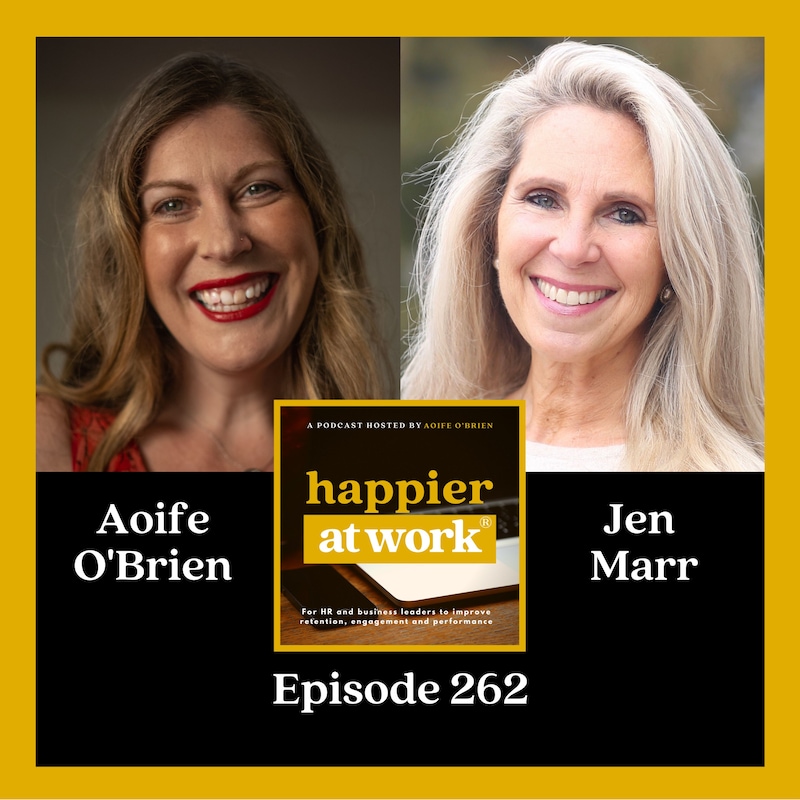
Shownotes
How can you build stronger human connections at work and lift your team out of the awkward zone?
In this thought-provoking episode of the Happier at Work podcast, Aoife O’Brien is joined by Jen Marr, author, researcher, and expert on supportive workplace cultures. They explore the essential human skills that leaders need in today’s rapidly changing, tech-driven world. Drawing from her rich personal and professional journey, Jen shares insights from her books "Showing Up" and "Lifting Up," delving into the art of meaningful support, tackling loneliness and isolation, and offering practical frameworks for leaders guiding their teams through uncertainty and disruption.
In This Episode, You’ll Discover:
- The “awkward zone”. Many well-intentioned people struggle to provide meaningful support, especially during difficult times, due to fear of saying or doing the wrong thing.
- Tools and clear boundaries for when to escalate issues, how to differentiate between manager, HR, and mental health professional roles, and how to build sustainable supportive cultures.
- How to create psychologically safe environments.
- The importance of leading by example. Effective support is pragmatic, not just emotional.
Related Topics Covered:
Lonliness & Empathy, Supportive Leadership, Younger Generations at Work
Connect with Aoife O’Brien | Host of Happier at Work®:
Connect with Jen Marr | Founder & CEO of Showing Up LLC:
Related Episodes You’ll Love:
Episode 181: Exploring Leading Indicators for Happier Workplaces with Zach Mercurio
Episode 195: Workplace Culture Dynamics Creating a Positive Work Environment with Caroline Collins
Episode 218: How Can You Improve Happiness and Trust at Work with matt Phelan
About Happier at Work®
Happier at Work® is the podcast for business leaders who want to create meaningful, human-centric workplaces. Hosted by Aoife O’Brien, the show explores leadership, career clarity, imposter syndrome, workplace culture, and employee engagement — helping you and your team thrive.
If you enjoy podcasts like WorkLife with Adam Grant, The Happiness Lab, or Squiggly Careers, you’ll love Happier at Work®.
Join Aoife O’Brien for weekly insights on leadership, workplace culture, career clarity, imposter syndrome, and creating work that works for you.
Website: https://happieratwork.ie LinkedIn: https://www.linkedin.com/in/aoifemobrien/ YouTube: https://www.youtube.com/@HappierAtWorkHQ
Transcripts
Ep. 262 Jen Marr FULL EP
===
Aoife O'Brien: [:I'm your host, Aoife O'Brien, career and culture strategist for Global Teams. You are so welcome today and we're talking about how to build relationships through caring at work. My guest, Jen Marr shares insights from her new book. I'm really excited to dive into that and understand a little bit more about what goes on here because I think it's so important to address these kinds of issues.
awkward conversations, that [:I know you're gonna enjoy today's episode. I would love to know what's one thing that you're going to do differently as a result? And do let me know what you think in the comments, or don't forget to leave a rating or review on your favorite platform or share it with a friend who you think would really benefit.
Jen, you're so welcome to the Happier Work Podcast. I'm so thrilled to have this conversation. I'm excited for what it brings. Do you want to let listeners know a little bit about your background, how you arrived at doing what you're doing today?
Jen Marr: Thank you, Aoife,. Thank you. It's so nice to be here. And thank you for joining.
ee young daughters and ended [:Shortly thereafter, I was half a mile from the finish line, running the Boston Marathon when the bombs exploded. And those two events in my life, one, I was there to support. I spent five years, supporting Sandy Hook Elementary going in every week, and the other one I needed support. And those two things along with my business development background, put me on a path of understanding our human behaviors when it comes to people that are hurting, challenged, suffering in hardship , as I witnessed during those times how awkward humans have become.
e in a peer to peer, support [:Really going through a difficult time. Could be a friend, a family member. Those skills are very foundational and very passive. You need to understand a little more how to listen better, how not to offer advice, knowing, when to talk, when not to talk. And so in this case, it's a, a very passive skill.
As we, as soon as we took that workout, it. I knew I needed to get it to the next level, which is leaders, which leaders don't have the luxury of not giving advice because they're being looked to, to guide people through hard times. And so utilizing all of tho that research I had done, on the showing up work along with my.
ut lifting up then goes much [:Really challenged in front of me and I need them to do their best work and I need to get them to the next level. And I need my team to perform and I've got these conflicts and, everyone's burnt out and exhausted and we don't know what's ahead and I don't have the time myself to deal with this. How does that leader.
That that is what this book is all about. So kind of ties it all together.
Aoife O'Brien: Can we take a step back and talk about showing up first, just in terms of the foundational behaviors, and then I'd love to dive into lifting up in a little bit more detail.
Jen Marr: Yeah, showing up. I would say our core piece of work in showing up is that we identified and really began to study what we call the Awkward Zone, because most people will say that they are compassionate and empathic, and they're good people.
and compassion sometimes is [:They, they thought it in their head, but then they were afraid like, ah, I'm afraid I'm gonna say the wrong thing. I don't know if it's the right time. What if I make it worse? I don't wanna make 'em cry. I don't wanna do this. And so, or you would say. Things that you thought were right but completely missed the mark.
You know, let me know how I can help. It's just like it's a phrase that is not helpful in any case, 'cause it puts the burden back on the person that's struggling. And so over and over again, we saw this awkward zone and, really dove deep into analyzing those behaviors, putting it into a common language.
in the, in an organizational [:What are you gonna do? How do you know when to talk? How do you know when not to talk? How do you deal with silence? How do you not just jump in and try to be the fixer? And so those are all the foundational skills we put out in showing up.
a positive thing to say, but [:And so actually it makes us feel good in the moment, but it's not helpful to the recipient whatsoever. Because then they have to think, well, how could they help? What are some alternatives to asking that? Is it, you know, thinking ourselves, what could be helpful and making a suggestion? How do we actually approach that?
Jen Marr: Actually just doing something, first of all , or giving an option. As, as an example, you run into someone you. You. You know, they lost their husband. You haven't sent them a card, you haven't done anything, and all of a sudden you're face to face with them in the supermarket. And usually this is what happens in those moments.
t say, look, I would love to [:It's like, wow. It just throws it over to someone. Whereas it's, you're wanting to know right there face to face, right? That's the difference. Would that help? Is there something else? Can I follow up with you in a week? And, and engaging to a point where you have a solution right there in that conversation instead of blowing it off, I think is, is what's key.
instead of just saying, Hey, [:Aoife O'Brien: Yeah, yeah, yeah. Instead of batting it back to them and saying, Hey, you go and do some thinking and you let me.
Know how I uniquely can help you as opposed to what is the support that you need right now? And I will do that. Yeah. Love that. Absolutely. And then in terms we're, we're elevating then to lifting up. Talk to me about that journey and, and how you identify the gaps and what, what does that actually mean? What's that kind of next level?
Jen Marr: Well, the next level becomes. When we have this awkwardness in human interaction, right? And when we're dealing with the world as it's just changing so drastically, we're in a post pandemic world, whatever that means, where. We were separated for a while and that changed a lot of things with organizations, whether it's remote work, work from home , a lot of different distributed workforces.
same way it was before , and [:You can take generational changes that's disruptive , such different needs from native digitals and native analogs , and you, you just have this world events and constant pressures coming out in the news. Those disruptions are causing a lot of personal disruptions to every person in the workforce, right?
d those are personal issues, [:They're coming together with complete company disruption in the face of AI and technology. As an example, every company's dealing with some sort of massive technological shift. You can take a company like Starbucks that used to be a community meeting place and now is a mobile pickup order place. And in each of these shifts with how we use technology and what customers now want, that company gets caught in a.
A web of change and who's gonna implement that change? Who's strategizing that change? And so organizations are drastically shifting while people are massively being crushed by the weight of it all. And so what what's happened then is leadership is caught in the middle, especially middle management leadership.
ze how they're gonna fix all [:They don't wanna work the way it used to be. It used to be that left work at the door and you came to do your job, and this native digital generation is like, no, I need to bring my whole self. If I'm struggling with my mental health, I wanna talk about it. And so. What's happening are the middle managers are getting squeezed.
The senior leaders don't know how to support the middle managers. The middle managers don't have the skills to support this new generation, and it all boils down to interpersonal skills. It all boils down to that awkward zone. It all boils down to leaders saying, this is not anything I used to have to deal with.
do your job, and so I felt. [:That apply to all leaderships. So, you know, supportive leadership is not a whole new leadership framework. It's kind of just these are the human skills you need to lead through challenging and uncertain times.
Aoife O'Brien: I love that. And there's a couple of things that are kind of popping up for me that I've seen or read in the last couple of days in relation to these technology shifts.
hat GBT because you're gonna [:And then at the other end of the spectrum, there's Gary V talking about. The kind of companies that Excel will be the kinds of companies that are bringing the human relationship back into what they're doing and his hypothesis. And oftentimes he's right about these things, but his hypothesis is that companies that we're going to want to pay people in the future to spend time with us because we need those human relationships, we need those interactions and people.
Now who can tap into that type of journey or that type of sale or that that type of service are gonna be the ones that come out on top, which I think from a technology perspective, it's really interesting and, and kind of two slightly different approaches to that. But I'd love to come back to this idea.
a couple of times. And this [:It caused a huge amount of disruption, I think. People are still probably, and I include myself in this, still feeling the effects of what happened during that time, but it brings us on to the role of leaders and like what's, what do you think are the big blockers for having those truly. Human relationships at work, you know, what are the things that are getting in the way?
I
ship in a different way. And [:And I think now is the time that this is starting to emerge and we'll just continue to emerge more and more and more and more. And it has to do with all the things we talked about, but. Technology use is a big, big driver of it. And I'll share a statistic, when, you know, we work with college campuses and we work with organizations and so , we like to look at data broken out in those areas just to really kind of understand this new generation coming in the workplace.
also ask, how lonely are you [:Anxiety and depression. The current workforce at the age of 35 or over is somewhere in the area of 35%, which is still statistically significant on college campuses. Anxiety and depression is at about 60%. Wow. It's almost double when you look at loneliness. Workers over the age of 35 sit at about 11%.
Doesn't even really register college students. Up to 75%. Wow. Why is that? These are the digital natives . they don't love the fact that they were raised with a screen in their hands. And when you go to a college campus, we had some student leaders. Say this to me and it was like, oh my gosh, it's so true.
It's like, it's [:They don't know how to meet people. It's so awkward that they go back to their room on their phones and they. The issue is, is our screens give us an escape. It gives us an out. If you think of when we didn't have phones in our hands, we would have to have conversations. There was no way out. But phones now give us an out.
Phones allow us to escape in our own world., If you ask an audience how often. You use a phone to avoid connection? Everybody raises their hand. Because human interaction is becoming more awkward because we can escape in our screens. We work all day on screens. We use our screens for everything.
r friends on screens. And so [:It's creating more loneliness because when we actually do get face to face with people, then we're smack d in the awkward zone. You know, A, a screen can't prepare you to have a good. Spontaneous face-to-face conversation. And that's, that's the gap, that's the challenge we're facing now. That's what leaders are gonna have to recognize.
, um, people born after:And so it's a very curated world. Okay. And, and that's not how the workplace can be. And so a lot of times in the workplaces now, you'll have people that are great with their emails and slack messages and things like that. They can communicate very well and you get 'em face to face and they just. They kind of are deer in the head.
They, they, they're not as, they're not able to communicate in the same way, and that's the challenge. And so the only way through that is not for the older leaders today. Suck it up. Come on. I had to learn this when I was your age. But to recognize like, whoa, they were raised fully different than I was. I have no idea what it's like to be them.
lso say, but wow, they're so [:These are the skills they don't have. On the digital natives and the digital analog, same thing. These are the skills they have. These are the skills they don't have, and guess what? They kind of marry pretty well together. Yeah. So, you know, figuring out how to blend those and, and not be at a generational war is really what we're going to need to be looking at.
find things awkward and, and [:Jen Marr: It's very true. And, I. Or people that have just been raised on it and don't know anything else, they look at that face-to-face conversation as a very, very different thing. And I would challenge anybody listening to this to think about what I'm saying when you are talking with a, a young, native, digital person.
g a conversation to a native [:And so it's, this is what. Will be growing over the next five years. And I think for people to be able to, it's something I've very much paid attention to over the last year as I've written this book. And it's crazy. Like any, any parent that has, a child and like they're out in public and they talk to a stranger, that child might say, oh my gosh.
onna continue to, to surface [:Support it. And so back to your original question, you know, why is this needed and why are we doing this? And what do those older leaders think? It's, they need the awareness of all of this. In order to older leaders wanna leave a a legacy, they wanna leave an impact. They wanna make sure that they leave this world a better place.
That is what an, a senior leader will always say, um, for them to do that they can't get them frustrated with the younger generations. They need to recognize why those behaviors are happening, not blame the person for the behaviors, but. Explain the trends that are creating the behaviors that are being exhibited in the employee.
to that person than a boss. [:Then all of a sudden it's like, oh, okay. I get it. I get it. Okay. That makes sense. And it becomes the smallest little things that create that supportive environment that take very little time. But it's just a shift in how you lead people, right. With those, those human behaviors. Yeah. Yeah.
Aoife O'Brien: And so what can leaders do?
I know you have. Some very specific frameworks that you mentioned in the book. What can leaders do to create these kinds of environments to help to support those, uh, digital natives?
Jen Marr: Yeah. I think the best thing is just think of human relationships as an accumulation of hundreds and hundreds of touchpoints.
e you stop by. Where they're [:Trusted and loyal employee, and when we do everything through screens and everything is efficient through screens, and we don't have that human touchpoint, we end up with people feeling like robots, that they're just being task managed, and then they don't feel seen. Then they feel lonely, then they feel isolated.
ndreds of little touchpoint, [:Yeah. During their day.
Aoife O'Brien: I think it, it ties in with the most recent Gallup results, which share that it's the younger managers who are becoming more and more disengaged. And I was also listening to a podcast recently where the lady was talking about how. If something happens to us and we feel like we are the only person that this is happening to, we feel really ashamed about it.
So in her case, she had just been fired. and she felt really ashamed about it and she thought I'm the first executive who's ever been fired, and like, this was so terrible. And I think we put that on ourselves where we're like this, I'm the only person that this is happening to, and I feel so ashamed about it, and I think that causes more isolation if we don't want to connect with other humans, but act, and I know I go into that, like if, if something's going on with me, I will retreat into myself.
that, but that then breaks. [:Jen Marr: Yeah, no, a hundred percent. Because what you brought up is that additional element of not only support giving, but support seeking.
So we, by, I talk about in the book the five eighties, that, and for every organization we've worked with, you know, give or take 15 points, it's 80%. 80%. Actually up to a hundred percent of people will consider themselves compassionate and empathic people. I'm a good person. I can see others when they struggle.
right. Then we ask the next [:And that 80% is also, no, I don't share. Then the next 80% is, do you wish you could 80%? Yes. Nobody likes to hide what they're dealing with because we're relational beings, right? And so that last 80% is how do I navigate this space? How do I, how do I ask for support? And in, in my world as a leader, you have to lean in.
You shouldn't be asking the ones struggling to do all the reaching out, which is why I'm so passionate about lifting up people. But also within this book, we have a framework for support seeking, for those people that. Really aren't speaking up, but for their health, it's so bad to hold in, in our, you know, to hold in what you're dealing with, to not get support, to not ask for support.
up, it is for the health of [:Good leadership will create healthy teams.
Aoife O'Brien: Those, those numbers are really interesting in terms of. How people think they're showing up in the workplace. Yeah. So I am a compassionate person, but I don't feel others compassion towards me and other people don't see, and I wish I could share. And I think it's, it's really hard, especially in, and we're kind of coming back around to this awkward conversation or this awkward zone again, but it's in the, in the workplace especially.
, because I've never done it [:So how do we seek out that support to begin with? And that's awkward because we've never done it before. But also as a leader. How do I create that support for someone else that they don't have to do, like you say, the heavy lifting, but also as the individual, how do I accept that? Because what if I've never needed help before?
I never needed support before. So how do I give myself permission to accept this support when it's provided as opposed to feeling like I have to carry the burden myself? So three different kind of, right. Sometimes, well,
e not as productive, they're [:And so whether it's asking support or a leader asking the employee, it always starts with, is there anything that's interfering right now with your ability to do your best work? Is there anything that you're challenged with right now that is impacting your ability to do your job? What. Is it that I can do to support you, to get you to a place that you can do your best work?
have this source and there's [:What. Is it as a leader that I can do to get this employee back on track? Consider a coach of a sports team. If they have an injured player. That player can't contribute to the team they normally would. They usually put 'em on injured reserve. They create a, a rehabilitation plan for, and they have to.
You know, figure out the team plan around that injured player. They have to adapt. That's what it should be for every leader that's leading a team. If you have an injured player, if you've got someone that maybe their husband lost their job. And that they've got severe financial issues. They can't afford childcare.
Their, their lives are disrupted. You don't have to know the extent of all of the challenges in their personal life. But what you can do is say, okay, what, let's, let's make this simple. What can you get done this week? What can I support you with? What do I need to take off your plate? Let's figure this out.
to solve everything in one. [:It's, I'm, I'm having a hard time getting my work done. I'm being challenged by these things. I have too much on my plate. I've tried this and I've tried this and I've tried this. It's not working. I need your help to sort this through with me. That's what it's, it's basic. I'm challenged right now.
and I need support to get my job done. Yeah. Now, ultimately, at the core of that, are some real, real human issues that are going on. But in a, in a professional environment, the leader has a lot, a lot of control over making that person's life livable or? Horrible. Yeah. If they're gonna be a task master and just not recognize and try to support them, it makes life miserable.
Whereas if they'll say, [:Five minute conversation would allow you to say, oh my gosh. All right. I feel better. I feel seen. I can focus on this one thing and I can do that for today. That's what this is all about. It's not about going into deep human emotion and being vulnerable about the worst things that have happened in your life.
It's supporting people through their day-to-day life. In order for them to be able to do their best work. So in the middle of all these challenges, people feel supported, they feel seen, they feel valued, and, and that then trickles down into the rest of their life. Yeah. Make sense?
Aoife O'Brien: That's, that's, that's amazing.
by saying, it's okay if this [:Or we're embarrassed because maybe it says something about our own capabilities, or it's gonna say it's going to speak badly of us, or we don't want to get a bad performance review or whatever it might be. All of these reasons to not seek. Seek out help or to share what's going on for us because we think we can hide it in some way.
But I think that the biggest thing I'm gonna take from our conversation is the importance of being seen at work. I think you've mentioned that a couple of times, but it's like, do I feel really seen in what I'm doing? As a human being in this organization. We've covered quite a few different areas today.
Jen, is there anything you feel like we haven't covered? That that would really add to the conversation. Is there anything else you feel like we should be talking about?
d in the conversation, but I [:Yeah. And in order to do that, they need to know the boundaries between what is hr? What is my role? What's the role of a mental health counselor? Where do I fall within this? What can I say? What should I not say there? People, leaders get concerned about things, so understanding that framework, which we call a barbell.
Theory , and knowing and giving leaders the tools to say in these scenarios, here's, here's how you know, when to escalate it up. Here's how, you know, you know, a lot of times leaders will be like, ah, I don't, I don't wanna bring this up to HR yet. I don't, I, I'm, I don't wanna break the trust with this employee, but I'm worried about them.
efore elevating it to HR and [:And so those are the kind of challenges that this new era will bring. The solution to all this is very pragmatic, and I think that that's the number one thing that I wanna get across. The solutions to supporting people should be as black and white as the company handbook. And that when we do things right, it ultimately cultivates the best emotions.
But that's not, we don't need to address these things as an emotionally driven process. It should be a very pragmatic skill-based process and that's why I'm excited about this.
Aoife O'Brien: Brilliant. So it's the practical stuff, but it's leading to positive emotions at work essentially. And I love this, that like just understanding your role.
o in a very practical way to [:Jen, the question I ask everyone who comes on the podcast, what does being happy at work mean to you?
Jen Marr: Oh, to me it's it's having those relationships. It's everything we're talking about. If we don't have those supportive relationships, if we're not attuned to what's going on in the lives of the people around us and live life with them and give them, space and grace with their challenges, it makes work hard when you are in tuned and aligned with everyone and you work as a team, just like a coach on a sports team.
Knows how to get everybody motivated. That's where the magic happens. And it is in working through the most challenging times where we grow our best relationships. And so if leaders can embrace that, they will find that they will have their most loyal, healthy, and most fulfilled teams when they can live life together.
And it's all relational based. It's all relationships.
Aoife O'Brien: Yeah, [:So I love that. And Jen, if people want to find out more about the book, if they want to connect with you, what are the best ways to do that?
Jen Marr: Absolutely. Well first of all, please follow me on LinkedIn, i'm Jen Maher on LinkedIn one N. The book will be on Amazon, both., Print and ebook. Audiobook will be out in six months.
But my website is, showing up.com as well where you can find out about organizational training. We certify trainers. All these things are available. This is not just a book and a talk series. This is an actual measurable, scalable, sustainable framework. Yeah., With Train the Trainer programs in it.
So. Brilliant. Thank you. Aoife. This has been so fun on,
l, that it's, it's all based [:Yeah. Love that lot of science. Thank you. Really, really enjoyed this conversation. Thank you so much for your time today, Jen.
Jen Marr: Thank you Aoife.
Aoife O'Brien: That was Jen Ma sharing insights from her book Lifting Up, and I really hope you enjoyed today's episode. Do let me know what you think, get involved in the conversation on social media.
I'm most active on LinkedIn. Don't forget to share it with a friend who you think would benefit from it. And don't forget to leave a rating or a review on your favorite platform.




