Shownotes
Recorded 17 November 2025
Welcome to Where it's AT | the Architectural Technology Podcast
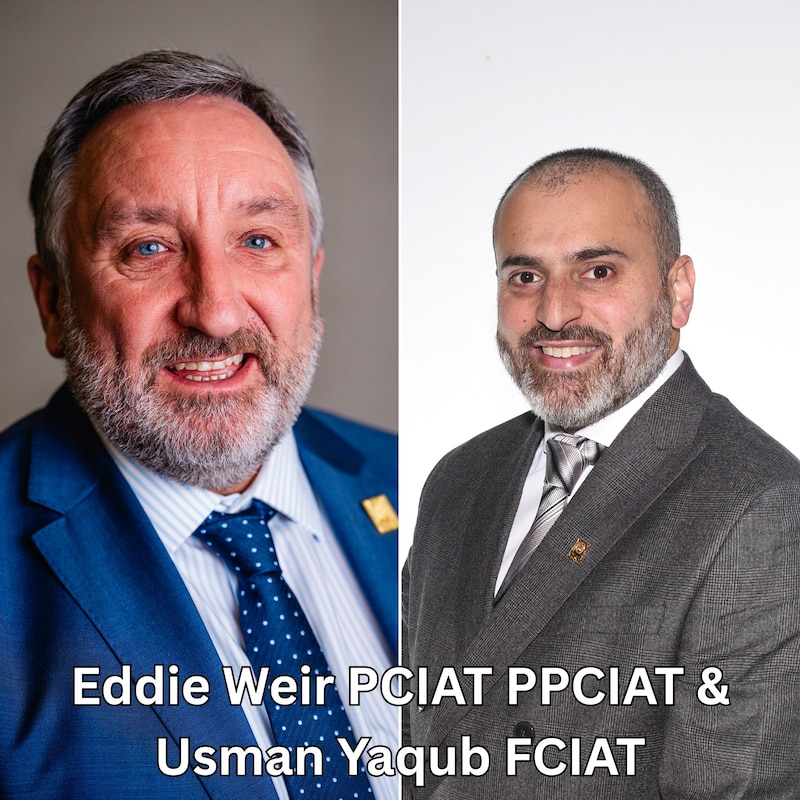
In this special 'CIAT at 60 anniversary' episode of 'Where it's AT,' CIAT President Eddie Weir and President-Elect Usman Yaqub discuss the evolution of the Chartered Institute of Architectural Technologists (CIAT) and the discipline of Architectural Technology. The conversation highlights CIAT's journey from its founding in 1965 to its current status as a leading global voice in Architectural Technology. The co-Hosts share personal reflections on leadership, the importance of continuous improvement, and the Institute's future direction in tackling challenges like climate change, digital transformation, and inclusivity. They also emphasise the significance of supporting and developing the next generation of professionals in the field.
Eddie Weir PCIAT PPCIAT
Eddie Weir is the President of the Chartered Institute of Architectural Technologists and has previously held the posts of Vice-President Practice and Regional Chair for the Northern Ireland Regional Committee.
Externally, Eddie is the Vice-Chair of the Northern Ireland Construction Professionals Council (which is affiliated to the CIC) and is a member of the Management Boards of the prestigious NI Construction Group and the Construction Industry Forum of Northern Ireland, representing the industry at the highest level. He is also the President for the Architects’ Benevolent Society (ABS) where Architectural Technology professionals are supported alongside architects.
Eddie is a frequent guest speaker at professional seminars and workshops regarding Architectural Technology and architecture. He also represents CIAT as an expert witness at Parliament Buildings at Stormont, when required.
In November 2014, Eddie was a recipient of the prestigious CIAT Gold Award for his services to the Northern Ireland Region.
Usman Yaqub FCIAT
Usman Yaqub PCIAT FCIAT has worked in the field of architecture and the built environment since 2007 and is a Fellow Member and recently inaugurated President of the Chartered Institute of Architectural Technologists (CIAT). As the founder and principal of his own architectural practice, Usman has developed extensive experience across projects of all scales — from early feasibility studies and planning, through to detailed design and construction.
With a career grounded in technical design and delivery, Usman is passionate about promoting the value of Architectural Technology (AT) and the essential role Chartered Architectural Technologists and Technologists play in shaping a sustainable, innovative, and inclusive built environment. This passion can also be found in Usman’s academic role as Associate Lecturer at the University of the West of England, where he is able mentor and guide the future talent of AT.
As President of CIAT, Usman is honoured to represent and champion the discipline of Architectural Technology — advocating for its recognition, influence, and future direction within the wider built environment. In this role, Usman is committed to supporting members at every stage of their professional journey, strengthening collaboration across industry and education.
—
Highlights
00:00 Introduction
01:09 Special Episode: CIAT's 60th Anniversary
01:45 Reflections on Leadership and Achievements
02:11 Historical Milestones of CIAT
03:42 Eddie Weir's Leadership Journey
08:22 Usman Yaqub's Vision for the Future
08:57 Challenges and Opportunities in Architectural Technology
22:19 The Importance of Inclusivity and Diversity
24:06 Closing Remarks and Future Outlook
—
Key Takeaways
Leadership means taking responsibility and being honest.
Eddie Weir shared that leading CIAT taught him the importance of carrying responsibility, being clear with people, and always trying to improve. Good leaders are open, build trust, and help others move forward together.
Architectural Technologists are problem solvers who must keep learning.
Eddie and Usman talked about how the profession faces many changes, like climate change and new technology. They said it is important for members to keep learning, share their skills, and be ready to solve new problems.
Supporting the next generation and being inclusive is key for the future.
The interview highlighted the need to help students and new members, making their path easier and more welcoming. They also said that having people from different backgrounds makes the profession stronger and better for everyone.
—
Know someone who could benefit from listening? Subscribe and share this episode with your network.
Know someone with a story to tell or a topic to explore? Email us at [email protected] to nominate a guest or a topic.
Want to learn more about Architectural Technology, how to progress your career, or how to work with a Chartered AT? Head to architecturaltechnology.com to find out more
—
Podcast recorded and edited by: Jon Clayton [Podcasting]
—
Disclaimer
The contents and views expressed by individuals in the Where it's AT podcast are their own, and do not necessarily represent the views of the companies they work for or the Host. This podcast is for informational purposes only and should not be considered as advice.
The episode transcript is AI-generated. Typos or incorrect words may still be present.
Transcripts
Eddie Weir PCIAT PPCIAT: We are both standing on the shoulders of many people
Speaker:who's built CIAT into what it is today.
Speaker:And at the same time, we have the responsibility of helping
Speaker:to ensure that the institute.
Speaker:Does continue to evolve and thrive long end of the future
Speaker:and for the next 60 years.
Speaker:Usman Yaqub FCIAT: I think the role of Architectural Technologist is only
Speaker:going to become even more critical as the industry faces challenges like
Speaker:climate change, digital transformation, and the need for greater inclusivity.
Adam Endacott:Welcome to Where it's AT.
Adam Endacott:The podcast from CIAT shining a spotlight on the future focused design
Adam Endacott:discipline of Architectural Technology.
Adam Endacott:Know someone who could benefit from listening.
Adam Endacott:Subscribe and share this episode with your network.
Adam Endacott:Eddie Weir PCIAT PPCIAT: Hello, my name is Eddie Weir and I'm the
Adam Endacott:president of the Chartered Institute of Architectural Technologists.
Adam Endacott:I'm delighted to be joined today by Usman Yaqub, who is
Adam Endacott:CIAT's current president-elect.
Adam Endacott:And of course, that's our status at the time of recording.
Adam Endacott:Welcome, Usman.
Adam Endacott:It's always a pleasure.
Adam Endacott:Usman Yaqub FCIAT: Thank you for having me.
Adam Endacott:Eddie Weir PCIAT PPCIAT: This is a special episode of where it's at and
Adam Endacott:it marks a major milestone, and that of course is CIAT 60th anniversary.
Adam Endacott:We'll be celebrating this by looking back at our journey so far and looking ahead.
Adam Endacott:Uh, to what the next 60 years might hold for this wonderful institute and the
Adam Endacott:discipline of Architectural Technology.
Adam Endacott:So those who know me will know that I make no secret.
Adam Endacott:The fact that I just love everything about CIAT and this fabulous
Adam Endacott:discipline of Architectural Technology.
Adam Endacott:Many of you'll have heard me saying continually that as an institute
Adam Endacott:we must always be improving.
Adam Endacott:On a reflection, as I come to the end of my second term as president, I can
Adam Endacott:honestly say hand and heart, that CIAT is in the best position that it's ever been.
Adam Endacott:Well, as far as I can remember anyway.
Adam Endacott:And that, of course, is quite simply down to the hardworking efforts of
Adam Endacott:our wonderful central office staff and are dedicated members who continually
Adam Endacott:volunteer their time selflessly to promote and support everything that we do.
Adam Endacott:When you think back, CIAT has come a long way since its very humble beginnings
Adam Endacott:as A-S-A-A-T to become the leading global voice for the discipline and
Adam Endacott:profession of architectural technology.
Adam Endacott:It's pretty incredible to think that 43 people gathered on the 12th
Adam Endacott:of February, 1965, the four of the foundations of what we know today as CIAT.
Adam Endacott:If we fast forward to 2025 with between nine and 10,000 members and affiliates,
Adam Endacott:CIAT is in an incredible inclusive institute that leads and promotes
Adam Endacott:architectural technology and sets them, maintains the standards for education
Adam Endacott:and practice all throughout the world.
Adam Endacott:If I was to pick out other standout moments in the past 60 years, we would
Adam Endacott:have to mention, you know, that granting of our royal charter in our 40th year, uh,
Adam Endacott:and the formation of the protected title of Chartered Architectural Technologists.
Adam Endacott:And my goodness, let's not forget our first AGM, which was held outside
Adam Endacott:of Europe, and that was in Hong Kong, which I think was 2007, 2008.
Adam Endacott:Trip was absolutely amazing.
Adam Endacott:And of course we've hosted AGM weekends regionally, all over the
Adam Endacott:UK and all our other centers and most recently, uh, in Denmark.
Adam Endacott:And of course, for those who'd like to know a wee bit more about our
Adam Endacott:detailed history, we have a special part of our website all dedicated this.
Adam Endacott:Please take your time.
Adam Endacott:Have we look?
Adam Endacott:Usman Yaqub FCIAT: You've raised some really interesting points, Eddie.
Adam Endacott:One particular area, obviously you now are a two term president.
Adam Endacott:And it'd be really interesting to hear about what excites you about
Adam Endacott:the institute, but particularly what you've learned about leadership that
Adam Endacott:you'll carry with you beyond your term.
Adam Endacott:And I think the membership, uh, old and new would be really
Adam Endacott:interested to hear more about that.
Adam Endacott:Eddie Weir PCIAT PPCIAT: My goodness.
Adam Endacott:Well, suppose without a doubt being, um, the president of
Adam Endacott:CIAT on both occasions is.
Adam Endacott:Definitely shaped my understanding of leadership and in, uh, ways that the
Adam Endacott:most certainly always stay with me long after, uh, this second term ends.
Adam Endacott:I suppose it fits really well with one of my own personal standout moments
Adam Endacott:and that would be taken to the stage in the 2018 President's Ball in
Adam Endacott:Glasgow, just after becoming president earlier that day at our AGM event.
Adam Endacott:Obviously the run up to that election process that was focused on my
Adam Endacott:manifesto focus points, and they were inspire, promote, and support.
Adam Endacott:I'd said it that many times as you'll know throughout their whole manifesto campaign,
Adam Endacott:and I was pretty confident in how I was gonna be able to deliver on these.
Adam Endacott:Then Cummins, the announcement as I sat at the dinner table.
Adam Endacott:Please welcome to the stage the president of the Chartered Institute of.
Adam Endacott:Architectural Technologist, Mr. Eddie Weir and without a nerve in my body.
Adam Endacott:I took to the lecturn and looked over at the hundreds of members,
Adam Endacott:guests standing, clapping in chair near, had a heart attack.
Adam Endacott:Um, honestly, for me standing there, it seemed to go on for ages.
Adam Endacott:It was like I was watching it in slow motion.
Adam Endacott:I mean saying thank you, you're very kind a couple of times nodding, you know,
Adam Endacott:sort of waiting for the noise to sort of die down and still the cheering kept on.
Adam Endacott:If you look back at the fellow footage, you'll see me say, wow,
Adam Endacott:it was truly incredible and I never experienced anything legged in my life.
Adam Endacott:At that moment, I felt a huge weight of responsibility.
Adam Endacott:'cause all of these people and all of our members had put their faith
Adam Endacott:in me to represent them and our institute to the best of my abilities.
Adam Endacott:And for that sort of reason, it's why it's so important for me to continually
Adam Endacott:put a big shift in, you know, everybody will say, oh geez, Eddie's so busy.
Adam Endacott:He's running length of breath of the country.
Adam Endacott:That's the reason for me why that's so.
Adam Endacott:So considering that one of the most significant lessons has been recognizing
Adam Endacott:that weight responsibility, that comes with leading an institute.
Adam Endacott:And it's not about guiding day-to-day operations.
Adam Endacott:It's about overseeing the organization's reputation, safeguarding its
Adam Endacott:values, making sure that that the decisions that are set are
Adam Endacott:set on the tone for the future.
Adam Endacott:Leadership requires constantly boss and what is right for individuals and what
Adam Endacott:is right for the institute as a whole.
Adam Endacott:And understanding that every action carries an impact beyond that moment.
Adam Endacott:I've also learned that it's so important to manage people's expectations clearly
Adam Endacott:and consistently, people naturally look to leadership for direction,
Adam Endacott:for reassurance and for answers.
Adam Endacott:For me, it's important to be transparent and when the message that you need
Adam Endacott:to deliver sometimes isn't difficult.
Adam Endacott:You gotta make sure that you build trust and that everybody's engaged and comes
Adam Endacott:along that journey with you at times X.
Adam Endacott:Expectations can exceed what's possible, but I've discovered that being honest,
Adam Endacott:being a good communicator, and most importantly being grounded helps
Adam Endacott:people feel respected and informed.
Adam Endacott:Perhaps the lesson, the most value is the importance of.
Adam Endacott:Continuous improvement.
Adam Endacott:As an institute, we cannot stand still.
Adam Endacott:You know, you'll have said it earlier and I'll be saying it
Adam Endacott:many, many times in the future.
Adam Endacott:We, what they are members, uh, our discipline, uh, and our future.
Adam Endacott:To always look for ways to, to refine what we do, question how we operate,
Adam Endacott:and always strive to be better.
Adam Endacott:You know, leadership means fostering a culture where progress is not
Adam Endacott:just encouraged, it's expected.
Adam Endacott:Where every challenge becomes an opportunity to learn and every success
Adam Endacott:becomes a foundation to build upon these lessons of responsibility.
Adam Endacott:Clarity of expectations and commitment of ongoing improvement will shape
Adam Endacott:how I lead, uh, in all of my roles that I would take on from here.
Adam Endacott:So Oman, at no time at all, you're gonna be CIAT's next president,
Adam Endacott:and of course I'll be there alongside you for the next year.
Adam Endacott:Paying on your side help you to whatever you need.
Adam Endacott:Tell me what excites you most about leading CIAT on the next part of its
Adam Endacott:journey and give us a wee taste of some of the issues that are close to your heart.
Adam Endacott:Usman Yaqub FCIAT: Most definitely.
Adam Endacott:Obviously the, the immediate one is obviously I'm gonna have
Adam Endacott:a whole year with Mr. Weir, so that's, that's absolutely amazing.
Adam Endacott:Eddie Weir PCIAT PPCIAT: God love you.
Adam Endacott:Usman Yaqub FCIAT: But honestly I, what really excites me, uh, as we move into
Adam Endacott:this new era of architectural technology, I do really feel like the, the amount
Adam Endacott:of development that's happening at the moment is absolutely, uh, mind blowing.
Adam Endacott:We've got.
Adam Endacott:Challenges in a range of sectors where we are looking at housing
Adam Endacott:shortages, retrofit, climate change, safety regulation, um, new composite
Adam Endacott:materials, materials that were once allowed or no longer allowed.
Adam Endacott:We've got ai, which is hugely affecting a whole range of areas.
Adam Endacott:however, the real key and important element is that all of these areas where
Adam Endacott:chartered architectural technologists do and will thrive, we are problem solvers.
Adam Endacott:And as someone once said is where the Swiss army knife, so we innovators
Adam Endacott:and this is our moment to lead.
Adam Endacott:This is our moment to move forward.
Adam Endacott:Take.
Adam Endacott:Note, sit at the table, be present in the rooms that you are, you were
Adam Endacott:uncomfortable with, but now you realize that you are most welcome, you are needed.
Adam Endacott:This, this is the time for all of our peers to take a step
Adam Endacott:forward and actually get involved.
Adam Endacott:There's, going back to my manifesto, there was three key areas that I was looking at,
Adam Endacott:making sure that I could have an effect.
Adam Endacott:I hope to have an effect in all of those areas and many more with the support
Adam Endacott:of, um, obviously past presidents, um, the central office, and also the
Adam Endacott:hundreds of people who give their valuable time year in, year out to
Adam Endacott:help not only the institute, but also the industry and society as a whole.
Adam Endacott:First, there's developing our members through a stronger CPD framework.
Adam Endacott:CPD in 43 is my brainchild, and it's shown that people have a hunger to
Adam Endacott:improve their professional development.
Adam Endacott:They want high quality learning, and I want to build on that and in and
Adam Endacott:introduce things that would be most relevant for the membership and also
Adam Endacott:ultimately benefit, uh, everyone as a whole in the longer term.
Adam Endacott:Secondly is showcasing our value.
Adam Endacott:We have so much expertise in the profession, but we need to shout
Adam Endacott:about it louder and prouder.
Adam Endacott:That means elevating campaigns like the Wheres It Act campaign, the
Adam Endacott:podcasts that we're doing right now, and a whole range of other services
Adam Endacott:that we can offer, and that will.
Adam Endacott:Make us more present and make us, um, better heard and better understood.
Adam Endacott:Strengthening our identity and giving both individuals and practices better
Adam Endacott:support, especially around areas of the business of architecture.
Adam Endacott:Many other facets would be hugely valuable to the membership, society
Adam Endacott:as a whole, then the general public.
Adam Endacott:And third and very importantly, retaining and supporting the next generation.
Adam Endacott:There's hundreds of at students that graduate every year, and we need
Adam Endacott:to make their journey to chartered status clearer, more engaging and
Adam Endacott:better supported strengthening that pipeline and launching the Future
Adam Endacott:Leaders Initiative, which Eddie was.
Adam Endacott:Uh, pushing forward for many years, and hopefully we can bring that into
Adam Endacott:formality with the support of aspirations.
Adam Endacott:As long as they're happy with the content and the structure of that
Adam Endacott:is a huge opportunity for the institute, and we really need to
Adam Endacott:make sure that we are creating that continuity in that pipeline of.
Adam Endacott:Highly skilled students that have come young, really hungry,
Adam Endacott:wanting to get involved and actually have a positive change.
Adam Endacott:Ultimately, what excites me the most is championing this profession.
Adam Endacott:Of incredibly talented and incredibly important people who
Adam Endacott:can take on any role when given.
Adam Endacott:And this is the right time for architectural technology to be a louder
Adam Endacott:voice, a stronger voice, and have, um, as big as impact as we possibly can
Adam Endacott:to make improvement for our current generations and our future generations.
Adam Endacott:Eddie Weir PCIAT PPCIAT: The, uh, the, I love the wee bit there about the
Adam Endacott:Swiss Army Knives of architecture.
Adam Endacott:I gonna have to put my hand up.
Adam Endacott:That was me.
Adam Endacott:That's one of my, that's one of my teasers.
Adam Endacott:And it's for every, I remember, I remember, uh, being at a, a seminar
Adam Endacott:and someone says, oh, uh, Chartered Architectural Technologist, are the
Adam Endacott:Swiss Army knives of Architecture.
Adam Endacott:And then they said, I'm not too sure who, who conned that phrase.
Adam Endacott:And I'm sitting with a big grin in the background.
Adam Endacott:Oh, that would be me.
Adam Endacott:Know someone with a story to tell or a topic to
Adam Endacott:explore email [email protected] to nominate a guest or a topic.
Adam Endacott:Usman Yaqub FCIAT: Classic.
Adam Endacott:Often, I often, to be honest, I often talk about the Rubik's Cube and I, and
Adam Endacott:I say that what, what an AT does is we can solve a Rubik's cube whilst having a
Adam Endacott:conversation, because often we'll be given a problem and the co problem constantly
Adam Endacott:changes and we'll have the Rubik's cube in our hand and we're slowly solving
Adam Endacott:it whilst also speaking to someone.
Adam Endacott:Um.
Adam Endacott:People often, especially probably someone who's quite qualified,
Adam Endacott:understands exactly what I mean.
Adam Endacott:But whenever I say it to students, students go, oh my
Adam Endacott:God, is that what I have to do?
Adam Endacott:And I always, I always say to 'em, look, it comes with
Adam Endacott:time, you'll be perfectly fine.
Adam Endacott:But it's just, I'm just trying to give a bit of an idea of
Adam Endacott:how it could potentially work.
Adam Endacott:Eddie Weir PCIAT PPCIAT: Our we brains are wired completely different to everybody
Adam Endacott:else, but we, we have this wonderful ability to have a, an imagination of
Adam Endacott:what our finished projects looks like in our head, uh, and try to get that image
Adam Endacott:of what that is over to your client.
Adam Endacott:And that's what we have all this wonderful, modern technology to do.
Adam Endacott:So.
Adam Endacott:Usman Yaqub FCIAT: Exactly, but o on on that, all of this points, these points
Adam Endacott:that we're making, there's an element of reflection that we could do as, so.
Adam Endacott:I would really like to hear about what it means to you to have represented CIAT at
Adam Endacott:such a milestone moment, but not only such a milestone moment for how coming to the
Adam Endacott:end of a second term of being president, um, being a, a lead in an architectural
Adam Endacott:practice in Northern Ireland, offering services, um, all over the country, um,
Adam Endacott:engaging with, uh, lots of different people from different walks of life.
Adam Endacott:Uh, it'd be amazing to sort of hear more about that.
Adam Endacott:Eddie Weir PCIAT PPCIAT: Yeah, getting a, getting, uh, putting,
Adam Endacott:uh, uh, your manifesto ahead and getting elected once is incredible.
Adam Endacott:Uh, to do it twice.
Adam Endacott:It's something else.
Adam Endacott:I, I dunno what used word letting yourselves in for, but, uh, here we're,
Adam Endacott:we're near to the end of it, but, so I'm always, I'm always joking about it.
Adam Endacott:It's, uh, uh.
Adam Endacott:Put the faith in, in our electoral colleagues and our processes.
Adam Endacott:Uh, so yeah, for that, and only thank you for, for, for letting me represent
Adam Endacott:you and, and represent CIAT Of course.
Adam Endacott:It is a special thing, especially during the, the 60th anniversary
Adam Endacott:year, and probably it's been one of the greatest honors of my life.
Adam Endacott:Uh, I've honestly been overwhelmed.
Adam Endacott:You know, I, I, I couldn't say it enough about the amount of personal support
Adam Endacott:that I've received, and of course, a lot of that's from all our members, but.
Adam Endacott:From the way their industry circles as well.
Adam Endacott:You know, you'll have seen me, uh, networking and chatting to, you
Adam Endacott:know, hundreds and thousands of people at all these events, and I
Adam Endacott:feel as if I nearly know everyone.
Adam Endacott:But milestones like this don't come around though often, you know?
Adam Endacott:Uh, and being part of such a significant moment in the institute's history made
Adam Endacott:me feel both humbled and deeply proud.
Adam Endacott:Usman, we.
Adam Endacott:We are both standing on the shoulders of many people who's
Adam Endacott:built CIAT into what it is today.
Adam Endacott:Leaders, volunteers, members, associates whose dedication over the
Adam Endacott:last 60 years has shaped our very identity, our impact on our brand.
Adam Endacott:And at the same time, we have the responsibility of helping
Adam Endacott:to ensure that the institute.
Adam Endacott:Does continue to evolve and thrive long end of the future
Adam Endacott:and for the next 60 years.
Adam Endacott:And one of the elements of this role that has mattered most to me is just
Adam Endacott:what you mentioned there, champion succession planning, uh, and supporting
Adam Endacott:the future leaders within CAET.
Adam Endacott:Celebrating those 60 years reminded me that our longevity only matters
Adam Endacott:if we invest in the next generation.
Adam Endacott:You know, those who'll take the institute further than we can ever dream of.
Adam Endacott:You know, I see these young people in aspiration groups at
Adam Endacott:all our events, and we think that we are really good at network.
Adam Endacott:No, these guys are amazing at a, that's a different level.
Adam Endacott:Uh, and I know when, when they're standing in the positions that we
Adam Endacott:are, uh, they're gonna be absolutely incredible at what they do.
Adam Endacott:And being able to com contribute to that sort of pipeline, uh, of emerging talent
Adam Endacott:has been, for me, incredibly rewarding.
Adam Endacott:And it's something that'll remain.
Adam Endacott:And I'll remain passionate for forever.
Adam Endacott:And for one last reflection, I would say that to represent CIAT
Adam Endacott:at such an important moment in this journey is something yeah,
Adam Endacott:that I'll always carry with me.
Adam Endacott:And it's reinforced how meaningful our work is.
Adam Endacott:How strong.
Adam Endacott:Amazing and incredible our AT Community can be and how vital it is to continue
Adam Endacott:improving our institute as presidents.
Adam Endacott:We are just a small part of CIAT's leadership history and hope you
Adam Endacott:feel that I have served you well.
Adam Endacott:So Usman, before you take us out, tell us how you see the role of the discipline
Adam Endacott:evolving in response to the emerging challenges like climate resilience,
Adam Endacott:digital transformation, and inclusivity.
Adam Endacott:Usman Yaqub FCIAT: Definitely.
Adam Endacott:Um, but whilst, whilst you was raising those points, it really came to mind.
Adam Endacott:Some really interesting points because, for example, let's look at myself.
Adam Endacott:I can give you the, the, the way I've grown with this institute.
Adam Endacott:So I came from a student on an accredited degree, then I volunteered helping some
Adam Endacott:bits and bobs, then regional chair, fellow, and then winning the gold award.
Adam Endacott:And these were really pivotal for me.
Adam Endacott:Considering deeper engagement with the institution, almost, uh, relatively
Adam Endacott:serendipity to a certain degree of me sort of really getting involved and being
Adam Endacott:basically awarded for this involvement.
Adam Endacott:So honestly, for everyone who is thinking about it or has done this,
Adam Endacott:it's really key for you to get involved.
Adam Endacott:In the institute and really help us affect change.
Adam Endacott:We have a huge amount of consultations, uh, groups, societies, um, and so on.
Adam Endacott:Obviously, Eddie's, um, jump in if there's any bits that I missed, but ultimately
Adam Endacott:there's a. The technical expertise that we have and the way in which we can engage.
Adam Endacott:There's often the need for us to feed back to government, um, to
Adam Endacott:legislation, to British standards.
Adam Endacott:These can have an effect not only regionally, nationally,
Adam Endacott:but also internationally.
Adam Endacott:And these are really, really important don't ever think that you
Adam Endacott:don't have a reason to be involved.
Adam Endacott:Your thoughts are valid.
Adam Endacott:We want you to be involved.
Adam Endacott:We need you to be involved, and you are the future of architectural technology
Adam Endacott:regarding the, the points on evolution of the profession.
Adam Endacott:It sort of echoes parts of the conversation that we've already raised.
Adam Endacott:I think the role of architectural technologist is only going to become
Adam Endacott:even more critical as the industry faces challenges like climate
Adam Endacott:change, digital transformation, and the need for greater inclusivity.
Adam Endacott:these are very specific problems and these are only a few that we're touching
Adam Endacott:on, but these are social ones and also these are ones where we thankfully
Adam Endacott:have a skill set that really shines.
Adam Endacott:So it's not just these three, it's just that we have the time to sort of run
Adam Endacott:over these three on climate resilience.
Adam Endacott:We have an area where at already lead.
Adam Endacott:On building performance, building physics, materials, regulations, and
Adam Endacott:whole life thinking, the whole circle of life in regards to reuse and so on.
Adam Endacott:With issues like flooding, overheating, rack and biodiversity, net gain,
Adam Endacott:becoming everyday challenges.
Adam Endacott:Our ability to bridge design and building physics makes us an essential partner
Adam Endacott:to create safe future proof buildings.
Adam Endacott:And then we have digital transformation.
Adam Endacott:This is another huge opportunity where whether it's ai.
Adam Endacott:Building information, modeling automation, data driven design, and so on.
Adam Endacott:Again, there's only so much we can run over because these are, each and
Adam Endacott:every one of these are quite complex environments to discuss, and architectural
Adam Endacott:technologists are naturally positioned to turn these tools into real world, world
Adam Endacott:solutions and unlock hidden potential.
Adam Endacott:We understand how technology integrates with construction, and
Adam Endacott:that makes us key to driving in innovation rather than reacting to it.
Adam Endacott:And then when it comes to inclusivity, both.
Adam Endacott:Who we design for and who enters a profession.
Adam Endacott:I see eighties playing a major leadership role.
Adam Endacott:We're a profession rooted in problem solving, practicality and collaboration
Adam Endacott:that gives us the ability to champion inclusive design, but also a, attract
Adam Endacott:a more diverse generation of students and future leaders, especially
Adam Endacott:if we strengthen that journey from student to chartered status.
Adam Endacott:This then would be fully representative of all the, the ratio of.
Adam Endacott:Male to female, the various backgrounds of people from different working
Adam Endacott:classes, different and so on.
Adam Endacott:There's all these different areas where it would enrich the environment
Adam Endacott:further, and even abilities and disabilities, et cetera.
Adam Endacott:All of these different facets are so integral to be part of
Adam Endacott:this, this space, because it will help and enrich this space.
Adam Endacott:So for me, the evolution is clear.
Adam Endacott:Architectural technologists will be the technical anchors of a
Adam Endacott:rapidly changing built environment.
Adam Endacott:Our expertise in performance technology and people focused design puts us right
Adam Endacott:at the heart of industry's biggest challenges and its biggest opportunities.
Adam Endacott:I hope both what me and Eddie have raised during this.
Adam Endacott:Very short podcast goes into some way of highlighting the huge opportunities we
Adam Endacott:have and the reflection that we could do on the past because the past helps inform
Adam Endacott:the present and the future, and we have all of this potential with all of the
Adam Endacott:burgeoning technological developments that are coming and how we adapt and how we
Adam Endacott:could potentially change to take advantage of those in the best way possible.
Adam Endacott:This brings an end to this very special 60th anniversary episode of Where's it at?
Adam Endacott:A heartfelt thank you to Eddie Weir, immediate press president,
Adam Endacott:not yet, but almost for sharing his reflections and insights as we
Adam Endacott:celebrates six decades of progress.
Adam Endacott:Innovation and professional excellence.
Adam Endacott:We are also looking forward to a future shaped by collaboration,
Adam Endacott:creativity, and growth.
Adam Endacott:Thank you ever so much for listening, and please do tune in for future episodes.
Adam Endacott:Are
Adam Endacott:Eddie Weir PCIAT PPCIAT: Thank you very much.
Adam Endacott:Thank you.
Adam Endacott:You've been listening to where it's at.
Adam Endacott:A huge thanks to our guests and to you for listening.
Adam Endacott:Want to learn more about architectural technology, how to progress your
Adam Endacott:career, or how to work with a Chartered Architectural Technologist?
Adam Endacott:Head to architectural technology.com to find out more.
Adam Endacott:The contents and views expressed by individuals in the where it's at
Adam Endacott:podcasts are their own and do not necessarily represent the views of the
Adam Endacott:companies they work for or the host.
Adam Endacott:This podcast is for informational purposes only and should
Adam Endacott:not be considered as advice.




