Shownotes
In today’s fast-moving digital world, parents face an urgent challenge: how to raise children who can think critically, question information, and navigate the growing influence of AI and social media.
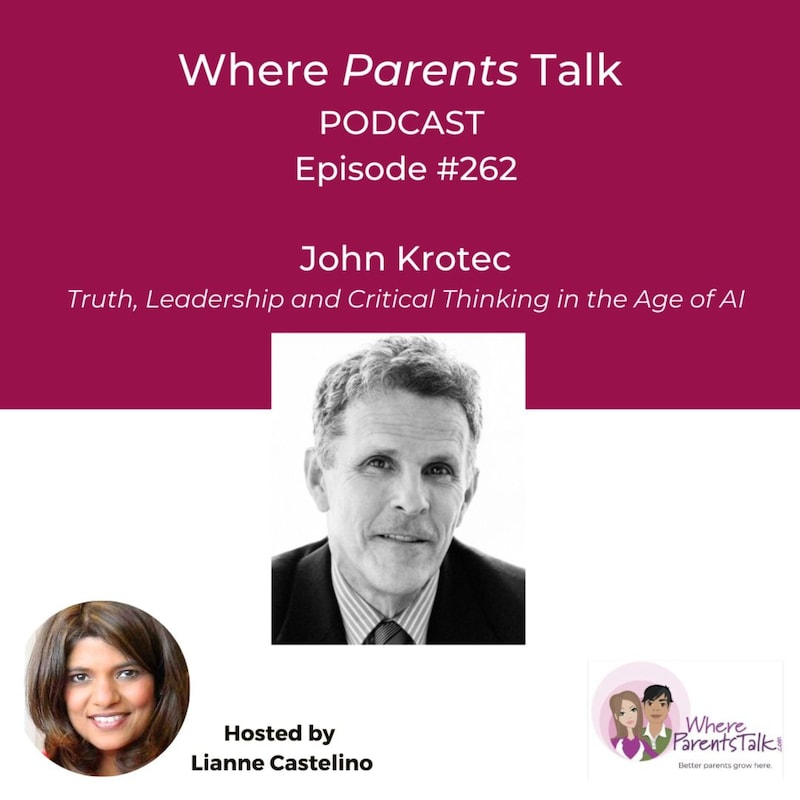
In this episode of the Where Parents Talk podcast, host Lianne Castelino speaks with John Krotec—educator, entrepreneur, U.S. Army veteran, and founder of Neo Masculinity Solutions—about why teaching kids how to think is more important than ever.
Drawing from personal experience, leadership training, and his work developing AI-integrated learning tools, Krotec shares actionable insights for parents, including:
- Why today’s information overload makes critical thinking a must-have life skill
- How to help kids distinguish fact from misinformation, disinformation, and AI-generated content
- The role of curiosity, courage, and questioning in raising independent thinkers
- Practical ways parents can guide children to use AI as a tool—not a shortcut
- Early warning signs your child may be passively consuming information
- Three simple habits parents can adopt to raise resilient, thoughtful kids
This conversation offers into why parenting in the digital age isn’t just about protection—it’s about preparation.
Links referenced in this episode:
Companies mentioned in this episode:
- Neo Masculinity Solutions
This podcast is for parents, guardians, teachers and caregivers to learn proven strategies and trusted tips on raising kids, teens and young adults based on science, evidenced and lived experience.
You’ll learn the latest on topics like managing bullying, consent, fostering healthy relationships, and the interconnectedness of mental, emotional and physical health.
Links referenced in this episode:
Transcripts
Welcome to the Where Parents Talk podcast. We help grow better parents through science, evidence and the lived experience of other parents.
Learn how to better navigate the mental and physical health of your tween teen or young adult through proven expert advice. Here's your host, Lianne Castelino.
Speaker B:Welcome to Where Parents Talk. My name is LIanne Castelino. Our guest today is an educator and an entrepreneur. John KroteC is also a US army veteran and an author.
He's the founder of Neo Masculinity Solutions, which seeks to redefine modern leadership and critical thinking around the world. He's also created the Sentinel Handbook, focused on developing an AI integrated curriculum to support learners in assessing information.
John is also a father of two, and he joins us today from Newmarket, Virginia. Thanks so much for taking the time well, Leanne.
Speaker A:You make me feel so special right off the bat.
I can tell this is going to be a great conversation, so thank you for that and thank you to your listeners who are here today sharing their precious time with us.
Speaker B:I'm looking forward to this conversation for a number of reasons, because of the perspective you bring on this topic when, when we're talking about leadership and critical thinking skills.
But I do want to start by asking you what concerns you the most as you look out at today's current landscape where it concerns information dissemination and truth.
Speaker A:Wow, Great question right off the bat. Thanks, Leanne, for that. You know, our children are being bombarded and us as adults, you know, 24, 7, 365 days a year by information.
And most of that information, as much as we'd like to think that it isn't, is unreliable. So as parents with children, we have, you know, our children need to be able to discern fact from fiction, truth from lies, reality from fantasy.
If they can't do that, then we have failed as parents. But even more so, they're going to find it very difficult to find any amount of success in the world.
So I'd say my greatest fear is that we as parents leave our, our children to the wolves, unable to, you know, decode information that's not real or not truthful.
Speaker B:It is such a large challenge, right, because the average adult is struggling to discern and distill what truth really is. So how do we go about teaching that to our children?
Speaker A:A number of different ways.
We have to be committed, probably, you know, parenting is both a skill, as you know, but it's also a commission if our heads aren't in the game, so to speak. Critical thinking. Right.
If we're Intuitively not committed to making sure that we can be part of raising the most incredible people on the planet, boys and girls, then. Then we're going to have a tough challenge. And I like the fact that you mentioned that parents or that adults are having that challenge as well.
What we're seeing with the research that we've done is that just like anything else, people are intellectually lazy. And we're not trying to label anybody. We're just trying to say that they're not using the skill sets that they've been given.
Human intuition, These great critical think, they're just not using them. They're allowing social media and mass news outlets create their own, create their reality.
Instead of us as leaders of our own lives, we need to be the ones with our own hearts and our own minds. We need to be the ones creating our own reality. And unfortunately, too many people, they're not committed to doing that.
So if we have people that aren't asking questions or tuning into their own intuition, how is that going to trickle down to their children? It's a huge disservice.
Speaker B:It's a huge question. And I want to backtrack a little bit because your background is so interesting.
Your path has taken you, as we mentioned, from US army veteran to educator to entrepreneur. Curious as to what experience in all of that convinced you that teaching people how to think matters more than teaching people what to think?
Speaker A:Great question. You know, I was the recipient of a trauma very early in my life between the summer of my third and my fourth grade grades.
And it happened on a neighborhood sleepover. And we won't go into detail, but. But it was, it was an event, maybe lasted 90 seconds that forever changed the course of my life.
And what I realized was that I didn't want to be. I didn't want to spread any more pain. You know, this ancestral trauma that happened to me charted a different path for me at a young age.
And so what I realized was we have to. We have to really think about the things that we're doing. And it sounds so cliche or it sounds so trite too, but.
But unless we can do that, unless we can actually take a deep breath, use our intuition, we have a thing called the, the human intuition sniff test. When we hear something that doesn't sound right, you know, there's a, there's a plot for that or the, the anger litmus test.
If we're angry within 45 seconds of being told something, then we have to think about a different path. But the proverbial word Here with all of that is thinking. We just.
With all these great bells and whistles that we have these days in the digital world. See, Leanne, we're using this. But with all these great tools, people have misappropriated them in a way that they're not.
They're not taking the time to actually get anything. Due diligence.
And I'm saying that rhetorically because there are a lot of people out there and a lot of great parents who are making sure their children get schooled. But. There's a but. You're right. We have a lot of work to do.
I don't know if that answered your question, but that was where I first started to think about there's more to life going on than just the things that were being told. In fact, some children and young adults, boys or girls, need not go through those things.
And so I want to spread something of value instead of something of pain.
Speaker B:You talk about confronting a past trauma. You also survived a traumatic brain injury.
And I'm curious as to how those two, you know, ish experiences that you had individually and then collectively helped reshape your understanding of resilience and learning.
Speaker A:Great question. Thanks for asking. I. Immediately after that event that happened to me, I went inside. I. I started to do creative writing.
I started writing poetry, short stories to deal with the pain. But I. I kept it all inside. I never dealt with it. How does the third grader deal with something like that? I had no outlet to go to, thank God.
Every day I had mentors, both men and women, that saw something to me along the way. So every time I got too far out there, there was always somebody to yank my chain and pull me back. So I'd go.
I went along for 45, 50 years, overachieving, trying to find success in everything that I did, be the best I could. Be kind of like that commercial, right Army. But I. I never really dealt with that emotional trauma.
And then in:I was not friendly to my. To my better half, my wife. And within short order, I found myself in the middle of a divorce. Like, holy cow. And I was not. It was more of a mental.
Mental abuse, you know, verbal abuse towards my wife. And it was. I couldn't figure it out. So what I needed to do, I knew that I couldn't Live my life this way. So I, I sought hell.
All the memories of that, that thing started to come up and I, I sought help, you know, I got down on my knees and I cried many a time out by my prayer circle, my house in Florida. And I got, I met a woman in the cognitive behavioral therapy space and I started the long journey of getting myself right. It was tough.
And I was told early on, you need to let your wife go, you just need to let her go. Stay out of that. And the universe, as it always does, intervened and my mother in law got hurt. So my wife and I separated anyways.
She was in Virginia taking care of her mom and I was taking care of myself in Florida.
And it is perhaps the toughest thing that I ever had to do in my entire life was to say goodbye to my wife pretty much and go about trying to, trying to figure out why I need it, how to deal with that event. And it was, it was cognitive behavioral therapy.
I had a lot of cognitive errors and I guess it was about three months into that seven month program that Cheryl, my therapist, was like, you sitting across from me and, and smiling. And I thought I had done something wrong. And I said, cheryl, is everything okay?
She says, listen, you make me happy because I've been at this a while, John. She said, and it, it, I sparkle inside when I see people actually doing the work. You're actually doing the work.
And anytime you have a hard challenge in your life emotionally and you want to get right, you want to get well, you want to heal, you're going to have to do it on your own. There's no Calvary coming. So it was a few months after that that I got a letter a couple days before Thanksgiving.
It was actually a card from my wife and basically read something like this. I was alone in my house when I got it. She was still in Virginia.
Basically said, I want you to know that I called my attorney today and I'm calling off the divorce. I've seen a change in you and I want to stay married to you and Leanne, I gotta tell you, I, I was alone.
I fell to my knees and I cried like a baby because for the first time in my life, I dealt with personal issues on my own. I had to do the work, but I felt like I had all the things I had done.
I felt like I had truly earned something, which was a marriage to a woman that really cared about me. And I didn't know about a lot of those feelings because I was dealing with my own stuff.
So that that was what really turned me around, was nobody's coming to help you. Whatever you're dealing with, you can get through it. And as a parent, even more so. It's even.
It's even more important that we deal with those things so that we can influence our children in a positive way. And it's an ongoing battle, you know, so don't think that once you, quote, unquote, get well, that the party's over and it's just chill time.
Because every day when you're dealing with emotional things, you have to get up, you have to face. Face them still. So it takes work. And I never understood any of that until that moment in my life.
Here I am, you know, now trying to go global and help as many people as I can, primarily parents and children, with programs and processes that actually work. I don't know if that's the answer you wanted, but that's kind of how I got to where I'm at.
And we can get into neomasculinity, obviously, and how that came about, but we have to be real. And one thing about you already land the conversation we had before we came on your show.
As I thought to myself, this woman is authentic, and everybody wants to be authentic, but that sometimes needs some help to get there, and it just comes from within, and you have to want to do it. Thank you.
Speaker B:Thank you for your kind words, John, and especially thank you for sharing something so intensely personal with me and with our audience. It really does help understand the lens that you're seeing this through.
So when we talk about that lived experience that you had coming through it, doing the work as you talked about, how did that then translate into neo masculine solutions and. And sort of tell us a bit about that and what the goal is.
Speaker A:Okay, great. And thank you too, as well. Well, you know, I guess it was five or six years ago, we kept hearing the word toxic being associated with masculinity.
And my buddies and I, my business partner and I, we were wondering, you know, why we've never seen this before. You know, masculinity and toxic and toxic and masculinity.
And so we started to do some research into what masculinity is and why that narrative is out there. Right. What we found out is traditionally, which was a vintage gender role, that men traditionally are the protectors of the family goes way back.
Doesn't mean that a woman is not a protector, because sometimes a single mom and even a married mom can be a protector.
She can take on a masculine role when she needs and same Thing with the feminine role, you know, a compassionate role and a nurturing role, men can do that too.
So what we found out was, is that if you make a man feel less than, if you take away a man's purpose, if you, if you, if you, if you initiate a man to question his own masculinity, then you take him off of his purpose. And a man without a purpose is a toxic man. There's no doubt. So when we, when we saw the name neomasculinity, we were like, well, what is that?
What is this all about?
And so we did some investigation on a very popular search engine, and we found out that the proverb, that the, the current definition of neomasculinity is that a man cannot embrace his masculinity unless he accepts changing social norms.
We won't get into the issues on the changing social norms, but so what he wondered was if the changing social norm is not based on truth or facts or is fabricated for some ideological narrative. So you're telling a man he has to lie to be masculine. So we were like, no, no, no, no, let's take neomasculinity.
Instead of doing a dot com or a dot co or dot whatever, we went with dot Solutions. And so we've kind of been operating under the radar.
And what we, what we've done@neomasculinity.solutions is we've created tools that both men and women can use to educate themselves on intuition, critical thinking, logic and reason and common sense. But they can also impart that knowledge to their own children or to their sphere of influence. So that's what we do.
We're building tools to help educate global populations against unreliable information, which, by the way, is dividing families, it's disrupting societies, in some cases even destroying cultures, and it's disempowering both men and women.
So this unreliable information, we need to be alert and we need to be able to spot the five forms of unreliable information in order to protect ourselves and our families and the people we love. You mentioned the Sentinel Handbook.
No disrespect to anybody, we wrote that for eighth graders because on average, that's the, the grade level that most people globally read, read with. And, and so we've got it in nine languages. And the Sentinel Handbook, it's $10, it's a PDF, and it basically is a primer.
It lays out the challenge of the information in digital age.
And then it gives processes and programs and strategies to combat all of that unreliable information, which quite honestly, is creating a humanity that's just hanging on for survival. And no way will it thrive if we can't think for ourselves. There's no way.
Speaker B:I want to unpack a bunch of different things that you've just outlined there. Going back to neo masculinity solutions, and you talk about the tools that are outlined. You also talk about intellectual courage.
Curious as to what are the tools that you talk about that you think kids need to have before leaving high school? And how do those tools and then those behaviors that hopefully those tools lead those kids to end up supporting intellectual courage?
Speaker A:Great question. You know, well, we have, we, we live in these emotional states, all of us. Men, women, boys, girls, young adults, older adults. We have these.
And we have these emotional states, right? And it's a vibrational state, all of them. There's anger and there's hatred and there's mistrust and distrust.
And those kinds of things are like lower emotional states. And then you have the higher states. Critical thinking, love, collaboration, etiquette. That's another whole subject is etiquette. Where is that gone?
Higher consciousness states. But right in the middle, there's a yes. What children need. Children need to have the courage. That's always the step off emotion.
To get into those higher states of existence emotionally is courage. Moms and dads need to work on making their children brave. Ask questions.
If they ask a question that you consider is not a great question, answer it anyways. Children need to be brave.
That's the only way that they're going to be able to face the world once they get out from under our wings, I guess, so to speak. So that's what children need the most. And they, and they need us to keep. They need us to show up. We talk about it all the time. Show up.
Those children didn't ask to be born. You made a choice to have that child. Some, maybe, in some cases, maybe not, but in most cases, yes. And that life changes.
And we've heard that, Leanne, you've talked to thousands of parents that the life drastically changed once they had those kids. So, you know, be willing to put yourself out there for your children and your loved ones. It, it's what, it's what men and women who have kids do.
And we can do that. We can do that starts in the home.
And you know, even at this stage of the game, when we're around children, you can, you can kind of spot children whose parents probably did a good job and you can spot children whose parents, you know, didn't do a good job. And very briefly, I Think this is an important.
I'm glad you asked that question because when I was in college, took a marketing class in the business school, and this is something that parents can, can, can learn from or help their children with.
And I remember it was a marketing class and one of the suggested reading, or what do you call that when you actually have to read the book was Amy Vanderbilt's Book of Etiquette. And I was like, it was a female teacher. And I was like, you know, what do we need to read this for?
She basically was like, just get the book, you'll find out. So read the whole book. Back to cover was required reading. That's what it was.
But I gotta tell you, that book, Amy Vanderbilt's Complete Book of Etiquette, was the most valuable book that I learned in college.
And so if we could teach our children not only critical thinking skills or how to, or, you know, push them to be brave or etiquette, your children will set a high bar and it will separate them from all the other children out there. There's nothing like a child, a young person that, that exercises and demonstrates etiquette.
If we had more etiquette going on, imagine, Leanne, how the world, what a paradigm shift. The equator would shift right there if we just had more etiquette. So it's a long haul. You mentioned the kids, mine 47 and 42. We never stop parenting.
You're in it for the rest of your life, however long that is. Hopefully it's a nice long one, but for the rest of your life as your kid, for your kids too.
And so just be committed, be committed to, to making the world a better place. As a parent, you can do that by turning out children that are brave.
Speaker B:So being brave, you talked as well about being curious.
As a parent, I'm wondering how parents can go about teaching their kids to use AI as tool for thinking rather than a shortcut that replaces thinking, which you alluded to a little bit earlier.
Speaker A:That's a great question. Now we're working with an AI company, brilliant people over in Ireland.
And what we found out about AI is it can be a crutch, but, but we have to be, we have to demonstrate some caution because depending on how you ask AI the question or how we use it, you may or may not get an answer. That's totally the way it needs to be. AI is phenomenal. As a matter of fact, we're working on a comm.
On a cartoon, a 45 minute cartoon, kind of like a Tolkien type thing where a family disembarks on a journey with these superheroes of intuition and critical thinking and all this, and then all misinformation pops up and disinformation pops up. And so we're using that as an educational tool because middle schoolers learn in a different way.
But that's one thing that as parents, you need to realize. We all learn it at different stages of our lives and ages at varying degrees. We need to keep an eye on what's going on in the digital world.
We can't just pass off these tools to our children thinking they're going to get it. We still, as parents, need to monitor that and just keep in mind that AI will give you whatever you want.
And yeah, we've used it to answer questions, but always use your intuition and use your own human critical thinking skills to verify what it is that it's telling you, because whoever programs that particular program, sometimes you're going to get stuff that's biased and slanted, not necessarily totally truthful. Keep an eye on it.
Speaker B:Absolutely. John, can you tell us what does intellectual courage look like for a teenager today, in your estimation?
Speaker A:Great question, Leanne. It's really having, say, the audacity. Oh, heaven forbid, right? Ask questions. That's intellectual courage.
Don't just sit there and, and I'm saying don't just take what they're, you know, what they're, what they're telling you, what they're feeding you, what they're giving you information wise, you know, the question is, are you allowing social media platforms and conversations the ability to create your own reality? You know, are these news stations and media creating your own reality?
We have a thing called the anger litmus test, where if you're angry within a minute after listening or to hearing something, you probably need to turn it off because higher states of anger or chronic states of anger are not healthy. And a lot of this information that we're getting is manipulated. We talked about the five forms of misinformation.
And as long as you know that and you're aware, it boils down to awareness is another part of it, Leanne, that everything that's out there isn't necessarily the truth or based on facts. And a lot of times it isn't. What do we have? We have misinformation, we have disinformation, we have mal information, which is really insidious.
We have what we call noisy information, which is those social media platforms. And then now we have, and you mentioned it, Leanne, the AI information.
And then on the other hand, we've got Truthful information based on facts, based on things that are verifiable. They're not ideological. They're just mainly absolute truth. So it's a wild and woolly information world out there, and we got to be prepared.
And your kids have to be prepared, prepared, too.
Speaker B:Are there any early warning signs that perhaps a young person is becoming more of an information consumer rather than an independent thinker?
Speaker A:I would say yes. I think there are, and I. But I think every child's different. I don't think we can just label this or that.
You know, we all react to information differently. But you.
We want, you know, isolation, you know, and, you know, growing up, Leanne, as kids, we went through mood swings and different times in our life and, you know, so some of that stuff is just natural anyways.
But if you start to notice, oh, my gosh, I wish somebody had noticed something with me early on, because I went from inquisitive, curious Cub Scout to a great white. Some people saw it. They thought, well, you know, he's just over the top and rebelliousness.
So if you start to see intense mood swings, this radicalization is taking place. We've seen it with some of the things we've witnessed in the news, but we just want to keep a pulse on what our children are doing.
We're not going to catch all of it. You know, we. My mom and dad are both gone now, but I could probably have shared with them stories that they never knew.
Some of the stuff was going on, and I had two older sisters and a younger brother. So we had. We had an awesome time growing up, but there were things that we did that my mom and dad never knew. So some of that's just growing pains.
I would say more of the extreme. If you start seeing them take on a more extreme position on something or a lot of anger, those are things I would think would be a warning sign that.
Something you might want to check into.
Speaker B:Now, through Neomasculinity Solutions, you are working to redefine leadership education. Curious as to what makes your approach different.
Speaker A:Thank you. Well, you know, leadership has been around for a long, long time. There's lots of ways to approach it.
When I was in the army, I went through the primary leadership development course. A lot of leadership is classic, but now with the. The admission of the digital products and services, we have to take a different approach to it.
One of the things that we're introducing with our brainery courses that will be launched here early summer is that we're starting to look at things, what we call Quantum cognition. And quantum cognition sounds real exotic and everything like it's for brainiacs, but it really isn't.
It just allows us to approach information in a different way using quantum theory. And what that means, we don't have to go into the dissertation on it today, but imagine that.
Imagine being on the tip of the spear with, with quantum cognition. Talk about being a leader. That would immediately separate you.
If you took some of those principles and started to apply them in your own information analysis, you would be on the tip of the information analysis spear. And so that's one of the things I think that separates us. And we're utilizing quantum cognition and the development.
We've just finished our college course. It's ready to go. But like I said, we're going to wait and launch it. High school course is almost finished.
And then the cartoon, we're working on the cartoon script. So the brainery which we really haven't talked about is our basically breaking the ice on critical thinking.
And we're developing these silos where we collect brains, not grains, you know, a granary. We're calling it the brainery.
And it's really a consistent program across the board to teach skill sets, critical thinking to grade schoolers, middle schoolers, high schoolers, and on into college. The college course is incredible. It's not out yet, but it's done. And then we have a mini course called Brain Freeze.
And I, you know, it's, it's, it's, it's for sale, but it's really, it's a, it's a three part AI generated course on critical thinking. And I recommend every single parent to get a copy of it. Watch it with your kids.
There's more information in that short mini course than I've seen in some month long college courses. And it's good information, it's reliable information. It's ancient wisdom using modern digital tools to teach. That's a killer course. We love it.
We're, we're going to be doing more things like that.
So yeah, we're just, we're that that's what separates, that is what can separate you in leadership is, is being a quantum thinker and what that means.
Speaker B:So building on that point, if you could redesign one element of the education system as it currently exists, what would you change? Where would you start first?
Speaker A:Well, you know what, I would have parents involved in the, in the curriculum process. I think that, you know, we can leave the education of our children to the experts, but we've all also seen where that can damage them.
I Think parents need to be part of that process of picking and choosing curricula doesn't mean they have to write it.
But I think, especially in a type of system like we are in, where I just think parents need to take that role and they need to be allowed to take that role. You know, what are children being taught?
And if it's not critical thinking or actual skills that they will be able to use to make their lives and the planet better, then we need to reevaluate that. So I would say more parental involvement and curriculum.
Speaker B:And the pandemic in many ways did give parents that lens into what their kids were learning, just by virtue of the fact that a lot of this is learning was going on at home virtually. So parents had that line of sight that maybe they hadn't had before.
For parents listening today, John, what three habits can you suggest that they could start right away to help build stronger, more independent thinking children?
Speaker A:Great question. I'd say take the time.
Time is a human construct, but it's so valuable and so important and every single minute that you can involve yourself in your child's life is going to only be exponential. So take the time. Just take the time. Be open minded. You know, your children are individual beings themselves and they have their own way of thinking.
Doesn't necessarily mean that it has to agree with yours. So be open minded when you're dealing with your children. Allow them to express themselves and to exercise their skill sets.
They're not going to be clones of us. They might look like us and act like us and as we grow older, I think we look more like our parents. But. But be open minded.
So I'd say take the time, Be open minded and never give up. Never ever, ever. Persistence, perseverance. Never give up on your children. You owe it to them. They didn't ask to be born, but they're here now.
And it would be an underservice to them in a big understated way if we did, if we gave up on them. You know, that goes with the territory. Like I said earlier, Leanne, when we first got started parenting, is that both a skill set and a commission?
And we better show up for it. That's what makes a good parent. Time, open mindedness and persistence, those things.
Speaker B:John KroteC, entrepreneur, educator, author, founder of Neo Masculinity Solutions. You've certainly given us lots of food for thought. Thank you so much for your time and your perspective today, Lianne.
Speaker A:Thanks. It was fun. It was nice to finally meet you. We've traded emails but thank you very much.
And thank you to your listening audience and all the great parents out there. You know, keep doing what you're doing. It's going to reflect on your children and, boy, what a great legacy you can leave. Thank you.
Speaker B:Absolutely. Thanks a lot, John.
Speaker A:You're welcome. Thank you. To learn more about today's podcast, guest and topic, as well as other parenting themes, visit whereparentstalk.com.
