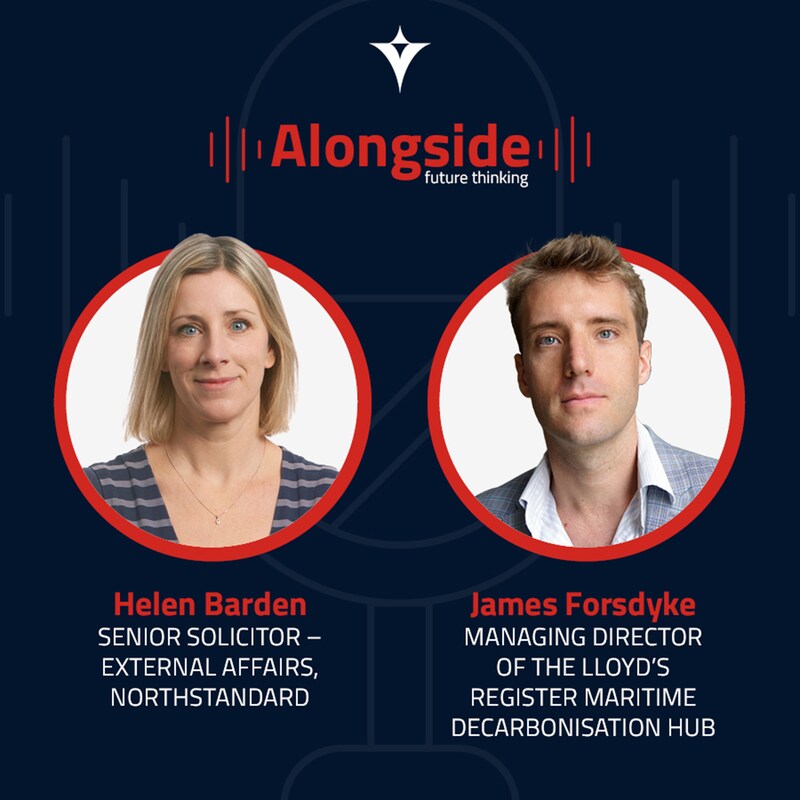
In this episode of Future Thinking from NorthStandard, Helen Barden is joined by James Forsdyke, Managing Director of the Lloyds Register Maritime Decarbonisation Hub. They discuss the establishment and objectives of the hub, its focus on advancing safety and risk management for future maritime fuels, and the importance of engaging industry partners in the transition towards decarbonisation. They also explore the critical role of human safety in implementing new fuel systems and the need for industry-wide standards to ensure the safety of maritime workers.
Highlights:
00:00 Introduction to Future Thinking
00:28 Meet James Forsdyke: Background and Role
00:42 The Maritime Decarbonisation Hub: Structure and Goals
02:50 Impact of IMO's Greenhouse Gas Strategy
05:01 Addressing Risk and Safety in Future Fuels
07:12 Human-Centric Safety in Maritime
12:40 Learning from Other Industries
15:31 Collaborative Efforts for Safety Standards
17:26 Conclusion and Next Episode Preview
Transcripts
[:
[00:00:31] James, welcome to the show.
[:
[00:00:34] Helen Barden: Perhaps we can start James by you giving a little bit of your background um and your role at the hub and perhaps also explaining the reason why the maritime decarbonisation hub was set up in the first place.
[:
[00:01:08] So we primarily focus on programs of work that advance our understanding of hazards, risk, and safety as it pertains to new fuels. That's one, that's one program of work that we do. We have a first movers program, which is a team that, uh, Put together coalitions of of industry partners to enable first movers, whether they're green corridor projects or other projects with government partners or industry partners to try to remove barriers that are preventing people from starting or from trying to take action against on climate.
[:
[00:02:00] Evidence led research that enables the industry to make decisions from transparent access to evidence based insights. So that's, um, that's why we were set up and broadly how we're structured. Me, personally, um, I've been first with the Lloyds Register Group for the last 18 years or so and recently moved into this direct position, uh, at the Hub.
[:
[00:02:37] Uh, but yeah, back to me, I'm a, I'm a naval architect originally, uh, working with the, with the Lloyd Judges Group for a long time, all over the world, doing lots of different things as a surveyor. Building ships in China, repairing them in the Middle East, um, through to client relationship roles, operational management roles, a whole, a whole bunch of things.
[:
[00:03:26] 2040 reduced greenhouse gas emissions by 70 percent, striving for 80 percent. And I just wonder whether that revision to the greenhouse gas strategy last year has changed the focus or priorities in any way?
[:
[00:04:06] So I would say that the second one that was, uh, that was updated, or the updated one rather, that actually brought the regulatory frameworks more in line with our own goals within the hub. So it didn't change. What we were focusing on or how we were setting objectives for what it was that we wanted to achieve with our, with our programs, how we prioritized, which programs we would, we would undertake.
[:
[00:04:50] So, in that sense, it was quite helpful. Actually, it normalized where our goals were with what the industry was, was, uh, willing to contribute to our work.
[:
[00:05:17] I just wonder whether you think that, um, risk and safety are going to be sufficiently addressed by the time these future fuels such as ammonia are more widely adopted within the industry.
[:
[00:06:02] And, and I'm conscious of the fact that I'm probably generalizing a little bit with what it is that I'm saying now that there are, there are safety professionals within the industry. Certainly. Um, within the programs of work that we run that have really mature safety cultures and safety expertise who, who might feel like what I'm saying here is a bit of a simplification, but if I try to be representative of an industry culture at large, what, what I think we're seeing is that we are, we are cognizant of the risks and we are undertaking programs of research and analysis to identify hazards and to, as systems thinkers, address those hazards, Hazards as far as practical and then.
[:
[00:07:08] But in that, in that same breath, we will all say, as the industry quite rightly, that we want to put the safety of our people first, and that we're very conscious of the safety of our people. And when we think about, in the hub, what that actually means, we find ourselves really thinking about what we can do to, um, Minimize the burden of safe behaviors on, on the people, to minimize this, this reliance on asking people to be that last mile of safety and to upskill themselves.
[:
[00:08:06] Bunkering, whether they're fuel handling, whether they're engine management, whatever it is that they may be. We should be thinking of the more and more like human system interfaces and think about what other standards that we should put in place for making sure that these interfaces address risk and hazard as far as possible and are standardized as far as appropriate so that.
[:
[00:08:55] Versus a designer, a shipyard designer per se, designing an ammonia bunkering station. So, you could choose to think of both of those scenarios as designing a human system interface that has with it inherent risk, that comes with it the need to manage a process that could have catastrophic outcomes. Now, If you're designing that cockpit, your, your, your centricity in your design thinking and your design philosophy is human pilot ergonomics, interaction with that cockpit, standardization as far as possible, so that a certified pilot can just lift in and out.
[:
[00:10:11] And we just sort of find ourselves wondering, well, what would putting the human first really actually mean if we lent into human centricity in safe practices in the adoption of, of fuels, um, could it mean regulating for a certain minimum standard of human, of human system interface for the ammonia bunkering stations of the future or the engine handling systems of the future so that, so that we really are.
[:
[00:10:57] We're trying to bring that further and further into the fore to say what does that human centricity actually mean to make sure this transition to new fuels is as safe as possible.
[:
[00:11:30] And whilst the kind of digitalization of the industry, we see it in many ways as being a positive thing. All of that, I think, like you say, needs to happen with the seafarer in mind. And I suppose leading on from that, do you, do you think that, um, while a lot is obviously said about how important seafarers are to this energy transition, do you think there is the, the True focus and the, the kind of true importance being given to that side of things.
[:
[00:12:24] So, so for me, it's not, it's not a question of whether we really mean that we want to put the seafarer at the heart. I think there's a, there's a, genuine, very authentic desire to do that because so many of us feel like we can we can touch that experience with our memories. We know, we know what it is and we know that the risk and the essential role that seafarers play and other maritime workers.
[:
[00:13:13] Helen Barden: Yeah, and I, I suppose it's, it's not gonna be a short job to get to that point either, because we don't have that history. And like you say, it's different in the, um, in the, the airline industry. But I, and,
[:
[00:13:48] So their ability to standardize is far easier than, uh, than, than in maritime. And then the second point is that the, the nature and the behavior and the interaction of the aircraft. Aviation regulator with the aviation OEMs is very, very different from the way in which the IMO interacts with the OEM base.
[:
[00:14:29] And, and I think, you know, if, if I continue working on the, on that scenario of a, of that ammonia fuel chip with an ammonia bunkering station, you know, if we were to think about through maybe through the vehicle of SOLAS or others, legislating for a minimum standard of human system interface, we have a window to do that today.
[:
[00:15:25] So it's not what we're advocating for, but it's to just think about where are the areas where we could do it, where they're going to address critical hazards in a way that probably make us better off.
[:
[00:15:59] James Forsdyke: well it's going to have to be a meeting of minds of regulators, major OEMs, and major ship designers. So, okay, ship designers, ship builders are also OEMs, so I'm talking second and third order OEMs who support shipyards within their supply chain. But it has to be that trifecta of people coming together because it shouldn't just be legislation.
[:
[00:16:47] So people like the Singapore MPA, for example, and others, you know, you could. you could quite easily put together a core coalition of people that could start putting some great ideas forward to start making policy proposals to the IMO in the short term. And in fact, we're already doing that. We're, I'm sat here in Singapore.
[:
[00:17:14] Helen Barden: I think it's not just on this point. I think in terms of collaboration between industry and policy makers in the energy transition as a whole, that's the story that we keep hearing this need for joined up thinking between industry and those making the regulations. Thanks very much James for your insight today.
[:
[00:17:38] James Forsdyke: With pleasure.
[:
[00:17:51] In the next episode I'll be talking to Steena Tiger Ivo from BIMCO. You'll find the Alongside podcast and this miniseries on the North Standard website at north standard. com and wherever you get your podcasts, you can also click follow to ensure you don't miss an episode. So from me, Helen Barden, thanks for listening and bye for now.