Shownotes
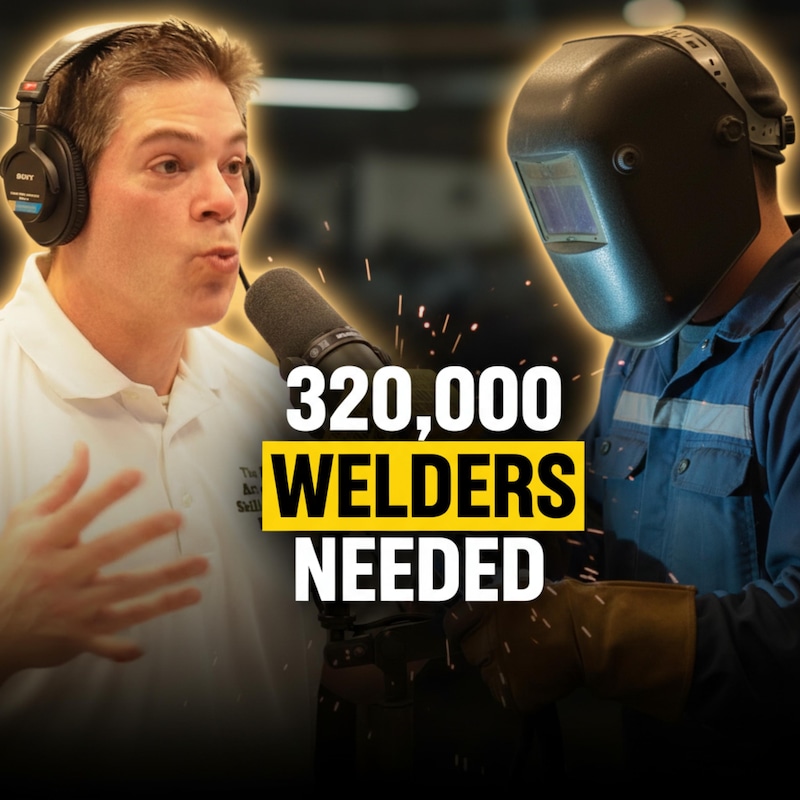
Host Andrew Brown tackles the growing welding workforce shortage and explains why it’s one of the most urgent challenges facing the construction and skilled trades industries today. As experienced tradespeople retire and fewer young workers enter the pipeline, the future of welding jobs in the U.S. hangs in the balance.
Andrew breaks down how to get into the welding trade, why traditional advice is failing Gen Z, and what’s missing from today’s education system. He explores skilled trades careers for Gen Z, highlighting how craftsmanship, problem-solving, and creativity are being overlooked in favor of outdated college-only narratives.
The episode also compares welder apprenticeship vs trade school, showing contractors, parents, and young workers how to evaluate real career pathways not marketing promises. Along the way, Andrew ties welding to the broader ecosystem of carpentry, HVAC, electricians, plumbers, millwrights, and the entire trades industry, calling for stronger advocacy and leadership from industry experts, contractors, and organizations like the Skilled Trades Advisory Council.
IN THIS EPISODE
- (00:00) Why This Episode Matters: The Welding Workforce Shortage & AWS Summit Context
- (02:19) 9/11, the Trades, and Why This Mission Became Personal
- (05:13) From IT to Trades Advocacy: Building Toolfetch and Telling Trade Stories
- (07:28) Why Gen Z Isn’t Entering the Trades: Shop Class, Guidance Counselors, and Perception
- (09:47) Trade School vs Reality: Barriers to Entry and Early-Career Frustration
- (11:49) How to Get Into the Welding Trade: Standing Out, Follow-Up, and Personal Branding
- (14:17) The Future of Welding Jobs in the U.S. and Why AI Won’t Replace the Trades
- (16:44) Final Advice: Earning Your Stripes, Staying Patient, and Building a Career
KEY TAKEAWAYS
- The welding workforce shortage is a long-term structural problem driven by retirements, broken education pipelines, and poor messaging.
- The future of welding jobs in the U.S. remains strong, stable, and essential to construction, infrastructure, and manufacturing.
- Choosing between welder apprenticeship vs trade school depends on mentorship, employer commitment, and real job placement—not tuition price alone.
- Skilled trades careers for Gen Z must be reframed around purpose, creativity, problem-solving, and long-term opportunity.
KEYWORDS:
Welding workforce shortage, How to get into the welding trade, Skilled trades careers for Gen Z, Welder apprenticeship vs trade school, Future of welding jobs in the U.S., Carpentry, HVAC, Electricians, Plumbers, Millwrights, Construction, Craftsmanship, Problem-solving, Creativity, Tradespeople, Advocacy, Trades Careers, Industry Experts, Contractors, Education, Skilled Trades Advisory Council
ABOUT THE HOST
Andrew Brown is the host of The Lost Art of the Skilled Trades podcast and the founder of Trades Media. He works with industry leaders, educators, and employers to close the skilled trades workforce gap by telling real, on-the-job stories that resonate with the next generation. Andrew focuses full-time on elevating trades careers through podcasting, keynote speaking, and live event activations across North America.
SUPPORT THE SHOW:
If you’re getting value from these episodes and want to help keep the mics on, consider tipping the show here → https://andrewbrowntrades.kit.com/products/toolbox
Every dollar helps us keep bringing unfiltered insights from the trades, straight to your ears.
Transcripts
Hey, this is Andrew Brown, host of the Lost Art of the Skilled Trades podcast. We're doing something different today. We're going solo on this podcast because I have a pretty hot topic, urgent topic. I am actually speaking at the welding summit for American Welding Society next week in Texas. And I'm talking about retaining, talking about getting the next generation into the welding trade.
I think what a lot of people don't realize, which is really interesting, that we have over 771,000 active welders here in the US. But the interesting thing is what's happening in the welding trade, like most other trades.
welders by: lders every single year up to:in 45. There are more welders leaving than coming in to the industry. For every five that are leaving, only two are coming in. It's an interesting concept. And I don't think, and why do I even care about this? Because it dates back to my journey and how I came up recognizing people in the trades. And I didn't start off in the trades, nowhere near it. I was a high-tech technician.
Andrew Brown (:I worked for banks, I was a programmer, but there's one date that really stuck with me and that's 9-11-2001 where I found myself on ground zero, helping first responders and working back to back with tradespeople on site. What I mean by tradespeople, finding survivors the entire day.
Andrew Brown (:ironworkers, pipefitters, electricians, plumbers. Some people don't realize that people in the trades work side by side with first responders. And I couldn't believe exactly what they did, the tradespeople who were there helping. And what was said is that a lot of them
didn't have the right PPE on the right protection. And a lot of them got respiratory illness. And years later, a lot of them got cancer. And I had a chance to go down to the 9-11 Memorial by the Freedom Tower in New York City. I haven't been down there since this happened where I was on ground zero when I was 23. Went down there with my wife and it was just, I mean, it's one thing obviously to remember the 9-11 tragedy and I don't want to go into that.
Looking at those pictures and the things that these amazing people did on site and there's a lot of pictures of ironworkers and people in the trades helping down there. But it just really got me thinking about that day and how it changed my life. actually, from that day on, actually quit my job in IT and I formed a tool and equipment business.
the last 25 years to provide tools and equipment of over a million different products to men and women in different trades around the country. Built an e-commerce platform, one of the first ones 25 years ago, and built a portal to get tradespeople what they want, when they want, and where they want, so they don't have to spend the resources chasing it. But I've shifted my complete career.
I am now running a trades media company because my mission is really to work to get the next generation into the trades and get the awareness out there. And I become a storyteller for the trades where I bring on men and women onto my podcast, The Lost Art of the Skilled Trades, this podcast. I share their stories and I talk about some of the difficulties they've had.
Andrew Brown (:coming up in the trades. Some of them were career changers. They were in different, they were in white collar jobs and moved over to blue collar. Some of them started their own businesses. And I love sharing those stories through podcasting and through social media showing up on every platform, TikTok, LinkedIn, YouTube, going live, speaking to people who are interested working with their hands and making a real impact. Sometimes you don't feel like you make an impact.
And then somebody reaches out to you and says, I watched your content and now I am going to be a welder or I'm going to be a plumber. And that, that makes me happy because then I know that the hard work that I'm putting in day in day out by staying consistent is working out there. But a lot of things what I'm seeing out there, and this goes over a 25 year career of
walking factory floors, meeting with customers, talking to welders and carpenters and plumbers and electricians across the country. And the number one thing, especially from a business owner standpoint, that business owners say, we cannot find fill in the blank trade, welder, carpenter, plumber, we can't find them. We try to do advertising, we try to get in front of people, but it doesn't work. We put the investment
into bringing in some of these individuals and they leave within three to six months and all of sudden we have to start all over again. This is not a hiring problem ladies and gentlemen, this is a perception problem. Gen C, the younger generation, has many different options today. They can be in tech, they can be in IT support, they can be
something in AI. They can be social media influences. Everybody wants to be the next Mr. Beast. So they have options. They don't necessarily want to work with their hands. But the thing is in this industry,
Andrew Brown (:There was a lot of barriers to entry into the welding trade in other trades out there. And it's almost like it was unintentional over the years. And some of this was in our control. Some of this is out of our control. Shop class was removed out of most schools today, high schools. It's almost like non-existent. Some still exist out there. And when shop class was moved out, those individuals who had that technical spark or that mechanical ability bypassed
even thinking about working with their hands on top of meeting with guidance counselors. And the first thing a guidance counselor would say is, hey, what college do you want to go to? And a lot of kids probably looked them and said, I don't want to go to college. And teachers are pushing that initiative.
I don't think guidance counselors are saying to kids, hey, you know what? You should be an iron worker. You should be a plumber. You should be an electrician. I don't know if that conversation is truly happening out there. I don't, maybe it happens in some, some schools out there, but most of the time the guidance counselor doesn't know you. And they'll tell you that
They'll tell you that that college is the only way to make a living. And to reinforce this, it's interesting. I'm just thinking about an example. My kids and I, I have young kids and we were playing the game of life. Anybody's played that as a younger kid, they have the updated version. And the updated version is you can either take a college path or a career path. But what's interesting in the instructions in bold, I remember reading this.
It said, you're more likely to get a higher paying job if you get a four-year college degree. And I was like, my God, if our games are saying this, our guidance counselors are saying this, our teachers are saying this, where are kids getting information from? And they're being led down this path of, well, I should go to college because I'll get a return on investment. And that's not the case anymore. You're not getting that return that you
Andrew Brown (:once did. And I'm proof of that. I went to school, the university of Rhode Island for four years, four years. I started off as a programmer. I took advanced calculus courses.
And I was completely lost. And then I went into business administration, MIS, management information systems. I minded in finance. And then I went into IT and then I went into running my own business as I just shared about my story about 9-11. And I came out of school more lost out of school than I was in school. And a lot of kids deal with this as well. So we need to do a better job overall to get in front of the younger generation.
But going back to what I was saying about the barriers to entry, there are jobs out there that are put out there by organizations. They want three to five years of experience. And it's interesting, I get feedback across all social networks saying, Andrew, I do want to be in the trades. I went to a trade school, but I cannot find a job. Where's the job? Some people are saying trade school is a scam.
It's a scam. They take $12,000 and they say, well, yeah, you can get a job, but then they don't get a job. That's people's different perspective. I think it depends on what trade school that you go to, what area you're in. There's a lot of factors there.
But these kids are getting discouraged. And they're saying, well, if I cannot get in, now I put this investment into trade school, what should I do? Andrew, I see that there's an open job at Chipotle or McDonald's, I can make $21, $22 an hour. I'm like, well, yeah, but the thing is the likelihood of actually working your way up for McDonald's is slim to none. You might be making that $22 five years from now versus going into a trade.
Andrew Brown (:as an apprentice, maybe making $16 to $18 an hour, but as a journeyman, maybe you're making $35 to $40 an hour. Yes, you got to put your four years of experience in a certain amount of hours. But there's a future for you. And what's good about the trades and working with your hands is that you can take that anywhere, anywhere, any state, you can leave the country, go to another country, you'll get a job as a trades person, most likely. So companies need to
really get a good understanding and say, well, what is my zero experience policy? Am I not letting any of those individuals in because I want a 10 year guy or girl? But the thing is, and I've spoken to a lot of people who don't have the experience that came out of trade school, they had the soft skills as well and some tech, technical skills, but companies need to give them a chance. But also individuals need to be a little bit more assertive.
When I spoke to an individual, his name is Troy. Troy said he sent out about a hundred or so resumes and he couldn't get in. So I said, are you following up? What are you doing above and beyond? And he just said, I'm kind of sending in resumes. And I said, well, you need to stand out because companies get overloaded with the amount of resumes they get. Being a business owner for 25 years, we would get flooded with resumes and it was hard to
parse through them. With AI, it's much easier today, but you need to be a little bit more assertive. You need to follow up. You need to call. You need to, sometimes you need to show up at the company. You need to say, okay, I can't get into this particular role, but maybe I can get in as a helper. And if you get in as a helper within maybe six months, eight months, you're a hard worker. Maybe you'll get that apprenticeship that you've been denied at. It's a possibility because the owner or the business owner
or a VP of some sort might say, you know, this person is a hard worker, I want to keep them. So you need to be a little bit more assertive, you need to stand out, showcase your work. If you know a little bit about welding or another trade, then put it on camera, show it to them. Start building up your personal brand on social media, on TikTok and YouTube. Personal brand is huge. If you told me about personal brand five years ago, I would have looked at you sideways.
Andrew Brown (:I built up a personal brand over the last handful of years. Just unintentionally, I've been because I've been consistent about it, but I built up a brand. Once you build up a brand, you have more authority out there and you can showcase the work that you've done. So showcasing exactly what you're doing, it doesn't have to be a talking head video. could just you could just set up a tripod and then showcase the work. This video you work. You want to take a step further showcase your work.
and do a voiceover on the video. You want to take it step further? Talk on video. Talk about what you're doing before and after. Sometimes it's a little bit difficult to get on camera. And I know a lot of people judge how they sound, how they look. I can tell you that growing up, I had a learning disability and a speech impediment. And it took reps to get on camera. But after a handful of years and reps, I'm comfortable on camera. As I'm talking to a camera right now, just looking at the camera.
I'm just looking at the camera. It's a little weird, but I'm kind of used to doing that, talking to an empty camera. it's about what you put in is what you get out. And sometimes, yeah, you might get 65 nos to get one yes. And that's what you need to do. So overall, yes, there are shortages out there. And I just, I mentioned some shortages in the welding trade. I also talked about a few other trades, plumbing and welding and carpentry and electrical.
But your opportunity to scale the ladder of success in the trades, and especially with AI, the disruption of AI into white collar jobs. I have a lot of friends who have white collar jobs and they're scared. Andrew, I'm scared. I've been here 20, 25 years. What do they need me for? AI is smarter than me. I think there's a longer runway in the trades. I don't think AI is coming for your blue collar job. Robots are not coming for your blue collar job.
Johnny the robot, Elon Musk, optimist robots are not knocking on your door tomorrow to fix or go into your crawl space or fix your sink or your AC. That's not happening anytime soon. Stuff happens. Things break. I had an HVAC problem yesterday and luckily Wes, who's a really amazing HVAC tech has a small business.
Andrew Brown (:called me back right away, fixed it. One of his workers came down within an hour and I had my AC up back in running at a 95 degree day. So, you know, there are good people out there doing wonderful, wonderful things. I think you have the ability to do very well. You just have to stick with it. You have to be a sponge and you need to learn. And sometimes you in the beginning stages, you're not gonna make a lot of money. You'll learn your earn, but you'll earn your stripes and you'll work your way up.
I am Andrew Brown. This is the lost art of the skilled trades. I will be doing some more solos because I actually enjoy doing some of these solos. Thank you and be well.