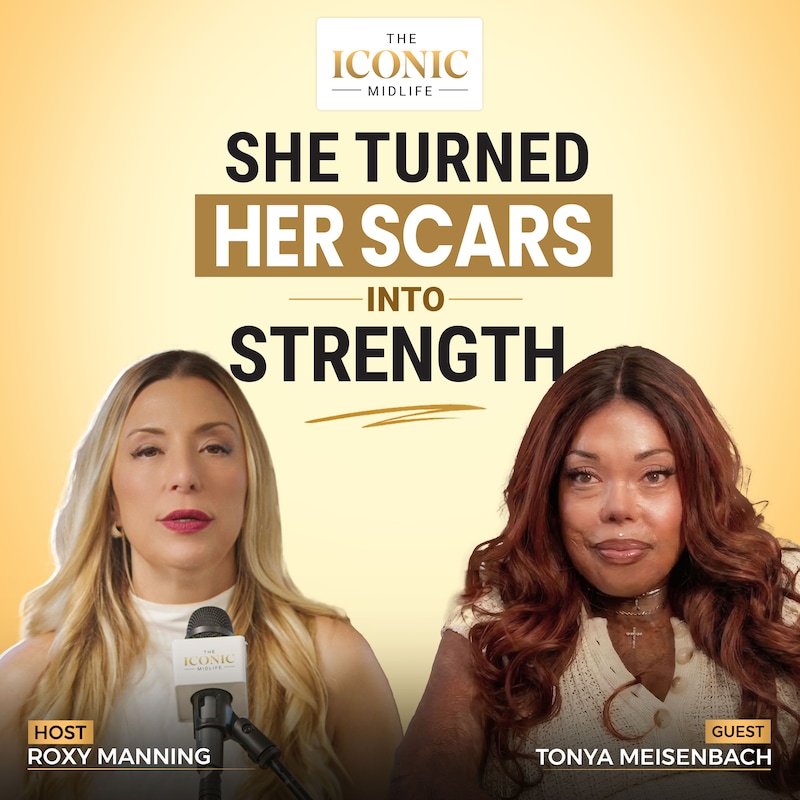
Shownotes
What happens when the life you knew disappears in an instant?
In 2018, Tonya Meisenbach survived an unimaginable act of domestic violence that left her with life-threatening burns and forever changed the way she looked. But what followed wasn't just a story of survival—it became a story of resilience, reinvention, and discovering a confidence she never knew she had.
In this deeply moving conversation, Tonya opens up about rebuilding her life after trauma, learning to embrace her scars, raising her children while healing, and why she says she actually feels more confident today than she did before she was burned.
We also talk about redefining beauty, finding purpose after unimaginable loss, the power of manifestation, and why your greatest chapter may still be ahead of you.
This is a conversation about hope, healing, and the extraordinary strength that can emerge after life's darkest moments.
In this episode, we discuss:
• Tonya's incredible survival story and the long road to recovery
• The emotional healing that came after the physical healing
• Learning to see beauty differently
• Why confidence comes from within—not from appearance
• Motherhood, resilience, and rebuilding after trauma
• Manifesting a bigger future and dreaming without limits
• What Tonya wants every survivor to know
If this episode inspires you, please follow The Iconic Midlife, leave a review, and share it with someone who needs the reminder that no matter what they've been through, their story isn't over.
Follow Tonya Meisenbach:
Instagram: @burnedbeauty2018
Follow The Iconic Midlife:
Social Media: @theiconicmidlife
Watch full episodes:
YouTube: @TheIconicMidlife
Follow Roxy Manning:
Social Media: @redcarpetroxy
Content Note: This episode includes discussion of domestic violence and trauma that some listeners may find difficult. While portions of this conversation touch on those experiences, the focus is ultimately on healing, hope, resilience, and rebuilding a meaningful life.
Transcripts
And I remember getting to that corner and looking back at him and saying, no. And he threw a Zippo at me that we had just bought in Switzerland. It was red with the Swiss flag with the point cross. And then I'm in flint.
And I didn't know why, but I felt more confident than I did before I got burned.
Roxy Manning:Isn't that amazing?
Tonya Meisenbach:I didn't know. Our truth is our power.
When you speak out and you say whatever it is, no matter how ugly or dirty or whatever it is, there's nothing anybody can ever do to you. I want to tell the story again as loudly and proudly as I can. Also, it's not just a story of what happened. It's the story of what happened next.
Roxy Manning:Hello, everyone, and welcome back to the iconic midlife. I'm your host, Roxy Manning. One of the things I believe most deeply is that life doesn't always ask our permission before it changes us.
Sometimes those changes come gradually through aging, motherhood, divorce, illness, or loss. Other times they happen in an instant. Today's guest knows better than almost anyone.
In:But instead of allowing that tragedy to define her, she chose to redefine beauty itself.
nd the founder of Burn Beauty:This isn't just a conversation about trauma. It's a conversation about identity, confidence, reinvention, and finding the courage to love yourself after life changes everything.
I hope you'll listen all the way through because I have a feeling this conversation is going to stay with you long after it ends. Here's my conversation with Tanya Meisenbach. Tanya, welcome to the iconic Midlife. I'm so happy to have you here. Thank you so much for coming.
Tonya Meisenbach:Thank you so much for having me.
Roxy Manning: hing, can you take us back to:Like, what do you remember from that day? Take me back a little bit.
Tonya Meisenbach:I can recall being upset the Whole day that morning. It's called ruminating when you know a narcissist is lying to you, which is what I was marrying to you.
I was ruminating like, you know, you're trying to. Like your mind is like this. 2 And 2 does not equal 4. So. And it was because I'd been angry with him for a few weeks.
We had just renewed our vows in the French Alps. Our 10 year vow renewal a month before in the French Alps. A dream. But he disappeared while we were.
Left me standing on the streets of Geneva, Switzerland, which is the same thing he would have done at home, just like disappear for the whole night. I was not forgiving him that time, you know, it had been 15 years. The kids had just moved out that month as well, while we were in the ounce.
Cause they were, you know, old enough and both moved out. We were in the house alone. And I had started working as a realtor. So working outside of the house again with my own money.
And I think he felt threatened. I didn't know it though, you know, that's the retrospect. What was going on that day was I was just angry.
I was just, you know, telling him, you know, you're a liar, whatever.
And I sent him a text at 5:40, I think it was 5:43pm That I still is on my phone because iCloud, right, loaded it back in, he deleted it, but it came back and it was something snarky. And he got home shortly after that. And I remember him saying, let's go sit out by the fire. Because that's what he always loved to do that.
So that wasn't unusual. We sit out there, we used to smoke, drink. So that's what I remember is him coming home after that text. 5:43Pm, let's sit by the fire.
And at 8:09pm was the 911 call.
Roxy Manning:So that time in between, that gets.
Tonya Meisenbach:Fuzzy, you know, because also I was drinking wine. I'm stressed. I'm drinking wine, some cigarettes. And I remember us sitting there, you know, sitting by the fire. I'm sure we were arguing.
I know my daughter came to pick something up and she said, I can hear you from the street. She stuck her head out the back door and said, I could hear you from the street. And I remember kind of laughing.
And in after I woke up, I remembered that I was laughing before she said that. So my mind got mixed up right with the afterthoughts. But you know, when I woke up from the coma, I didn't remember what happened.
But what actually happened was me reaching out across the fire and him squirting the lighter fluid. So the flame came up and me running. We, you know, like, in the backyard. Our backyard was very private.
So I ran like I was running to the driveway towards my car. And when I got to the corner, he had been squirting lighter fluid at me the whole time as I ran. I had this really long hair in.
It was, like, down my bottom. And I can remember that. And I remember getting to that corner and looking back at him and saying, no.
And he threw a Zippo at me that we had just bought in Switzerland. It was red with the. The. The Swiss flag with the white cross. And then I'm in. I'm in flames.
Roxy Manning:So when you woke up in the hospital, what was going through your mind? Because again, this is like two months after it happened. So what was going through your mind, especially those first few days? And what happened?
What had happened?
Tonya Meisenbach: dn't see. I didn't know until:I didn't see the police report that showed they closed the case within maybe eight hours. Like, oh, yeah, it looks like an accident. And he told a bunch of different stories, you know, throughout the time.
Cause, you know, it takes a liar a while to work that out. And he's under stress. But. So I'm waking up and he's there because he's not been questioned. He's been the doting husband in the hospital.
He's enjoying it. He's the hero now, taking care of his. I wake up and it was February when I woke up, and there were roses there and a giant stuffed grass.
Yeah, he's buying me stuff. Why I'm in a coma. Who are the flowers for? They're for everybody else, right?
Roxy Manning:It's for the show.
Tonya Meisenbach:I'm in a coma. Why are you doing these things? And I don't know.
I think a lot of people knew he wasn't right in the hospital, but it's not theirs to their decision to make. But, yeah. So waking up, then he's telling me about the accident. And, you know, you are so heavily sedated.
You've got paralytics and fentanyl and morphine, and you're just like, you don't know what's going on. I just knew I was alive. They were asking Me, if I knew. What month is it? It's like December, you know, and they're like, no, it's February.
And so you're just very confused. And I'll tell you the one thing I thought, though, you know, a little bit later, he said to me, you know, I really missed you. I'm really sorry.
Now I can see how bad I've been treating you all these years, and I really missed you. I'll never do it again. Now I understand how bad I've been treating you. Now.
He hadn't been hitting me all those years, but emotional abuse all those years that I didn't know was abuse. And do you know, I found that to be a relief. That's how bad narcissistic abuse is. I was laying in a bed. I literally didn't have a face.
I couldn't move. I couldn't pick up an arm. I don't know if I'm going to live or die, because just waking up from the coma is no guarantee.
And I felt relieved just by him saying he was not going to torture me anymore. That. And that's. That's what we have to understand about emotional abuse, right? It is killing you. It is horrible.
Roxy Manning:When was, like, the first time you knew, like, the totality of what had happened?
Tonya Meisenbach: It was:I knew things were going wrong the whole time after we got home, he was doing stuff like stealing my pain medicine. No kidding. I mean. And then I later, like, 20, 22 or somewhere in there, found out he had been on meth the whole time. I had no idea.
I thought he had a problem drinking, right? No, he's on meth and heroin. He's stealing my pain medicine. But still, I felt like I still didn't remember.
And I don't know if that was a choice or not because I didn't have anywhere to go. I don't have family. I don't want to move in. And with my kids, they're living their best life.
So I just kind of hunkered down and I don't know where I was. A very dark place, you know, just try to stay alive. I'm hiding my pain medicine once I was able to give it to myself, so I started doing burn beauty.
And that was just because I finally made a video to tell my friends what had happened. Like, my Facebook friends. I didn't know anything about making videos. I didn't know anything about social media, but I made it.
And didn't realize that anybody could see it. And so people started to respond, right? They're like, oh, my gosh, we're going through this.
So when I was able to connect that dot, like, okay, this is what I can do for the rest of my life, because I was only 47 at the time, and I don't want to sit on the couch for the rest of my life, right? So when I started doing that, it started to change things.
ect do I realize that. But in:And I did that for two months, maybe three months. And eventually, just the pictures in my head didn't match my words, because, you know, you're on autopilot with the words.
The pictures didn't match, and I got so confused. Fortunately, I was in therapy, and I asked my therapist, like, is this real? Could this be true? And she went, yes. And I think she already knew.
She was very quid. I could tell she didn't care for him, you know, and she was like, absolutely. Let's work it out. Wow. And life saving.
Roxy Manning:Life saving. Thank God you had therapy like that. So when you came home from the hospital, you two were still living together at that point?
For years after that, right?
Tonya Meisenbach:He's my caretaker. Yes. They send me home with him, perpetrator with him. You're sleeping with the enemy. And how he's taking care of me. I still couldn't walk.
I had to learn to walk and talk. I couldn't swallow, so I had a feeding tube, and I couldn't swallow the pills. They had to be grinded up and put right.
So he was completely in charge of everything. Oh, my gosh. And he's sadistic, too. He does some ugly things, but he, like, he. On like, three occasions, he put, like, this liquid laxative.
I don't know what it's called, but it's really strong. It's magnesium stuff, right? You know, it's the clear stuff.
But he put that in my feeding tube without telling me, and put so much that I woke up in the middle of the night laying in waste.
Roxy Manning:Oh, my.
Tonya Meisenbach:Laying in waste with him saying, well, I don't want you to get constipated because of the pills. They keep saying not to get. I was like, what is wrong with you? Oh, my God. Why would you do that?
Roxy Manning:Why would you do that? He just wanted to Talk to you?
Tonya Meisenbach:I'm not sure. Once.
Roxy Manning:Right.
Tonya Meisenbach:But three times. That's why. It's not a mistake. No, it's a choice.
Roxy Manning:That's sick. And is he. Yeah, no, that's absolutely sick. So what took.
Was it the therapist that kind of pushed you to make the decision to, you know, like, escape him essentially?
Tonya Meisenbach:You know, I mean, as soon as I remembered and I needed validation from someone else to say, yes, you are allowed to believe your memory because that's the damage narcissistic abuse does, or any emotional abuse, you doubt yourself. That's the biggest loss. So I wanted to leave. But then it's like, well, I don't have any. I don't have enough money.
He had all the money, and by this point, he had blown all the money.
We had a family business, and it was falling apart because I used to run it, and I would run it as the office manager, and he would always, you know, tell me, and he would just insult me about it, like, oh, you can never run a business. Blah, blah, blah. And in retrospect, I was running the business. Right. So. But, yeah, so it was falling apart. There was.
I didn't realize a lot of things like, that I could leave and get temporary alimony. Didn't know that. Right. Ultimately, I started. I thought, well, let me save my money. I've got to get out.
And I contacted the Partnership Against Domestic Violence in Atlanta, told them my story. They said, you could go to a shelter, but you can't take your dog. And I said, no. I said, no.
Now a lot of shelters have changed that because I didn't want to kennel him because he knows how long I'm going to be there, and he and I are all together. He's my emotional support. So I started sleeping downstairs on the couch in the house. He would sleep upstairs.
My dog would sleep in the bed because my dog went to bed. You have to know him. No matter what. He's going to bed. He's like, look, I'm going to bed.
Roxy Manning:Right.
Tonya Meisenbach:Right. So he'd be in the bed. They'd sleep up there. And I slept on the couch for over a year. And it wasn't even a real couch. It was like a recliner.
And I slept there for over a year with sort of my aching, broken body. But I would work. I would sleep there so I could hear him coming. We had guest rooms upstairs. But, no, I needed to hear him coming.
And no one should do that. This is not what you should do. But I didn't know at that Point. I still didn't know what narcissistic abuse was.
I still didn't know that the 15 years prior had been abuse. I thought it had just been, he's a jerk. It's a difficult marriage, but when you come to understand what's happening to you, you have to get out.
So I worked at least. I called the Partnership Against Domestic Violence.
We put together a safety plan because they understood that I was staying, and they said, okay, well, here's what's gonna happen. If he gets upset, what are you gonna do? So I had XYZ that I need to do. And then the financial abuse started.
He knew I was making money, so he stopped paying bills. And, like, the electricity gets turned off. I've got to get the electricity turned back on.
We're in a huge house, like, 4,500 square feet, and the heirs were in. All these are huge bills, Right. So it started to drain my money that way. I'm always trying to cover the bills. He's not.
I saw him not go to work for two months at one point, and that's when it started to feel hopeless. Like, how do I get out? And he actually. He got me arrested. People. Oh, girl.
Roxy Manning:Oh, my God.
Tonya Meisenbach:So there's a thing called provoke and record for a narcissist, where they're gonna get you riled up, and then they're gonna turn on the camera and act very calm. Well, he did that when my dog was injured, and I pushed him out of the way. Cause he was in my face. He's 6' 4, 220.
I pushed him out of the way, didn't know he was recording, didn't care, came back. The police didn't believe him. But still, I got arrested. I've never even had a ticket. It all got dismissed.
Everybody understood what was what, you know, I got let out. However, he then, on top of it, went to get a restraining order against me. But that gave me the opportunity to file for one against him.
Because until that moment, I wasn't able to. Telling the court, oh, he set me on fire five years ago is not enough to get you a restraining order. Like, well, what has he done lately?
Roxy Manning:That's the response.
Tonya Meisenbach:That's really. It's like, he hasn't done anything recently. So you're like, he tried to kill me. It's like, yeah, but he hasn't done anything recently.
So you don't go to restraining order. But when he did that, then I could answer counterclaim. And that got him out of the house. And that was 20, 24.
I was still stuck though, in Georgia, because now I'm in the house. I've got some temporary alimony. But what do I do now? You know, like, I can't stay here, but how do I save money to move?
It was always just a challenge to get out until a nonprofit called Face Worried International saw me on an ad that I did on Instagram and said, hey, you know, we could do some work around your nose and your eyes. And we have a place for you to stay in Los Angeles. You can stay for free, you and your dog. That's how I got out.
Roxy Manning:And that's how you did it. That's how you did it. You.
Tonya Meisenbach:I just said yes.
Roxy Manning:Yeah, you just said that's it.
Tonya Meisenbach:It was just like. I mean, it was a crazy thing to do.
I didn't have nostrils at the time, so I mean, of course I would like to have them, but I wasn't thinking of having surgery. But I literally. I had a meeting with the executive director.
She told me they could help me because I thought we were meeting about me being like a brand ambassador. I didn't know they wanted to help me. And when she said it, I just said yes. And 40 days and 40 nights later, we were in LA.
I packed up what I could into a pod and put it in storage. And then I couldn't fly with my dog. Cause he's giant. He's 126 pounds.
So they flew one of my friends from Los Angeles to Atlanta, rented us a car and we drove back across the country.
Roxy Manning:So what do you think was holding you back from saying yes earlier?
Tonya Meisenbach:From just getting out? Just the fear of, you know, I'm 53 and I. Until last year, I'd never lived on my own because I'd been in my grandparents house. First husband, kids.
Met the second husband very shortly thereafter. Quirrel ran, which it always is. So I didn't know I could do it by myself.
That fear, and that's what keeps a lot of us in, you know, we choose a familiar hell over, you know, over what may be.
Roxy Manning:Isn't that crazy? It's like the. It's almost like part of your comfort zone. Like in a way as bad as it is. Right.
Tonya Meisenbach:At least you know what it is.
Roxy Manning:You know, it's familiar.
Tonya Meisenbach:You know, it could get worse in your mind, but it really can't.
Roxy Manning:Yeah, no, it really can't.
Tonya Meisenbach:It really can't.
Roxy Manning:So as you're going through like the healing process as well, what was harder for you was it the emotional Scars, the feeling, physical scars. I mean, what. What. How did that look?
Tonya Meisenbach:I think that the emotional scars are much worse. You know, of course, initially it was the physical because I had a lot of. There was a lot happening.
You know, you don't have nose, your mouth doesn't close. They've recreated me completely. So that was definitely my focus in the beginning. And that took a few years just to overcome that.
And I didn't know why, but I felt more confident than I did before I got burned.
Roxy Manning:Isn't that amazing?
Tonya Meisenbach:I didn't know. Yeah.
Roxy Manning:Wow. Wow. You just.
Tonya Meisenbach:I just.
Roxy Manning:You're like a different person now completely.
Tonya Meisenbach:You know when they say trial by fire or forged in fire, and a lot of us, you know, do it. Not literally like I did, but it really is a change if you can just get to the other side. That's what I always try to encourage.
And I know it's hard to walk out. I often say I don't know if I ever would have gotten out if he hadn't done that. And I was miserable. I can't, you know.
So those emotional scars are still popping up because I didn't even know I was a domestic violence survivor. I thought, okay, I got attacked. He set me on fire even after I remembered. But the words domestic violence, it took me a long time.
It was like 20, 24 when I was like, okay, I'm a. That was domestic violence the whole time.
Roxy Manning:Was it just too heavy, too hard to kind of, you know, really put. Put those words to what happened?
Tonya Meisenbach:Yeah, I mean, it really was, because I. I don't know, it's odd just thinking, okay, well, he attacked me.
But when you say domestic violence and then you add in all those horrible feelings for the 15 years before, the misery, the anxiety that fight or flight, the, you know, you feel. I think that's worse. I do. I think that emotional aspect is. Is worse than the physical.
Roxy Manning:Much harder. It's like the scars you don't see, you know, that's what's inside. And, yeah, it's cutting. It's deep, right? It's very deep.
So what part of you remained untouched through all of this process? What is something the fire did not take from you?
Tonya Meisenbach:My joy and my optimism. It's important that you not let the negativity change who you are. I still trust people. Even I get so mad at myself. Right.
For I'll be like, why do I insist on trusting? Right? I said, why do I insist on doing this until. Until someone shows me otherwise. And I was saying that to A friend.
And she's like, because you didn't let it change you, because you didn't let the negativity change you. And I thought about that a lot and I was like, yeah, that is important. Don't let them change who you are at your core.
Roxy Manning:And you know that.
amazing platform Burn Beauty:I mean, it's absolutely amazing, actually, Tonya, because I feel like so many people might shy away from what happened to them and maybe retreat or maybe just allow it to change them all the way. And it's like you've done the opposite. You've run towards it. You've put it out there for people to see, and you've really. So talk to me about that.
Why was it important for you to kind of put it all out there?
Tonya Meisenbach:Well, for variety of reasons. Number one, he's not in jail. My biggest fear is he's going to do this to somebody else.
Roxy Manning:Or how was he not in jail, by the way?
Tonya Meisenbach:Oh, well, because it was when I asked him, when I asked the police to reopen the case. Just never heard back. It's just like, no matter. I've checked. I checked. It's up to the state and the prosecutors for what they think they can.
What they think they can prove. And you need to call it attempted murder, which is a crime in Georgia, believe it or not. That is not a crime in every state.
It's not called attempted murder. You would call it aggravated assault, because aggravated assault is a whole crime.
Attempted murder indicates half a crime and the sentence could be less. But most states want to prosecute it as aggravated assault, and that has usually a 4. Your statute of limitations.
Roxy Manning:There should be no statute of limitations.
Tonya Meisenbach:There should be none at all. I'll be campaigning for that because that's ridiculous. Is that something I would like no statute. Yes.
I would like no statute of limitations in domestic violence or however it can be written, because it is so often that we don't come out and speak about it. I did, number one, because of that. And number two, because just of what my platform is, and I've always been transparent. Also, it gives me power.
I think that our truth is our power. When you speak out and you say whatever it is, no matter how ugly or dirty or whatever it is, there's nothing anybody can ever do to you. No.
Roxy Manning:And you're helping people like you're helping. There's gotta be.
There's so many other women who are in that same spot, you know, and that need the, you know, the assurance that things can be okay on the other side.
Tonya Meisenbach:Exactly right.
Roxy Manning:That they can have the confidence to do it. Yes, right.
Tonya Meisenbach:That it is okay because it definitely doesn't feel like it when you're in it. It doesn't. They've trained you to not feel like you can survive without them and you're afraid. But I'm here to say you can.
I'm also here to say again, your truth is your power. We are not going to live in their shame. I am not going to be ashamed of what he did to me. I'm not going to be judged by it. That's him.
And that's a big part of domestic violence, is that we feel ashamed for what they've done. Or people will say, why didn't you leave?
Well, ask any of the women who try to leave and don't make it because that's the most dangerous day you can be with one of those guys. That's when you, even if they haven't touched you, that's where you might lose your life. Why didn't you leave?
Well, I have kids, I don't have any money. I'm isolated. I don't have my family anymore. It's not that easy as why didn't you leave? Rather than asking women that, we need to say, what can I do?
Or not even what can I do? Offer suggestions. Don't leave it open ended. Can I help you? Can I pick up the kids? Can I? Whatever, just offer something if you want to help.
A lot of times it won't work out. It takes time.
Roxy Manning:It takes time. It takes time. And you have to be able to make that choice right for yourself. I mean, it's putting yourself first, essentially.
You know, you have to get tired.
Tonya Meisenbach:And most of us get scared and realize, okay, I'm not going to make it if I stay with him. My kids are not going to have a mother if I stay with them. And I think I represent that.
I think that when women see me and men, because it happens to a lot of men too, but when they see me, they can't not understand how bad it can get.
There's a physical representation, you know, my words, my story will match a lot of theirs, but they really have to get it in their mind, like this is what can happen. I. You can't get around it.
Roxy Manning:You can't, you can't, you can't get around it.
Tonya Meisenbach:So I think it's, you know, a Big part of the. I love it. It makes me smile. If you can do it, you know,.
Roxy Manning:Like, you're a very bright light, which I love. I'm like, I feel the energy and the brightness. Yeah, I love that. I love that about you. But, you know, I love that also.
d your platform burned beauty:And what do you want other women to know about beauty and confidence?
Tonya Meisenbach:Oh, my gosh. I had so little my whole life, and that's what set me up for all the men I was with. And I want women to know that it is inside you.
You know, we love hair, and we love makeup, and, you know, I like pretty nails and all these things, but without doing the inner work, none of it will shine through, ever.
You won't see it, and others won't see it, because I know if you're listening, you've seen a lot of people who should be are classically beautiful, but you look at them and you don't see beauty. That's. That's part of the definition, because so much of it is inside of you.
Roxy Manning:It's got to radiate out.
Tonya Meisenbach:It has to. It starts on the inside, and it's not about makeup, even though I love it. I have a sign on my wall that says, makeup is our beauty of spirit.
And it is. It starts on the outside, and then, of course, good hair. Yeah, yeah, but, you know, how about me and hair? No, no, no. No insults to that.
But you've really got to do the inner work. You really have to love yourself. And in order to do that, I think you have to understand your part in situations so that you can heal them.
And when I say your part in it, not your fault, but you have a part in everything except maybe a random violent crime. What is the part in it? Well, I didn't love myself.
I was okay with someone treating me that way, so I'm going to heal that so no one can ever do that to me again. And, you know, you'll always have a part. And if you just go for that and sit with it, that helped me so much.
Roxy Manning:Do you know the moment that you started loving yourself in that way, that.
Tonya Meisenbach:That was, like, the moment. Oh, you know what?
It was probably a lot more recently than everyone would think, because, like, truly feeling it, you know, I felt confident after the burns. I don't. Again, I don't know why people were looking at me like crazy. And it was Hard.
In the first couple of years, I didn't go out much, but it was also Covid, you know, But I felt confident then, but truly beautiful.
with that. And so that's like:And with that, I started to do a lot of things differently. I was able to then, Okay, I didn't lose a lot of weight. That was really weighing me down physically.
The skin grafts, they don't stretch, so if you gain weight, it's painful. So things I had to do. And then I started to stand up straigh Right. I could feel it. And my nose is done, and people are, like, complimenting that.
And then it's like, yeah. And the reflection in the mirror, I'm so happy with.
Roxy Manning:That's amazing.
Tonya Meisenbach:Yeah. So it really. It took time. I guess that's the point. You know, you can. There's stages to it where, okay, I'm building my confidence.
I'm feeling really good. But now you can't tell me nothing.
Roxy Manning:Now we're done. You're like, I am gonna walk out there. And you should, by the way, I want you to get a modeling contract with Fenty. Oh, yeah.
Tonya Meisenbach:Rihanna. Riri.
Roxy Manning:I'm like, you need to put this woman in your campaign. Hello.
Tonya Meisenbach:It's because I love her so much because those clothes were the only thing I could wear in the beginning. I couldn't even find a bra that would work because everything hurt me. Right? My skin.
So I started wearing them because I had to think about, like, why is it that I'm so obsessed with this? That's why I put it on. Even sitting at home in a wheelchair, it made me feel feel good.
Roxy Manning:As part of your recovery process. It was part of your healing.
Tonya Meisenbach:It made me feel cute.
Roxy Manning:Amazing. Yes. And you are so cute. I was watching your social media. I'm like, okay. I'm like, you have got all the amazing looks.
I'm like, okay, I need to go, like, hang out with Tanya more because this is. She's got it all down.
Tonya Meisenbach:That's what's starting to happen now. I'm really starting to enjoy it.
Roxy Manning:See, that's amazing. Like, having that joy, like, you're saying, like, undiluted joy.
Tonya Meisenbach:My grandmother Always said, never let it steal your joy. That's the key. No matter what happens, never let it steal your joy.
Roxy Manning:And you haven't.
Tonya Meisenbach:But I would say he was definitely stealing my joy during that emotional abuse time, because that's the biggest thing. There's no way to feel good during that.
Roxy Manning:Yeah. That's like a. I mean, just the daily toll of it. Every day, day in, day out. Yeah.
Tonya Meisenbach:How does brain damage.
Roxy Manning:It changes your brain. You're probably your chemistry, Right.
Tonya Meisenbach:Change your brain chemistry, it reduces your amygdala. It causes actual brain damage. The scans of women who've been through it look like that of combat veterans. Isn't that amazing?
So the fact that brain damage doesn't have to happen in, like, one big. You know, we think of one big.
Roxy Manning:Hit on the head, blunt force trauma like that, Right?
Tonya Meisenbach:Yeah. And the fact the studies show now it can be over time, a little bit at a time.
And that's why you see women with such a higher incidence of Alzheimer's.
Roxy Manning:Wow. It's just learning that in so much.
Tonya Meisenbach:Just so much. If they're with it, if they're with an emotionally abusive person.
And then, you know, you see grandma who's been with grandpa forever, and he's never laid a hand on her. But maybe you don't know what's really happening. Emotional abuse is manipulation. It's not screaming. It's not.
I mean, it can be, but it's more about making you doubt your own reality so that you have to depend on them. Absolutely.
Roxy Manning:How did becoming a survivor change you as a mother? Like, what was that sort of, you know, journey like? Did it change you? How did you. Like, what. What was your relationship with your kids.
Tonya Meisenbach:Like throughout all those? It got better because they had been. My kids are from my first husband, thank God. So I was like, thank God.
Roxy Manning:And there's, like, no gene sharing there.
Tonya Meisenbach:Dodged that bullet because that would be horrible. And they are. My daughter's 28. My son is 30. So I got married young, you know, the first time.
And they were so angry with me during that marriage because they were seeing and accepting what I didn't like. They were seeing me take less than I deserved. I wasn't being hit, but I was always unhappy.
And my daughter, you know, after getting away, and I told her, okay, I'm gonna get a divorce. And this is even before I knew I was gonna get out of the house or anything. And she said, you should have left him 10 years ago.
Roxy Manning:Was she telling you this whole time during that 10 years, or was It.
Tonya Meisenbach:No, she said it after. I mean, she said it after, you know, you should have left 10 years ago. And so that's how much her kids are seeing.
And they were a big part of why I wouldn't. And that's why I say when people ask, why didn't she leave? They were teenagers. We were pretty well off. They had every opportunity.
You know, their college. They don't have student loans. That was paid for.
And all I could think, you know, when it was getting bad there at the end was, how can I provide this by myself when the business is. You know, he would always say, it's my business.
It's my business, you know, And I. I wanted to be able to give them that life, but I know they would have rather had less. So that's how it changed me as a mother. Talking to my son. He said, mom, we would have worked Johns. We could all worked.
And so that makes me want to cry, because how sweet is that, right?
Roxy Manning:They'd rather see their mother happy, safe, loved, than all the material things in.
Tonya Meisenbach:The world and all this nonsense. And I'm always unhappy and, you know, and I'm. It was. It's amazing what you can learn. But, you know, my kids were older.
But I promise, if you have younger kids, they're still thinking that same thing, that they just want to see you, mom or dad happy. Because there are a lot of women narcissists out there, just operating a little differently with the men, but it's still dangerous.
Roxy Manning:Yeah. Do they operate in men and women in the same way if they're, like, true narcissists?
Tonya Meisenbach:Yeah, a little. Kind of. Very much my brother. He's not really. He's my cousin, but we're brother. Brother and sister. Right. So we grew up together.
Roxy Manning:Yeah.
Tonya Meisenbach:So his wife, clearly a narcissist, and. And he was going through it at the same time that I was going through this with my husband. So we couldn't even see to help each other.
But that's kind of interesting because we're both from the same background, so we both have the same. We're both empathetic, both kind, but we both have some of those same insecurities, and that opens us up to these people.
This woman behaved very much the same way, just lying, cheating, disappearing. And they are not, you know, men are a little bit harder on us as narcissists about. They kind of attack the way we look.
Women generally attack your worth as a man or how you just mean things. It's all the same. It's all about ego.
Roxy Manning:And they're so broken inside that they're trying to hurt.
Tonya Meisenbach:They're trying to somebody else. On the outside, they know they're broken. They think they're jealous of you. They don't like you.
You know, if you're with a narcissist or you're with someone who's treating you this way, they do not love you. People who love you do not purposefully hurt you. Not ever. Not ever. Not ever. Not ever. Not on purpose. I mean, we can hurt people, but not purposefully.
And, you know, they really. They do hate you because they're jealous of you. You're everything they can never be.
And all it takes is one moment, one fit of narcissistic rage, and you can get hurt. And it happens more than we know, you know, when. For the people who don't survive, they're not there to tell the tale.
But I'll look at a lot of news stories and I'll think, yeah, okay, well, we know what happened. Because it'll just be like, oh, he snapped. No, he didn't. He's been abusive the whole time, just not physically. He just, you know, got tired.
And I want all of us to know that I think men are in less physical danger from women narcissists because we're women right. At our core. But you're really in danger if you're with someone like that.
And if they have ever choked you, then you're 800% more likely to be killed by them than in an instant, than regular domestic violence.
There's just so many interesting studies now about how this works, and I love being able to talk about it, and I love that we have platforms where we can share it, because I never knew. I never heard. If you'd asked me what a narcissist was, I would have told you. Somebody who really loves himself.
Roxy Manning:Right, right, right. Because that's what you think.
Tonya Meisenbach:That's what we heard from Narcissus. He's staring at his image in the water. Right. He's amazing. Well, he was staring at himself because he didn't like himself.
Roxy Manning:Wow.
Tonya Meisenbach:That's the part we missed, you know?
Roxy Manning:Right. Because you think one way, like that,.
Tonya Meisenbach:It's that way, but it's counterattack.
Roxy Manning:Exactly.
Tonya Meisenbach:We think it's vanity. And it's everything but vanity. It's self loathing. And they want you to be unhappy. So people who love you don't want you to be unhappy. Oh, my God.
And you have to get out.
Roxy Manning:Yep. You have to get out.
So what would you Say to the women who might be listening and watching this that, you know, feel stuck or might be in some sort of a situation that they do want to get out of or, you know, just want to make a change on their life in some way. Like, what would you say to them?
Tonya Meisenbach:Well, if you're with someone and it is emotional abuse, you need to contact a domestic violence organization. A lot of people hesitate to do that because he's not hitting me. But I promise you, they are versed for it.
Do that and then please reach out to whoever it is you are now estranged from, because I know you are. If you're with someone like that, your family isn't close. Now, they've had to.
They've had to put up a boundary to protect themselves because you continue to go back to them. But if you're ready, reach out to your friend, your family, whoever it is that's not speaking to you, they love you. They just had to draw a boundary.
They will help you when you come back. Genuinely, you cannot do it alone either.
You know, a support group is so helpful and a domestic violence organization, they will give you a mentor to help you. Don't try to get out alone, because a lot of times if you do, that's where you're really going to get hurt.
And if you're just looking to make a change in life altogether, do it. Just say yes, right? Just do it. Just take the step.
Roxy Manning:Yes. And I imagine a lot of women also feel like shame and embarrassment of what is going on with what's happening.
And that might even keep them from telling friends, family, you know, trusted confidants. But tell somebody, right?
Tonya Meisenbach:Tell somebody. Talk to people. I didn't talk. I mean, if I had told my friends, hey, you know, my husband disappears a couple of times a week. He turns off his phone.
No, they didn't know. Because you're. Because you're ashamed, you're embarrassed. And that's why I said, I refuse to live in his shame. Now, I did it for so many years.
But you also do it because you know that if you tell them, hey, my husband disappears twice a week, turns off his phone, disappears until bar closes. They're going to be like, what are you doing? They might make you make a change, you know, so don't. Don't hide it. Your truth is your power.
You don't have to tell the world like I do, but tell somebody.
Roxy Manning:Tell somebody, and no one can change it. That is yours.
Tonya Meisenbach:That's yours.
Roxy Manning:Is yours. Yes, yes.
Tonya Meisenbach:Nobody can. There's never a Wrong answer.
Roxy Manning:No. No, never.
Tonya Meisenbach:Right?
Roxy Manning:Never. Well, I mean, you have so many bright things on the horizon. A little birdie told me you have a talk show in the works.
Tonya Meisenbach:Working on it. I wanted this.
Roxy Manning:What? Like, that is absolutely amazing.
Tonya Meisenbach:It's like a dream. Can you always listen to me? Can you talk a little bit about.
Roxy Manning:What's happening with that?
Tonya Meisenbach:Well, we're working on. I need to get a pilot together. Okay.
I first found my interest in Talk shows when TikTok asked me to do one years ago when they started doing, you know, livestreams, culture. And my TikTok actually asked me to do a show. Well, it was done virtually, but it was so good.
It was done virtually and live, which, you know, creates some situations, right? Yeah, there's some situations live. But it was so good. It was so moving. And I thought, oh, my gosh, that's what I want to do.
I tell my story all the time, and I gladly do.
But when you can give people a platform to tell theirs when they're ready, it is so empowering for them to sit and talk about it and tell the world, because, again, that truth is their power. And that's what I want the talk show to do.
I want to be able to use my platforms, pull that together, and give people a chair to sit in and to tell their story if they want, give a voice. And the more voices we give, the more people we reach, the more the people have to hear these stories.
Roxy Manning:Yes. And I understand you have some big talent attached to that too, Ms. Sherri Shepherd.
Tonya Meisenbach:Oh, that was.
Roxy Manning:Is that.
Tonya Meisenbach:Well, she's attached to something else. I met her. Listen, this is the craziest thing, okay. My agent contacted me and said, do you know Sherri Shepherd? I was like, yes, like, of course.
Roxy Manning:I know Sherri Shepherd. Hello. Like, Sherri Shepherd.
Tonya Meisenbach:I love Sherri Shepherd. And they just said, she's a fan. She would like to meet you. And I just thought that was the craziest thing I'd ever. I was like, what?
That is so amazing. So we had a big zoom call, and, you know, all the details. I don't know what will come of what. And, you know, all that still under wraps.
But that was amazing because I, you know, was sitting with her and her agents, and they said, what do you want? And I said, I want a NETFLIX original.
And I've been manifesting that because, you know, I believe in manifestation, like to say, ever since I got to la, every time someone asked me what I wanted, I said, I want a NETFLIX original because I want to tell the story again as loudly and proudly as I can. But it's not just a story of. Also, it's not just a story of what happened. It's the story of what happened next.
Roxy Manning:Yes.
Tonya Meisenbach:I think overcoming that.
Roxy Manning:Yes. That's so important because you're showing women out there that there is hope and they can do it. You know, people can do it.
Tonya Meisenbach:So I want them to see, like, hey, if you're in this situation, it's bad. You need to get out. Yes, the story is tragic, but over here, on the other side, you can be living your best life, happier than you've ever been.
Roxy Manning:Yes. 100%. Looking back, would you change anything?
Tonya Meisenbach:No. Well, because I couldn't end up here.
You know, I just said the other night, like, you know, would I, if possible, learn my lesson sooner and skip all the pain? Of course. You know, I can't say I'm happy I got set on fire, but I can say that I'm grateful for everything that's happened since.
And if that was a part of it, then that's what it is.
Roxy Manning:And look what you've done with it. I mean, it's absolutely amazing.
Tonya Meisenbach:And I feel kind of like a badass. Like, it's like a word.
Roxy Manning:Hello. This is what I see in your future. Like in the next year, talk show and modeling for Fenty. Right.
Tonya Meisenbach:Like, and we're going to get that. And I need a Netflix original.
Roxy Manning:Yes, the Netflix original. That is no doubt going to happen.
Tonya Meisenbach:I mean, it's all happening.
Roxy Manning:Yes, it is. Yes, it is. It's happening. It's happening. I mean, the way that people have, you know, embraced you, especially on social media, has been amazing.
Tonya Meisenbach:So grateful, so great. But it does mean that they relate to me.
Roxy Manning:Yes.
Tonya Meisenbach:And that's huge to realize, how widespread.
Roxy Manning:Yes. And it's not even necessarily that maybe they had the exact same thing happen to them, but they might be feeling the same way.
You know, it's like, people are right.
Tonya Meisenbach:It's more so about resilience. That's why the important part is about what happened next. Because whatever knocked you off the horse, Right. It's not about that.
It's about getting back on it.
Roxy Manning:That's right. That's absolutely right. Well, Tanya, thank you so much for joining us.
Your story is just as soon as I heard it, like, it hit me, and I knew I wanted you to come on the iconic midlife, because no doubt you are going to help so many women listening and watching. So if people want to follow you and find out more about you. Where can they do that?
Tonya Meisenbach: very platform as Burned Beauty:Might start doing some on TikTok again, but all my I always make sure to post all my content to every platform because the goal is to reach everyone neat people where they live. So you'll find me.
Roxy Manning:Oh it's amazing. And I can't wait. I can't wait to see that Netflix show and that modeling gig with Rihanna. Yes, it's happening.
Tonya Meisenbach:It's happening.
Roxy Manning:Call her. Call Tanya. Amazing. Thank you so much, Tanya for joining us on the Iconic Midlife.
Tonya Meisenbach:I am so happy to have been here.
Roxy Manning:Thank you.
Tonya Meisenbach:Thank you.
Roxy Manning:What an extraordinary conversation. Tanya's story reminds us that beauty isn't the absence of scars and it's the courage to stop hiding them.
Whether your scars are visible or invisible, whether they came from trauma, illness, heartbreak, motherhood, or simply the passage of time, I hope today's conversation reminded you that your story is still being written.
If this episode moved you, inspired you, or made you think differently about your own journey, I'd be so grateful if you'd help us reach more women by following the show, downloading this episode, and leaving a quick review on Apple Podcasts, Spotify, or Amazon Music. Those reviews truly make a difference and help other women discover these conversations.
You can also watch the full video episode on YouTube by searching the Iconic Midlife and be sure to follow us on social media, heconicmidlife and edcarpetroxy for behind the scenes moments, clips and updates on upcoming guests. Thank you so much for spending part of your day with us.
Until next time, remember this life may change the way you look, but it never gets to decide your worth. I'll see you next week on the Iconic Midlife.




