Shownotes
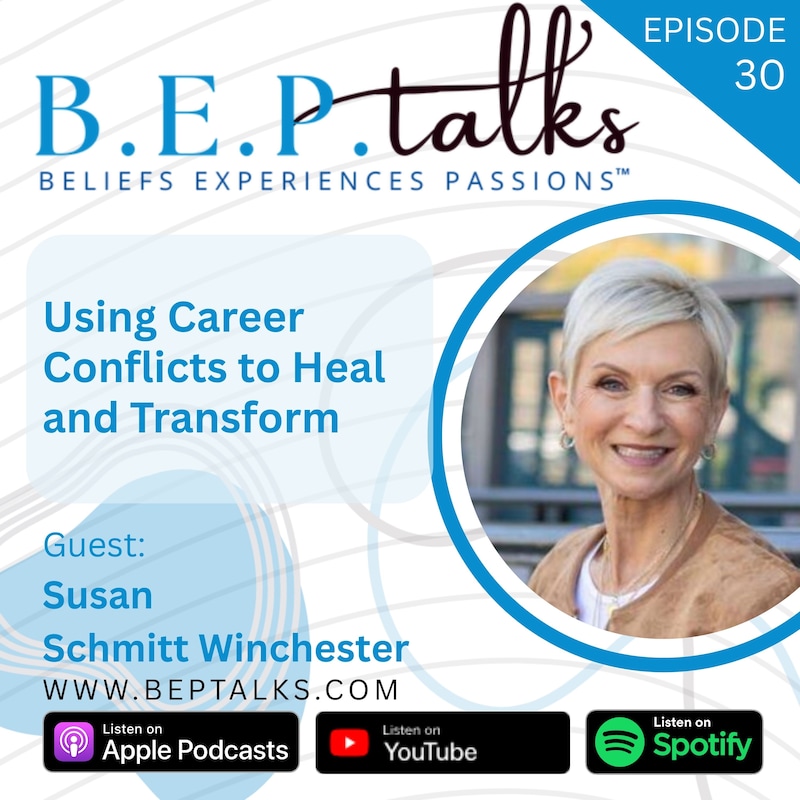
On this episode of BEP Talks, I sat down with Susan Schmitt Winchester, a powerhouse in human resources and co-author of Healing at Work. We explored how childhood experiences shape our workplace behavior, why self-acceptance is key to breaking unhelpful patterns, and some practical techniques to move from stress to freedom on the job. Whether you’re an executive or just starting your career, Susan’s insights on emotional intelligence and self-awareness are game-changing for anyone looking to thrive at work and beyond. Check out Healing at Work and start transforming your work life today.
If you ever dread Mondays or find yourself reliving old stories at work, you’re not alone—and there’s a path to greater freedom and joy.
Check out "Healing at Work" on Amazon, and connect with Susan Schmitt Winchester at: https://www.Susanwinchester.com
---------------------------------
B.E.P. Talks makes it possible to connect with those who most resonate with your own personal or professional life – or both. Follow-up in the moment or come back to them when you need them most, attend their events, read their books, participate in their courses.
Visit often! Meet experts from the cross section of the world. Let them motivate, inspire and educate you.
🎤Interested in telling YOUR story?
Visit https://www.beptalks.com/ for all the info you need.
Schedule an interview. Expand your reach and influence. Begin to change the lives of others by changing your own.
You’ll love the experience and your audience will appreciate you.
🔎Explore the MeetN Platform: https://meetn.com/features?x=94034
▶️Subscribe to our Channel: / @beptalks
Follow Us on Social:
Facebook: / thegsew
LinkedIn: / johnstonbeth
Transcripts
Well, hey there and welcome to this edition of BEP Talks.
Speaker:I'm your host, Beth Johnston, coming to you from the BEP Talk
Speaker:studio at the Global Society of Empowered Women, where it is my
Speaker:great pleasure and honor to introduce you to amazing
Speaker:people from all walks of life, from around the world,
Speaker:different ages and stages in their career and in life. But
Speaker:all who come here to so generously these and openly share
Speaker:their beliefs, their experiences and their passions.
Speaker:And we have never, ever, ever had an exception and we're not going to start
Speaker:today. My very special guest today
Speaker:is Susan J. Schmidt Winchester. I just
Speaker:love that name. Now Susan comes to us with
Speaker:36 plus years of experience as a
Speaker:human resources executive and currently
Speaker:holds the highest honor in that category as a
Speaker:fellow of the National Academy of Human Resources.
Speaker:So you can see how excited I am to have someone of that caliber
Speaker:joining me here today. Now Susan comes with 36
Speaker:plus years, as I mentioned, and
Speaker:has so many passions that she's going to share with us today. She's worked
Speaker:with Fortune 100, Fortune 500 companies, has an illustrious
Speaker:cross industrial combination of experience,
Speaker:experience, all which I think has probably come together. And something I'm very
Speaker:excited to talk to her about is the book she co authored
Speaker:called Healing at Work. I can go on and
Speaker:on about Susan J. Schmidt Winchester, but let's get
Speaker:right to it. Please welcome to the BEP Talk stage. Susan.
Speaker:Hi there, Susan. How are you today? I am terrific and
Speaker:very excited to be here with you today. Well, I am excited to have you
Speaker:here and thank you for those very, very kind words.
Speaker:I kind of don't know where to begin because you have so many
Speaker:accolades about which we can speak. And we will. I mentioned
Speaker:your 36 plus years of experience as a human resources executive
Speaker:again across many different industries. What was it that
Speaker:originally attracted you to hr?
Speaker:Well, that's a great question. I had gone to college and
Speaker:I had a double degree in psychology and French. I had no ide idea what
Speaker:I was going to do with that. And so I went on and got a
Speaker:graduate degree in industrial organizational psychology, which
Speaker:I really loved. It's a nice combination between the quantitative and the
Speaker:qualitative. So my very first job in Chicago
Speaker:was working as a compensation analyst for at that time a private
Speaker:company that made a variety of different hair care
Speaker:deodorant kinds of products. And I was
Speaker:incredibly blessed to to fall into a career by accident
Speaker:that became the most fulfilling experience one could imagine
Speaker:personally and professionally. It was an amazing, amazing
Speaker:journey. You know, you said kind of by
Speaker:accident I personally don't think there are any coincidences
Speaker:in life. I think we end up where we're destined to be. And
Speaker:we, all of us, like you and I, cross paths
Speaker:when we are supposed to. That's fair. I completely
Speaker:agree. I never expected it to be so amazing. I
Speaker:loved the work. I just didn't expect all the blessings that would come from the
Speaker:work, from the relationship with lots of different people, lots of very
Speaker:complex people. My own journey on that path and
Speaker:I reflect back on it and I just am incredibly, incredibly grateful. I
Speaker:have so much gratitude for that. You think yours do,
Speaker:right? That's kind of where we all find ourselves. You
Speaker:are also a very sought after keynote speaker and a
Speaker:TEDx speaker. How did you get into speaking?
Speaker:Well, I, you know, Martha and I wrote the book back in 2021
Speaker:and I felt an incredible, compelling
Speaker:feeling. It was, it was really a feeling that I had that
Speaker:it was my responsibility to share what she and I discovered
Speaker:in the writing of the book. And I learned back in the early
Speaker:two during the leadership seminar that my purpose
Speaker:for being here on this earth is to teach self acceptance to
Speaker:create a more joyful world. And I feel like the book
Speaker:Healing at Work was all about
Speaker:helping people to find a deeper level of self acceptance.
Speaker:And it was really that whole experience
Speaker:that led me to want to share it on stage. And I've been
Speaker:very blessed to be able to speak to audiences all over the world.
Speaker:So some amazing experiences literally in Europe and Asia
Speaker:and in the US and all kinds of different audiences.
Speaker:At first it was kind of scary. I mean, I'm a pretty good speaker when
Speaker:I'm working in the workplace. But getting up on stage and talking about
Speaker:the personal journey that I experienced, being open
Speaker:and vulnerable was a completely different approach to speaking.
Speaker:And it took a little bit. In fact, you and I were talking a little
Speaker:bit before I almost didn't publish the book.
Speaker:Literally, it took me, I think I worked on the book for about
Speaker:from 2004 until 2018. So it was a long journey of
Speaker:writing a manuscript. And I was very blessed to
Speaker:partner up with Martha Finney, my co author, who is a professional
Speaker:writer, extremely creative. And she and I spent another
Speaker:two and a half years writing the book. And so 17
Speaker:years the book was in process. And when we were ready to publish,
Speaker:I said, I can't do it. I was afraid of being
Speaker:judged professionally and personally and I won't go into
Speaker:all the story behind it. But Martha helped me break through that
Speaker:by introducing me to somebody who really helped me understand
Speaker:that my purpose for writing the book, my why, was
Speaker:way bigger than my fear. And once I had that clarity,
Speaker:boom, I was able to get on stage and talk to anybody.
Speaker:You know, it's all about the why. If your why is big
Speaker:enough and you are committed to it, really nothing can stop you. You might hesitate
Speaker:or take an extra couple of years to make the why big enough. But we're
Speaker:so grateful that you did so. The book, long
Speaker:in process. I'm curious,
Speaker:because through 2004 and 2018,
Speaker:like a whole new generation entered the workforce
Speaker:during that time. Was there a lot of editing going on? Because
Speaker:did your perspectives change based on
Speaker:the years on the calendar, so to speak? It's a really
Speaker:smart question, and my answer is probably not going to sound too
Speaker:smart. I never
Speaker:intended to write a book. I felt, however,
Speaker:compelled that I had a responsibility to write the book. I feel
Speaker:like I have a great faith in God, and I believe
Speaker:that it was God's
Speaker:love that guided me to keep writing. And I didn't even really know what
Speaker:to write about. And I had had
Speaker:an opportunity to speak to a team that I was working with when I was
Speaker:at one of my companies in Singapore, and they'd asked me to speak to them
Speaker:about my career, which I thought, well, you know, who wants to hear
Speaker:about someone talk about themselves? You know, I just didn't seem like a good topic.
Speaker:And so one of my mentors said, well, maybe
Speaker:you should just talk about the good and the bad of your career. And I
Speaker:ended up calling the presentation the Good, the Bad and the Ugly.
Speaker:And it had such a profound effect on the audience.
Speaker:I was really surprised because when I talked about the things that had happened that
Speaker:were bad and ugly, not only in my career, but in my life,
Speaker:I felt. I just. I'm getting chills right now. I felt so
Speaker:connected to the audience, and you could have heard a pin drop.
Speaker:And when I came back from that trip, I knew that
Speaker:the writing that I was doing was supposed to be based on
Speaker:different experiences that I'd had. And I love the work that you're doing
Speaker:with experiences and passions and beliefs. And so
Speaker:I just continued writing stories I had. You know, you talk
Speaker:about thinking about the context of the new generation entering.
Speaker:I was thinking about that in my work world, but it had nothing to do
Speaker:with my journey of just basically writing stories.
Speaker:I wouldn't even really call it a. Well, it was a book, you know,
Speaker:certainly a manuscript was a lot of stories written over many years,
Speaker:loosely sewn together by an amateur.
Speaker:And. And it really, it was really. I just
Speaker:kept thinking about, well, what has happened in my life that was good and bad
Speaker:and ugly, and that's essentially what led to the manuscript.
Speaker:So I was disconnected from my
Speaker:work experience and what was happening in the world of people
Speaker:and talent because I was just so
Speaker:frustrated. It was taking me so long to write these stories,
Speaker:and so I was not as clever
Speaker:to think about how might this affect our future generations. I can
Speaker:definitely see it now. If I could go back in time to when I started
Speaker:in my career in 1988, January 4th in Chicago,
Speaker:I would have paid a million dollars to know the insights that I know
Speaker:now, that I teach now that I coach on now,
Speaker:because it's life changing. I mean, I am a different person because
Speaker:of the insights that Martha and I discovered together, when we came
Speaker:together. I didn't have those insights until Martha and I worked together.
Speaker:And so I was frustrated, of course,
Speaker:because I wanted to publish a book. But then Covid happened, and it gave
Speaker:us lots of time to continue doing the research and the work that
Speaker:led to Healing at Work, which actually was just recently
Speaker:an international bestseller in five countries. So I'm really proud of that.
Speaker:Congratulations. Oh, that's wonderful. That's wonderful. I have
Speaker:to say, clearly you were meant to speak because you are so
Speaker:particularly wonderfully good at it. Thank you. And the message is,
Speaker:might you agree with me that regardless of the story. So the book
Speaker:wasn't meant to be a textbook kind of a thing. It wasn't an educational thing.
Speaker:It was storytelling. Do you believe,
Speaker:as I do, that regardless of what the story is
Speaker:or whose story it is,
Speaker:listeners find themselves in the story?
Speaker:Absolutely. Absolutely. Without a doubt. I have lines of
Speaker:people coming up to me after I speak, wanting to share their own
Speaker:experiences related to what they connected to in the talk.
Speaker:So when you touch the heart and the soul,
Speaker:you have a profound effect on people. And that is so to
Speaker:your credit. Thank you. I want to ask you a couple of
Speaker:questions we kind of talked about. Well,
Speaker:tell me, you tell me. Who is your audience? Who should be
Speaker:reading Healing at Work? Well, basically anyone who
Speaker:dreads Monday morning, honestly, the
Speaker:books, for anybody who is working in a job, it
Speaker:doesn't matter what job you're working in, and who
Speaker:goes into the workplace and experiences what I call the pit of
Speaker:painful suffering, emotions, anxiety, stress,
Speaker:fear, worry, disconnected, alone. If
Speaker:you're feeling those things, if you're feeling upset
Speaker:because something's not happening for you in your career,
Speaker:if you're angry at a boss or at a colleague, any of these
Speaker:things that you're experiencing. These are all things that
Speaker:Martha and I call these bumper car moments, which are moments when we're
Speaker:working, when we crash into somebody or somebody crashes into
Speaker:us and it's an emotional crash. And, and so if you're
Speaker:anything like me, for 30 years of my 36 year career,
Speaker:I was in a bumper car moment all the time. I had stories going on
Speaker:all the time in my head, you know, blaming and judging the other person
Speaker:that had wronged me, you know. So if you're experiencing any of this, this
Speaker:book is definitely for you. Oh, wow.
Speaker:I'm thinking it's for everybody then. Yeah, pretty much everybody.
Speaker:I'm going to say pretty much for everybody. We all have those moments.
Speaker:Earlier in this conversation, Susan, you mentioned
Speaker:self acceptance.
Speaker:Based on that you use that term and based on what
Speaker:you just described, what's the connection between,
Speaker:is it lack of self acceptance, therefore we look to blame
Speaker:everybody else? It's never about us, it's never our fault. Is there a
Speaker:connection there? Well, here's the connection. So there's some
Speaker:amazing research that was done by Kaiser Permanente and the Centers for
Speaker:Disease disease control and two doctors that led the research,
Speaker:Drs. Felipe and Ananda. This was back in the
Speaker:late 90s. And what they were studying was the impact of
Speaker:childhood trauma on health. And they did a
Speaker:survey of 17,000 people in the US which by the way, has been
Speaker:replicated in many countries now, asking them to review a
Speaker:list of 10 what they called the adverse childhood experiences,
Speaker:also known as the ACEs. And these are 10
Speaker:significantly traumatic things that can happen to someone when they're little before
Speaker:the age of 18. Things like sexual abuse, physical
Speaker:abuse, social abuse, neglect, physical or
Speaker:emotional, substance abuse in the home, an
Speaker:incarcerated parent. I mean, the list is 10 significant things,
Speaker:addiction, et cetera. And what they found in
Speaker:their research, which really surprised them was that
Speaker:nearly 2/3 of the people that responded indicated that
Speaker:experienced at least one ace one of those adverse
Speaker:childhood experiences. And there were many people who
Speaker:also experienced even up to as many as four or more.
Speaker:I know I was surprised when I took the survey and found that I was
Speaker:in the four or more category of adverse childhood experiences,
Speaker:as was my co author Martha. And so to bring that
Speaker:together into the workplace, if you think about many of us
Speaker:have grown up in dysfunctional childhoods. And when we're in
Speaker:that dysfunctional childhood, we are taking on certain beliefs about
Speaker:ourselves based on whatever's happening around us. For
Speaker:me, for example, my dad, who was. And by the way, this isn't about judging
Speaker:parents and caretakers. I think they all have their own traumas from the past.
Speaker:So that's not what this work is about. But my dad,
Speaker:well, he was brilliant, very worldly, very,
Speaker:he was just a very strong man. He suffered from
Speaker:some past experiences. I, I, I, I'm not going to go into the details of
Speaker:that. But basically it manifested as
Speaker:unpredictable rage. And so small things would set him
Speaker:off. Like I remember one day
Speaker:he was really angry when I slammed a screen door.
Speaker:And he was a big man, he was very obese, he was very scary. And
Speaker:I was a small little girl and he would charge at me like a bull.
Speaker:And so what happened as a result of that living in that state of kind
Speaker:of chronic hyper vigilance was
Speaker:I came to believe that
Speaker:everybody else determined my worth and value and
Speaker:my job was to be as perfect and people pleasing as possible to earn
Speaker:that validation. And so I never learned that self
Speaker:acceptance was my job. I believed that I was accepted
Speaker:only through performing or pleasing other people. Use
Speaker:different strategies and they all fall into fight, flight,
Speaker:freeze and fawn, which is pleasing. So people that use
Speaker:fight to create a sense of safety and predictability are the
Speaker:bullies in our workplaces. The flight. There are
Speaker:people, you and I were talking a little bit about people who leave companies, the
Speaker:retention, you know, engagement story. Too
Speaker:many people are leaving because they're blaming somebody in the workplace for
Speaker:their poor experience. There are a lot of people
Speaker:who freeze in the workplace. That was their strategy.
Speaker:And they don't speak up, they don't disagree with a senior level person.
Speaker:We have this kind of state of people not speaking up in the workplaces. I
Speaker:think a lot of those people freezing. I remember one
Speaker:time a woman I worked with at one company said, Susan, I've been here 30
Speaker:years and I've never spoken first until spoken to.
Speaker:And I thought, oh my gosh, talk about freezing and hiding.
Speaker:And so these dynamics are playing out at work. I think
Speaker:going back to your original question, the self acceptance connection is that
Speaker:we learn things about ourselves that we had to do something in order to
Speaker:be loved and to avoid pain. And
Speaker:we didn't know that our job. I never knew self acceptance was
Speaker:my job until Martha and I wrote the book to realize that
Speaker:nobody else gets that power. You know, my boss, you know,
Speaker:I obviously want to do good work for my boss, but I am not
Speaker:going to go into that pit of painful suffering emotions we were
Speaker:talking about just because my boss may be unhappy about something.
Speaker:But so many of us are unaware. Call it the unconscious,
Speaker:wounded career path where the past unconscious beliefs
Speaker:and patterns about ourselves and others, especially people in authority,
Speaker:are playing out in the workplace every single day. And
Speaker:so I have a chart in one of my keynotes that talks about we're not
Speaker:only bringing our professional adult self into the workplace, we're bringing our
Speaker:childhood reality with us. And guess what? Nearly
Speaker:2/3 of the people in the workplace are doing the same thing. It's no wonder
Speaker:we have bumper car moments every day. Boom. Right?
Speaker:What else do you know? I always think that you either
Speaker:repeat what you know because you know it and that's
Speaker:all you know, or sometimes you might do, depending, of course, on the
Speaker:severity and the situations go completely opposite, which
Speaker:is not always the solution. That could be perhaps even more
Speaker:devastating than repeating. But the
Speaker:fourth one you said, fight, flight, freeze. What is the
Speaker:fawn? Fawning is pleasing. It's a form of pleasing
Speaker:in order to earn validation. I'm an expert at that. It's the
Speaker:perfectionist pleaser. It's the overachiever, which
Speaker:of course, can lead to burnout and overwhelm easily.
Speaker:I find that. I call that looking for love in all the wrong places. Perfect.
Speaker:I love that. That's a simpler way to say what I just said. Yeah, well,
Speaker:no, it's just I can, you know, I. Yep. I talk to a
Speaker:lot of people and you kind of hear,
Speaker:while every situation and combination of two people, of course, is unique. That
Speaker:there are patterns, Right? That there are patterns. So
Speaker:are there solutions that by the time. Let me. Let me back up
Speaker:a little bit. In speaking with other people, they say that what you learn,
Speaker:what you hear, what you experience by the age of seven, which I
Speaker:know we used to call the age of reason, where you could kind of begin
Speaker:to, I don't know, rationalize,
Speaker:judge, discern, is what kind of
Speaker:forms you and you take forward. Is that still
Speaker:the feeling in today's world? Well, I don't
Speaker:have broad research around that. What I do Is have the ACEs research,
Speaker:which has been replicated many different times. And
Speaker:so I do believe that our beliefs about ourselves
Speaker:and behavior patterns that we take on to create
Speaker:a sense of safety and security are formed. Well, certainly,
Speaker:you know, depending on where. When you experience a trauma
Speaker:and. And that it has a profound effect
Speaker:on how we experience the workplace. And it's all. Most
Speaker:of it, for most people, it's unconscious. That's what's so unique about
Speaker:healing at work. The book is, normally we think about the workplace as
Speaker:a source of stress and pain and what we're doing is teaching
Speaker:people that actually can be quite the opposite. It can be a place for healing
Speaker:on many levels. And we always say, you know, instead of the
Speaker:dog biting the man, the man's biting the dog. That's what our work does to
Speaker:teach people that they can reverse, not reverse. They can become
Speaker:aware of how much their past is shaping
Speaker:their experience here at work today. And actually, even
Speaker:people that did not experience one of those aces often come up to me and
Speaker:say, you know, I had wonderful parents, they were loving. I didn't experience any
Speaker:of those 10 traumas. And then they tell me another story.
Speaker:And my dad was highly successful in the job he was doing and I never
Speaker:felt like I measured up to that or,
Speaker:you know, my mother was very concerned about me and so she spent
Speaker:too much time with me, so I thought maybe something was wrong with me. So
Speaker:we form these beliefs, you know, unconsciously, we're not
Speaker:aware of it. And again, we just bring it into the workplace
Speaker:and repeat and perpetuate unconscious
Speaker:patterns and beliefs. Which I know because,
Speaker:you know, the, the way I experienced
Speaker:this is again, I was the performer over performer,
Speaker:overachiever, perfectionist, pleaser. And
Speaker:you know, a lot of people look at that personality in the workplace and think,
Speaker:oh, they're driven for a need for success. It was actually not
Speaker:driven by need for success. It was driven by my fear of failure
Speaker:and getting in trouble because that's what I learned when
Speaker:I was little. And so
Speaker:it really, it all boils back to becoming
Speaker:aware and conscious and to recognize that there's nothing
Speaker:wrong with you. I think this is part of the human condition and that there
Speaker:is a path forward for learning new ways of
Speaker:interacting with difficult people, situations, our
Speaker:reactions, et cetera, using the workplace. That's
Speaker:what's so neat about the book. That is so neat about the book. And as
Speaker:I said earlier, I am sure every reader will find him
Speaker:or herself in one or many of the stories
Speaker:that you share. So in addition to the book
Speaker:being a vehicle, if you will, to help
Speaker:people, you also are an executive coach.
Speaker:How do you work with people? Well, it
Speaker:may be my most joyful part of my post retirement experience as the
Speaker:executive coaching. I have amazing leaders
Speaker:who I'm coaching. And so basically what we do, of
Speaker:course there's a journey where you build the relationship, you build the trust.
Speaker:And as we get more into the relationship,
Speaker:generally every client, and by the way, I'm also coached by an amazing coach,
Speaker:so I know this to be true for myself too, is that things come up
Speaker:at Work sometimes that can really set us off.
Speaker:That can really cause us to have a strong charged
Speaker:reaction, a triggered reaction, an activated reaction, however you want to describe it.
Speaker:And so when that happens, what
Speaker:I do with my client, when they're talking about a certain situation at work
Speaker:and they're experiencing this painful experience, I'll often say
Speaker:something to the effect of, by the way, I'm not a therapist, I'm a
Speaker:workplace expert. So I stay very focused on the workplace. All I
Speaker:say is, first of all, I say, what did
Speaker:you take it to mean about yourself when that happened? What was the belief you
Speaker:had about how that other person treated you? So that's
Speaker:the first thing I remember. One person that I was working with said
Speaker:that they felt extremely disrespected by another
Speaker:leader that they were in partnership with. And
Speaker:I said, okay, you know, and this person had a very strong anger
Speaker:reaction. And I said, can you think about anybody in your past
Speaker:that might have caused you to feel disrespected?
Speaker:And it doesn't matter where it could have been a basketball coach along the way,
Speaker:who they felt disrespected them, and, you know,
Speaker:so just help them tap into the experiences that they've had related
Speaker:to the belief they're feeling at that particular moment.
Speaker:And then all I say is, is it possible that that past experience
Speaker:is accentuating or influencing your reaction today?
Speaker:Because what I noticed after working for so many years with so many people
Speaker:is that when someone has a story, an overreaction, like they are
Speaker:overreacting to something that's just happened, it's always,
Speaker:I always believe it's a bumper car moment that's happening in their own head
Speaker:based on experiences of the past. In fact, my TEDx talk,
Speaker:which is tackling perfectionism at work, it's only nine minutes
Speaker:long, but it's me talking about getting extremely triggered
Speaker:by one of my early bosses a long time ago, a
Speaker:woman who got very angry at me. And I immediately.
Speaker:The thought that came into my head at that moment when I was sitting in
Speaker:the chair in her office with hot tears streaming down my face was,
Speaker:I deserve to get into trouble, because that's what I believed with my dad.
Speaker:And so her ridiculous out of control
Speaker:rage episode, I blame myself for it.
Speaker:And it was totally. It was such a total overreaction to what was
Speaker:happening in the moment. I clearly, I was a bumper car
Speaker:moment for her. She was for me for different reasons.
Speaker:But, you know, working with my clients, we try to get at the root about,
Speaker:you know, you know, and I'm not trying to fix personal relationships. I'm
Speaker:trying to help them with difficult work related relationships. What
Speaker:they can start to detach from, you know, this person really triggers me
Speaker:because they remind me a lot of my younger sister.
Speaker:And then we can work through. Okay, are you putting too much energy
Speaker:on the situation with this person? And by the way, I teach a lot of
Speaker:different techniques for people to help process the emotion that's going
Speaker:on because I've had wonderful mentors and
Speaker:advisors throughout my career. But first of all, it's just
Speaker:a realization, the conscious awareness of, yeah, you know what, you're
Speaker:right. My brother was really awful to me. Or I had several brothers
Speaker:that would beat me up and there was this fighting instinct that this person
Speaker:had. You know, there's always a story. You and I were just talking about that.
Speaker:We all have our stories. And depending on whatever story you've
Speaker:had in the past, it can easily be triggered in the moment at
Speaker:work if somebody at work has hooked you.
Speaker:I. My hook was angry authority figures.
Speaker:Right. And I kept trying to hook into angry authority figures,
Speaker:hoping that I might resolve this all unconscious, some unmet emotional
Speaker:need that my dad was never able to give me. Yeah. So, yeah,
Speaker:the work with the. That my coaching clients ranges because of the breadth of the
Speaker:HR experience I've had. Sometimes they're working through some difficult issues
Speaker:with structure or communications, but when it gets personal
Speaker:and they're really emotionally charged by another person, that's when
Speaker:healing at work comes into play. Right, right. Interesting. When you send it
Speaker:back to Trigger and the person that you had that difficult moment with and you
Speaker:said, you know, warm tears streaming down your face,
Speaker:triggered moments can
Speaker:set off a ripple effect. Yep. And
Speaker:one person, and then there's two, and then it affects the department, it
Speaker:affects a company that it's. It's really
Speaker:something that needs to be somehow harnessed.
Speaker:I don't know that it can be controlled, but it needs to at least be
Speaker:recognized. And at least when you recognize it,
Speaker:then maybe. Well, then I would say then there is a potential to do something
Speaker:about it as opposed to let it go on. And I would say that that
Speaker:happens in family structures also. It does. It's
Speaker:just a different environment. And you're saying that's where so much of this that you
Speaker:take to the workplace came from. The household, family
Speaker:environment. You know, life can be so difficult, can't
Speaker:it? And to think that it starts with children at
Speaker:such tender ages that they don't realize it
Speaker:and how it can affect them, us,
Speaker:everybody, for the rest of our lives. It's.
Speaker:Yeah, that's fascinating. You know, the other thing that you made
Speaker:me think about, too, is that when. When you're working in a company
Speaker:or a team and the leader who's responsible for
Speaker:leading people is unconscious, unaware, and
Speaker:dysregulated, it can absolutely not only
Speaker:affect how people experience their workplace, but it can
Speaker:actually start to erode the culture of the entire company, depending
Speaker:on the level of the person. And so, I mean, our senior
Speaker:leaders, our politicians, you know, all of us are.
Speaker:Well, many of us are carrying these old past pains and beliefs about ourselves
Speaker:unconsciously. And because we never. I never learned how to
Speaker:regulate my nervous system. Most of us don't. So my way of
Speaker:regulating it was alcohol, Chardonnay and I were best friends for many,
Speaker:many years. I'm very grateful to be sober now for 22 years.
Speaker:These patterns are playing out everywhere. And
Speaker:so, you know, the impact of somebody more
Speaker:senior in the company who is unconscious and
Speaker:unaware and dysregulated can absolutely not
Speaker:only affect the system at work, but people will take their own
Speaker:pain home from that leader, and it would be diffused
Speaker:in their own family. Right.
Speaker:Somewhere. Right. You can't keep it all in. Yeah.
Speaker:Actually, I'll just say one other thing.
Speaker:After writing this book for so many years, I almost didn't publish it because I
Speaker:was afraid of personal and professional judgment.
Speaker:And then as we were talking about, you know, helping me realize my why was
Speaker:bigger. My why was because I was so
Speaker:concerned about what people thought about it me thought about me at work, because
Speaker:I was so hard on myself and beat myself up at night thinking about work.
Speaker:I also neglected my own sons growing up
Speaker:because I was emotionally unavailable for them because I was so
Speaker:consumed with the need for approval and validation through the workplace.
Speaker:So, you know, I worked with difficult people. There's no
Speaker:question about that. But I'm responsible for my reaction. And
Speaker:so, you know, it is. It is affecting the entire company, our
Speaker:families and generations to come. And
Speaker:life is 10% of what happens and 90% of how you
Speaker:react to what happens. I have to
Speaker:appreciate you for so many reasons. I want to point
Speaker:out your. Your candor, your transparency,
Speaker:the vulnerability that you've put out here of yourself
Speaker:and the value of that for other people, because we all
Speaker:have it. How much time do you have? Kind of a
Speaker:conversation. But I think that that is
Speaker:so cathartic for other people.
Speaker:And I'm going to say, particularly for women, that's typically my audience and who
Speaker:I deal with, to know that you're not the only
Speaker:one. You're not alone. Right. As
Speaker:unique and special as each one of us is, and yes we are,
Speaker:that there are patterns, there are trends, and most
Speaker:importantly, and I want to say this and thank
Speaker:Susan as I'm saying it, that there are
Speaker:places to go, people to see. It was a great song from Bye Bye Birdie.
Speaker:I think to find help, to find
Speaker:relief and release and whatever
Speaker:stage you're at of Fight, Flight, Freeze or Fawn, that
Speaker:there is another step you can take, right. And
Speaker:you can identify your triggers. If you haven't already, you were blessed
Speaker:that you identified yours. And when you identify it, you
Speaker:kind of arm yourself. Do you not just say, here it comes
Speaker:and I'm ready, I'm ready and it's not going
Speaker:to set me off this time. Right. That I love
Speaker:that. In fact, I was just talking to a friend last week, Ben, and he
Speaker:said, you know, talking about the next step rather than fight, Flight, Freeze and
Speaker:Fawn, he said, then we can get freedom.
Speaker:When you started saying that, I immediately felt freedom. Yes.
Speaker:Well, and that is so true. And again, we don't have time
Speaker:to go into all the practices, but there are ways to
Speaker:learn how to become regulated, to learn how to
Speaker:recognize those limiting beliefs. And you said it so beautifully
Speaker:earlier, is that when we're not aware of these things, we are
Speaker:ruminating throughout the day, at night, we are
Speaker:having fear, anxiety, stress, worry, unhealthy self
Speaker:soothing habits. All these things are playing out. But there
Speaker:are techniques, and I can share some of them, depending on our time today,
Speaker:of how you can actually break through that to get to the freedom. Because
Speaker:when you get to the freedom of releasing the belief that other
Speaker:people get to decide your worth and value,
Speaker:it is absolutely a place of freedom, without a doubt. Thank you.
Speaker:Can you share one, at least one very important way for
Speaker:us to all find that? Yeah. I'll give you a really simple technique and
Speaker:it's called, it's a key question. It's a simple question to ask the
Speaker:next time you feel upset by something
Speaker:someone's done at work. Ask yourself this question.
Speaker:Because we always are telling ourselves a story about why we're upset. The question is,
Speaker:am I sure? And what I mean by that is if I'm
Speaker:sitting in a meeting and my boss gives me,
Speaker:let's just say, a dirty look, I read it as a dirty look and I
Speaker:immediately assume that he didn't like my presentation.
Speaker:He doesn't think I should be in my job. I mean, I'm telling myself a
Speaker:whole story Stop yourself and say, am I sure?
Speaker:Maybe my boss is just having a bad day. Am I sure? He's
Speaker:really angry at me and judging me, you know. So it
Speaker:immediately causes the body to go back into the
Speaker:prefrontal cortex, the executive functioning, problem solving part of our brain.
Speaker:When we're lost in fight, flight, freeze and fawn, we are unable to
Speaker:problem solve. We are distracted. But just asking, am I
Speaker:sure? You know what, I'm not sure. Maybe he's mad at the guy sitting next
Speaker:to me. I have no idea. That's a very simple, easy to
Speaker:implement practice. Another practice that's really easy to
Speaker:implement is to start a journal of
Speaker:when you experience a bumper car moment when you get upset at
Speaker:work. Something's happened, someone's mad at you, you've done something, it
Speaker:doesn't matter. There's so many, you know, you get left out of a meeting, somebody
Speaker:interrupts you in a meeting, you know, oh my gosh, there's so many
Speaker:different things that can happen when that happens.
Speaker:Start taking a journal. Write down, this is what happened. What was my
Speaker:belief, you know, what was the limiting belief and story I was telling
Speaker:myself about when this happened and what were
Speaker:my reactions? What did I tend to, what did I, what was my response? What,
Speaker:how did I react? Did I stay quiet?
Speaker:Did I get angry? Did I want to run away? Did I want to leave
Speaker:the company? Just start noticing and becoming aware
Speaker:of your limiting beliefs, the stories you tell yourself, and
Speaker:the behavior patterns that you then play out at work again.
Speaker:I think self awareness and self regulation are the two most important
Speaker:capabilities we all need at work, particularly those of us in leadership
Speaker:roles. So those are two very simple practices
Speaker:that to start and then there are other,
Speaker:there are other things as well, but that'll get people started. Is just start, start
Speaker:to wonderful. Does the book get into a little bit of that?
Speaker:Yeah, you know the book. It does, absolutely. It gets into that.
Speaker:Martha and I wrote the book in 2021. We're now five years later.
Speaker:So I've evolved and simplified some of the techniques
Speaker:I have. I mean, I have lots of things I can provide. I have
Speaker:digital courses that I can offer people. Obviously coaching is
Speaker:one of my most favor to really get into some of the
Speaker:work. Because the other piece going on here is that
Speaker:when we experience those traumas when we're little, when we experience
Speaker:stress and anxiety at work, it's all showing up in our body.
Speaker:And it's really important that we learn some of the body techniques, the
Speaker:somatic practices to release that out of our bodies.
Speaker:And so there are different techniques to help people do that.
Speaker:And so that's another technique that's a little bit more sophisticated.
Speaker:So I know that your book Healing at Work is an Amazon
Speaker:best selling internationally. So the book is
Speaker:available on Amazon. And I urge everyone healing
Speaker:at work. And work might be the workplace, but for a lot of people, and
Speaker:again, I'm going to say, particularly women, the workplace is the home
Speaker:and that there are stories in there that will be relevant,
Speaker:relatable to you. I have to share with you, Susan.
Speaker:Growing up, I'm one of six children. Bumper cars were always
Speaker:our fate. Well, and roller coasters. We were like, you know, adventurous kind
Speaker:of kids. But we loved bumper cars. I'm not sure why, but we loved
Speaker:bumper cars. And I was getting visuals of all that, how you'd
Speaker:aim for someone and go in and what happened. When I talked about the
Speaker:triggering effect, I was picturing bumper cars that once two
Speaker:hit, it's likely a third one is going to hit and a fourth one. And
Speaker:you see it in real life, you know, on the highways, unfortunately,
Speaker:you know, pile ups, pile ups. That small
Speaker:things can become huge things. And anything that we can do
Speaker:to mitigate that and it always, always
Speaker:comes from within. The seed may have been planted
Speaker:by our elders, our parents, our grandparents, what have you. That's
Speaker:been going on forever. It's what we know, it's how we're raised.
Speaker:But there comes a point where, as you say, we can identify it
Speaker:and self awareness, self regulation,
Speaker:self respect. Right. Has to become part of it. And
Speaker:I'm going to throw in self accountability.
Speaker:Yes, self responsibility, responsibility account.
Speaker:I'm very big on that is to say, you know, well, we've all grown up
Speaker:and it's easy to say I'm here today because you know, how many years
Speaker:ago, how many decades ago someone said or looked at, at me this way or
Speaker:that way, There comes a point where, well, you either,
Speaker:I guess that's a freeze moment. You just accepted it, right?
Speaker:You just kind of accepted it. You froze in that moment and now you have
Speaker:a built in excuse for everything. Let's get over that because
Speaker:we can. And we have a brilliant person by the name of Susan J.
Speaker:Schmidt Winchester who is a KeyNote speaker, a
Speaker:TEDx speaker, you've heard her here. She's magnificent in what she knows and how she
Speaker:shares it. She, along with her co author
Speaker:Martha Finney and the book Healing at A guide
Speaker:to using career conflicts to overcome your past
Speaker:and to build the future that you deserve.
Speaker:Beautiful. That's right. Please go to Amazon, look for that
Speaker:book. Susan, you're one of these people. I feel like I could just, I feel
Speaker:like I know you for a long time. We met less than an hour ago,
Speaker:truly for the first time. And I know I could speak with you
Speaker:forever. I'm going to get the book because that is how you and I will
Speaker:be able to keep this conversation going. I love it.
Speaker:Everybody, Chapter one is intense. I mean, it is. It is. Oh, okay.
Speaker:That's the whiplash for the whole book. It sets the stage. But I just want,
Speaker:I always like to warn people that be prepared. Well, you know what? I think
Speaker:you just increased the sales based on that very good little promo. We like
Speaker:those kinds of things. Yeah. Susan, thank you
Speaker:so much for being my very special guest here today on BEP
Speaker:Talk where the vulnerability that we share
Speaker:helps other people to step forward. And I hope
Speaker:to want to share their story here on BEV Talks where you believe your
Speaker:bring your beliefs, your experiences and your passions in a very
Speaker:authentic way. And it would be my honor. Please go to beptalks.com
Speaker:see how to become a guest on BEP talks. And
Speaker:as we always say, until we talk again,
Speaker:may the best always be yet to come. Thanks for joining
Speaker:us and we'll talk again soon. Bye for now.