Shownotes
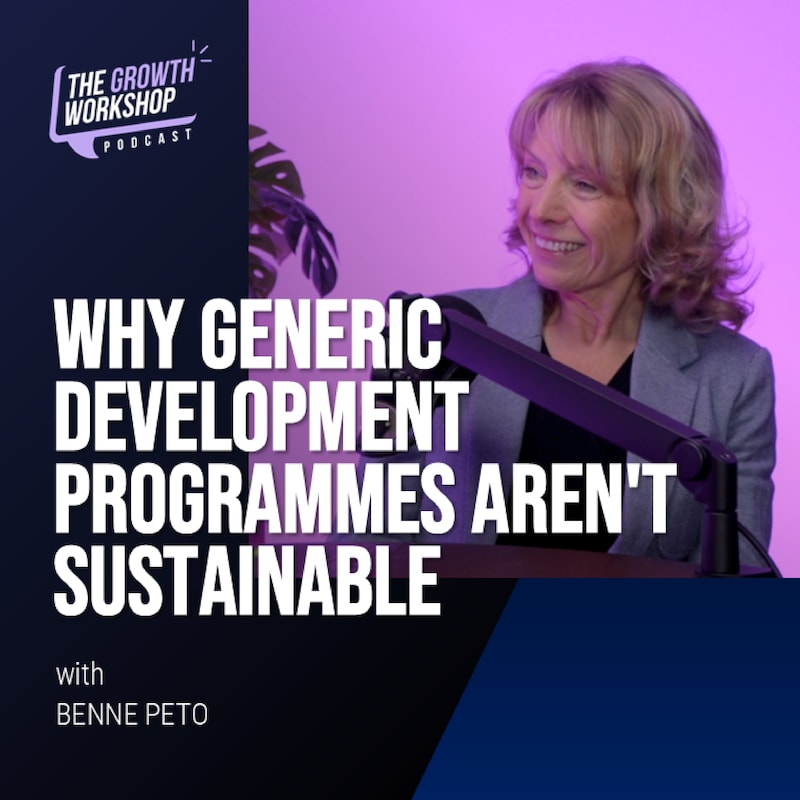
Benne Peto opens with her commercial-to-HR journey and explains why growth-focused people strategy starts with business outcomes, not learning activity. The conversation then lands on the core argument: one-size-fits-all development is expensive theatre unless it is targeted at the people and capabilities most likely to shift performance.
Transcripts
Hello, and welcome to the Growth Workshop Podcast.
Matt Best:In this podcast, we'll be hearing from other industry leaders to get their
Matt Best:thoughts and perspectives on what growth looks like in modern business.
Matt Best:This podcast is aimed at leaders from exec all the way down to line managers.
Matt Best:You're listening to part one of a three-part series.
Matt Best:Hello, and welcome to the Growth Workshop podcast with myself, Matt
Matt Best:Best, and the wonderful Bill Bauer joining me at the table today.
Matt Best:We're both joined by Benne Peto, and she's an experienced chief people officer in
Matt Best:the financial services space, working, with wealth management organizations
Matt Best:and driving organic growth, so Benne, thank you so much for joining us today.
Matt Best:we're thrilled to have you at the table.
Benne Peto:Thanks for asking me.
Benne Peto:I'm really, pleased to be here.
Benne Peto:Yeah.
Matt Best:That's wonderful.
Matt Best:And look, I think as we've talked about, or as I mentioned just at the
Matt Best:top there, this podcast episode really is all around driving commercial growth
Matt Best:within, within the wealth management space, both organic and inorganic.
Matt Best:and I know your- you've got an incredible rich history in this, in this space.
Matt Best:So Benne, tell us a little bit about your career so far.
Benne Peto:Yeah.
Benne Peto:when I was younger, I started actually in commercial roles in
Benne Peto:retail operations, then went into consulting, and then moved sideways
Benne Peto:into HR- looking at change management and development, and then eventually
Benne Peto:moving into HR director positions.
Benne Peto:So I think that sort of background of starting with the commercial heart
Benne Peto:of the business or front of mind before then thinking about what, HR
Benne Peto:tools, what development can I leverage to help deliver on that strategy
Benne Peto:for growth has really, helped me.
Benne Peto:And over the last sort of 15 years, I've been lucky enough to be, a CPO
Benne Peto:or HR director in high growth PE businesses within financial services.
Benne Peto:So I've really had the opportunity to really flex that muscle and make sure that
Benne Peto:HR is really delivering for the business, and its growth and commercial agenda.
Matt Best:Wow.
Matt Best:Yeah.
Matt Best:And I know we've worked together a little bit at, one of those-
Matt Best:Yeah … one of those financial services business, Evelyn Partners, of course.
Matt Best:and, your real- I guess sort of strategic forward-thinking approach that you,
Matt Best:put forward and mandated at Evelyn Partners, I think is, is a big part of
Matt Best:what we're here to talk about today.
Matt Best:And I love that linkage that you make between your commercial experience
Matt Best:and how you could see then as a, chief people officer- Yeah … how it was,
Matt Best:how that was so important in terms of how you could be a, a key component
Matt Best:in the growth of that business.
Matt Best:it'd be good maybe for the, audience just to understand a little bit
Matt Best:about that, what that s- what was that story at Evelyn Partners?
Matt Best:What was it that, that made you take that, take that approach and the approach that
Matt Best:you did, and perhaps even just describing a little bit about that as well.
Benne Peto:Yeah.
Benne Peto:Evelyn was really performing well.
Benne Peto:Now, both inorganically in terms of its M&A strategy, and comparing
Benne Peto:well in terms of its organic growth com- to its competitors.
Benne Peto:So it wasn't as though there was a challenge or a problem with performance,
Benne Peto:but I think the CEO at the time, Chris Woodhouse, saw that, there was a still
Benne Peto:an opportunity to do better, and he set me the challenge of looking at driving
Benne Peto:the development of its practitioners.
Benne Peto:Yeah.
Benne Peto:but what he wanted was to make sure that we were developing the
Benne Peto:right skills with the right people.
Benne Peto:And I'd been in the business for about a year, and of course, I was like, "Yeah,
Benne Peto:can- I can absolutely do that." Walked out the office and went, "Oh my God."
Benne Peto:"What am I gonna do?" So what I really need, it was a blank sheet of paper and
Benne Peto:it was a great challenge and a great opportunity, but what I needed to do
Benne Peto:was to pull together, an approach which was really targeted and analytical.
Benne Peto:So we needed to understand
Benne Peto:what traits, what personality traits were associated with high performance.
Benne Peto:Yeah?
Benne Peto:And, and therefore also to understand the capabilities that were also
Benne Peto:associated with high performance.
Benne Peto:And, we know who are our high performers.
Benne Peto:Yeah?
Benne Peto:We have that data.
Benne Peto:It's within the business.
Benne Peto:So then you can start to correlate what are the personality traits there,
Benne Peto:and what are those people good at.
Benne Peto:So it's not rocket science, it's within your own business.
Benne Peto:You can find it out, but you do need to be analytical, and you do need to be
Benne Peto:targeted and use the right tools, and that's what we're talking about today.
Matt Best:Yeah.
Matt Best:A- and what led you to take that sort of ana- 'cause I guess there, there
Matt Best:would be some in your position who would say, we've got this challenge.
Matt Best:We need to drive that.
Matt Best:Let's focus on, you know- throwing some stuff out there- Yeah … and having
Matt Best:a go at some things- Yeah … rather than taking that day-to-day approach.
Matt Best:What was it that, that, that helped you to realise that's, what you needed to do?
Benne Peto:Yeah.
Benne Peto:I think firstly, the CEO, explained he didn't want that approach.
Benne Peto:He wanted something that was targeted and was going to, give
Benne Peto:us, a real return on investment- and move that performance style.
Benne Peto:And I think all CPOs, all leaders, all businesses have seen those generic
Benne Peto:and vanilla development approaches where you give everybody the same
Benne Peto:development, you spend quite a lot of money, and it doesn't move the dial.
Benne Peto:Yeah.
Benne Peto:Yeah.
Benne Peto:And so you, we know that isn't gonna work.
Benne Peto:I knew it wasn't going to work.
Benne Peto:My CEO knew it was not g- going to work.
Benne Peto:And what the business and the leadership team were looking for was something
Benne Peto:different, something that was based on, I think, more rigor, more analysis, and
Benne Peto:therefore had a higher chance of success.
Benne Peto:And it proved to be successful- Yeah … because taking this approach, we, with
Benne Peto:the pilot group, we saw, a 30% increase on their AUM growth compared to, their QIS.
Benne Peto:The controls.
Benne Peto:Yeah.
Benne Peto:Yeah.
Benne Peto:The control group, yep.
Benne Peto:And, and also that return on investment, that increase in
Benne Peto:performance was sustained over a three- Yes … year period that we measured.
Benne Peto:it, the results speak for themselves.
Benne Peto:We all know what doesn't work.
Benne Peto:But, doing it differently, being more targeted, being more analytical, you
Benne Peto:can get the results you're looking for.
Bill Bauer:Yeah.
Bill Bauer:and I, sometimes think, some of this stuff is what I always think of as L&D
Bill Bauer:theater in a way- Yeah … which is w- we wanna be seen to be doing something.
Benne Peto:Yes.
Bill Bauer:we've got some budget, we've gotta, wanna be
Bill Bauer:seen to be doing something.
Bill Bauer:And I think o- one of the things that fascinates me about that story
Bill Bauer:is th- two, two crucial things.
Bill Bauer:The first one is you start fixing the roof while the sun's shining-
Bill Bauer:which I think is really interesting.
Bill Bauer:So there was no sense of complacency that we're doing well organically,
Bill Bauer:we're doing well inorganically, tickety-boop, nothing to worry about.
Bill Bauer:No, we can, we just power on through.
Bill Bauer:No, there was always a sense that this was a platform from which to do even better,
Bill Bauer:and I think that's, that kind of ambition is really, is really very notable.
Bill Bauer:and the second one is exactly that.
Bill Bauer:The whole thing about, no, we're not just going to do some theater
Bill Bauer:where we are, we're gonna be showing that we've done something.
Bill Bauer:We're actually going to try and do something that makes a difference.
Bill Bauer:And as you say, makes a difference not just once, but
Bill Bauer:actually in a sustained way.
Bill Bauer:That's a really, powerful approach.
Matt Best:Yeah.
Matt Best:And, and when we talk about this thing of, that, that same
Matt Best:development one-size-fits-all approach doesn't work, why?
Matt Best:if you think about the audience here, like why doesn't that approach?
Matt Best:Yeah.
Benne Peto:I, think, what- the more analytical approach does is that you're
Benne Peto:identifying through the personality traits, you're identifying those
Benne Peto:people that have the potential Yeah.
Benne Peto:To change their behaviors and develop further, right?
Benne Peto:And that's where you need to invest.
Benne Peto:Yeah.
Benne Peto:You might e- every organization and team has a range of capabilities, yeah?
Benne Peto:Some lower, some higher, yeah, and, those that are really, high potential.
Benne Peto:But by targeting your development and your investment to those that have
Benne Peto:that highest potential that you've identified, then you're going to get
Benne Peto:You're really going to move the organization forward.
Benne Peto:And it's not that you shouldn't have development for the rest of
Benne Peto:the team, but it's where you're going to invest the most, yeah?
Benne Peto:If you're going to do a high investment, high contact- development, that's
Benne Peto:where you need to do it and that's where you're going to get the return.
Matt Best:I think this is a really interesting point of, I think there's
Matt Best:this assumption perhaps of, if I take a targeted approach, that means
Matt Best:I'm ignoring half the business.
Matt Best:So what you're saying there clearly, and what we would advocate for of course,
Matt Best:is that you'll … it's just about a different approach for different people
Matt Best:at different stages based on their, needs.
Matt Best:Yeah.
Matt Best:So it's actually a fairer outcome for everybody, 'cause you don't get those
Matt Best:individuals who turn up to a training session who are, either bored because
Matt Best:they, you know- Yeah … because genuinely they're high performers
Matt Best:and they, do it all already.
Matt Best:They have
Bill Bauer:the high capability already.
Bill Bauer:Yeah.
Matt Best:Yeah.
Matt Best:Or the other side, where they land in a room and go, "Oh my
Matt Best:gosh, I can't" … I'm stranded.
Matt Best:"I'm stranded. I've got no idea what they're talking about. I don't understand
Matt Best:this language, let alone how I'm supposed to take it forward." Yeah.
Matt Best:So I think, that's a really important point, isn't it?
Benne Peto:Yeah, it, is.
Benne Peto:And the thing is you, through this profiling, the personality traits, the
Benne Peto:key is, looking at your high performers and identifying that profile, yeah?
Benne Peto:Now, it's not to say that those people are, who already, high-performing
Benne Peto:can't increase their performance more.
Benne Peto:Absolutely.
Benne Peto:Yeah.
Benne Peto:But they're going to think that they are already developed, and
Benne Peto:they're probably well developed, but there's always room for improvement.
Benne Peto:But what you're doing is taking those sort of profile and saying,
Benne Peto:who else in the organization who is maybe earlier in their career would
Benne Peto:really benefit from the development, and taking their development up and
Benne Peto:therefore increasing their performance.
Benne Peto:But the key, one of the key things to do is involve the high performers.
Matt Best:Yeah.
Benne Peto:Make them the mentors as well, yeah?
Benne Peto:So you're not just, learning from, let's say, the trainer at the
Benne Peto:beginning, at, the front of the room.
Benne Peto:There are high performers in there, and you're using them as mentors
Benne Peto:to say, "Yeah, that's what I do.
Benne Peto:Yeah.
Benne Peto:That's how I am successful." And actually, you dial up their performance.
Benne Peto:You,
Benne Peto:get them to be leaders of the team from within, yeah?
Benne Peto:And an advocate for the program, and also they're coaching their
Benne Peto:colleagues by being in the room.
Benne Peto:that internal sharing of best practice and learning from others, as well as
Benne Peto:learning from the program itself- Yeah
Benne Peto:the more formal training, is really, important.
Benne Peto:That's
Matt Best:really powerful.
Benne Peto:Yeah.
Matt Best:But it's the proximity to the learner in terms of
Matt Best:the experience level as well.
Matt Best:We often talk about this, of course, in, in, programs.
Matt Best:If I was to, have Rory McIlroy teach or use Rory McIlroy-
Matt Best:Yeah … as a, as a, benchmark for me to play golf, I'm so far off.
Matt Best:Just for the audience, I'm not-
Benne Peto:Yeah
Benne Peto:… Matt Best: as good as Rory McIlroy, right?
Benne Peto:So, therefore it becomes like, I couldn't possibly hit it that far, or I- th- I'm
Benne Peto:never gonna be able to putt that well.
Benne Peto:those are the things, whereas actually by, bringing me closer to
Benne Peto:somebody who's at a similar level, I can start to see the journey.
Benne Peto:I can see the pathway and the opportunity- Yeah … to develop my own skills.
Benne Peto:And, having, that awareness is really, important.
Benne Peto:So when it came to the capabilities, so you said, Benne, and part of that
Benne Peto:program, and obviously part of the work, that we're increasingly doing
Benne Peto:with, with, a l- with a lot of our clients now is- is mapping those and
Benne Peto:understanding those capabilities.
Benne Peto:So again, back to that Evelyn example, like, how did you define
Benne Peto:and assess what those capabilities or behaviors needed to be?
Benne Peto:Yeah.
Benne Peto:So you broadly know, from your competency frameworks- Yeah … what
Benne Peto:capabilities that you're looking at, and they're all probably pretty important.
Benne Peto:Yeah?
Benne Peto:So you still need, let's say there's six or eight key ones, you still need
Benne Peto:to be developing on those fronts.
Benne Peto:But what you're trying to do through this program is really identify the ones that
Benne Peto:really make the difference- Yeah … that you need to focus on first, that are the
Benne Peto:performance accelerators, And the way in which you do that, line management
Benne Peto:assessment of, you're, looking at your high performers, and your line managers
Benne Peto:are saying, are helping you with the assessment saying, "These high performers
Benne Peto:are really good at these things." You also get them to assess themselves.
Benne Peto:That's a valid way as well.
Benne Peto:But you tend to have unconscious competence.
Benne Peto:So maybe, that's not gonna give you all the data points you need.
Benne Peto:But what we found was really, powerful was doing observations.
Bill Bauer:Yeah.
Benne Peto:All right?
Benne Peto:So observing the high performers in action, how do they approach their work?
Benne Peto:How do they approach their day?
Benne Peto:how do they, get things done?
Benne Peto:How do they organize themselves?
Benne Peto:But also, how do they approach developing their network?
Benne Peto:How do they approach, conversations with clients and building relationships?
Benne Peto:So really- observing that, and how that happens within your organizational
Benne Peto:context and your clients, I think that's where the gold dust is.
Benne Peto:So you've got to get into that detail and really try and document
Benne Peto:that and understand what are the capabilities within your organization
Benne Peto:that are, have that X factor.
Bill Bauer:Yeah.
Bill Bauer:I mean- Yeah … w- we've talked about this before, and I think it's such a,
Bill Bauer:again, it's a perhaps a slightly subtle point, but it's a really pivotal one.
Bill Bauer:You talked about your organization and your context.
Bill Bauer:It's not that there is a single profile which will be the same for business A
Bill Bauer:as is for business B, as bus- is for business C. And the kind of thought
Bill Bauer:experiment I always use for this is to say, well- business A is, dominant
Bill Bauer:in the market, very large, has a huge array of internal support resources.
Bill Bauer:and, a- and the role that people are being asked to play is lo- is, principally
Bill Bauer:about servicing an existing base.
Bill Bauer:Business B is a challenger in the market, has a limited brand, very little in
Bill Bauer:the way of support resources, and a lot of what's being done is new business.
Bill Bauer:of course, the profiles that you need, the capabilities you need for
Bill Bauer:those two people are not the same.
Bill Bauer:So it really, you … I think you've used the word unique target capability
Bill Bauer:profile, Benne, which I really like, which is that you need to isolate
Bill Bauer:the unique target capability profile, which is what's driving success in your
Bill Bauer:business in all of the contexts, both external in terms of the market and also,
Bill Bauer:but also really importantly internally in terms of resources and support.
Bill Bauer:some businesses will, want people to do more of this stuff themselves,
Bill Bauer:and others will actually have a whole team which does that for them.
Bill Bauer:And, y- it's not the same.
Bill Bauer:Yeah.
Bill Bauer:It's not the same.
Bill Bauer:So I think that's the crucial point is it's, not just that you need to be
Bill Bauer:correlating capabilities with performance, but you need to be doing it uniquely
Bill Bauer:in your organisation and context, which is another way of saying no cheating.
Benne Peto:Yeah, But it is your- Yeah … what you're doing by
Benne Peto:developing this insight in terms of who are the people that are successful
Benne Peto:within our organisation, what are their personality traits, and what
Benne Peto:capabilities lead to success within our organisation in these roles.
Benne Peto:That's your IP.
Matt Best:Yeah.
Benne Peto:That's your IP as an organisation, and that, building on
Benne Peto:that insight is really going to be able to take you forward in so many ways.
Benne Peto:Yeah.
Benne Peto:really understanding your people, their capabilities, their profiles, and what
Benne Peto:really enables them to perform highly.
Matt Best:Yeah.
Matt Best:Yeah.
Matt Best:And I guess this is
Matt Best:when we think about this from a wealth management context specifically, and we
Matt Best:think about, the challenge for lots of wealth management firms out there at the
Matt Best:moment, which is that, that, the Holy Grail of organic growth- Yeah, And, I
Matt Best:guess it comes back to your talk of, IP.
Matt Best:their IP, the capability's the IP, but the, value is in the
Matt Best:individuals and, what they deliver.
Matt Best:So- Really recognising and understanding that, and they, the 3X performance that
Matt Best:you referred to- Yeah … previously is the, it, that, that's the, that's what we
Matt Best:need to be able to scale across, across the team to find that organic growth.
Benne Peto:Yeah, absolutely.
Benne Peto:And, I think any organization, every organization, including
Benne Peto:wealth management, really needs to get that sustained organic growth.
Benne Peto:Yeah.
Benne Peto:But I think, an organization that can supercharge that,
Benne Peto:yeah- and make it central to its strategy, i- is, going to win.
Matt Best:Yeah.
Benne Peto:And, as you mentioned, wealth management is about those
Benne Peto:relationships with clients.
Benne Peto:It's about building trust and having the expertise.
Benne Peto:It's a highly competitive market, yeah?
Benne Peto:retaining clients is a challenge nowadays.
Benne Peto:Yeah.
Benne Peto:It's really, competitive.
Benne Peto:There's lots of alternatives that clients can go to, platforms
Benne Peto:and, you know- other businesses.
Benne Peto:So you have to, as a practitioner, really work hard not only to
Benne Peto:retain clients, but get new ones.
Benne Peto:And knowing how to do that well, I think every practitioner welcomes and, w- you
Benne Peto:know, we've talked before about, what's in it for the practitioner, right?
Benne Peto:Because they've got to buy into this, they've got to want to do it.
Benne Peto:But a lot, practitioners are client-focused.
Benne Peto:They want to win new clients.
Benne Peto:They want to retain their clients.
Benne Peto:developing them further to be able to do that better, that's a win-win,
Benne Peto:a win for the business in terms of growth and a win for them as well.
Bill Bauer:And, Matt, one of the things I think, again, this coming back to
Bill Bauer:this data-led approach and the what's in it for me, is that of course once
Bill Bauer:you've actually done the correlation work, you can start to give people not
Bill Bauer:just a generalized what's in it for me, which is if these are the capabilities
Bill Bauer:that matter and if you are better at them you'll be more successful.
Bill Bauer:But you can actually start to say to them, "Look, if you got these three
Bill Bauer:capabilities from where you are now up to the level of the average, that would
Bill Bauer:mean X percent more for you." Yeah.
Bill Bauer:X percent more AUM in this case for you.
Bill Bauer:Because we've got data, so you can give people qui- a quantified what's
Bill Bauer:in it for me as well as a general one.
Bill Bauer:And that's not everything.
Bill Bauer:A- as Benne quite rightly says, they're also very concerned about
Bill Bauer:making sure that their clients are getting a better experience-
Bill Bauer:Yeah … and we must never neglect that.
Bill Bauer:But- at some point what goes in their pockets matters.
Benne Peto:Yeah.
Benne Peto:Yeah.
Benne Peto:Absolutely.
Benne Peto:Absolutely.
Benne Peto:And what we found was, those practitioners that had been on the initial pilot
Benne Peto:program, had been through it, we did videos, advocacy videos- Yeah … et
Benne Peto:cetera, of them talking about the impact that it had on their own performance.
Benne Peto:And again, practitioners hearing from other practitioners, from
Benne Peto:colleagues that they respect, that this has really made a difference
Benne Peto:for them, their performance- Yeah
Benne Peto:of course, their bonus at the end of the day.
Benne Peto:Yeah.
Benne Peto:But also being able to retain more clients and, bring more clients into the business.
Benne Peto:you can imagine a practitioner hearing that, that's really
Benne Peto:gonna sell it into them.
Matt Best:Yeah.
Matt Best:Yeah.
Matt Best:And that's the key catalyst, again, as we think about the success
Matt Best:of a behavioral change program.
Matt Best:Stick with us.
Matt Best:Part two continues the conversation
Matt Best:For more insights, make sure you subscribe, and if you enjoy the journey,
Matt Best:don't forget to leave us a review.
Matt Best:Your feedback fuels our growth.
Matt Best:Until next time, keep up that forward-thinking mindset.
Matt Best:Goodbye.



