Shownotes
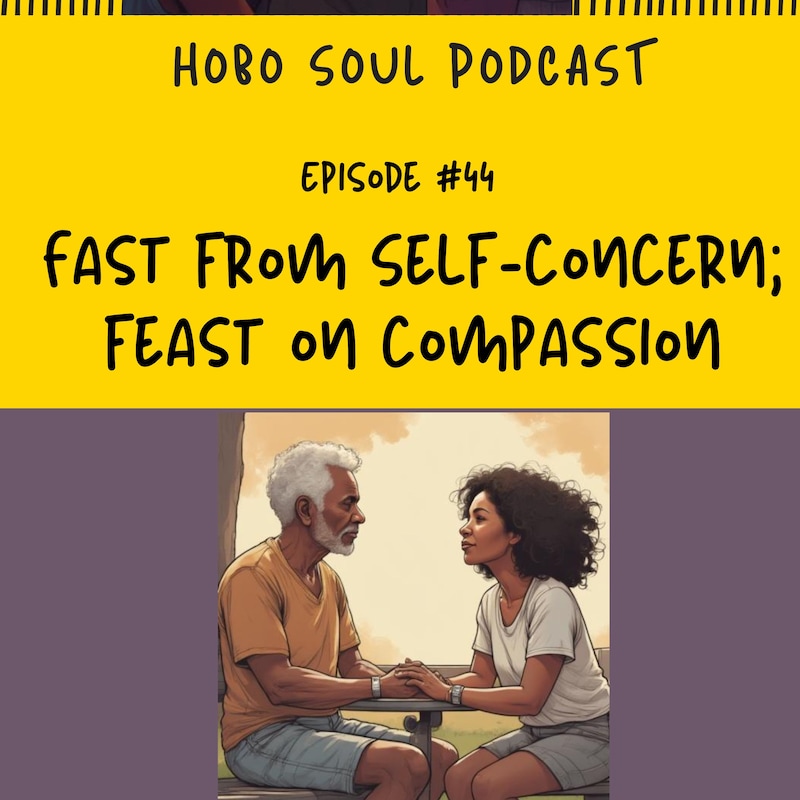
Today's discussion centers on the theme of "fasting from self-concern and feasting on compassion." We explore the biblical command to love our neighbors as ourselves, emphasizing the importance of compassion in our interactions with others. By examining the concept of fasting, we highlight how stepping back from our own needs can lead to a greater understanding and empathy for those around us. The episode also delves into the true meaning of compassion as characterized by gentleness and mercy, contrasting it with the often self-focused narratives prevalent in society. Ultimately, we encourage listeners to reflect on their own behaviors and strive to cultivate a more compassionate approach to life and relationships.
Takeaways:
- Fasting from self concern means consciously prioritizing compassion over personal satisfaction.
- Loving our neighbors requires us to balance self-care with a genuine concern for others.
- Compassion is a gentle emotion that reflects how God cares for His children.
- We often overlook the relational needs of others, which can lead to insensitivity.
- Being aware of our words can prevent us from unintentionally hurting others in conversations.
- We can ask God to help us see the needs around us and to cultivate compassion.
Links referenced in this episode:
Transcripts
Welcome to the Hobo Soul Podcast of Road advised from the Bible and from me, Yvon Prehn, someone who's a little further down the road of life.
I'll talk to you every Tuesday and Thursday for about 10 minutes, and if you'd like more in depth information on walking with Jesus, you can find it at the www.bible805.com website. For now, let's get started on our topic for today, which is
Episode number 44 Fast from Self-concern; Feast on Compassion.
Our verse for today is
"Love the Lord your God with all your heart, with all your soul, with all your mind, and with all your strength. The second is this Love your neighbor as yourself. There is no commandment greater than these."
This comes from Mark:To begin with, I want to talk a little bit about fasting from self concern, the idea of fasting when we do without something that's normally good for us, such as food, it isn't something that we want to continue to do indefinitely. We fast for a time sometimes to get control over what we're fasting from.
For example, part of fasting from Food for a Time can be a conscious attempt to control our eating habits if we feel they've gotten out of hand, or if we feel like we're doing some things that aren't good for us. Sometimes completely doing without something for a time helps us reintroduce it back into our life in a far healthier way.
Food, again, is a good example. We might fast when we feel our eating is out of control, and for a time we cut down or do without food.
But that doesn't mean we're never going to eat again. I think this is an important clarification to make as we talk about the trade off between self concern and compassion.
Self concern in and of itself is not a bad thing, as our verse for today reminds us. We're to love others as we love ourselves, with the implication that we do love and care for ourselves. We're supposed to do that.
But reality is also that sometimes that first part of the verse, loving our neighbor. That part can get left behind or maybe pushed into a corner when we're overly busy making sure that we're taken care of.
I mean, that's what we see on the web and on social media and Everything else, number one, take care of yourself first. Do everything for yourself. But maybe it's time to fast from that, focusing primarily on ourselves, on what concerns us, what satisfies us.
Remember Jesus? It talks about in Philippians how though he was in very nature, God, he emptied himself, he became a servant.
And so maybe we might want to fast a little bit from that and look at the opposite thing that the poem talks about and challenges us on. And that's compassion.
Now whenever I start trying to study something, I like to look up what is the meaning of it, so that I know that I'm talking about the right thing. The Bible has a number of verses about compassion, but what is compassion really?
I looked up the Hebrew word for it because there are many times in the Old Testament where it talks about how God is compassionate to his children. He doesn't destroy them because of his compassion. He loves us because of his compassion. And, and the Hebrew word there is the word raham.
And what was interesting to me though about that Hebrew word is that eight times it is translated as compassion, but the very same word is translated as Mercy 32 times. And often we hear so much about the mercy of God in many ways because they're the same word really in the Hebrew, they're a lot the same thing.
Now what then does that mean mercy, compassion? What are we talking about?
Well, I looked it up a little bit more and in the Hebrew Chaldee Lexicon, again coming from the Blue Letter Bible, this is how it describes that particular word. It says it comes from a phrase meaning to be soft, to love.
It goes on to say the primary idea in this word appears to be in cherishing, soothing and in a gentle emotion of the mind. It is very similar, it says to the love parents feel towards their children, of the compassion of God towards man.
It means to be merciful, to obtain mercy.
I really like that. I love that definition. To be soft, to be soothing, to be gentle, to be cherishing.
Wouldn't it be wonderful to be cared for in that way? It's the idea perhaps of being picked up in a strong, gentle hug.
When I've thought about being compassionate in the past, I don't know if I really thought about this softness and kindness and mercy in the past. I think maybe it was quite honestly tainted with the idea of sort of pity.
Not that pity is necessarily a bad thing, but somehow being kind to someone from maybe a more. More superior place. I don't know. I didn't think of it in such a soft, kind way.
But to be truly compassionate to be compassionate in the way that God loves his children, the way Jesus felt in his compassion for the crowds. Remember, it talks about before he fed the 5,000, that they'd been with him for days and he was concerned about them.
He felt compassion towards them because they didn't have enough to eat. And he recognized that need with gentle mercy.
It wasn't just a superior oh, I'm the Creator God and I've got lots and so I'm going to give to the needy. God's compassion recognizes that we're all beggars. We don't own anything he didn't give us first.
And so we give without holding back to others who have less.
And if we can do it in ways that they don't know who gave it or where it comes from, that's all the better because the focus will then never be on us as the channel that God simply used to give.
Now I want to talk about something a little bit tough, but this really came to mind and that is that in addition to material goods, the people we have or don't have in our lives, they are all a gift also. And here's one area that compassion can be greatly lacking in.
We need to be so careful, so aware of the relational needs and voids in the lives of those around us.
We would never think of flaunting how much money we have to people who have very little, or going on and on about extravagant vacations around people who are never able to take one. Although this does sometimes happen in social settings and even in church related ones.
But sometimes we talk about relationships, let's be honest, in ways that are equally as callous and hurtful as if you talked about eating at a five star restaurant and regaling your small group about it when you know that half the people there can't hardly afford to go to McDonald's. That wouldn't be nice to do. We wouldn't do that about again, money or eating out or whatever. But relationship boasting can be equally hurtful.
Of course it's never intentional, but I'm thinking specifically of the self-concerned complaining about a spouse or his or her irritating little habits in a small group that maybe contains a person recently widowed who would give anything to have the past irritating habits back into their life.
Or complaining frequently how your children just don't do all the things you want them to do. They only visit when you invite them and they don't really hardly ever drop in or anything like that. And doing that around a person unable to have children who might never even have the possibility of a caring child visiting as they grow old alone.
We don't think about those things, about how our words can be so non-compassionate, how they can wound deeply.
If we move out of that castle of self-concern and focus on how meeting our needs is primary, we might see it a little bit if we strive to truly understand the life of the people we're around.
Beyond Sunday school morning smiles and small group chit chat, we may have more compassion for those who may not have the relationship wealth that we take for granted. We may show real compassion by simply being silent or working to talk about relationships and stuff and activities that everyone can share.
We're all lacking in compassion more than we wish, but it's something we can all work on. We can ask the Lord to help us see the gaps, the hurts, the unspoken needs that we might unthinkingly make worse by what we say or do.
We can ask him to help us exchange self concern for compassion in areas of life that we didn't even know needed it. We can ask him to help us reflect his soothing, gentle, tenderest affection to the people around us. And in his loving, compassionate way, He will.
That's all for this podcast, for transcripts, links to related material, and much more to help you learn to know, trust, apply and teach the Bible, go to www.bible805.com for now, let me end with this benediction and prayer.
May you walk each day surrounded by the gracious love of the Father, guided by the gentle wisdom of the Holy Spirit, and conscious of the astoundingly real presence of Jesus, who will walk with you until you're no more a holo soul, no more a transient wandering heart, but at home in the kingdom prepared for you with your God forever. Amen.

