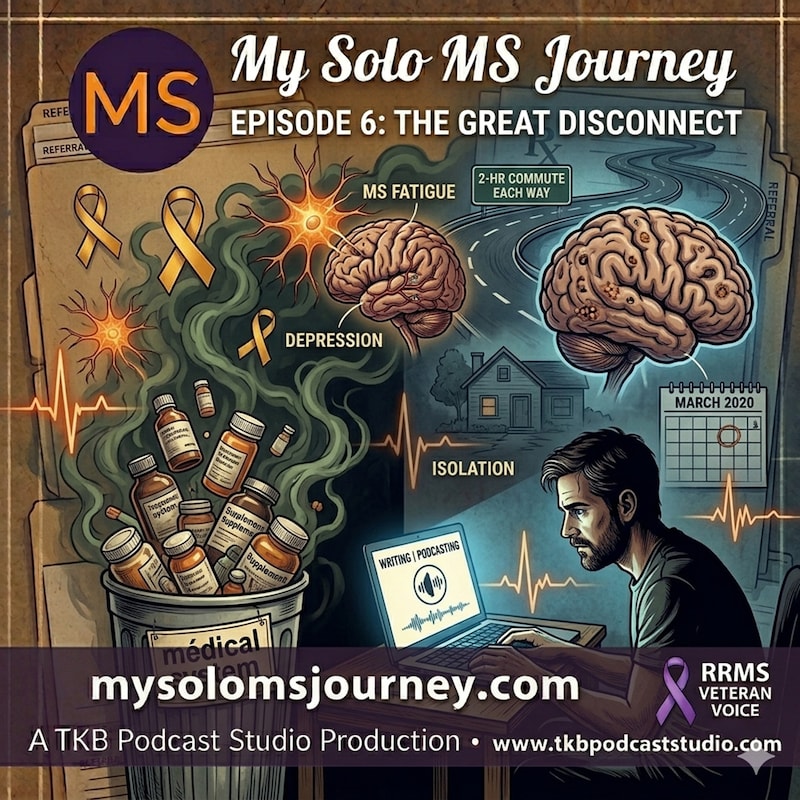
Shownotes
In Episode 6, we explore the breaking point of the "History" era (2014–2021). [Your Name] pulls back the curtain on the mental exhaustion of balancing a four-hour daily commute, newborn twins, and a barrage of surgeries, all while battling the invisible, crushing fatigue of MS. This episode explores the moment [Your Name] decided to fire his neurologist, throw away his medications, and step into a period of medical isolation just as the world faced the 2020 pandemic.
In This Episode:
- The High-Performance Mask: Trying to be the "upbeat" provider who bought a first home while internally drowning in depression.
- The Breaking Point: Firing a neurologist after being told a traumatic spinal tap experience was "just in your head."
- The Medical Sabbatical: The choice to throw out every pill and supplement and walk away from doctors for nearly two years.
- Isolation within Isolation: Navigating the 2020 pandemic through writing and podcasting while feeling physically and emotionally depleted.
This episode includes personal discussion of chronic illness, mental health, medical treatment, and the lived experience of multiple sclerosis. Listener discretion is advised.
Website: www.mysolomsjourney.com
Email Updates: Subscribe on the site to follow the journey
Produced by: TKB Podcast Studio
Thank you for listening to My Solo MS Journey. This is a deeply personal documentary of Timothy Brien's journey with Relapsing Remitting MS. The views expressed are Timothy's alone and are not meant as medical advice. This production is made possible by TKB Podcast Studio, where we help you lead through the noise with quiet professionalism. For more information on TKB Podcast Studio, go to www.tkbpodcaststudio.com to discover what we can do for you.
Transcripts
Welcome back.
Speaker A:I'm calling this episode the Great Disconnect.
Speaker A:Because in the last episode, last two episodes, we talked about the surgeries, the pharmacology, and today we're going to be talking about the man underneath all of that.
Speaker A: Now, by: Speaker A:I moved from a bean bag in Chicago to my first home in Virginia.
Speaker A:I had twins, high paying job, brand new marriage, but I was absolutely empty.
Speaker A:My name is Timothy Bryan, and this is my solo Ms.
Speaker A:Journey.
Speaker A:Now, with the job that I had, my commute was about two hours each way every day.
Speaker A:I started working in the VA while I transferred from Chicago to D.C. working at the VA. And I had to take the train in because traffic in Northern Virginia is insane.
Speaker A:So for four hours of my life, every day was spent on the road, on the rails.
Speaker A:And once I got up to dc, I had to hop on, well, they call it the Metro here.
Speaker A:It's much like the L in Chicago.
Speaker A:It's the subway system.
Speaker A:And I had to go from the train station to my stop on the metro.
Speaker A:So we're looking two hours each way with all these people around me.
Speaker A:Now, if I didn't have ms, I'd be a zombie.
Speaker A:But with Ms.
Speaker A:Fatigue already draining my battery before I could even sit at my desk, I was trying to be the upbeat dad, productive employee, and the attentive husband.
Speaker A:And depression was a heavy, wet blanket.
Speaker A:Ms.
Speaker A:Doesn't just attack your nerves, it attacks your joy.
Speaker A:Now, I was making more money than I ever had.
Speaker A:And at this time, I'd never been more miserable in my life and more alone because all of my friends were back in Chicago.
Speaker A:My family was in Chicago.
Speaker A:Rockford, Illinois, but close enough to Chicago, Texas, Wisconsin, Minnesota, there was nobody around me.
Speaker A:It was just me, myself and I.
Speaker A:At this time, and remember, this is before the diagnosis of ms, the official diagnosis of Ms. Now with all those surgeries and scans and spinal taps I was doing, the breaking point wasn't the surgeries and all the scannings.
Speaker A:It was a conversation.
Speaker A: Now, in: Speaker A:And after being a good patient, I snapped.
Speaker A:I fired him right then and there.
Speaker A:I went home.
Speaker A:And in a fit of absolute impatience and anger, every pillar in the medicine cabinet, every supplement that I had bought to help me out, it was in the trash.
Speaker A:I was done.
Speaker A:I was done with doctors.
Speaker A:I was done with supplying the money for their yachts, for their kids, vacations in Europe for their mistresses, for whatever I was done.
Speaker A:And I stayed that way for about two years.
Speaker A:Nothing with my primary.
Speaker A:No neurologist, no nothing.
Speaker A:And I decided if they couldn't fix me, and they were making a lot of money not fixing me, I'd rather be broken on my own terms.
Speaker A:And it was even lonelier time at that point in my life.
Speaker A: re many of you remember March: Speaker A:And yeah, it was still in D.C. and yeah, I still had to take the train up there.
Speaker A:And it makes me even tired now.
Speaker A:Just thinking about it makes me exhausted.
Speaker A:So I started the job.
Speaker A:And three months later, the pandemic hit.
Speaker A:Now the world was catching up to my isolation.
Speaker A:Folks couldn't go out and travel around freely, and while everyone else was learning to stay at home, I was already there.
Speaker A:I was still exhausted, I was still tired.
Speaker A:I still didn't have my diagnosis.
Speaker A:But now everyone could feel that isolation that I was feeling.
Speaker A:And maybe that was a little vindication.
Speaker A:You know, I really, really was feeling alone.
Speaker A:I didn't have any medical stuff going on.
Speaker A:So I really jumped on the little old computer here and really started writing and podcasting and I was trying to find my voice when my body felt like it was losing.
Speaker A:Losing its own voice.
Speaker A:Now, if you've ever wanted to quit the medical system, I want you to hear what I'm going to tell you and something that I would tell my younger self.
Speaker A:But all the writing I was doing, all the stuff that I was creating, I remember I was referring to my brain as a ticking time bomb.
Speaker A:Just, I was waiting for it to go off.
Speaker A:I was waiting for diagnosis.
Speaker A:But I had already been obsessively researching everything under the sun about Ms.
Speaker A:I probably knew more than most doctors, than most neurologists who don't specialize in Ms.
Speaker A:I was spending hours a day because I had to time because I was stuck at home like everybody else.
Speaker A:And my frustration just grew and grew and grew and my anxiety went through the roof.
Speaker A:Until finally I had to see my.
Speaker A:My doc, my primary care physician.
Speaker A:And we got me back on my regular course of meds and I let him know what was going on.
Speaker A:My wife was getting really upset with me because I wasn't treating this unknown, that I had, this unknown condition that I had.
Speaker A:And I remember walking my twins back from the playground that we have in our neighborhood now.
Speaker A:It's maybe an eighth of a mile away.
Speaker A:It's not that far.
Speaker A:It's A couple minutes walk, But the left side of my body just went limp.
Speaker A:Now, luckily, I had both of them there with me.
Speaker A:They were about 6 at the time.
Speaker A:They just started kindergarten.
Speaker A:And they, of course, pandemic hit.
Speaker A:They are learning from home.
Speaker A:So it's me, my wife, my twins, my nephew, and my stepson, and we're all trapped in this house together.
Speaker A:But I was still alone mentally.
Speaker A:So anyhow, left side goes and it stays gone.
Speaker A:The kids got me home, thank God, but it stays gone for a couple of hours, and I'm not knowing if I'm ever going to get it back.
Speaker A:And that leads me up to 20, 21, and that's a good spot to end at.
Speaker A:Now, what would I tell myself right now?
Speaker A: So I'd look at that guy in: Speaker A:It's okay to be impatient, and it's okay to fire a doctor who, you know, gaslights you.
Speaker A:In fact, you should take a sabbatical from, you know, the docs when the noise gets to be too loud.
Speaker A:But don't spend all that time researching your symptoms obsessively.
Speaker A:It does you no good.
Speaker A:The Internet is a beautiful thing, and it's also a dark hole that's only going to feed your depression.
Speaker A:Be patient with the process.
Speaker A:Some people I know, they got their diagnosis really quickly.
Speaker A:Right away.
Speaker A:Some people, it took years, and for me, it definitely took years.
Speaker A:When you take a pause from the docs, find yourself, you know, the you that exists outside of that diagnosis.
Speaker A:Take a break, but don't give up on the journey.
Speaker A:Basically, what you're doing is you're just clearing out the cobwebs, clearing out the.
Speaker A:Clearing out the weeds in the yard.
Speaker A:You're putting a nice edging on the sidewalk so that way you have a path.
Speaker A:You're going to get back on that journey again.
Speaker A:Sometimes you need to take a pit stop.
Speaker A:Sometimes you need to go off into the rest area, really concentrate on you and concentrate on what you need and how to better yourself.
Speaker A:That's what I would tell myself.
Speaker A:That's what I'm telling you.
Speaker A:If you're about done with it, if you're about ready to throw in the towel, say, screw all the doctors.
Speaker A:Do it.
Speaker A:Do it.
Speaker A:For a short amount of time, you're allowed to do that.
Speaker A:You can fire all your doctors.
Speaker A:You can fire them anytime you want.
Speaker A:They're not going to come crying back for you.
Speaker A:To come back into the office because they've got other people that they're going to deal with.
Speaker A:And, you know, maybe I was thinking that, you know, somebody would call me back and say, hey, Tim, just.
Speaker A:Just come back to the office.
Speaker A:Let's talk this out.
Speaker A:That never happened, and that's never going to happen.
Speaker A:More than likely it's never going to happen.
Speaker A:If it does, let me know.
Speaker A:It never happened for me.
Speaker A:So take that time away when you need to, but then you need to get back up on that horse.
Speaker A:If not for yourself, for your spouse, for your kids, for your family, for your job, whatever it takes for the great spaghetti monster in the sky, whatever it is, you need to get back on that horse.
Speaker A:And I can tell you, as somebody who does have ms, we are some tough motherfuckers and we can do it.
Speaker A:May take a little time, may do it a little bit slower, but get back on that horse and get back to getting your health under control.
Speaker A:That's all I got for you this episode.
Speaker A:I want to thank you for joining me on this solo Ms.
Speaker A:Journey.
Speaker A:As you can tell, I kind of tired of being solo on it, so that's why I'm doing this.
Speaker A:For all the episodes, you can go to the website mysolomsjourney.com you can email me Timothy kbpodcast studio.com it's the company that I run.
Speaker A:It's gonna be okay.
Speaker A:I'll talk to you next time.