Shownotes
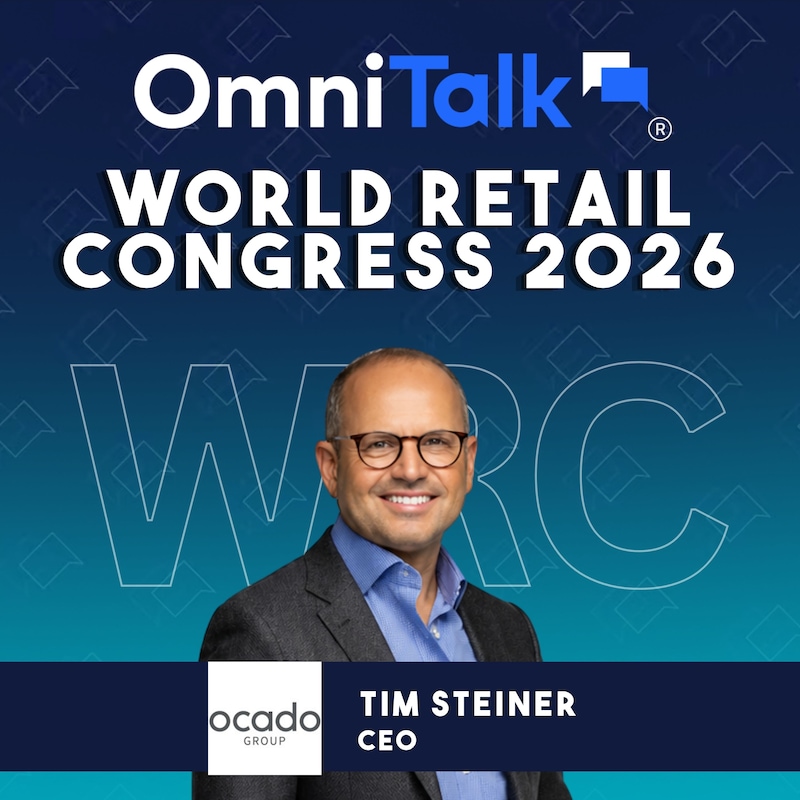
In this Omni Talk Retail interview, recorded live from World Retail Congress 2026 in Berlin, Chris Walton connects with Tim Steiner, CEO of Ocado, to discuss the rapidly evolving future of grocery ecommerce, fulfillment, and retail automation.
Drawing from Ocado’s work with retailers across global markets, Tim explains why grocery ecommerce continues to operate so differently market by market, from the UK’s delivery-led ecosystem to France’s pickup dominance and the increasingly hybrid US landscape. The conversation explores how local consumer behavior, labor economics, and store infrastructure continue to shape fulfillment strategies worldwide.
Tim also shares why automation and micro-fulfillment are beginning to regain momentum after several uneven years across the industry. He explains why many early automation deployments struggled to produce strong returns, why growing ecommerce volumes are creating new urgency around fulfillment capacity, and how Ocado believes robotics can help retailers improve both operational efficiency and customer experience over time.
The interview also dives into:
• Why the US grocery ecommerce market has evolved so rapidly
• The operational differences between delivery and pickup models
• Why many first-generation micro-fulfillment solutions failed
• How automation economics improve as online grocery scales
• The growing capacity challenges facing US grocers
• Why sub-one-hour fulfillment changes the economics of picking
• How robotics can improve both efficiency and speed
• Why retailers may eventually need automation to stay competitive
• The complexity behind building scalable grocery automation systems
• How Ocado approaches fulfillment differently from traditional automation providers
Thank you to Vusion for supporting Omni Talk Retail’s live coverage from Berlin.
#WorldRetailCongress #WRC2026 #OmniTalkRetail #Ocado #GroceryRetail #Ecommerce #MicroFulfillment #RetailAutomation #SupplyChain #FutureOfRetail
This podcast uses the following third-party services for analysis:
Podcorn - https://podcorn.com/privacy
Transcripts
Hello, everyone.
Speaker A:This is Omnitalk Retail.
Speaker A:I'm Chris Walton and we are coming to you live once again from the World Retail Congress in Berlin from the Vusgen Podcast studio.
Speaker A: iew last year at Grocery Shop: Speaker A:Tim, how are you?
Speaker B:I'm good, thank you, Chris.
Speaker B:It's nice to be back with you.
Speaker A:It's nice to see you again, too.
Speaker A:So you just got in last night, right?
Speaker B:I did.
Speaker A:And what brings you to wrc?
Speaker B:I am speaking on a panel later.
Speaker A:Okay.
Speaker A:On what?
Speaker B:Emerging trends, I think relevant.
Speaker B:But I mean, the exact name of the panel is one that I'd have to check.
Speaker A:Yeah, right.
Speaker A:I know, right?
Speaker A:That's always.
Speaker A:That's always the tricky part.
Speaker A:It's something long with a colon and everything.
Speaker B:You know your subject, you know your topic, right?
Speaker B:Yeah, I'll take part and you go with it.
Speaker A:Yeah, you kind of are an expert on your subject for sure.
Speaker B:Have you been here before to wrc?
Speaker B:Yes, yes.
Speaker A:Yeah.
Speaker A:And how do you find the show generally?
Speaker B:They're always fascinating because, you know, I don't always get into as many of the sessions as I'd like to, which are usually super interesting, but also just it's a great opportunity to catch up and meet new people and sometimes see, you know, new things.
Speaker B:So always learn something, meet someone interesting, chat with interesting people like yourself.
Speaker B:Thank you.
Speaker B:Flat reel gets you everywhere too, you know.
Speaker A:Yeah, yeah.
Speaker A:No, the networking here is high class too.
Speaker A:Very high class.
Speaker A:All right, so I was thinking about what questions do I want to ask you today?
Speaker A:And so I kind of bucketed into like three different things.
Speaker A:And so the first thing I wanted to ask you about is if you think about the market globally.
Speaker A:I last interviewed you, God, it was almost nine months ago now.
Speaker A:It's hard to believe how time flies.
Speaker B:Wow.
Speaker B:But yeah, right.
Speaker A:Crazy.
Speaker A:How would you sum up that?
Speaker A:The global market is looking at the fulfillment mix itself for E commerce.
Speaker B:So I would say it's still incredibly different around the world.
Speaker B:So you've got different consumer behaviors, you've got different labor rates, you've got different property prices, you've got different store sizes, you've got different legal, regulatory, union type quirks that all influence the way the markets have evolved and the way that you should efficiently operate in a market.
Speaker B:What kind of thing do?
Speaker B:I mean, my home country, the UK is still a delivery market.
Speaker B:It's probably well over 90% of all E Com grocery is delivered.
Speaker B:And the vast, vast majority of that, you know, 80 plus, 80 to 90% of that is what I call scheduled delivery.
Speaker B:It's kind of, you know, at least three to four hours out, mostly today for tomorrow.
Speaker A:Okay.
Speaker B:And then there is a growing short lead time, you know, business sub one hour.
Speaker B:And the pickup is something that the UK grocers have wanted to do for years, but just never gains any significant traction.
Speaker A:Right.
Speaker B:If I just go across the English Channel, which is a pretty small body of water and I get to France, you know, the food's great and there's other great attributes there.
Speaker B:The market is completely opposite, right.
Speaker B:And it's a 90% pickup market, okay.
Speaker B:Largely from, not from every supermarket interestingly.
Speaker B:So the retailers have managed to concentrate the customers to go to like not every store that they offer it from.
Speaker B:But it's a very significant market and it's all pickup.
Speaker B:The rest of Europe looks more like the uk.
Speaker B:Move over to the, you know, your home country and I think you're something like 50% pickup, 50% delivery these days.
Speaker B:But the retailers own businesses are 70% pickup and 30% delivery.
Speaker B:And then you've got the add ons of instacart and doordash and people that are 100% delivery.
Speaker B:Most of it is two hours plus and you've got a growing sector that is sub one hour.
Speaker B:Now what does that mean for automation?
Speaker B:Is that the right automation in most European non French market is still, you know, depending on the scale of the business though, the most efficient thing is to do large scale, automated centralized sites with routes that are doing 20 to 25 deliveries on a scheduled route or 10 to 15 on a shorter route that does a turnaround, this type of thing.
Speaker B:But the benefits of the scale and the centralization and the robotics means that you can sell groceries at the same price as a hypermarket with a relatively token delivery fee.
Speaker B:And if you have the volume, you will make at least the kind of margins that you make out of physical store retailing in the markets like the US where at least half that business is going to be picked up from a store and half that business is going to be delivered.
Speaker B:The delivery is cheaper with a courier based, you know, a gig economy for a variety of reasons you can't, you know, how do you take advantage of the tipping that the U.S. is, you know, it's a cultural thing in the U.S. how do you take advantage of it if you employ the driver because you're still paying them all the wages and all the fringes and stuff like that.
Speaker B:So you can definitely see why it has trended towards a gig based pickup.
Speaker A:Got it.
Speaker B:And then if you're going to do pickup and delivery, you know, the hyper local location of your store is attractive.
Speaker B:What's so interesting is, you know, we were on a journey as a kind of partner with retailers on a very exclusive basis for about eight years.
Speaker B:So the last eight years in many of our markets we've been exclusive to one retailer that's all fallen away and now we're kind of open.
Speaker B:In that time the global market has doubled in E commerce, but the US has gone up nearly 8x.
Speaker B:So the US eight years ago was a kind of sleepy behind.
Speaker B:The global trend market rapidly caught up.
Speaker B:US consumers clearly love the convenience of either just driving past the store and having it put in their trunk or boot as we would call it in the uk or having it delivered to their homes.
Speaker B:And so the US market has transformed in that sense.
Speaker B:And you know, hyperlocal didn't work in any way other than manual in the US eight years ago because the individual store volumes were so light.
Speaker B:They were like one or two million dollars a store.
Speaker B:No point about thinking about anything like automation, just clearly not viable.
Speaker B:Right now you're getting stores that are doing over 20% of their sales volume that can be turning 25, 30, $35 million of E comic and the average can be 10 to 15.
Speaker B:And you know, automation could solve two challenges if someone can get it right.
Speaker B:And the first challenge is capacity.
Speaker B:So a lot of US stores we're seeing are either already through or are approaching, are growing and approaching max capacity where it's very disruptive to their regular customers or just physically impossible with the kind of space at the back of the store to do the aggregating and the consolidation and dispatch and stuff.
Speaker B:So I think that's a big challenge.
Speaker B:And then obviously there's the whole kind of cost perspectives and the ease of use from the consumers and stuff like that.
Speaker B:So I think automation is absolutely right now we're talking to a number of players in the market in those locations.
Speaker B:I mean, if you're doing, you know, 10, 15, 20, $25 million, you're maxed out now and you're losing business to your competitor.
Speaker B:You don't want to do that or you're just degrading the customer service because whilst you've got a theoretical two hour or four hour offer, it's not two hours or four hours if you're sold out for the next three days, right?
Speaker B:Right.
Speaker B:It's become a four day service.
Speaker A:Right.
Speaker B:And so I think that the market needs some automation.
Speaker B:But let's be clear, people have been playing the automation game in stores for, you know, at least eight years.
Speaker B:Takeoffs.
Speaker B:I can't remember when they were prominent, but probably six or seven years ago.
Speaker B:And they didn't work because they used too much space, they needed too much capital and they didn't generate the efficiencies.
Speaker B:We're able to deploy the same product that we developed for the big sites that we're better known for globally in terms of the kind of ASRs type, the cubic storage machines that we have combined with the on grid robotic picks that we do, where we're now picking millions of items a week, we're picking over a million and a half items in individual sites a week, fully robotically.
Speaker B:So we're able to kind of combine that and deploy it in small formats from 5,000 square feet to 20,000 square feet, from $10 million to $100 million of throughput, from 8,000 to 35,000 SKU range in them to doing things like merging stuff that's coming from other parts of the retailer, like scripts and things like that in there.
Speaker B:So we haven't deployed anything at scale.
Speaker B:We are super confident about this space.
Speaker B:We think it's unbelievably interesting.
Speaker B:And so we think that that will emerge as I think, a massive product in the US market.
Speaker B:But we'll continue building big sheds in Europe for scheduled delivery and I think we'll add some of those on in Europe for the, you know, for the growing ultra short lead time.
Speaker B:When you move into the ultra short lead time, what happens is you can no longer batch pick in a store.
Speaker B:So to gain the efficiency in the store pick that everybody globally does the majority of volume in you batch, you know, 6, 8, 10, 12, 16 customers or whatever it is onto a single trolley.
Speaker B:You then divide the store up into different areas and you go out and pick one to 200 items at a time.
Speaker B:And the pick takes you, you know, 30, 40, 50 an hour.
Speaker B:Yeah.
Speaker B:Right.
Speaker B:Before you get it back.
Speaker B:And of course, remember, you got to take all those orders first and then systemically batch them and then send the person out.
Speaker B:And that's why two hours of four hours is the kind of standard.
Speaker A:That's why we're at the level that we are.
Speaker B:Right.
Speaker A:Yeah.
Speaker B:But that now we have services, a lot of them that say we'll do it in under one hour.
Speaker B:When you do that, you run out and pick an individual customer order, your pick rate drops between 50 and 75% in efficiency.
Speaker B:So the labor cost goes up dramatically.
Speaker B:You charge the customer a significant premium.
Speaker B:Using the automation, there shouldn't be a premium.
Speaker A:Okay.
Speaker B:And so if you think that's an emerging and growing part of your business, the automation is even more valuable because we can pick an order in minutes at no incremental cost compared to picking the, you know, the kind of, the more scheduled stuff.
Speaker A:Right.
Speaker A:So it should get you faster ultimately.
Speaker A:So.
Speaker A:All right, Tim, so let me get you out here on this.
Speaker A:I love, I love talking to you too, because I can just listen to you forever talk about this subject because you're such an expert on it.
Speaker A:You kind of alluded to it already, but.
Speaker A:And you know, and I've watched it happen too, but you know, especially in the us the desire to go into micro fulfillment for automation, whether at the store level or say like a nearby site, a dark store, quote unquote, it's gone up and down like it's waxed and waned.
Speaker A:And it felt like we were felt like coming out of the pandemic, it was like at a trough, it started to bounce back up.
Speaker A:Now it felt to me like it was kind of going back into a trough.
Speaker A:But you're saying the opposite.
Speaker A:You're saying you think the demand is still there to experiment and deploy the capital to try to accomplish what you're accomplishing.
Speaker B:Yeah, look, I would say that pre pandemic there was a lot of just a general experimentation and actually it's one of the reactions to some of our clients starting to build big sites was competitors to try and build micro sites and see if they could achieve the economic advantages of the big sites, but in a more hyper localized way.
Speaker A:Right.
Speaker B:Mostly fortunately or unfortunately, I'm not sure they failed because actually the automation and the software wasn't there.
Speaker B:So actually the promised benefits that were supposed to arrive didn't arrive.
Speaker B:What the retailers discovered was actually it was costing them more than doing it manually.
Speaker B:It was super complicated and therefore a lot of them just got decommissioned, which makes absolute sense.
Speaker B:As in no one needs to buy automation because it looks clever.
Speaker B:You want to buy automation because it financially saves you money and delivers a better experience for your end shoppers.
Speaker A:Funny how often that happens, correct?
Speaker B:Absolutely correct.
Speaker B:Covid, obviously huge growth, but very hard for people to deploy things because, you know, there's only certain stuff we were allowed to do and stuff like that.
Speaker B:Right then you came out of COVID and the manual capacity that a lot of people have built now Wasn't getting used because there was a bit of a reversion back to physical retail.
Speaker B:And so the idea of investing capital into a business that was in retreat was obviously very limited.
Speaker B:Then we stabilized and we grew for a bit and people were a bit more confident.
Speaker B:But actually, it's when we've grown around the globe to not just grow, but get back to doing the peak volume we did during COVID and then go beyond.
Speaker B:So now we don't have.
Speaker B:People don't have the capacity out there.
Speaker B:Now, as I say, I think the driver at the moment, I think that there is a little bit of a less demand in the sense that between the gig economy, the tips and charging, that the retailers got themselves in a bit of a more comfortable position plus scale.
Speaker B:Because if you built a dedicated pickup port and you spent $150,000 doing it or $200,000 doing it, but the store was only doing a million dollars, we're doing in the UK we're doing about 1.3 million pounds of sales per van per year.
Speaker B:So you translate that into the US in my head right now, as I'm doing, that's about 1.7 or so million dollars of sales from a single van.
Speaker B:A van cost like $80,000.
Speaker B:People were spending two or three times that to create a pickup port, saying, oh, it's much cheaper, because my customers come to me.
Speaker B:Meanwhile, actually, they were spending way more.
Speaker B:They were using more labor and more asset to do it when the stores were at 1 to 2 million.
Speaker A:Okay.
Speaker B:So they've also had the advantage of these stores, like, going up Eightfold in volume.
Speaker B:And they've got to a bit of an equilibrium where people feel a little bit more comfortable, I think, with where they are, where the discomfort's coming back in again, where the demand, the initial demand is they're maxing out.
Speaker B:This thing just doesn't stop growing.
Speaker B:So it's like if you could just put a lid on it, we'd all be quite happy.
Speaker B:Right?
Speaker B:But no, the consumer wants more and more and more of it.
Speaker B:And it's like we're running out of capacity now.
Speaker B:I think that at the moment, there's not a big drive to try and do something to try and save 5 or 10% operating because actually people perceive the risk of failing to be worse than the, you know, the other side of succeeding.
Speaker A:Yep, that makes sense.
Speaker B:I think is going to happen in the market is the.
Speaker B:The drive to create more capacity because serving your customers is paramount.
Speaker B:That's going to drive the initial trial.
Speaker B:If the Trial shows what I suspect it will, that you're going to see significant cost savings with, you know, very low single digit year returns on upfront investments, then the people are going to go, hold on a minute now I've deployed this and I can see that it works.
Speaker B:I can now roll it out across my network in a sensible way from the busiest stores down to the least busy over time.
Speaker B:So that's a trend I wouldn't be surprised to see.
Speaker A:Right, and how do you think about that trend competitively in your mind?
Speaker A:Is this something that particularly again from the US market, is this something that US grocers are going to eventually have to do to stay competitive or is it not quite that yet?
Speaker B:Look, I think that if it's just giving capacity to your competitor and you still have manual capacity, then you don't have to do it at the point that your competitor is now operating their business at 5 or 10 points lower, you know, all in fully amortized, fully costed economics than you.
Speaker B:You're going to find that you probably have to do it as well.
Speaker B:You do.
Speaker B:Okay, I think where for 20 years people underestimate the complexity and the difference between a good one and an average one and a bad one.
Speaker B:Okay, ok. People think automation is automation.
Speaker B:I think people naively sometimes think when I want it I'll just do it.
Speaker B:And I can buy that from anybody that sells automation.
Speaker B:And the industry is littered not just in E Com grocery but also in case replenishment to store with solutions that didn't actually deliver the benefits they were supposed to.
Speaker B:And I think one of the reasons why we believe in our future success is that we really understand the grocery industry because obviously we run a grocery business.
Speaker B:We we have a 5 billion a year run rate grocery E Com entirely automated business in the UK which if you think the UK is a pretty small place, it's not a small achievement.
Speaker B:And you know, we understand the flows.
Speaker B:We have manual picking software in over a thousand stores.
Speaker B:So to the extent these are built, attached to stores or in stores, the integration between utilizing the capability the store and the automation is something we really understand most automation players won't the vagaries and the throughputs and the kind of peaks and troughs and challenges with inbound and storage and stuff, they're all things that we totally understand.
Speaker B:We simulate and model all these things before we design them for clients.
Speaker B:And so I think people just massively underestimate how complex and difficult it is to make one of these things great.
Speaker B:But we believe that that's exactly what we can do with the product set we have now in these new formats.
Speaker B:And that's what we're working on.
Speaker A:Got it.
Speaker A:Got it.
Speaker A:Yeah, that makes sense.
Speaker A:So, you know, it comes back to me, like, at some point we are going to see this.
Speaker A:It's just a question of when, you know, at the end of the day.
Speaker A:Well, Tim Steiner, thank you so much.
Speaker B:Thank you.
Speaker A:Absolutely.
Speaker A:Pleasure to see you again, too.
Speaker A:Yes.
Speaker A:Tim Steiner, the CEO of Ocado.
Speaker A:Thanks to Vuzion for allowing us to bring you all of this great coverage from all these fabulous retail executives at the World Retail Congress in Berlin.
Speaker A:And, and on behalf of all of us at omnitalk, as always, be careful out there.