Shownotes
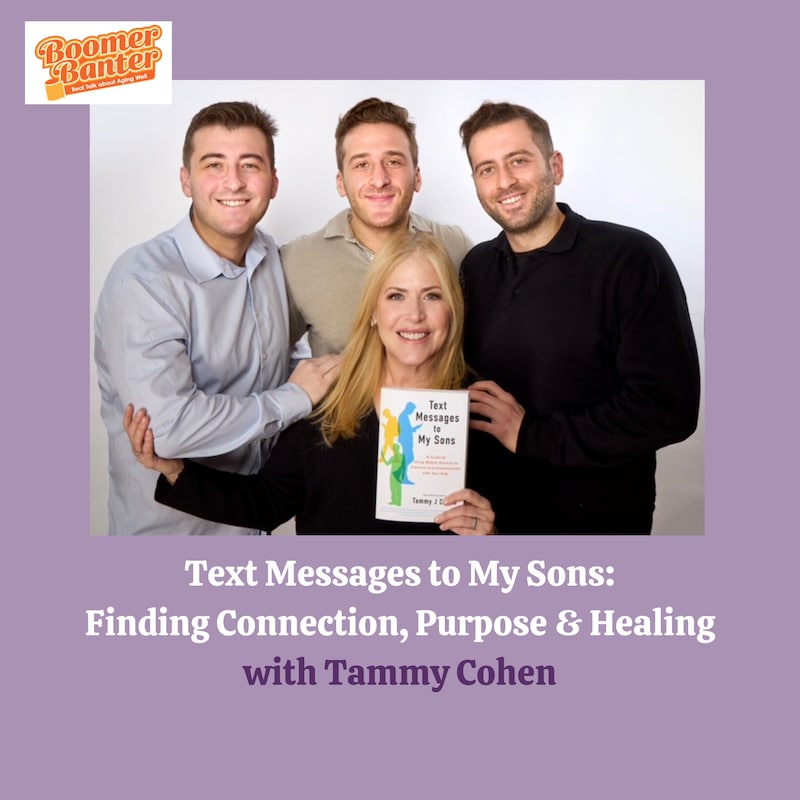
Wendy Green, the delightful host of Boomer Banter, dives deep into the heart of familial connection in this episode with Tammy Cohen, a passionate author, entrepreneur and mother. Tammy shares her journey of writing text messages to her three sons during the pandemic, which began as a means to communicate amidst uncertainty. But these weren’t just ordinary texts; they evolved into a heartfelt collection that conveyed love, wisdom, and support. Through their chat, Wendy and Tammy explore the essence of these messages, reflecting on how they serve as a bridge between generations. A big theme here is that life is full of gifts, even in tough times, and Tammy’s story illustrates how we can transform challenges into opportunities for personal growth and connection.
Tammy’s book, “Text Messages to My Sons: A Guide to Using Mobile Devices to Connect and Communicate with your Kids,” is not really about parenting; it’s about self-discovery and the importance of nurturing relationships with our loved ones. She emphasizes that these texts were a way for her to share what she learned about gratitude, resilience, and self-worth. The conversation highlights how Tammy’s introspective journey led her to a deeper understanding of herself, and how that in turn allowed her to foster a more profound connection with her sons. It’s a beautiful reminder that our vulnerabilities can become strengths, and that love is a language that transcends generations.
Throughout their lively exchange, Wendy and Tammy sprinkle in humor and relatable anecdotes, making the conversation feel like a cozy chat between friends. They discuss the reality of parenting & grandparenting in the digital age, where reaching out via text is often more effective than traditional methods. The episode is both uplifting and informative, encouraging listeners to embrace their own journeys of connection and communication with their families, while also reminding us that it’s never too late to start sharing love and wisdom.
Takeaways:
- During COVID, Tammy started sending her sons daily text messages filled with love and wisdom.
- The journey of self-discovery can lead to profound connections with loved ones through simple messages.
- Connecting with loved ones is something we all need.
- Aging well means always learning, staying connected with loved ones, and taking care of your health.
Links referenced in this episode:
This podcast uses the following third-party services for analysis:
OP3 - https://op3.dev/privacy
Transcripts
Hello and welcome to Boomer Banter, where we have real talk about aging. Well, my name is Wendy Green and I am your host.
And every week we have honest conversations about what it really means to grow older in today's world. We talk about navigating health. We talk about purpose, relationships, caregiving, and everything in between.
I was introduced to my guest today, Tammy Cohen, by my sister's partner. He had known her professionally, and they had developed a trusted relationship over time.
And then when he heard that Tammy had written a book called Text Messages to My Sons, a guide to using mobile devices to connect and communicate with your kids. It's a mouthful, right? He thought she might be a good person for my show. I said I would talk to her, but honestly, I had some trepidation.
I know my kids don't like anything that sounds like advice. And I wasn't sure what Tammy's text messages were going to be like.
But we connected and started chatting and, like, instantly I knew that I had to have Tammy on the show. Yes, her book is a collection of text messages she started to send her sons during COVID but it is so much more. It's a journey of self discovery.
It's an exploration of dealing with health challenges. It's a sharing of love and support for her three sons, and it is all in the form of text messages.
So I'm looking forward to introducing you to Tammy and having her share her story with you. I also want to take a moment to appreciate that the 20 living hostages have been returned to Israel.
Many mothers, fathers, wives, siblings, and children who could not send messages of love like Tammy has done over the past five years are now going to be able to embrace the loved ones that were taken over two years ago. And with that, let me welcome Tammy to Boomer Banter. Hello, Tammy.
Tammy Cohen:Hi, Wendy. I just want to tell you thank you so much for bringing up the homecoming, the returning home of 20 living hostages. It's such a momentous time for us.
And when you spoke about their parents not being able to be in contact with them or message them or have any communication, that was something that always was in back of my mind because I was always, like, thinking, God, these poor, these poor hostages are in tunnels. They're young, they're. It's. They're in the hands of a savage enemy. And I just was like, as parent, it's some.
Something you can't even wrap your head around. So thank you for acknowledging that. Thank you for your beautiful welcome. Really, I'm very moved.
Wendy Green:Well, thank you for Being here, Tammy. So I want to start at the beginning. It was Covid time, right? And you started to really write these messages.
But it wasn't just a checking in with your kids to see are you doing okay in Covid. Just talk to me about what inspired you to do this. Was it daily? And what was going on in your life?
Tammy Cohen:Well, we all. You know, Covid seems like it was a while ago, but it was really just five years ago, if you really think about it. And at that time, I was working.
I was traveling two weeks out of the year. All my validation as a human being came from my job and my clients, and that was it.
Like, I wasn't an emotionally happy person, but I didn't even realize it because I was always busy. Okay. And when the pandemic happened, which happened to a lot of us, you know, things kind of just shut down. We were home. We. We weren't working.
I know I lost, like, 50% of my pay off the bat. I wasn't traveling. And my clients, you know, it was like, where are the clients? So I had a lot of time to sit and think, like we all did.
And, yes, it was a challenging time, but in a lot of ways, it was very transformative for me because I had really come to deal with myself and my limiting beliefs and my mindset, and I realized I wasn't okay. I wasn't happy. And I really knew that I needed to work on myself.
So in those days, what I did was I hired a life coach, I hired a business coach, and then I got very involved with every program under the sun. I was reading nonstop. I did Unleash the Power within virtually twice. I was Joe Dispenza, you know, like every thought leader, Robin Sharma.
I was reading like crazy, and I was learning a lot. And it's funny, I never became a certified coach, but I've done enough programs where go for certification. But it was more because I wanted to learn.
And the one thing that was very consistent for me, Wendy, was realizing that we. They don't teach any of this stuff to our kids, us in school.
Like, I'm from that generation where you listen to parents, you didn't question anything. You love them and respected them. That was it. And my. My mother, my.
They weren't interested in what I had to say or what I think, and they weren't asking my opinion. This is how it was. I had to respond. I had to be available. We didn't have cell phones. The distractions weren't the same.
And it's very different time, right.
So I was like, wow, you know, gratitude, mindset, stuff, appreciation, leadership, mindfulness, any of these things, beliefs, thoughts, you know, nobody talks about them and nobody talks about where they come from, and nobody talks about generational discord or your soul or any of these things. I was like, wow, you know, I'm learning all these really amazing things. And it was kind of a spiritual awakening for me.
But I said, I really want to share this with my kids now. At the same time, I was reading Atomic Habits by James Clear and, you know, think and grow Rich.
I was just reading non stop because as Tony Robbins says, the best thing you do is get yourself either a mentor or read books.
Because there are people who lived a very long time ago, thought leaders from 100 years ago or less, who spent years figuring something out or learning or going through a very hard road, and they put it in a book that you could read in a week or two. Honestly, that knowledge is out there, you know, So I was like, this is incredible.
So I just started really messaging my kids like daily to share what I was learning. But what happened, Wendy, is in sharing wisdom that I was learning, I was kind of work, like parenting with them in a way.
Wendy Green:I was sharing yourself?
Tammy Cohen:Yeah. I wasn't telling them, I wasn't telling them what to do. I wasn't advising them. I was just sharing what I was learning.
And what happened was I started also sharing the amount of love I have for them. And I started saying to them how much they matter and how worthy they are and how extraordinary they are because nobody told me that.
I was always looking for it. And I just said, you know, I want them to know these things. It just all started coming together.
It became very heart centered and my heart was opening up. And I realized this isn't a one and done practice because you can't send a message and say, I love you, I think you're great.
You know, then you're reprimanding them the next text. No, it has to be like a consistent practice. And that's where the James Clear part was, helping me build this habit, this, this daily habit.
Wendy Green:So, so these kids who, like, who is this woman? She was never like this. She was never so, like introspective and, you know, thinking about herself and what she needed to do to change and grow.
And now she's telling us all these things and loving. I mean, what kind of reaction did you get from those boys?
Tammy Cohen:Well, the first thing that I thought to myself was, I have zero expectations in return, you know, that they'd even respond to me because, let's face it, I decided I wanted to reach them where they were, which is on their phone. Like, this generation is on their phone. We're all on our phones. Okay, let's be honest.
I don't know anybody who's having in person conversations except you and I. Right? Seriously, like, think about it. Most people are looking at their phone. It's in their pocket, it's in their hand, it's in their.
Their pocketbook. So that's like the first point of contact. So there was two things I thought, if I want to.
If I want to be in touch with them, if I want them to take in anything that I'm trying to share with them, it has to be through their phone. And it has to be simple. It has to be a text message. I mean, you could do it with WhatsApp. You can do it, however works for you.
But I realized that's where they were. And the second thing was I realized this is an unconditional act on my part.
I have zero expectations that they will respond or that they will even appreciate it. Not what this is about. I'm looking to deepen a connection, and I want to start from meeting them.
Because, look, Wendy, if you want respect, you have to model respect. If you want somebody to be accountable, you have to kind of model accountability.
So for me, I was modeling learning and growing and sharing and that regardless of the age, you know, you can do something new. You can become aware of something. You can change direction and say and try to do something to make things better, to communicate differently.
Wendy Green:This was very brave of you, Tammy. You know, you. You said you had this very successful career, right? And, and, and so finally forced on you.
You had to take some time to look at yourself. And now it's like, oh, how long did it take you to say, I have some broken pieces that I need to fix and then start to share those with the kids?
Tammy Cohen:Oh, okay. That's a really great question, because I knew it. I always was the one who, you know, I was triggered very easily activated.
You know, like resent and anger and frustration. That was very. Those are very clear triggers for me for a while. And I was very externally, like I said, like love was. I had to get.
Feel love, you know, I had to get it from an external source. I had to get validation from external sources. And I realized that I was, you know, also had a lot of saboteurs.
I'm a big fan of positive intelligence. I've been doing Shahzad Shamin's positive intelligence program for over a year now. You're. It's going on a year and a half, probably soon.
And I realized I had a lot of saboteurs. And I played the victim for many years. I played the avoider, I played. I played the pleaser, I played the you. When I lose.
That was a big thing that I did for a long time because I didn't know how to ask. I just felt like if, if you win, if I let somebody else win all the time, they'll take, you know, they'll give something to me, they'll do for me.
Right, right. Internally, together. So what happened was it took. I knew, I knew it, but, you know, I never slowed down, you know.
Wendy Green:Yeah. So we're busy building a business.
Tammy Cohen:Yeah.
So when I, When I started really becoming brave enough to tackle these things was when the first pandemic happened, because I really had no choice, did I? I wasn't going anywhere. I wasn't running away anywhere. I wasn't busying myself anywhere. I. You know, you just see yourself.
So I started, you know, when I started working with the coach, I started doing certain exercises that were very mind opening to me too. And this stuff was just boom, boom. It was so powerful.
My, My head was exploding with excitement and, and my eyes were opening and I felt like there was. I was evolving and in a lot of ways. And, And I said, you know, who are the people closest to me? That's who I want to share it with.
And it's funny because my sons kind of went with it. But then what happened was over time, you know, I would share it with colleagues, friends. Oh, you know, like, I do this practice with my kids.
I just message them and I share with them and I message them love and gratitude and inspiration and accountability and resilience and everything I'm learning. And my know people like, that's incredible. Wow. You should put it in a book. And I was like, what? I need to write a book. There was no.
I didn't even think about it. And I had to write a book, actually. So I started thinking more and more of it. And my kids were very supportive of putting it together in a book.
And that's how the first edition came out. And now this text message, my son, is the second edition. It's an expanded edition.
It's got a lot more in it than the first edition, which was kind of like my trial thing. Like, I didn't really know. And. And this book is published so by a publisher. So it's a very different Piece of work.
But what was beautiful for me, Wendy, was my kids, like, writing the forward my sons about.
Wendy Green:Oh, I know what a heartfelt forward that is. Yeah.
Tammy Cohen:This means to them that knowing that they matter to somebody, that somebody loves them enough to take the time to do this, it helps them feel bulletproof. And I can tell you, you know, I have one son who. Who will write, I love you, and the other son won't respond.
And one son will be like, that's a great message. Or too long. Like, they. It's not consistent. They don't have to. They know it's not about that.
Wendy Green:It's not. They're not meeting your expectations.
Tammy Cohen:No, there's no expectations. Because for me, I just want them to know that they matter every day. And what happened was, you know, like, I start.
Started realizing there's a ripple effect going on here. I started thinking differently as I was messaging to my kids, and my mind started thinking differently.
I started speaking to other people, like, almost the same type of way. I started sending messages to friends, loved ones, colleagues, even. Even community people.
Like, it was just moving out to think in a different way, to get people to do this.
And the audiences that are showing up are very interesting to me for this, because it's becoming more of a mission, like, you know, find that person who, you know, you ma. You want them to know they matter, whoever it is, and make sure you are that point of that foundation, that asset, that.
That pillar for them, that source of support. Everybody needs that. Everybody today.
Wendy Green:And that's so beautiful. Tammy, thank you for that mission.
But I want to move on to some of the challenges, like, thank God had done all of this personal work, because then life did throw you some challenges. Right. You received this breast cancer diagnosis, and then just hours later, your son had a major health crisis.
Tammy Cohen:Yes.
Wendy Green:How did you hold on to your message of resilience during that time?
Tammy Cohen:Well, you know. You know, Wendy, it's really interesting. The brain is a phenomenal thing. When.
When deep stuff, when big things happen, what's really crazy is your brain kind of shuts down and it just says, I have to get through this. We have to get through this. Okay?
And I was glad that I had that fortitude in them, and I was in alignment with my brain to not fall down, but to say, yes, I'm going to get. We are going to get through this.
And what was really interesting is on January 22, in earlier part of the day, I sent a message to my sons, and I said, you know, it was very. It's very impactful. It's one of my favorite messages.
I said, you know, I wrote to them that life, if you look at life as your best friend, okay, life will always give you gifts. Everything is a gift. It might not seem like a gift, it might seem like something else, but it's a gift. Think of your best friend.
Your best friend wants to do good for you. Your best friend doesn't want to hurt you. Life is your best friend.
And if you're going to look at all of these things that come your way, come our way as gifts and opportunities, you know what? You're going to pivot, you're going to grow, you're going to learn, and you're going to move into a much better place.
Now, if you're going to look at life in completely different ways, these aren't gifts, these are hardships. And why me? And why is this happening to me? You're going to have the life sucked out of you. It's all up to you how you look at it.
Literally a couple hours later, I received the diagnosis and 10 hours later I found my youngest son on the floor of his bedroom.
He had a sudden onset seizure and literally in the middle of the night and it was so severe he dislocated and fractured both his shoulders and was laying on the floor up against an ice cold radiator with no heat on and he couldn't get off the floor. He laid there all night and I had no idea. I didn't hear anything.
So I just kept going back that that's the message God had me send that particular day. And it was very, very, very, very extraordinary to me and Wendy.
The thing was, is that my kids were, my older two sons were very flipped out over what happened with my son, with our young, their young son. And we were in the hospital and I didn't tell them anything about me because I knew I still had to see the breast surgeon.
I had an appointment literally like two days after he came out of the hospital with the breast surgeon. I didn't want to say anything until I got the lay the land. I didn't know it was exactly going on, just that I had a breast cancer diagnosis.
And when I had to tell them, you know, after everything with my, my youngest son, like this is, oh, by the way, I have breast cancer. It was very tough. But you know what? It was the hardest thing I ever had to do. Yeah, they looked at me and they said, we got this, we're strong with.
And they start messaging oh for, you know, and they Started coming to the table, mom, you know, what do you need? How do you feel? What can I do? They supported me through treatment. They were doing the food shopping and picking up all of my.
My prescriptions when I couldn't get up, I couldn't walk, I couldn't move.
And even with my, you know, with everything that went on with my youngest son, God was with us in so many ways, Wendy, because we had our surgeries in the same month, but his was before mine, and I was able to take care of him. He wound up going back to work April 9, and my chemo started April 1, so he was already better and back out.
He, you know, did all of his physical therapy, and he lived at home, and it was very easy because I was at home. So.
Wendy Green:Okay, so when you. When you go back to that message, life gives you gifts, and it's an opportunity to learn.
What are the gifts and the learning that you got from all of this?
Tammy Cohen:Well, I realized that my. My faith and trust in God went way higher. Okay. And I realized that God had me messaging.
Start messaging my sons, because really, I was messaging myself. And I didn't realize that the connection to myself that I was going through. Breast cancer, for me, was a second pandemic. It was a personal pandemic.
Okay. Whereas the first one was global pandemic, because I was home. You can't go anywhere. You can't get. Can't get sick. You can't, you know, be out.
I was home for many months. I also had issues, side effects from the chemo where I couldn't walk, I couldn't put shoes on. I couldn't. It was very bad.
So for me, being in another pandemic was God's way of saying to me, you're not done. Yeah. Still do things. You have to still realize things. You have to still work on things internally. And I did.
And I realized everything I sent my sons was me talking to myself. And I also started being able to accept love and compassion and also ask for help and support, which is something I couldn't do.
And this is all I feel, because these messages have become, like, ingrained in my head and in my heart. And that's what helped me the most.
Wendy Green:And isn't that beautiful that all that you put into your sons, they were able to now give back to you and. And be the messenger to you of strength and love? And, I mean, that's just fantastic.
Tammy Cohen:Incredible.
Wendy Green:So are you still daily set or as much as possible, sending messages?
Tammy Cohen:Oh, I said messages daily.
Wendy Green:Do you.
Tammy Cohen:Yeah, sometimes I, I get to them more in the afternoon. It depends on the day. But, you know, I. This is something, this is a habit I built. And you have 960 minutes that you're awake during the week.
And finding 10 minutes to send love and gratitude and to share something is not tough.
And frankly, at the end of the day, because this, like, what happens is when you become very present, when you engage in an act like this, I started noticing so many things around me, like signs I never saw before, nature. I never noticed it. I became more present. And what happens is when you're becoming more present, like I said, like, you see miracles everywhere.
You think, see things going on.
So, yeah, I always have a source of things I can share, you know, and, and whether it's a longer message or shorter, I mean, I tend to go longer on the message. Yeah, yeah. But my end, my boys let me know. Sometimes it's like it's too long. You're setting too long.
So I try to shorten them up a little bit on Sundays.
But at the end of the time, at the end of the day, we're, we're doing a lot as human beings and we have a lot to share, a lot of good stuff and listen.
At the end of the day, you know, unfortunately, the phones, they have this beautiful benefit and they have, they have a negative benefit, the negative side of it. And it's not a benefit. It's these algorithms, you know, they're there to take your focus, to steal your focus, to learn you, to over engage.
And they are over engaging and bringing our loved ones. Too much negativity, too much hate, too much misinformation, too much indoctrination. It's. It's really quite concerning.
So at the end of the day, if the. Every minute, you know, like every day, they know that message of love and support and truth is coming to them. I think it helps balance.
You have that foundation, you know, so you.
Wendy Green:Yeah. And you broke up your text messages.
I know you don't do this on a daily basis, but you broke up your text messages to talk about encouragement or gratitude or, you know, finding resilience or these kinds of things.
Do you have a couple of examples of text messages that you could share with us just so people get an idea of what they're going to get when they get your book?
Tammy Cohen:Yes, it's very interesting because I just do the messages.
But when we were putting it together for the book, we realized there were themes that were coming up in different messages and that's how the chapters and then you know, and the why, like why? Message about gratitude, appreciation why Message about accountability and mindset.
Mindfulness and mindset and leadership, like why these types of messages will be said. So that's how we divided the book up.
And let's say, yes, I can, I can definitely, I can definitely show you share a couple of messages that I think are really nice. And let's say, all right, good morning. And now you have to say that every message, I personally said I'm not doing tons of emojis.
Every, every message from me to my son starts with good morning. And then the sunshine is the emoji of the sunshine. Why sunshine is because you are my sunshine, my only sunshine.
So I send each boy, each of my sons the message separately, but it starts with good morning sunshine, lovely day, another week until the end of another month, thought before the weekend.
No matter what part of your life you're in, your 20s, your 30s, your 40s, and so on, you need to keep growing and take stock of what you are doing and where you are at. Even if you are at the proverbial top of your personal professional life and everything is a win.
You need to evaluate and continue to evolve, grow and change.
It takes a great amount of accountability and self awareness to do this, to be able to check in regularly with yourself, to change what is not working and to maintain and grow what is. It's the inner work that has the greatest impact and drives the external choices. Take it from me as I'm coming to terms with this later in life.
Remember what, you are not changing, you are choosing. And I have an unknown as the contributor to this. I choose to send you messages because I love you.
And then at the end where there's love or something like that, I have three heart.
Wendy Green:Yeah, one for each son.
Tammy Cohen:That's always the standard. And, and then I have one here where I wrote a little bit because I have a chapter of dedication and discipline. Good morning. It's a beautiful.
And this is a little bit longer. Wendy. I'm sorry. It's a beautiful day and honestly, every day is a beautiful day when you wake up whole and healthy. How about just walk waking up?
Don't ever take that for granted.
I was reading this quote from James Clear and thinking how often we just think of immediate rewards or the quick return and not about the longer wait which can yield bigger return rewards and may take more effort.
I think today's technology and constant information flow on mobile devices and the pace of change over the pandemic have led to the idea of immediate returns in everything we do, or it becomes not worth doing. Maybe this type of entitlement and quick expectation is also a generational thing. We often make choices based on immediate outcomes. What can I do?
Experience a little joy in the next 30 minutes? What can I accomplish in the next hour?
But if you always expect to get a little bit of reward for a little bit of effort, then you often overlook the actions that lead to greater payoffs down the road. The relationship between input and output is really linear.
The course of action that could provide greater happiness, meaning or satisfaction in the long run may not make you happy in the next 30 minutes, but this is okay because at the end of the day, happiness is an inside job. I send you everlasting love, not just for the next 30 minutes or hour. You know, like, those are the types of messages that, you know, I send.
So some are a little longer and some are a little shorter.
Wendy Green:Did they ever push back, Tammy? Did they ever say, mom, okay, enough, enough?
Tammy Cohen:No, they. Then, you know what? They never pushed back. Now, I do have, I do have parents tell me that, you know, sometimes they'll, there's.
They'll be like, well, my, my, my child doesn't answer. And I'm like, yeah, well, that's not the point of this. So you keep doing it. Well, my, my, my son told me, cut this crap out now.
And I'm like, so that's okay. You keep doing it. You know why? I don't know.
A person alive, doesn't matter what age you are, that doesn't want to know that their parent love them and their parent thought them worthy. The parent taught them smart and good and all these things. This is a universal thing. Everybody wants to know that.
And you keep doing it because when you go to the next life, your kids aren't going to miss what you bought them. They're not going to remember what you bought them necessarily. They're going to miss.
They're going to think about memories, but they're going to miss the message. That's what they're going to miss. Remember back in the day when you listen to a voicemail message?
Remember we had recording answering machines and you listen the voice. Yeah. You watch a video and you see them moving and talking because these are what matter the message is what matter. The that, that memory.
Everything else is just external, you know.
Wendy Green:I don't know how old your sons are, but my kids. John just turned 47. Sandra's 49. Shocking. Shocking.
And, and they have said to me over the years, you know, we'll be talking and I'll say, well, have you thought about this and this and this? And they're like, mom, no advice. And so it's made me a little bit gun shy.
So instead, as I read your book and I get ideas from other things I read and see, like you said, I've started messaging my grandkids because, like you said, you got to meet them where they are. You know, I would love to be able to talk to them every day, but they're in college or they're in high school and I'm not on their radar.
But if I can send them a message with some kind of encouragement and some kind of, you know, hey, I'm in your corner, I'm thinking about you. I'm so proud of you. Whatever. This has inspired me to do that because this is a way I can build this connection that's going to last my lifetime.
You know, it's going to bring them closer to me and me closer to them. And, and I, I, I can't say I'm as altruistic as you because there are times that I'm like, did they get it? How come they're not answering.
Tammy Cohen:Kids?
Wendy Green:I know, right? But I just think it's a beautiful thing that you're doing.
How would you advise people to get started, like, you know, come up with the ideas of what they might want to say to their kids?
Tammy Cohen:Okay, this is very interesting. So there's been so many audiences that I was like, when I started, I was like, okay, this is, I'm not a coach, I'm not a psychologist.
I go, you know, this is, I'm a mom and this is what I do with my, my boys. Okay. It goes with, for girls also, because as you can see, Good Morning Sunshine is neither male nor female. Right.
I just said text them in my sons, but, you know, a guide to using mobile devices to connect and communicate with your kids. But I only have sons, so I was going to say, you know, to my daughters. Right.
But at the end of the day, what really shocked me is I started realizing, we'll talk about the ripple effect.
How many grandparents are doing this because people are living longer and they have teenage grandchildren, college age grandchildren, grandchildren who were moved on and are married. I find that the grandkids are very open to it. With the grandparent, it's a different. Absolutely. Plus a grandparent they know has.
You have beautiful stories to share of stuff that they don't know.
Wendy Green:Yeah.
Tammy Cohen:Your parents of things you remember growing up of, of, of things that you, that, that excite you, like it's a different relationship. I have divorced fathers who are very in, you know, really got into this because, you know, many men weren't raised to be nurturers.
I feel now this younger generation of fathers are maybe more into that partner nurturer, you know, like taking on more responsibilities. But generations before, you know, they would, they, they didn't sit there and say, I love you and I believe in you.
And it wasn't like it wasn't that kind of way for the men to be. But you have a lot of situations with divorce. It's not amicable and the father, you know, isn't able to see their child.
Wendy Green:That's right.
Tammy Cohen:But the texting is giving them the opportunity to say, I love you. You matter to me. I wish I could see you. I will see you one day.
I will keep hoping, you know, that things work out the best, whatever they want to say to keep that connection open. Because there's a lot of anger. And then also for our dads who are just, you know, I love my kids, I just don't know how.
Wendy Green:Right, right, right.
Tammy Cohen:Much more comfortable. Grandparents also learned during the pandemic, he's texting all the time. It's not like nobody knows how to text anymore. It's so simple.
It doesn't cost a lot of money. What I tell people is you don't have to be a genius and figure out the message. Here's the book. Pages of text messages already written.
I'm not saying that you need to copy my text message. I'm saying tweak them.
Wendy Green:They get inspired by them.
Tammy Cohen:But you know what, they're evergreen. And you know what, at the end of the day, I promise you, in no amount of time, if you commit to the habit.
And I'm working on putting together a habit, a calendar, you know, for. To build a habit, a 30 day calendar. We're working on different things with the publisher, but the idea is you will start sending your own messages.
You will not need the book. You will start with the book because it will get you primed. But everything will come from your heart.
Every message will start coming from your heart and you'll be able to do this. It's a ten minute practice.
Wendy Green:Yeah, yeah. And, and you're right. I think the grandchildren are more open to receiving, at least in my experience, you know. Yeah, yeah, those.
Tammy Cohen:And I tell people, listen, if you don't have par, if you don't have grand, if you don't have grandchildren, you don't have Kids, Right.
But you have nieces, you have nephews, you have exactly friends, you have people you care about, you have spouse, whatever you have, just take the minute to take, tell that person that they matter, that they you care, that you're there for them, that you're a support system.
Simon Sinek, you know, had a very interesting podcast about, about this and I really admire his work and talked about, you know, people really, when they're going through an awful time, they all they need is eight minutes of somebody to listen to. Like listen to them, let them pour out their heart. This is a little bit easier. It's, it's messaging every day.
It's not taking eight minutes and just listening to somebody's going through a hard time, but it's letting them know you're there all the time, always thinking about them, that you always care.
Wendy Green:So Tammy, is this your full time thing now or do you still have a regular business that you're doing?
Tammy Cohen:Oh, well, that's a good question, Wendy. Yeah, I've kind of made some transitions in my life now. I still have my brand messaging business.
It's mostly focused in the gem and jewelry space industry. But you know, I work with businesses to and small business owners to help them fine tune their brand messaging. It's a big pleasure. I love doing that.
Well, you can see, like messaging is my connection and it means a lot to me. My husband and I have a restaurant on the Upper east side called 18 Restaurant, which is a joy. It's been open over 15 years.
It's on 81st between 2nd and 3rd. And he's magnificent. He runs that restaurant and he does a great job with it. And I'm kind of behind the scenes with that mostly remote.
And I, Reese, I had founded a women's business network about six years ago. Five, six years ago. And that was, is a big source of joy for me with the wonderful connections. But I'm now transitioning out of that more.
We have a podcast too, that I host.
But for me the mission is getting people to connect, getting people to send love and gratitude because that energy frequency of sending gifts, okay, sending love is a very high frequency vibrating energy. And right now we're so steeped in violence and hate and negative anger and terrible things and that's very low vibrating energy.
So if everybody just takes it upon themselves to do this, I believe this movement, we can like actually cancel out that negative hate and that negative low energy and really raise the energy level of the world in a better way, in a better place. And that's my mission, and that's what I want to do.
Wendy Green:I am 100% behind you on that mission, Tammy. Thank you. Thank you. I like to ask my guests at the end because we talk about aging well. What does aging well mean to you?
Tammy Cohen:Wow, That's a great question.
Wendy Green:Thank you.
Tammy Cohen:Okay. Aging well means couple of things for me. It's. It's a bigger picture. It means always learning. The minute you think you know everything, it's not.
It's not good. Always evolve and always learn. Always be open to learning. That's most important thing. Also, always manage to take a step.
You don't have to figure everything out. Okay. It's never too late. It's never too late to try something, do something. Wendy.
Somebody would have told me five years ago, oh, you're gonna find a woman's business at work. You're gonna go. You're gonna create. Having an LLC instead of a sole proprietorship. You're going to author two books. You're going to have a podcast.
I would have said, no way. My kids would have said, what? At the end of the day, I'm doing it because you can do anything. It's never too late in life. Don't think you're done.
Don't think you're done. You're never done. Okay. Just take the opportunity to give yourself time to learn and take one step. The next step will open and reveal.
I think also having trust and faith in God is very important for aging. And then the connections with loved ones. Keep your connections going with your loved ones. Don't say, I don't need it. You do need.
You do need loved ones. You do need love. And finally, take care of your health. Stretch every day. Walk, build your muscles. Do resistance training. Eat well.
I'm a big fan of Dr. William Lee. Eat to beat disease.
There's so much we can do so that you can stay limber and that you can, you know, keep your muscles so that you can walk and move as you get older and not be stuck and homebound in these things. So, yeah, I think it's. It's like the mind, the body, the spirit. This is what we have to work on.
Like, we have to keep these things going, you know, so.
Wendy Green:Yes.
Tammy Cohen:Gracefully and.
Wendy Green:Yes.
Tammy Cohen:And age well.
Wendy Green:Beautiful, Tammy. It's. It is. It's one big picture all wrapped together with the bow, right? Yep. That's beautiful. Thank you.
I want to tell you all how to get in touch with Tammy and check out her website. There's so much on there. Tammy J. Cohen. Dot Com.
Tammy Cohen:Yes.
Wendy Green:And you can find her book there. You can contact her from there. You can read about other things that she does there.
So check out her website and, and get her book, Text Messages to My Sons. It is an inspirational read.
Some of the messages probably will inspire you as well, but it will give you other ideas and insights into things that you might want to share with your loved ones or that you might even want to explore yourself as we are continuing to learn and grow. All right, so.
And I have found, as I mentioned, that the ideas in her book have spurred me onto messaging, both text messaging and Instagram messaging, because that's what my grandchildren use a lot.
And it's really been a fun way for me to connect with them because, you know, they've grown up with other forms of communication, not what we've been used to growing up with email and phones. And so you got to meet them where they are, right?
Tammy Cohen:You.
Wendy Green:You gotta. They're not gonna. They're not going to receive if you're not meeting them where they are. So encouragement, love, all of that.
As Tammy said, occasionally I'll ask him a question like, how's school?
Tammy Cohen:That's a good question. Yes.
Wendy Green:Sometimes they ignore that. But I also want to encourage you. And, and you alluded to this, too, Tammy.
Think about others that you may have lost touch with, because we do need connection and it's good for our mental health to stay connected.
So reach out to someone that you've not touched in a while, and it may be that text messaging is the way, but it may be a phone call, it may be a regular letter that you put in the mailbox. You know, people like to know that they're important to you. So don't forget the other people in your life.
And please be a good friend and share this episode. I mean, share the whole podcast, right?
Because we talk about so much good stuff like we talked about with Tammy today, and, and we want to share this out with other people and let them know what we're doing. I also want to brag a moment about this, this quiz that I created. And it's a quiz to figure out why you're stuck, right?
We all get stuck sometimes, and when we're stuck, it's really hard to find our way out of the fog and the headspace that's keeping us from moving forward. And so I put together this quiz that's going to give you kind of a. A stuck type.
And then you're going to get five customized emails that will give you ideas and links to ways that would help you get unstuck.
And I put this together because I've spoken to so many people who are stuck in fear, and just then they get discouraged and they feel stuck in a cycle of hope and despair. And it's a common struggle we face when we're dealing with change, you know, but you don't have to stay stuck. So give the quiz a try.
I'm going to put the link in the show notes and it's HTTPs://bit.ly not stuck- renewed. It's fun. It's fun. I think you'll like that.
Tammy Cohen:I think it's a great quiz, Wendy.
Wendy Green:Yeah, thank you. And part of, you know, I created this Age Wise collective group of 12 women that speak to older adults who are going through all kinds of change.
But it's also people dealing with dementia or family members with dementia dealing with that want to travel, that want to recognize amazing things that women are doing around the world. So as part of the Agewise Collective, every month we like to recommend one of our men member shows.
And so this month I am recommending Late Bloomer Living by my friend Yvonne Marchesi. She's an upbeat, enjoyable podcaster and she talks about embracing change, sparking joy, and living playfully.
That's like really her foundation, living playfully at any age we forget to play. And so she encourages listeners to bloom with curiosity and courage. Her podcast is late bloomer living.com podcast.
So take a listen, see what you think about that. Tammy, thank you. This has been such a joy and a gift to everybody listening.
So thank you for all that you've shared and for the love you share with the world.
Tammy Cohen:Wendy, thank you. And I'm so moved and honored that you are doing this with your grandchildren. And it means a lot to me.
Every time somebody tells me that they're doing it, I'm like, wow, I'm, I'm honored. So thank you.
Wendy Green:Yeah. Well, thank you for helping me get started with that. And thanks to all the listeners for tuning in today.
Let's continue to banter about topics of interest and importance as we age. See you next week.
Tammy Cohen:Sam.



