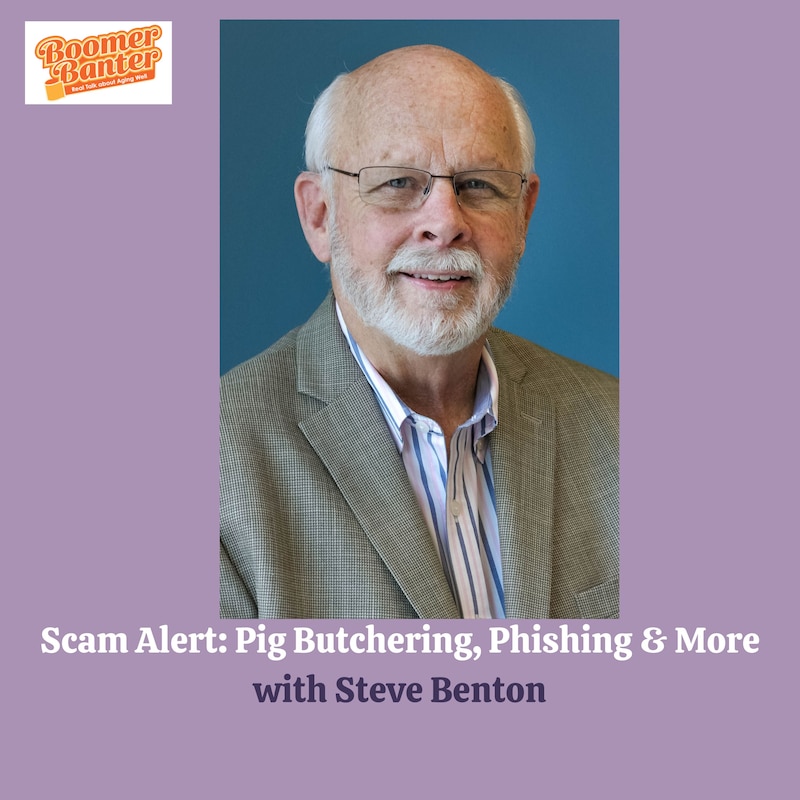
Shownotes
This episode of Boomer Banter is a wake-up call for seniors and their families as it tackles the pressing issue of financial scams targeting Boomers and Beyond. Wendy Green, the ever-enthusiastic host, engages in a lively conversation with Steve Benton, an authority on elder financial safety. Together, they shine a light on the staggering statistics surrounding scams, revealing how seniors lost nearly $4.9 billion in 2024 alone—an increase from the previous year.
They dissect various scams, including catfishing and the harrowing ‘pig butchering’ scheme, where victims are lured into investing money in fake opportunities. Steve's expertise shines as he shares practical advice for recognizing signs of scams and protecting oneself, stressing the importance of skepticism in today’s digital world. He suggests having a family password. This episode is not just a discussion; it’s a heartfelt appeal to the community to look out for one another and ensure that aging well includes being financially secure and aware of potential threats.
Listeners will walk away not only informed but empowered, with useful strategies that can be applied in real life to fend off scammers. Wendy and Steve remind us all to stay vigilant and support one another as we navigate the complexities of aging in a world that can sometimes feel overwhelmingly unsafe. If you care about someone who might be vulnerable to scams, share this episode—it could make a world of difference!
Takeaways:
- Seniors are increasingly vulnerable to scams, for many reasons.
- It's essential to have a family password to confirm identities during unexpected calls or messages.
- Trust your gut! If something feels off or too good to be true, take a step back and think.
- Don't go it alone; sharing experiences and advice with family can prevent falling for scams.
- Pause, Reflect, Get someone else involved.
Links referenced in this episode:
- Schedule a complimentary 30-minute call with me.
- Email Steve Benton at The Senior Source
- Call the Senior Source contact line at 469-517-7523
- Check out Greenwood Capital for your Financial Planning needs
Learn more about Greenwood Capital or find resources at www.GreenwoodCapital.com. Boomer Banter is sponsored in part by Greenwood Capital Associates, LLC. Greenwood Capital Associates, LLC is an SEC Registered Investment Advisory firm with offices in Greenville and Greenwood, SC. As a fiduciary firm, Greenwood Capital is obligated to disclose any potential conflicts of interest with this arrangement. The host of “Boomer Banter”, Wendy Green, is a client of Greenwood Capital, and her show “Boomer Banter” has been compensated for her testimonial through Greenwood Capital’s sponsorship. Greenwood Capital is a Legacy sponsor at the stated rate of $2,600 for the 2025 calendar year.
This podcast uses the following third-party services for analysis:
OP3 - https://op3.dev/privacy
Transcripts
Well, hello and welcome to Boomer Banter, where we have real talk about aging well, and I am your host, Wendy Green. And every week we have honest conversations about what it really means to grow older in today's world.
Navigating health, purpose, relationships, caregiving, and everything in between. And do you sometimes feel like your days are running together? Your energy is low, you've lost your motivation, and you feel adrift since you retired.
Well, you haven't lost your value. You've simply stepped into a space that is unfamiliar to you.
So I want to tell you that this is a natural, a natural experience, and it's a temporary part of adjusting to a new season of life. So let's talk about how coaching can help you navigate this time of your life.
You can schedule a 30 minute, absolutely complimentary time with me to talk about what's going on, to figure out what you might want to do differently, and probably leave with one small, meaningful step that you can take with you after this initial conversation to feel more energized, more purposeful, and more like yourself again.
So check on that link calendarly.com boomer-banter 30 minutes, which I will put in the show notes and schedule a time for us to have a short chat and see if coaching might be something that would be helpful to you. I also want to give a shout out to our sponsor, Greenwood Capital. And Greenwood Capital is my financial planner.
And I'll be honest with you, finances are not my strong suit. It can all feel overwhelming at times. But the team at Greenwood Capital really gets me.
They explain things clearly, they take their time, and they make sure that my plan fits me as an independent registered advisory firm. Greenwood Capital is a fiduciary. They must place your interests above their own.
And I also want to share that as a sponsor, Greenwood Capital has compensated my business for this testimonial. And for more information about how they can help you make a financial plan, go to greenwoodcapital.com all right, let's dig in.
Have you noticed an increase in texts from people who don't know you? I got one the other day that said, marina, are you still interested in that lakefront property we talked about?
My name is not Marina and I never talked to anyone about lakefront property.
Have you seen the emails that come from the post service or Amazon telling you your package can't be delivered for some reason, but you can fix it by just clicking on the enclosed link and. And giving them the necessary information?
And how about Facebook requests from to be friends with some guy who's stationed overseas or an email from what appears to be your bank or credit card company telling you there's a problem with your account. Oh, my gosh. How scary is that?
without thinking. In fact, in:Well, today we're going to unpack scams like these along with a scam called Pig butchering with Steve Benton.
Steve helps older adults avoid the dangers of financial uncertainty and exploitation as an Elder Financial Safety center, financial coach, counselor, and exploitation specialist at the Senior Source.
The Elder Financial Safety center is a collaboration of the Dallas County Probate Courts, District attorney's office, and the Senior Source addressing elder financial abuse. Steve specializes in complex cases, including fraud scams and elder financial abuse.
And we're very happy to welcome Steve Benton to the boomer banter stage. Hi, Steve.
Steve Benton:Well, good morning or afternoon for you, Wendy. It's a pleasure to be here. I definitely am a boomer, and I know how to banter. So we're ready to go.
Wendy Green:So let's go. Would you start by just giving us briefly your background in the fraud and scam space?
Steve Benton:Well, I won't go back too far, but I've been in the investment business my entire career.
I started out as an investigator for finra, the self regulatory agency of the securities industry, and then grew up in the securities business and ran various brokerage firms across the country. And so very much into compliance and knowing what's right and wrong. And so I had retired early and looking for volunteer opportunities.
ict attorney's office back in:And it went from two days to three days to four days. And I said, I drew the line, I couldn't work five days a week because I'm one of the older boomers. So there you go.
Wendy Green:Well, you know, we all need to find a sense of purpose after retirement. So it sounds like you really have, and we're glad to have you here.
In, in one of our early conversations, you had said that the, the scam that are going out put the seniors in like a perfect storm of vulnerability. Why is it that we are more vulnerable in, in our age group?
Steve Benton:Okay. You know, and I use a Gary Larson cartoon with the, the deer standing there with the target on their chest and bummer. Of a birthmark. How?
And basically, boomers have a birthmark on them, a target, because 70% of the personal assets in this country are owned by baby boomers and above. And the youngest baby boomer turned 60 last year. So 70% of the wealth in this country is baby 60 plus year olds.
@ the same time, they're beginning to experience cognitive difficulties. And the numbers are 1 in 10 at 65, and then by the time they're 85, it's 1 in 3.
So they've got declining cognitive ability, the ability to discern, you know, what's good, what's bad, and so forth. And so they're easy to fool.
At the same time, the con artists are getting more and more sophisticated and they're doing this full time and trying to surprise people and so forth. So all that is working as the perfect storm and technology curve.
You know, I forgot to mention that that's always where we're struggling to keep up and we're never going to get there completely. And so they're taking advantage of that deficiency also.
Wendy Green:Yeah, I was going to ask you about the technology curve because none of us grew up with these smartphones and these desktop computers and stuff. So it is. And they change it every day. They change update or updating. So you've said that scammers are smart and patient.
Can you walk us through how they gain the trust of some of the targets that they go after?
Steve Benton:Well, you know, people always say, but he was so nice. Well, all Connors are nice or he wouldn't talk to them.
So they gain your confidence that through many ways, I mean, when you're talking romance scams, those sure can pop up on Facebook. The perfect example of that is the happy birthday thing. You've got your birthday out there, 28 of your girlfriends call you up and not call you up.
They post, happy Birthday, Happy Birthday. It's all over your Facebook.
And there's a guy that's hacked into one of them and he's seeing every one of those, and he approaches them with, oh, I see what you post. I really like that. And of course, he's got a fake website, a Persona out there, it's called catfishing.
And he's got a good picture and he's got things that women like. And that texting back and forth through Facebook begins that relationship.
And pretty soon he says, let's move over to the WhatsApp, which is more private. And this relationship develops over text. And so out of those 28 women, it only takes one. And he's got a hit and can develop a relationship.
And it is, it is love. You know, we talk about, you know, it's middle school love. Oh, it's only puppy love. Well, it's real to the puppy.
The demographic is basically women, 60 to 75, a divorced widow, never married, and they're looking for love one last time.
There's a male element too, but those are typically older men that have been married all their life and been the caregiver of their wife, and now they're just kind of lonely. And so they're both susceptible to, you know, romance scams. And it's amazing that it's.
A lot of times it's text only, back and forth, back and forth, and they're truly in love. So there you go. Well, at least she or he is.
Wendy Green:Yeah, I've certainly seen those, you know, the. Oh, I like what you're saying. You know, let's be friends and.
Steve Benton:Yeah, exactly.
Wendy Green:Don't click on it. So. So you called that catfishing. And we also have something you call pig butchering.
I don't know where you guys come up with these names, but tell me about pig butchering.
Steve Benton:Well, you're diving deep into the biggest scam today is called pig butchering. We didn't make that up.
That's a really what it kind of coming out of Asia, coming out of the Burma, if you remember the Burma country that's now called Miramar or whatever. It's a lawless country. And they are, they are pushing all this out there. And it's just, it's diabolical the way they build these relationships.
They build them through LinkedIn, you know, people looking for jobs and, and. Or there. It's kind of romance scam on steroids sometimes. But it doesn't have to be. You know, there can be a relationship built.
Otherwise they're building in all these different ways and they're showing themselves as being very successful.
Unlike regular romance scams, where it's usually a military from Desert Storm or Afghanistan trying to get home or the North North Sea oil rig people. And they develop it very slowly. This one is they project themselves as having money. And so the conversation comes up, how'd you make your money?
Cryptocurrency trading. Okay. And of course, they don't have a clue how that works. Well, I can show you. And so they start talking about it.
and gets a nice:We've had three cases in the last year, over a million dollars lost. A lot of the men that have, you know, 401k plans, they're 70 plus and think they're in love with a 35 year old. But a lot of it is greed.
Also it doesn't have to have a romance component. So the pig butchering, nobody likes that term, but it really catches people's attention because you're being fattened up for slaughter.
And it is just very, it's the biggest losses today and it's just kind of come up in the last couple of years.
Wendy Green:What about AI? Is that making scammers more efficient or you know, what, what are you finding with AI?
Steve Benton:Well, on a number of fronts. First of all, it's just voice imitation. You know, that was kind of the first level.
Anytime, like hearing your voice, AI captures that they can start writing a script and you're speaking their words and so that's a danger in itself. Now they're doing facial recognition and it's you talking your picture and so forth. So very effective.
Now they're developing websites, you know, just overnight they can develop a really nice website imitation of bank of America or whatever that really works just like theirs. And so it's, it's only going to get worse and worse.
And we're going to talk about hopefully what you can do to protect yourself because it, it's amazing what AI can do.
One of the things I tell people is, you know, remember the kidnapping about a year ago that the granddaughter or somebody was kidnapped and it was their boys and so forth and they're scrambling around trying to get money and so, so forth. Well, every family needs to have a password now. And it starts with the children.
Up to the parents, up to the grandparents, even the great grandparents, they need to have a family password. Maybe it's popcorn, maybe it's peacock. Something that's very memorable to every member of the family.
So that if any conversation comes up and you don't feel this is right, all you can say is what's the family password? Am I really talking to my grandson? Am I really talking to my granddaughter that's needing bail out of Puerto Rico or whatever.
It's like, give me the family password. Of course they don't have it. Good tip right there.
Wendy Green:And so when you do that, they would typically just hang up at that point.
Steve Benton:Well, yeah, you know, it's over, you don't have to listen anymore. But you know, and we'll talk about everything's to Be distrusted now, you know, with AI and so forth.
I always talk about the Ronald Reagan trust but verify during the Cold War days. Now it's distrust everything. I mean, you can't believe text. You can't believe phone calls. You got to quit answering the phone.
Do not click on anything. It's kind of depressing, but that's the only way you're going to protect yourself.
Wendy Green:It is depressing. I. Yeah, so let's talk about some of these if it sounds too good to be true kind of scams and what people can do besides just not trusting.
How can they even recognize that there's a scam happening to them?
Steve Benton:Well, basically, they're. They're.
You're living life, everything's going well, and all of a sudden something comes in, a problem in your life that, that you didn't even know you had, and suddenly it appears on a phone call, on a phone message. We pretty much stopped people from answering the phone anymore. Everything should roll a voicemail.
Everything should go to your answering machine, because 90% of scammers will hang up because they want to talk to a live person that they can fool. And that's why you don't take calls, because you're now in a database of all these scammers of somebody.
It's a real life number with a real life person, and so that's why you don't ever want to answer. So 90% of them will hang up.
But the ones that you do get on your voicemail or answering machine, if they scare you, don't ever, ever call that number back. They'll be from your bank saying your bank account's been frozen or your Amazon account's been frozen. But go directly to your provider.
Okay, call your bank. There's an 800 number on the back of your bank card and say, do I have a problem with my account?
And of course you don't have a problem with your account. We. You really need to just stop when you're scared. So that. That's part of the problem is they scare you.
And I can tell you all sorts of stories of people being awakened in the middle of the night. It's a U.S. treasury Department, you know, they work around the clock just to protect you.
And saying your Social Security number has been stolen and all that, all of it's a scam. And so if you would just ignore it and not, you know, they present this urgency that you got to take care of this today to protect yourself.
And so if you would just ignore it. Pause. Okay, reflect on what's going on, and then get somebody else involved.
I can't tell you how many of the victims try to solve the problem themselves. So you call your kids, who are now smarter than all of us, and you say, here's what I got. And they say, no, dad, that's a scam, and so forth.
But you got to get somebody else involved. They ask you to pay in weird ways that you're not used to. You know, gift cards, you know.
Wendy Green:Right.
Steve Benton:Always. You know, that's the nature of gift cards today. And so any payment is a scam, but they have you going to.
People just don't realize there's ATM machines now where you can get bitcoin, you know, around your convenience stores in your major cities. And it's always a scammer that's teaching this older person how to give them money.
They're feeding 100 bills in there to get the payment, paying a debt in bitcoin and so forth. So that's a lot of detail that I do in an hour presentation normally.
But that's what's going on, is they just bring a problem into your life that you've got to take care of, and they're there to help you. And as you say, there's no free lunch NFL. Nobody is really wanting to help you. Okay.
Wendy Green:Yeah. And they do. They do play on your fear.
You know, I know the couple of times ago when I was getting ready to travel, you know, we got up at like, three in the morning, and suddenly there's this text on my phone that says capital one. Said you had this big, you know, charge on your account. Was that a legitimate charge at three in the morning? You know, you're like, what?
Oh, my God, I'm getting ready to go away? And so you get into that anxiety state, and it does take a lot of extra effort to say, oh, wait a minute, let me check directly with capital one.
Instead of clicking on the link that.
Steve Benton:Was in the text, never, never click. And you know, the old when you're on fire, the same stop, drop, and roll. We all learned that, you know, growing up, you don't run.
Now that I think Art came up with the pause, reflect, think about it, and then protect yourself. And so there's no urgency. But that's that command to don't respond immediately and then get some help. Don't go it alone.
Wendy Green:Yeah, that's. That's really good advice. Now, you mentioned in one of our earlier conversations also that 60% of your cases involve family members.
Steve Benton:Yeah. There's a division when you talk about scams and frauds, you're really talking about things that are coming from overseas.
You fall for those, the money's gone, you'll never see it again. You'll never meet those people in person ever. Whether it's romance scam or anything else.
But the other half is really financial exploitation by family members, by caregivers, by quote, trusted friends. And that's the case. That's probably 60% of my cases and power of attorneys.
Mothers in memory care and daughters out spending the money under a power of attorney. So those are the cases that we can prosecute.
But the scams and frauds, people just got to realize once you're giving away money, it's never to be seen again. The FBI is not standing ready to assign an FBI agent to your case. Though people think they should be, they're certainly not.
There's really, you can report it. The FBI, the ftc, they all want your reports because they're gathering data.
That's where you got your data of how it's increased year over year this past year. That's all they're doing is so they can go to Congress and get more money to fight it. But you're not going to get any in.
And even on a local basis, the detectives are just overwhelmed with their caseloads and there's just not enough detectives. Detectives. But you're not getting a lot of personal handling of any scams and frauds because they know it's hopeless.
You know, when you've been scammed by an out of country scammer. And basically we spend a lot of our time as financial counselors putting people's lives back together after they've been scammed. And okay, now what?
You've lost that amount of money, what do you got left? And what can we do to help you? So, so that's. So the, the family exploitation. We can get involved, okay?
And a lot of times we can do it with phone calls and it's a misdemeanor and a felony to spend mom's money.
When you're a power of attorney, you're a fiduciary and you want to go to jail and then they'll stop, you know, and a lot of the grandmothers and so forth, if they're called to testify, the defense attorney will say, do you really want Johnny to go to prison? No, I just want him to quit stealing my money. And the prosecutors just roll their eyes because they're in the business of prosecuting people. People.
Wendy Green:Right.
Steve Benton:So they make lousy witnesses so, yeah, but at least we can stop it, you know, protect the senior that way.
Wendy Green:You know, I think there's some shame involved when people get scammed. They suddenly lose hundreds of thousands or their whole nest egg and they don't want to tell anybody. How do you address that, Steve?
Steve Benton:It is the most under reported crime today because people are embarrassed about the money that they've lost, especially like romance scams and so forth. And so it is a problem. And you, you've just got to get other people involved with them, family members and so forth.
And that's the only way you can protect yourself with others. Don't go it alone. You've heard of the boomerang kids that come back to live in your basement.
We went through that period or are going through it right now. Well, now we're in an era of boomerang parents because they've been scammed. They're left with just their Social Security.
They can't even make their house payment. By the way. Boomers are the first generation ever to reach retirement, still have a mortgage to pay. That's never happened before.
So baby boomers and I is one, as they say. We were persistent spenders our whole lives. We know how to spend money, we like things. And now we've reached retirement.
As you said earlier, a lot of people are not prepared for retirement. And so that's why they fall for some of these scams where they can make more money because they're coming up short.
Wendy Green:That's a good question. What about when you get a letter from a company and they say your data's been breached? What do you.
Steve Benton:Yeah, I'm sorry, I didn't mean to interrupt. I get that question all the time. Is, is my Social Security safe out there? Well, you can almost guarantee that it's not.
There's been so many data breaches that it's all out there in the dark web. You just got to count on it being there. What you can do to protect yourself.
If you're a senior now, you're not going to get another mortgage, you're not going to get a new car and borrow a bunch of money, then freeze your credit. That's the way to protect yourself with all three of the rating, rating agencies, Equifax, Trans Us Union and so forth.
So that's a safe way to protect yourself from somebody stealing your Social Security number.
You know, you've got double protection when you log into your financial accounts now, where it's coming to your phone only, so you can pretty much protect yourself. That way.
So even if they have your Social Security number, they really can't do anything with it, with your bank and your financials because that's not necessarily an identification. That's, that's used to the fullest extent. They'll ask you all the secret questions about who is your first grade boyfriend and all that.
So but you know, you brought that up and I just grabbed this out of my folder. I got this letter this week and this was from TransUnion, okay, one of the three big agencies and they had a data incident. And it's also low key.
You know, we had a data incident, third party application, lost all their data. And then I get down to me and they say what information was involved and it was linked to specific data elements.
In your case, all they got was your Social Security number and data, date of birth.
Wendy Green:That's all they need.
Steve Benton:That's all they got. And so, so it, so to answer your question, that was a long way to answer.
It is you've got to just understand you're probably vulnerable and just protect yourself and don't believe anybody and get help and minute something pop up because it's, it's probably being used out there and.
Wendy Green:It'S two factor authentication. I mean it's super annoying. But can you explain to listeners who see the request all the time, you know, do you want two factor authentication?
And they go always, how does that work?
Steve Benton:It makes you feel good. And it's basically on your financial accounts, you know, at the credit union, at the bank. That's where you got your money.
You got it at your brokerage firm, your financial advisor.
Those are the main ones you need to protect, you know, and I just love it because I know that nobody has my phone in my, in my hand and I, I can get a authentication right on the spot. So it, once you get used to using it, you, you just feel safe every time you do it.
Wendy Green:There are different ways though. Like I have some that I had to download an app onto my phone that the number changes every minute so, every 60 seconds.
And that's the number you have to enter in. You know, there are others that seem to just click, click here. And now you've been authenticated and, and.
Steve Benton:It'S called an authentication code. And that is, is actually the safest.
I mean we had this way back, you know, 15 years ago with the brokerage firm that I ran on the west coast and you had a little tag that you kept with you when you traveled and that number changed like every 30 seconds. And so when you were ready when, when you had to authenticate, you had to put that number in quickly because the number would pop up again.
Wendy Green:Right.
Steve Benton:And so it is a little bit of a hassle to go on your phone and have to go through an authentication deal, but once you get used to doing it, it is the safest way to go. So I would just. If you have any concern at all about your financial well, being in your accounts, that's a very safe way to do it.
Wendy Green:I guess the other way they do that is they'll, they'll text you a number. Right?
Steve Benton:So yeah, yeah, six digit number, that's, that's really the true double authentication. But that new one you're talking about is, it's an authentication app that is sending you a number that expires very quickly. So either way.
Wendy Green:So, you know, you mentioned a couple of times, you know, talk to somebody, tell your kids all of that. Is there something that our kids can do to help us feel safer, to educate us with, you know, in respectful ways?
Steve Benton:Yes, I know what you're saying. And, and I always like the younger audiences that I get in front of.
Like I was at the Junior League six months or so ago and I said, how many of y' all have parents in their 70s and 80s and of course a lot of hands, what do you know about their finances? And of course everybody just kind of ducked their head because, well, they don't share anything with us.
Well, those days are really over because mom and dad are getting scammed like crazy and you've got, you know, I was out with my younger brother and his wife the other night and he's got a 93 year old and 89 year old in laws. And I said, how do you, what do you know about their finances? Oh, they won't tell us anything. Well, you've got to walk through that stiff arm.
You, you need to have a family.
When you have siblings, you know, like yourself, you know, you, you, you, all of you outnumber them out, outnumber mom and sit around the table and say, mom, we've got to protect you, you know, and those days are over. So remember my stats, 1 in 10 at 65 and then 1 in 3 at 85. That 20 year period you can see the deterioration of cognitive abilities.
And you've got to act somewhere in the 70s of being part of everything, just making sure that you're seeing what's going on.
And if you just have a good relationship where you train them to call you, if they question anything, then you're Pretty much safe to, you know, be involved in their finances. Does that make sense?
Wendy Green:Yeah, it does. My mom will call me if anything weird happens, so I'm, I'm glad she doesn't click on links anymore.
Steve Benton:But yeah, the sad ones are the ones where the families have, you know, somebody's in Bangor, Maine and mom's here and so forth and they have no clue what's going on in their life until it's too late. And so what we have now is the Texas Financial Elderly Exploitation Act.
We passed that a couple legislators ago allowing banks, credit unions, investment advisors and so forth.
If something is out of character with an account and they're not responding well, like they know it's a scam, they now have the permission to freeze that account for 10 business days. Whereas before, you know, these poor tellers were just, Mrs. Smith, you're being scammed. Oh no, I've got to do this. Give me my $10,000.
And they couldn't stop her. Now they can just freeze her account or it doesn't make them happy, but at least it protects them and you can get some family around them.
But I have had so many children in my office when mom and dad have lost their money and it's, you know, the horses are out of the barn and you're trying to put their life back together and they're in shock that they got scammed. So you need to be involved with your parents. That's a very good question.
Wendy Green:Yeah. And I, I don't have a password with my grandkids who are both two of them in college now, and I think that's something I need to get on right away.
Steve Benton:Right.
Because they're going to call you from Puerto Rico because they're in jail and they need bail by 3 o' clock and you're going to run to the bank and get it wired. Right?
Wendy Green:Yeah, yeah. So instead of just saying, prove to me who you are.
Steve Benton:Exactly.
Wendy Green:Just. Yeah, you know, it's so uncomfortable that you have to be so untrustworthy. But you say, don't trust anybody, verify everything.
Can you give us a couple of examples of how to do that in real life?
Steve Benton:Well, first of all, you've got to trust no one that you don't have a face to face conversation with. Okay. Somebody has called you, they've used some type of mechanism to get to you by texting or so forth. You've got to immediately suspect.
You need to start at the negative. And I know that's bad, but you're not, you didn't Ask for a relationship with this person. They invaded your life, okay?
And so you're under no obligation to do anything at all. But you've just got to distrust people that you don't have a face to face relationship with. And so that's one of the keys.
You know, you'll get text, like, and you probably got one of these. Is this Elizabeth? That's right, yeah. Now you let think about that text. No, it's not Elizabeth. You don't know Elizabeth.
You don't have any information about Elizabeth. So you're going to be no help to this person whatsoever. Why would you even talk to them or text with them?
Wendy Green:Well, I'll tell you why. Because we're nice and we want to say, oh, you don't have anything off.
Steve Benton:You, you don't have anything to offer.
Wendy Green:But I, I, the first time I got that, my response was, oh, I'm sorry, you have the wrong number. This Elizabeth must have given you the wrong number. And they go, oh, okay, I'm sorry. And then they try and keep talking.
Steve Benton:That's exactly right. And so I did that one night just to play along. And sure enough, it was about the third back and forth. Tell me a little about yourself.
So see, somebody's invaded my life now wanting to know about you, me, and what you've also done by responding. You're now on the you heard about the do not call list. You're on the call this person all the time because he talks, okay. Or he texts back.
And so you're just gonna get more and more scams. They're gonna multiply and breathe like rats.
Wendy Green:Because they share that. They share that.
Steve Benton:Oh, yeah, they share it all. And so like I said, you have nothing to offer. And all they're looking for is to get a relationship starting with you.
Wendy Green:And I think that's one of the biggest challenges is that we grew up in a time when, you know, you tried to be nice to people and you, you know, everybody was your friend and it's not that way. It's not.
Steve Benton:No, it's not. And that's why, you know, of course a generation is, is slowly passing away that thought the phone was really cool. And you answered every phone call.
Now, you know, you call your, your kids, they never answer. They never answer your email, but you text them and gosh, they have it back. And so here's the stats. Why are you getting so many texts?
Because 97% of all texts are looked at within 20 seconds, okay? They get an immediate response from you. And if they can Scare you. They say, oh, I've got a problem. I've got to get on this immediately. Okay.
Whereas you might listen to your voicemail once a day. But. So that's why they're using that to steal your data and everything else.
Wendy Green:You're so right. You're so right. Now, you mentioned that do not call listen, does that even exist anymore?
Steve Benton:It. It does and it's totally worthless. Let me tell you.
It was put out by the ftc and I had this back when I was running a brokerage firm out in California. We were meticulous. And if they were on the do not call it, you cannot call any number in our firm that was on the do not call this.
Now, do the con artists believe that? I mean, do they follow that? Because there's no, there's no prosecution.
You just, you have a data requirement there where they don't prosecute anybody. So why would a con man just, just keep calling your same number?
So all they're doing is you're filing with the FTC and it doesn't work anything, it doesn't block anything. So it is worthless.
Wendy Green:So let me ask you this as a community of older adults, boomers, you know, out here in boomer banter land and older. Right, right. What can we do to help each other stay safe from all of these scammers?
Steve Benton: population has doubled since:People that live alone is up 442%. That's just boring stats. But people are living in houses that are falling down around, and they're trying to age in place.
And so they're having to pay their utilities, pay the yard man, pay repairs, and they're always, you know, doing something at some point in time. It's just safer to be in an independent living where you can socialize.
And, you know, it's fun going to the independent living facility and doing my talks because they're in there playing bridge, they're socializing, they're sitting in meals together. So you got eyeballs on one another. So isolation is the number one risk. And then shortly, close behind that is actually the computer.
You are actually opening portals into your home, into your apartment with people and engaging with people that you will never meet and that you probably wouldn't let in the front door if you saw them. So, you know, we have a saying around here at the senior source. If you thought taking dad's car keys away was tough.
Wait till you try to take away his computer because that is his, you know, interaction with the world. And so those are the two big problems that are out there. Living alone and using the computer.
Wendy Green:And I would say to everybody listening, you know, this is on YouTube, so you can, you know, most seniors are more comfortable with YouTube than with podcasts. So you can share this with them and your parents and your friends and, and give them some of these tips that Steve's been leaving with us.
So it's super important, super important to share this message. Okay, Steve, final question. The full name of the show is Boomer Banter. Real talk about aging well. So what does aging well mean to you?
Steve Benton:Well, when you think about financial security, that's really. Financial wellness is financial security. And financial security is the gateway issue of really public safety.
Your financial security determines where you can live, what you can do, where you can go, what you can eat. And so you've got to protect what you've got. And, you know, it's hard enough with the financial planning we teach and so forth. Do you have enough?
I always get that question when you've gone through all my financials, do I have enough money? And I said, oh, that's such an easy equation. We've talked about your income. We know your Social Security. We know the dollars coming in.
We know the assets that you have that are eventually going to have to be liquidated to offset any budget decreases. There's only one part of the equation we don't have. And they always go, what is that? When I go date of death.
Because nobody knows how much money you're going to need. And so, you know, country saying is, get all you can, can all you get, and sit on the lip. And so that's, that's financial security.
You got to protect what you've got. Even if you don't think you have enough, you cannot afford to be scammed. And so that's why it's so important.
It's a public safety issue, very frankly. So that's, that's financial wellness to me.
Wendy Green:And aging well. Yeah, protecting, protecting what you have. And, you know, avoiding these scams so important.
-: Steve Benton:Well, that's my personal number. So there isn't actually another. But that's fine, you know.
Wendy Green:Sorry, I thought that was okay.
Steve Benton:That's all right.
Wendy Green:But you know, the Elder Financial Safety center is in Texas, so they can't. They can. It can give you advice, but they can't prosecute anything that might come up unless you are also in Texas. Is that correct?
Steve Benton:Right. We're in the Dallas area and north. We serve clients all over the north Texas area.
But, you know, I'll get calls, you know, from cities here in Texas because they don't have a senior source, and we'll take the calls.
And of course, we can't pursue with an investigation or what's going on, but we can give them some advice, you know, and so I've talked to people from Philadelphia and things like that, and they're. They're fairly short calls, but hopefully informative.
Wendy Green:Yeah. And, you know, maybe just a pointer to where they could pursue help.
Steve Benton:Right.
Wendy Green:So I just want to say that, first of all, Steve, this is great. Thank you for your time on this.
And I want to say to everybody listening that getting older doesn't mean we will inevitably fall victim to a scam, but it does mean we have to get wise. What Steve reminded us today is that wisdom looks like slowing down, asking one more question and verifying before we act.
Steve Benton:And getting help.
Wendy Green:And getting help. And if something feels urgent, secret, or too good to be true, that's your first cue to pause.
And if you have been targeted or if you've even fallen for a scam, please know this shame belongs to this scammer, not to you. So as Steve said, tell someone you trust. Call your bank, Report it. The sooner you speak up, the more power you take back.
And the more help someone else, the more you would help someone else to avoid the same trap. So let's look out for each other.
Share this episode Like I said earlier, with a friend, check in on a neighbor and have that quick family conversation about safeguards and passwords. Oh, so if, if you want to reach Steve, those. All of those contacts will be in the show notes. Steve, you've been wonderful.
Thank you so much for all that you've given us.
Steve Benton:My pleasure.
Wendy Green:I also want to remind people that if they are interested in talking about retirement and they're. They're feeling stuck and they are like, oh, my gosh, I don't know what to do with myself. Let's have a quick conversation.
Just 30 minutes, just to chat and see where you are. See if we can just do a minor tweak or if you want to do, you know, a six month, three month conversation to kind of help you get back on track.
Go to calendly.com boomer-banter30 the number 30 minutes. And let's schedule a time to talk. And I also want to thank Greenwood Capital for sponsoring Boomer Banter.
They are a registered advisory firm providing wealth management, investment solutions and financial planning to clients in 23 states. All right. Well, that is all for today. Thank you so much. I hope this has been helpful and meaningful to you, Steve.
I know every time I talk about something like this, I learn something. So thank you for that. I will be talking to my kids about a passport. And I hope you have a wonderful, wonderful rest of your day.
Steve Benton:Thank you. Wendy.



