Shownotes
Season 26, Episode 16 - Shaun Boyce, Bobby Schindler
Summary
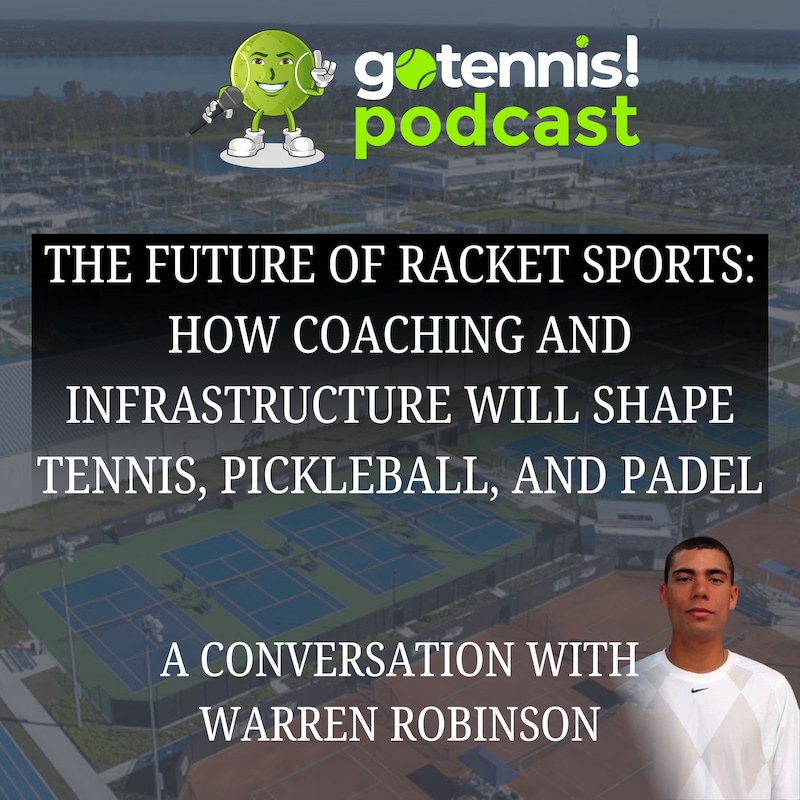
In this episode, Warren Robinson explores the future of racket sports, focusing on tennis, pickleball, and padel. Warren shares insights on industry growth, coaching certification, and strategies to make sports more inclusive and accessible.
Key Topics
Growth of pickleball and padel
Coaching certification pathways
Inclusivity and accessibility in sports
Keywords
racket sports, tennis, pickleball, padel, coaching certification, sports industry, inclusivity, infrastructure, USTA, grassroots development
Sound Bites
"Pickleball needs a structure to grow."
"Padel is coming globally, and it's exciting."
"The program aims to develop industry leaders."
Full YouTube Video: https://youtu.be/XUBw_askQ-E
Warren's King of Tennis Answer: https://youtube.com/shorts/YHRSHG5HAQo
Learn more about Warren: https://www.linkedin.com/in/warren-robinson-tennis/
Contact Our Hosts
- Shaun Boyce, RSPA: [email protected] | https://americanracketsportsassociation.com/
- Bobby Schindler, RSPA: [email protected] | https://letsgotennis.com/windermere
- Geovanna Boyce: [email protected] | https://regeovinate.com/
- GoTennis Website: https://letsgotennis.com/
Learn more about the Marc Kaplan Media Excellence Award we (the GoTennis! Podcast) won from USTA Georgia: https://letsgotennis.com/captivate-podcast/gotennis-podcast-wins-the-marc-kaplan-media-excellence-award/
Join Our Community
Check out the GoTennis! Atlanta Facebook page for deals, updates, events, podcasts, news, stories, coach profiles, club information, and more.
Support the Show
- Donate Directly: https://gotennispodcast.captivate.fm/support
- Crypto Donations: Get into crypto with https://coinbase.com/join/PEWRLWK?src=referral-link
Start Your Own Podcast
Considering your own podcast? We recommend Captivate: This podcast is hosted by Captivate, try it yourself for free.
Transcripts
Hey hey, this is Shaun with the award-winning GoTennis! Podcast powered by Signature Tennis.
Speaker:Check us out at LetsGoTennis.com and we invite you to learn more about the award by
Speaker:following the link in the show notes.
Speaker:And as you're listening to this, please look in your podcast app where to leave a review
Speaker:and do that for us.
Speaker:We would love to earn your five-star reviews.
Speaker:And now let's get into our recent conversation with Warren Robinson, who is part of the
Speaker:current cohort going through the USTA's Racket Sports Management Apprenticeship Program.
Speaker:Warren shares his insights on industry growth.
Speaker:We explore the future of Racket Sports, coaching certification, and strategies to make sports
Speaker:more inclusive and accessible.
Speaker:Have a listen and let us know what you think.
Speaker:Warren Robinson, I really appreciate you taking the time to be here with us.
Speaker:We've been trying to get you on for a while.
Speaker:You have recently partially relocated to Florida and last I saw you last fall.
Speaker:You were looking to get married and you've just got a lot going on in your life.
Speaker:So I want to start with our most obvious question, which is, who are you and why do we care?
Speaker:Yeah, things are having the podcast, glad to be part of it.
Speaker:So who I am, I'm Warren Robinson.
Speaker:I am one of 15 applicants that are part of the Racket Sports Management Apprenticeship Program
Speaker:at USTA National Campus.
Speaker:I am a full-time employee.
Speaker:So I work 20 hours a week or more to teach all programming from pickleball, to padell,
Speaker:to tennis, to junior programming, to adult programming.
Speaker:And on top of that, I learn about the industry from pickleball, padell and tennis, and learning
Speaker:the governance of all bodies and figuring out the marketing, the how it's progressing through
Speaker:the country and the world, and where does all these programs lead us in the future in the
Speaker:country?
Speaker:Okay, and you answered my next obvious question, which is, "USTA is tennis only."
Speaker:So you're not necessarily training in the other sports or are you?
Speaker:Because the USTA has gotten into coaching and that's a big deal in a giant industry level
Speaker:conversation right now, but you said very specifically, "Racket Sports," and there are the other sports
Speaker:that's my main thing is, you guys aren't just tennis.
Speaker:Yeah, right.
Speaker:So, I won't get into the political reason, but yes, so we also teach pickleball, padell.
Speaker:That's also a complimentary sport.
Speaker:That's what tennis considers it.
Speaker:So when you go, let's say to a country club or a publicsility or a park's erect, the goal
Speaker:is that tennis is king and the company sports will be pickleball and padell.
Speaker:And so this month, I will be getting certified into by the RSTA through pickleball.
Speaker:And at some point, I will get padell certified.
Speaker:So as of right now, I'm recertified at PTR level for pickleball.
Speaker:However, when you work at the US National Campus, it is required that we go through the
Speaker:RSTA program to get certified through them.
Speaker:That's interesting.
Speaker:Bobby, were you aware of any of the specific "Hey, we're USTA," but we're still using RSTA
Speaker:and PTR certifications at levels?
Speaker:Only background noise, but this is a good scoop right here.
Speaker:Have they bring it?
Speaker:Well, and that's interesting, Warren, because we love learning what's actually going on.
Speaker:Like Bobby says, it's background noise from the point of, "Well, I heard they're doing
Speaker:this."
Speaker:Not allowing that, and we assume USTA has said we're tennis only, but they have to train
Speaker:you.
Speaker:You're in a management program for racquet sports.
Speaker:They've got to know that to get the biggest jobs, especially in the country club world,
Speaker:we'll point out that caveat.
Speaker:But especially in the country club world, to get the biggest jobs, you got to know more
Speaker:than tennis.
Speaker:Correct.
Speaker:Yeah, and this program is part of our internship, our learning process to get certified in
Speaker:Pickleball Padel.
Speaker:Like I said earlier, the great thing about this program is that we know tennis is king.
Speaker:And we know that there's a demand for Pickleball and Padel, right?
Speaker:The statistics are proven to us that Pickleball is a fast growing sport in the US.
Speaker:However, globally, Padel's coming.
Speaker:Padel's already here.
Speaker:And it's one of those sports that, you know, it may turn to Pickleball in the few years.
Speaker:The market is huge, the demand is huge, the money, the investment is there.
Speaker:Right now, the infrastructure hasn't met up to the demand, but there's a lot of investors
Speaker:putting money into this sport.
Speaker:So right now, Pickleball, it is still a big deal, but Padel is coming.
Speaker:And so it's required for us to all be certified in all these sports.
Speaker:Yeah, that makes a lot of sense.
Speaker:And I think Pat El at this point is what averaging 20 courts per state.
Speaker:So I really don't think it's a giant issue, so to speak, but we are looking at a director
Speaker:of racket sports title, director of rackets, even director of court sports at some levels
Speaker:with you include Bocchi and some other country club games, I would say, that aren't necessarily
Speaker:with a racket.
Speaker:So that's, that's fun to know.
Speaker:So tell, tell us a little bit about yourself Warren.
Speaker:You and I met in coming, but you've got a place in Duluth, I think it is.
Speaker:So you're in Metro Atlanta.
Speaker:What about you?
Speaker:You got married recently?
Speaker:How is life?
Speaker:Yeah, so my background is Richmond, Germany.
Speaker:I came to US and 9/9, I was 12.
Speaker:My dad was military.
Speaker:If I'm German, I've been a military for 20 years.
Speaker:Well, going on 20 this May, so I'm, I finally hit 20 in the Navy.
Speaker:Cheapay officer played college tennis.
Speaker:I played pitch for pitch for Pickleball for about two years, 2020, 2021.
Speaker:So I've been kind of everywhere.
Speaker:I mean, I've played tennis, enjoyed my life and then I started playing Pickleball and I
Speaker:really found it fascinating.
Speaker:It's fun.
Speaker:I still love tennis more than Pickleball.
Speaker:I won't deny that, but Pickleball is fun.
Speaker:And so now I've discovered Padeau and it's also fun.
Speaker:It's a lot like tennis with Pickleball touch and, you know, I'm like a big kid in, in this
Speaker:world, just privilege and honor to be part of this program and be part of this, this
Speaker:life just because I get to play three things at once and I enjoy all of them.
Speaker:Yes, good.
Speaker:And we sometimes we play the sport that isn't necessarily our expertise because we're all
Speaker:exceptional tennis players typically at this level.
Speaker:And we've played for, you know, 40 years, some of us, 39 in my case, we won't talk about
Speaker:Bobby, but we look at, we look at the point of view of finding that thing that can challenge
Speaker:us that new concept where a lot of people get it, tennis players get into Padeau and my
Speaker:God, it's just different enough to really challenge me and get me excited about something
Speaker:and it's not like me having to go out and learn how to play American football.
Speaker:So I think that's, that's a lot of fun.
Speaker:Now from your perspective, there's a uniqueness to what you're doing because it sounds like
Speaker:you're in school.
Speaker:It sounds like you're in training, which also makes it sound like you're a newbie, but
Speaker:you're not.
Speaker:Would you describe this apprentice program more like a master's degree or a doctorate
Speaker:where if we were to put it on an educational scale, where do you think it would land in
Speaker:this industry?
Speaker:Wow.
Speaker:That's a great question.
Speaker:I wouldn't tell you that was coming first.
Speaker:No, it's great.
Speaker:I would honestly say the doctorate and the reason why I say that is I would say when
Speaker:you get certified, you know, I would say you have a cause degree and I would call a master's
Speaker:something you specialize in because you've done it for a few years.
Speaker:I would consider this a doctrine program because you're learning about the entire industry.
Speaker:And quite honestly, my experience has been country clubs, some park wrecks and commercial,
Speaker:but I've never been resort.
Speaker:I've never worked with a 501 3C.
Speaker:So there's parts of the industry that I have no clue.
Speaker:And so going to the process, you learn from God like Edgelpont to come in and just say,
Speaker:hey, I'm here to be your mentor, your teacher, whatever you need from me.
Speaker:I'm here.
Speaker:You get this access to these leaders of the industry that you would have to go to a convention
Speaker:and they may have time for you or you may work for them.
Speaker:You know, you build this rapport in this program and you got to think about it out of 400 applicants,
Speaker:only it gets chosen.
Speaker:And so you have to have some kind of background to be chosen for this internship or leadership
Speaker:program to be able to be put out back into the industry with more knowledge.
Speaker:I mean, think about it when you leave here in two years, you have been certified at the
Speaker:highest level for USH coaching on their base platform.
Speaker:RSP8 for Patel for pickleball.
Speaker:You have now met most of the leading leaders of the business and you have access and you
Speaker:know how to budget, you know about financing, you understand private, you understand equity,
Speaker:not equity, you know, you understand commercial property, you understand as a business for profit,
Speaker:you understand how these business works inside and out.
Speaker:I mean, again, do you have to have a lot of experience?
Speaker:Not really, but generally you're going to get this experience.
Speaker:You're going to get the opportunity to visit locations and ask all the questions you want
Speaker:because eventually when we leave this program, we will be the director of rackets or the
Speaker:sends director at that property or that location, depending wherever one of us decides to go
Speaker:in our future.
Speaker:Bobby, I'm sure you got questions.
Speaker:I just keep, every time he says, "Tedis is king," I agree.
Speaker:Not.
Speaker:I'm really great.
Speaker:Keep saying it.
Speaker:Keep saying.
Speaker:I mean, my biggest question would be, I'll be growing outside of the world of tennis and
Speaker:rackets sports as far as your instructors.
Speaker:No.
Speaker:What I mean by that is working at USDA, the vision is 35 by 35.
Speaker:And so that's the goal.
Speaker:It's to get, how many can we get 35% to play tennis?
Speaker:Now with that said, it's our job.
Speaker:It's our duty to try to fulfill the obligation.
Speaker:Now, again, like I said, pickleball and peddler comp me sports because that's what they are.
Speaker:Every club, private, public, whatever you want to call it, they're going to look at peddler
Speaker:and pickleball's comp me.
Speaker:So the main focus is the growth of tennis to make sure it's inclusive for everyone.
Speaker:So when Bobby, did I hear, yeah, did I hear your question properly, Bobby, where you're
Speaker:asking about the only tennis or rackets sports experts as instructors and mentors there,
Speaker:you were asking, are they from outside the industry as well?
Speaker:Is that where you were going with that?
Speaker:Yeah.
Speaker:Because I mean, obviously if you were talking about business, are we getting business leaders
Speaker:in there?
Speaker:Are we just talking about, because everybody's going to bring it in her own bias.
Speaker:And you know, there's an argument, yes, pickleball is by far the fastest growing sport in
Speaker:this country.
Speaker:But it's not translating into lessons, it's not translating into, it is what it's a round
Speaker:robin.
Speaker:Yes, it helps with its structure, but that's where the success is.
Speaker:Paddle is great.
Speaker:Yes, it's growing in North, but it's got huge problems coming up as far as due diligence.
Speaker:I mean, just with costs associated with it.
Speaker:And do you build something or knock something down to put in something that's still only
Speaker:going to have four people on the court?
Speaker:The racket industry went through this back in the day.
Speaker:Tennis courts went through with racket ball courts when gyms realized I put two people
Speaker:on this amount of space or four people on this amount of space or I can put 100 life cycles
Speaker:on this amount of space.
Speaker:So are we getting a good idea?
Speaker:Are we getting everybody who's walking in saying, well, you know, tennis is king this month,
Speaker:but pickleball is going to be king.
Speaker:Are we being realistic?
Speaker:Like you said, are we looking at this?
Speaker:How do we grow?
Speaker:Because by my, you know, philosophy we've said it here, I wish all the tennis guys were taking
Speaker:all the money that they, you know, the new money they're getting from these other sports
Speaker:and buying all the tennis toys they can.
Speaker:You know, all the technology, exposing the clientele and make people realize all the exciting
Speaker:things that are going on in tennis because as you've said, tennis is king.
Speaker:Yeah, I mean, so I can't even get a opinion on this, right?
Speaker:And we had Sarah Ann's Berry that came in a week ago, right?
Speaker:And we had Marcus DelPR who's the godfather of Adele.
Speaker:It's simple.
Speaker:It comes down to is there's, there's just nine enough, well, one, it comes down to coaching,
Speaker:right?
Speaker:Coaching hasn't been solidified in a sense of there's a pathway.
Speaker:That's the problem.
Speaker:And again, this is what comes from their mouth to my ears to you is that there's nine
Speaker:enough of a pathway for structure.
Speaker:And then two is the infrastructure, right?
Speaker:And then the other part of governing body, USPA pickle balls are governing body for pickle
Speaker:ball.
Speaker:But yet the UPA is governing the PPA tour and the MLP.
Speaker:So it's a bigger problem than that.
Speaker:It's not, it's just not, it's not being regulated well.
Speaker:And again, it's just a, it's an opinion, right?
Speaker:It's not from USTA's mouth or anybody else is from what I've seen my research.
Speaker:And for what I've talked to the business leaders is that there's not a pathway.
Speaker:The structure isn't there.
Speaker:The demand is there.
Speaker:But then it's also the infrastructure like pickle ball courts are by being used by tennis
Speaker:course, because they're not being utilized.
Speaker:So that's the other problem.
Speaker:And tennis is that tennis is not utilizing the infrastructure that we have.
Speaker:So pickle balls invading.
Speaker:So with that said, it's going to be a bigger or a deal with the government body.
Speaker:And like I said, infrastructure and pathway and coaching, the big parts coaching tennis
Speaker:is been around long enough to have tradition and culture to have an establishment for coaching.
Speaker:We have a curriculum, right?
Speaker:We know what to do.
Speaker:There is a pathway for coaching.
Speaker:And unfortunately pickle ball just doesn't have the structure it needs to be able to grow
Speaker:because eventually you may have more players, but where's the revenue part of it?
Speaker:Like where's the infrastructure?
Speaker:So I don't know when pickle balls going to plateau for say, but I know that Padelle is
Speaker:very expensive to play.
Speaker:And there's a pathway for that as well.
Speaker:But overall, it's got to be changed.
Speaker:I might be agree with you.
Speaker:The point being is that are we going to first you've already said it, are we making the
Speaker:same mistakes that we made from a leadership perspective that we made in tennis being so
Speaker:how many different franchises trying to say, you know, whether it be USDA, RSPA, PTR, we
Speaker:already already alphabet soup and they were more back in the day.
Speaker:You know, learning from past errors, like you said, second of all, we got to be patient because
Speaker:the reality is we were a little disingenuous in the beginning, I'll just say RSPA with
Speaker:everybody go get pickle ball certified.
Speaker:Well, I've never played a moment of pickle ball in my life.
Speaker:And you're telling me because I can hold a tennis racket and have some proficiency there
Speaker:that this is going to be true.
Speaker:I don't feel good about that.
Speaker:There's intricacies.
Speaker:Yeah.
Speaker:We game.
Speaker:I'd be far more comfortable teaching that a pitch than teaching that a play pickle ball.
Speaker:Was it just things like that?
Speaker:And we rush to the opportunity, but we don't look at it from a long term perspective.
Speaker:As you said, if pickle balls really going to take a stand, it's going to be 20 years from
Speaker:now that we see it because we're going to have to see whether kids took up pickle ball
Speaker:and just took, like you said, a pickle ball path.
Speaker:Right now we have a bunch of former tennis players playing pickle ball and teaching pickle
Speaker:ball.
Speaker:Right.
Speaker:And I just picked up a, oh, you know, the pickle ball has been a long, a round long enough
Speaker:to sit there and say, yeah, I grew up as a junior pickle ball player.
Speaker:So it's different.
Speaker:You know, are we going to be patient and let's recognize the fact that it is different.
Speaker:And you know, and in the big part, even for the paddle, because we've heard another
Speaker:of the wonderful things about paddle and just the sound alone makes it far more popular
Speaker:with me than pickle ball, whatever be, but we've already made it to be to something different.
Speaker:And now you're going to turn down and, you know, be valentine, early at business man takes
Speaker:advantage and says, I'm going to put tip D on a pickle ball court.
Speaker:And so now there's two uses for a pickle ball court.
Speaker:So you know, yeah, I always get worried because there are tough decisions and that people don't
Speaker:want to seem to be able to make them sometime.
Speaker:I love the program.
Speaker:I love the idea.
Speaker:That's what I want.
Speaker:And we always say this, let's tennis go outside of tennis.
Speaker:Go get some ideas, you know, go get Mark Cuban, get the shark tanks.
Speaker:You know, big shark tank fan, everybody thinks, oh, let's get, you know, I want to pay
Speaker:all to the market, you're the market.
Speaker:And at one time Mark Cuban said, now it's okay to have an exclusive product that asks for
Speaker:too much money.
Speaker:There's something to be said.
Speaker:And you're like, okay, that's a different train of thought, which is a good thing.
Speaker:That I just want different chains of thought than other than who was the last CEO at Wilson,
Speaker:who was the last one who ran this.
Speaker:We know all those guys.
Speaker:I want to know the guys, you know, W, what is W of E now, who, you know, still houses on
Speaker:an event with everybody knows the outcome has been predetermined.
Speaker:Yet people still dull because there's a story.
Speaker:Yeah.
Speaker:No, I mean, I agree.
Speaker:I feel like, I just kind of thought about this.
Speaker:What tennis has done well is we have a grassroots program, right?
Speaker:We have nonprofits who all are all about the grassroots program.
Speaker:The problem with this again is in my opinion, but Delary has a grassroots program, but it's
Speaker:still growing.
Speaker:And if you think about Pickleball, it really kind of doesn't have one.
Speaker:It really grew out because it supplied a man, right?
Speaker:Adults wanted to play it, became huge.
Speaker:The tour guy established.
Speaker:There's people fighting for the tour.
Speaker:Really what it comes down to, Pickleball is there's really no grassroots program.
Speaker:There's no junior development program.
Speaker:So how do you get people to buy something that's not really established yet, which is what
Speaker:Sarah Ann's bear is doing.
Speaker:She's trying to build grassroots.
Speaker:And I would honestly, if you really want to get more information, I would really ask her
Speaker:to invite her to your podcast and ask her about Pickleball or ask Marcus Dill PR about
Speaker:the Dell because he is the Godfather of Pickle or Padel in the US.
Speaker:And then I was in the entire world.
Speaker:So I mean, he has the biggest name and sense of where do you see Padel going?
Speaker:And he would be another good resource reach out to him.
Speaker:Oh, and again, I think there's room for every one of them.
Speaker:I just wonder is tennis zing up too much of its clout promoting other things when the
Speaker:focus should still be on a little bit more.
Speaker:With USDA is making a huge move getting into the coaching aspect of it, which again, I think
Speaker:is a good move.
Speaker:Let's concentrate there rather than be all things to all people, which is of losing about
Speaker:because there's always going to be somebody who's got it, you know, the antithesis opinion.
Speaker:We know that's all the good.
Speaker:What are we talking about in the forum?
Speaker:Are we looking at this realistically?
Speaker:Are we looking at this?
Speaker:Are we just saying, hey, go gung hold.
Speaker:We're just going to sit the wall and then figure it out, which again, history says we have
Speaker:a tendency to do that.
Speaker:I just look at tennis right now.
Speaker:What's being played is on parallel.
Speaker:The players involved are the best.
Speaker:I mean, we're finally at a point where we have tier one athletes.
Speaker:I would say worldwide, obviously, playing this sport.
Speaker:I would love to see that come to the United States where we get the tier one athletes
Speaker:playing tennis because tennis is amazing right now with what's being played.
Speaker:You could go even further if we change things a little bit.
Speaker:Should we do that?
Speaker:Yeah.
Speaker:Yeah.
Speaker:So, I can say this.
Speaker:Everyone from Simon Gale to Dr. Call Davies, there's a vision at USDA and an division for
Speaker:USA Coaching.
Speaker:And the gold, like, then my guess, when's the last time you went through a certification
Speaker:course where wheelchair tennis was part of it?
Speaker:So my certification course for USA Coaching is I think it will to certified.
Speaker:It's a requirement.
Speaker:It makes you think of a coach how to be inclusive to all things.
Speaker:It's people for adults, to children, to adaptive tennis.
Speaker:Like, I've done adaptive tennis and adaptive tennis or that's a pickleball as well.
Speaker:So, USDA Coaching is trying to expand beyond just the regular coaching pipeline.
Speaker:We're trying to expand into all inclusivity, all of it.
Speaker:And that's why I love about is that, you know, why not have the best professional adaptive
Speaker:players?
Speaker:Why not have the best professional wheelchair players in our programs?
Speaker:Why not grow that?
Speaker:I can go back.
Speaker:We could any of that by point being, if you are an accountant, I don't need you to do marketing.
Speaker:Yeah.
Speaker:What you're talking about, you're a businessman now.
Speaker:And this is what I'm getting at.
Speaker:Is that, are we teaching this in the profession of that you're a better tennis player than
Speaker:everybody else?
Speaker:Or are we teaching this from the fact that we want you to be a better, better businessman?
Speaker:If I'm you, I'm going to go higher, the best wheelchair professional I can find.
Speaker:And I'm going to go higher, and I'm going to trust them, but their knowledge and their
Speaker:background is if we're using your resources the best, if we're making you exposed to everything.
Speaker:Because I think this is the way we teach in this country, we're afraid to commit to
Speaker:one thing and say, this is what I'm good at.
Speaker:And there's nothing wrong with that.
Speaker:Why don't we say, this is what I'm good at.
Speaker:I'm a great manager of people.
Speaker:I'm going to surround myself with the best people.
Speaker:And I don't need to know as a thing about pickable because that's what I have this gentleman
Speaker:for.
Speaker:That's all that.
Speaker:That's, again, that's why I always get nervous with these things because no other place
Speaker:operates like this.
Speaker:If you're a doctor, if you're an orthopedic surgeon, they don't tell you all of this
Speaker:and to go into cardiology.
Speaker:No, you don't do it.
Speaker:We're not good on the surgeon state being an orthopedic surgeon.
Speaker:I don't know.
Speaker:I would say, yeah, no, I think, well, play this.
Speaker:So I know with us who coaching, they're still rolling out more of their programs.
Speaker:There's a program for high performance.
Speaker:There's a program for actual business management.
Speaker:There's a program for adult development.
Speaker:There's different pipelines, USTAs trying to develop different opportunities in tennis.
Speaker:So if you want to be a business manager, if you want to do a GM, there's a pipeline for
Speaker:that coming out in the next few years.
Speaker:So everything you're saying is accurate.
Speaker:USTA coaching is developing it as we speak.
Speaker:It just hasn't been not done yet.
Speaker:Well, I think that's what's great about that.
Speaker:If I can share one, I think the other idea we need to be reminded of is that you're in
Speaker:a two year fully immersive program.
Speaker:So the rest of us got certified over a weekend while we had other jobs and we had a full-time
Speaker:job.
Speaker:So we only learned so much.
Speaker:And I can do the same thing.
Speaker:I can find what I'm good at, which I did.
Speaker:And then I put all my resources into learning as much of that as possible because Bobby and
Speaker:I can specify what we do because we have to run the full-time job.
Speaker:Most coaches have to do it that way.
Speaker:Now that's what I was curious from a doctor's degree level point of view.
Speaker:We want to be able to understand that this is two years that you have.
Speaker:It's not a big chunk of that time frame to spend an entire week learning one aspect like
Speaker:adaptive or wheelchair specifically.
Speaker:You spend a whole week on it where most people might get 20 minutes as part of their certification
Speaker:on a weekend that says, "Oh yeah, and sometimes we play tennis in a wheelchair."
Speaker:So I think there's so much that you're going to learn.
Speaker:You're in such a unique position down there, which answers that why are you unique question
Speaker:which we always ask because you get so much over two years and they're paying.
Speaker:This is a pay gig.
Speaker:You're living down there.
Speaker:This is full-time.
Speaker:You've got to separate yourself from your wife.
Speaker:You've got to immerse yourself in this whole thing.
Speaker:So I think, yes, to piggyback on Bobby's concerns, which is, "Are you going to be specialized?"
Speaker:In this case, after two full years, you're going to be specialized in the entire industry.
Speaker:At that point, you should be able to run a club and then say, "I know how to hire the right
Speaker:adaptive person."
Speaker:Or, "I know what to look for in my accountant and my marketing and someone to focus on
Speaker:budgeting."
Speaker:I'm just hoping, "Is it down there, drinking from the fire hose?"
Speaker:Well, let's play this.
Speaker:So, USTA coaching is trying to, I'll say this, they're trying to mimic the ITF.
Speaker:The ITF certification workshop isn't eight hours long.
Speaker:So week long, days long, hours long.
Speaker:So the other part is it's not because I'm just going to be specialized.
Speaker:To also coach and teach my staff to teach and how to run programming.
Speaker:And so, the thing with USTA coaching, it's not about me, to get ahead of forehand.
Speaker:It's me showing you how to run a class.
Speaker:Teaching you, "Hey, we have an odd number of seven players.
Speaker:How do you do rotations?"
Speaker:Right?
Speaker:We're talking about stop show, go.
Speaker:How can I give seven people instructions and not make it a five minute long conversation?
Speaker:We ended out within 30 seconds.
Speaker:This is what we're doing.
Speaker:We're going to stop.
Speaker:I'm going to show you what we're doing.
Speaker:And then I'm going to ask you questions.
Speaker:And then we're going to go.
Speaker:Right?
Speaker:That's the thing is like, "Cork, dot a call gives me a good point."
Speaker:Problem with coaching is, we spend 55 minutes doing a lesson.
Speaker:Let's say a group lesson, right?
Speaker:40 about five minutes we give on just talking.
Speaker:So that means that the lesson really is if 55 minutes long, it's pretty much long.
Speaker:And so the idea is to make sure that I lose program is that I can help that other coaches
Speaker:develop because another part of our program is that is developing the next leaders.
Speaker:How can I teach them what I know in a small group, a private with juniors, with odd numbers,
Speaker:with 12 members, with 8 members, with 6 members?
Speaker:Because when was the last thing you went to a workshop where I talked to you on how
Speaker:to do rotations?
Speaker:And when the last thing they talked to you how to do a large group.
Speaker:December 6th, Bobbing.
Speaker:We had somebody working on that.
Speaker:And I know I'm getting into weeds here Warren, but are they really telling you that while
Speaker:you're talking, that's taking away from the lesson, meaning Bob, he's going to completely
Speaker:disagree with you.
Speaker:If you're going to tell him that him speaking doesn't count toward lesson time and that
Speaker:five minutes of you talking throughout your 55 minute lesson, if I take only 10% of it
Speaker:and speak, that's the actual information you're getting.
Speaker:That's part of the lesson.
Speaker:That's part of the classroom.
Speaker:That's part of the learning.
Speaker:Just hitting balls.
Speaker:That's not a lesson.
Speaker:You just go get a ball machine.
Speaker:What's the point of having the coach?
Speaker:Well, if you're going to tell me I can't spend time to coach.
Speaker:What's a good point?
Speaker:So, what we believe at USH is called Hit Fast.
Speaker:The whole point is make your coaching clear in concise.
Speaker:Get to the point.
Speaker:Without the instructions and have progressions and regressions.
Speaker:How do you get better at teaching tennis or hitting ball?
Speaker:How do you get better at playing tennis?
Speaker:By talking or hitting.
Speaker:You get more balls, right?
Speaker:We also try to add a tactic with a technique.
Speaker:Everything has a purpose.
Speaker:I'm not saying talk for five minutes saying you can talk, but get your point across.
Speaker:What is it that you want to emphasize?
Speaker:Because you got to realize that even for a child or adult, the attention span, listen, after
Speaker:a minute you've lost me.
Speaker:What is it that you want me to do?
Speaker:Show me what you want me to do.
Speaker:You got to tell me to show me.
Speaker:Yeah.
Speaker:If you want to show me, we're going to do surplus one.
Speaker:Show me it.
Speaker:You got to tell me about it.
Speaker:You can show me while you're talking about it and we can move on.
Speaker:So, that's what USH coach and you guys taught me is, again, a lot of this I've already
Speaker:knew, but some I didn't know.
Speaker:All this does is add more tools to my toolbox on how to coach and how to place.
Speaker:That's what you get me wrong.
Speaker:I'm a big, and it's show tell do is my mantra.
Speaker:I completely agree with you on that.
Speaker:My point would be you want to learn how you're talking too much.
Speaker:When you see four of your students moving their strings, you're talking too much, right?
Speaker:I mean, they're, they're wounds.
Speaker:And again, this is a bigger conversation.
Speaker:We've been coaching tennis for how long now?
Speaker:As an industry.
Speaker:100 years.
Speaker:Long time.
Speaker:Yeah, 100 years, right?
Speaker:100 years in and now all of a sudden we decided this was a good idea to develop.
Speaker:That's where my cynicism comes from.
Speaker:Better late than never, Bobby.
Speaker:Better late than that.
Speaker:That's how I feel.
Speaker:Again, I love the program.
Speaker:Like I said, and I.
Speaker:There's a lot of things, you know, or I think the failing is, I think it's unfortunate is
Speaker:that we don't get in front of the, the, the students enough and tell them what we do.
Speaker:They understand why we don't break this down and talk because although you want to hear
Speaker:and you need something right now, I have five people behind you fiddling with their strings
Speaker:looking at their shoes, telling me they're very bored.
Speaker:They want to move on.
Speaker:So you know, these are things, I think, as an industry where we have not done a great
Speaker:job.
Speaker:And again, I look for how, where is the leadership of the industry support helping me?
Speaker:And if we're doing this, which I think is great 100 years in, it opens up a lot of holes
Speaker:for arguments where again, okay, now you're making your warrant of warrant a great tennis player.
Speaker:We're making a pick up all player.
Speaker:He's a great tennis player.
Speaker:Why would I not want him to be a great tennis coach?
Speaker:Yeah, understand pick up all yes, understand the rules because he's going to have to hire
Speaker:somebody, but do I need warrant to be a great pick up all player?
Speaker:No, I think that's a great resources.
Speaker:That's all.
Speaker:I think we could, I'd rather get a warrant figure out, let's be on the edge of technology.
Speaker:Let's develop more things that, you know, messaging because there are certain, we all
Speaker:though there are a lot of holes in the industry as far as getting messages out.
Speaker:How do we improve that?
Speaker:You know, where is AI in this factor in?
Speaker:So the on court stuff, staying in it long enough, you're going to get your masters degree because
Speaker:you're going to lose business.
Speaker:Economies of scale, I mean, you know, supply and demand, I'll tell you, okay, I'm not in
Speaker:demand right now.
Speaker:What about doing wrong?
Speaker:So you're going to make some changes.
Speaker:Like I said, I might buy, I want this to be what it, what it could be, what it should
Speaker:be.
Speaker:And you know, STA is doing it.
Speaker:So if you're the doctorate, what is the, the RSPA doing with Florida?
Speaker:They're masters of, you know, that's what I'm saying.
Speaker:Again, I don't expect you to know, I'm just saying the messages we're sending with all
Speaker:these layers of different programming.
Speaker:If this is the programming in the, in the USDA is the governing body of this country in
Speaker:tennis, say, this is where we expect you to pick our pros from because most educated
Speaker:the most qualified and take a stand, which means you're going to tick off 15,000 people in
Speaker:the RSPA, people in the PTR.
Speaker:But for the long term, is that better for the game?
Speaker:Yeah.
Speaker:So this is, again, I cannot speak for Florida in their program, right?
Speaker:I can only tell you what we do, right?
Speaker:I get to the difference right now.
Speaker:They're not in the court teaching 20 hours a week.
Speaker:They're not getting paid.
Speaker:They're not in front of the male and business that we are in front of.
Speaker:Now, is there education less than ours?
Speaker:No, absolutely not.
Speaker:I'm not saying that at one bit.
Speaker:You know, the difference is it's that it's the amount of education you get from coaching.
Speaker:If I was at USDA for two years, just to learn out of the industry, I could do that online
Speaker:too.
Speaker:But you're getting what, what USDA wants from this is to build every year eight new coaches,
Speaker:right?
Speaker:And the state plus eight is to continue to grow the coaching philosophy at the Eastern
Speaker:National Campus.
Speaker:I can tell you right now that all major coaching, USDA National Campus is a beast of its own.
Speaker:It is, it's not like anything I've ever seen before.
Speaker:It's crazy how much, how many people you see every week or every day or every month,
Speaker:how we had a big 10 tournament.
Speaker:We had the, well, we had a W 15 for both men's and women's pro circuit and a big 10s, all the
Speaker:same time.
Speaker:How many people can say that?
Speaker:How many people can say you're coaching while you are still in the middle of having programming
Speaker:and having some guts?
Speaker:So the program that used to be special and it's unique.
Speaker:And again, I'm not saying that you can't get the same experience, but the coaching and the
Speaker:programming and the, when you leave here, like it's before, it's to add more tools to the
Speaker:box.
Speaker:I'm not saying that PTR or RSPA doesn't do anything.
Speaker:I'm not saying at all.
Speaker:It's all educational tools for learning and how to coach.
Speaker:However, I would say USDA coaching has redefined my way of programming.
Speaker:That's it.
Speaker:It's just programming.
Speaker:And it's with butch staples and Craig Jones in the court with us.
Speaker:I could say this is some long days and it is phenomenal and how in depth these coaches
Speaker:can get into and how much learning you get.
Speaker:Legends.
Speaker:That's my point.
Speaker:What I'm trying to say to the world here is that when Warren becomes available out of this
Speaker:program, there should be a bidding war because you have gone above and beyond.
Speaker:And I don't think that should be something the USDA or anybody else who develops this
Speaker:program should be shy about saying.
Speaker:Agress questions and we'll continue to have them.
Speaker:But at this point, I want to jump to our King of Tennis question, Warren, which you know
Speaker:is coming.
Speaker:So hopefully you put some thought into it.
Speaker:And we would ask whether it's the entire world or just the United States or just whatever
Speaker:professionals, social, whatever level you want to consider it.
Speaker:If you were King of Tennis, is there anything you would do or change?
Speaker:I mean, I thought this for a while.
Speaker:And the one thing I've learned from this program is the big thing is everyone has a different
Speaker:governing body, right?
Speaker:And I'm going to focus on the US alone because that's all I can really control is where I
Speaker:live.
Speaker:The thing I want to change about tennis is the stigma that this sport is just for wealthy
Speaker:people.
Speaker:I can't afford it.
Speaker:It's not affordable for me.
Speaker:I have no access to it.
Speaker:The most humbling experience I've had is learning about parks and rec and a 501c3.
Speaker:That there's organizations, there's coaches who are out there to grow the grassroots of
Speaker:the sport.
Speaker:If I was King for the day, I wouldn't make it that every kid, every adult had access to
Speaker:the sport everywhere, right?
Speaker:And I would make it where they get a free racket, they get balls, they get lessons.
Speaker:Period.
Speaker:Because this is them.
Speaker:This is them one of the most amazing sports you can play.
Speaker:It gives you out of problem solve, it gives you adversity, it gives you things to have
Speaker:on multitask, it builds relationships with other kids and adults.
Speaker:I mean, what sport gives you that ability?
Speaker:I mean, no, it's tennis is a very open sport where it's constantly having to adjust and
Speaker:adapt.
Speaker:And that would be my rule.
Speaker:If I was King, I would make it affordable and give it a stigma.
Speaker:Tennis is for everyone.
Speaker:It's inclusive for anyone.
Speaker:Adaptive wheelchair doesn't matter.
Speaker:You're a sex or race.
Speaker:It's everyone's you playing tennis.
Speaker:That would be my tie-in, I guess being a tie-in or a king, making it accessible for everyone.
Speaker:And then, you know, if I had the money, go for it.
Speaker:That's why I believe 35, 35, 35.
Speaker:That's not a dream is a possibility and that's what UST is working towards.
Speaker:And I'm all for it.
Speaker:Bobby?
Speaker:Well, you know, I'm the same way.
Speaker:I think the way we go about things as backwards.
Speaker:I love the idea of, I'm the poor kid.
Speaker:My dad was a longshoreman.
Speaker:The last sport we thought I was ever going to play was tennis.
Speaker:And it's great.
Speaker:And to build on what Warren said, and you live nine years longer because the participation
Speaker:in the game and it has everything to do with the physicality as well as the problem
Speaker:of solving associated with the game to keep your mental.
Speaker:It is.
Speaker:It's tragic.
Speaker:And that's so much where my frustration comes in, I think, is that we're big, huge fans.
Speaker:There's no question.
Speaker:I want this.
Speaker:I want everybody to experience this.
Speaker:And, you know, I'm a jock.
Speaker:I love all sports.
Speaker:And I want people to appreciate tennis just like I appreciate tennis and basketball.
Speaker:Now, don't ask people how to be the Hawks last night.
Speaker:I don't want to get into it.
Speaker:But, you know, nonetheless, you know, it's.
Speaker:It's a great game.
Speaker:And I wanted to see them.
Speaker:Glad this program is existing.
Speaker:I have my question would be to the powers that be why did it take so long.
Speaker:But I love the idea.
Speaker:And let's not pussy foot around.
Speaker:Let's say there's, are you dumb or are you hiring Warren Robinson?
Speaker:In the year when he comes out, there should be a war.
Speaker:Who gets him?
Speaker:That's it.
Speaker:This is what you're looking for.
Speaker:So let's stop trying to be nice to everybody.
Speaker:And let's, let's make a stand, be a little tyrant and say, we have something that's
Speaker:going to increase your life's nine years ago.
Speaker:I call dibs on being Warren's agent.
Speaker:I'm honored.
Speaker:Thank you.
Speaker:I call dibs.
Speaker:I'm your agent.
Speaker:You have no choice.
Speaker:It's coming.
Speaker:I'm coming for you.
Speaker:Warren, I appreciate your time.
Speaker:We both appreciate your time.
Speaker:Thank you so much.
Speaker:Bobby, as always.
Speaker:Yeah.
Speaker:Just real quick.
Speaker:This is a person who served our country as well for many, many years.
Speaker:I mean, it does.
Speaker:Pluto is again to the USDA who they chose for this position.
Speaker:Warren was very humble in this.
Speaker:I've known Warren since I was a lot younger.
Speaker:I don't know where he was at that person, but I did.
Speaker:He had such a heavy ball that I hated hitting with them all the time because my shoulders
Speaker:would ache for days.
Speaker:But you know, this was a great choice on their part.
Speaker:This is somebody who obviously is very passionate, but it's done so much before getting to
Speaker:this point that he didn't even bring up.
Speaker:So yes, there's even more reason why you want this person when he graduates.
Speaker:Thank you, Bobby, for the kind of words, man.
Speaker:Thank you.
Speaker:Thank you guys for having me.
Speaker:I appreciate your time, and I look forward to next time, guys.
Speaker:Thank you so much.
Speaker:Well, there you have it.
Speaker:We want to thank reGeovinate.com for use of the studio and Signature Tennis for their
Speaker:support.
Speaker:And be sure to hit that follow button.
Speaker:For more racquet sports content, you can go to LetsGoTennis.com.
Speaker:And while you're there, check out our calendar of events, great deals on racquet sports products,
Speaker:apparel, and more.
Speaker:If you're a coach, director of any racquet sports, or just someone who wants to utilize
Speaker:our online shop, contact us about setting up your own shop collection to offer your branded
Speaker:merchandise to the racquet sports world.
Speaker:And with that, we're out.
Speaker:See you next time.
Speaker:[Music]
Speaker:[MUSIC]






