Shownotes
00:00:00 Hello listeners
00:01:39 Set the Mood - Divulging
00:03:24 Sharing More
00:13:47 No Judging
00:21:40 In 1997, Arthur Aron found
00:26:59 Self-Entertaining and Amusement
00:37:07 Takeaways
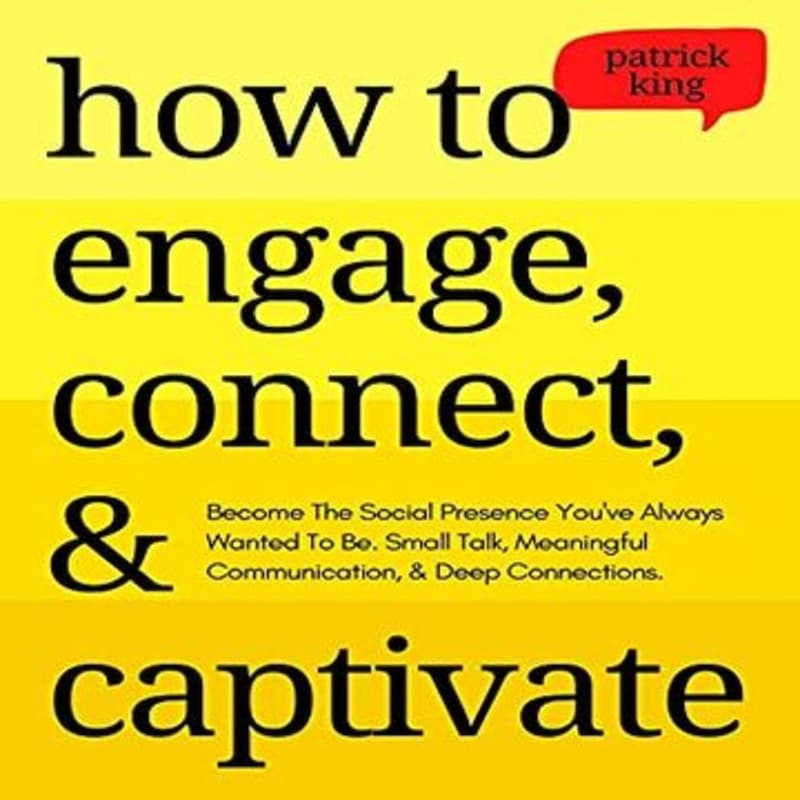
How to Engage, Connect, & Captivate: Become the Social Presence You've Always Wanted To Be. Small Talk, Meaningful Communication, & Deep Connections By: Patrick King
http://bit.ly/EngageConnectKimg
https://www.amazon.com/dp/B0952B32XQ
Stop cringing at small talk. Become more charismatic. Turn surface interactions into deep connections.
Hi, what’s your name, what do you do, what are your hobbies, and where do you come from?
We can do so much better than that. It’s time to take your interpersonal relationships into your own hands and learn how to connect with anyone.
Not a generic book of one-liners or ice-breakers. Proven principles for social success and likability.
This book is not just common sense advice you might find on the Internet. This is where you learn to socialize from the ground up. This is where you will start to get compliments on your social skills and level of charisma.
The knowledge in this book can change every aspect of your life; romantically, professionally, and of course socially. The most likable people in the world sail through life quite smoothly .
this can be you as well.
How to confidently walk into a room full of strangers, and walk out with a bunch of new friends.
Patrick King is an internationally bestselling author and social skills coach. His writing draws of a variety of sources, from scientific research, academic experience, coaching, and real life experience.
A comprehensive overview of how to become supremely likable.
•The top conversational landmines you are probably stepping on.
•How to do most of the work in a conversation before it even begins.
•How to go deep from the get-go instead of staying in small talk.
•How to make your life a series of engaging, funny stories.
•Being more spontaneous and witty on command.
•Channeling charisma like you never have before.
How to never run out of things to say and also avoid interview mode. Verbal strategies for any purpose you might have.
Transcripts
Hello listeners, welcome back to Social Skills Coaching where you become more likeable, more charismatic, and more productive.
Speaker:Today is March 12, 2026.
Speaker:Have you ever felt awkward or unsure how to start a conversation?
Speaker:What if the key to deeper connections is simply being more open about yourself?
Speaker:Today's featured book is How to Engage, Connect, and Captivate.
Speaker:Become the social presence you've always wanted to be, written by Patrick King.
Speaker:Today's episode specifically pulls from Chapter 3 of this book, entitled Set the Mood.
Speaker:Here, we're diving deep into the art of making genuine connections through captivating conversations.
Speaker:In this episode, we'll explore how intentionally revealing personal information can actually create stronger bonds and foster trust with others.
Speaker:debunking that old myth of oversharing.
Speaker:We're going to discuss powerful techniques for keeping conversations flowing, like responding to questions with many stories, and embracing vulnerability to encourage emotional connection.
Speaker:We're also going to show you how to unlock this secret to self-amusement, a mindset shift that makes you more relaxed, confident, and magnetic in conversations.
Speaker:So get ready to ditch the scripts and discover the joy of truly engaging conversations.
Speaker:Chapter 3.
Speaker:Set the Mood
Speaker:17 00:01:44,880 --> 00:01:44,880
Speaker:19 00:01:44,880 --> 00:01:44,920
Speaker:21 00:01:44,920 --> 00:01:44,920
Speaker:Divulging
Speaker:24 00:01:45,680 --> 00:01:47,440 Remember the boring and annoying know-it-all?
Speaker:The “technically correct” person who brags or shows off?
Speaker:Good conversational chemistry is not made from fascinating facts or impressive feats.
Speaker:It’s an emotional experience—people bond over how they feel in one another’s company, and not strictly on the content they exchange.
Speaker:Sharing more about yourself can make others like you more.
Speaker:The principle of self-disclosure involves disclosing information about yourself to make people more interested and emotionally invested in you.
Speaker:It can also make people feel closer to you and more open to sharing things about themselves in exchange.
Speaker:Sharing things about yourself works because it makes you become a real three-dimensional human they can relate to and feel familiar with.
Speaker:When you self-disclose, others will, too, and that’s where you really start to break through barriers.
Speaker:You’ve probably experienced this already.
Speaker:You might have been on casual acquaintance terms with someone, but one day, you feel the relationship takes a step forward somehow.
Speaker:Why?
Speaker:It’s usually because one or both of you has taken a step to reveal themselves emotionally, and to open up.
Speaker:The problem is, most people don’t do this off the bat.
Speaker:Like in the first principle, you must make the first move and start disclosing things about yourself to encourage the other person to do so.
Speaker:Sadly, the responsibility to initiate likability again falls on you.
Speaker:Sharing More
Speaker:42 00:03:26,800 --> 00:03:29,880 Now you may wonder just what to share.
Speaker:What kind of information should you impart?
Speaker:What information is TMI (too much information) and hence will make people not like you?
Speaker:What information is beneficial to share with others and enhances your likability?
Speaker:What should you keep private?
Speaker:People err on the side of appearing mysterious, in control, and invulnerable.
Speaker:(Remember the cool guy?
Speaker:This is him again.)
Speaker:I’m going to tell you something that may rankle your inner Cool Guy: Generally, the more you disclose, the better.
Speaker:TMI is actually beneficial for your likability because, again, this is how friends relate.
Speaker:Friends are notorious for oversharing without shame or inhibition.
Speaker:They may laugh, gag, or declare, “I didn’t need to know that!” But they still share everything.
Speaker:The sharing, in fact, is a sign of closeness, trust, and familiarity.
Speaker:There’s an old piece of advice that says that if you want to befriend someone, start by acting as if they already are your friend.
Speaker:It works because we switch from being guarded and carefully measured, and instead relax and reveal our true, lovably imperfect selves.
Speaker:So even if you feel that you are entering TMI territory, that is still better than not disclosing anything because you are still treating others like your friends.
Speaker:And you still stand out in people’s memories as someone genuine, unusual, and noteworthy—in other words, human is better than perfect!
Speaker:Socializing can be scary.
Speaker:It’s not easy to share yourself with others because there is always the threat, real or perceived, that you will be judged or disliked.
Speaker:We may not even realize that to counter this anxiety, we put a subtle wall around ourselves, being careful never to appear too emotional or even weak.
Speaker:But this is actually the opposite of how it is.
Speaker:By under sharing, you present a version of yourself who is afraid to make any waves .
Speaker:.
Speaker:.
Speaker:and is ultimately very forgettable.
Speaker:In fact, many people find themselves not really liking those people are agreeable and generic and bland.
Speaker:Perhaps they can sense that the whole personality is not fully present?
Speaker:Share what is on your mind.
Speaker:TMI might include details of your sex life or your controversial opinions that will offend or alienate people.
Speaker:In polite conversation with strangers, these details are not appropriate.
Speaker:But friends love to cross polite boundaries, so to put both this principle and the first one into play, overshare on things you normally would not share with strangers to gain more leverage and likability with others.
Speaker:Share slowly at first to gauge people’s responses, but once you get the sense that someone is on the same page and willing to befriend you as well, you can open the floodgates, so to speak.
Speaker:The more you reveal about yourself, the more connection points you generate with the other person.
Speaker:You reveal things you like or dislike, which the other person may be able to relate to and disagree or agree with.
Speaker:You can find more things in common as you reveal your preferences, opinions, loves, hates, likes, dislikes, sensitivities, memories, emotions, thoughts, and anecdotes.
Speaker:If you are unsure of whether a particular anecdote is genuinely too much, err on the side of making fun of yourself, revealing an unflattering secret or stating an outrageous but generally harmless opinion or memory.
Speaker:In other words, if you target somehow, it’s best to target yourself.
Speaker:For example, say you are at a party and meeting with people you have never seen before.
Speaker:Usually this situation is daunting and you feel awkward and clam up with a drink in your hand to protect your fragile ego from rejection by these new people.
Speaker:But using the tips in this book, you disclose a lot about yourself and you talk about how much you like fishing, anime, and knitting, all three of your seemingly unrelated hobbies.
Speaker:You have stories about each of these that you can launch into from normal small talk questions.
Speaker:They speak to your interests, how you react to situations, and your personality in general.
Speaker:Everyone in the room who loves one of those three things (or can simply relate to how you might react to a situation) can now connect with you, and a conversation is born based on the topic you two share.
Speaker:All you needed to do was answer questions with a series of details about yourself or tell a story about yourself.
Speaker:In this case, you don’t even have to take any risks by revealing something personal; you simply have to volunteer more information than is strictly required.
Speaker:Think about it this way: provide three details where you would have replied with a one-word answer, or provide three sentences where you would have replied with one sentence.
Speaker:That’s the basic type of step that is needed for self-disclosure to work its wonders.
Speaker:If you had a boring weekend, still name three details so people aren’t left with nothing to work with.
Speaker:It might feel extraneous at first, but it might also let you realize how little you disclose about yourself to others.
Speaker:Share your emotions.
Speaker:The reason emotions are so powerful is because they are universal.
Speaker:Everyone in the world, from Americans to Aboriginals to African bush people, share similar emotions, emotional responses, and even facial expressions.
Speaker:Scientific studies have shown that people from different cultures can recognize what smiles and frowns mean, which indicates that all people feel and express emotions in similar ways.
Speaker:So, expressing your emotions and making them known to others is a foolproof method to get others to feel close to you.
Speaker:You access more primal, universal and nonverbal ways to communicate.
Speaker:You become more human and relatable when you express your emotions.
Speaker:And others feel more comfortable expressing their own emotions and agreeing or disagreeing with how you feel once you dare to be open about your emotions.
Speaker:It’s as though, in sharing your own self freely and confidently, you communicate to others that you will receive them in the same way, and that it’s safe to be genuine with you in return.
Speaker:Again, this starts with talking about how happy or sad something makes you—that’s all it takes to open a deeper dialogue.
Speaker:It can be particularly effective to lean into the kinds of emotions that other people feel less inclined to share.
Speaker:For example, somebody sharing how happy they are about being newly wed to their dream partner will get good reactions from people, but perhaps they may respond more readily when you share an amusing but embarrassing story of something unusual that happened to you.
Speaker:We are all, to some extent, wearing social masks—if you can reveal emotions that temporarily give people a glimpse of the real, imperfect human underneath the mask, you will connect with people on a much more powerful level.
Speaker:Share stories from your own life.
Speaker:Again, this makes you seem more real and three-dimensional.
Speaker:Even though it doesn’t feel like it, we all go through similar circumstances and struggles every day.
Speaker:We all brush our teeth, hate waking up, and do some kind of work.
Speaker:You almost certainly have some part of your life story that others can relate to.
Speaker:This makes people feel closer to you and lets them laugh and talk about how they went through the same thing.
Speaker:Often, they will start to tell their stories based on yours.
Speaker:We all have common experiences.
Speaker:We all remember when we learned to ride a bike, embarrassing moments in high school, or disasters in dating.
Speaker:Share your story with gusto to make it seem more engaging and entertaining.
Speaker:Finally, give people room to interject with their own stories so that they can feel as if they are participating and relating to you.
Speaker:You won’t be as likable if you hog the spotlight and never let others talk.
Speaker:The purpose of sharing is to encourage mutual sharing, so don’t keep things focused on you.
Speaker:Ultimately, you want to just get into the habit of talking about yourself more and sharing things you wouldn’t necessarily think about sharing right now.
Speaker:You can work on even just thinking out loud more.
Speaker:You seem more real and spontaneous to others and you ensure that others can relate to you.
Speaker:You create more conversations out of thin air.
Speaker:It can be intimidating.
Speaker:You have been taught your whole life to be modest and even private.
Speaker:Now you are going against years of teachings.
Speaker:You may worry that you are bothering others or overstepping boundaries.
Speaker:You may wonder if anyone cares about your weird story or wants to know your opinion.
Speaker:But the thing is, you will find that people actually love it when you talk about yourself more and become more open—it’s an invitation for them to be more genuine and relaxed.
Speaker:You will have an easier time capturing others’ attention, forming bonds, and even having fun with others just because you talk about yourself more.
Speaker:Be warned, though, that this isn’t permission to focus on yourself to the detriment of the conversational flow.
Speaker:The obvious rules still apply: listen to others, ask questions, and share the floor rather than taking the opportunity to give a speech.
Speaker:The only time where sharing more is a bad move is if you dominate the conversation to do so—for example interrupting someone else’s story so you can interject your own!
Speaker:No Judging
Speaker:133 00:13:53,120 --> 00:14:01,320 If you are still on the fence about opening up about yourself, here are some scientific studies that support the value of doing so in social situations.
Speaker:A 1989 study by Hilton and Fein set out to determine the cause of people’s judgments, assumptions, and stereotyping.
Speaker:What made the brain immediately assign traits and a veritable backstory to some people versus others?
Speaker:Why were some people so quick to jump to conclusions?
Speaker:It was found that the less information people had about a certain subject or person, the more they began to fill in the gaps with information that was stereotypical of a general representation.
Speaker:If I described someone who belonged to a country club, drove an expensive car, played tennis, and liked lacrosse, there’s a very specific image you might conjure up.
Speaker:It’s almost like other people become like Rorschach blots onto which we project our own biases and assumptions—the more vague the picture, the more room for our own personal interpretation to come into things.
Speaker:To prevent stereotyping and being instantly judged, Hilton and Fein found that simply providing details about the subject completely unrelated to the stereotype in mind diluted the stereotype and made people more likely to trust and like others.
Speaker:The more detail about the person, the better, even if it was completely random.
Speaker:This worked to turn people from members of a homogenous group into unique individuals.
Speaker:When we have limited information, we assume a person is just the same as the most stereotypical representation that has those traits.
Speaker:When we have more information about someone in any regard, we realize we can’t define them by those one or two traits, and we cease stereotyping and judging.
Speaker:You can make people like you more, stereotype you less, and emotionally invest in you more by providing seemingly useless and nonsensical details about your life.
Speaker:Recall the example of the person who liked anime, knitting and fishing.
Speaker:If they were in the company of people that had unflattering assumptions about anime fans, the detail about fishing and knitting may go a long way to cancelling those out—they might realize, “oh, this is not a stereotype, this is a complex, even contradictory person!”
Speaker:People like to make fun of TMI as a kind of social faux pas, but the reality is that TMI can ultimately make you more likable.
Speaker:Think about it, who do you like and trust more—the composed, high achieving, perfectly in control person who is nevertheless a little cool emotionally, or the person who is okay with their flaws, confident enough to share their opinions, and happy to reach out to you on an emotional level?
Speaker:Of course, preferably you share positive or at least neutral information about yourself.
Speaker:You become less of a threat and more of a known quantity.
Speaker:People become less suspicious of you and are more willing to give you the benefit of the doubt.
Speaker:In other words, you start to seem like a friend!
Speaker:By sharing seemingly trivial information about yourself, you allow people to feel like they know you, and they stop making assumptions.
Speaker:And again, it doesn’t even matter if the details are relevant to your identity, career, nonthreatening nature, or life.
Speaker:You can share your preference of glasses brand, your favorite color, and perhaps where you went to school.
Speaker:The more information about you that is out there, the less readily people can judge and stereotype you, simply because you won’t fit those stereotypes and assumptions anymore.
Speaker:For example, what if we learned that the person who plays tennis and belongs to a country club was poor growing up and went to college on a tennis scholarship?
Speaker:Also, they drive a twenty-year-old car and prefer to eat burritos.
Speaker:Does that change your view of them?
Speaker:We certainly wouldn’t stereotype and make more assumptions about them like we previously did.
Speaker:In fact, the additional information we’ve learned blows the doors off any category we could put them into.
Speaker:And in a sense, that’s the goal: to make it impossible for us to fit into any broad category or generalization.
Speaker:People are only judging you based on what they aren’t seeing of you.
Speaker:With more information, people suddenly become three-dimensional and not the static character biographies we see in movies.
Speaker:They are suddenly part of a story, which is also compelling.
Speaker:We are humanized, and we eventually realize that all humans are complex amalgamations.
Speaker:We were never going to fit into a stereotype or box.
Speaker:In reality, you really haven’t done anything profound.
Speaker:You haven’t even given any information that’s important or useful.
Speaker:Oversharing to maximize likability works to get people to feel that they know different sides of you.
Speaker:An easy way to share more details is to get into the habit of offering unsolicited information.
Speaker:For instance, if someone asks about your weekend, don’t resort to answering, “Good, how about yours?” A guideline I like to use is to give three of four distinct details when answering easy questions—in this way, you will get into the habit of giving people more information, which will make conversation flow better anyway.
Speaker:Here’s an example of zero sharing, little information, and a high likelihood of judgment and stereotyping.
Speaker:Where are you from?
Speaker:Oklahoma.
Speaker:You?
Speaker:If you don’t know anything about a person besides the fact they are from Oklahoma, where does your mind automatically go?
Speaker:It goes to whatever your stereotypes about Oklahoma are.
Speaker:You don’t know if this person was born there, raised there, or only lived there for a couple of years.
Speaker:You don’t know what they feel about Oklahoma.
Speaker:You don’t have the context to make a good judgment about them, and yet you do anyway.
Speaker:So, this one trait defines them in your mind.
Speaker:Now, here’s an example of why giving unsolicited information can be helpful.
Speaker:Where are you from?
Speaker:Oklahoma, but I was born in New York.
Speaker:My parents were originally from France and I grew up visiting France very frequently.
Speaker:Also, I have eight dogs.
Speaker:Now attempt to put this person into a box.
Speaker:It’s the same person as before, but it’s nearly impossible because there is so much information about them that you simply have to take them as they are.
Speaker:By knowing more about them, they have become more humanized and interesting.
Speaker:You may even find yourself wanting to know more about them.
Speaker:Like, why on earth eight dogs?
Speaker:The added benefit to sharing unsolicited information and more in general is you make it extremely easy for others to connect with you.
Speaker:When you spout off details about your life, it’s easy for them to find common ground and know you as a person.
Speaker:If you divulge personal information or intimate details of your life, you’ll also be appearing to take the first steps to building trust and showing vulnerability to others.
Speaker:The more that’s out there, the more there is for people to hook on to and relate to.
Speaker:In 1997, Arthur Aron found that sharing did more than simply make you less susceptible to judgment from others.
Speaker:It creates emotional closeness and investment.
Speaker:In fact, the more intimate and invasive the information, the better.
Speaker:He split participants into two groups.
Speaker:One group questioned each other on thirty-six very specific and intimate questions, including personal vulnerabilities and insecurities.
Speaker:Sample questions were “What is your most terrible memory?” and “What is your most treasured memory?” It’s impossible to not get personal when faced with these questions.
Speaker:The other group was tasked to ask each other only shallow small talk questions about their everyday lives.
Speaker:It’s not something people are comfortable doing, but the participants followed directions.
Speaker:We feel like we’re offending people or showing too much of ourselves, which is frightening.
Speaker:But the participants who were tasked with asking each other sensitive and sometimes prying personal questions developed greater levels of trust, rapport, and mutual comfort with one another.
Speaker:They felt emotional closeness, even though they didn’t know each other before the study.
Speaker:Here are some examples of the questions used:
Speaker:1.
Speaker:Do you want to be famous?
Speaker:For what?
Speaker:This tells you what a person really values or imagines themselves to be skilled at.
Speaker:This can reveal someone’s deepest desires and fantasies.
Speaker:2.
Speaker:If you were able to live up to ninety and save either the mind or body of a thirty-year-old, which thing would you want to save?
Speaker:You learn whether someone values the physical or mental more.
Speaker:You also learn if someone is honest or not.
Speaker:3.
Speaker:If you could change anything about how you were raised, what would you change?
Speaker:Here you gain deep insight into someone’s past and history.
Speaker:You learn about his or her regrets and if his or her childhood was happy.
Speaker:You may learn some deeply personal secrets about someone.
Speaker:4.
Speaker:If you could wake up tomorrow with any one quality, what would that quality be?
Speaker:This question enables you to learn what someone wants to be and what he or she values in a person.
Speaker:The person you are asking this question of will always answer with the quality that matters most to him or her—or perhaps the one thing they feel they lack.
Speaker:5.
Speaker:Is there something that you have wanted to do for a long time?
Speaker:Why haven’t you done it yet?
Speaker:People all have dreams.
Speaker:They also have regrets.
Speaker:Asking someone this lets you uncover what he or she dreams of or what he or she regrets not doing.
Speaker:It also makes him or her like you more because you are essentially goading this person to live his or her dream before it’s too late.
Speaker:The other group, however, didn’t develop this level of trust, confidence, and intimacy.
Speaker:They essentially remained at their initial level of emotional closeness.
Speaker:Aron proved that when you share information, the receiving parties will like you more and feel closer to you and reciprocate.
Speaker:In a way, effective small talk is anything but small—it represents quite a big leap we take in broaching the distance between being strangers and being close friends.
Speaker:Finally, according to a study by Theodore Newcomb, people tend to like those who are similar to them.
Speaker:The similarity-attraction effect is where people are drawn to like people.
Speaker:Newcomb measured his subjects’ views on things like sex and politics and then sorted them into a house to live together.
Speaker:The subjects who shared the same viewpoints were usually friendlier by the end of the study than those with dissimilar viewpoints.
Speaker:To compound the results of Newcomb’s study, another study conducted by researchers at the University of Virginia and Washington University in St. Louis found that Air Force recruits tended to get along better with those who shared their negative personality traits rather than their positive ones.
Speaker:Now, you don’t necessarily have to agree.
Speaker:But here’s the thing.
Speaker:You can only discover possible similarities when you self-disclose.
Speaker:So by sharing more about yourself, you can find things in common that make others like you more.
Speaker:Even if you don’t ultimately find anything in common, you will still be appreciated by others as frank, forthright and confident.
Speaker:You know all those characters and celebrities that people “love to hate”?
Speaker:The fact is that a genuine person is simply more likeable and appealing—even if you don’t agree with them!
Speaker:Self-Entertaining and Amusement
Speaker:253 00:27:04,560 --> 00:27:10,240 We’ll move on now to something that we’ve already hinted at somewhat in the previous section.
Speaker:By sharing more and not being judgmental, we come across to others as confident in ourselves.
Speaker:We communicate the message, “Here I am, being myself.
Speaker:I am not concerned with how that looks to others, I’m just being who I am.” It’s an attitude that is intensely appealing because it is calm and reassured in itself.
Speaker:This isn’t a person who is desperate for approval, or working hard to force the interaction one way or another.
Speaker:Rather, it’s a person who is doing something that everyone wants to be a part of: having fun.
Speaker:Self-amusement is what it sounds like—amusing yourself.
Speaker:Having a good time.
Speaker:Pursuing what is interesting and amusing to you, and chatting about things simply because you find them interesting.
Speaker:It’s a subtle but definite difference between focusing on entertaining others, and focusing more on making yourself happy.
Speaker:Couples counsellors often suggest that people observe their partners doing something they’re passionate about that doesn’t involve them.
Speaker:Something about seeing someone happy, confident, and engrossed in life is attractive to us—we are drawn to them and want to be a part of their enjoyment.
Speaker:Picture an informal social occasion, for example a group of friends meeting up or people out on the town having a good time.
Speaker:Now picture someone who finds the whole prospect anxiety inducing, and is really petrified of talking to strangers or people they don’t know well.
Speaker:They do their best to dress up nice, they give themselves a pep talk before leaving home, and in the moment they do their very best to come across as charming, telling jokes, and talking loudly.
Speaker:They’re trying hard.
Speaker:Perhaps a little too hard.
Speaker:You can’t put your finger on it, but you sense the person is not at all confident, no matter how much they seem to be forcing themselves to be otherwise.
Speaker:Everything about them feels a little manufactured and insincere.
Speaker:You get the feeling that all this socializing business is actually quite hard work for them.
Speaker:And this is turn leaves a bad taste—why are they trying so hard?
Speaker:Isn’t everyone supposed to be having a good time?
Speaker:It’s obvious: you can’t force yourself to be relaxed.
Speaker:You can’t plan to be spontaneous.
Speaker:You can’t pretend to be authentic.
Speaker:All of these are not just uncomfortable for other people, they’re logically impossible.
Speaker:People sense the tension in you, the effort, and respond to that.
Speaker:Picture someone else at the same social gathering.
Speaker:They just seem to be in the zone.
Speaker:They’re vibing off other people, there’s a good flow and lots of laughs, and everyone seems to be riffing off one another, spurring one another on and, well, enjoying themselves.
Speaker:There’s a kind of magic happening.
Speaker:The difference?
Speaker:Nobody is trying to do anything.
Speaker:They’re just doing it.
Speaker:In the moment, as they are.
Speaker:In a way, it’s the difference between work and play.
Speaker:The difference between spontaneously jamming in the kitchen when you hear your favorite song, and performing a professionally choreographed piece you’ve practiced for months.
Speaker:To be playful and loose in this way takes a mindset shift.
Speaker:We are all like this as children, but we can lose touch with this spirit as we grow older and learn the boring rules of how to engage with and appeal to others.
Speaker:But, what happens when you think of conversations not as stressful interviews, but as games?
Speaker:What happens when you treat others not as potential threats or people to impress, but as co-creators of a totally exciting new adventure?
Speaker:The idea with self-amusement or self-entertainment is not to put your head in the clouds and selfishly pursue your own whims, but to allow connections to develop from a place of curiosity, fun and creativity—which you can start by indulging in all by yourself.
Speaker:Keep things light in tone and flowing.
Speaker:You are not seeking attention or being a loudmouth, you are simply being loose and allowing the conversation to flow where it goes, without being too attached to any outcome.
Speaker:Unlike what we’ve discussed so far, this is more of a mindset than a technique—in fact, it’s an anti-technique, since it’s all about forgetting the rules and following what is interesting, pleasurable or compelling, rather than following a trusted formula.
Speaker:Again, we see the power of genuineness, of the confidence to be vulnerable, and of remembering that engaging with others is supposed to feel good.
Speaker:So, how can you use this principle in your own social life to be better at small talk?
Speaker:Be playfully curious.
Speaker:Don’t do things because you should, do them because you genuinely want to see what happens if you do.
Speaker:A conversation has infinite possibilities, and can unfold in any direction—play around and see what happens when you do this, or do that.
Speaker:Be like a scientist—notice what’s happening and ask questions about it.
Speaker:Experiment—say something and see how it lands.
Speaker:For fun, throw a wild card in there just to see how it plays out.
Speaker:By keeping things open-ended, you keep the conversation fresh and alive (not to mention you have fun).
Speaker:Don’t second-guess yourself.
Speaker:If you’re constantly self-conscious about what you’re saying, you’re unable to respond authentically and spontaneously.
Speaker:Avoid self-censoring—within reason, say what you feel (here’s the TMI again).
Speaker:It’s not that you throw all social convention and etiquette out the window, just that you relax and be natural, even taking a risk now and then.
Speaker:Express yourself—what is needed in a conversation is you, as you genuinely are, not a script or performance.
Speaker:Be a little assertive.
Speaker:You need to be polite and accommodating, yes.
Speaker:But don’t make the mistake of assuming you have to be a pushover to win friends.
Speaker:Speak up, and don’t be afraid to go against the grain.
Speaker:Take your time when you talk, share your honest opinions, and don’t feel you have to go along with conversations or activities you don’t enjoy.
Speaker:State your business with the confidence of someone who knows that difference isn’t a threat—in fact, it can be a source of interest and value.
Speaker:This is the key to making the switch from performing to some kind of ideal of what you think you should be, and simply prioritizing the pleasure of being how you actually are.
Speaker:Big difference.
Speaker:Be brave.
Speaker:Overthinking and overanalyzing kills that childlike spirit of curiosity and play.
Speaker:While you’re busy turning over this or that in your head, the moment passes you by.
Speaker:Instead, throw the caution to the wind sometimes and just go with it.
Speaker:Trist the flow of the conversation and your ability to move with it.
Speaker:At first, you may feel like you’re being a bit reckless, but again, reframe this as excitement and adventure—you don’t know how things will pan out, and that’s a good thing!
Speaker:Forget about the rules.
Speaker:So many conversations are bad because, when you really think about it, they’re not conversations at all.
Speaker:They’re simply people parroting the same old tired script they always, while their true opinions and personalities are hidden somewhere else.
Speaker:Rules can make things feel stale and inauthentic.
Speaker:Instead, stop worrying about what you can and cannot say, and try to really be in the moment, on your feet.
Speaker:Think of it as conversational Zen: just be alive to the possibilities of each moment without clinging to the old habits, tropes and stereotypes we all fall back on.
Speaker:The good conversationalist is not some smooth talker who has mastered all the right tricks—he’s more like the guy who knows he’s best when unencumbered by tricks in the first place, and doesn’t need them anyway.
Speaker:Overall, it’s a question of attitude.
Speaker:Yes, you’re reading a book about small talk “rules” right now, but try not to forget that people are fascinating, and that engaging with them in conversation is fun—a lot of fun!
Speaker:The people we talk to are whole universes in themselves, with entirely different perspectives, experiences, and things to teach us.
Speaker:What could be more exciting than stepping into that world with them, if only for just a minute?
Speaker:Takeaways
Speaker:339 00:36:49,040 --> 00:36:54,800 • Connection with others is a wonderful thing, but how do we set the mood?
Speaker:We need to create the conditions to make good conversational chemistry flow.
Speaker:One big way is to divulge information about ourselves voluntarily, to get the conversation moving along.
Speaker:• Oversharing may seem like something to avoid, but there is plenty of research to suggest that honestly opening up to others actually makes them like and trust us more.
Speaker:You’ll distinguish yourself from the automatic stereotypes by giving specific details about yourself, and make your life seem more interesting and compelling.
Speaker:• We can divulge both by revealing additional information or by confessing to how we feel, sharing a story or revealing something unexpected about ourselves.
Speaker:People bond over emotional identification, so don’t worry about appearing weak or vulnerable—divulging will actually encourage others to do the same and foster good rapport.
Speaker:• When you’re asked a question, try responding with three or four pieces of information.
Speaker:Try sharing mini stories about your experiences, your memories, your hopes and dreams.
Speaker:• Oversharing is almost always a good idea, except if you are hogging the conversation to do it!
Speaker:• Self-amusement and self-entertainment are not a technique but a mindset, and a shift from focusing on what you ought to do for others, onto your own experience in the conversation.
Speaker:• We can develop this attitude in ourselves by staying curious and open-ended, thinking of conversations as play, refusing to self-censor or second guess ourselves, being a little more assertive and brave in our self-disclosure, and being genuine and spontaneous rather than relying on old stuffy rules.
Speaker:• With self-amusement, we come across as more relaxed, confident, and attractive to others.
Speaker:We are no longer desperately trying to win approval or attaching to any outcome, but experimenting to see what happens, and where the conversation goes.
Speaker:This flexible spirit is precisely what makes a conversation really “click.”
Speaker:355 00:39:16,760 --> 00:39:16,760
Speaker:And that wraps up today's episode.
Speaker:The secrets to unlocking those truly engaging conversations all wrapped up in the beautiful package of genuine self-expression.
Speaker:Remember as you go through this week, vulnerability isn't weakness.
Speaker:It's the key to connection.
Speaker:So go ahead, share your stories, your feelings, and even those unexpected quirks that make you unique.
Speaker:as Maya Angelou so eloquently said, if you don't like something, change it.
Speaker:If you can't change it, change your attitude.




