Shownotes
Christian Luczanits talks about the eccentricities of early Buddhist art in the Mustang region of the Himalayas, the intellectual exchange that ran through the region long before its 15th-century kingdom, and the importance of documenting the manuscripts and sculptures of mountain monasteries in situ. Interview by Miles Osgood.
Transcripts
[Prologue]
MILES OSGOOD: Welcome to “The Ho Center for Buddhist Studies at Stanford” podcast. Come join us by the tree.
[music - Ani Choying Drolma, guitar]
In the center of northern Nepal, on the Tibetan border, the Kali Gandaki River cuts through the Himalayas on its way to the Ganges, carving out the world’s deepest gorge and also, in the process, a road for trade and travel. In the 15th century, this became the central axis of the Mustang Kingdom, a monarchy that managed the flow of local commerce and systematized religious doctrine. Historians and archaeologists have found a rich record of Buddhist art and architecture from this era onward, preserved by the arid climate, high altitude, and the quiet of the kingdom’s late years.
But what happened in the centuries preceding the monarchy, when Buddhism first arrived in the region? Here, among monasteries built into peaks and caves, we find art objects that don’t conform to any centralized order: sūtra manuscripts with mismatched covers, episodes from the life of the Buddha that mix up the chronology, illuminations whose stylistic debts are both southern and northern.
One story is that these eccentricities evolved because the region was relatively remote, inaccessible to standardizing influences: a legend that imagines Mustang as a “lost,” “forbidden,” or “hidden” kingdom. But the river was always running, and with it a steady stream of lamas, craftspeople, and master artists. What is needed, then, for researchers in our time looking to correct the record, is to follow their footsteps, back into the sacred sites once cut into the mountains.
CHRISTIAN LUCZANITS: What I find fascinating about it, in an overview, is how often Mustang actually changed, or underwent major changes over time. With first, apparently, you know, single monks, with—on a village level, establishing Buddhism. And it seems one question that I ask myself is, “Why are there only caves from the early period?” Is that because the political situation was so insecure?
[music - Ani Choying Drolma, guitar and bells]
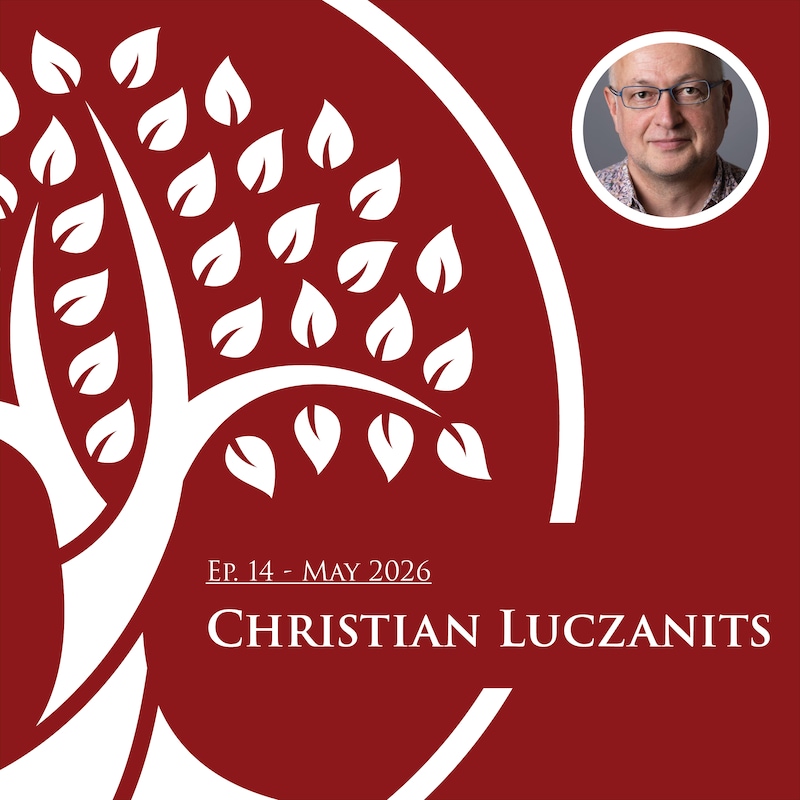
My guest this month is Christian Luczanits, the David L. Snellgrove Senior Lecturer in Tibetan and Buddhist Art in the Department of the History of Art and Archaeology, at the School of Oriental and African Studies, University of London.
Christian’s PhD at the Institute of Tibetan and Buddhist Studies, University of Vienna, established the basis for his first book, Buddhist Sculpture in Clay, published in two thousand and four..
Since then, he has held research fellowships and visiting professorships around the world: in Lumbini, Nepal; Berlin, Germany; and here in California, including positions as visiting professor at Stanford and UC Berkeley in twenty ten. He was Senior Curator at the Rubin Museum of Art in New York from twenty ten to twenty fourteen, when he started at SOAS.
As a specialist in Early Buddhist art of the Himalayas, Christian is the co-author of the book Two Illuminated Text Collections of Namgyal Monastery and the editor of four other volumes on monastic art in the region.
Christian returned to Stanford and the Ho Center in February for our workshop on “Tibetan Buddhist Materialities” and to present new research on “Early Buddhist Art from Mustang, Nepal.” That was the occasion for our interview.
With that, let’s head into the library and hear it.
[bell chimes]
MILES OSGOOD: So welcome, Christian, and welcome back to Stanford.
CHRISTIAN LUCZANITS: Thanks for having me here.
MILES OSGOOD: It's great—it's great to have you again. Well, so I wanted to start generally about your approach to your field in general (laughing): your work as an art historian, but somebody who is not working—as we might imagine art historians often do—in galleries and museums—certainly, that's part of it—but much more, as you describe it on your own website and in terms of your own practice, being in situ, being on the ground to see archaeological and living Buddhist locations in Nepal, in North India. Could you tell us a little bit about your fieldwork and your approach to art history and where you find yourself relative to your colleagues?
CHRISTIAN LUCZANITS: Yeah, I think the study of monuments and going to the sites has always been an important part of art history to some extent in all areas, as is architecture in principle. But with the Himalayas, I think the issue was that it wasn't accessible for a long time. But on the other hand, works of pioneering scholars like Giuseppe Tucci have shown that there is a lot to gain from studying the monuments. And so as soon as the Himalayan areas were opened, I think several people tried to go there and—essentially following the tracks of Tucci, and studying the monuments that are in situ. And I think over time, this actually has become more important, because this early research in the 80s and 90s also documented things that don't exist anymore. And so in that sense, that always has been an integrative part of my research. From the earliest trips, I also realized—and that's where the book about clay sculptures comes about—is that often, at that time, photography was limited in the sense that you couldn't take hundreds—or you could take hundreds of films, but it was a major financial investment to bring it there, to organize the photography. So many monuments were actually known by their paintings, which are a secondary topic, and not by the sculptures that are in the main sanctum, for example. And that's where the clay sculpture topic came from: to essentially correct that perception and bring the emphasis on the right things that actually were emphasized in the monument. The problem with that is that—or was that many of them are restored. And so the more emphasis there is on a monument, historically, the more restored it is. And you have to figure out what is earlier, what is later, and how do the different parts relate to each other historically.
MILES OSGOOD: Yeah, that makes sense. So you mentioned this in some of your work, that one of the distinctive things about working on Buddhist art, but also in this region in particular, is that this art is constantly renewing itself or potentially being replaced. So the idea of preserving images of it at particular times is important. And it sounds like then it must be important for you to be able to continue to make return trips and see how things have maybe changed and—compared to what you were able to record before. Can you tell us about, in general, how your approach to doing photography work has evolved?
CHRISTIAN LUCZANITS: Yeah. I essentially was not even trained properly in photography, but essentially emulate Jaroslav Poncar in his methodology for documenting in situ. And it's relatively simple, with two portable flashes and the camera. And it's necessary, or it has been necessary—and photography has been challenging in the area, because the monuments are very dark. The paintings are often varnished, and so they actually mirror when one flashes against them. But flashes are often the only means that you can take along to actually document the wall paintings. And so you have to flash from the sides, you can't do big overviews, for example, because you don't have the lighting for that. And you would have a white blob in the center. And so it's actually very challenging, or was at that time, especially when you didn't see what the outcome is...
MILES OSGOOD: Mm-hmm.
CHRISTIAN LUCZANITS: ... until you came back and the films got developed and so on.
MILES OSGOOD: Does this give you any kind of historical sense of how these paintings and sculptures would have been initially made or appreciated or visited when light is an issue?
CHRISTIAN LUCZANITS: Yes, I think one always has to consider that as well. But in that case, monuments today are very misleading, because they added lights. (Miles laughs) They added lanterns. They were altered in a way to actually allow you to give you more light than in the past. But when you look at what historically was photographed, it's very clear that up to the nineteen thirties, there are no interiors, because the lighting was an issue.
MILES OSGOOD: Yeah, the images just weren't worth taking or weren't worth preserving. (laughing)
CHRISTIAN LUCZANITS: Yeah.
MILES OSGOOD: Yeah, that makes sense. So I thought maybe just to situate your work even more precisely and to talk sort of anecdotally about particular artifacts that you visited, that we could go back to a moment in twenty ten, where you were working here and you were working at UC Berkeley, but you were also making your first trip to Mustang, the region that you're going to be talking about in the lecture this evening. So can you tell us a little bit about what was on your mind at the time, what kind of work you were doing, and what this trip and this encounter kind of first revealed to you in terms of generating what has now been, you know, more than a decade of work?
CHRISTIAN LUCZANITS: Yeah, interestingly enough, the work that we did here and the work that I do—did in the Himalayas are completely different, because we worked on Gandhāran art here. And essentially, we looked into the notion of the potential of Pure Land Buddhism in—in the Gandhāran period in the area. And from a textual and art historical perspective, that Paul Harrison initiated, and I think resulted in a very fruitful cooperation of which we also published an article about in Japan.
MILES OSGOOD: Hmm.
CHRISTIAN LUCZANITS: But at the same time, I met a person in California who then invited me to Mustang. And that's Joyce Clark. And she brought a friend of hers to Mustang and said, why don't I come along and I can tell them what we see and so on. So I came along. And the photographer Jaroslav Poncar also came along. And we essentially visited the different monasteries. And one thing that was striking for me was that most monasteries were full of sculptures. And I didn't know that because in Ladakh, in Himachal Pradesh, most of the sculptures are hidden away. And you don't actually see them. And so I was surprised how much there is and how much there is preserved. And that essentially triggered the monastery collection project. And in particular one, Lamdre Lhakhang in Namgyal, that was just so full of sculptures, mostly clay or papier-mâché, that I thought this needs to be documented.
MILES OSGOOD: What kinds of sculptures are we talking about? What did you see?
CHRISTIAN LUCZANITS: These are mostly “lamdré” transmission lineage. So if the Sakya school has one particular teaching, it's called the “lamdré” teaching, or the "path with the fruit." And that entails the worship of the entire teachers of the transmission. So many monasteries, Sakya monasteries, have this entire lineage transmission represented person by person. And that amounts, by the 15th century, to around 24 sculptures, 25 or something like that. And so it takes a major part of the collections.
MILES OSGOOD: Yeah. Yeah, neat. So you mentioned earlier on, sort of the question of this region being accessible and when, you know, photographs first started being taken and when research started being done. I know when you came to the Ho Center in twenty twelve, you talked about just the, you know, physical adventure that it is to get up into these mountains. You say, you know, it's a “trekker's paradise” and you show us videos of yourself arriving in this small plane in this remote location. And this all goes into the lore, I think, around Mustang and around other regions in the Tibetan region—what is now Nepal—of whether inaccessibility has something to do with the kind of Buddhist iconography that we find, because of the relative influence or lack of influence among neighbors and among other regions. So I suppose it's a two-part question. First, to describe what it's like to get there yourself today in the twenty tens and the twenty twenties. And then what you're able to intuit about sort of what was the relationship of this region to its neighbors? Has it always, in fact, been a “Hidden Kingdom,” as is sometimes the myth?
CHRISTIAN LUCZANITS: Yeah, on the one hand, access to all these regions has changed dramatically over the last decades. Ladakh much earlier than Mustang. And by the time I came in—to Mustang in twenty ten, the region was still only reachable through trekking. But shortly after, I think they started—or maybe even shortly before—they already started to use the riverbed as a road to reach and supply the Upper Mustang region through trucks over the winter months
MILES OSGOOD: Hmm.
CHRISTIAN LUCZANITS: when the river is low enough. And so there was already change coming. But the remarkable thing is now there is a two-lane road there.
MILES OSGOOD: Hmm.
CHRISTIAN LUCZANITS: And it completely changed from a trekking paradise (laughing) to a place that you can reach now. I think you can drive from Pokhara to Lo Manthang in the same day now, which of course took six days before—with the plane and just walking...
MILES OSGOOD: And was this motivated—was this motivated by scholars, by tourists, by pilgrims? Where was the impetus to sort of create these roads?
CHRISTIAN LUCZANITS: The road creation, I think, throughout Nepal is motivated by the locals, partially by the government as well. But the roads at first are very primitive. They're essentially just one-lane dirt roads for jeeps. But then there was another push when there was a dispute between Nepal and India and the border was blocked. Nepal realized it needs more connections to China. And the Mustang region became one of those connections.
MILES OSGOOD: Yeah.
CHRISTIAN LUCZANITS: And that's why they invested much more money in widening the road.
MILES OSGOOD: Yeah.
CHRISTIAN LUCZANITS: And now it's actually a trade hub to a certain extent. For example, electric cars from China...
MILES OSGOOD: ... are coming through this way.
CHRISTIAN LUCZANITS: ... through Mustang
CHRISTIAN LUCZANITS: ... to Kathmandu.
MILES OSGOOD: Yeah, wow, okay. So now the historical question: is there evidence that this was at all a trade nexus at other periods? Because I think one thing that's at stake in your lecture tonight is the question of sort of: in what ways were the artistic decisions that go into manuscripts, say, assignable to the eccentricities of a region that might not have always had so much contact or might have been self-reliant in terms of its own artistic expression, versus commissions that are coming from outside? So what do we know about this region's relationship to its neighbors?
CHRISTIAN LUCZANITS: What we know so far is that it was always a transition area, always a connecting area. And partially it's geographically, because it's a direct connection north-south through the Himalayas that is relatively easy to control. And I think the success of the Mustang Kingdom was to control that trade.
MILES OSGOOD: Hmm.
CHRISTIAN LUCZANITS: And that's why they could assemble quite a lot of wealth within a short period of time. But that transition—and you see that transition from the earliest archaeological evidence—where (there) were beads from India and gold masks from the...
MILES OSGOOD: And what years are those?
S: Oh, that's, I think, about:MILES OSGOOD: Yeah. Yeah.
CHRISTIAN LUCZANITS: But there are different graves that have been excavated, and only some of them are really well researched. But it is an early phenomenon. And even later, Mustang was always related to trade, and many families traded. And even today, Mustang is—or until the recent past, went in winter to India to sell sweaters and stuff like that, to make—to supplement, essentially, the household income. So this always played a major part in the region, the trade and the connections. And that is also expressed in the art. And so, the assumption before starting the documentation was really that most of it is just made by artists who were either invited from the north, from the main centers in Sakya, or they came from the Kathmandu Valley. And of course, the documentation now changes that picture quite a bit. And it seems that in the early period, they made manuscripts. So here, the “Sūtra Collection,” for example, we think was produced in Lower Mustang, most likely as a place of origin. And I have now much more evidence for production locally. Bronze sculptures of a particular type...
MILES OSGOOD: Hmm.
CHRISTIAN LUCZANITS: ... with very rich inlay seem also to be a local product during the Mustang Kingdom. And so there's a lot of new information that comes from the fact that it's documented in situ and we know where it is.
MILES OSGOOD: Yeah.
CHRISTIAN LUCZANITS: And where the documentation across monasteries just shows—you know, if you suddenly find many objects of the same type within that region, but they're only known here, that's a good indication that they actually come from there.
MILES OSGOOD: Yeah, yeah, that makes sense. So maybe this is a chance for us to turn now to a couple artifacts that could be examples from your research of ways in which we can see these kinds of, you know, sort of homegrown ideas and icons, and then the arrival of external influence or the need to systematize in a way that may be aligned with other, kind of, Buddhist aesthetics. So I think, you know—I think about this book in particular, which I've been looking at, the “Two Illuminated Text Collections of Namgyal.” And, before we even get into the manuscripts themselves, there's the question of the book covers. You know, there's this problem that you can't judge these books by their covers, because the covers in the interior books might not even match: that we don't know whether these wooden block covers were even supposed to be with the original manuscript within. And then there's variations within those book covers, too. You talk about a “Perfection of Wisdom in 8,000 Lines” sūtra that has a polychrome cover that doesn't look like the rest. So could you tell us, you know, as you start to crack these things open, what's that challenge and what does it tell you?
CHRISTIAN LUCZANITS: Yeah, of course, these collections have a long history and the manuscript that I talk (about) today is actually much more mixed up than the ones we published. (laughing) But the—so it's not surprising that the covers don't necessarily match the manuscript they are found with. And it simply depends on how consistent the care was given over time. And if—yeah, also sometimes monasteries are kind of assembling institutions. Namgyal is said to have its collections from different places. And it's not entirely clear where these text collections come from, and in what condition they came to Namgyal itself.
MILES OSGOOD: Hmm.
CHRISTIAN LUCZANITS: And so I think that—so the approach in this case is more that we'll take the book as an assemblage of three objects, or even more objects, because even the manuscript can be multiple layers of different manuscripts, that...
MILES OSGOOD: Mm-hmm.
CHRISTIAN LUCZANITS: And then assess from there, separate documentation if they actually belong together. Often you have a hint immediately, if the sizes don't fit...
MILES OSGOOD: Hmm.
CHRISTIAN LUCZANITS: ... because usually the book covers just overlap, maybe a finger wide or something like that to protect the manuscript.
MILES OSGOOD: Yeah. But if that doesn't fit, it's a clear indication that it's not (laughing) the right book cover. It's too small: it's obvious—if it's too long as well.
MILES OSGOOD: And this is all an indication that some of these things must have come from outside and been collected in one place. And I think you have anecdotes as well of these things leaving their monasteries to take part in live rituals, right? That sometimes people will carry these books around villages for the sake of protection. So these are books on the move, both historically and in the present.
CHRISTIAN LUCZANITS: Yes, these are also books on the move. And this is commonly done in practically all villages, that they take especially the canonical literature and carry it around all the fertile ground of the village for protection.
MILES OSGOOD: Yeah.
CHRISTIAN LUCZANITS: And I've witnessed that at least two times, I think, in different places.
MILES OSGOOD: So to take another example, I think of your twenty twenty article in the “Journal of Tibetology” about depictions of Medicine Buddhas and the colors that they are rendered in, and the question of when this became standardized and when it allowed for some kind of maybe more creative freedom, perhaps. Can you tell us about that example a little bit?
CHRISTIAN LUCZANITS: Yeah, that's a very interesting example because it doesn't—the Medicine Buddhas... So then... Let's take a step back.
MILES OSGOOD: Yeah, yeah.
CHRISTIAN LUCZANITS: So the link between, you know, iconographic appearance and the depiction is usually based on esoteric Buddhist texts. And with esoteric Buddhism, that's a very important connection, that the deities are depicted accurately and they are described accordingly because of the symbolic value that they carry. The Medicine Buddhas are curious because they are Mahāyāna—they derive from a Mahāyāna source—but then they become an esoteric Buddhist topic as a maṇḍala of the Eight Medicine Buddhas. And so the Namgyal example I wrote about was interesting because it's on the edge between the two versions of that. And the Buddhas don't really have a distinct iconography that is described, but then in the maṇḍala they get one. And then the question is: when do they get one? Where does it become a maṇḍala? And so on. But there is also—it linked to this broader question of, you know, how is iconography communicated, maintained, and then revised? And it seems that while there is a centralized power above the monastic institutions, there seems to be a kind of consistent attempt to keep to the text.
MILES OSGOOD: Hmm.
CHRISTIAN LUCZANITS: While when that does not—is not the case anymore, that connection disappears.
MILES OSGOOD: Hmm. And it's now very clear that both in Ladakh and in Mustang, 14th-century iconography is a mess. (Miles laughs) And it's not only with the Medicine Buddhas: with everything. It's very individual, and it's very difficult to figure out what is going on. I also studied, for example, the Pancharakshas, the five protective goddesses, because they occur in these manuscript illuminations a lot. And it's very clear they have iconographic concepts that do not link up with what scholars have previously written: that there are certain Nepali versions, certain Indian versions, and they all derive from there. In Mustang, we have a lot of other versions that clearly indicate that it's more the internal connections or internal reasons that may change the iconography of these deities. And so that's very interesting...
MILES OSGOOD: Yeah.
CHRISTIAN LUCZANITS: ... but quite unique. And it seems to go away again with the establishment of the Ngor school with the Mustang Kingdom, because there is a strong movement then again for systematizing.
MILES OSGOOD: Yeah. So at that point, it starts to align with what we see artistically.
CHRISTIAN LUCZANITS: Yes. And especially the founder of the Ngor school, Ngorchen Kunga Zangpo, was a prolific writer, and he wrote down a lot of tantric commentaries that essentially fixed the iconography of deities where it wasn't clear from the sources originally.
MILES OSGOOD: Yes.
CHRISTIAN LUCZANITS: But linking it back to earlier translated sources.
MILES OSGOOD: Mm-hmm. Yeah, good, so a writer and a reader, somebody who's trying to align things...
CHRISTIAN LUCZANITS: Yes. Exactly.
MILES OSGOOD: ... with the scripture and the texts as they exist, but then also make sure that it's clarified going forward.
CHRISTIAN LUCZANITS: Yeah.
MILES OSGOOD: So we've talked a little bit then about what these objects tell us about geography, what these objects tell us about maybe historical and political chronology. There's also this third example of what we can notice from the internal chronologies of going page by page or through a sutra or through a sequence, particularly in instances of images of the life of the Buddha. You notice that there is sometimes—I think, if I'm getting this right—more consistency in images that precede the Sujata episode. And then again, this sort of eccentricity and mess (laughing) and chaos of how to depict things afterward. I think in particular of an image that you get into in this book of the “Taming the Elephant” episode and what that looks like and whether there's an understanding on the part of the artist of what this is supposed to depict.
CHRISTIAN LUCZANITS: Hmm.
MILES OSGOOD: Could you tell our audience a little bit about those kinds of internal variations?
CHRISTIAN LUCZANITS: Yeah, I think it's essentially the same phenomenon, but it's based on the fact that the life of the Buddha hasn't been transmitted to Tibet by one consistent source.
MILES OSGOOD: Hmm.
CHRISTIAN LUCZANITS: And so there was—already in Indian Buddhist literature, there's this distinction that you have life narratives that go up to the awakening and then other episodes are embedded into the Vinaya literature. Or they have spec(ial)—like the “Mahāparinirvāṇa” episode has a special sūtra dedicated to it. And so one of the remarkable things in Tibet, then, in the earliest depictions of the life of the Buddha is that you can quite literally see that process of them trying to make a complete life. And you see that also in the literature that they write. They summarize the life of the Buddha. But I think what we see then in the fact that these later episodes don't actually have a chronology and sometimes are entirely misunderstood is that they don't come together with the story...
MILES OSGOOD: Hmm.
CHRISTIAN LUCZANITS: ... in a certain way. They probably were communicated visually, misunderstood, and then were misunderstood in their chronology. It's very interesting because it's not—it seems not to be part of the life story. The life story is really up to the awakening...
MILES OSGOOD: Yeah.
CHRISTIAN LUCZANITS: ... even in the oral transmission later. That's what I would read into the slight chaos that happens between those—or in those depictions as well.
MILES OSGOOD: Yeah, so you mentioned in terms of the various factors that could explain and that we could intuit into this variation: things like this being a collaborative workshop, things about—as you mentioned, I think with the clay sculptures—commissions to honor particular practitioners who are conveyors of this knowledge. You look at captions that seem maybe not to match their particular images or that are just coming much later. What do we learn from these kinds of things about dating or about maybe marginalia or about method that also show up in imagery and iconography?
CHRISTIAN LUCZANITS: I find them fascinating because they make the—or they bring the object to life, essentially, not only as one that was created originally, but also how it was used over time. And so that captions essentially are added later with the intention of identifying things that they weren't entirely sure what they are anymore, are very interesting in that respect—also that somebody made the effort. And there is a—and what I find, in that connection, also interesting, that in the West, of course, when we study these things, first we use the captions to identify things.
MILES OSGOOD: Hmm.
CHRISTIAN LUCZANITS: And of course, in that case, if you don't consider that they may be later and they actually may be mistaken, (laughing) that can create a lot of confusion as well. And so there's this interesting thing that you always have to assess if an object is actually consistent in itself. The same is with illuminations. We can't necessarily be sure that they're contemporaneous with the text.
MILES OSGOOD: Mm-hmm.
CHRISTIAN LUCZANITS: They could theoretically be added at some stage later. Sometimes it's clearly a workshop process. But assessing that is very, very difficult...
MILES OSGOOD: Yeah.
CHRISTIAN LUCZANITS: ... and often time-consuming, but very interesting because it does bring the objects to life.
MILES OSGOOD: Yeah. That's wonderful, because it sounds like it could be the kind of thing that would freeze you as a scholar or just invite paralytic caution of sort of, “I can't even trust the relation of the text to the image “or the image to the caption: the kinds of things that ordinarily I would rely upon.” And I think about this in relation to your work for the Rubin Museum (laughing) and the way that we approach the relationship of the placard to the image now, as kind of the authority that it gives us on a date, on a description, on the content of what's being identified. To go into these objects and not be able to trust that feels maybe frightening, but I like the idea that what it tells instead is a historical living story of an object that's been passed through various hands and that we might take an interest in, you know, the handing from one to the other. So on that note of sort of what this—how this relates to curatorial work and museum work and preservation work and documentary work and your own history, having done, you know, Senior Curatorial work for a museum: can you tell me about the living institutions that are starting to grow around Namgyal and Mustang and these other kinds of regions? Because you mentioned in a “Gods’ Collections” essay that there are small museums—or at least one small two-room museum that's come up in Namgyal—that, you know, is imperfect, maybe, in some ways and not showing off the full collection, of course, but might nevertheless be a model for what we will see elsewhere at other monasteries. And then you mention, you know, a sort of more long-standing relationship that some of these sites have had with scholars who are doing more photographic and book-length documentary work. So what is the future of the way in which visitors, scholars, researchers will engage with these materials based on how, you know, regionally and internationally they are being presented now?
CHRISTIAN LUCZANITS: Yeah, that's...
MILES OSGOOD: A big question.
CHRISTIAN LUCZANITS: That's a big question. And with many, many different angles. So if we'll take Namgyal as an example, or let's put it that way... There is a tendency for monasteries now to create museums. The tendency in that is essentially just to use them as display place—spaces. And the idea I think originally came up with in Ladakh, I noticed the first time, as an option to actually charge visitors entry fees...
MILES OSGOOD: Sure.
CHRISTIAN LUCZANITS: ... because traditionally there were no entry fees in museums—or, in monasteries, because visitors to monasteries gave a donation anyway.
MILES OSGOOD: Right.
CHRISTIAN LUCZANITS: So there was no need to charge an entry fee. But with the emergence of group tourism in Ladakh, it turned out that groups come, (laughing) occupy the monastery, go away, but don't leave anything.
MILES OSGOOD: ... don’t leave anything.
CHRISTIAN LUCZANITS: And so monasteries started to charge. And I think the first idea for a museum was (to) create essentially spaces where Westerners could be interested in.
MILES OSGOOD: Yeah. Later on, I think there was a noticeable shift in the sense that they realized they have a lot of old things that they want to preserve, but don't really know what to do with it, but that it represents their culture. And why not create a museum?
MILES OSGOOD: Yeah.
CHRISTIAN LUCZANITS: And that's essentially the Namgyal case. The problem with that often is that the only thing that they consider then worth of entering a museum is when it's out of use.
MILES OSGOOD: Hmm. So a pot that has a hole (laughing) or objects that are damaged in one form or another. So not necessarily objects that we in the West would associate with a museum...
MILES OSGOOD: Right.
CHRISTIAN LUCZANITS: ... and would essentially bring us necessarily to go there and pay an entrance fee. (both laughing) Because the result would be very easy with social media. Somebody goes there and then just messages around...
MILES OSGOOD: Frustrated.
CHRISTIAN LUCZANITS: ... negatively or frustrated about it, and so on. And it wouldn't be very successful.
MILES OSGOOD: But is the more positive spin on that—it sounds like you're suggesting—that it might invite preservation work: like people who are invested in that kind of effort, to want to repair some of these objects or something along those lines?
CHRISTIAN LUCZANITS: Yeah. The preservation... The very positive thing about the Himalayas in general is that it's a preservation area.
MILES OSGOOD: Hmm. So objects are best preserved when they are not bothered with... (laughing) as long as they are protected from rain, essentially.
MILES OSGOOD: Yeah. Yeah.
CHRISTIAN LUCZANITS: And that, of course, is what preserved them in the first place, especially in peripheral areas that have been very poor in between. I mean, Mustang was an extremely poor area in the 19th century. That's pretty clear from the history and there's no new production at that time, for example. And the same is in the Ladakhi areas that I worked or the Spiti transition area towards West Tibet. These were extremely poor areas and that's why the things are still there. Otherwise, they tend, of course, not to use broken items themselves and then dispose of them. And—but the museums... I think the only exception to the rule is where the museum was essentially created to make objects accessible again, not only for tourists...
MILES OSGOOD: Hmm.
CHRISTIAN LUCZANITS: ... but also for locals, is Hemis Monastery, that has essentially a treasure of stuff because it's the richest monastery in Ladakh and they created a substantial museum with objects ranging from the—I think—8th century onwards...
MILES OSGOOD: Wow.
CHRISTIAN LUCZANITS: Kashmiri bronzes of major sizes. But they treat the museum in that case the same way as they would treat the sculptures in the temple.
MILES OSGOOD: Hmm. And so they also call it “Museum” for the Westerners, but “gtsug lag khang” or “house of images” for the locals.
MILES OSGOOD: So, it could be...
CHRISTIAN LUCZANITS: So they make a clear difference.
MILES OSGOOD: It could be a semi-sacred space or a place of pilgrimage in a different way.
CHRISTIAN LUCZANITS: For them, it's essentially a sacred space. So I was witnessing an image of Padmasambhava carried from the temple to the museum without any ritual because it wasn't necessary. It just moved from one sacred space to another sacred space.
MILES OSGOOD: Yeah, yeah, that's fascinating. Well, so, you know, just to kind of wrap this conversation up, which has been wonderful and completely illuminating, (laughing) I thought I'd return to this question of the reputation that Mustang has and that some of these regions have. You mentioned again the ways in which some of their inaccessibility or their regional specificity has led to the possibilities of preservation. It makes me want to return to this question of whether there is a relationship to the doctrinal or iconographic particularities of the approach to Buddhism in a region that was—or that has been seen as hidden away, as relatively inaccessible. I think we have to revise that because, as you say, “No, on the contrary, this has been an important trade channel. “This has been an important conduit between two major regions.” So certainly “hidden” is not the reality. But then what is particular, would you say, about, you know, whether it's that 15th cent(ury)—14th to 15th century period, where there's a transition to kind of bureaucratic standardization, perhaps, or the 500 years since that take us, you know, to the present day, what would you say has been particular? If not an authentic Buddhism that was in a kind of secret enclave, then what? What maybe is particular about the approach to Buddhism in this region? What story can we tell?
CHRISTIAN LUCZANITS: What I find fascinating about it, in an overview, is how often Mustang actually changed—or underwent major changes over time—with first, apparently, you know, single monks on a village level, establishing Buddhism.
MILES OSGOOD: Yeah.
CHRISTIAN LUCZANITS: And it seems one question that I ask myself is, “Why are there only caves from the early period?” Is that because the political situation was so insecure? And that may well be one of the reasons why that was, in a certain way, a time where it was centered on very small communities. That changes completely with the Mustang Kingdom, where it's essentially a state institution that supports one particular school, and that spreads monasteries throughout. And that's where we have the major constructions from. And that link to the royal house was very important. But later, the royal house itself shifts its emphasis to Drukpa, Nyingma lamas, without really changing their Sakya affiliation either. So there is a much more vibrant sense in this in a way, in the interlinkage of the royal house or the Mustang region with the different Buddhist communities. And it seems to link a lot to particular personages. So there are suddenly portraits all over Mustang, by—or depicting particular teachers: for example, Kaḥthog Rig'dzin Tsewang Norbu, a Nyingma teacher, or Mipham Sherab Phuntsok, who is a Drukpa teacher, who was the preceptor of the royal house for a certain period. But that didn't change the overall affiliation of the region with the Sakya school.
MILES OSGOOD: Hmm.
CHRISTIAN LUCZANITS: And I think this flexibility is quite unique. And I think it relates to all these linkages that relate to the Mustang region. So I absolutely concur with you that it's far away from a “hidden region” in a way. They see themselves really at the heart of the kind of Tibetan world, communicating with the Kathmandu Valley as well, with the Indian plains in that case.
MILES OSGOOD: That's wonderful. And then to ask the question then of what is distinctive about it, you have to avoid the trap of saying that there is one consistent set of icons, set of images, set of beliefs, because in fact, even though there are consistent affiliations after a certain point, what's distinctive is in fact the flexibility, the variability, and that that's what all of this imagery has shown us.
CHRISTIAN LUCZANITS: Yeah. It may actually be characteristic for all those peripheral regions, but it's not researched in that way. It's only when you document in situ in density that you suddenly see things that you would not have seen otherwise, or could not have studied from objects that are just in the West in different collections.
MILES OSGOOD: Yeah. Yeah, well, that's wonderful and a great way to come back full circle to the nature of your work and the necessity of going to these places, looking at and seeing how these objects actually relate to one another: what encloses the manuscript or the clay sculpture that hasn't been photographed before. That's all really lovely. Well, thanks so much. We're excited for the talk that you're going to give tonight. And that's also something that we're going to record. So that'll be available on our channel as well, and hopefully will complement everything that we talked about just now.
CHRISTIAN LUCZANITS: Thank you.
[Epilogue]
[music - Ani Choying Drolma, guitar and bells]
Thanks again to Christian Luczanits for joining us on the show. On our YouTube channel, be sure to check out the recording of Christian’s February lecture, “Early Buddhist Art of Mustang, Nepal,” which is filled end-to-end with photographs of mountain monasteries and scans of illuminated manuscripts.
[music - Ani Choying Drolma, Oṃ maṇi padme hūm̐]
Until next time, this has been “The Ho Center for Buddhist Studies at Stanford” podcast.
[music - Ani Choying Drolma, Oṃ maṇi padme hūm̐]

