Shownotes
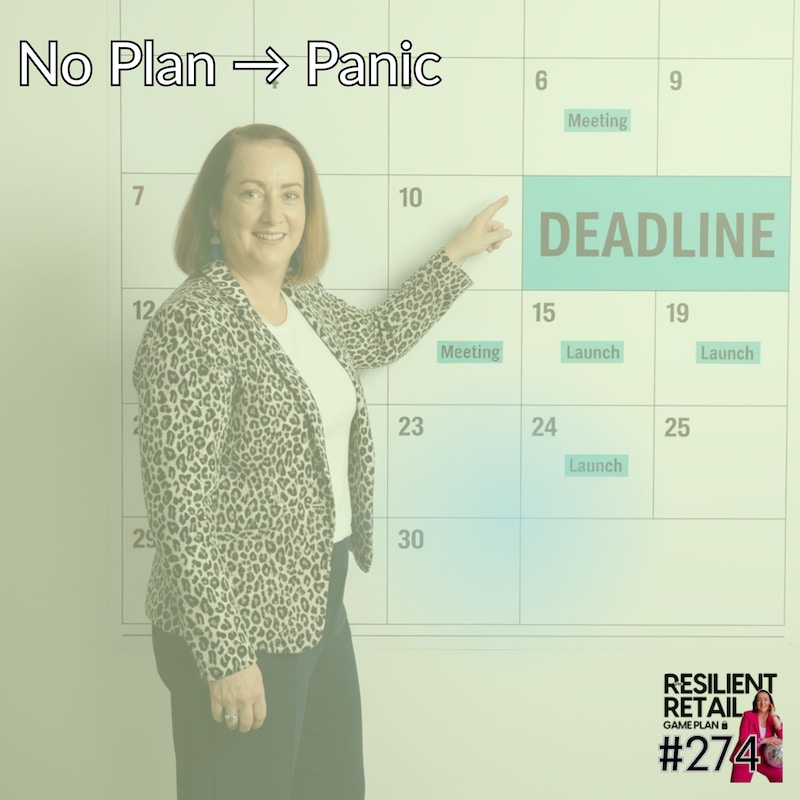
If you’re tired of winging it with your retail sales, this episode of The Resilient Retail Game Plan is your turning point.
I'm Catherine Erdly, and in this episode I'm revealing how mapping out your sales year gives you more creativity, not less.
Plus, we're all about calmer launches, better cash flow, and loyal customers.
Learn how to replace last-minute panic with a confident plan that fits your life, not the other way around.
Timestamped overview
00:00 Planning Enhances Creativity
03:40 Avoid Reactive Selling Strategies
07:09 Predictive Marketing Example
10:57 Plan Themes, Fill Gaps
15:07 "Planning Ahead for Success"
18:14 Holiday Planning for Retail Success
Website: https://www.resilientretailclub.com
Invite: https://resilientretailclub.com/retailsales
Podcast: https://www.resilientretailclub.com/podcast
Tell me what landed for you—DM @resilientretailclub on Instagram with your biggest takeaway or guest wish list. Tap follow (and rate and review me while you're there) in your favourite app to keep updated on new episodes.
Mentioned in this episode:
Faire 50% offer
Use the code GamePlan25 to get 50% off and free shipping with your first order at faire.com
Transcripts
You don't need more willpower, you need a plan. If you're tired of
Speaker:reacting, scrambling and posting on a whim, then today's
Speaker:episode will show you how planning your sales year in advance can
Speaker:completely change how you run your business.
Speaker:Welcome to the Resilient Retail Game Plan. I'm Catherine Edley and in the
Speaker:next few minutes, you're about to get powerful real world retail strategies
Speaker:from insights shared both for my guests and myself, backed up
Speaker:by my 25 years in the retail industry. Keep listening to learn
Speaker:how to grow. A thriving, profitable product business. Let's
Speaker:jump in with this latest episode. So one of the most common
Speaker:misconceptions about planning that I come across is that it's
Speaker:somehow the opposite of creativity. I talk to so many
Speaker:people who will tell me, oh, I don't really like plans
Speaker:because I feel like they're very restrictive. I, I feel like if I
Speaker:put a plan in place, then it makes everything more
Speaker:robotic or more structured. And that's why I left the
Speaker:corporate life, to find something that is
Speaker:more freeing, more creative. And I totally
Speaker:understand that. I hear that all the time, especially for people who
Speaker:are extremely creative by nature, people who are designing
Speaker:their own products, making their own products, and really
Speaker:feel that they want to be in touch with their creativity and, and they
Speaker:don't want to be pigeonholed or fit into a particular
Speaker:structure. So I hear that all the time. However,
Speaker:in my experience, what happens is, is if you don't have a plan,
Speaker:and even just a broad overarching plan, then it can
Speaker:lead to a lot of complications and it can lead to a lot of
Speaker:fatigue and a lot of burnout, especially
Speaker:when it comes to making decisions. And it can just
Speaker:actually feel overwhelming. So what we want to do
Speaker:is we want to find something that is somewhere in the middle.
Speaker:It's true that if you sat down and planned everything to the
Speaker:nth degree, what I'm going to say on that day on Tuesday
:00am, I'm going to be doing X, Y, Z. For some people, that would
:be too restrictive. But for most people,
:what they find is once I've convinced them or I've got over this
:dislike of the idea of planning, what they actually find
:is that it gives them freedom. So I was talking to a client
:about this. They were one of those skeptics that was
:totally dead set against the idea of putting anything into a plan because they
:felt that it really interfered with their creative flow. And they actually
:said, well, it gave me some structure. And then within that structure,
:it meant that I could be more creative. And the reason that
:happens is that once you take away all of that mental load that goes
:with working out, what am I actually even supposed to be doing today? You can
:have more mental space to think about, well, what does that look like for me?
:What do I want to do? And to get in touch with the creativity
:planning. For me, it's a really important process
:and it can be so beneficial. And what I
:see is when people take the leap and they go from being completely
:ad hoc to being more structured, they just
:feel a sense of relief. There's something about your nervous system that kind of goes,
:okay, I know what the plan is. And now I can be
:more relaxed and actually do some of my best work.
:So this episode isn't about
:detailed content calendars or over planning, although I
:do believe that a content calendar is extremely useful. But it's about strategy and
:it's about building a business that works for you.
:So let's just start off by thinking a little bit about what actually
:happens when you are stuck in this reactive selling. So the first thing is, is
:that to be honest, it wastes a lot of time. You spend a lot of
:time thinking or constantly trying to work out what to promote.
:And definitely I'd say one of the biggest issues, and I've
:touched on this in previous episodes, so for example,
:271, the three mistakes keeping you stuck, or episode
:272 Overcoming Feast of Famine sales cycles. I touch on this in more detail,
:but one of the things that happens when you don't plan is that you
:miss some really key seasonal opportunities. In
:retail, it's really all about thinking about what the customer wants
:right now. So thinking about on the
:10th of February, if you're a gifting brand, the thing
:that's most likely that somebody's going to want to buy from you, assuming
:you can still get it to them in time, would be a Valentine's Day gift.
:Now, if you don't plan out your year, then it can
:mean a lot of waking up on the on the 9th
:of February and suddenly thinking, oh, maybe I should have done something for Valentine's Day.
:And big retailers, who, incidentally, I would argue, probably go too far the other
:way. They plan things out not just 12 months in advance, but usually 18
:to 24 months in advance. And they will always
:have these big seasonal peaks locked in
:and planned out in meticulous detail. So again, you don't
:have to be that prescriptive and you don't have to be that planned that far.
:In advance. But there is a reason that they do it. And the reason that
:they do it is they're ready to tap into people's
:desires, what they're looking for at that particular time.
:I also think if you are stuck in the reactive
:selling cycle, it's really hard to build momentum with
:your audience because they're not quite sure what to expect
:from you. And interestingly, one of the things that we fear the
:most is small business owners and small product business owners,
:small creative product business owners who have beautiful products that they feel
:very passionate about. One of the things that people fear the most is they fear
:that they're going to bore their customers, that everybody's seen
:this, everybody has already got one of these. I
:need to show them something new. And while newness can be really important,
:an important sales driver, there needs to be an element of newness to help renew
:the conversations. At the same time,
:repetition is something that actually, really, really
:builds trust. And again, if you think about any
:big retailer, you'll know what to expect from them.
:You'll see the same messaging, you'll see the same types of launches,
:you'll see the same types of seasonal products that come out year after year
:after year because they know that that repetition is what builds the
:trust. Repetition builds reputation. The other thing as
:well is if you rely exclusively on reactive selling, then you end up
:defaulting or you can end up knee jerking to discounts or quick
:wins. You think to yourself, oh, I really need to do something this month.
:What shall I do? 20% off? Okay, yeah, let's do that.
:Because you haven't really thought it through and you haven't really mapped
:it out. It can mean that you end up doing these blanket discounts
:more often than you should. Which blanket discounts, by the way, is money off?
:Absolutely everything. And those are the ones that can be really super brand
:damaging. So when you're constantly reacting, you're never really in
:control and you're almost a couple of steps behind your customers. You
:want to be ahead of your customers, you want to feel like you're in your
:customers heads and you know what to expect. One of my
:favorite emails that I got this year from a product business
:was perfect example of. This is going to sound like a very
:mundane example, but I think it's really powerful. I said to my
:husband recently that we were, you know, in the car, the
:wipers weren't brilliant. I said, okay, I think we need new wiper blades.
:Lo and behold, about two weeks later, just when I was thinking to
:myself, right I should get around to ordering some. I got an email from the
:company that I had last ordered wiper blades from three
:years previously. And they obviously had done
:some kind of analysis, worked out the usual gap that people ordered new
:wiper blades blades, and they had sent me an email saying,
:is it time for new wiper blades? Here's a free shipping code and
:here's a link to what you bought last time. Which was brilliant because the last
:thing I wanted to do was go and research what wiper blades I needed for
:my car. Now, you can see in that moment, it very much felt like
:the company that sold the wiper blades was not two steps behind me.
:They figured out exactly when I needed them and they sent me a reminder.
:Now, of course, this is an evergreen flow that they would have set up as
:opposed to their annual planning. But the idea is the same.
:It's about you being in tune with what your customer wants
:and when and not feeling like you're trailing behind.
:The other thing that happens as well, if you get into reactive
:selling is you can actually end up with some messaging
:jams if you like. So all of a sudden you're doing an event
:and you're doing a discount and you've got a new product launching all at the
:same time. And then you go from having weeks with
:quiet times, with not really much to talk about, to all of a sudden too
:much to talk about at the same time. And then you're not really able to
:spotlight things in the way that you want to.
:So all of that can mean that it ends up feeling more messy.
:So what planning actually looks like proactively
:planning, therefore, is. It's all about
:zooming out and taking the bird's eye view. A big fan of
:this, because in my experience, this is what really helps. People
:go from feeling like they're looking at a tangled pile of
:yarn to feeling like they actually can see the threads in their business
:and how it all ties together. So it's all about
:mapping out your key moments. So usually what I start
:with is a process where we go through what are the key
:dates for the year. And everybody's got different key dates.
:For some people it will be the back to school time period. Other people it
:will be Christmas. Other people, it might be
:fair trade. Fortnite, for example, might be their biggest time of the year.
:There's lots of different triggers for each different business.
:So it's all about you knowing what your key dates are. So you get those
:planned in. Then after that you start layering in when
:do you have new products launching? When do you have
:restocks coming in? When are you having events in your
:business? When are you going to be on holiday? So you
:don't want to plan a big launch in the middle of that. That's also really
:important to know as well. So once you start layering
:on all of those different things, depending on the business that you have,
:some people have so many new product launches that that can literally
:be what they talk about each week for the whole year.
:Other people may not have that situation. They may have a very
:limited product range, in which case we need to look at other reasons, other
:conversations. They can start with their customer throughout the year,
:which is absolutely fine. It's just a question of being aware of that.
:Once you have broken it all down, you can then start
:to see each week what the obvious thing is to talk about. So if
:Valentine's is your biggest day of the year, then the
:three weeks in the run up to Valentine's Day is probably all you're going to
:be talking about is Valentine's Day. If Mother's Day is really important for
:you, the run up to Mother's Day, that's what you're going to be talking about.
:And you can start to see where there are clear themes for your business
:and then you'll start to see where there are gaps.
:So there may be a six week time period where actually nothing's really
:happening. So that is when you could start thinking about, do I
:have a competition? Do I find somebody to collaborate with? But by
:zooming out and looking at the bird's eye view, then you
:can start to see those rhythms and those patterns well
:before they happen. So one of the things that people
:sometimes find difficult with this is I talked about new product launches, for
:example, and people will say to me, well, the thing is, is I don't
:really know when I'm going to be launching new products. Or
:sometimes I just create them on a whim and put them up
:for sale. And sometimes I
:just find things that I like at a trade show and then I'll launch them,
:which I totally get. The way that you kind of balance that
:restriction versus freedom in your plan
:is you can plan out roughly what you think you're going to need and then
:it helps you shape some of that ad hoc spontaneous
:product launching into a more
:consistent rhythm. So, for example, let's say you're
:somebody who has a bricks and mortar store, so you buy your products from
:other people. You may normally
:just go, and if you see something nice, you'll buy it and then you'll launch
:it. But if you do this planning piece, you'll go through and you'll
:say, well, actually, really, in February, I need to be talking about
:Valentine's. In March, I need to be talking about Mother's
:Day. Okay, but what would be really helpful is after Mother's Day, it
:would be super helpful if I had some spring lines to launch.
:So, okay, I'm going to bear that in mind. And when I am look out
:and about looking, I'm going to see if I find things that will fit for
:that launch. And equally, you might say, right,
:I'm going to have a high summer launch. I'm going to launch my autumnal
:products here. And I don't necessarily know what those are right yet.
:That's okay. But I've got a place for them and I've got a plan for
:them. And again, it's that kind of balance between it being
:super prescriptive. It's not about necessarily you having to say, I
:know exactly what I'm going to launch every single week of the year. It's
:about you being able to say, right, based on the rhythm of the year, this
:is what I think I'm going to need here. Therefore, does this fit into that
:launch? And of course you can have ad hoc things. Of course you can drop
:something in that you just fell in love with and had to bring in right
:away, that's absolutely fine. But it will also save you a lot of stress
:if you have a broad plan for the year and you're able to slot
:things in. And then once you've done that, once you've chosen your clear focus for
:each week, it makes everything else in terms of your marketing
:much cleaner, much easier. So your email, your social
:and events that you're doing in the store or online, depending on your business,
:they just flow much better because you know what it is that you're
:talking about. Then you can create consistency across all the touch points.
:So your social media can match your email and your email can match your blog
:post if you've written one. All of those things go together for a
:weekly theme and it just makes things much calmer and much easier.
:Think of your sales year like a school term. It's structure. You know what's coming.
:Doesn't mean that necessarily every lesson's written in stone, but you've
:got a framework for it.
:So what are the benefits for planning this way? I would
:say the biggest one I touched on in this at the beginning is it's not
:just about being organized. It really helps you reduce that decision
:fatigue. Now, especially if you are somebody
:who either is diagnosed or strongly suspects you have
:adhd, then this kind of thing can help you just put that
:structure in and really, really help some of that decision
:fatigue be reduced. Many people are juggling
:family or other caring responsibilities with their work.
:Lots of people I work with have got very limited amounts of time to work
:on their business so they just need to be ready to go when they do
:have that time, they have that pocket of time when they can sit down and
:work on an email for the week or even a month, try and
:batch it, do the month ahead. If you've got it all planned out, you just
:really, really reduce the amount of time that you spend going oh, what do I
:think I need to do? It's amazing that if you
:sit down on a Monday and try and decide what you're going to do for
:the week, the amount of time it takes you to do that, you could
:probably plan out most of your year. And I know
:that sounds unbelievable, but planning, especially if you follow that
:process of blocking in the certain dates and mapping it all through,
:it doesn't necessarily take that long and it
:just means that it then each week you know exactly what it is that
:you're going to do. Whereas if you have to make that decision every week, it
:seems to take take much, much longer. So it helps then with
:your audience, helps them trust you and they see the consistency and
:it helps build a rhythm to support long term growth. So this is
:what my new course the retail sales game plan is all about. We're all about
:creating that structure, putting it into place. I've got templates that I
:can share, we have got workshops to work through these
:and then also co working sessions where you'll have time and space
:to work through for your own business and I'll be there to answer any
:questions. So it's really fabulous if you listen to this and you think this is
:exactly what I need, but I'm going to need some accountability to get it done.
:Then the doors are open for the retail sales game plan for just another
:few days. So if you want to sign up, head over to resilient
:retail club.com retail sales and check it
:out. You know most people who I speak to her
:running small businesses, they are managing their businesses around
:children or around other caring
:responsibilities. Several people I work with have chronic
:illnesses for example and many of them
:have got really restricted times for lots of different reasons for them to be
:able to work on their business. So it's not about
:doing more. For a lot of people, doing more just isn't
:necessarily feasible. But what they do need
:is to work in a more efficient way. That old
:chestnut, you know, don't work harder, work smarter. But that's really,
:really true. It's about being more efficient, being more
:focused, having the vision for what you want for the business for
:the year, and then putting that into a plan
:really quickly. Then quick wins. How to start planning now? Have a think
:about well, first of all, go check out the retail sales game plan,
:but there's three quick steps you can take today. Think about your
:focus for the next four weeks. Do you know what you want to talk about
:week on week for the next four weeks? Can you make a decision so that
:when you sit down on a Monday or whenever it is that you have time,
:then you are able to just jump in rather than trying
:to figure it out? Look at your next key seasonal moment.
:Obviously we've got Christmas barreling down the track
:us and that's one of our first tasks inside the retail sales game plan is
:to sort out Christmas. But you know, are you ready for it? Have you put
:the things in place you need to and then just make sure
:you have time each week to look at your overall plan and then
:execute on it. What are you doing this week to support that? And you may
:find that once you've put that big plan in place, the amount of time you
:need each week to actually be consistent and keep things moving forward will
:be less than you think. And the key thing here is planning is not about
:perfection. It's about having a don't direction so when
:the busy season hits, you're not thrown off course
:so you don't have to keep winging it. You can run your business in a
:way that supports your life, your energy and your values, but it does start with
:taking the reins and being intentional. And no, it won't turn you into a corporate
:robot. If you have a plan, the key is about having the
:getting that balance between a guide that will help you
:stop floundering around when you're not sure what to do, but not one that's
:overly restrictive. You want to be able to
:have a plan that will help you tie together all of your marketing activities
:and your product activities and put it together in a way
:that helps you build that consistency and helps build a
:calm and consistent sales business. So head over to resilient retail
:club.com retail sales and check out the course.
:Thank you so much for listening. Listening don't forget to like, follow or
:subscribe to the podcast wherever it is that you're listening in from.
:And that way you'll be the first to know about each new episode. Every
:Thursday morning.




