Shownotes
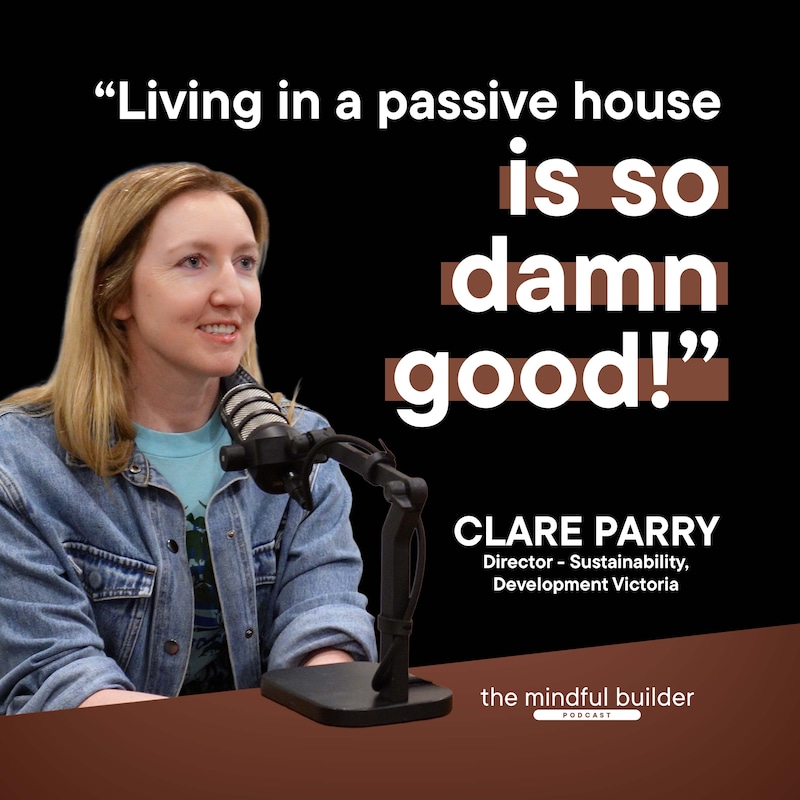
"You're wearing a tin foil hat if you think Passive House will work in Australia."
That’s probably what Clare Perry would have heard back in 2011 when she co-founded the Australian Passive Haus Association. Fast forward to today, and while Passive House hasn't yet become mainstream, the landscape has shifted dramatically. Industry appetite has grown, more building professionals are actively exploring the concept, and even government is starting to take notice. We sat down with Clare to understand how this shift happened and what it means for Australian builders.
For builders considering Passive House, the question isn't whether to adopt these standards but when. Early adopters gain competitive advantages as client awareness grows and regulations tighten. The industry is moving toward higher performance standards, whether individual builders choose to lead or follow.
Clare's journey from "tin foil hat" advocate to government sustainability director demonstrates how persistence and proven results shift entire industries. The Passive House revolution isn't coming, it's already here. The only question is whether you'll be part of driving this change or catching up later.
LINKS:
Australian Passive Haus Association:
https://www.passivhausassociation.com.au/
Connect with us on Instagram: @themindfulbuilderpod
Connect with Hamish:
Instagram: @sanctumhomes
Website: www.yoursanctum.com.au/
Connect with Matt:
Instagram: @carlandconstructions
Website: www.carlandconstructions.com/
Transcripts
So the queen of passive house,
Speaker:we formally agreed not to use that phrase, but,
Speaker:so yeah.
Speaker:Where you are with Claire Perry, in 2011 you started the passive house Association.
Speaker:That's when, I reckon that's when the.
Speaker:The earliest iterations of it started and it was just three professionals having
Speaker:coffee just with this idea in mind, Uh, I just found passive house through my work.
Speaker:, Wasn't even as an, as an engineer.
Speaker:As an engineer, sustainability engineer.
Speaker:uh, it wasn't even a project I was working on.
Speaker:It was a project some, some other people in my office were working on.
Speaker:And, uh, I got so intrigued that I went off to New Zealand on
Speaker:annual leave and did the course.
Speaker:On my own cost.
Speaker:So New
Speaker:Zealand were already doing it.
Speaker:Yeah.
Speaker:Cara Rosemore over there.
Speaker:She was doing the training at that point.
Speaker:Um, but yeah, I didn't even tell my boss.
Speaker:I was just like, I followed my nose into passive house and when I got
Speaker:back, I don't even know how I did it.
Speaker:I must have put myself on the, there was a, you know, the designers register on
Speaker:LinkedIn or something and David Power, who's a, you know, name that's actually
Speaker:left, I think he's back in Ireland now.
Speaker:He is an Irish guy.
Speaker:He was working at Sustainability Victoria at the time.
Speaker:I reached out, um, and there was another, a German guy, so it sounds
Speaker:like the start of a great joke.
Speaker:But, um, uh, Christophe Bager, who I think now works at Schneider.
Speaker:Um, so they've, they're both, you know, outta the passive house industry now.
Speaker:But you know, what we created is pretty cool, which is just this, um,
Speaker:monster.
Speaker:Uh, we're kind of a monster, but just a community.
Speaker:Yeah.
Speaker:So you first, when you probably discu, like the first time you ever
Speaker:went to someone about like, oh, I'm looking at this passive house thing.
Speaker:Was it like.
Speaker:What tin fall hat are you wearing?
Speaker:Or like, what are you talking about?
Speaker:Because 2011, you know, in construction terms in Australia
Speaker:is a long fucking time ago.
Speaker:Like I feel like we haven't come that far forward, but we've
Speaker:come a reasonable way forward.
Speaker:But 2011, like I remember what I was building back in 2011.
Speaker:It wasn't,
Speaker:I didn't even know what day it was
Speaker:anywhere near what we consider as a good building now.
Speaker:Um.
Speaker:Yeah, it was definitely, it's definitely very, very fringe.
Speaker:But, you know, my first couple of clients found me like I didn't have
Speaker:to, I wasn't doing any spooking.
Speaker:I think I might've done the odd, um, presentation at an architect's office.
Speaker:They're European that have to be, that'd have to be like German, yeah's, a lot of
Speaker:expat who come over here and go, what, what the fuck are we living in?
Speaker:You know, like that's, that's generally where the first few
Speaker:projects came from for sure.
Speaker:And to, so, so, um, the Australian passive has association, you, you.
Speaker:Founded started in 2011, when was the first certified building in Australia.
Speaker:It actually wasn't that long after that.
Speaker:So, um, Dale Roberts down in Geelong, who does AFI projects.
Speaker:Uh oh yeah.
Speaker:Yep.
Speaker:He was doing his parents' house and probably similarly he was, he started with
Speaker:a willing client, which was his mom and dad said, I'm gonna have a crack at this.
Speaker:Mm-hmm.
Speaker:And um, yeah, we got that certified.
Speaker:And he beat Justin by like a week, didn't he?
Speaker:For his house down in Tazzie or something.
Speaker:Wasn't Justin saying on the podcast that he just got pipped at the post?
Speaker:Oh, it's Harley, Harley, Harley.
Speaker:Harley, Harley, Harley.
Speaker:Yeah, yeah, yeah.
Speaker:Harley
Speaker:was definitely doing some stuff in camp at the time.
Speaker:Yep.
Speaker:Yeah.
Speaker:So your first PHPP that you would've done, like, there would've been very little
Speaker:help to like, Hey, what do you do here?
Speaker:Oh, there's, there's a steep learning curve.
Speaker:Yeah.
Speaker:Yeah.
Speaker:I, I definitely bought my first passive house.
Speaker:Yep.
Speaker:Like
Speaker:it, it would've cost me.
Speaker:In fact, I know that we Cat and Chris, if you're listening, we broke even.
Speaker:Yeah.
Speaker:Broke even on that job.
Speaker:But it was to get a certified building, you probably
Speaker:also did it as a learning curve.
Speaker:Like it, it, it, you, it's an investment into where you are now.
Speaker:And we're also building like in, at the very beginning of COVID as well.
Speaker:Oh, okay.
Speaker:And like throw a, throw a data to figure out where the
Speaker:construction prices were gonna end.
Speaker:Uh, we're gonna, we're gonna end up, um, okay.
Speaker:So 2011.
Speaker:So back then, how many members were there?
Speaker:Uh, a handful.
Speaker:Um,
Speaker:so, so would've this been the conference, just the three of us having you, Cameron?
Speaker:Uh, I can't, I can't remember
Speaker:when the first conference is.
Speaker:I reckon it would've been 2014, maybe.
Speaker:About then.
Speaker:Yeah.
Speaker:Um, by then we'd built up like a really cool community.
Speaker:Yeah.
Speaker:It was, it was wonderful.
Speaker:Uh, everyone was willing to just, you know.
Speaker:Roll up their sleeves and get some stuff done.
Speaker:And I organized that first conference myself.
Speaker:I just remember, you know what?
Speaker:Yeah.
Speaker:I just like, I was ringing.
Speaker:People were like, oh, we need, we need an extension cord.
Speaker:And I was like, all right, I'll go and get an extension cord, and I had to go
Speaker:to, you know, my 10 or something, or we need backdrops for our display booths.
Speaker:And I was like, all right.
Speaker:Um, how, where do we get those from?
Speaker:And I was figuring all this out.
Speaker:So you're like, why
Speaker:did I do this?
Speaker:No, I loved it.
Speaker:Um, I reckon I could probably do anything now having done that sort of stuff, but.
Speaker:The community was just, um, you know, people pulled me aside
Speaker:at the recent conference and said, remember that one we did.
Speaker:And I, I didn't realize they knew at the time I was doing
Speaker:it by myself, but they knew.
Speaker:But you know, they, they were just so happy to be there.
Speaker:Just the community is pretty cool.
Speaker:Like, we,
Speaker:we don't talk without this community.
Speaker:No.
Speaker:Like, it's you, you drink, you do drink the Kool-Aid and it's like off you go.
Speaker:You do.
Speaker:Yeah.
Speaker:And it's pretty strong Kool-Aid.
Speaker:Are you pretty, are you pretty like, 'cause I mean you were at
Speaker:this year's conference, like.
Speaker:We're, what, 10, however many years on 12, 13, 14 years on now.
Speaker:Like you're pretty proud of where it's at.
Speaker:Yeah.
Speaker:Yes and no.
Speaker:Like I absolutely, the, the community's awesome, you know?
Speaker:Yeah.
Speaker:These are some great humans who have just gone, what we're
Speaker:doing needs to get better.
Speaker:Um, but at the same time, I'm just like, what?
Speaker:Where the bloody hell are these buildings?
Speaker:Like why, why is this not?
Speaker:Why has everyone not realized that this is the, oh,
Speaker:this, this was gonna be one of my, this kind of flows onto a question because
Speaker:I'm not, I'm not, I'm not disappointed in the, I was actually, I was actually a
Speaker:little bit worried.
Speaker:I was actually a little bit worried about where that was going just then.
Speaker:Like, I like, but I get No, I get, yeah, I get that.
Speaker:Because I mean,
Speaker:should have been 2000 people there, you know, like, yeah.
Speaker:Okay.
Speaker:True.
Speaker:And why isn't it in the code?
Speaker:Why is everyone still like,
Speaker:but now, you know, in 2025, people know what passive house is.
Speaker:Yeah.
Speaker:That's awesome Like that, you know, like even if you don't.
Speaker:Want to build a passive house, you know, it exists, but 14 years on,
Speaker:like I'm with Claire here, like 14 years on, like, why isn't there more?
Speaker:I'm impatient,
Speaker:but, but this, my question here is like, do you think it's actually growing?
Speaker:Because I think it, whilst it's growing in our bubble, it's not
Speaker:growing further to more like as a percentage of houses that are built.
Speaker:Yeah.
Speaker:It's still such a tiny, tiny, tiny percent.
Speaker:Like, to me it's like, why aren't we?
Speaker:Because it's, it all makes sense.
Speaker:I remember when I found passive house and I was just, I was just
Speaker:sort of looking around going, does does everyone know about this?
Speaker:Like, is this, yeah.
Speaker:So I just found this and nobody else, am I stupid that this all makes sense?
Speaker:And
Speaker:it, it's like, oh yeah, this is how you should build a building.
Speaker:Like why am I the odd one here?
Speaker:yeah, my disappointment and I, I know the world's a complex place and
Speaker:there's so many problems we need to solve all at once to make this fly,
Speaker:but it's, it's just so goddamn logical.
Speaker:It's so rational.
Speaker:It's such a rational response to a good building.
Speaker:Yeah, and it's so simple.
Speaker:I think the people that go passive house is really hard.
Speaker:Kind of don't get it.
Speaker:I, I know that it's not the easiest thing to do, particularly
Speaker:where you've got our BAU sitting.
Speaker:Like it's not hard to go from there.
Speaker:Sorry.
Speaker:It's not always easy to go from there to passive house.
Speaker:But once you know, the absolute answer is, you know, a good building
Speaker:has these minimum characteristics.
Speaker:It's, it's really hard to justify not doing it.
Speaker:I, I
Speaker:agree.
Speaker:So let, let's actually justify not doing it.
Speaker:Yeah.
Speaker:Like why, like, I wanna actually throw in the opposite, like, 'cause you
Speaker:obviously know passive house very well.
Speaker:Like, why wouldn't you do it?
Speaker:There's just so much inertia, so much business as usual that just resists it
Speaker:there's too many reasons and I, I'm, you get a bit fatigued, I guess, trying
Speaker:to fight it, but, um, I, I don't know.
Speaker:I honestly dunno the real answer.
Speaker:I, I,
Speaker:I went full cold Turkey, like I canned a project because I'm like,
Speaker:I can't build that way anymore.
Speaker:Yeah.
Speaker:Not, I don't, all projects don't need to go to certification.
Speaker:Yeah.
Speaker:But the method is, it covers out, like the pure reason I started is it covers
Speaker:my ass as a builder from molding, condensation and issues in the future.
Speaker:Yeah.
Speaker:And it was the first time a sustainability box had been ticked where it's like.
Speaker:We've spoken about this where it's like, oh yeah, I'm a sustainable builder.
Speaker:I'm like, am I, I'm doing, I'm, I'm using timber.
Speaker:It's, it's, it's very what I like about it and what Drew drew me
Speaker:in from the beginning, it was, it was, it was not, there was no
Speaker:sort of wishy washiness about it.
Speaker:It was very prescriptive.
Speaker:There was a clear path that you had to follow.
Speaker:There was a recipe you had to follow.
Speaker:And then it was checked by someone
Speaker:and it was shiny and our brain's like shiny.
Speaker:Well, well that, that aside, but I, for me it was like, it was very clear.
Speaker:You like it was a passive house or it wasn't passive house.
Speaker:Yeah.
Speaker:And these are the things that you have to follow to get there.
Speaker:It's probably gonna lead onto my next question.
Speaker:There's a lot of people out there saying they're building high performance homes.
Speaker:There's a lot of people that are following the passive house principles, right?
Speaker:In your opinion, can you still build a good home?
Speaker:If you follow the same steps without it being certified or without it hitting
Speaker:some of the key metrics of passive house,
Speaker:um, all of the metrics exist for specific reasons.
Speaker:So, you know, there's, there's a, the minimum expectation to avoid cold, radiant
Speaker:surfaces or the minimum threshold to avoid risk of mold or the, you know,
Speaker:there's these numbers aren't accidental.
Speaker:Yeah.
Speaker:Um.
Speaker:So I'd, I'd probably say no, but, um, it really, it's a personal preference.
Speaker:If you, if you are happy, if you are, you know, good enough for you
Speaker:to live in whatever you wanna live in, then it's a personal preference.
Speaker:But I think, a high performance building should meet the minimum expectations
Speaker:of being, you know, healthy, well ventilated, good thermal performance,
Speaker:good comfort outcomes, um, and durable.
Speaker:And that's, those are, you know.
Speaker:The fundamental expectations.
Speaker:It's not asking much really, is it?
Speaker:I would say on your comment there, high performance is this loose term.
Speaker:Every building should, if you were to passive house, it should just
Speaker:meet low energy within that range.
Speaker:And I think the world would be
Speaker:this.
Speaker:I mean, this is this, this is the kind of space that we operate
Speaker:within with our buildings.
Speaker:Like we try most of our buildings try and have it land within that PHI low energy
Speaker:territory at the, at the very least, that's kind of our minimum standard.
Speaker:But we've got a project at the moment, which we're working.
Speaker:With Cameron's involved, Cameron Monroe involved, and it's an
Speaker:old Alistair Knox building.
Speaker:Now it is almost impossible to get that one to a even an effort
Speaker:level of construction, but, and, and still maintain, you know, that
Speaker:Alistair Knox integrity and heritage.
Speaker:But we've got Cameron in to model any risk and he's come back to us and said, well.
Speaker:Think we're gonna need to put some intella here.
Speaker:I think we need to do this there.
Speaker:So we kind of understand that building intimately.
Speaker:But we also know that it's, I think, is at 45 or 50 kilowatt
Speaker:hours for, uh, heating demand.
Speaker:Mm-hmm.
Speaker:So it's outside of even PHI, low energy, but I'm kind of comfortable with it
Speaker:because we've gone through these logical steps to try and manage our risk.
Speaker:Still got HIV in it.
Speaker:We're, we're.
Speaker:It's a flat roof.
Speaker:So we're doing the pro climber flat roof system on there.
Speaker:And Cameron's run all the numbers on it,
Speaker:but yeah.
Speaker:Could, in your opinion, can that still be a good building?
Speaker:I think, yeah, as long as you understand where the compromises are
Speaker:and what you're gonna get out of that and where your risks remain, yeah.
Speaker:So.
Speaker:I was hoping you're gonna say no, so you could argue
Speaker:stop.
Speaker:Yeah.
Speaker:Um, it, it, it, it's, it's just about having transparency and having your eyes
Speaker:open to, to what you're not getting.
Speaker:When you do things like that and you've done as much as you can, I think
Speaker:that's gotta be celebrated as well.
Speaker:And, and look, the reason I brought that specific example up, because we've got
Speaker:how many tens of thousands of buildings in Australia that shouldn't be knocked down,
Speaker:I think 9 million,
Speaker:right?
Speaker:And, you know, what is now the process to make these buildings better?
Speaker:And I know I'm probably gonna an annoy some people when I say this, following
Speaker:the passive house principles, but really following them like there is
Speaker:I, in my opinion, there's probably a lot more work that's needed from
Speaker:a modeling point of view if we're gonna be retrofitting these buildings
Speaker:because there's more risk involved.
Speaker:So
Speaker:didn't you, was it during the week Dylan sent us something that the UK government
Speaker:and now they had a handout for insulation fixing all these old buildings and now
Speaker:they've gotta go and rectify them all.
Speaker:'cause they're getting literally fungus.
Speaker:It, it looks like stranger things.
Speaker:Some of these houses.
Speaker:Yeah.
Speaker:So you're like, it's,
Speaker:these are problems that have arisen in multiple other countries multiple
Speaker:times and we do risk going down the path of just repeating those mistakes.
Speaker:And we should, we should leapfrog, you know, we should go.
Speaker:They did it all here and here and here and here and here and here.
Speaker:Let's not do that.
Speaker:'cause you do build in risk when you do things the wrong way.
Speaker:Yeah, definitely.
Speaker:So we're
Speaker:the dumbest people of all, if we follow it down, like it's really the harsh reality.
Speaker:If we go, oh,
Speaker:insulation, let's add insulation.
Speaker:But without understanding, you know, the, the high growth thermal.
Speaker:Response of a building when you just, you know, slap dash pop insulation on it.
Speaker:Um,
Speaker:could from, from, from an engineer's point of view, and obviously passive
Speaker:house designs point of view, can you just expand on that a little bit?
Speaker:Now all this makes sense to me and Matt.
Speaker:Mm-hmm.
Speaker:But could you just expand on that, like how we actually change the physics of
Speaker:the building and that we're actually potentially by putting insulation in
Speaker:which we think is a good thing Yeah.
Speaker:Can actually make that building unsafe.
Speaker:Because
Speaker:this is about to become, I think, a law in Victoria where any
Speaker:rental has to be fully insulated.
Speaker:So the, the landlord is now expected to incite the walls and roof.
Speaker:Mm. So, because this is gonna be a problem.
Speaker:Yep.
Speaker:Yeah, it is.
Speaker:So when, I guess to keep it really simple, when you change the materials, you change
Speaker:the air tightness, you change the way moisture or vapor moves through a building
Speaker:envelope, you, you move problems around.
Speaker:And so if you have a building that you know is pretty lakey
Speaker:maybe the, the, it's pretty cold.
Speaker:It's probably, it's probably you, you're in a fortunate.
Speaker:Unfortunate place where you don't have moisture problems but you're
Speaker:freezing cold, um, and you probably don't have great ventilation or,
Speaker:you know, maybe it's quite leaky.
Speaker:Then if you try to improve one aspect of that, you risk making other aspects worse.
Speaker:So if you insulate, you change the point at, you might change
Speaker:the point at which vapor, um.
Speaker:Or you get condensation within or on the surface of a wall, um, depending
Speaker:on which material you use and whether vapor can transfer through it, what
Speaker:climate gets super complicated.
Speaker:Um, and often without modeling using some quite sophisticated and detailed
Speaker:software and parameters, um, you're just not gonna know until the problem arises.
Speaker:And, um, I think we can build databases of, if this is
Speaker:the situation you're facing.
Speaker:Do it this way and we, we, we can get to that point in having the intelligence
Speaker:to say, you know, does yours match this?
Speaker:Yep.
Speaker:Here's the safe way to go about it.
Speaker:we have the ability to make changes in our home because it's ours.
Speaker:Uh, and it's familiar to us.
Speaker:But, you know, building science is hard.
Speaker:Yeah.
Speaker:Like I've been doing it for nearly 20 years and I still know that I have to.
Speaker:Do a lot of work to understand a problem.
Speaker:I can't just look at something necessarily and understand what the answer's gonna be.
Speaker:So, and each
Speaker:wall, each, each wall is different, each on a different orientation, different
Speaker:facing a different way, location.
Speaker:Like, it, it, it, and I understand why it could be so hard for someone.
Speaker:'cause you do one.
Speaker:Yeah.
Speaker:You do one project and you're like, oh, I've got all the answers now.
Speaker:It's like, no, that doesn't apply in that situation now.
Speaker:Yeah.
Speaker:I think going back though, when we say about like, should every
Speaker:house sort of be a passive house?
Speaker:I think if I think blank rule, if you are building brand new.
Speaker:It should be like, it's easy.
Speaker:Like it's this,
Speaker:this was actually gonna want to be circling back to, right?
Speaker:Like, 'cause I, I, I think that the, the easiest path forward is
Speaker:just to build certified buildings.
Speaker:'cause then it's, we, we know what the outcome's gonna be.
Speaker:Passive house built a passive house is easy on a new build.
Speaker:If you can't do it, I think you.
Speaker:Of doing something fundamentally wrong personally.
Speaker:Like you're either not following the correct process, you're not holding
Speaker:your trades accountable, you're not putting the right team around you.
Speaker:It's a, at its basis, basic core.
Speaker:I feel like it's very easy when you hit renovations.
Speaker:It's, yeah, I mean, I
Speaker:think that's probably the next problem, that it'd be great to kind of get like
Speaker:a big thought group happening because like, I don't think we should just be
Speaker:knocking homes over and rebuilding them.
Speaker:Like we've got some great beautiful architecture out
Speaker:there where heritage needs to.
Speaker:Be maintained, but we also need to provide a healthy, comfortable
Speaker:environment for people to live in too.
Speaker:So, and, and in some situations passive house is probably almost impossible.
Speaker:Pro most, most likely.
Speaker:From a cost point of view.
Speaker:You can keep throwing money at a problem to solve it.
Speaker:Yeah.
Speaker:But not everyone's got money.
Speaker:That doesn't solve the sustainability issue.
Speaker:Exactly.
Speaker:Yeah.
Speaker:You just keep
Speaker:throwing product at it.
Speaker:Is that sustainable too?
Speaker:Well that, yeah, I mean, I guess that's another part of it, but
Speaker:like, not everybody's got endless dollars they can spend on something.
Speaker:So how do we, I'd like one of those money trees, and this is more hypothetical.
Speaker:I'm not asking you to try and solve it now, but like, I think no,
Speaker:you've gotta solve it right now.
Speaker:This is, I I, I think it's something that we should, we probably, you
Speaker:know, we know passive house works.
Speaker:We know it works, right?
Speaker:And you can design for passive house from the beginning, but when we've got existing
Speaker:structures, how can we put like a, a roadmap or a recipe in front of people?
Speaker:To be upgrading these homes in a safe way.
Speaker:I actually think almost all of the intelligence we need
Speaker:has already been created.
Speaker:Yeah, okay.
Speaker:Like there are, there are enough projects out there that have gone
Speaker:through Nfit and been retrofitted to.
Speaker:Um, you know, resolve these issues.
Speaker:Um, that first project I mentioned with Dale Roberts down
Speaker:in Geelong, that was in, wow.
Speaker:So that was, um, my first project, which I didn't realize the significance at the
Speaker:time was actually a retrofit project.
Speaker:Um, wow.
Speaker:Okay.
Speaker:Geez, you don't
Speaker:mind jumping into the defense, do you?
Speaker:We'll just finish your podcast now.
Speaker:So I was
Speaker:green on at that phase.
Speaker:Um, it's like you young, you
Speaker:excited?
Speaker:Oh, this is, yeah, we're doing something.
Speaker:Do
Speaker:you know what naivety is the best, like a good thing thing for innovation?
Speaker:Right?
Speaker:Apple wouldn't
Speaker:exist if I wasn't
Speaker:naive.
Speaker:Yeah.
Speaker:Yeah.
Speaker:Yeah.
Speaker:You're just like, you, oh yeah, I can do that.
Speaker:And then you're like, oh fuck.
Speaker:That was hard.
Speaker:Yeah, yeah.
Speaker:But it's, it's also, but then you look, it's hard 'cause you
Speaker:look back and go, that was hard.
Speaker:But you go, oh, that was easy too.
Speaker:At the same time, like, you, you like, oh yeah.
Speaker:What makes the next thing easier?
Speaker:Definitely.
Speaker:Yeah.
Speaker:But then, but then no,
Speaker:but then you go like, I, it's, it's a case of then you realize
Speaker:you don dunno what you dunno.
Speaker:So does it become harder?
Speaker:The first one I felt, my first passive house is by far the easiest passive
Speaker:house I built because I was like.
Speaker:Oh, cool.
Speaker:We're doing it.
Speaker:Then the next one like, oh, but I know that doesn't work.
Speaker:And then, then you start to like,
Speaker:should I be optimizing?
Speaker:Yeah.
Speaker:Yeah.
Speaker:How about this and that?
Speaker:And
Speaker:then you're worry about these details.
Speaker:Like does that even matter?
Speaker:Well, I
Speaker:mean, you said
Speaker:it
Speaker:before you, your worst projects.
Speaker:You last.
Speaker:Yeah, I say it all the time.
Speaker:Yeah.
Speaker:And I tell my clients like, my worst project will be your project.
Speaker:Like, because I, I should learn along the way.
Speaker:That's.
Speaker:Like it's good message for your new clients.
Speaker:Yeah, yeah, yeah.
Speaker:Like you, like, do you want
Speaker:if to switch your entire marketing to that whole like piece?
Speaker:My last project was my worst.
Speaker:Yeah.
Speaker:But like, the thing is like their project, do you wanna be the
Speaker:next worst project?
Speaker:Yeah.
Speaker:But the, but the, the next, their project, the outcome was based on making
Speaker:mistakes on other people's projects.
Speaker:So I hope I make mistakes on their projects.
Speaker:So then the next project learns from them and each one, and,
Speaker:and I mean, let's just be clear that the mistakes that you are, I'm gonna
Speaker:say inverted comments, mistakes that you are making are small mistakes.
Speaker:But I learn off your mistakes.
Speaker:I learn off our.
Speaker:Builders group chats, mistakes.
Speaker:Like that's how,
Speaker:but when we say mistakes, maybe mistakes can be kind of small.
Speaker:Yeah.
Speaker:And learning and not astronomically detrimental to
Speaker:the home that you value over.
Speaker:Yeah.
Speaker:Yeah.
Speaker:Um, but yeah.
Speaker:And sorry, just to circle back on that last point, um, I think all
Speaker:the intelligence we need exists.
Speaker:It's probably not well collated.
Speaker:Um, but one of the great things I love about the passive house community in
Speaker:particular, and this is a global thing.
Speaker:And I've experienced it across my whole career is that everyone shares Yeah.
Speaker:Almost everything you need.
Speaker:Somebody's got something and they'll say it immediately.
Speaker:Sharing, but
Speaker:not the great at marketing and communicating.
Speaker:I feel like, oh, marketing comes, I, I, I re I reckon passive house is the worst
Speaker:marketed thing by people going around.
Speaker:I, it's, it's so simple and I, I just don't understand why it hasn't been
Speaker:marketed correctly at, at any aspect.
Speaker:Mm. From across, from association level, even through to my own business.
Speaker:Like I, the messaging is not working.
Speaker:I, um, so that, that's kinda my key point is that, um, none of the,
Speaker:none of the technical questions are the thing that is our problem.
Speaker:It's the sales pitch.
Speaker:My client doesn't
Speaker:care if I've got 11 kilowatts of heating demand.
Speaker:They don't give a shit like they, like, that's, you know what, maybe they do that.
Speaker:So, okay.
Speaker:One or two clients are like, what are the numbers they want to, yeah.
Speaker:Like, but the thing is like, that's why I don't talk about
Speaker:passive house to clients anymore.
Speaker:It's health, durability, energy efficiency.
Speaker:Like, let's talk about them.
Speaker:They care about comfort and health and the aspects is just
Speaker:not thermal that like, people have this misconception that running the
Speaker:heater inside is thermal comfort.
Speaker:But you, you, you are, you are also, I would argue, potentially an outlier.
Speaker:'cause you are getting almost a hundred percent of your projects modeled.
Speaker:So you're actually, you can tick all these and talk about all these
Speaker:things, but you're, you've still got the benefit of the modeling data.
Speaker:Yeah.
Speaker:I, I, yeah.
Speaker:But it's also that.
Speaker:Let's just go back to like the basics of what Claire said originally.
Speaker:It's durability, it's comfort, it's health.
Speaker:Like talk about that.
Speaker:Clients care about that stuff.
Speaker:They don't care about, like, they don't care about the, I don't know, the PR
Speaker:and these other random things that get put into the p. Neither should
Speaker:they, and I mean, they don't, they also don't, under, they, they don't really
Speaker:care about, you know, the standard with which you installed that waterproof.
Speaker:Roofing in the laundry.
Speaker:Like they don't, they don't go to, you don't have to tell him about that stuff.
Speaker:They don't ask the engineer about their, their breakdown of their,
Speaker:um, their calculations to see which beam worked and which one didn't.
Speaker:Exactly.
Speaker:So why do we need to know about the, the PHPP?
Speaker:So should be assumed.
Speaker:Yeah.
Speaker:Yeah.
Speaker:And I think I, I, I just think it needs to go back to, it's almost needs to be
Speaker:taught at a, like the architects and a architectural degree, there's gonna
Speaker:be some form of passive house, like a whole, like a whole unit on that.
Speaker:Same as engineers.
Speaker:Construction degrees, even apprenticeships or every apprenticeship from brick light,
Speaker:a P plumber or electrician, there's gotta be some form of education so people are
Speaker:aware 'cause we're just not doing anyone justice if we don't because they're gonna
Speaker:just fall behind 'cause this will grow.
Speaker:Mm. Maybe not the pace we would like, but it will eventually become, building
Speaker:science will be forced to become something
Speaker:I feel, I feel like people are, uh, much more educated now
Speaker:and they're demanding it more.
Speaker:So much for
Speaker:information through social media now.
Speaker:Yeah.
Speaker:Like it's, yeah.
Speaker:Claire, so you, you are an engineer.
Speaker:So what are you doing now?
Speaker:So you, you, you're not involved in the association anymore, you're not No.
Speaker:Or you're, I'm assuming you're a member.
Speaker:Uh, yep.
Speaker:Yep.
Speaker:Just, um, well, I, I was clever.
Speaker:I wrote myself in as a lifetime member, wrote constitution, um, but recently
Speaker:had my organiz, how'd that go down?
Speaker:Organization.
Speaker:Join.
Speaker:Yeah.
Speaker:So we're now a corporate member as well.
Speaker:Yeah.
Speaker:Yeah.
Speaker:Cool.
Speaker:Um, so what are you doing now?
Speaker:Um, I am a sustainability director at a government agency.
Speaker:Um, so passive house for me when I came across it, I was a generalist at the time.
Speaker:Um, so, you know, water, materials, um, I can't think of anything else.
Speaker:Energy efficiency.
Speaker:Yeah.
Speaker:All of like generalist, um, sustainability in, uh, development projects.
Speaker:Yeah.
Speaker:And passive house.
Speaker:I rent down one hell of a, um, a rabbit warren for a while there
Speaker:and I've come back out to become a bit more of a generalist.
Speaker:Yep.
Speaker:So, yeah, driving sustainable outcomes and a couple of passive
Speaker:house outcomes on government projects.
Speaker:Awesome.
Speaker:Which is awesome.
Speaker:Can't reveal them yet, but they'll come out pretty soon, I think.
Speaker:Unreal.
Speaker:Um, and I do a bit of certification in my, uh, my spare time.
Speaker:Oh, so you're still doing, you're still doing, because this is one of my questions
Speaker:that I had here is like, you've obviously gone from, you start your association,
Speaker:that you also have your own business.
Speaker:So you kind of, as business owners, you kind of do what you wanna do
Speaker:when you wanna do 'em, but now you go work for government and
Speaker:now I'm assuming that you've.
Speaker:There's layers of the people you gotta go through and you
Speaker:can't just do what you want.
Speaker:How do you find that and navigate that?
Speaker:'cause it would be very hard to, I
Speaker:literally just wrote government friction.
Speaker:Yeah.
Speaker:How hard to sell, because you are just probably
Speaker:like, the fucking answer is here.
Speaker:Like, I'm telling you, this is the, and then it's just like, you gotta
Speaker:investigate that or study that.
Speaker:And,
Speaker:um, well, the, the agency I work for is, is.
Speaker:Is kind of in a nice position halfway between government and industry.
Speaker:So we we're a developer, we're the state government's developer.
Speaker:Um, and so we're not as hamstrung as say a department would be.
Speaker:Okay.
Speaker:Um, and I know that's probably nuance most people don't appreciate, but,
Speaker:um, we have our own strategy and we approach our projects with, um, ambition.
Speaker:My mantra is just do the work.
Speaker:Like if we're gonna build something and we can, um, strategize about what
Speaker:that project should do and should be, and if passive house is on the
Speaker:table, then um, do the work to test why we wouldn't do it basically.
Speaker:Um, and that's why, that's how we've got a couple of projects up.
Speaker:So is now like, 'cause is now that you've done say the passive house
Speaker:stuff, are you like born, like let's do the living building challenge.
Speaker:For sure because it's like, I've done that.
Speaker:Boring, won the technical working group for the Living
Speaker:Building Challenge in Australia.
Speaker:Yeah.
Speaker:Because that's
Speaker:like, but I feel like I did, I started doing the course and I
Speaker:actually stopped doing it 'cause I felt like it was too Americanized
Speaker:because, well, that's our job is to ize it.
Speaker:Yeah.
Speaker:'cause I, they're talking about solar and I'm like, we'd already do this.
Speaker:So I actually quit the course from the American side of things.
Speaker:I felt it was just like, I didn't feel like it was relevant
Speaker:almost a lot of the time.
Speaker:Yeah.
Speaker:Um, yeah.
Speaker:I mean they, they are very nice compliments.
Speaker:Um, I mean, with.
Speaker:Any rating tool?
Speaker:Um, I haven't come across one yet.
Speaker:That's terrible.
Speaker:That hurts most, oh, sorry, I forgot about that one.
Speaker:Um, that's building code.
Speaker:That's not really a rating.
Speaker:Um, uh, they're, they're, they're sort of more outcomes driven.
Speaker:So the living building challenge, the whole ethos is around, you
Speaker:know, making, uh, projects do good, um, as opposed to less bad.
Speaker:Yeah.
Speaker:Um, so in
Speaker:what, in what way?
Speaker:So, you know, a project should remove any toxicity from materials
Speaker:rather than just reduce it.
Speaker:Yep.
Speaker:Readily freeze.
Speaker:It should be self-sufficient.
Speaker:With energy and water on site.
Speaker:Um, and there's some fantastic and super inspirational projects
Speaker:that have been achieved.
Speaker:There aren't a lot, like, this is not easy.
Speaker:It's more a
Speaker:commercial thing.
Speaker:Like residential's probably a lot harder.
Speaker:A
Speaker:few resi around.
Speaker:Yeah, even like,
Speaker:like the, the say for example, the, the sewerage component
Speaker:and the water use, like that's,
Speaker:yeah.
Speaker:Oh, it's, it's within, you know, it's within stuff that makes sense.
Speaker:You know, like you're not gonna have every house having
Speaker:a little on site sewage system.
Speaker:Isn't rational.
Speaker:So there is something called scale jumping in there.
Speaker:So, but the, the, you know, passive house is a great compliment to living
Speaker:building challenge because if you, if you wanna achieve the living building
Speaker:challenge outcomes, passive house is your most rational way to achieve that.
Speaker:So you can, you reduce your demand and you improve your indoor environment
Speaker:quality and your, you know.
Speaker:95% of the way there on those relevant aspects because I wanted to do
Speaker:it for my house, and I was started doing the materialist
Speaker:and I, I can't be bothered.
Speaker:Like it's, I
Speaker:started doing it at my house.
Speaker:Yeah.
Speaker:So, um, proclaimer products.
Speaker:So declare, yeah, declare label.
Speaker:Um, uh, what else is the
Speaker:tex, the, the, um, poly installation?
Speaker:The, there's, there's a pretty good list of, I think I've got about eight.
Speaker:Declare labeled products in my house.
Speaker:Yes.
Speaker:That I was, I actually went outside, but
Speaker:Biophilic carpet as well.
Speaker:Paints.
Speaker:Um, yeah, like I, yeah, there's a, there's a, and there's a, there's a number
Speaker:that I've used that definitely would be easily passed if they like just lime
Speaker:paint, which is lime and water like, so
Speaker:yeah, it's, and it's really like, uh, so the declare label, which is in the
Speaker:Living Futures, um, sort of family of, um, rating schemes, um, is one that
Speaker:I'd encourage everyone to look at.
Speaker:It's how do you, um.
Speaker:Remove toxicity from materials.
Speaker:So really just to give people an idea, and this is my
Speaker:understanding of the declare label.
Speaker:It's you go to supermarket and you pick up a piece of like a, a packet of
Speaker:chips and you look at the ingredients list and it tells you what's in it.
Speaker:It's the same thing for building products.
Speaker:Yep.
Speaker:Yeah.
Speaker:And, and so there's Red list.
Speaker:Red list Free is like the ultimate Yeah.
Speaker:And red list as any, you know, chemicals that I guess disrupt your.
Speaker:Body and natural function.
Speaker:I probably explained that badly, but, um, so Red List Free is
Speaker:the best type of declare label.
Speaker:And declare just means a manufacturer said, here's all
Speaker:the things in my product, which
Speaker:there's hundreds there from Australian.
Speaker:You can actually click the Australian tab.
Speaker:Now there's hundreds of them.
Speaker:So I was actually gonna ask that 'cause so, so the declare label
Speaker:has nothing to do with that, like construction movement or the architects
Speaker:declare movement, or the builders declare No, it actually doesn't know.
Speaker:You know.
Speaker:Um,
Speaker:but it's a, it's a transparency label and if you're seeking healthy
Speaker:materials, it's a really fabulous.
Speaker:Place to go.
Speaker:I
Speaker:actually live on it all the time 'cause I'm actually
Speaker:looking for rugs at the moment.
Speaker:There's rugs there that, that are declare labeled too.
Speaker:Um, it with you doing your house, it's just interesting.
Speaker:Yeah.
Speaker:'cause I know for example, there's a lot of plum, originally a lot of plumbing
Speaker:fittings and fixtures had led through the, through the actual fittings and that's one
Speaker:thing I wanted to remove from my house.
Speaker:But now it's actually become coded with the removed lead from
Speaker:light faucets and stuff like that.
Speaker:I want to just ask you a quick question.
Speaker:So you're obviously in the development.
Speaker:Um, of the Victorian government.
Speaker:Do you ever just like go and do like a sneaky PHPP on sort of projects even
Speaker:when you haven't been asked to do?
Speaker:I'd be so tempted to do
Speaker:that.
Speaker:Like
Speaker:failing, haven't I haven't recently, but I definitely have done that.
Speaker:Yeah.
Speaker:Yeah.
Speaker:We've had, God, I'm just gonna put consultants
Speaker:do it in
Speaker:front of you.
Speaker:Right.
Speaker:But it's also
Speaker:probably hard not to be a conflict of interest too.
Speaker:Is it?
Speaker:Like, do you feel that because you're probably so passive house pro, like how
Speaker:is that a conflict of interest?
Speaker:No, but like, you kind
Speaker:like you.
Speaker:No, no, I can't certify our projects.
Speaker:Yeah, yeah, yeah, yeah.
Speaker:No, no, no.
Speaker:You can't, you
Speaker:can't, you can't be the, you know, examiner and assessor, you know,
Speaker:the sit, the test and, and you know, market tick, tick market as well.
Speaker:Okay.
Speaker:Conflict of interest probably isn't the word I was probably you should
Speaker:have used, it's more just like
Speaker:biased.
Speaker:Yeah, yeah, yeah.
Speaker:You know, when you're trying to push something, you kind of gotta let people
Speaker:figure it out themselves a little bit.
Speaker:Yeah.
Speaker:Yes.
Speaker:And we are really
Speaker:closely involved in our project, so we are the client on a lot of them.
Speaker:Yeah.
Speaker:So I'm not shy about.
Speaker:Going and biased should,
Speaker:Hey guys, we should, we should look at this.
Speaker:You know, this is something that we probably should look at.
Speaker:Yeah.
Speaker:It, so you have to
Speaker:have that conversation.
Speaker:That shouldn't even be the conversation.
Speaker:It should be just like, every job should be just like, yeah, cool.
Speaker:We're doing that.
Speaker:Especially at a government when we've talking about this before.
Speaker:Sorry to cut you off.
Speaker:Like education for schools and kindergarten, social housing.
Speaker:Yeah.
Speaker:So, and then also, um, uh, age care centers, like they're the most vulnerable
Speaker:people in society, and they're usually the people that can't afford any of it.
Speaker:I remember when I was first looking at schools for Darcy, my youngest pet.
Speaker:Many years ago, four or five years ago, I mean, we're in Wite and there's
Speaker:this old, you know, this sort of a hodgepodge of a school, right?
Speaker:There's, there's these old, beautiful buildings, and then you've got kind
Speaker:of these demountables, which have now become like permanent fixtures
Speaker:throughout the old portables.
Speaker:The old portables.
Speaker:Yeah.
Speaker:And I walked in there and it was in the middle of winter, and I just looked
Speaker:up and there's just a condensation on all the, all the windows inside.
Speaker:And I'm like.
Speaker:I don't know how I feel about this, like this, you know, I know this
Speaker:is not being ventilated properly.
Speaker:It's being heated.
Speaker:You know, we've obviously got this condensation potential mold problem,
Speaker:but what are the CC O2 levels in your
Speaker:blood?
Speaker:Uh, so surely there's a study on that, someone, well, of course there is.
Speaker:Yeah, yeah,
Speaker:yeah, yeah.
Speaker:And you can't, and, and as I'm saying these words, I'm now wondering why Darcy,
Speaker:who goes to school with a massive smile on his face, comes home and he's a little.
Speaker:She's probably got, she's like, I've gotta hang out with dad.
Speaker:Well, there's, there's, there's, there's that.
Speaker:But also, you know, you can't blame him one overstimulated and stuff at school.
Speaker:But also he's probably not in an environment which is in, which is,
Speaker:you know, beneficial to him as a young person with oxygen levels.
Speaker:So, question here, and, 'cause I don't have kids at school yet,
Speaker:like COVID, we chucked all these air purifiers in these rooms.
Speaker:They still run them.
Speaker:I dunno.
Speaker:Oh, good question.
Speaker:Because he paid a fortune for it.
Speaker:Like,
Speaker:yeah,
Speaker:probably not.
Speaker:Wouldn't that make sense to keep them going?
Speaker:Yeah.
Speaker:This is no criticism to the school that my son goes to, by the
Speaker:way, because what school was it?
Speaker:It's a great, honestly, it's a great school, but it's, um, you know, it really
Speaker:makes you think, you know, how are we setting our new generation of humans?
Speaker:Yep.
Speaker:How we setting them up?
Speaker:There are, there's oodles of research around this and there's parts of
Speaker:Germany where they've mandated passive house and that's the exact reason.
Speaker:And, um, I did a study when I had my own consultancy with,
Speaker:uh, Andy Marlow in bioTE.
Speaker:We were fortunate enough to find an advocate in the New South Wales
Speaker:school's infrastructure building body.
Speaker:Um, and they commissioned us to write a report to say, we're
Speaker:about to build this building.
Speaker:What?
Speaker:And we just really did a, you know, I guess an academic exercise,
Speaker:say, well, what would it take for this to be passive house?
Speaker:Um, and I think at the same time, Andy also did some work to
Speaker:say, oh, and you know, there's a huge opportunity if you made it.
Speaker:CLT to make, you know, the air tightness easier to bring the
Speaker:embodied carbon down, stuff like that.
Speaker:'cause it was a steel frame.
Speaker:So we know the answer, we know what the benefit could be.
Speaker:We even, we did all them bridge modeling.
Speaker:I think we, we might've even given them some indicative costs.
Speaker:And, you know, we published it online.
Speaker:It's still available if you wanna search for it.
Speaker:So
Speaker:what was the outcome?
Speaker:Did they build it?
Speaker:No,
Speaker:like what's the reasoning cost?
Speaker:Um, or
Speaker:like, what's the catch?
Speaker:Or, I think
Speaker:it's, it's a, yeah, I think sometimes that what's the catch
Speaker:bit is playing in people's mind.
Speaker:They're just like, it can't be this easy.
Speaker:Or, you know, how much does this really matter?
Speaker:And the beauty of that study actually was that that school is being built in one
Speaker:of the most benign climates in Australia.
Speaker:I think it was Port Macquarie, and, and we still showed that they were
Speaker:gonna save something like 80% energy.
Speaker:Wow.
Speaker:And it's like, yeah, it's this, this is the best, worst case I can give you.
Speaker:Like this one works.
Speaker:Yeah.
Speaker:It absolutely sails through.
Speaker:And, and it didn't go through, it didn't go through and there's probably lots
Speaker:of reasons why, but the government at the time was spending a lot of money.
Speaker:They'd identified a problem around schools not having cooling.
Speaker:So in some of the, the kids all suffered and not having, and they
Speaker:were removing gas at the time as well.
Speaker:Um, and I think they'd figured out they needed.
Speaker:To have a ventilation program.
Speaker:So the stars were kind of aligning, but this solution probably wasn't.
Speaker:I think sometimes people think they know what the answer is they're looking for.
Speaker:Yeah, and it was.
Speaker:Take out the gas, put in air conditioning, tell the teachers to open the windows.
Speaker:And so we gave this thing from left field left and it probably
Speaker:didn't really, it wasn't,
Speaker:it wasn't ready.
Speaker:They, but the studies there, are there
Speaker:schools, anyone wants to pick it up?
Speaker:Is there any, like, and you might not be able to talk about it.
Speaker:Yeah.
Speaker:But like there are schools that have been passive US certified or attempting to.
Speaker:There's one that's either just been certified or write on
Speaker:the cusp being Clifton Hill.
Speaker:Amazing.
Speaker:Yeah.
Speaker:It's three story.
Speaker:They're such a clear, so Clifton Hill,
Speaker:it's a, it's a public, it's a public.
Speaker:School.
Speaker:Yeah.
Speaker:Awesome.
Speaker:But like, and there was a, a, yeah, makes much sense.
Speaker:And I think this was a private school in Terry Hills, but there was a, there
Speaker:was a presentation in last year's Thrive Con conference, about two or
Speaker:three buildings that were made out of a prefabricated, I think from LA
Speaker:or was it Laro or was that the, is
Speaker:that the one in Sydney where they talked about the childcare center?
Speaker:No, no, this was in, this was in Terry Hills and I think it was two,
Speaker:two or three buildings that was,
Speaker:could be, um.
Speaker:Um, were they CLT?
Speaker:I think they know the one you
Speaker:think about.
Speaker:Maybe, maybe, maybe they were CLT.
Speaker:Yeah.
Speaker:Yeah, yeah, yeah.
Speaker:Um, anyway, there's, there's proof of concept.
Speaker:It works
Speaker:so much.
Speaker:There's so much proof of concept.
Speaker:It's, um, so one thing I've recently done is gotten sick of that question
Speaker:around the technical aspect, and I, I mean, I think I've known this for a long,
Speaker:long time, is it's about the people.
Speaker:People just choosing Yeah.
Speaker:What to do or understanding it.
Speaker:It is the social aspect and the cultural shift.
Speaker:And you'd see this yourself like.
Speaker:It's a cultural shift you need to make in construction, not technical.
Speaker:Yeah, people have to wanna do it and pick up the right products
Speaker:and, and aspire to the outcome.
Speaker:So I'm, I've ba I've gone off on doing a grad cert in this and I'm gonna gonna have
Speaker:a crack of finding hypothesizing about whether I can find the answer or not.
Speaker:And, and are you kind of more talking about how you sell it?
Speaker:No.
Speaker:About shifting behavior.
Speaker:Shifting.
Speaker:Okay.
Speaker:More fundamental.
Speaker:Yeah.
Speaker:Okay.
Speaker:Yeah.
Speaker:'cause that we do need to change the way we talk about it.
Speaker:Yes.
Speaker:I've, I've tried a hundred different approaches though, and
Speaker:yeah, there's an opportunity for a marketing platform out there
Speaker:for like a social media team or a digital marketing team to come
Speaker:probably.
Speaker:I think the thing, the point is that there's no one answer as well.
Speaker:Um, like a lot of people, I actually love how dorky and
Speaker:scientific the institute are.
Speaker:If they had better marketing, they, the whole world would be different though.
Speaker:But like, I'm gonna be Amy, is she gonna hate me now?
Speaker:, Like I, I think we've wasted time.
Speaker:This is my opinion, by the way, not anyone else's.
Speaker:We spent too much time arguing, whether it's about H-O-U-S-E or HOUS.
Speaker:There's bigger things to worry about.
Speaker:Oh yeah, I couldn't care less.
Speaker:Like, who cares?
Speaker:They're both passive ass.
Speaker:Who
Speaker:gives a fuck?
Speaker:Seriously?
Speaker:Like they like, let's work out how to get these in, in people's houses and
Speaker:schools and childcare and everything else.
Speaker:Why worry about the spelling that's not selling and making
Speaker:it sexy can take them both.
Speaker:It's just pushing people against each other, arguing and
Speaker:taking away from real issues.
Speaker:Can I,
Speaker:can I also point out like this is.
Speaker:If you are new to passive house, let me just ask, how the fuck
Speaker:are you gonna put it into Google?
Speaker:Are you gonna write passive house or are you gonna write passive house?
Speaker:I You're gonna write passive house.
Speaker:I guarantee it.
Speaker:So just drop that.
Speaker:You just heard it.
Speaker:I actually, I actually drop, drop,
Speaker:drop the whole like, we're gonna spin it, do it this way, that way.
Speaker:That's just dividing, putting a divide in there that is unnecessary.
Speaker:And you've got that in my opinion.
Speaker:Sorry, I'm gonna go back again.
Speaker:You got me.
Speaker:So passive house, I you spelled differently to passive house in Australia.
Speaker:And then the plaques we get that are certified, say, H-O-U-S-E,
Speaker:the certification says H-O-U-S-E.
Speaker:And I just, I just think we've wasted so much time and effort around an issue
Speaker:that it just, it's like, it's like the,
Speaker:it doesn't, it doesn't matter, but I mean, honestly it doesn't matter.
Speaker:Let's claim 'em both, but also both.
Speaker:They're both just
Speaker:as good as each other.
Speaker:But
Speaker:when we set up the passive house association, the Germans were
Speaker:actually trying to approach the English speaking world and saying,
Speaker:we want to be speaking in English.
Speaker:They, they chose.
Speaker:They, they actually told us that we had to spell it in and the money that we
Speaker:thought, you know, this isn't what we want, but let's just do what we wanna
Speaker:do.
Speaker:And then the money that gets spent having to educate and market people,
Speaker:it's already confusing enough.
Speaker:Now we've gotta take, it's
Speaker:one sentence.
Speaker:I couldn't care less about it.
Speaker:Yeah.
Speaker:So, yeah.
Speaker:So I think that's already
Speaker:consumed too much time and that might piss people off, but I couldn't give a fuck.
Speaker:I think
Speaker:people need to get over it a bit.
Speaker:Yeah.
Speaker:And just, um, you know, the opening sentence is, house also means
Speaker:house or house means building.
Speaker:Like, all right.
Speaker:Done.
Speaker:All right, let's move on.
Speaker:Let's move on.
Speaker:Yeah, yeah, yeah.
Speaker:Is it sausage rolls or hot dogs for lunch?
Speaker:And it's like, it's seriously, it's, what's it, do you know what?
Speaker:Let's have both, because they're both delicious.
Speaker:Yeah.
Speaker:I just need to know
Speaker:that taco a, you know, have both.
Speaker:Yeah.
Speaker:It's
Speaker:sauce.
Speaker:I just get so fresh.
Speaker:So go.
Speaker:Because the marketing message is everything.
Speaker:Like that's, and I, I feel.
Speaker:You know, when you, but the
Speaker:marketing isn't about, how do you spell it?
Speaker:The marketing is about what do you get?
Speaker:Like I think that's where we've fucked up.
Speaker:Like we, we need to,
Speaker:I, I've been, I've been chatting with a few people about some marketing stuff
Speaker:and um, uh, jaunt motors recently.
Speaker:I dunno if you guys know who joint motors are, right?
Speaker:They've got a really cool, yeah, they electrify buildings,
Speaker:electrify, um, cars, but old cars like defenders and mos and stuff.
Speaker:And they've got this really amazing series at the moment on their, uh.
Speaker:Um, Instagram about how the car feels.
Speaker:So they're not gonna try and sell it.
Speaker:They're actually getting the reactions of people that are
Speaker:driving these old 1950 defenders.
Speaker:Yeah.
Speaker:And you're just like, wow.
Speaker:Oh my God, they look damn cool.
Speaker:So, you know, how cool is it?
Speaker:Yeah.
Speaker:But, but, but how do we capture the same 'cause You go, oh, what's it
Speaker:like to live in a passive house?
Speaker:Oh, well, you, well, I can tell you like I, my house is half passive house half.
Speaker:Eight, um, 1910 double brick, freezing cold monstrosity, which is where
Speaker:we sleep and we live in the other half and we are trying to move.
Speaker:You hate going to bed.
Speaker:We don't want to.
Speaker:We know we're trying to move house.
Speaker:And, um, and we, we just, every time everything we look at it's like we
Speaker:have to leave this passive house.
Speaker:We don't want to like living in a passive house.
Speaker:Small.
Speaker:You wanna live, move location or
Speaker:uh, move closer to friends.
Speaker:Yeah.
Speaker:Um.
Speaker:But you know, the, the reality is living in a passive house is just so damn good.
Speaker:I don't wanna live anywhere else.
Speaker:So this is where I think, you know, when you go and so we've gone,
Speaker:missed the marketing right there.
Speaker:Yeah.
Speaker:Just sit,
Speaker:you gotta sit down
Speaker:people who live in a passive house
Speaker:to sell it.
Speaker:Yeah.
Speaker:My marketing this week, Claire doesn't wanna move house 'cause
Speaker:their, their house is so comfortable.
Speaker:But going back to, so when I, Nicole and I, were about to move in, in
Speaker:about six, seven weeks to our house.
Speaker:We finish, oops.
Speaker:Not certified yet.
Speaker:It's ticks all the boxes.
Speaker:They're gonna be certified now.
Speaker:The, when you have someone come into a new industry, like with construction for
Speaker:example, Nicole's in marketing mm-hmm.
Speaker:And she sees how things are done, she's like, why do you do it that way?
Speaker:Why do you do it that way?
Speaker:It, I think what marketing's gonna take is someone from completely external that's
Speaker:not part of construction passive house or anything like that, to start understanding
Speaker:how to talk to people about it, not us trying to talk to someone about it.
Speaker:We need to be told what to say.
Speaker:Does that make sense?
Speaker:Like, yeah, we need someone that's gonna come in with a complaint.
Speaker:Like what's, I don't even need to know what passive house is.
Speaker:What does it do?
Speaker:If you think about, like as I said before, a house is a machine.
Speaker:Um, you know, if you think about your car, you, if you were driving along and we used
Speaker:to, my brother used to have a WB Ute and it was horrendous 'cause I'd be sitting
Speaker:next to him and we couldn't talk to each other 'cause it was, sorry damn loud in
Speaker:the, that you'd be driving along and you just silence and then you get wherever
Speaker:you're going and you start talking again.
Speaker:You then, you know, new cars are much more insulated, they're
Speaker:quieter, they're more comfortable.
Speaker:Um, they're optimized.
Speaker:You don't, you don't go in to buy a car and say, can I speak to the
Speaker:guy in the factory who built this?
Speaker:Like, you just know what, yeah.
Speaker:Elon's not picking up the phone
Speaker:being like, oh, Matt, like, I've got this feature that's coming.
Speaker:Well, even, you know, you know the guy on the, the guy on the um, uh, the assembly
Speaker:line who put the insulation in the roof and glued the, the finish on, um.
Speaker:But you speak to the sales person who says, here's what you're gonna get.
Speaker:You know, you, you buy a car in a completely different
Speaker:way and it's a machine.
Speaker:And people, I think underestimate how much of a machine a house is.
Speaker:We think of it as this dumb box with windows and doors.
Speaker:But it, a finely crafted house is so great.
Speaker:But we also talk, this is a hard thing about housing as well, is like people
Speaker:go spend a fortune on car understanding.
Speaker:It's a depreciation depreciating asset.
Speaker:Yeah.
Speaker:And, and don't the housing sectors a bit, but, but people are too
Speaker:worried to spend a little bit more on the thing they spend 90% of their
Speaker:time in to make it comfortable.
Speaker:It makes no, yeah.
Speaker:Well, and people make decisions in when they build a house that are bizarre.
Speaker:Like they'll, they'll buy and I realize, you know, things that are
Speaker:beautiful you are willing to spend money on, but I, my favorite part
Speaker:of my house is my ventilation.
Speaker:System.
Speaker:You know, people come around and they're like, oh, it's this beautiful
Speaker:timber, and Oh, come and look at this.
Speaker:And I'm like, no, no, no.
Speaker:Come, come over here.
Speaker:Come look at
Speaker:all the bugs caught in my filter.
Speaker:Yeah.
Speaker:My, my six monthly picture on Instagram of like changing the filters.
Speaker:Look at this.
Speaker:Yeah.
Speaker:I still
Speaker:remember the one that Burkhart did when we, it was the bushfire season and he
Speaker:showed it like the, the filter of the, and I was, that was, I'd just done the
Speaker:course and I was like, why the fuck?
Speaker:Like, how is this just not blowing up?
Speaker:Mm-hmm.
Speaker:Yep.
Speaker:Like I have, and this is super selfish.
Speaker:I have.
Speaker:Because there will be another bushfire and I'll be in my house by then, I've got
Speaker:some things in my head to like, 'cause it's like the topic that you've gotta talk
Speaker:about when no one wants to talk about it.
Speaker:I hope you're
Speaker:not waiting for a
Speaker:bushfire match.
Speaker:No, I know I'm not.
Speaker:But it's gonna be in the window going Ha ha.
Speaker:Yeah.
Speaker:But, but that's what you have to do because you gotta gonna be, it's
Speaker:gonna be on social media going, ha ha.
Speaker:Yeah.
Speaker:But you've gotta talk about it when it's most uncomfortable to everyone else.
Speaker:Yeah, yeah, yeah.
Speaker:It's like, yeah.
Speaker:Yeah, it's, it's it, unfortunately, that's when it starts conversation.
Speaker:And we live in a negative hook at the moment in social media, and that's the
Speaker:world we live in with marketing and digital, that the only reason you sit
Speaker:and watch on your phone, you've got three seconds to go, am I gonna watch this?
Speaker:And it's only the ones you go, oh, what have they done wrong?
Speaker:So you've gotta spin it the opposite way to grab the short
Speaker:attention span to people that's not,
Speaker:yeah,
Speaker:I mean, okay, so 2011.
Speaker:AFA was started, um, we're now, geez, we've gone off track.
Speaker:We're now, now at 2025.
Speaker:Yeah.
Speaker:Now I, I think, I reckon I've been in the space since 2018, 2019, and I
Speaker:am pretty excited about how much it's accelerated in the last couple of years.
Speaker:I know, you know, there's probably, there was a bit of a
Speaker:lag from when you sort of started.
Speaker:I, but I really feel like right now, just the people that are
Speaker:coming to us know about it now, two years ago, I had to convince them.
Speaker:Now they're coming to me for a solution question.
Speaker:The trades that are working for us or new people, like my, my dms are
Speaker:full of, oh, have you got any work?
Speaker:We'd really love to get on some of your sites.
Speaker:Yeah, like, that wasn't happening two years ago, but it's happening now.
Speaker:So I feel, I'm hoping, you know, my last half full brain, like we're on this
Speaker:precipice of, you know, like actually.
Speaker:Regardless of whether there's code freezers or not.
Speaker:Yeah.
Speaker:That the consumers are gonna demand these new buildings or these, these
Speaker:better, better buildings and just a
Speaker:minimum standard people can go.
Speaker:I want more.
Speaker:I, um, I think if you, you asked me before if I'm proud to where
Speaker:the industry's at, I'm, I'm pretty fucking proud that you guys can just
Speaker:focus your business on passive house.
Speaker:That's so cool.
Speaker:Yeah.
Speaker:And, and, and that's awesome.
Speaker:And let's just point
Speaker:out that you, if it wasn't for you, that probably wouldn't have been the case.
Speaker:I, I do remember like the, the hardest thing when even when I had
Speaker:clients in say, 2015, the hardest thing was we'd go through design.
Speaker:They'd say, do you know any builders?
Speaker:I'm like, shit, like, who's gonna build this thing?
Speaker:There were, there were some willing builders out there, dev, but my
Speaker:God, that was hard to find a builder and Yeah, you, you'd go to like
Speaker:Devon's site and it was beautiful.
Speaker:You know, you, you just, it was a thing of beauty.
Speaker:Like every piece of tape was perfectly pushed down and perfectly straight.
Speaker:Like it was wonderful now.
Speaker:Yeah.
Speaker:But you said
Speaker:to.
Speaker:A carpeted 10 years ago, like I remember when I was an apprentice and I'll be
Speaker:open here, you'd put Thesing on the wall.
Speaker:You couldn't give two fucks that how it went on.
Speaker:You'd just be like, whack that in.
Speaker:It's gotta rip it up, move on.
Speaker:Now if it had tape on it, no, no, you didn't tape there.
Speaker:There was no tape, there was no tape on it.
Speaker:I didn't know what, I didn't know what tape was.
Speaker:But now every single tradie, so, uh, that's all I wanna
Speaker:showcase on social media.
Speaker:Look how.
Speaker:And neatly I wrapped a house, which is awesome.
Speaker:Like, I think
Speaker:if you can be proud of your work in that way, that's, that's pretty cool.
Speaker:And, and if people are coming to you looking for work, so the,
Speaker:the young carpenter who built my house, um, he, Evan, he was, no,
Speaker:he is a guy named Jordy McCallum.
Speaker:And he is not located in Victoria anymore, but oh my.
Speaker:It's crafted to perfection.
Speaker:It's so beautiful.
Speaker:They just care.
Speaker:Um, he, he just really, really wanted to do a passive house and
Speaker:he was ringing the architect all the time saying, yeah, you've got
Speaker:any work, have you got any work?
Speaker:So one thing I'll say is I think it's.
Speaker:So great that you guys just share your stories.
Speaker:'cause I think we are crowding out the shit like we're, we're sort of just
Speaker:crowding out the, um, the bad stuff.
Speaker:And if people just come across it, like that's ha that's the first
Speaker:hurdle we've gotta get across.
Speaker:People just finding these
Speaker:stories.
Speaker:You, you, you, there are some battles there.
Speaker:There's people who still
Speaker:fighting.
Speaker:There always will be.
Speaker:Yeah.
Speaker:Should we, should we name names?
Speaker:And uh, and, uh, and, and I and I and I think, and I think
Speaker:you just gotta ignore that.
Speaker:Uh, yeah, there's always gonna be a naysay.
Speaker:There's always like, but that's healthy because you can have a argue,
Speaker:like you can have a conversation that someone argues the opposite point.
Speaker:Like, that's, that's how we, that's fine.
Speaker:It challenges you and
Speaker:you've gotta know when to just leave those people to their own devices.
Speaker:You've gotta, there's, there's always gonna be people who are just
Speaker:in opposition and they're, they're, they'll probably not change their
Speaker:mind and they'll just, they just love being an adversarial sometimes, but.
Speaker:Um, they're entitled to an opinion
Speaker:too, though.
Speaker:They can, whether it's right or wrong, we might disagree or agree.
Speaker:Like they, they, it's the nature of the world.
Speaker:Yeah.
Speaker:I
Speaker:think it's how you're Yeah.
Speaker:Don't, you know, preserve your own bandwidth, I'd say in those situations.
Speaker:Yeah.
Speaker:Yeah.
Speaker:I definitely, I haven't refrained from, I've tried.
Speaker:What, what's next for you?
Speaker:you moving,
Speaker:moving house?
Speaker:Hopefully Yeah.
Speaker:Stay in Victoria.
Speaker:Yeah, yeah, yeah.
Speaker:Just.
Speaker:Um, rebuild building
Speaker:again, or
Speaker:I think, um, yeah, we might rent.
Speaker:I mean, we are, we're moving into summer, so it's probably easy
Speaker:for me to sort of say, let's rent for a little while and then next
Speaker:winter I'll be bitching about it.
Speaker:No end.
Speaker:Um.
Speaker:Uh, there's
Speaker:your story, there's your marketing though.
Speaker:I think that's like, can you capture that?
Speaker:Like that's your, like
Speaker:my suffering?
Speaker:No, but no, but there's, but that's how you, you've gotta capture it.
Speaker:Yeah.
Speaker:Like, we've gotta play on emotions.
Speaker:Yeah.
Speaker:No, we do, we do.
Speaker:Um, but the, I mean, one of the things I love about, um, living
Speaker:in the passive house, I've got a 10-year-old and he's never sick.
Speaker:Ever.
Speaker:Yeah.
Speaker:So I've just got, I've got an 11 week year old jeans are great, but, you know.
Speaker:Yeah.
Speaker:I've got an 11 week year old and we are gonna move in in six
Speaker:weeks, so she's gonna spend.
Speaker:Hopefully all but 16 weeks of her life in a passive house or something.
Speaker:Pretty lucky.
Speaker:Yeah.
Speaker:We've got three kids now, and I know personally, I've been battling something
Speaker:cold wise for the last eight weeks and it just keeps coming back and I'm like,
Speaker:I just wonder if I was in a different home right now, Phoenix wouldn't be sick.
Speaker:Darcy wouldn't have a sniffle.
Speaker:You know, I probably wouldn't.
Speaker:I would've shaken this ages ago.
Speaker:Yeah, because I'm getting cold, hot, cold, hot, cold, hot.
Speaker:No, but passive house costs more,
Speaker:man.
Speaker:But this is also like, I also have a very strong opinion, but it's
Speaker:not just You have a strong opinion.
Speaker:Yeah,
Speaker:yeah.
Speaker:So it's not just, it's not just a construction sector of say.
Speaker:Whatever we gonna talk about.
Speaker:There's also the health sector should be pushing harder for these buildings.
Speaker:Oh, great.
Speaker:Because house hospitals, they should,
Speaker:every social housing project we build and every affordable
Speaker:housing project, every house.
Speaker:So where I live, let's start there.
Speaker:So where I
Speaker:live, let's just, you know, let's just start with every
Speaker:house and then problem solve.
Speaker:So where I live, Marmong city Council, call 'em out here, they have the
Speaker:highest rate of cardiovascular, um, respiratory, and another whatever of, uh.
Speaker:Rates of diseases in that they can, that might be due to multiple reasons.
Speaker:It's very multicultural, but the big one thing is air quality.
Speaker:We're about to live yarraville, second highest suburb for worst
Speaker:quality in air quality in Australia.
Speaker:Like surely the health department are pushing on some level of
Speaker:government, be like, we have the answers to reduce our burden on
Speaker:healthcare spend if we do it this way.
Speaker:But yet, like we've got the two filters of the, the stacks of this new tunnel,
Speaker:they're refusing to put filters on.
Speaker:So what's now the cost of.
Speaker:The healthcare system that has to have that burden when we keep removing
Speaker:healthcare funding, when we've gotta be putting towards things like these filters
Speaker:to reduce the burden on the society.
Speaker:These are, these are rational trains of thought and ones
Speaker:I'm trying to follow as well.
Speaker:Yeah,
Speaker:yeah.
Speaker:I'll talk to you.
Speaker:I, there's a whole thing that we've got coming out early next year around this,
Speaker:and I can't talk about it on air just yet.
Speaker:I'll tell you after and I'll be able to talk about it in about 10 weeks.
Speaker:But, um, yeah, this is, it's something that just makes you
Speaker:sit there and you're like, who's.
Speaker:Writing this, like the answers are there, the outcome's there, like other
Speaker:people have done it and yet we just make it hard on ourselves and then
Speaker:we pay a fortune to fix the issue.
Speaker:Stay positive people.
Speaker:I'm just kidding.
Speaker:It better
Speaker:we, I mean, the things we should be optimistic about it.
Speaker:All the right pieces of passive house are in the code.
Speaker:We insulate, we consider thermal bridges.
Speaker:We're improving glazing condensations.
Speaker:Now in there, ventilation is in there.
Speaker:It's not.
Speaker:They haven't, the thing they need to do is come together and properly
Speaker:enforced and, and influence, particularly residential design better.
Speaker:We're almost there.
Speaker:It just like needs a little bit of a quick tie up and we're, we are good.
Speaker:It's, it's, it's taken a lot of time and a lot of energy to get to this point.
Speaker:Um, but we should take heart that the bits.
Speaker:Can come together.
Speaker:And you have a
Speaker:choice though, because that is the minimum standard and you can build better minimum
Speaker:legal allowable product.
Speaker:Mm-hmm.
Speaker:Um, we should stop focusing on it.
Speaker:And you wouldn't drive in a car with no seat steering wheel or seat belt.
Speaker:So why jump in your house without one?
Speaker:Yep.
Speaker:mindful moment.
Speaker:Um, this was brought to you by MEGT Australia's apprenticeship
Speaker:experts, where both Hamish and I have our apprentices signed up.
Speaker:Two, two apprentices, so four roll up.
Speaker:And, um, they're the people that, uh, funnily enough, I actually did my
Speaker:apprenticeship through too, so pin up boy.
Speaker:Um, so I actually have this week again, we are gonna go on an apprentice topic
Speaker:of, uh, a moment that was learned, so on.
Speaker:Monday I get a call from one of my carpentry team on site, and
Speaker:I'll say, it's Jack from Fresh Con, and Jack does an amazing job.
Speaker:I'll give him a, a shout out.
Speaker:Now, what actually happened is they had framed the window sills of this
Speaker:passive house or targeting passive house certification that they
Speaker:framed him 40, 0, 30 mil too low.
Speaker:All right, so, which meant that some of the lines didn't line up correctly.
Speaker:And we're sitting there and Jack, myself and one of my team, were
Speaker:like, how are we gonna fix this?
Speaker:And out the back we hear Cal, which is, and he's, he's like, are you
Speaker:gonna talk about this on the podcast?
Speaker:And I said, yes.
Speaker:So he actually, fourth year apprentice said, I have a solution to it.
Speaker:And all he said is like, they'll Logic house windows.
Speaker:And we put the reveals on, we'd screwed 'em and glued 'em to fit
Speaker:them into the easy reveal line up.
Speaker:And he's like, because we had too much packing, I saw him.
Speaker:I was like, that's too much packing under a window.
Speaker:I wasn't happy with it.
Speaker:He's like, why don't we just screw another pine reveal on the bottom,
Speaker:so it's pine across the hallway to build it so we can drop it down.
Speaker:But it's still the same height.
Speaker:He solved the problem.
Speaker:Were you worried about the packing from a thermal bridge point view?
Speaker:No, just it was
Speaker:too much.
Speaker:It was like 45 mil packing.
Speaker:I just didn't want that much on your window.
Speaker:So we could reduce that.
Speaker:And he's like, why don't we just, we're gonna rip it out.
Speaker:All the windows we're gonna cut down and lower it with more pine.
Speaker:But he's like, we're just putting pine on anyway.
Speaker:Let's just do it to the bottom of the window reveal.
Speaker:And I was like.
Speaker:You've just solved everyone's problem.
Speaker:You saved two or three days work of work for Jack and his team, like
Speaker:probably thousands of dollars of cost.
Speaker:But the motto of the story is like if you're an apprentice or you're someone
Speaker:that's young, don't be afraid to speak up.
Speaker:If you've got an idea, and it might not be right all the time.
Speaker:Yeah, it might be wrong half the time and it that's okay to be wrong, but
Speaker:it might give an idea to someone else.
Speaker:It's a little bit more experienced to go, oh, we could play on that and we can prove
Speaker:that, and you kind of feed off each other.
Speaker:So I just wanna give Cal actually a huge shout out because.
Speaker:You had three builders on site that were trying to solve the problem,
Speaker:and the fourth year apprentice of the person actually solved it.
Speaker:Love it.
Speaker:Well done Kel.
Speaker:So, um, Claire, thank you very much for coming on.
Speaker:I think from both of us, we don't, uh, we're not here where we are without
Speaker:what you've done from a passive house.
Speaker:Um, to perspective, I means everything.
Speaker:It's yeah, like you, um, like we, we've got it pretty easy.
Speaker:We get to reap the rewards almost like we, where you've had to put in
Speaker:all the hard work to get to where.
Speaker:Probably the Associ Association is today.
Speaker:Um, and I'm pretty
Speaker:excited 'cause I think we, uh, we might have a project together, which is pretty
Speaker:awesome, pretty cool, pretty excited.
Speaker:I'll call you Claire.
Speaker:Hey, well, I just get to say yes or no.
Speaker:Just make, make his life so hard.
Speaker:Make his life super hard for me.
Speaker:Um, but thank you for coming on.
Speaker:Awesome.
Speaker:Thanks Claire.
Speaker:Thank you.
