Shownotes
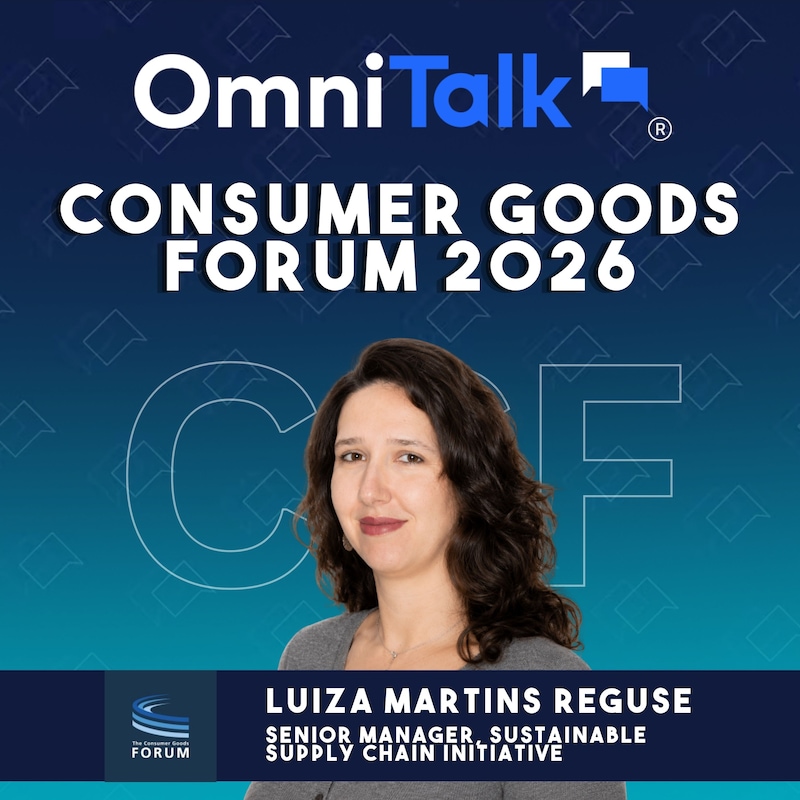
In this Omni Talk Retail interview, recorded live from the Consumer Goods Forum Global Summit 2026 in Vienna, Chris Walton sits down with Luiza Reguse, Senior Manager of Sustainable Supply Chain Initiatives at the Consumer Goods Forum, to discuss the growing complexity of sustainability compliance and how the industry is working toward greater consistency, transparency, and accountability across global supply chains.
Luiza explains how the Sustainable Supply Chain Initiative (SSCI) helps companies navigate a landscape of hundreds of sustainability programs by creating common benchmarks and recognition standards. She also discusses the shift from traditional checklist-based audits to more outcome-focused approaches, the challenges of defining and measuring regenerative agriculture, and why social and environmental sustainability can no longer be addressed separately. Drawing on her experience as a former auditor, Luiza shares valuable insights into the realities facing producers, auditors, retailers, and manufacturers as they work toward more sustainable supply chains.
Key Topics Covered:
• What the Sustainable Supply Chain Initiative (SSCI) is and how it works
• Why there are hundreds of sustainability compliance programs worldwide
• The challenge of creating consistent sustainability standards
• Moving beyond checklist audits to continuous improvement
• Reducing audit fatigue for manufacturers, suppliers, and auditors
• Harmonizing sustainability requirements across the industry
• Why social and environmental sustainability are increasingly connected
• The growing focus on regenerative agriculture
• Challenges in defining and measuring regenerative agriculture
• Avoiding greenwashing through clearer standards and outcomes
• Lessons from working as a sustainability auditor in the field
• The importance of understanding real-world implementation challenges
• The future of sustainability compliance and responsible sourcing
Special thanks to the Consumer Goods Forum Global Summit and the CGF Leadership Studio sponsored by Vusion for supporting Omni Talk Retail's coverage in Vienna.
This podcast uses the following third-party services for analysis:
Podcorn - https://podcorn.com/privacy
Transcripts
Hello, everyone, this is Omnitalk Retail.
Speaker A:I'm Chris Walton and we are coming to you live once again from the Consumer Goods Forum in Vienna, Austria.
Speaker A:And of course, we're recording this from the CGF Leadership Studio, which is sponsored by Vuzion.
Speaker A:Now, joining me is Luisa Ragus.
Speaker A:She's the Senior Manager of Sustainable Supply Chain Initiatives for the Consumer Goods Forum.
Speaker A:Luisa, it's great to meet you.
Speaker A:Thanks for joining us.
Speaker B:Nice.
Speaker B:Thanks for the invitation.
Speaker A:So you just told me you hail from Brazil.
Speaker A:What are Brazil's chances in the World cup this year?
Speaker B:8%.
Speaker B:I read some.
Speaker A:8%.
Speaker A:8%.
Speaker A:8%.
Speaker A:Okay.
Speaker A:So.
Speaker A:Okay, so you're bullish on Brazil's chances that or not.
Speaker B:Let's see what happens.
Speaker A:Yeah, you never know with them.
Speaker A:You never know.
Speaker A:They sometimes sneak up on you.
Speaker A:Yes.
Speaker A:All right, so tell us about the Sustainable Supply Chain Initiative at cgf.
Speaker A:How does it work?
Speaker A:What is it?
Speaker A:Who's involved?
Speaker A:The whole nine yards.
Speaker B:Okay, so the Sustainable Supply Chain Initiative, or the ssci, as he used to say, it is a benchmarking initiative.
Speaker B:It was created just because there is a lot of sustainability programs over there in the market covering different topics and that retailers and manufacturing are using in their supply chains to make sure that they are being sustainable.
Speaker B:But it's super difficult for them to understand which program should they use because there's just so many covering different topics.
Speaker B:That's why they created the Sustainable Supply Chain Initiative.
Speaker B:It is to benchmark the programs, creating like a baseline requirements that all of them need to comply with in order to be recognized by the ssci.
Speaker B:So we have a very thorough process with different steps, starting with a self assessment, going through an office visit with an expert, verifying the program if they are compliant with our requirements or not.
Speaker B:And it finishes with a public consultation and the recognition or not.
Speaker B:So once they are recognized and in the basket, they send a sign out to the market and to the retailers and manufacturers saying, look, I'm recognized by cdf, so I'm complying with the minimum requirements.
Speaker B:You can trust what I'm doing on the ground.
Speaker A:Right?
Speaker A:Okay, so give our audience at home, like some form of perspective, maybe an example of like, just how many different compliance programs are there out there?
Speaker A:Like, give an idea of just how complicated this gets.
Speaker B:Well, that's super difficult.
Speaker B:But when we started it, we said there are more than 300 on the market and more and more emerging every year because this is not yet regulated.
Speaker B:So we can have private programs or a company code of conduct and others.
Speaker B:And if I decide Today to create my Louisa Green standard, I can have my own requirements and go to there and sell to the companies and say, look, trust me, I'm verifying your processes.
Speaker B:So it's all fine.
Speaker B:So that's why we have so many programs emerging there.
Speaker A:Right, Right.
Speaker A:So compliance itself has also evolved too.
Speaker A:Right.
Speaker A:Like there were old ways of doing compliance, new ways of doing compliance.
Speaker A:Explain for our audience like what was the old ways and what are some of the newer ways to think about compliance and ensuring it?
Speaker B:Well, I'm not sure if we can say now it's old and new.
Speaker B:I think we are moving towards a new way of doing compliance and understanding compliance.
Speaker B:Okay.
Speaker B:What is well known and what we are doing in the past is like the checkbox exercise.
Speaker B:So I go to the field, I check are you compliant with this requirement and that one and this one?
Speaker B:Yes, yes, yes, no, no, no report certified or not.
Speaker B:What we are trying to implement and try to work towards is like have more continuous improvement checking the environment or check the real implications of the requirements we are talking about here all the time.
Speaker B:Just yesterday we had a meeting with our members from the steering committee and we are discussing exactly one case where the contracts of a worker in a plant, in a processing plant was missing in the system.
Speaker B:So this can be a basic checklist, non compliance, say, okay, you don't have the contract uploaded, but this can also be a sign of forced labor because there is no contract.
Speaker B:So you need to be able to check beyond the compliance and verify the conditions over there.
Speaker B:What is happening?
Speaker B:Okay, is this the only issue?
Speaker B:It is a documentary issue or is there something more?
Speaker B:Right, so this is something also that we are trying to implement and work on.
Speaker A:Got it, got it.
Speaker A:Talk about the burdens on the factory too, because a lot of times I hear there are things like double, triple check compliance.
Speaker A:Like the factories have to do all these different compliance procedures for all the different retailers that they're working with.
Speaker A:So how do you create the clarity through your programs of, of how you can simplify that for everyone involved so that they can have the clarity of like this is the compliance mechanism you should be looking to that you can trust, that you can rely upon.
Speaker B:Yeah, it's creating by this harmonization.
Speaker B:You know, when we talk about this global baseline, it means that if I'm a retailer and I have three different programs that I know are covering the same baseline requirements, I can go beyond and understand the program that's a best fit for my needs, but not in terms of the content they are covering.
Speaker B:Because this is.
Speaker B:I'm assured on.
Speaker B:Because you already checked it.
Speaker B:Ssci thanks to SSI skills.
Speaker B:Right.
Speaker B:You know, so I think that creating this harmonized approach really helps retailers on their choices.
Speaker B:And at the same time, the ones that are on the ground being audited by 10, 12 different programs, it makes also their life easier.
Speaker B:And we cannot forget about the auditors because this is also a burden for the auditors.
Speaker B:I've been one in the past.
Speaker B:And sometimes you are auditing for three or four different programs at the same time.
Speaker A:Right.
Speaker B:So you need to know all the rules and you need to apply different checklists.
Speaker B:So the harmonization is really important.
Speaker B:Wow.
Speaker A:So, man, you also.
Speaker A:So this gets really complicated really fast.
Speaker A:So the other.
Speaker A:I mean, and I'm going to add to the complexity here.
Speaker A:So the other thing that I've learned in preparing for this interview is that you've also expanded your scope too, to include things around manufacturing, processing, but also forestry and primary source of production too.
Speaker A:So what prompted the broadening of scope?
Speaker A:I mean, is it as simple as, like.
Speaker A:It's because it's really complicated and it needs it?
Speaker B:Yeah, it is super complicated.
Speaker B:And we can't see a social and environmental sustainability separated in silos anymore.
Speaker A:Okay, got it.
Speaker B:If you are checking practices on the ground, you cannot talk about worker rights without talking about water and pollution and waste and management.
Speaker B:So it is a moment and we are talking about sustainability.
Speaker B:It goes together, social and environmental.
Speaker B:And then when it comes to those programs that we assess, they usually have both to offer.
Speaker B:So both different scopes.
Speaker B:That's why we decided to add it to our scope as well.
Speaker B:And we started with social because social, it was such a complex landscape and we understood that we needed to expand to go towards like more forest positive practices and environmental management systems and see if those are also covering the same basic requirements and guidelines.
Speaker A:Got it, got it.
Speaker A:So basically you're saying there's a convergence of everything happening here where you just can't treat everything in isolation anymore.
Speaker A:Everything is working together in concert in some way.
Speaker A:Okay, that's.
Speaker A:That's something I've never thought about.
Speaker A:So what is the current state of the industry?
Speaker A:Feedback around some of those things, particularly like in the regenerative agriculture side of it, like, what are you hearing from the retailers?
Speaker B:Yeah, so this is a tricky one.
Speaker B:Not an easy one because.
Speaker B:Well, you know, there's a lot being talked about regenerative agriculture everywhere, but we still don't have a clear common definition, I would say.
Speaker B:And also, what does that mean?
Speaker B:Regenerative for you and for me and for the farmer that was just speaking the panel before, it can be different.
Speaker A:Right.
Speaker B:So what we try to do is not to define regenerative agriculture.
Speaker B:We are not entering in this field.
Speaker B:We are trying to establish what the programs, sustainability programs should be covering in terms of regenerative agriculture when it comes to that.
Speaker B:Because we take programs that are over there and already cover agriculture, primary production scope and they are expanding to now include regenerative.
Speaker B:But what should they cover?
Speaker B:So in terms of the requirements.
Speaker B:So that's what this is the research we've been doing and try to identify.
Speaker B:Okay.
Speaker B:At least you should cover.
Speaker B:So soil health, biodiversity, livelihoods of farms and the basic needs.
Speaker B:So that's what we are trying to understand.
Speaker B:And we're not creating another standard.
Speaker B:We are not saying what do you need to do?
Speaker B:We are just saying, okay, we understood that regenerative is outcome based.
Speaker B:How do you monitor it, how it's going to be in 10 years and how do we assess it today so we can make sure and send the sign on again to our retailers, manufacturer say, okay, those programs, they are covering regenerative agriculture in a good way.
Speaker B:Okay.
Speaker B:So at least with the minimum.
Speaker A:Got it, got it.
Speaker A:And better you than me trying to answer that question that you just posed rhetorically.
Speaker A:Thank God.
Speaker B:I'm sorry if it's too complex.
Speaker A:No, it's okay.
Speaker A:I'm like, oh my God.
Speaker A:Yeah, I have no idea.
Speaker A:But I'm curious.
Speaker A:You actually raised a thought in my head though, which is like when people are trying to discuss regenerative agriculture and trying to align on it, where do some of the impasses exist?
Speaker A:Like, what are people disagreeing on?
Speaker B:Disagreeing on, I think, I don't know if it's disagreeing, but it's more like, okay, what are the common factors we have when it comes to that?
Speaker B:Right.
Speaker B:So this is what we understood is like outcome based.
Speaker B:So it's not about only the practice, but the results you get with some time.
Speaker B:And also something that we realize is like, okay, you don't see the results tomorrow, it is in 10 years.
Speaker B:So it's all about continuous improvement as well.
Speaker B:And measures.
Speaker B:Because if you're talking about soil health and you need to have a better soil because you are going for regenerative agriculture, you are doing the practice.
Speaker B:So the way we have to check it and to see it is for that you need to measure the soil quality.
Speaker A:Yeah.
Speaker B:You know, so it's not that simple.
Speaker B:It's not just.
Speaker A:Yeah, no, it's, it's you know, what's going through my head, as you were saying, is like, yeah, we're all just learning this at the same time.
Speaker A:We're learning like how to define the inputs and the outputs of what we're expecting, which is what makes this so inherently complicated.
Speaker B:Yeah.
Speaker B:And so beautiful at the same time.
Speaker B:Right.
Speaker B:Because we need to get to an agreement and understand, okay, we are going this direction so we can avoid greenwashing, we can avoid many other problems could happen if we don't have clarity on what we expect from those practices.
Speaker A:Yeah.
Speaker A:And it just takes hard work to figure that out.
Speaker A:Okay, so my last question for you.
Speaker A:I'm gonna get you out of here on this.
Speaker A:You mentioned that you were an auditor in your past life and now you're leading the ssci.
Speaker A:What perspective does that give you in terms of solving the issues around everything we've just talked about?
Speaker B:Well, to be honest, I think it changes everything because I had the opportunity to be on the ground and see what was happening there and the burden that it is for the producers, the farmers.
Speaker B:Sometimes I have the perspective of the auditor because we expect a lot of them.
Speaker B:Inside of ssa, we're always talking about the audit integrity and auditor competence.
Speaker B:And all the companies, everyone say, no.
Speaker B:The auditor, they need to be better, they need to do this and that, but they are still human beings.
Speaker B:And they work a lot, they travel a lot.
Speaker A:Right.
Speaker B:I spend.
Speaker A:Oh my God, yes.
Speaker B:Once I went to the Amazon forest.
Speaker B:So I took a 12 hours flight plus two buses, plus one boat to get to the riverside communities.
Speaker B:And when you get there, they collect assay berries, trees from the trees, the palm trees.
Speaker B:Right.
Speaker B:And you need to ask them.
Speaker B:They barely speak Portuguese.
Speaker B:Brazilian Portuguese.
Speaker A:Right, right.
Speaker B:And it's difficult to communicate.
Speaker B:And still I coming from.
Speaker B:I was coming with like a formula from the European Organic Commission.
Speaker B:And the question was for the producer, what do you understand for sustainability?
Speaker B:You know, you are in a situation and you're barely communicating.
Speaker B:Yeah.
Speaker A:Right.
Speaker B:So you need to understand the reality and say, okay, how can I make this question understandable for them?
Speaker B:How can I bring this reality in my report?
Speaker B:And to those that are sitting in Europe in their offices and making their rules, you know where I am today.
Speaker A:Right, right, right, right.
Speaker A:Well, and like I said, thank God that you have that perspective to bring to the discussion, because I got to think it's very valuable.
Speaker A:I almost don't understand how you would do it without it.
Speaker A:Honestly, I think it'd be really tough.
Speaker B:I mean, I think you can do it.
Speaker B:It's just that the view you have can be different because if you're just like writing down requirements and bureaucracy and saying standards, do this, do that, you don't have the view of the implementation on the ground and how this cascades down.
Speaker B:It's different.
Speaker A:Yeah, you gotta have done.
Speaker B:Yeah, it really brings a lot.
Speaker A:Yeah, you gotta have the on the job experience.
Speaker A:Well, Luisa, thank you.
Speaker A:Thank you for enlightening us on this topic of supply chain compliance.
Speaker A:It's something that we don't touch on all that often at Omnitalk, but I'm really glad that we did today and thank you for doing that.
Speaker B:Thank you for the invite and I hope that now you can talk about regenerative agriculture.
Speaker A:I know, yeah, I know more about regenerative agriculture than I did before, that's for sure.
Speaker A:All right, and thanks to CGF and Vuzion for helping us to bring you all this great coverage with interviews like the one we just did with Luisa.
Speaker A:And as always, on behalf of all of us at Omnitalk, be careful out there.