Shownotes
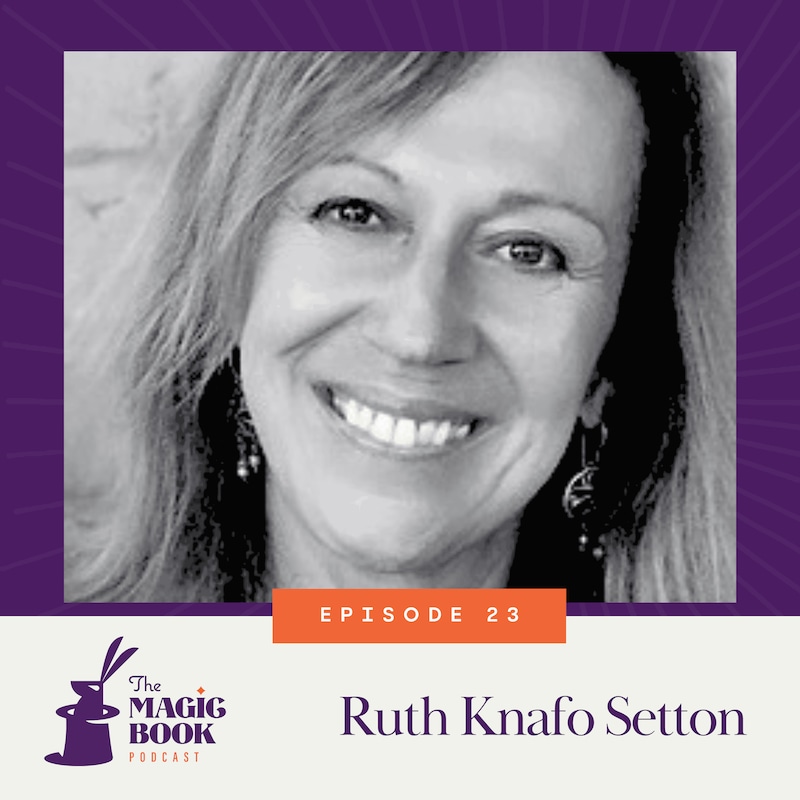
Ruth Knafo Setton, author of award-winning thriller "Zigzag Girl," shares her journey from a childhood steeped in Moroccan wonder to studying performance magic with legends including Eugene Burger, Teller, and Max Maven. Discover why she calls herself a storyteller who uses her pen as a wand, how a nameless character in an unfinished novel pulled her into the magic world, and why the seedy, resilient boardwalk of Atlantic City became the only possible home for her noir-tinged feminist thriller.
Transcripts
[MUSIC] Coming up in this episode of The Magic Book Podcast.
Ruth Knafo Setton [:I'm a storyteller who uses magic, who wants to become as powerful as a magician on stage on the page, using words to weave my spell and using my pen as a wand. In a sense, that's my goal.
Adrian Tennant [:You're listening to The Magic Book Podcast, conversations about classic and contemporary books that teach, illuminate, and celebrate The Art of Magic. I'm your host, Adrian Tennant, a lifetime student of magic and mentalism, occasional performer, and longtime book collector. Thanks for joining me. [MUSIC FADE] Today, my guest is Ruth Knafo Setton, a writer whose work exists at the intersection of magic, mystery, and storytelling. Born in Morocco and now based in Pennsylvania, Ruth is a professor of Jewish Literature and Creative Writing at Lehigh University. For nearly two decades, she's immersed herself in the study of performance magic, learning from legends including Eugene Burger, Teller, Max Maven, Jeff McBride, and Luna Shimada. She's presented multiple times at Jeff McBride's Magic and Meaning Conference in Las Vegas, and Ruth's 2009 essay, "Sisters of Magic and Mystery," has become an influential piece on women's roles and representation in the magic world. Now Ruth has channeled all of these passions into "Zigzag Girl," a noir-tinged feminist thriller set in Atlantic City's haunted magic underworld.
Adrian Tennant [:The novel is a finalist for the International Thriller Writers Award for Standalone Book of the Year. It also won the Grand Prize in the Screencraft Cinematic Book Competition and First Prize in the Daphne du Maurier Awards for Mystery and Suspense. Published in the UK in late 2025, “Zigzag Girl” arrives in the United States on March 2nd. [MUSIC] Ruth, welcome to the Magic Book Podcast.
Ruth Knafo Setton [:Thank you so much, Adrian. I'm very excited to be here.
Adrian Tennant [:You were born in Morocco before ultimately making your way to the United States. What are your earliest memories of Morocco, and was there something inherently magical about growing up there?
Ruth Knafo Setton [:It's such a magical country. I think anyone who's been there would agree. For me, the magic was centered on my grandfather, who was probably the first magician I ever saw, though he wouldn't have called himself that. And he had a rooftop terrace where he grew roses, wrote poetry, played the oud, and also raised homing pigeons. So he had two large cages of homing pigeons, never locked the gates, but they always returned to him. One afternoon, he and I painted their wings red, blue, yellow, and set them free to fly. And we stood at the edge of the roof and watched them and watched the people below on the street just stopping in wonder. And people talked about this for years afterwards.
Ruth Knafo Setton [:I never forgot this. And it would come back to me sometimes. Why he did this? What was it about? I never had a chance to really ask him. You know, I was too young. And he died— actually, I was the last person he spoke to. I returned to Morocco. But I think he created a moment of wonder for people. The kind of magic that he did was the kind that spilled from the stage to the street.
Ruth Knafo Setton [:And it's the kind of magic I think I've been following and searching for all my life. I like when there are no boundaries. I like when you turn around and there's magic in the real world. I just love that sort of thing. I ended up reading tarot cards for a living for years, and I didn't even think about the connection. This is before I met magicians and went into magic, but I think all of this affected me, you know.
Adrian Tennant [:Well, in your 2013 PEP talk at The Magic and Meaning Conference, you described returning to Morocco for your grandfather's funeral and witnessing professional mourners, women who kneeled and expressed raw grief. Now, you drew a connection between those mourners and the ancient sirens who carried the dead to the afterworld. Can you tell us about that experience, and how it shaped your thinking about women's voices in magic?
Ruth Knafo Setton [:It affected me a lot. I taught university students creative writing courses for many years, and I created a course called ‘Sirens and Mermaids.’ So that I could do more research on it myself. And what I learned were things that I don't think most people know. They think of sirens as evil, you know, evil voices. Odysseus has to be chained to the mast and his ears plugged up so he won't hear them. But when I went to Alexandria, Egypt, and I saw the site of the old lighthouse, the Pharos Lighthouse, that was one of the ancient wonders of the world. And I learned more myths and legends that had risen around there. The sirens would fly around.
Ruth Knafo Setton [:They were bird women. They had wings and they would fly around the lighthouse watching for sailors coming to shore and they would guide them to shore. They would guide them with their voices. Their songs were beautiful. They were light. They were life. At the same time, the sirens with their wings would carry the dead person to the underworld. And when they got them to the underworld, they would sing that person's life.
Ruth Knafo Setton [:They would sing his story. And I think this is like, it's a death truth in a way. My theory is that, I mean, men have been afraid of women, I think, for a long time. This is not something new. But I think that the idea of the siren, that symbol of the siren, this woman whose voice is both life and death, light and dark, that it was a way to try and control that voice, to say it's evil. And that when men were shutting their ears off, plugging their ears not to hear her, what they were doing in a way, I don't think the fear was just of her voice. I think the fear was of the words she was saying. She was speaking truths about death, about what happens after life.
Ruth Knafo Setton [:This is terrifying stuff. Through the years, the siren turned from this incredibly powerful bird woman goddess into an evil thing whose voice should be silenced. And I think that leads to other things about women, to vanish them, to muzzle them, to hide them behind veils, and to just kind of control their power.
Adrian Tennant [:Well, in an earlier essay in 2009 – the essay was entitled “Sisters of Magic and Mystery” – you wrote, quote, "Woman is magic, man performs magic." What do you mean by it?
Ruth Knafo Setton [:Well, this was not my phrase. This was something that I kept hearing in the early years when I was studying magic. Male magicians would say this to me all the time. “You don't really have to worry about this. You are magic in yourself. Women are magic”. I heard it repeatedly. I don't believe it.
Ruth Knafo Setton [:Almost by giving her this awesome, you know, power, it's dehumanizing her. If she's more than human, it's almost the same as saying she's less than human. She's not human. And I think women perform magic the same as men perform magic. We're humans. We're all humans. But when a woman's power is allowed to be unleashed, when her voice can be heard, you know, when she can control the narrative, it becomes truly awe-inspiring. I think, because their magic can enter in different avenues, different areas than a lot of men's magic.
Ruth Knafo Setton [:But instead of sawing her in half or banishing her or relegating her to the wings, to let her be equal. And I think a lot has changed since I wrote that essay. I mean, all you have to do is look at Connie Boyd's book, “The Power of Magical Women,” and you see the variety of female magicians who are out there and, you know, doing good deeds in the world, and recreating magic with a woman's touch. And I think it's wonderful. As Eugene Burger said, “Magic is a house with many rooms.” And I think there are rooms for all of us, you know, to fit in in some way.
Adrian Tennant [:Indeed. Ruth, when did you first encounter performance magic and what led you to start studying it seriously?
Ruth Knafo Setton [:I was working on a novel that had no title. It was set in Israel in the '70s, and it was a dual-time narrative. I was writing about a little troupe of actors in Jerusalem who were putting on a movie about the ancient Maccabeans, something like this. But the past and the present kept interweaving. And slowly I realized there was a character who kept showing up on the set, and he had no name. He had no function there. There was no reason for him to be on this set. And I tried to push him aside.
Ruth Knafo Setton [:He kept coming back. Finally, and this is true, I followed him on the page. Like, I was writing, “Where are you? What are you doing here? Who are you?” And I followed him to a theater in Jerusalem called Noah Ha'Ahava, “Theater of Love” in Hebrew. And there were mimes there, jugglers, performers. And this guy, I started calling in my mind ‘The Magician.’ And soon, I lost interest in the rest of the story. I just wanted to find out who this guy was, why he had kind of entered my imagination in my mind, and what to do with him. I went on Google.
Ruth Knafo Setton [:I searched “Magician, '70s, Israel.” I thought there might be some clue there. And I came up with Uri Geller, who I hadn't known anything about. Spoon-bending, psychic, you know, all of his notorious controversial things, but … and I got caught down— it's like you go down a rabbit hole. You know, you start wanting to know more and more. I started reading about him. And then one day, and this is how things happen in art, and I'm sure you feel the same way, it's like when you're looking for something, the world just gives it back to you. I saw an article about a professor in my town who was teaching a course on the philosophy of magic.
Ruth Knafo Setton [:“Wow. This could be something very interesting.” I contacted him. We met, and we ended up sitting over coffee for 3 hours talking. And by the time I left, I had a friend and a mentor. His name is Larry Hass, and he became my guide. And we're still good friends, my guide into the world of magic.
Ruth Knafo Setton [:And so I audited his course. I stopped writing that book. I realized I need to find out a lot more about magic. I need to learn about this world. He was holding magic conferences at the college. And so that's where I first met Eugene, Jess McBride, George Parker, John Carney, Jamy Ian Swiss. I met so many people. It was wonderful.
Ruth Knafo Setton [:And from then on, there was just no turning back. I had discovered something I loved so much, and I knew it would influence me. That's really how it started.
Adrian Tennant [:Well, as you mentioned, you've studied with some legends. Eugene Burger, Teller, Max Maven, Jeff McBride, and Luna Shimada, among others. Now, Eugene Burger was clearly a friend and mentor. What did he teach you that stayed with you?
Ruth Knafo Setton [:He taught me so many things. First, his presence, just his presence, so warm and kind and funny. That voice. Every time I heard the voice, it was like a spell or something came over me. But he taught me many things, and he encouraged me. He encouraged me always to move forward with whatever I thought magic could be, you know, to find my own path. He taught me that magic is not about fooling a spectator. It's about creating an emotional experience for the spectator.
It's about creating an emotional experience for the spectator.
Ruth Knafo Setton [:He taught me to look for the difference between mystery with a small ‘m’ and Mystery with a capital ‘M.’ Deeper mystery where, yes, it's entertainment - it has to be entertaining, it's a performance art. But at the same time, Lee Siegel said something I've always loved: "Magic is religion with a 2-drink minimum." I think that's brilliant because I think that's really what it is. It ties in a lot with the way I see magic. And when you have Magic with a capital ‘M,’ there's that depth, the shadow story behind that goes deeper than the surface entertainment.
Ruth Knafo Setton [:And I write that way, and I love magic that does that, that plays with that sort of thing. And Eugene was a master of it. He also taught me about economy. He said as he got older, he was rewriting his scripts and eliminating words all the time, paring it down to the essence. And I think that's a very important lesson too. And to perform what you're passionate about.
Adrian Tennant [:Eugene is obviously a rich source of quotations, and he wrote that “magic books are written for right-handed men.” Now, you've described yourself as a left-handed woman who's had to find your own voice, and your own magic. So Ruth, as a writer rather than a performer, how did you find your place in the magic community?
Ruth Knafo Setton [:This goes back also to Morocco. One of the first, most powerful, transformative experiences I had was in Marrakesh, going to the famous square, the Jemaa el-Fna, where for thousands of years, people gather every night. The snake charmer, the henna woman, the food stalls, the musicians, and the storyteller. And I have sat and watched that storyteller for hours at a time. He is so powerful. You don't have to understand the language to understand that he is weaving a spell around the viewers. And from the beginning, I thought, "This is the kind of storyteller I want to be." I am a storyteller. That's how I define myself.
Ruth Knafo Setton [:Not even as a writer, I'm a storyteller. And I'm a storyteller who uses magic, who wants to become as powerful as a magician on stage on the page, using words to weave my spell and using my pen as a wand, in a sense. That's my goal. So yeah, I found my own way of doing it.
Adrian Tennant [:[MUSIC] If you're enjoying this episode of The Magic Book podcast, please consider leaving a rating on Spotify or a review on Apple Podcasts. You can also follow the Magic Book Podcast page on Facebook. Thanks. [MUSIC FADES] Ruth, let's turn to your new novel, “Zigzag Girl.” It opens with evocative epigraphs about Atlantic City, including the former mayor's observation that “Atlantic City is like Dracula. You can't kill it no matter how hard you try.” And in your acknowledgments, you write that the story couldn't take place anywhere but Atlantic City. So, why Atlantic City?
Ruth Knafo Setton [:I grew up going down to the Jersey Shore and watching Atlantic City transform itself. In the novel, I refer to Atlantic City as a dame, you know, who's been kicked down so many times, but each time she picks herself up, puts on a Carmine red lipstick, and gets back in the ring. She refuses to stay down. That's why I love Atlantic City. Yes, she's seedy, she's crime-ridden, definitely on the way down right now. But I always have faith that Atlantic City will pick herself up again and keep going. So, I had this feeling. I've always felt a magical link to Atlantic City since I was a little girl.
Ruth Knafo Setton [:I just loved it. And first, I was going to set it in Las Vegas, the novel. But then I went to Atlantic City on a visit, and I just realized the contrast of the boardwalk, that ancient boardwalk with, you know, the history kind of seeping through. The old stores I'd seen as a little girl, the signs were painted over fresh, but you could still see the traces of the old letters, the original letters. And the ocean. You're at the end of the world in a way. You could call it the anti-magic city, but I prefer to think that this is the kind of place where magic can really happen.
Ruth Knafo Setton [:I started looking into it, and I learned things that amazed me about the history. I had not known about Atlantic City's glorious past during World War II, that the US Army took over and transformed it into Camp Boardwalk. So for a couple of years, the Boardwalk became an Army base. The buildings were transformed into Army living quarters for the soldiers and officers' clubs, a hospital called the Thomas England Hospital. And here's where the story really began. I got very fortunate because I was taken on a tour through Resorts Casino, which is the first casino on the boardwalk and the first casino in Atlantic City. And what they did with Resorts is build around the old edifice, which was a Quaker rooming house called Chalfont Haddon Hall.
Ruth Knafo Setton [:That was transformed into Thomas England Hospital in 1943, I think it is. And at the heart of it, on the 13th floor, is a haunted theater. And I was taken to see the haunted theater and I stood on that stage. There was a ghost light at the center stage. The ghost light was burning. It was daylight. And this little theater has two walls of windows, which is extraordinary in itself. It's a small theater, 300-some seats.
Ruth Knafo Setton [:I modeled Black Widow Theater on this theater. And when I stood on the stage, center stage, and looked out through the windows, I could see myself performing for an audience of— Sirens and mermaids and fishermen and all of this. It was so beautiful, so powerful. And I didn't have to be told it was haunted. I knew it. I felt it inside me. That was where I first felt Cleo West, my World War II magician, because it's like she was standing behind me on the stage. And I thought, “Okay, there's something here.”
Ruth Knafo Setton [:“I need to find out more.” And the more research I did, the more I just fell in love with this. And I created my own world, of course, but the bones were there, the bones of that place. So it gave me another appreciation, a deeper appreciation of Atlantic City. And I hope, you know, people who read the novel as a mystery and everything will also learn that Atlantic City has something to offer. There's a lot of great things happened there. Also, all the movie stars came at that time. During the '40s to entertain the soldiers.
Ruth Knafo Setton [:All the stars, all the musicians, Benny Goodman, Frank Sinatra, everybody came. Everybody came. And it's there. The spirit is still there.
Adrian Tennant [:The book is described as “a spellbinding noir mystery where magic and murder share the same deadly stage.” You and I share a love of film noir. So, in what ways do you weave noir elements into the novel?
Ruth Knafo Setton [:It wasn't hard with Atlantic City because Atlantic City embodies noir, I think. Especially the thing that I think— I'll tell you, I don't know if you feel this way, Adrian, but for me, noir breaks my heart because in a sense, it's hopeless. People are always fighting. It's like they're struggling to climb stairs and they see themselves going down. They run to the end of a street where there's a little light at the end, you know, a streetlight, And it turns dark the minute they get there. And they're always running from the past, and the past always catches up with them. Probably the biggest lesson in noir is you cannot escape your past. So, Atlantic City is that kind of place.
Ruth Knafo Setton [:And I love noir. I love the shadows. I love the way the light is very sparing, but when it comes, it's brighter than in a story that is all sunlight. You feel it there, and your heart goes out to these characters. I don't like going down, down, down, down, down. In my story, I've created, I think, my own kind of noir. I call it ‘noir with hope’ because I want the light. To me, dark and light work together.
Ruth Knafo Setton [:I can't just have darkness unrelieved. I have to have light because I think you feel the dark even more when you have moments of light, moments of hope. But that's my sort of way of of seeing it. There's also the idea that eyes are following you everywhere. You're being followed in noir. If you watched “Ripley,” - the show “Ripley,” - it took place in Italy. There were statues, the eyes, every statue, the cat, everywhere there were eyes following Ripley as he tried to escape his fate. And I like that.
Ruth Knafo Setton [:It's good. It's spooky, but it's also very haunting. Yeah.
Adrian Tennant [:Well, “Zigzag Girl” is a feminist thriller. And when we were preparing for this interview, you did say that one of the things you wanted to do was to shift the gaze away from the traditional male perspective in noir. How does your protagonist, Lucy Moon, embody that shift?
Ruth Knafo Setton [:Well, that idea began when I was sawed in half. And I was like in the box, looking up at the magician. A very kind magician did this for me. But it struck me that he would never know how I was feeling at that moment, that his story was very different from mine in the box. And I thought, “We've heard that story many times, the traditional idea of the magician with a top hat and a wand, and he's the one who saws his assistant in half.” I wanted to know about the one in the box. And I thought, “I can really explode this story, you know, make the female be the active agent rather than the one acted upon.” And with “Zigzag Girl,” the illusion of the Zigzag Girl was the perfect metaphor for that because, well, yes, it's an upright cabinet. She saws it in thirds, not halves. I was in that one too, and I was sawed in thirds, and it was a very illuminating experience.
Ruth Knafo Setton [:The idea of identity being slippery, I like that. You can see it on the cover of “Zigzag Girl,” which the artist, I thought, did brilliantly to put her in three pieces, but not in the right order. So it gives this idea that identity can be shifted. And the whole story in “Zigzag Girl” circles around one question: Who are you? Or who am I? Every single person in the novel, all the main characters, need to find out something about themselves. And the Zigzag Girl is such a perfect …it's called the perfect illusion. And what you realize is the female is at the heart of it all. She's the power.
Ruth Knafo Setton [:And I thought, "Yes, that's exactly the metaphor that I want for this story.” And it fits Lucy Moon, who's the main character, because she's got to figure out who she is. There are mysteries and secrets about her past that she doesn't know. And though she fears the box, the Zigzag Girl is the one that she can tolerate.
Adrian Tennant [:Well, Lucy is a 27-year-old magician and also part of a female trio called Rebel Magic. Now, is she modeled after any of the magicians you've met during your studies?
Ruth Knafo Setton [:She was definitely inspired by all of the female magicians I had the good fortune to interview, meet, watch, hang out with. Luna gave me many hours. We really talked a lot. Joan Dukore, Kayla Drescher, Connie Boyd, Carisa Hendrix helped out with something important. I interviewed also Frances Marshall, who was wonderful. She had such stories to tell me about touring with her family when she was a kid. Abigail McBride. I don't want to forget anybody, but they all inspired me.
Ruth Knafo Setton [:And then I had to go and imagine my own magicians, my own little troupe, and try and get them to be different, but each has her own magic. So one of the most fun things for me was creating their illusions. What would they do? What kind of magic would they do on stage? And that was inspired very much by a magician I met way back in the beginning, that first year when I met Larry, and I was walking around in a daze watching their illusions, meeting magicians, talking to them. And I remember telling one of them, “I'm imagining these illusions for the story I want to write, but I don't know if they're possible.” And he told me, “If you can imagine it, Ruth, we can make it happen.” And that was such a freeing thing to hear. I thought, “Okay. I can do this.”
Ruth Knafo Setton [:“I can let my mind and imagination wander.” And so I created Lucy and Stormy Weather and Van Kim and their illusions and even Clea West too. So yeah, that was just wonderful.
Adrian Tennant [:Well, your novel's title does come from Robert Harbin's famous Zigzag Girl illusion. And Lucy, as you mentioned, does have a complicated relationship with the Sawing A Woman In Half effect, specifically, the fear of being in that box. But you also have a 1940s character, Cleo West, who saw things a little differently. Ruth, can you tell us about why this illusion became so central to your story and that duality between Lucy and Cleo?
Ruth Knafo Setton [:I have a complicated relationship to the box myself, which is why it plays such a central role. I think you can only write about things you're really deeply questioning or wondering about. So, I've watched the Sawing A Woman In Half illusion countless times now with many, many magicians, including reverse ones where the female magician will saw her male partner in half, or Penn and Teller's way of playing with it. I've seen them all. When I started out, I felt like Lucy. It's misogynistic. It's degrading to women. It's time to say goodbye to this illusion. And yet it's the most popular stage illusion of all time. It shows no signs of going away.
Ruth Knafo Setton [:So Lucy is haunted by it. She's terrified of it, and especially the classic kind of box. Your head isn't outside. It's like a coffin. I was in one of those too. And really, if you have any tendency toward claustrophobia, do not go into one of those because you are really closed in. It's like being buried alive. And I think that's her fear.
Ruth Knafo Setton [:But when I started working on Cleo West in the 1940s, and she's performing in a haunted theater that used to be a hospital at that time, and her audience is mostly soldiers, wounded soldiers, many of them amputees. Thomas England Hospital specialized in dealing with amputees. And as I was channeling Cleo, I pictured how she was feeling and how the audience was feeling. And I suddenly realized this goes much deeper than what I was thinking. For Cleo, a woman who was abused in many ways, every night she's sawed in half, she's killed, and then she rises triumphant. And I thought of how she would feel. It's a— for her, it's a triumph. It's a nightly triumph.
Ruth Knafo Setton [:She's triumphed over death. And the soldiers, those wounded soldiers, especially the amputees, for them, it's like a promise that being broken doesn't mean being destroyed. So there's a hope there too. And I think for me, it was like seeing the whole picture. It became much more I guess more complex and more interesting that way.
Adrian Tennant [:There are many specific magic references woven throughout “Zigzag Girl”: FISM, the IBM Lifetime Achievement Award, the Magic Lounge in Chicago, the Broken Wand ceremony. One character, Lucy's rival, Elvis Jones, has even written for Genii magazine. Now, you could have fictionalized these references, but you didn't. Why was it important to retain the real names?
Ruth Knafo Setton [:That was critical for me. It was very simple so that someone like you could read that book and think, “She's not faking it. She knows what she's talking about.” Because the quickest way to get somebody out of a story is when you make mistakes with really crucial details. And Lucy and Declan Moon and Maze Moon and all the magicians, they would have known these things. I wanted the reader, the magician reader or magically aware reader, to be able to read this and say, "Okay, this is for real." And the next step to that is Lucy and the gang could actually live in the real world.
Ruth Knafo Setton [:They're dealing with the same things we are, getting gigs, doing this stuff, and recreating your act. But also that the details are authentic.
Adrian Tennant [:[MUSIC] Just a reminder that you can be notified when new episodes of this podcast are published by subscribing to the email alerts. You'll find all the details on the podcast website at TheMagicBookPodcast.com, which is also where you can find transcripts plus accompanying blog posts with summaries, timestamps, and links to resources mentioned in each episode. [MUSIC FADE] Ruth, without giving too much away, there are moments in the novel where Lucy can see and experience things that happened in the past. Would you describe these as ‘magical realism’?
Ruth Knafo Setton [:Yes, for I don't know any other way to describe it. A kind of heightened realism, I guess, which is what magic realism is. I think that going back to my experiences in Atlantic City and other places in the world, I have encountered places that I feel are what the Celtic Irish term "caol áit": thin places. Thin places are places where the past sort of seeps through into the present so that you're never really just in one time. The past refuses to stay buried. The Pine Barrens is like that too. Atlantic City, Jerusalem, you know, certain places I've been where you're walking on the street, and if you stop for a moment, you might even hear footsteps behind you when no one is there. Or you hear voices when you press your hand against a stone wall.
Ruth Knafo Setton [:I felt that very much. And I think Lucy even says this at one point, that anybody who would think she was crazy if she said, Atlantic City is a ‘thin place.’ It's got that, you know, seedy, sordid atmosphere. But I have experienced that. And I think that it opens the door to portals, a portal into the past. When I would walk on the boardwalk, often I would hear voices. I would hear something. So this didn't come out of nowhere.
Ruth Knafo Setton [:Later, after, when I had written a first draft of the novel, I interviewed a former Atlantic City policeman who told me: "Oh, those voices. Well, you were probably hearing Camp Underground." I said, "What? What's that?" He said, “Apparently, a lot of people at one point, and they no longer are there, moved in under the boardwalk. They created little tent houses immediately under the boardwalk where homeless people, you know, they just live there and that most of them were addicts." There were apparently many killings. It was very dangerous. But they would even sometimes order pizza delivery to come to them under the boardwalk. Eventually, they were torn down. But I thought, “Well, here's something that a thin place became actually real.” That I had no idea these people lived down there.
Ruth Knafo Setton [:It just seemed very strange to me. But It's true. So yeah, there are things there that make it both real and magic at the same time. It's that thing I was talking about with my grandfather, that magic spills from stage to street. So maybe there is a sense that magic cannot be contained. It can exist in the real world.
Adrian Tennant [:The narrative of “Zigzag Girl” actually starts with a flashback to the Pine Barrens in New Jersey, a landscape that feels almost like a character unto itself. What drew you to that setting, and how does the Jersey Devil figure into the story?
Ruth Knafo Setton [:I don't remember exactly how it started. I don't. But one night, I found myself in the Pine Barrens. I knew I had to go there. I didn't know why. Maybe because it was visible. You know, if you stand on the shore, of Atlantic City, you can see the Pine Barrens. And it's very close.
Ruth Knafo Setton [:It's less than an hour away, but it's like another world, an eternity away. It's a million acres, a lot of them not developed. Swamps and trees, forests of trees that are dead and living standing side by side. Mysterious sounds. And the whole place is haunted by this character called the Jersey Devil. And for people who have never heard of him, he is a creature who surfaces every 50 years or so from the Pine Barrens and goes out and, you know, murderous rampages or just goes out to terrorize people. He's got goat hooves and a tail and beast ears. He's visualized in many different ways.
Ruth Knafo Setton [:But what struck me most was that he was born human. The Jersey Devil was born human and he transformed into a monster. So when I went there to the Pine Barrens, I felt this ancient spirit there. And I went to his supposed graveyard, his hiding place. When he's not out in the open, he's buried in this place, the graveyard. And then he rises, does his thing, and disappears for another 50 years. And he's still being sighted in a lot of places. The thing is, the Pine Barrens were first inhabited way before the Europeans came.
Ruth Knafo Setton [:They were inhabited by the Lenni Lenape, a Native American tribe who talked about a spirit known as the ‘Mesingw/Mising,’ who was in a sense a spirit of transformation. Which it kind of is the background to everything I think about with magic, the feeling of transformation. And I thought, this is the Jersey Devil too. A human being who transformed himself into a monster. And that night in the dark, standing in that graveyard with the air, you know, just crackling around me, the ground seeming to move beneath my feet, it was like, the dark heart of my murderer just burst forth, and I knew what I needed to write.
Adrian Tennant [:Well, I want to return to your 2009 essay, “Sisters of Magic and Mystery,” in which you wrote about the limited archetypes available to women in magic, namely The Maiden, The Mother, The Seductress, and you propose some new ones. How does Lucy Moon fit into your reimagining of female archetypes?
Ruth Knafo Setton [:Well, I had to balance things with Lucy because you can see already I love all these sort of myths and all this, but at the same time, Lucy was raised in New Jersey. And Jersey is known for being down to earth, and I thought I had to create a new kind of magic for her, Jersey girl magic on the corner of “woo-woo” and “fuhgeddaboudit!”. It's tough and wondrous at the same time. Her magic smells like espresso. It sounds like Springsteen. She uses Aquanet hairspray for certain illusions. So I love that. And she has humor.
Ruth Knafo Setton [:She's usually witty. But the two main illusions that she performs in the story, there are a few, but one is Making Mr. Right, where she creates the perfect lover for herself. But there's a surprise twist to that, a very Jersey kind of twist. And the mask and shadow, which is, again, time with the mask hiding the truth about what is really behind. And in another sense, she's recreating herself in this novel. She is trying to find her persona, to move beyond her family.
Ruth Knafo Setton [:She comes from a very famous, legendary magic family. And as the story goes on, she's creating herself. And I think by the end, she's the storyteller. She is rewriting the story, her story, and creating a new one.
Adrian Tennant [:Ruth, you've captured one of the paradoxes of magic as, and I quote, "The lie reveals the truth. The mask reveals the true face." How does that concept play out in “Zigzag Girl”?
Ruth Knafo Setton [:I think in many ways, that idea of the surface story and the shadow story: we see one thing, but there's something else behind it. However, the mask reveals clues about what it's hiding. I think about, for example, transforming a scarf into a dove. When I watch that, I see the ripples like a bird's wing in the scarf. It's as if the scarf already had the hints of being a bird so that when it becomes a bird, it makes sense. It's just fulfilling its promise. I'm fascinated by fairy tales, and I love the story of Cinderella. And there are over 300 versions of Cinderella all over the world.
Ruth Knafo Setton [:The most powerful versions are the ones where the prince recognizes Cinderella when she's covered with ashes. He recognizes the princess hiding behind the ashes. The ashes are just a mask, but he has to be able to recognize her true nobility. If he just falls in love with her when she's a beautiful princess, it doesn't have that resonance, that depth. So what I was trying to capture is this idea that you have to see the mask and what hides behind the mask in order to see the whole picture. And actually, Lucy says at one point in the story, "I like to enter a place from backstage first, so I see what's hidden behind. Then I go to the stage and the audience, the auditorium, the theater, and see what the audience sees. And if I put it all together, I get the whole picture." And the characters are all wearing masks to a degree.
Adrian Tennant [:Ruth, “Zigzag Girl” had already won multiple awards before publication, including the Grand Prize in Screencraft Cinematic Book Competition. Can you tell us about the book's journey to publication and how you connected with the Black Spring Press Group?
Ruth Knafo Setton [:Sure. I had just recently parted ways with my agent, amicably, but decided to go on my own for a while. And the pandemic hit. And during the pandemic, I took long walks all the time, and I started listening to podcasts. And they became my companions on these walks. And I discovered one called “Two Crime Writers and a Microphone.” It was Luca Vesti and Steve Cavanagh, both UK crime writers, quite well known. And they were so entertaining and enlightening. They interviewed crime writers and everything.
Ruth Knafo Setton [:And I just registered that. And then later, I was thinking, “What will I do with my book, with ‘Zigzag Girl’?” And I saw that Black Spring Press had just begun a crime series, and it was curated and edited by Luca Veste. So I thought, “Let me just see.” And so I sent a letter and Luca read the book and loved it. And that's how it led to that. And now what's wonderful is that it's a UK press, but it will be released and distributed in the US by Simon and Schuster. So it will be out there, it will be available, you know, but that's how it started.
Adrian Tennant [:Well, the book has been out in the UK for a few months now. What has the reaction been like?
Ruth Knafo Setton [:I think good. It sounds good. We've got a lot going on. There's a blog tour I'm going to be on. I'll be at a couple of conferences in the UK, in Scotland. And yeah, the Crime Writers Association featured a piece I wrote called "The Magician's Guide to Murder." So, it's good. And now we're preparing for the US.
Adrian Tennant [:Indeed. You are preparing to launch “Zigzag Girl” for US readers on March 2nd. Now, do you have any events over here planned around that publication date?
Ruth Knafo Setton [:Yeah, sure. There will be a big blog tour in March. I'll be appearing on many things, a few podcasts. There's some things I can't put out yet because I don't have dates. I don't have exact details. But I'm writing a few pieces that are “Zigzag Girl”-adjacent that will appear. And we'll be getting some reviews. I'm doing events.
Ruth Knafo Setton [:I'm going to have a great big book party for my friends and hoping to get a magician to come and entertain and do some stuff. If it wasn't mine, I would do tarot readings. I would go around with my cards, but I can't do that. So yeah, and I'll be at conferences. I'm going to be at ThrillerFest in New York in May. I'll be at AWP in Baltimore in March. I'm appearing at just certain places to talk about the book.
Adrian Tennant [:Perfect. Ruth, this is the Magic Book Podcast. So what is your most cherished magic book or books and why?
Ruth Knafo Setton [:You know, I entered magic through books, so I cannot choose just one, but we're in my study now and I have an entire bookshelf just devoted to magic books because I love reading about magic as much as I love watching it. The very first magic books I read were “The Books of Wonder” by Tommy Wonder, which was such a deep dive. And I still have a quote right here at my desk that I keep near me. "The highlights will give you the shadows. The shadows will give you the method. And the method will give the dream to your audience." I love that.
Ruth Knafo Setton [:So that's Tommy Wonder. Behind me is “Magic and Meaning” by Eugene Burger and Robert Neale, two of my favorite people in the world. And I've learned so much from that book. I keep going back to that one. Another book that I really love that inspired me is “The Death and Resurrection Show” by Rogan Taylor. I love that book because it's hard to find, but I got a used copy years ago and I just keep going back to it because what Rogan Taylor does is place the magician as a kind of shaman figure and a keeper of wonder through time. And he talks about Houdini a lot as one of those characters.
Ruth Knafo Setton [:I just love that image of a magician as “a keeper of wonder.” That's a book that affected me a lot. And then a couple of recent ones, one who I encountered through your podcast, someone I already feel is a friend even though we haven't met, Charles Green III and his book on Ionia. I have her poster downstairs, and actually I had sent to Luca me in the early days of planning the book, a poster of Eonia and said, "I would love to have this be a cover for the book." But he said, "We'll do our own cover." But I think Charles did a magnificent job with Ionia. And Connie Boyd's book, “The Power of Magical Women.” So these are more recent, but there are many in between. I love magic books.
Adrian Tennant [:Well, you're in just the right place for that conversation. Yeah. So, Ruth, it felt pretty self-contained, but is there a sequel to “Zigzag Girl” in the works?
Ruth Knafo Setton [:Yes and no. I am working on two projects at the same time right now. They both contain magic. One goes back into the past, and it's a thriller. I'm working on that one. At the same time, I didn't think about it before, but I have a vision for another Lucy Moon magic book. And I have a lot going on with that. I can't talk about either one because they're both so fresh in my mind, but I am working on both.
Ruth Knafo Setton [:So it's possible there will be another book with some of these characters.
Adrian Tennant [:I'm really pleased to hear that. As you know, I thoroughly enjoyed “Zigzag Girl.” Thank you. Ruth, if listeners would like to learn more about you or purchase a copy of “Zigzag Girl,” where should they go?
Ruth Knafo Setton [:Well, they can purchase the book after March 2nd on Amazon, at Barnes Noble, online, almost all the sites. They can also go to my website, RuthSetton.com, to find out news about events, where I'll be, what I'll be doing, where I'll be appearing, news about the book, reviews, things like that. I'm on Instagram too. You can find all those things on my website, but I also do a free monthly Substack newsletter that is, I hope, a source of inspiration to writers, artists, magicians, all kinds of creatives. And people are welcome to sign up there. That's ruthsetton.substack.com. So those are the best places to find out what I'm up to and to ask me questions, to connect with me.
Ruth Knafo Setton [:I love to connect with readers.
Adrian Tennant [:In your acknowledgments, you quote Teller saying, "I love to wallow in magic." And you add, "Me too, Teller." Ruth, what is it about “wallowing in magic” that has kept you in its grip all these years?
Ruth Knafo Setton [:I think it's magic. I don't need to explain it. You know, it was like from that first 3-hour meeting with Larry, or maybe even just that magician who walked onto the stage of my book, or my grandfather telling me, "Let's set these birds free and see what happens." It's like I recognized magic and it recognized me and sort of beckoned me inside that house with many rooms that Eugene described. I feel at home in it, even though I'm not performing. And many magicians have urged me to perform, to try. I don't feel that's my thing. Maybe I could do a little something, but I love the way magicians think. I love that sense of possibility that almost every magician I've met has.
Ruth Knafo Setton [:Not a closed mind, not even thinking outside the box. There's no box. It's like a free way of looking at the world and of seeing wonder all the time. And I respond to that so deeply. So I also dedicated the book “To the magicians,” because I'm so grateful for everything I've learned and absorbed, and I don't see any sign of it stopping.
Adrian Tennant [:Great conversation. Ruth, thank you so much for being my guest on The Magic Book Podcast.
Ruth Knafo Setton [:Thank you, Adrian. Thank you so much. And thank you for doing this podcast. When I discovered it, I thought, how could there be something more perfect for me than someone who loves magic and who loves books? It's the ultimate combination. So thank you. Thank you, Adrian.
Adrian Tennant [:[MUSIC] You've been listening to The Magic Book Podcast. In this episode, we explored Ruth Knafo Setton's journey from Morocco to the world of performance magic, examined her influential work on women's voices and archetypes in magic, and took a deep dive into her thriller “Zigzag Girl,” a novel that weaves together her passions for magic, mystery, and storytelling. You'll find the transcript accompanying this episode on the website at TheMagicBookPodcast.com, plus a blog post with a summary, timestamps, and links to resources we mentioned. If you have a question or would like to suggest a topic or a guest for a future episode, please contact me: [email protected]. Thanks for listening to The Magic Book Podcast. I've been your host, Adrian Tennant. Until next time, goodbye. [MUSIC FADE]
