Shownotes
In this episode, Nick Trenton discusses how catastrophic thinking fuels anxiety and overthinking. Learn why we often overestimate negative outcomes and underestimate our ability to cope. Discover practical strategies to challenge these distorted predictions and build confidence in your resilience. Watch now to understand the root of your fears and learn how to manage them.
⏱ CHAPTERS
0:00 Intro
2:15 Brain's Self-Preservation and Anxiety
5:47 Prediction of Anxiety Reduction
8:21 Resources and Ease in Facing Challenges
11:34 Step Three: Returning to Facts
14:11 Persistent Misconceptions About Anxiety
16:16 Challenging Beliefs and Observations
Transcripts
ever find yourself predicting the worst case scenario for just about anything or feel overwhelmed even when facing everyday challenges.
Speaker:Today we're going to talk about your anxiety being fueled by exaggerated fears and how to understand your genuine ability to cope.
Speaker:Hello listeners.
Speaker:Welcome to the path to calm.
Speaker:Stop overthinking.
Speaker:Become present.
Speaker:Find peace.
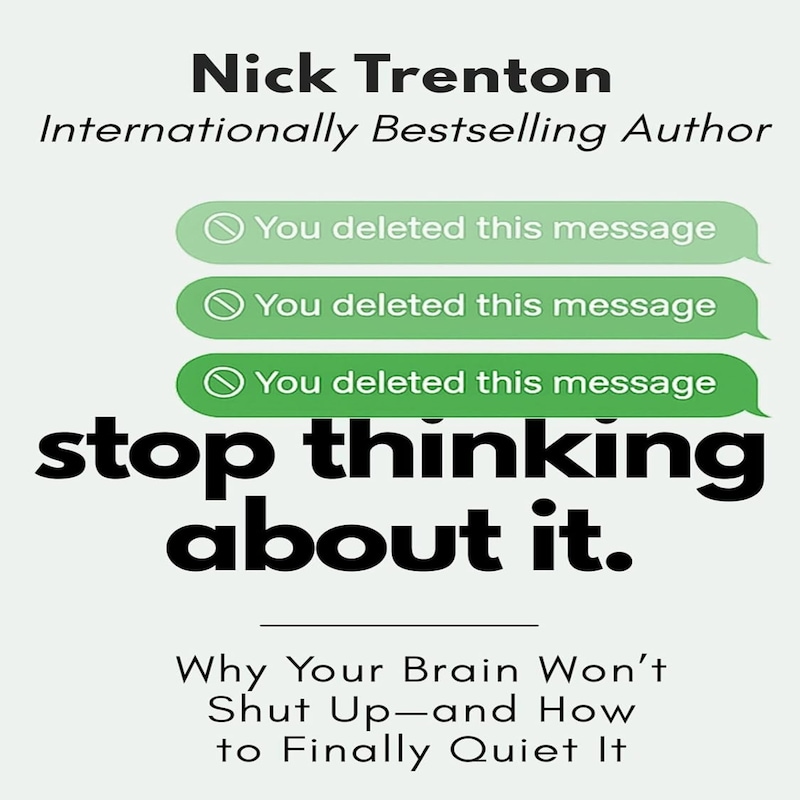
Speaker:Nick Trenton's book, Stop Thinking About It, Why Your Brain Won't Shut Up, and How to Finally Quiet It, brings us this episode, Predicting Doom or Resilience.
Speaker:In today's episode, we're going to learn how to stop catastrophizing outcomes.
Speaker:You know, those public speaking gigs aren't as terrifying as you predict.
Speaker:And if you believe that you'll crumble under pressure, that's just a limiting belief that's holding you back.
Speaker:We're going to talk about facing our fears, comparing our forecasts with reality, and we're going to watch anxiety shrink while our confidence soars.
Speaker:Thanks for being with us today.
Speaker:Build “I can handle it” confidence
Speaker:“You have within you right now, everything you need to deal with whatever the world can throw at you.”
Speaker:Brian Tracy
Big idea:Your brain’s self-preservation mechanism habitually weighs two predictions against one another:
Big idea:How bad is the outcome going to be?
Big idea:How well will I be able to cope with it?
Big idea:Anxious overthinkers tend to have highly catastrophic interpretations, paired with almost zero belief in their own competence.
Big idea:Let’s say you’ve just attended an important and nerve-wracking interview at the company of your dreams, for the job of your dreams.
Big idea:You prepared for days, you’ve done your very best, and… now you wait.
Big idea:You’ve been told to expect a decision within a few days, but these few days prove to be torture.
Big idea:Not knowing feels like it’s killing you!
Big idea:And then you start to ruminate.
Big idea:Your head feels a bit like a bowl of spaghetti, but when it comes down to it, there are just two main thoughts holding all this anxiety together:
Big idea:It’s going to be awful
Big idea:I won’t survive it
Big idea:In fact, this particular combination of beliefs, in one way or another, plays a key role in almost all anxious thoughts loops, panic spirals, and overthinking traps.
Big idea:We greatly overestimate the upcoming catastrophe, and we greatly underestimate our own ability to cope with it when it arrives.
Big idea:See if you can spot the combination:
Public speaking:“I’m going to totally humiliate myself and I’ll never recover.”
Social anxiety:“They’re all going to hate me and I’ll be alone forever.”
Social anxiety:Phobias and fears: “I’ll pass out in terror and I don’t even know what I’ll do then.”
Social anxiety:Many of us have experience with catastrophic thinking, imagining and elaborating on the worst-case scenario.
Social anxiety:Many of us also have a low sense of self-efficacy, meaning we have little confidence in our ability to cope with life’s trials and challenges.
Social anxiety:However, there is something particularly anxiety-provoking about both together.
Social anxiety:Imagine a seesaw.
Social anxiety:On the one side: our prediction of how catastrophic and threatening an event will be.
Social anxiety:On the other side: our prediction of how well we might cope and survive.
Social anxiety:It’s the balance between these two that determines how anxious we feel.
Social anxiety:After all, consider that if I predict that an outcome is going to be very bad, but I also predict that I am very strong and able to manage that outcome, then I won’t be anxious.
Social anxiety:The seesaw is balanced or even tipped in favor of “I can do it.”
Social anxiety:On the other hand, if I have predicted that I have basically zero ability to cope with anything that life throws at me, then even a small negative event will tip the seesaw in the wrong direction, and I will feel anxious.
Social anxiety:So, how do we reduce anxiety?
Social anxiety:We reduce our catastrophic predictions
Social anxiety:We increase our coping predictions
Social anxiety:Or both!
Social anxiety:In fact, this is exactly what Casey et.
Social anxiety:al.
Social anxiety:concluded in their 2005 paper published in the journal Cognitive Therapy and Research.
Social anxiety:The researchers wanted to know if a CBT treatment program would help participants with panic disorders, and if so, why.
Social anxiety:They found that:
Social anxiety:“Patients in the Standard CBT condition reported significantly greater shifts both towards higher panic self-efficacy and lower catastrophic misinterpretation of bodily sensations during treatment, as well as a significantly lower level of panic severity at posttreatment.
Social anxiety:Changes in catastrophic misinterpretation of bodily sensations and panic self-efficacy contributed significantly more to prediction of panic severity than did assignment to either Standard CBT or a Waitlist Condition.”
Social anxiety:In other words, what seems to make the biggest difference for people is whether they experience shifts in two key beliefs: self-efficacy and catastrophic interpretation.
Social anxiety:Interestingly, being able to make this shift was the thing that ultimately mattered-not whether a person did the CBT treatment program or not.
Social anxiety:To put it another way, the mindset least associated with panic, anxiety, and rumination is this:
Social anxiety:◦ It’s probably going to be OK
Social anxiety:◦ And I can manage it
Social anxiety:Uncertainty and the anxiety seesaw
Social anxiety:You’ll probably have noticed that the quantities we are measuring on this “anxiety seesaw” are predictions.
Social anxiety:This is important: They’re not absolute fact or truth, but guesses, estimations, and perceptions.
Social anxiety:Naturally, the mind tends to make more predictions in the face of the unknown.
Social anxiety:When you don’t really have the facts or you don’t really know the truth, then you guess.
Social anxiety:You make an estimate and appraise the situation as best as you can, given what you have.
Social anxiety:However, some of us make especially inaccurate guesses in the absence of full knowledge.
Social anxiety:“I don’t know what will happen, but it will probably be bad.
Social anxiety:And I don’t know what I’ll do, but I probably won’t cope at all.”
Social anxiety:“I haven’t heard back from the company yet, so I guess that means they’re not going to hire me and I’ll never find a job as good as that again.”
Social anxiety:Uncertainty and the unknown can be major triggers for anxiety precisely because they prompt this kind of anxious guessing.
Social anxiety:Not only do we imagine the worst possible outcome we can think of, we also somehow forget all the resources and skills we have at our disposal to cope.
Social anxiety:Plus, we dismiss all the times we’ve coped with challenges just like this one in the past!
Social anxiety:The way forward will naturally be to swing the seesaw the other way:
Social anxiety:Decrease catastrophic thinking
Social anxiety:Increase self-efficacy thinking
Social anxiety:We are going to focus on the second one-increasing self-efficacy.
Social anxiety:There are a few reasons for this, but primarily, it’s easier.
Social anxiety:It can be difficult to lessen the intensity of catastrophic thinking that is already well underway.
Social anxiety:It may be relatively easier to turn attention away from the feared outcome entirely and focus on building more confidence in your own ability to cope, no matter what happens.
Social anxiety:Let’s see how to do just that.
Social anxiety:How to build self-efficacy when it comes to uncertainty
Social anxiety:Predictions are slippery things.
Social anxiety:When you’re making guesses and estimations, anything goes.
Social anxiety:The only way to gently challenge any predictions you make-whether about a catastrophic outcome or about your own ability to cope-is to literally compare your prediction with reality.
Social anxiety:In other words, was your prediction right?
Social anxiety:The exercise below is a way to start gathering real counterevidence that pushes against the distorted predictions that are fueling anxiety.
Social anxiety:Two big caveats, however:
Social anxiety:1.
Social anxiety:We need to pay honest attention to the truth of our predictions.
Social anxiety:2.
Social anxiety:We need to give ourselves the opportunity to really test them.
:Keep a “predictions” log
:Let’s return to our earlier example.
:“I haven’t heard back from the company yet, so I guess that means they’re not going to hire me and I’ll never find a job as good as that again.”
:Let’s break that down:
:You predict that they won’t hire you (catastrophic outcome).
:You predict that you will never find a good job again (low self-efficacy).
:Check back in on your predictions
:After a few days, come back to your log and compare your guesses with what has actually unfolded in reality.
:Look at both predictions you made.
:Was the outcome as catastrophic as you believed it would be?
:Were you as helpless and hopeless in dealing with the outcome as you thought you would be?
:If you had to rate your predictions according to their accuracy, what score would you give them?
:It may help to literally write it down!
:Almost always, you’ll find that your predictions were greatly distorted.
:I predicted ____________.
:What actually happened was ________________.
:This tells me that _________________.
:The great thing about this exercise is that it doesn’t actually matter what the outcome is!
:It’s all data.
:Reality will either confirm your predictions or disconfirm them.
:Either way, you’ll learn something.
:Maybe you predicted they wouldn’t hire you, and they did.
:This is proof that catastrophic predictions can be wrong.
:Maybe they didn’t hire you.
:You predicted that you wouldn’t cope and that you’d never find a good job again.
:But a few weeks later, you did.
:It was difficult, but you managed.
:This is proof that coping predictions can be wrong.
:Keep returning to the facts
:The next time you’re in an anxious overthinking spiral, go back to your predictions log.
:Remind yourself that catastrophic predictions can be wrong.
:Remind yourself that coping predictions can be wrong.
:After all, you’ll be looking at actual proof.
:At the time, you may well have believed those predictions 110%.
:But they were still wrong.
:They felt real and intense and urgent and true.
:And they were wrong.
:And that means that the anxious predictions you’re making now could also be wrong.
:Once again, reassurance and forced positivity are not necessary here.
:We just need to gently tip the seesaw in the other direction.
:To lower anxiety…
:We don’t need to say: “Nothing bad will ever happen to me and besides, I’m invincible!”
:We just need to say: “Outcomes are usually not as bad as I fear, and I’m often stronger and more capable than I give myself credit for.”
:Ask yourself:
:Will the outcome really be a total catastrophe?
:Or is it more likely that it will be fine, or at the very worst a little awkward or uncomfortable?
:Is it really true that if something goes wrong you’ll be completely, utterly unable to cope?
:That you won’t be able to stand it, and will just curl up and die?
:Or is it more likely that it might be unpleasant, but you’ll find a way to get through it?
:Balancing the seesaw is about bringing both predictions back into the realm of ordinary plausibility.
:The anxious mind is nervous about not making such predictions.
:“How else am I going to keep myself safe?
:And what if the worst-case scenario really does happen?
:!”
:We need to be honest about the role that rumination plays for us.
:Anxiety might disguise itself as intelligent problem solving or useful “preparation,” but there’s an easy way to see through this disguise:
:“Is this anxiety prompting me to take beneficial action?”
:Real problem solving focuses your awareness on an issue, prompts sensible action, and once a decision is made, that intensity diminishes.
:Fake problem-solving (i.e.
:anxious overthinking) never goes anywhere.
:It doesn’t precipitate action.
:It just brings your attention to the problem, over and over again, amplifying itself over time.
:The more entries you make in your predictions log, the more you’ll prove to yourself-with hard evidence-that the things you most fear and dread never actually happen.
:You’ll also prove to yourself that all that rumination and worry never does anything for you-and it’s usually wasted effort.
:When you feel anxiety hitting again, go through your predictions log, and consciously tell yourself:
:“Even though right now it feels like my anxious predictions will definitely happen, I have felt that way before, and I’ve been wrong.”
:“I have been in challenging situations before, and I have coped.”
:“I have character traits, skills, strengths, and tools to help me manage difficult situations.
:I am not on my own, and I can always seek help and information.”
:“Challenging things happen in life.
:But they’re usually not as bad as I predict, and I know I can handle things, whatever happens.”
:It's clear that our minds often construct narratives around future events that are overly negative and limiting, and this just increases our anxiety and stress levels.
:But by understanding how these thoughts affect us, we begin to see a path towards healthier thinking patterns.
:We have to challenge our catastrophic predictions by observing whether they hold up in reality.
:That will significantly reduce fear and boost self-confidence.
:Here are the takeaways from today's episode.
:We make catastrophic predictions about outcomes.
:This includes thinking an event will be very bad or impossible to survive.
:For example, fearing you'll humiliate yourself during public speaking or that everyone will hate you for social anxiety.
:We also predict our inability to cope with events, such as believing you won't manage your fear during a phobia or recover from a failure in job hunting.
:The key is seeing if these predictions hold true.
:Predictions impact how we feel about an event's severity.
:Catastrophic thinking increases anxiety, while boosting self-efficacy reduces it.
:Comparing predictions to actual outcomes can reveal distorted views and soothe fears.
:We'll leave you with this quote from Daniel Gilbert, a psychologist known for his research on effective forecasting and happiness.
:When we take away a person's capacity to predict, we also take away that person's fears about the future.
