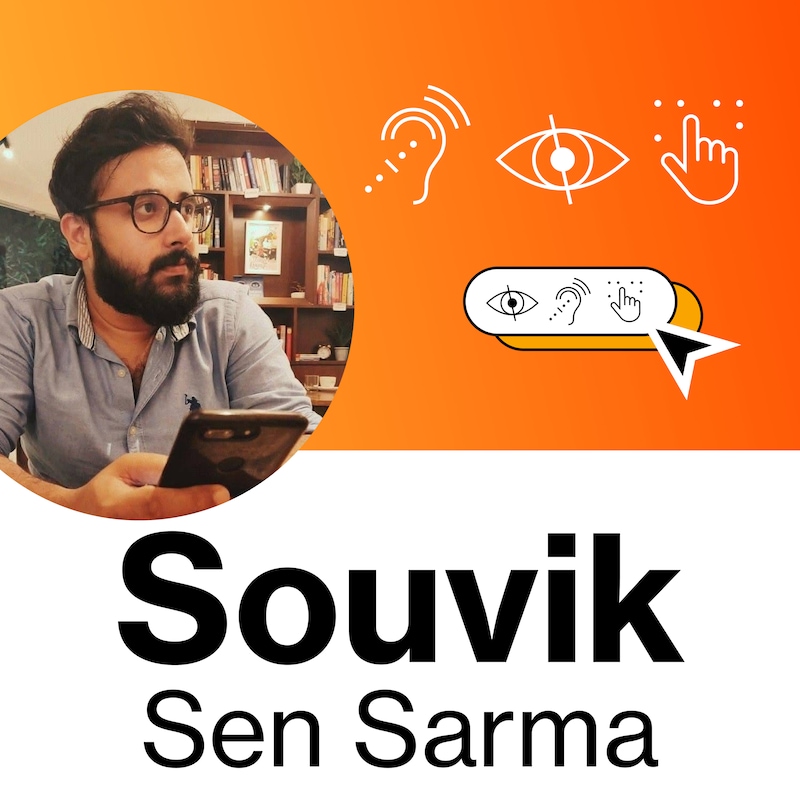
Souvik Sen Sarma shares his journey from front-end developer to Accessibility Advisor at Wells Fargo International. He discusses building accessibility processes from proposal through testing and sign-off, mentoring teams, and managing defect tracking at scale. Souvik reflects on how inclusivity first drew him into accessibility and why human expertise remains essential—even as AI begins to influence development workflows.
Transcripts
Speaker:
Well, hello.
Speaker:
This is Joe Walensky, and I'm the host of Digital Accessibility, the People Behind the Progress.
Speaker:
And it's off to another episode where today I am talking to
Speaker:
Suvik Sansarma. Hello, Suvik. How are you today?
Speaker:
Hi, Joe. I'm doing good. How are you? Good morning.
Speaker:
Yeah, it's a nice morning for me.
Speaker:
I'm in my home office in Bellingham, Washington, which is about
Speaker:
80 miles north of Seattle.
Speaker:
Where are you speaking to me from?
Speaker:
I'm speaking from Bangalore, India.
Speaker:
So it's evening time out here.
Speaker:
Well,
Speaker:
I appreciate you staying up late as I get up early.
Speaker:
It's always good to bring in the perspectives from
Speaker:
our international colleagues.
Speaker:
And so a good place to start is if you could talk a little bit about
Speaker:
the work that you're doingright now.
Speaker:
So currently,
Speaker:
I'm working as an accessibility advisor with Wells Fargo International.
Speaker:
So my job is
Speaker:
designing the whole accessibility system,
Speaker:
starting from getting the proposal to set the design development,
Speaker:
then overseeing the testing,
Speaker:
and getting the final sign-off. Yeah. So pretty much that is my work structure in Wells Fargo.
Speaker:
Well,
Speaker:
I imagine that there are quite a lot of different things that
Speaker:
you have to do for
Speaker:
that position.
Speaker:
Would you be able to tell us a little bit about what typically your work consists of
Speaker:
in a day or a week or
Speaker:
a month?
Speaker:
What are some of the things that you spend a lot of your time on?
Speaker:
Currently, mostly, I'm spending a lot of time on setting up the process, streamlining that,
Speaker:
setting the guidelines for the development team, like preparing the checklist,
Speaker:
seeing the grade checks for the testers,
Speaker:
reviewing the design,
Speaker:
and also monitoring the open accessibility defects
Speaker:
across the service line.
Speaker:
So these are the most
Speaker:
work that I'm doing currently.
Speaker:
Allright.
Speaker:
Well, we can talk a little bit more about
Speaker:
what's currently happening in your work a little bit later.
Speaker:
But another
Speaker:
place to check in with you on is your background.
Speaker:
What was the path that found you to accessibility?
Speaker:
What type of work were you originally involved with,
Speaker:
either for your work life or elements of your
Speaker:
lived life that contributed to where you are today?
Speaker:
So I have started as a
Speaker:
software engineer, front-end developer. I've started my career as a front-end developer.
Speaker:
So I was
Speaker:
basically doing HTML, PyPC, JavaScript,
Speaker:
and UI coding back that time when I
Speaker:
introduced accessibility back in 2012.
Speaker:
So it was pretty new
Speaker:
for me as well as well as others in accessibility.
Speaker:
So it drew my attention from the very first day.
Speaker:
I really liked the concept,
Speaker:
like making your website
Speaker:
available for most of the users.
Speaker:
I don't want to make it constrained for a certain type of users,
Speaker:
but I would like to say inclusivity kind of thing.
Speaker:
So it drew my attention the very first day.
Speaker:
So I have started reading more about the accessibility, seeing the guidelines,
Speaker:
started doing small POCs at that time. Then gradually, I've started becoming an accessibility developer.
Speaker:
I was working as an accessibility developer for
Speaker:
around two, three years.
Speaker:
Then I even gradually moved to that SME position with my next organization.
Speaker:
So I was mostly doing the
Speaker:
design reviews and the testing at that time.
Speaker:
So that is
Speaker:
how I moved to this SME path. And eventually, I have moved as a lead SME.
Speaker:
And now I'm managing a team of people out here in India
Speaker:
for accessibility.
Speaker:
So this is my whole journey till now.
Speaker:
Well, I think it's pretty common for a lot of people
Speaker:
who are involved in web development to
Speaker:
find their way to accessibility that way.
Speaker:
It is, I think,
Speaker:
a challenge to understand
Speaker:
how to apply accessibility to that work.
Speaker:
We have a lot of information, but sometimes it can be confusing about
Speaker:
what to look at first, how to develop your career.
Speaker:
What were some of the things that you found
Speaker:
in your own work that
Speaker:
helped you to build your skills?
Speaker:
I know you mentioned reading things, but
Speaker:
were there any community activities or other things that helped you
Speaker:
to build your skills up?
Speaker:
Right.
Speaker:
So I have joined back that time.
Speaker:
So I have a client called Pearson.
Speaker:
So Pearson is a giant in the educational market.
Speaker:
So they're big in edtech.
Speaker:
So that time, I've joined a couple of their workshops. I've attended a few trainings.
Speaker:
And I find it's very interesting,
Speaker:
building your website
Speaker:
not in a certain direction.
Speaker:
Apart from that, I can actually modify,
Speaker:
let's say, the applications of the websites in a certain way so that every other people
Speaker:
can use that freely.
Speaker:
And those workshops and the trainings really
Speaker:
drew my attention to accessibility more from
Speaker:
normal development.
Speaker:
So I slowly started moving towards accessibility and then development.
Speaker:
Well,
Speaker:
even though all of our information is primarily
Speaker:
online that we use now,
Speaker:
especially in technical areas,
Speaker:
there's still differences
Speaker:
in terms of geography from one part of the world to another.
Speaker:
Yeah, I'm familiar with the
Speaker:
West Coast of the United States primarily in that part of the tech industry.
Speaker:
And I'm just wondering,
Speaker:
are there any things that you feel are unique to
Speaker:
being where you are related to accessibility?
Speaker:
Or do you feel that it
Speaker:
could be the same if you were in some other part of the world?
Speaker:
I think since we have a standard guideline, I think it's more like same.
Speaker:
Yeah, obviously, abroad,
Speaker:
this accessibility is not just restricted to the digital platform.
Speaker:
It is spread across to the physical users
Speaker:
as well as the digital.
Speaker:
But in my part of the world, it is mostly digital as of now.
Speaker:
But people have slowly started moving to the physical
Speaker:
accessibility part as well,
Speaker:
implementing things for
Speaker:
day-to-day users. So yeah.
Speaker:
But apart from that, most of the things are similar, I feel.
Speaker:
Well,
Speaker:
you started off by telling us a little bit about the things that you're involved in for
Speaker:
your work.
Speaker:
Are there any activities that
Speaker:
you're spending a lot of time onright now
Speaker:
or looking to the future?
Speaker:
Are there any things that are coming up that you think
Speaker:
will be exciting or challenging in your work?
Speaker:
I think the
Speaker:
thing that I'm currently looking at from the last six to eight months,
Speaker:
it's the evolution of AI.
Speaker:
And I'm trying to understand how
Speaker:
we can incorporate AI in accessibility.
Speaker:
But it's a very initial phase still.
Speaker:
So we need to spend some more time on that.
Speaker:
But if in some way, not directly in accessibility testing,
Speaker:
if maybe in development or
Speaker:
creating templates,
Speaker:
defect creation, generating documents, if we can incorporate AI on that,
Speaker:
that will be easy for us
Speaker:
in some extent. I think that is the part I'm currently looking at.
Speaker:
And the last thing I just wanted to ask you about,
Speaker:
in terms of the things that you're currently involved with,
Speaker:
are there any things that
Speaker:
are more challenging than others?
Speaker:
Maybe what are the things that
Speaker:
maybe not so much take up the most
Speaker:
time in your work life,
Speaker:
but are there any things that you think are particularly
Speaker:
difficult to be able to manage?
Speaker:
Or is everything more or less under control
Speaker:
for the types of things that you're involved in?
Speaker:
So are you asking about that thing,
Speaker:
difficult to manage people when it comes to accessibility sort of things?
Speaker:
Yeah, whatever it might be, it's different for different people.
Speaker:
For example, you mentioned AI.
Speaker:
Some companies are moving faster than others with that.
Speaker:
And it can become a challenge to try and
Speaker:
build that into your existing processes.
Speaker:
But whether it's AI or anything else,
Speaker:
are there any things looking forward that you think
Speaker:
you're going to have to be spending
Speaker:
a lot of your time on?
Speaker:
Right. Like I said, so yeah.
Speaker:
So many companies are moving very fast in the AI field.
Speaker:
But as you know, in accessibility,
Speaker:
it's human intervention which is required.
Speaker:
And we cannot solely rely on AI or automation in accessibility.
Speaker:
So we need some manual touch, some human touch to understand
Speaker:
how the websites or the applications or apps are.
Speaker:
So we cannot completely move to AI in accessibility,
Speaker:
but we can use bits and pieces in some aspects,
Speaker:
in some parts of the accessibility.
Speaker:
But 100% AI in accessibility,
Speaker:
as of now, what my understanding is, it's not possible.
Speaker:
Well,
Speaker:
I appreciate you taking the time to speak with me, Suvik,
Speaker:
and providing a little bit of an insight into
Speaker:
your work.
Speaker:
So I appreciate this.
Speaker:
And I look forward to
Speaker:
staying connected with you in the accessibility profession.