Thanks to our Partners, Pico Technology, Autel, and Independent Wrench Jobs
Watch Full Video Episode
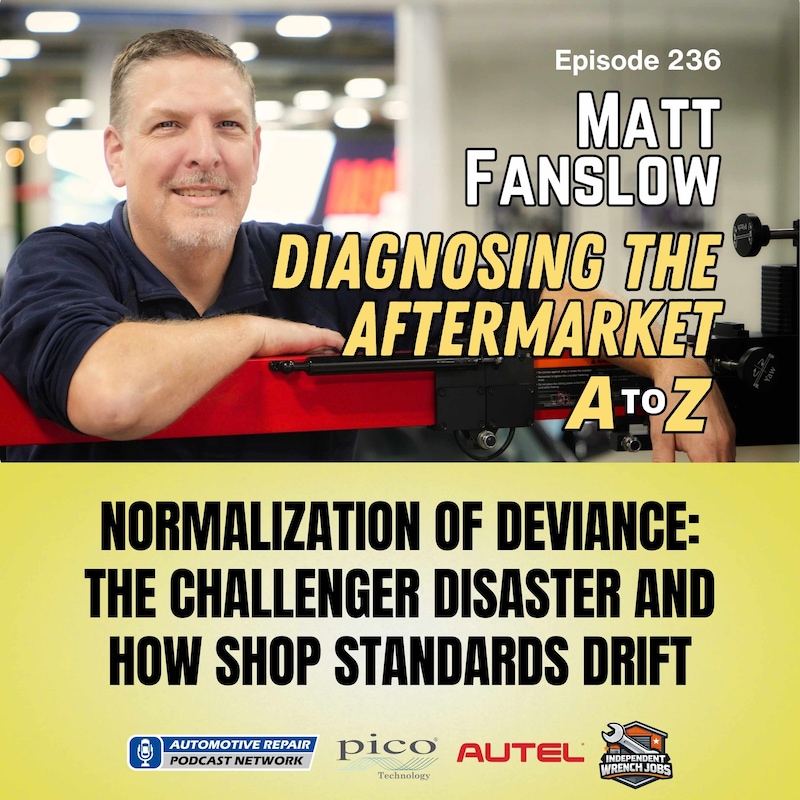
Matt Fanslow revisits the Challenger disaster, not just as a historical tragedy, but as a case study in how standards, tolerances, and risk perception can shift over time. The common simplified story is that management ignored engineers, pushed the launch forward, and disaster followed. While that is part of the story, Matt looks at the deeper concept sociologist Diane Vaughan identified: normalization of deviance.
The Challenger disaster happened 73 seconds after launch in 1986, killing all seven astronauts onboard. The failure was traced to O-rings in the solid rocket boosters that lost sealing ability in unusually cold conditions. But the broader lesson is not simply that one part failed. It is that warning signs had appeared before, yet each successful mission expanded the boundary of what NASA considered acceptable. What would have once been treated as outside tolerance gradually became normal.
Matt connects this idea to the phrase, “slowly, then all at once,” often used to describe the collapse of relationships, marriages, systems, and businesses. The visible failure may seem sudden, but the conditions that made it possible usually developed over a long period of tolerated drift.
From there, the discussion moves into automotive repair. Shops can experience the same pattern with ADAS calibrations, wheel torque procedures, tire repairs, safety glasses, uniforms, training expectations, and other operating standards. A procedure gets missed once. Nothing bad happens. It gets missed again. Still nothing bad happens. Eventually, the shop no longer treats the original standard as the standard at all. The absence of immediate consequences becomes false evidence that the deviation is safe.
Matt uses ADAS calibration as a major example. A shop may begin by following OEM procedures after alignments or repairs, but over time, scheduling problems, delays, cost pressure, or customer pushback can lead to skipped calibrations. If no warning lights appear and no customer complains, the skipped step starts to feel acceptable. But that does not mean the risk disappeared. It may simply mean the failure has not happened yet.
The episode also references tire repair liability and the John Eagle collision repair case as examples of what can happen when accepted industry habits conflict with OEM procedure. The lesson is not that every shop owner or technical specialist who drifts from procedure is malicious. The more uncomfortable lesson is that drift is natural. That is exactly why it has to be recognized and managed.
Matt closes by encouraging listeners to look around their own shops and ask where tolerance has expanded without conscious approval. Are torque procedures still being followed? Are retorques still being performed? Are safety practices still enforced? Is training still treated as essential? Are customer-facing and liability-related procedures being maintained, or have they quietly become optional?
Key Themes
Normalization of deviance: The gradual process where unacceptable practices become accepted because nothing bad happens immediately.
Challenger as a system failure: The O-ring failed physically, but the larger failure involved shifting standards, repeated warning signs, and expanded tolerance.
“Slowly, then all at once” Major failures often appear sudden, but the underlying drift usually develops over time.
Automotive examples: ADAS calibrations, tire repairs, torque sticks, wheel retorques, safety glasses, uniforms, training, and shop SOPs can all become vulnerable to tolerance drift.
OEM procedures and liability: The episode reinforces the importance of following documented procedures, especially where safety, liability, and driver-assistance systems are involved.
Not always malicious: Deviance can become normalized without anyone consciously deciding to take a major risk.
Memorable Ideas
- “What would have failed in 1981 passes in 1986.”
- “The tolerance for acceptability expanded.”
- “It happened slowly and then all at once.”
- “It’s not a problem until it is, and then it’s a big problem.”
- “The absence of consequences is not the same thing as proof of safety.”
Listener Takeaway
Every shop has standards that were created for a reason. Some protect quality. Some protect the customer. Some protect the business. Some protect people’s lives. The danger is that those standards can erode so gradually that no one notices until the failure is already public, expensive, or irreversible.
Thanks to our Partner, Pico Technology
Are you chasing elusive automotive problems? Pico Technology empowers you to see what's really happening. Their PicoScope oscilloscopes transform your diagnostic capabilities. Visit PicoAuto.com
Thanks to our Partner, Autel
From drivability diagnostics and TPMS service to ADAS and advanced safety systems, Autel helps technicians follow OEM procedures and repair with confidence. Learn more at Autel.com
Thanks to our Partner, Independent Wrench Jobs
Independent Wrench Jobs is a new, tech-only community to help you find better independent shops—fair dispatch, steady work, real leadership. No games.
Built by Technician Find—serving the industry since 2017. Join free at IndependentWrenchJobs.com
Contact Information
The Automotive Repair Podcast Network: https://automotiverepairpodcastnetwork.com/
Remarkable Results Radio Podcast with Carm Capriotto: Advancing the Aftermarket by Facilitating Wisdom Through Story Telling and Open Discussion. https://remarkableresults.biz/
Business by the Numbers with Hunt Demarest: Understand the Numbers of Your Business with CPA Hunt Demarest. https://huntdemarest.captivate.fm/
The Auto Repair Marketing Podcast with Kim and Brian Walker: Marketing Experts Brian & Kim Walker Work with Shop Owners to Take it to the Next Level. https://autorepairmarketing.captivate.fm/
The Weekly Blitz with Chris Cotton: Weekly Inspiration with Business Coach Chris Cotton from AutoFix - Auto Shop Coaching. https://chriscotton.captivate.fm/
Speak Up! Effective Communication with Craig O'Neill: Develop Interpersonal and Professional Communication Skills when Speaking to Audiences of Any Size. https://craigoneill.captivate.fm/