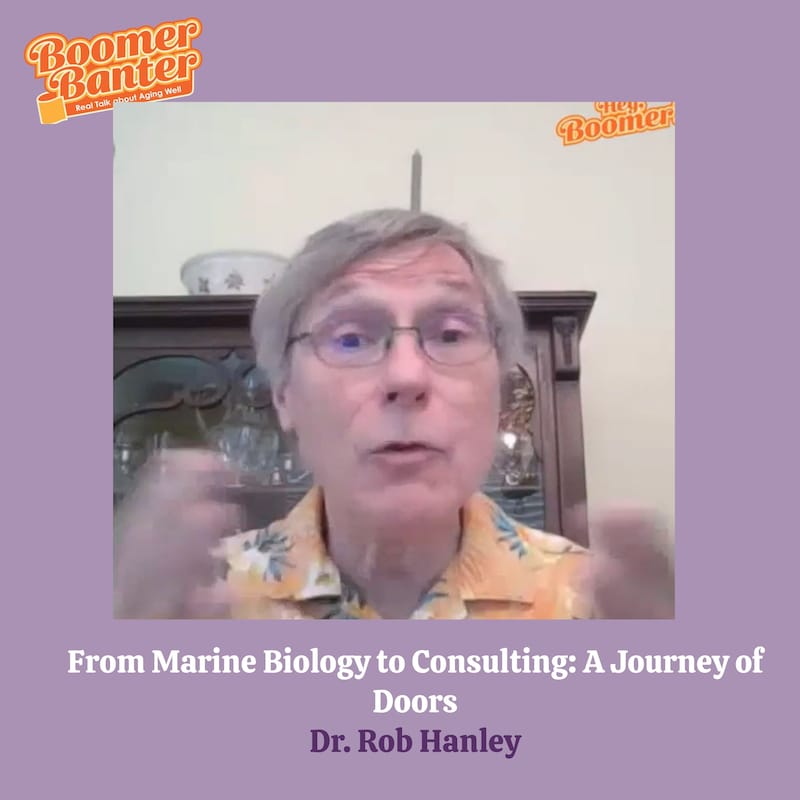
Shownotes
Today, we dive into the idea of finding new opportunities when life doesn’t go as planned. Our guest, Rob Hanley, shares his journey of navigating unexpected turns, reminding us all to keep our eyes peeled for those open doors. From aiming to be a marine biologist to becoming an environmental consultant, Rob’s story is all about embracing change and pushing through discomfort. We chat about how asking people about their stories can lead to deeper connections, and why it’s important to keep learning and growing. So grab your favorite drink, sit back, and let’s explore the paths life takes us on together!
Wendy and Rob bring a splash of warmth and laughter in this episode as they explore the theme of 'opening doors' in life. Kicking off the conversation, they reminisce about the closed doors many faced during quarantine, but they quickly pivot to the new paths these closures can lead to. Rob shares his journey from aspiring marine biologist to environmental consultant, detailing how each twist in his career has been a stepping stone rather than a setback. The stories shared are not just about careers; they’re about the beauty of unexpected opportunities and the importance of connection through storytelling. As they dive into Rob's academic background, listeners get a glimpse of his experiences at Florida State and Duke University. Rob's humorous take on his time in the marching band adds a light-hearted touch, making the technicalities of biology and consulting feel approachable and fun. They also discuss how the job market has evolved, drawing parallels to the current generation's struggles, highlighting the importance of mentorship and adaptation in today’s ever-changing world. This segment is packed with relatable content, as many listeners can empathize with the feeling of being adrift in a sea of choices and uncertainties. Towards the end, Wendy and Rob offer profound insights on resilience, patience, and the willingness to learn new things. Rob encourages listeners to embrace opportunities that push them out of their comfort zones, sharing personal anecdotes that illustrate the theme beautifully. The conversation wraps up with a genuine appeal for listeners to engage and share their stories, fostering a sense of community. It’s a delightful mix of humor, wisdom, and relatable life experiences that reminds us all that every closed door can lead to something wonderful if we’re open to it.
Transcripts
Foreign. Hello everybody out there. I am Wendy Green, and this is our fourth episode of hey Boomer.
Hey Boomer is a place where we start meaningful conversations that build bridges of understanding and build connections and start, like I said, wonderful conversations. Being the host of hey Boomer has really been opening up some wonderful conversations for me.
It's so interesting when you ask people about themselves, people that you may have known a long time or people that you may have just met, they all have stories to tell, so ask them. And giving a person the space to tell their story is not something that I take lightly.
And I am so grateful for everyone who has agreed to be open and to share their stories with us today and in the future on hey Boomer. I want you to share with us too. As we talk. Let me know your thoughts, your ideas, and your questions. Join us in this conversation.
And you can also start conversations by sharing some of the other stories on hey Boomer and then listening to the person that you share with. And you will learn so much about them and you might actually find that you deepen your relationship with them.
You know the expression, when one door closes, another door opens? That expression has been attributed to Alexander Graham Bell, originally attributed to him.
d it, but upon his passing in:But we often look so long and so regretfully upon the closed door that we do not see the one that has opened for us. We certainly have been experiencing the closed door of quarantine over the past couple of months.
This closed door is unlike any that we have experienced in the past. People have lost their jobs, gotten sick, lost their lives. And this has created a lot of sadness, a lot of stress and uncertainty.
It also is true that during this time of quarantine, people have been experiencing a lot of creativity. My daughter has taken up painting and she has really been doing some beautiful work.
I have friends that are experimenting with all different kinds of recipes and venues of different countries. And it was during quarantine that I came up with this idea of hey Boomer. So, new doors to walk through.
My guest today had some very specific plans for his life when he took off for college. Along the way, the opportunities did not pan out the way he had visualized. So he looked behind door number two. Rob Hanley.
governor of Rotary. District:We also both went to Florida State after high school. Go Seminoles. But Rob graduated cum laude with honors from Florida State with a Bachelor's of Arts degree in biology.
He was also a player with the Florida State Marching Chiefs band. I don't think I even know what a sousaphone is.
Rob has a Master's of Arts in zoology from Duke University with a minor in computer science, a PhD in biology from the University of Alabama with a minor in computer science and a minor in electrical engineering. He grew up in Rochester, New York, the youngest of three children in a single parent household.
And he decided to go study marine biology at Florida State University. Rob is currently employed at TRC Environmental Companies as a senior environmental consultant.
ave lived in Greenville since:They have three children, Lt. Col. Chris, Matthew, Aaron and Seth, and two grandsons, Sean and Zach, and an Aussie dog named Bailey. So, Rob, thanks so much for agreeing to be my guest today on hey Boomer.
Dr. Rob Hanley:Thank you, Wendy. It's a wonderful pleasure to be here and thank you for hey Boomer. So let me start.
You say opening doors and the door that when you and I were talking about this, one of the doors I forgot about is as you said, growing up, there was no question that I was going to go to college. When I went to high school in Rochester, New York, if you were a college bound person, you had a very specific curriculum you would take.
And I actually earned two high school diplomas. I earned a city school district diploma and a State of New York Regents diploma.
So I decided since marine biology was a cool thing and we kids in the 60s, we like to do cool, that I was going to go off and study marine biology and be the next Jacques Cousteau. That was my intention.
Wendy Green:Very cool. But why Florida State for marine biology? It's not on the ocean.
Dr. Rob Hanley:So there you go. So why Florida State? So I applied and my target school was University of Rhode island. Uri. Beautiful campus on the ocean.
Well, as my backup schools, I applied to Miami and Florida State and for whatever reason, Uri didn't accept me.
So in the spring of:So I flew by Myself up to Tallahassee and visited Tallahassee and then came home and in March, there was no question in my mind that Tallahassee was a place for me. No, not on the ocean, but not that far from the ocean either. So Tallahassee it was.
And in Florida, at Florida State, that's when the Marine, the marching band door opened up. I was not in the Marching Chiefs as a freshman, but my dorm RA Was a sousaphone player. That's the Oompa. The Oompa thing that sits on your shoulder.
The Oompa thing. So he was a sousaphone player, and he invited me for my sophomore year to join the Marching Chiefs. So that's how I got to be a marching chief.
And that was a wonderful, fun door that opened. And frankly, the only reason I graduated cum laude was because I took a band course every quarter, and that was a guaranteed A.
And that one little quarter hour of A made the difference between a 3.5 and a less than 3.5 GPA.
Wendy Green:Okay, well, I think that you probably did very well in your other classes, too, Rob did.
Dr. Rob Hanley:Okay, so my goal, my. My goal was to go on and be a researcher, and researchers have to get a PhD. So along the way, I sort of, kind of got married.
And again, I had two doors. I had. Door number one was a teaching assistantship at Oregon State University. Well, that's a country away.
Door number two was I would pay tuition to Duke. So because of my situation, first marriage, closer family, so forth, decided to go to Duke. And, well, it didn't quite turn out the way I had wanted.
That's why I have a master's degree from Duke and not a PhD but at Duke, another door opened, a very different door. My major professor at Duke was a University of Michigan graduate, he said.
One of the fellows at the Museum of Zoology at the University of Michigan, he's in the mollusk division. Those are clams and snails. He has a paid position for someone to be a collection manager.
Why don't you apply there and go up to the University of Michigan? Which I did. So my first wife and I moseyed off to Ann Arbor, Michigan. That's where the oldest was born in Ann Arbor.
And unfortunately, that door closed when the grant expired. So I got terminated at the ripe old age of 23. My first termination notice, because my grant job expired. No way to renew it. Had to do something.
Wendy Green:So, wait, so had you finished your master's by then?
Dr. Rob Hanley:Yes, finished my master's, finished your master's,.
Wendy Green:Went to Ann Arbor, and now you were sitting in Ann Arbor with no job and no grant money.
Dr. Rob Hanley:That is correct.
Wendy Green:Okay.
Dr. Rob Hanley:First wife from Florida. So my goal was to become a graduate student at the University of Florida. Went through the application process. No dice. But a different door opened.
And the person with whom I was going to study at Florida knew a physiological ecologist. He might accept you as a graduate student. So very late in the application process year I applied to the University of Alabama.
. Now, if you had asked me in:But there I was in Tuscaloosa five years, earned my PhD there, and it was a marvelous program. I had a lot of fun. And I met my current wife there. Lillian is a native of Alabama. And the reason we met was a different door that opened.
My major professor, he saw the handwriting on the wall. He said there aren't going to be many teaching positions available when you get your PhD.
So I would suggest you minor in computer science and environmental engineering, and that way maybe you'll have some more marketable skills. So I did. And that's where I met Lillian, because she was an environmental engineering major.
Wendy Green:So you ask a question, somewhere along the line, you went from your first wife to did you. Were you still married when you went to the University of Alabama?
Dr. Rob Hanley:Yes, but not for very long. We got separated my first year there, and then my first wife and I got divorced. Alabama was an easy state, and she moved back to Florida.
Wendy Green:Okay. And so. And. And your dream was to be a professor, right? A professor of biology or a professor of something?
Dr. Rob Hanley:Yes.
Wendy Green:Okay. So.
Dr. Rob Hanley:So one of the problems of being a baby boomer back then and going into university life was I was in the middle of the wave. So universities had staffed up well. Now that the baby boomers had graduated, university enrollments were declining.
So there were few positions and lots of PhDs. When I would apply for a university job, a tenure track university job, there would be 3, 4, 500 applicants for one job.
Not only that, it was:That the graduates of today are facing. Well, Lillian had gotten a job up in Connecticut with a company called Dora Oliver.
So off to Connecticut, that's where we got married, was in the great state of Connecticut. And. And I was just having a hard time finding any gainful employment.
Although I did, I did work for a Ralph Nader based citizen action group as a door to door canvasser.
Wendy Green:Oh, wow.
Dr. Rob Hanley:Me knocking on the doors asking for money. That was my job.
Wendy Green:Wow. So were you still looking, trying to be a professor at that point?
Dr. Rob Hanley:Yes.
Wendy Green:Okay, so how long did you continue to hold out hope that you would get a job like that? A tenure track job?
Dr. Rob Hanley:So we were in Connecticut 18 months and in that time frame I got a call from one of my professors in environmental engineering back in Alabama.
One of our classmates had taken a job in Greenville and their company needed somebody who knew computers, who knew a little bit about environmental engineering and who had the gift of Gap. And so he thought of me. So I interviewed with a company called rmt. Actually was RMT down here in Greenville for a software division.
They had a software program specifically for wastewater treatment plants and was offered a job. And I had to choose between the job in Greenville and a private school teaching job in Connecticut. Took the job in Greenville.
We moved down here, missed southwest Connecticut a lot because of the, the. There was just a lot to do in southwest Connecticut. So we missed that a good bit. Greenville had not yet blossomed.
It was nascent, just waiting to blossom, but had not yet blossomed. There were more empty storefronts on Main street than there were stores on Main street when we moved down here. So, so more doors.
So the company with whom I was hired had this software division and we were selling high priced software and we weren't selling a lot of it. And so the parent company, after about a year said, we don't want to be in the software business.
We don't understand it, it's not environmental engineering. We're going to sell the software division. And I had to make a choice. Do I stick with the software side or do I go with the consulting side?
So I opened up that door to consulting and went into business development and had a very gracious supervisor for the next eight or so years.
And that's how I got into environmental consulting, was through a door that I never would have imagined if I had thought about it when I started a PhD program. And I've enjoyed it enough that that's what I've been doing ever since.
Wendy Green:So I'm curious, do you ever look back and say, what if I had been able to become a marine biologist?
Dr. Rob Hanley:So I cannot tell. Yes, I do look back at that.
And there are times I still look through the scientific literature, I still look to see if any of my published papers get cited. I did publish two or three Papers in peer reviewed journals based on my dissertation.
And they would get cited for the first three, four, five years or so, not as much anymore. But I do look at that and I do wonder what would have happened if I had gone that route.
Well, one thing, I'm pretty sure I would be retired by now, which I'm not quite ready for yet. It's a different retirement program in this world than in the university world.
So, yes, I do look back at it, but I won't say I look back with regrets.
Wendy Green:Yeah, I was going to ask you.
Dr. Rob Hanley:About that and there's a reason for that. So the reason I don't look back at regrets is one of the reasons I wanted to go into teaching is I like to talk.
You may have gathered that I like to talk. And I get to do that doing what I'm doing for work, and I get to do that doing what I'm doing for Rotary.
And I get to do teaching, believe it or not, I volunteer as a fifth grade teacher at First Baptist Greenville. So I get to do teaching that way. So I have fun.
And I will be looking to see if there are opportunities as working, serving as an adjunct professor for some of the institutions around here or I've even considered and I haven't reached out, looking at the OLLI program at Furman to see if I could be an instructor.
Wendy Green:In an OLLI course, the Lifelong Learning Institute. Yeah. Which is actually all over the country.
Dr. Rob Hanley:Yeah.
Wendy Green:Yeah. So that's pretty cool.
So your theme of walking through door number two from, you know, graduate school, through the different jobs, Connecticut, now back to South Carolina. And I guess you've stayed here, which is great. We love having you here.
How have you been able to impart that theme, say, to your kids or to people that you have mentored?
Dr. Rob Hanley:Well, that's an interesting question, Wendy. I like that one. So. I. Partly it's, it's. This is interesting. We have a mentoring program at trc and I had not participated much in it until this year.
And I'm still not an official mentor, but one of the things that I have tried to do in my professional career is coach our new employees, our younger employees, on how to go about building their career as a consultant. And I won't say I'm the most successful at it, but I have learned a lesson or two. And so that is one of the things I talk to them about is.
And I encourage them to look for opportunities to reach outside of their comfort zone.
And I think that's one of the reasons that I've been able to work for TRC for over 30 years is something will pop up that it's a little bit outside of other people's expertise. But I am more than willing to take the time to learn and do and dabble.
And so I do things that not too many other people in the company do, like pesticide registrations and polychlorinated biphenyl registrations and stuff like that. So I encouraged my children and I encourage our younger employees to do the same thing.
To look outside of your comfort zone, to look for areas where you can provide something that is needed and to look for areas where you can learn. So I think our daughter was the, the classic.
Now I'm not going to say that she listened to her mom and dad, she went through a college program and she was bound and determined to be a history teacher. That was her original goal. And we said, no, Erin, you really ought to go into engineering. It's better jobs this, that and the other thing.
So she went through an undergraduate program, graduated cum laude from the University of Tennessee with a double major and was struggling finding a job. So she did go back to school, unfortunately to Clemson. I won't say that too loud.
At Clemson she's an industrial engineer and she has a job with Boeing and she has continued to look for other opportunities.
And so with Boeing, she was working on the 787 Dreamliner program in Charleston and she started looking around to see where she would like to go, if any place next and found an opening for their facility in New Orleans which makes rockets. And so she applied, took a job in New Orleans.
She hasn't moved yet because of COVID And she was wondering if she made the right decision until two weeks ago when she took a leap and went through a door and found out that Boeing was reducing force company wide.
But her supervisor in New Orleans said that is not affecting our program because we have must do things that we have got to accomplish for NASA in a certain time frame. So that is basically what I have found in my life is that I would love to have predicted where I would be, when I would be and how I would do it.
But I've not found that quite to be the case. There are a lot of little bumps in the road that pop up and sometimes it looks like there are no doors.
And at the time that we had the most difficult challenges, as I said, I've been terminated. Well, I've actually been terminated twice.
I got terminated because my job was eliminated at Michigan and I got terminated from RMT when They went through a reduction in force. So Lillian and I operated a consulting practice for about four years. And it was literally hand to mouth. Hand to mouth.
We get a job, do a job, get paid. Then we had to go find a job, do a job, get paid.
But because I didn't burn my bridges at R T a little while, four or so years later, when they were building back, I got hired back with R T. And I've been able to stay with them ever since, though.
Wendy Green:Yeah. You know, sometimes when you get laid off, because I was in the technology field, so lots of downsizings and upsizings and on and off.
Some people will say to you, well, you know, maybe it's a blessing in disguise. And, you know, that sounds like a platitude, but in many ways it has been a blessing in disguise because you find another opportunity.
And I think, you know, if you look back on Alexander Graham Bell's comment, if you look so long and regretfully upon the closed doors, then you don't see the open doors. So it may be a platitude, but if you're looking for the open doors, then you have the opportunity to step through them. And I think that's.
That's what you found.
Dr. Rob Hanley:I do not disagree with that. That is. That has been the story of my life. And I won't say that I've always been. It's not always an easy decision. So when I stepped off, so.
So back to, back to when I was 17 years old. I graduated from high school when I was 17. I'm an October baby, so I wasn't 18 when I went down to Tallahassee.
fore then. So Tallahassee was:Back then, there were a lot of different airlines. So I flew on United to Atlanta and then changed planes to Eastern and flew Eastern. Yes, that was an old airline.
Wendy Green:The Wings of Man.
Dr. Rob Hanley:That's the Wings of Man. And flew down to Tallahassee. And so I got off the plane in Tallahassee in middle September. It was 90 degrees. There were no gates.
It was just an open breezeway from where I got off the plane to go in the airport. And I literally said, what have I done? So, yeah, it was unsettling. To Tallahassee. There were no. I had absolutely Nobody from Rochester, New York, IN.
Florida State at that point in time. And certainly not in my class. Florida State. I knew not a soul on a campus of 20,000 students. That was a little unsettling.
And yeah, we had, we had an orientation, but it was a little different than I've seen my children get in that. We had a small group and we did a few things together. It wasn't nearly as detailed as people get now.
Wendy Green:Yeah. So one of our listeners asked, she said her husband grew up in Rochester and she wanted to know if you might have gone to Edison Tech in Rochester.
Did you? No, no.
She said that Edison Tech was an example of one of the barriers faced by female boomers in the 60s because it was a public city high school, but it was only for guys. Yeah, you were aware of it.
Dr. Rob Hanley:So I don't know that. I don't know that Edison was all male when I was in high school because I started. Well, first off, this is another different thing.
I only went to two schools. I went to elementary school through seventh grade and high school from eighth through 12th grade.
s. I graduated in:Home of Eastman Kodak, home of Bausch and Lomb, home of Gleason, works at high end, high end stuff, high end manufacturing. And Edison Tech was designed to push high school students into those industries, many of which have gone away and some of which have moved away.
So different high school. No, I went to Monroe High School. You can tell or she can hear that. I went to Monroe High School, southeast side of the city.
And we had a, our high school, my high school.
We had some students from the other side of the city come to Monroe specifically for our music program and specifically for some of the language arts part of the school curriculum.
Wendy Green:Okay. You still play the sousaphone?
Dr. Rob Hanley:Well, I still have a tuba, but I have not played in years, so my embouchure is a little weak.
Wendy Green:Okay. So Rob, tell me what you would like people to take away from your talk today about walking through door number two.
Dr. Rob Hanley:So I have to admit Lillian and I have been blessed in this time in that my job is stable. Our children have been blessed in that their jobs are stable.
I don't think our lieutenant colonel son and lieutenant colonel daughter in law have any fear of losing their job anytime soon. Our youngest son works for a logistics company.
And even though the containers may not be moving as quickly from China to the United States, they still have to get stuff from point a to point B. And then as I said, Aaron is working for a part of Boeing that has a NASA driven contract with NASA driven deadline. So we are lucky.
However, I know that this is a challenging environment for one graduates because they're not able to enjoy a lot of what we enjoyed and what our children enjoy. And I know it's a challenging time for people who are in industries that undergo a lot of flux or have less stability hospitality industry.
So one of the takeaways I would have, one of them is be patient. This is an economic cycle. It may be longer than most.
I do believe Covid will be with us, not Covid will be with us for months, perhaps longer than that. However, as time goes on, there will be opportunities and there will be new opportunities. And so that the first thing is be patient.
The second thing is. Look for new opportunities where you can take some of your strengths and push them in a direction that you may never have pictured before.
And again, my life story is as I said, I never would have imagined going to school in Alabama. I had no regrets for going to school in Alabama.
I never would have imagined when I started my college career that I would be working for an environmental consulting company. I have no regrets working as an environmental consultant. I have no regrets about the choices I made in my degrees.
But I took advantage to some extent when doors opened to stretch what I learned and to continue to practice. And then I have one third thing, and that is don't ever. And I know this sounds trite, but it is true.
Never stop trying to learn new things because you never know what something new you learn may be useful in your life. And try not to forget some of the old things. So I still remember some of the stuff I learned. Believe it or not, I was a Boy Scout.
I was a long time Boy Scout. I still know how to tie knots and how to do slices.
And there are times when I am stressed that will actually take two pieces of rope and I'll do a splice just to relax myself. So I find ways to relax myself.
Wendy Green:And I think I would add another one and that would be to be courageous. You know, I look at people in our age group that have lost their jobs now as well.
And we know if we've ever lost a job since we're 50, that it gets harder to find meaningful work at this point. And you know, our 401ks may be going up and down or iris, whatever.
But so I think where you said, you know, look for opportunities that play on your strengths and maybe push into that Discomfort and be courageous as you push into it. It's, you know, anytime you push into a discomfort, it feels scary, it feels uncomfortable, it feels unsettling.
But if you can continue to push through it, I think the doors, you will see other doors and other opportunities. At least that's been true for me.
Dr. Rob Hanley:I don't disagree with that. I don't disagree with that at all. So. And there are lots of doors out there, Wendy. You know that as well as I do. There are lots of doors out there.
When you push yourself through a door, go forward, don't try and go backward. Weigh those doors before you go through them.
Sometimes the choices you make may not be the best for you if you're in a family situation, but they may be best for your family. Sometimes the choices are difficult because you are throwing yourself into something totally new.
But I have found in almost 70 years that I actually enjoy the new and I enjoy something different.
One thing I've found this year as a Rotary District governor is that it has been very enjoyable seeing how different Rotary clubs go about doing their business.
And the lesson there is for me indoors is going in saying, well, Rotary club should do A, B, C, D, E. I've come away with their different ways Rotary clubs can operate, just like there are different ways you and I operate. And sometimes we have to see the door someone else has gone through. Not judgmentally as much as understandingly, if that makes any sense.
Wendy Green:It does. Yeah. And thank you, Beth. Beth says that maybe at this age, we don't always look for another job, but we look for a new business.
Kind of like what you and Lillian did when you had to do your own consulting thing for a while. You figure it out, right?
Dr. Rob Hanley:Yeah, you figure it out.
Wendy Green:You figure it out. So thank you, Rob, for what you've shared today. I really appreciate it. Yeah. And I'm glad that we had some participation in the conversation.
So that was pretty awesome as well. And if you would like to. Anyone else would like to share a story and be a guest on.
send me an email at heyboomer:My name is Wendy Green with Rob Hanley, and this is. Hey, Boomer.
Dr. Rob Hanley:Thank you, Wendy.
Wendy Green:Thank you, Rob.



