Shownotes
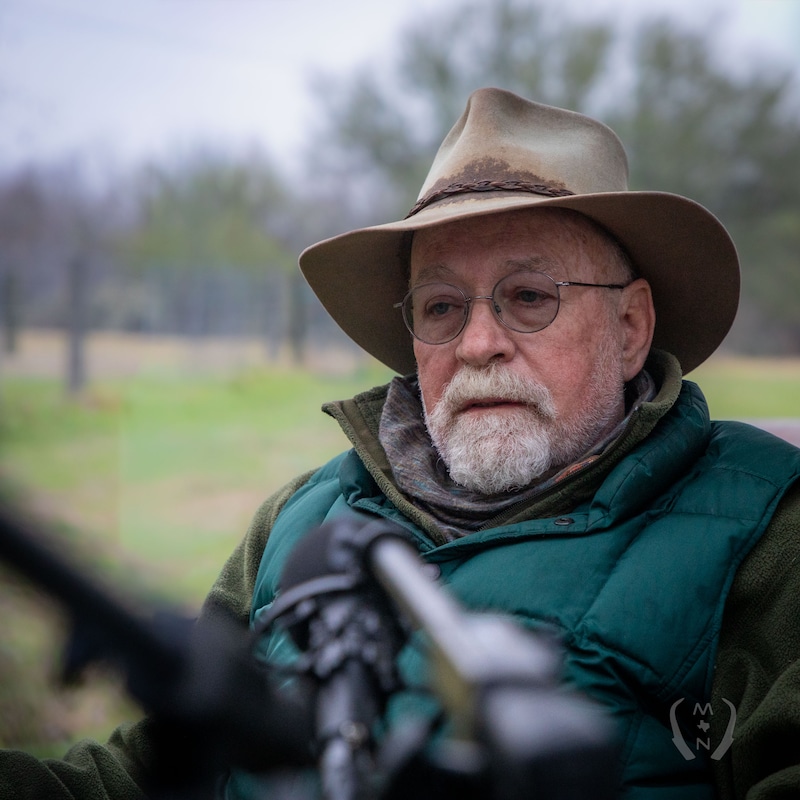
In Part One of my conversation with Dr. Randy Simpson, we talked about the experiences that shaped him as a naturalist and wildlife biologist.
In Part Two, we follow where that life took him and what he learned along the way.
Sitting beside the fire at Randy’s Cottonwood Farm in Gonzales County, our conversation moves through his early professional career, work on a South Texas ranch, and eventual return to Texas State University as a teacher and researcher.
But this part of our conversation increasingly becomes about something larger than a career.
Randy and I talk about the importance of getting students out of classrooms and into the field, learning directly from landowners and the people who work the land, and remaining curious enough to question what we think we already know. We talk about relationships and professional networks, the limits of applying scientific findings too broadly, and why knowing a place requires spending time in it.
We also explore something that has become increasingly important to both of us: the value of simply being outside. Nature contact. Observation. Getting up early. Keeping notes. Writing things down. Developing the habits that allow a naturalist to keep learning over a lifetime. Randy discusses early mornings, journaling, and longhand notes as part of those practices.
And then, almost impossibly, the wild world offers its own contribution.
If you heard me tease the coyotes at the beginning of Part One, this is the episode where they finally show up. Right in the middle of a conversation beside the fire, a nearby group begins calling into the evening.
We stopped talking. And listened.
It's difficult to imagine a more appropriate interruption to the first conversation on Modern Texas Naturalist.
Pull your chair back up to the fire. Here's Part Two of my conversation with my friend and mentor, Dr. Randy Simpson.
In this conversation
00:55 — Early career, opportunity, and life on a South Texas ranch
09:17 — Returning to Texas State and stepping into the classroom
20:15 — Finding a path through wildlife biology
25:12 — Nature contact, curiosity, and why being outside matters
29:07 — The coyotes have something to say
34:23 — Learning beyond the classroom
38:43 — Early mornings, observation, field notes, and writing things down
About Modern Texas Naturalist
Modern Texas Naturalist is a podcast about curiosity, the natural world, and the people whose lives have been shaped by exploring, understanding, and caring for it.
Hosted by wildlife biologist and conservationist Romey Swanson.
Edited by Dell Little.
New conversations every other Wednesday.
Transcripts
Welcome to Modern Texas Naturalist.
I'm Romy Swanson.
Romey Swanson:Pull up a chair and join me.
Romey Swanson:In conversations with people who spend their lives exploring, understanding and caring for the natural world and who might just inspire.
Romey Swanson:The rest of us to look a little closer.
Romey Swanson:Let's see what we can discover together.
Welcome back to Cottonwood farm.
In part one, I introduced you to my mentor and friend, Dr. Randy Simpson.
But when you put two naturals beside a fire with a full thermos of coffee, apparently you get more conversation than.
Romey Swanson:Will fit into one episode.
Romey Swanson:So pour another cup and pull your chair back up to the fire.
Here's part two of my conversation with Randy Simpson.
Romey Swanson:I interrupted you when you were about to tell us a bit about the early part of your career and after leaving A and M. So why don't you walk us through how it got started and how you launched into academia.
Randy Simpson:Well, I had several files full of applications to all kinds of jobs, federal government, state government.
You know, when you got a PhD, it was not one of those things where, oh, you're going to walk right into a job.
There was a dearth of jobs at that time.
It was really, really hard.
And all of us that graduated.
I had my PhD in:Okay.
As I used to tell students, may have told you, too, that don't expect to get rich when you get into this profession.
And second thing is, when the budget cuts occur, wildlife is going to be one of the first things to be cut back.
And environmental concerns, I mean, we see it all the time.
When the economy goes bad, people start wanting to roll back anything associated with those.
It's like, well, these things are.
They're not essential.
Romey Swanson:They're luxuries, almost.
Luxuries.
Randy Simpson:Yeah, they're luxuries.
Well, we got caught.
Those of us that were coming out of the school at that time got caught in those things.
So, you know, we were applying to everything that would come down the track.
And so for a while, I worked with a wildlife disease project at the Texas A and M vet School for a couple of years there.
Went around the state.
It was concerning brucellosis, which is again, another wormhole.
You can go down with diseases that are very political.
Anyway, don't want to really go into that.
The ideal job for a wildlife biologist would to be out on a ranch, a national forest, any type field, biology.
You know, you're a wildlife biologist out into that and so applied for positions like that and then finally would apply for anything, whether it was a desk job or not.
I didn't get any of those, you know, I made interviews on a number of them, but I must not interview well.
So to fill the gaps, I worked there at the vet school with a great group of people on the wildlife disease project.
And a job came open, actually.
Now a good friend, has been a good friend for a long time, happened to be visiting up at the vet school.
He's a veterinarian.
He visited with us about the disease project and happened to say, well, that he had a friend who owned a large ranch in South Texas.
Would I be interested in maybe that type of job?
And I jumped at it.
Actually, at the time I thought, you know, every department at a university has its political issues and its gripes and this and that.
And at A and M, at that time, there were some things going on and I just said, I never want to set foot in a university again.
And so when this job opened up down in South Texas on large ranch, ranch owners, the land and cattle company, I jumped at it, went down there and it was heaven on earth for the time.
Actually dabbled a little bit in deer breeding, which eventually that was scrapped, but we worked it.
I was involved in it and began to see my opinion again.
It's my opinion, and I think a lot of others too, that this deer breeding, breeding big bucks and for hunting is a waste of time and money.
Better effort and better expenditure money can be made on bonafide management projects dealing with the environment, the habitat and that route rather than this artificial, purely artificial B.S.
Romey Swanson:Yeah.
Randy Simpson:Of deer breeding.
Now that's.
That's as far as I'm going to go on that.
Romey Swanson:I could go further that for another episode.
Randy Simpson:Another episode, yeah.
So, but anyway, went down there.
It was a ranch that hunted.
We did a good bit of wildlife management.
Of course, cows came first.
And that's one of those things that.
That's the reality of the situation that you hit, and rightly so, in terms of making money.
Cows are harvestable whenever you want them.
You can sell them whenever you want them.
Going out there and trying to sell somebody, well, let's just go for a hunting income and we can raise all these big deer and we can harvest them and sell them for this exorbitant price.
Talk about inconsistence.
Unpredictable income is what it would be.
Wildlife management on a ranch that is set up for ranching, and I mean good ranching, mindful of the habitat, mindful of the grass.
Cows do come first in that situation.
Romey Swanson:Right.
Randy Simpson:But we worked around that, did wildlife management.
We hunted for a very short period of time during the Year, basically, we never started the hunting enterprise until December 15th and we finished on December 30th.
Romey Swanson:Wow.
Randy Simpson:So, yeah, in two weeks we crammed in a lot of hunting at that time.
The rest of the year you helped with the other ranch work, which was not disagreeable at all.
It was.
I found it fascinating.
Yeah, I enjoyed it.
Like I said, I came up associated with subsistence farmers and there were cows and everything else involved in that.
So it was kind of a good fit.
But beyond that, it was keeping in tune with where the cattle were moved, how the cattle were moved around, and watching the, the deer, the quail, the wildlife in general.
Because this family, I'm not going to mention names, this family was very conservation oriented.
A very old, well known family in South Texas.
Amazing stories that I could go on and on about.
They were very wildlife, environmentally oriented.
So I had a wonderful time down there.
But as time grew on, I kind of got restless and thought, well, I'm at about the peak of what I'm going to do here and if I'm going to do anything else, I need to go elsewhere.
And so we partied on good terms and I went back to A and M. Seemed like all roads led to A and M at that time.
Went back to Texas A and M and resumed work at the Wildlife Disease Project.
And this was after over six years.
I worked for another year.
And everybody said, you're never going to get back to a university.
And at this day and time today, as we're sitting here, and that would have been true.
Being away from an academic situation and trying to go back and get back into it would be impossible, I would think, and that's the way academics are.
But I found an opportunity through a friend positioned, opened at Texas State University for a lecturer.
And I said, sure, I'll take it.
And it's kind of ironic that I said, not that many years before, I never wanted to get back to a university again.
And I guess what led to that was that while I was down in South Texas, I would occasionally go and give talks to the Audubon societies and various other groups.
Not a lot, but some.
And just had an affinity for it.
Romey Swanson:I liked it, found joy from it.
Randy Simpson:I did.
And I thought, well, I've gained some experience down here that I wish I had known about when I was a student going through the wildlife program.
Perhaps somebody could benefit from the few things that I could throw out there.
Romey Swanson:Well, I'm hearing something that may be a little bit of a theme that you, you worked at the vet department at A and M. And a friend helped put you onto the position down in South Texas on the ranch.
Randy Simpson:Yes.
Romey Swanson:And then another friend or the same friend put you onto the lecturer.
And what I'm hearing is always appreciate your friends.
Well, and I'm hearing to some degree something that we tell a lot of folks, especially when they're striking out or when they're students, about the importance of networking.
Randy Simpson:It is.
Romey Swanson:And keeping a good core group of friends.
Because that network does do work for you.
Randy Simpson:It does do work for you, because.
And it's not the good old boy system, it's that, hey, I know somebody that might be a fit for this.
Romey Swanson:Right.
Randy Simpson:You know, so it's that kind of a thing that does work.
And so you need to be active in organizations with working groups that can lead to.
Not to climb the ladder, per se, but it might lead to something much more interesting.
Romey Swanson:Well, a better fit.
A better fit.
A better fit for you, your personality, your skill set and your interests.
Advice that I give a lot of folks is, especially in the early days and when you're figuring things out, you got to pay your bills, you got to meet your obligations, and when you're out there throwing out feed cubes and checking water every day, you don't have a lot of time to be checking the jobs board.
So when you got friends that know and know you and know how things might fit.
Well, isn't it nice to have that phone call?
Randy Simpson:It certainly is.
Romey Swanson:Well, anyway, please don't do go on.
Yeah, we're jumping over to the university now.
As a lecturer, right?
Randy Simpson:Yeah.
Well, the friend that led me to south Texas was Dr. Steven Benson down in the Rio Grande valley.
And then Dr. John Backus here at Texas State, who started the wildlife program.
He and I got to know each other through the Wildlife Society, became very good friends.
And he was the one that called me and said, hey, you still interested in a teaching job?
And I said, well, yes, I am.
And he said, well, I've got one for you here.
He said, the only problem is you got to be here in a week.
And so we made it.
And that's a story that my wife could wax long and detailed on how we moved a whole family in a week, got the kids enrolled in school, and all of those things that have to be done when you move, find a place to live in San Marcos.
We got there.
Romey Swanson:What year is this?
Randy Simpson:1989.
Romey Swanson:89, Yeah.
Okay.
Randy Simpson:Yeah.
And then got there.
And of course, as a lecturer, the student chapter was already in existence.
There was a wildlife program A degree program in place.
It was small in those days, but I didn't come in as a wildlife person.
I was a lecturer to teach whatever needed to be taught in the department.
Biology department.
So I taught general biology.
I taught zoology.
I taught.
Probably those two are the primary ones that I taught for first couple of years and then was handed vertebrate natural history and then later developed techniques in wildlife management.
Dr. Backus was teaching wildlife management.
So we need a separate techniques.
Took that and ran with it.
And then wildlife and recreation and also filled in with ecology.
Taught ecology for a while.
Romey Swanson:And I think that's where I first saw you.
Randy Simpson:Okay.
Romey Swanson:So Dr. Schwenning was rather new to faculty at the time, I think.
Randy Simpson:Okay.
Romey Swanson:And I remember sitting in a lab in Dr. Swinning's lab, and you walked in and somebody.
And I don't remember who I was sitting next to anymore, but I remember being like, oh, you better be glad you didn't take his class, his ecology or something like that.
They were talking about how it was very difficult.
And I saw you.
The first introduction I ever got to you was a stern professor in the biology department.
And you had a little bit of a severe look to you.
And I was like, yeah, he looks like he's got a hard class.
I'm glad I'm in here.
But I would later come to find out that you were probably one of the best lecturers, teachers, and advisors I could have ever hoped for.
Romey Swanson:But.
Romey Swanson:And I'll talk a little bit more about that, but I remember ecology was my first introduction to Dr. Simpson.
Randy Simpson:Okay.
Romey Swanson:When you walked in, you wouldn't remember because I was just another face in the crowd, but you would get to know me.
Randy Simpson:Yes, yes, I would.
And I appreciate those kind words that you spoke.
It was never my intention to be stern.
This is business.
If you want to learn, you have to pay attention.
Romey Swanson:Well, you weren't there to be transactional.
You were there to raise the.
The next crop.
And I think that that passion is what some folks may have mistook for stern or difficult classes.
And I'll tell you this.
Anybody that ever got serious in the wildlife department always appreciated you and your classes.
So that was just undergraduate sophomore level folks that didn't know any better being nervous and trying to find the easiest path to a good grade.
And out of college.
Randy Simpson:From the beginning, it was students were what.
What I was there for.
Romey Swanson:I would say that that's evident in the legacy of students that.
That come behind you in the wake of your tutelage and advisorship.
I mean, you got.
You got a lot of folks, and I'm, you know, I'm friends with a lot of them and even the ones that came before me that have such high praise to rain upon you, and they're all doing their own things and successful and in their careers, but you are a standout, and I think you've been recognized by the Wildlife Society as, you know, teacher of the year, professor of the year.
But you got a lot of folks that speak very well.
And the impact is evident not just in the success of your students, but the legacy that you leave and the relationship that you have with your students, former students and.
Randy Simpson:And so on since retirement.
Anybody that asks me, I say that.
What I miss most are the students, whether it was undergraduates or graduate students.
The teaching aspect was the best.
That was the most rewarding to me, the interplay and the exchange.
I've learned more from students than anyone can ever imagine.
I mean, that's where you learn from listening to your students, too.
Oh, did I miss something on that?
Just double checking, going and looking at new areas, new things.
A question that comes up that I'm not quite sure about that.
And I think I was.
I tried to be always honest.
If I didn't know something, okay, I don't know that, and I'll have to go and check on it.
And students providing insight by asking questions or making comments is invaluable.
And anybody that teaches and says that that's not true is lying through their teeth.
So that's the greatest appreciation I got out of it, is the interaction and the learning from students.
I learned more than I ever taught anybody.
Romey Swanson:That's a good note.
We had a few really good lecturers and researchers at Texas State when I remember when I went through.
But one thing I recall from your style is that you were invested, obviously, and you weren't just.
It wasn't just transactional lecturing.
It was, you know, I'm here to do a job and get you through the semester.
And you, I think, had a relationship with every class that you taught, and that was pretty obvious.
You got to know personalities, and obviously you taught the same, some of the same folks for multiple classes through their degree track.
You had graduate students, you had folks that you were coaching through master's program, which, you know, I eventually got there myself.
But you didn't shortchange undergraduates at all.
It was.
It didn't matter to you whether they were under your employee or in your lab or a person that was just taking one class, ecology class with you, you were going to pour into them as much as they were willing to receive and invest in them in a way that would set them up for success or to build a con.
That class, I think that was very.
Something I'm way more aware of now than maybe I was at the time and something that I've just immensely appreciated about you and me and some of your former students that obviously are friends to this day talk about when we talk about you.
So there's a little mirror from the class that maybe you don't, you don't necessarily get to hear or see, but big, big difference between the way that I saw you teach your classes and some of the other in, you know, all the departments, of course, five years of college, I was a little bit long.
It was just different and it was just obvious.
I also wanted to use this as an opportunity to share with you that, like my whole wildlife career is really based on the interaction of seeing you and seeing the student chapter Wildlife Society, and making it evident to me that wildlife can be a career, not just a degree track, not just a diploma, but a career, and that there were multiple things that you could go into.
It wasn't just going to go work on a ranch or become a researcher or lecturer, but there's such a varied number of opportunities to pursue with a degree in wildlife biology.
It wasn't long after meeting and having a couple conversations with you and being involved in wildlife study that I changed my whole degree.
I was originally looking at kinesiology, general biology and chemistry, and even up until that point was still uncertain the direction I went.
But boy, when I found wildlife, I found people.
I found the lecturers, the mentors, advisors that I needed.
And I found for the first time in my life, a goal to work on that I felt incredibly passionate about and that you and a couple of others stoked that fire, Even had to pull the reins back a couple of times, I'm sure.
But all of that got me to where exposure to others, learning about the network, learning about the wildlife society, and then the field trips.
You put so much effort into those field trips, associated the field element, the outside, the classroom element as a part of your teaching.
And because I think that was a huge part of what differentiates at Texas State and your classes in particular from a lot of the other universities and other wildlife programs.
Randy Simpson:Well, at the time, it just seemed like that's what you have to do, is you have to be outside to see the details that make the difference in understanding and just going through the motion in terms of what makes this world tick.
And that may seem a little bit grandiose, but until you notice the detail, until you see the very fine things that are happening, then you don't really have an appreciation for what's really going on.
So where do you go?
You go outside and where do you go?
You go to those places where you can actually have the freedom to explore, run around back in the day, catch animals as much as possible.
I know that there are harder to do real restrictions these days.
And bonafide it's unbonified restrictions in terms of animal treatment.
And I agree with that.
And in terms of caution for.
I mean, there are wildlife diseases that we have to be aware of.
So that has, in this day and time, created a lot of curtailment to some of the activities.
But you can still go outside.
You can still see, you can still record.
You can.
I mean, instead of using Sherman traps to catch small mammals, you can set up camera traps.
In my way of thinking, it's not quite the same.
Romey Swanson:Right.
Randy Simpson:But there are ways to still get outside, and you can't get it inside a laboratory in a building.
That's why we went on field trips.
Plus, it was a lot of fun.
That's where I had my most fun, is getting outside.
It wasn't a chore to go on field trips.
It was absolutely the most fun.
I think just about everyone that I know that teaches in wildlife agrees.
It's the same thing.
Yes, you have to get outside.
It's fun for everyone.
And I say fun in a very constructive way.
It is gratifying to be able to know what you're looking at, to walk through the environment and listen to birds, see the birds, see a snake, see lizards.
Whatever is out there, you just never stop.
It gives such a great appreciation to moving through the woods.
Romey Swanson:Yeah.
Randy Simpson:And you don't.
You can't get that inside a building.
I've said that already, but I'll say it again.
Romey Swanson:I think nature contact's so important to the human experience.
And for me, it's almost a therapeutic thing.
It's.
My body needs it.
My mind needs that nature contact to be able to process.
I mean, I'm not saying it's traumas or anything, but like, every day.
Every day seems like there's traumas and to resolve those things or to process them adequately.
A good walk outside.
My neighborhood has a nice dog park.
It's fairly large, and it has the most beautiful sunsets in the evenings.
And, boy, that's the place I need.
If I can't get out onto big country or somewhere super interesting.
The dog park and the little pond there and the sunset and the color of the sky just can punctuate an otherwise difficult day with a positive endnote.
And I know it in my bones that those opportunities to get outside and explore and to seek and to observe are meaningful.
Even if that's the only time that they some of those folks get out, they'll probably be memorable.
They'll probably be something that they look back on and speak about fondly.
Randy Simpson:Yeah.
And some of them, it was their first adventure.
I've heard this repeated by a number of people.
The same experience, but arriving at Elephant Mountain in the dark and stepping out and one student, and she was actually a graduate student, she stepped out and said, what is that cloud up there?
And I looked up and I cloud?
What are you talking about?
She said that it goes all the way across.
I said, that's the Milky Way.
She had never experienced the Milky Way as you experience in the real dark sky country such as out in the Trans Pecos.
But that was her first experience and it was very interesting and gratifying to experience that with her.
Romey Swanson:Oh yeah.
I mean, just from your perspective as the advisor and mentor teacher, introducing some of these folks to these experiences for the first time, it's memorable.
Randy Simpson:I think back on those.
Romey Swanson:Dr. Green was the first person that ever took me out to West Texas for his mammalogy class and our first trip to Elephant Mountain out there trapping and you may remember some of the names Michael o'.
Randy Simpson:Day.
Romey Swanson:And yeah, it's like he was kind of my run my buddy in that class.
And I remember he and I took a long walk after hours.
Everybody was in the bunk room and we said, well, let's just go take a walk.
I think I saw my first rattlesnake.
And you arrive there late, it's dark and all you can see is the silhouette of the mountain against the star studded sky.
But then the next morning when the light comes, the sun comes up and the grandeur of that for me, growing up on the Texas Gulf coast, seeing mountains in Texas and vistas that don't end was amazing.
You and I have shared many a conversation about West Texas in general.
I think we both have an affinity for west West Texas and the biodiversity that it supports.
But there's another introduction like Big Bend and Elephant Mountain, the Davis Mountains, places that to this day, if I have a spare weekend, I'm running off to go to go there and be a part of it instead of being apart from it.
What A beautiful landscape.
What an incredible natural history and obviously a place that resonated with you because I felt like there was a lot of conversation and some field trips and there's the coyotes.
Yeah, on cue.
Randy Simpson:Enjoy that.
Yeah, it sounds like, sounds like a.
A pair at least and maybe another.
But yeah.
The song dogs.
Romey Swanson:The song dogs.
Yeah.
Harken back to your masters.
Randy Simpson:Yeah, yeah.
Romey Swanson:Class.
Randy Simpson:I've always had that, that feeling for them.
Of course, to us they were never a threat, but agriculturally, to my folks, foxes were mostly in the hen houses, not coyotes.
Romey Swanson:Right.
They're coy and they're all sorts of things.
Mysterious and wily, mischievous.
Randy Simpson:Yeah.
I think that they Native American stories about the coyote are based upon just those very things.
I mean he's always portrayed as the trickster and so.
Wiley.
Romey Swanson:Yeah, Wiley coyote.
Randy Simpson:Yeah.
So it's a reputation that comes from their actual abilities.
They're such an adaptable animal, such bad to use the term like intelligent.
But they are adaptable.
They are plastic.
They learn very, very quickly and they survive.
And just brings up the idea of, you know, how many decades have been spent trying to control and eliminate coyotes.
And here they are, Here they are.
Romey Swanson:They, after man won the war against wolf and they turned their poisons and their traps towards coyotes.
They never really got them.
Randy Simpson:No, they never did.
Romey Swanson:They never did have the success outside of perhaps of the Edwards Plateau.
Randy Simpson:Well, it's situational, you know, it happens.
And you can, when you concentrate enough effort, you can accomplish a tremendous amount.
So in certain areas, yes, they, they were able to control them, extirpate them, but temporarily.
Romey Swanson:Temporarily, yeah.
I mean, if they're, if you would call it success.
The success they had against coyotes and Edwards was.
I don't know why they were successful, but I know that the ranching around sheep and goat where there was a lot of effort put on into removing and eradicating coyotes.
I know they got them mostly off of the plateau, but like you said, short lived.
As soon as the pressure was reduced, they're back and they came back in pretty good numbers.
And some of those folks were especially goat and sheep.
Still, ranching still exists in goodly numbers.
Coyotes are a strong target.
Randy Simpson:They are and they are a problem.
I have sympathy for sheep and goat raiser who suffers a tremendous amount of depredation.
There's no doubt coyotes will eat lambs.
Romey Swanson:Oh yeah.
Randy Simpson:I mean they're capable of it.
I think there's smarter ways of dealing with them than wholesale poisoning and trapping target.
You know, you know, you have a problem here.
Let's bring the powers together and let's take care of this problem in this area.
Not every coyote is a sheep killer anyway.
That's my opinion.
Yeah.
Romey Swanson:Well, I kind of approach it from get to know thy enemy and be, you know, targeted and smart about certain things.
And then, although Aaron has a great reverence for coyotes, and I do, too, for, to a large extent, I understand that, you know, there's ranchers out there that have not a lot of love for them, but that's because of they have real, real negative impacts on their efforts around production.
But I also know that there are some novel approaches to controlling or mitigating those problems.
And you see the use of some of these Pyrenees dogs amongst the sheep and goats, and that they seem to do a pretty good job of keeping the coyotes away or distributing them back across the landscape to where they're not being offensive.
Randy Simpson:Right.
Romey Swanson:What I don't want to see is a large ranch have to be broken up because the viability of their historical production is no longer viable.
So the choices are, let's split the ranch up, let's make a smaller ranch.
That's the worst.
Randy Simpson:Yes, I agree.
Romey Swanson:And so for that reason, I'm very supportive of many of the tools needed by our landowners to stay viable in their operations and to keep the ranch together.
That's something I've had to learn a little bit about even in the last year.
Randy Simpson:You can only impart so much knowledge to students, and then they're out on their own and they learn there.
Romey Swanson:Yeah.
Randy Simpson:And the best thing is always be open to.
Even if you run across things that go counter to what you've been taught, keep somewhat of an open mind.
Because one thing I've learned, never say never.
Never is a long, long time.
Be open to see.
Is there some nugget of truth in this?
Is there some difference that this situation conveys?
I think I've said this.
You've probably heard me say it.
All of these studies that we do on wildlife, every one of them is time and site specific.
Right.
And to generalize, based on one or a dozen or 20 studies that say this, in this area, you can't generalize it whole.
Romey Swanson:Right?
Yeah.
You know, a chapter from the text doesn't apply evenly to everywhere.
Randy Simpson:Exactly.
Romey Swanson:You made me think about the lessons I've learned working with landowners.
And, you know, I worked in wildlife consulting for a few years, and my job was to go and meet landowners and listen to them about their management goals and their challenges of land ownership and to prescribe activities for them to reach their goals.
Romey Swanson:Perhaps.
Romey Swanson:But what I learned was that many of these landowners, particularly a landowner that's been on their property for a little while, not just a brand new landowner, had plenty to teach me if only I asked the right questions and then sit back and listen.
And I think that I heard you say a very similar thing about the students that you taught.
Randy Simpson:Yes.
Romey Swanson:So this is a.
This is, I think, an incredible piece of advice to give anybody is that your education is not done when you get your diploma, and that many times the client or the student or whomever will have the lessons that you need most at that point in your life or that you might use later.
Randy Simpson:Yeah.
Learning is never done to be aware of that.
Like I say, never say never.
Never dismiss what you hear someone say.
One small anecdote for wildlife techniques.
Back in the early days when I started it, we were trying to do similar very simple projects.
So one of them in particular was survey the birds along the San Marcos River.
One day, two of them came in and said, any possibility that there could be magpies in this area?
And I said, no, absolutely not.
We're pretty sure we saw two magpies.
Now, y', all, this is not right.
No, no way.
And I just totally dismissed it.
One or two days later, I got a call from one of the local birders around in San Marcos, gentleman who actually wrote a birding column for the newspaper.
This is.
Oh, goodness, 20 years ago.
And he said, have you heard anybody saying that they have seen magpies?
I said, are you saying that there are magpies here?
He said, yes.
And we're trying to gather as many of these sightings because apparently there had been a number of sightings of a pair of magpies in the San Marcos area over the last few weeks.
And this was building more and more and more people.
And so he called me.
I just went, huh?
Well, I just told two students who came in here and told me they saw two magpies on the river that they were totally out of their minds.
There were no magpies in this area.
So never say never.
You never know what the situation is.
Romey Swanson:Right, Right.
I can share this because I observed it.
And one of the things I thought was so cool about you, especially when we go out to Elephant Mountain for vertebrate natural history, is you had a habit of getting up pretty early and you would have just kind of some reflection time, sipping a cup of coffee and journaling a little bit about your trip.
Randy Simpson:Yeah.
Romey Swanson:And I wondered if that was a regular habit or special to, you know, going out on an adventure, going out on a trip, being somewhere that was different.
Do you.
Do you have any routines that really help keep you centered or productive in that regards?
And if so, would you mind sharing it?
Specifically, that habit.
I always admired it, and I actually copy it now.
Randy Simpson:Getting up early.
Yes.
I always think back to Aldo Leopold's statement when he said.
And again, I'm paraphrasing terribly because I'm bad about quotes, but he said, when people say, there is no solitude in my area in the early morning, in the dawn, solitude is as far as the dew can reach.
The point he was making.
Get up early, listen to the birds chorus.
You can be alone.
And so for most of my life, I've gotten up early.
And particularly whenever we moved to San Marcos, my routine was to get up and, you know, get about as early as I can before dawn and walk my dog or dogs.
And we would come upon foxes.
We, you know, and I wrote down a list of the things that I saw each morning.
We'd see foxes, we'd see raccoons, we'd see ring tails here, coyotes.
And even this morning, up before dawn, and there were at least four great horned owls in the neighborhood hooting back and forth.
And they were stationary because I would hear them in the same place and then two more over here.
They seemed to be in pairs.
And I think there were even more than that off in the great distance.
But, yeah, get up.
Notice what's around you.
You know, if you're in the wildlife profession, it seems to be second nature to write down what you heard, saw, or whatever came about in those times.
So, yeah, I still do that.
Routines.
I would say, be open to doing new things.
You know, like I say, learn from students.
I've learned from my daughters more than they'll ever know about various and sundry things.
So be open to learning from even unexpected sources.
I think that's a real problem in this day and time, personally and politically.
And people get so polarized because they're not open to different things.
And I don't mean just opinions.
I mean different things that are happening.
Why do people do things?
Why do animals do things?
Just my viewpoint.
I've taken to trying to write down some of these very experiences that I remember over time going back as far as I can, and just writing them down more to relive them myself than for any other reason.
And so I've got.
I'm filling books of journals, and I love to write longhand, and I love a fine pen.
People have their own ways of expression.
And find how you can express yourself and do it.
Do it.
Romey Swanson:I think that's pretty dang good advice.
I love, I love the idea and the suggestion to be open and to try new things out.
I think that that is, that's a big step, an easy step for a lot of folks to take to have many more valuable experiences.
Randy Simpson:Yeah.
Romey Swanson:Well, Dr. Simpson, thank you for your time.
Thank you for having me out here to your beautiful ranch.
I appreciate the opportunity and this was a wonderful conversation.
And thank you for being my first guest.
And I can't wait to get this one out so folks can hear it.
Randy Simpson:Well, thank you very much.
Romey Swanson:Thanks for spending some time with us on Modern Texas Naturalist.
And a special thanks to my friend Del Little, who somehow takes all of these conversations and turns them into a podcast.
If this conversation made you think of someone, send it their way.
If something in today's conversation sparked your curiosity, follow it.
Read the book, visit the place, learn the bird, ask another question.
But better yet, step outside and see what you can discover for yourself.
Until next time, stay curious.
Sa.
Romey Swanson:Sam,.
Romey Swanson:It.


