Shownotes
What if the way you think about money isn’t really your story at all?
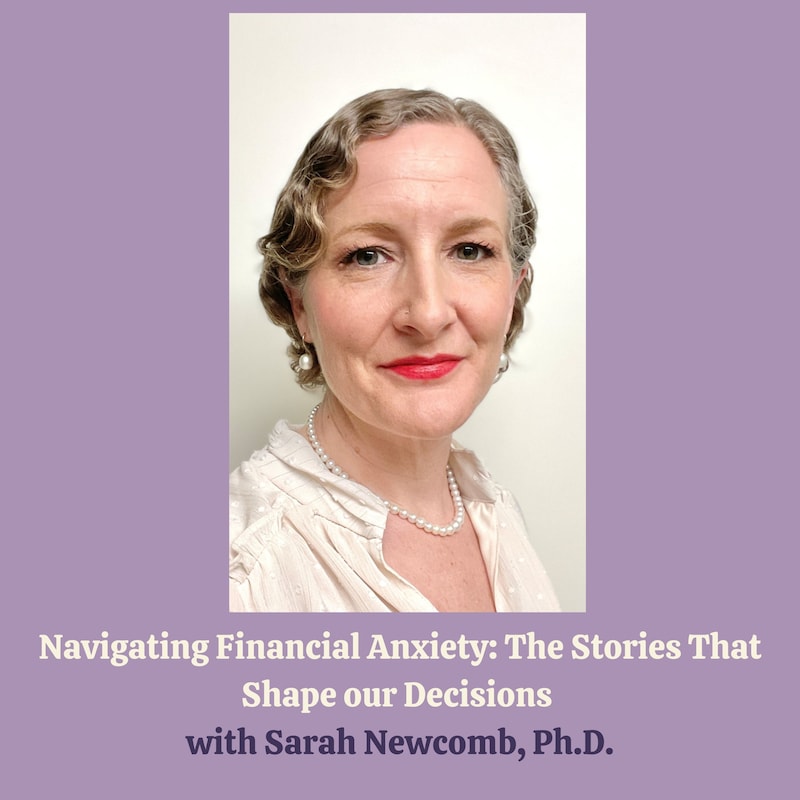
In this episode, I sit down with Sarah Newcomb, Ph.D., a behavioral economist who helps us unpack the powerful money stories we carry—many of which we didn’t choose. Sarah shares how the beliefs we picked up in childhood—about scarcity, success, and self-worth—can quietly shape our financial decisions for decades.
We talk about her surprising journey from aspiring opera singer to financial wellness advocate, and how rewriting her own money story helped her step into a life of purpose and confidence.
Together, we explore how emotions, family expectations, and old habits show up in our financial behavior—and how becoming aware of them can be the first step toward real change.
This conversation is part inspiration, part self-inquiry, and a powerful reminder that it’s never too late to change your narrative and take control of your financial future.
Takeaways:
- The most powerful tool in your financial toolkit is the narrative you construct about your personal money experiences, which shapes your financial behaviors.
- Understanding that the stories we tell ourselves regarding finances often originate from childhood experiences can profoundly impact our current beliefs about wealth and scarcity.
- The transition from viewing money as a source of anxiety to recognizing it as a tool for empowerment requires a reevaluation of one’s personal financial narrative.
- Engaging in introspective practices, such as writing down desired life stories and seeking evidence to support those narratives, can facilitate a healthier relationship with money.
Links referenced in this episode:
- If you like Boomer Banter, check out The Women Over 70-Aging Reimagined Podcast
- You can find Sarah Newcomb on LinkedIn.
- Email me, Wendy Green with any questions.
This podcast uses the following third-party services for analysis:
OP3 - https://op3.dev/privacy
Transcripts
Hello, and welcome to Boomer Banter, where we have real talk about aging well. And I am so glad you're here with us today.
We're going to ask the question, what if the most powerful tool in your financial toolkit isn't your savings account or your investments, but it's the stories you tell yourself? Stories are powerful. They stick in our brains. We remember stories we have heard. That's why great speakers always include stories in their talks.
Most of your stories about money probably came from your early years. You were aware in your family about the questions that were coming up around money. Was there enough? Was it abundant, or what times kind of tight?
Did you hear your parents fight about money? Did you start working early because there were things that you wanted and you were told, that's not in the budget?
All of these realities formed your beliefs about money.
My guest today, Sarah Newcomb, who has her PhD as a behavioral economist and is the founder of Thrive Financial Empowerment center, is a subject matter expert who has worked with corporate behavioral science teams at hello Wallet, Morningstar and others, helping financial advisors understand and respond to aspects of psychology that affect financial decisions. She's the author of a book titled Money Psychology and How to get ahead without leaving your values behind.
But Sarah was not always interested in finances. She had a dream of becoming an opera singer. She was a single mother working to earn her PhD before she even started saving for her financial future.
All of these experiences and her study of behavioral economics helped her look at her own money stories and question them. So let's welcome Sarah Newcomb to Boomer Banter. Hi, Sarah.
Sarah Newcomb, Ph.D:Hi, Wendy. Thank you so much.
Wendy Green:Oh, I am so looking forward to this. This is going to be a very important discussion, I think, for all of us. So as I alluded to, you wanted to be an opera singer.
You were not looking at finances. Can you give us a little history of your childhood and how your stories were formed?
Sarah Newcomb, Ph.D:Yeah. Yeah. So. So growing up, my parents were both really hardworking, but they had jobs, not careers. You know what I mean?
Wendy Green:I do.
Sarah Newcomb, Ph.D:And sometimes several, because they had four kids. When I graduated high school, it was just known to me that there was no money for college. That was not a track that I could afford to go on.
And so I was. But I was a very talented performer and in both theater and. And. And music. I actually was.
I spent some time singing opera on the streets of Portland, Maine.
Wendy Green:Oh, wow.
Sarah Newcomb, Ph.D:Yeah. And I actually got a job singing in an Italian restaurant doing that. But I had no formal training, and by the time I was Able to go. I actually was.
Was then accepted. A voice teacher found me on the street and said, I want to train you.
And she helped me to get accepted into the New England Conservatory, which is, wow, best opera schools out there. But again, there was no money and I. Short of, short of becoming an emancipated minor and taking my parents to court, which was out of the question.
Wendy Green:Right.
Sarah Newcomb, Ph.D:The only way that you can co sign for or that you can take out student loans without a co signer in the US is you have to be 24 or you have to be an emancipated. Wait till I was 24. At which time I had bought the story that I had aged out of the opera track.
Wendy Green:Oh, yeah, right. You got to start when you're young.
Sarah Newcomb, Ph.D:It's like being a gymnast. There are, you know, there are these tracks. And so I believed that story and I went on to, to. I, I went to college.
At 24, I just enrolled in the local state college and. And I ended up, I went in undeclared. Four years later, I found myself graduating with high honors with a degree in math.
Wendy Green:That's very different from opera because I.
Sarah Newcomb, Ph.D:Love puzzles, I love problem solving.
And I was taking all these high level math classes as my electives, and someone came along, one of my professors after class one day said, have you ever considered being a math major because you're asking the right questions? Had never crossed my mind. And it's because the story I told myself about myself was that I was the artsy person. Right? You were these things.
You know, the theme of stories runs through every part of our lives. So finally someone suggested to me that maybe I was a math person, maybe I have the aptitude for that.
So I ended up saying, well, yeah, that sounds great. So I, I got a degree in math. Now fast forward. At 28, I have a degree in math.
I'm married and expecting my daughter, and I still cannot get my finances together.
Wendy Green:The math and finances are not the same thing.
Sarah Newcomb, Ph.D:Well, so I, I finally was able to go, well, it's not the numbers, right? And it's not problem solving. I love both of those things. There was something else going on. And so I thought, okay, look, I was exhausted.
I had been poor all my life. Being poor is exhausting. And I said, okay, here's what I will do.
I went to night school at Bentley University for financial planning to become a financial planner. And I thought, I will learn how the pros do it. If I can understand the fundamental theorem of calculus, I must be Able to understand financial math.
I will learn this and then I'll be able to get a job where I earn good money and I'll know what to do it, to do with it when I have it. That was the plan. And again, I took an elective course on psychology in financial planning.
Wendy Green:There is such a course, Psychology, the.
Sarah Newcomb, Ph.D:First of its kind at Bentley. Dr. Jim Grubman was teaching it.
He is a neuropsychologist who has built his career counseling ultra high net worth families on the emotional aspects of managing assets together.
Wendy Green:Wow.
Sarah Newcomb, Ph.D:And so he was there to prepare us as budding financial advisors to be able to have real empathy for the challenges of great wealth.
Wendy Green:Wow.
Sarah Newcomb, Ph.D:But it really helped me with, because in, in doing the homework for that class, I had to answer probing questions about my own beliefs about money.
Wendy Green:Yeah, because your belief, Sarah, I don't mean to interrupt you, but your belief was being poor was hard and now you're being told being wealthy is hard. Right.
Sarah Newcomb, Ph.D:And, and, and I had very much bought into the cultural stereotype of demonizing the wealthy. It's definitely a coping mechanism for the poor to feel like, well, at least we have the, the high horse in terms of morals.
But I had to, I had to address those stereotypes and see them for the judgments and the, and the prejudice that they are. I had to really think about my attitudes about money itself.
And what was really powerful for me was that as I started to think through those things and recognize the really complicated love, hate relationship, I would even say, not love hate, but like lust for fear relationship that I had with money and wealth and how it had always to me represented the barriers, not opportunity, but barriers. Money was the reason why I couldn't do the things I wanted to in my life. Money was the reason why no had been why things had been off limits for me.
And so I had to address those just to do the homework for this class. And that was when I realized, well, no wonder it's not about the numbers. It really truly isn't the power.
If you are like I was, where you're smart, you're hardworking, you are trying, you're trying everything, you know, but you're still stuck, then most likely you are subconsciously getting in your own way.
And that's what I had to realize was how I had been getting in my own way, financially in so many ways because of this really sort of toxic relationship that I had with money itself, with economics, with all of it, with, with everything it represented. And that until I could get that relationship healthy, my finances Wouldn't be healthy. And that was when I said, you know what?
I don't want to be a financial planner. I don't want to manage people's money. I want to help other people who are like me get out of their own way. And so I want to study.
I'd read, you know, I'd seen all the books, Think and Grow Rich and the Millionaire Mind.
Wendy Green:Right, right.
Sarah Newcomb, Ph.D:Napoleon Hill As a Man Thinketh. Right. All these sort of manifestation texts.
Wendy Green:Right.
Sarah Newcomb, Ph.D:Like how to manifest Wealth.
What I wanted to know was, according to science, do we really have evidence to show that there are certain habits of thinking that correspond to good money management or bad money management? Are there ways of thinking that keep us poor? That's what I went in to do my PhD and examine.
I was able to create a PhD program at the University of Maine where we combined economics and psychology. And I looked at the question of the psychological barriers to sound money management. What is it that gets in our way mentally?
Wendy Green:Wow.
Sarah Newcomb, Ph.D:So as you pass it about this, because like so many things, it started with me search and now I want to share the, the changes that I've been able to make because, because of the changes in thinking and all the ways that I've been able to then tie that to the day to day things that we, the day to day decisions that we make with our money and how we can help ourselves just get out of our own way.
Wendy Green:I, I'm, I'm so fascinated by all of this and it has certainly caused me to do some thinking about my money stories.
You know, as I'm preparing for this episode and I wanted to ask you about some of the common stories that you've heard people say, but I want to tell you one first. And that was, I realized that over, really over the weekend, I think, and it has to do with eating out.
And when I was a child and you know, I was in a middle class family, probably upper middle class, and.
But when we would go to eat out, if, especially if I brought a friend with us, my father would constantly comment about what they ate and how much it cost and did they finish everything.
And you know, I would feel guilty, like I didn't order for them, but I would feel guilty that they ordered something that was more expensive than what I had ordered and they didn't finish, you know.
And so to this day, I'm 71 years old and to this day, day when I go out, first thing I do is look at the cost of everything and say, well, I can't order that. You know, I'll order this one. So that is definitely one of my strong money stories.
But, you know, do you have a comment on that before we go into the most common ones you hear?
Sarah Newcomb, Ph.D:Yeah, yeah.
I mean, as you're talking, I was thinking, you know, isn't it so interesting how as parents, you know, so often when we, we point things out to our kids and I think where we think what we're communicating is maybe a sense of cost consciousness or responsibility or gratitude. Right. And what we're really communicating is anxiety.
And it's just really interesting to me how much we pass on without realizing it and how much gets passed on to us that we take in without. Without thinking critically about it. And that's an area, I think, that is unique to money.
We get taught in so many areas of our lives to think critically about the lessons that, the stories that we've been told, the lessons that we've internalized. There are so many areas of life where we're asked to think critically, except when it comes to our beliefs about money.
We are not taught to notice or challenge them.
And so we're each out there walking around with this narrative in our heads around what money is, what it means, what it means about us, what it means about our opportunities, and it becomes this framework by which we see the world, but we are unaware that it is a framework we've built.
Wendy Green:Absolutely. I. I never would have thought about it if we weren't having this discussion. So with that in mind, there must be some comm. Themes that you hear.
Sarah Newcomb, Ph.D:The biggest ones. Right.
If we're just going to group things into one of two categories, the biggest themes are a belief that money is scarce and a belief that money is abundant. Scarcity. Or let me. Rather than abundance, let me say a scarcity mindset or a prosperity mindset.
I think those are kind of the two that we tend to fall into. If money was scarce growing up, you likely internalized a scarcity mindset.
Things that go along with the scarcity mindset are things like this, this unconscious or maybe conscious belief that you have to. That the harder you work, the more you will earn.
So therefore, we then have to face all these things when we work really hard and don't earn a lot, or when we start to earn more and aren't necessarily working harder. And either way can be a challenge.
When you're, you're working and working and working and you feel like you can't get ahead for trying, you're doing what you're supposed do. Right?
Wendy Green:Right.
Sarah Newcomb, Ph.D:But you're not getting ahead.
And then on the other side, if you're not giving yourself an absolute aneurysm, working so hard to earn a really good income, then you can feel like insecure around the income that you earn. So scarcity, prosperity, two big differences. I think they, so those, those are to emotionally charged ones beliefs about is, is money easy?
Is it easy to create value in your life or is it hard? Is it something you have to go out and get?
And that's one thing that I think is something that we, especially when you're, we're younger, really need to start to learn. And I really try to teach younger people when they have the opportunity to influence them that money is earning.
Money is not about going out and finding a job. The money isn't out there for you to get.
It's not like it's out there and it comes in and then you have to direct the flow and hopefully you can keep a little bit over here. For you that's a very that money in, money out is how most of us experience money, especially when we live paycheck to paycheck.
But when you think of earning money in terms of like I have to go and get it, what you're missing is a way of looking at it that's a lot more empowering but also true, which is that you are paid for your time, you're paid for your expertise, you're paid for you. You are an asset that you are renting out to an employer or if you're self employed, you're creating something of value.
You give that to people who find it valuable, they exchange it for money and you are producing value. The money is coming from you, from your time, your energy, your intelligence, your special sauce. You are creating value.
So understanding yourself as a source rather than as someone that has to go and get I think is a way to kind of flip the scarcity mindset to one of prosperity. I can create value, which is great.
Wendy Green:When you're still earning.
Sarah Newcomb, Ph.D:Yes.
Wendy Green:Right. So girl's question, right. You know, it was, you know, I was going there, right.
We are talking to boomers who are many are retired or maybe they're doing a part time job. But you know, if we saw that scarcity mindset, we don't have enough to retire if we're worried about that. I mean, how do you flip that story?
Sarah Newcomb, Ph.D:Yeah, I think there's a couple narratives we've got to flip. One is the idea that in order to succeed in life, you reach a point where you stop all work.
I think you know, retirement being a time when you can still create value, it's just more on your terms than maybe ever before.
That is a way to think about it where a lot of people may feel like if they are working at all in retirement, there's some sense of shame or failure to that. And that's a cultural narrative that I think we need to change. There's this arbitrary age, 65, that has to do with Social Security.
When people, when people first started taking Social Security, they lived about five years after. You know, we have these huge periods of time in our life that we're trying to prepare, to fund.
And I think shrinking that time is something we all need to think about doing. Working longer, working differently, but working longer. So that's one thing.
Wendy Green:Yeah.
And I think the other narrative that we hear in society is we don't want the older people to keep working because they're taking the jobs from the younger people or they can't keep up with the new technology. And so it does become more difficult.
And those are also stories that we tend to internalize as the older adults, you know, and so we need to flip that story as well, that we are still capable.
Sarah Newcomb, Ph.D:Well, and not only that, but what's the value that you have it as a mature person that younger people don't have is wisdom. And the, the, you know, it's. It's institutional knowledge, it's its expertise. It's. It's wisdom and packaging that somehow I think, I mean, I'm.
You've got me thinking about all sorts of things around, you know, how. How to package up, you know, whatever your career expertise is, and giving that to the younger generations, that's not taking a job from them.
That's teaching them how to do theirs better.
And it may not be a salaried role, but again, that's where, you know, being creative, we have this world with tech that is unprecedented in what we can create and what we can put out there. And it's easier than ever. I'm not going to say it's easy, but it's easier than ever to monetize that and to get people to pay you for your expertise.
And so I think just trying to think in terms of what assets do you have and how do you get that, how do you package it and. And turn it into something that other people can give you cash for.
Wendy Green:Yeah.
Sarah Newcomb, Ph.D:You know.
Wendy Green:Yeah. So that. That is a new story to start to tell yourself. How can you package your value? And if you want to monetize that, how are you going to do that.
And, and you were talking about the psychology of money and how you talk to financial planners about that so that they can deal with their clients.
And you know, we've been, since the first of the year, the stock market's been so volatile and I hear from people all the time, gosh, I'm, you know, I've been retired for 10, 15 years and now I'm really worried I'm gonna run out of money. What, what do you say to your people to help them manage those feelings?
Sarah Newcomb, Ph.D:Well, well, when uncertainty brings with it fear and the scarcity mindset, right? And what, what fear does to our brains is it does two major things.
One is the emotional arousal we become, we want some sense of control and so we become sort of the most controlling versions of ourselves. The other thing is that fear shrinks our mental time horizon. We suddenly can't see past our noses, right?
And we're, we're so focused on the present that we lose sight of the future.
And so basically volatility or any kind of major uncertainty turns us into the most short term thinking like the most myopic, control freak version of ourselves. Right? And we have to know that that's the response that fear is always going to lead us toward.
I'm not saying it's not scary to watch your net worth go up and down, especially when that is the only, you know, when those assets are, what will be your income? And I, I can't say this in terms of like having lived experience yet, so I, I will also couch that too.
But there are, you know, hopefully if you're planning your, your cash flow, well, it's just like when you're earning and in the times when you earn a lot, you save more.
So that in the time, in the leaner times you have that cash to, to depend on, hopefully you're not completely 100% in the stock market and that you've managed your cash flow so that in the booming times, you are setting some cash aside so that in these leaner times when the prices of stocks are low, that's not when you want to be selling for income. That's when you want to rely on the cash reserves that you set aside.
So if you have the cash buffer and you have the investments, just knowing the cash buffer is for when those prices of the investments are low. And you know, when, when the price of the investments is high, that's when you, you sell and you replenish the cash buffer.
And so just thinking of your, the risk and the, the bear and Bull markets in that sense, Remembering you're not 100% exposed to the market anyway. If you're retired and you're more than 50% in equities, then, you know, you've got to have, you know, you have to sort of hold on to your seat.
But even like a 60, 40 has been fairly okay this year.
So the point being, if you understand, if you want, if you're thinking about your cash flow long term, then you set it up in such a way that you've prepared for the bumps. And then when the bumps come, you go, okay, this is not the time to jump off the roller coaster ride.
Wendy Green:Yeah, yeah, yeah. But, you know, those of us in this age group are, are.
I mean, like, I lived through that dot com bubble where my advisor kept saying, no, hold on, hold on. It's coming back. It's coming back $60,000 later.
Sarah Newcomb, Ph.D:Yeah.
Wendy Green:And I'm thinking, man, I could really use that money right now. Right. So that's the story. And when the market starts to do this and I call my advisor and I say, oh, my God, let's go back to cash. This is awful.
It's coming from that story. Right. So she has to work hard to calm me down.
Sarah Newcomb, Ph.D:Right. Because you've. You've also been burned by someone who probably had you more exposed to a certain area of risk than you really should have been.
Absolutely.
Wendy Green:And you. And you trust those people. And so. Yeah.
Sarah Newcomb, Ph.D:Right.
Wendy Green:So those stories. So that kind of leads me into, you know, your whole study about redemption and contamination stories.
And so, you know, my contamination story, and I'm going to have you explain what that means was being in the stock market and losing $60,000, man, I was the victim of that. That's a bad place to be, and it's a bad story to have.
Sarah Newcomb, Ph.D:Yeah. So you were the victim of that. I think you probably got some bad advice. But when we all.
So this, what you talked about is contamination and redemption. And this comes from a line of research in psychology that I love called narrative psychology.
And the researchers in this area, this has been looked into for about 30 years or so going back to the 70s, so probably more like 50 years now. But what they were looking at is the. The way that starting in adolescence, we each start to generate this life story, a narrative of our life.
So if I were to ask you, tell me your life story, you'd give me a narrative arc. Right. We all start in our adolescence and create a narrative, and then we periodically update that narrative with new information.
And we're constantly Updating the narrative.
So these researchers, one of the really interesting lines of study that they did was they had a bunch of people write their narrative, and then they were able to sort of look at the themes throughout human life stories, right? And what they found was that most, pretty much all of our narratives fall into one of two categories.
And interestingly, both categories start the same way. So all of our life stories, you could kind of encapsulate them by, I was going along, and then this big ugly thing happened. And that's universal.
Adversity is universal. All of our life stories have some big ugly thing that happened, okay? So the universal theme is adversity, but this is where they. They part ways.
Some people write what are what the researchers have called contamination narratives. Okay? And so it goes, well, I was going along, and then the big ugly thing happened, and nothing is as it should be.
As a result, the big ugly thing poisoned my life. And so the big ugly thing comes to define the person's narrative. In my case, the big ugly thing for a long time was not being able to be a performer.
That was a huge narrative that the big ugly thing of poverty, of lack, kept me from being able to follow my dreams. So the contamination narrative says, I was going along. Big ugly thing happened, and nothing is as it should be as a result.
The other type of narrative is called the redemption narrative, and it says, I was going along and the big ugly thing happened. It was big and it was ugly, and it forced me to grow as an individual. And now I am a stronger version of myself because of it. And the. So a cont.
A contamination narrative emphasizes how adversity is. Has negatively impacted a person's life. The redemption narrative emphasizes how the struggle against adversity has created personal strength.
And the redemption narrative has to it what we all probably recognize as the hero's journey. You are now the hero of your story. Unwittingly, you didn't want to go there. No one wants the big ugly thing.
And we're not saying that the big ugly thing was a good thing, but we're saying that your struggle against it has turned you into a better version of yourself.
However it is that you've defined that and that empowerment, that storyline, that's based in a sense of strength and a sense of ability to overcome whatever may come your way. Because if you've done it before, you can do it again, right? Each time is its own struggle, but each time you emerge more of your own hero, right?
That is the story that if we can change our narratives to fit a redemption model, then we will make our decisions from a place of strength and not fear. And our brains just make better decisions when they're not afraid.
Wendy Green:It's a resilience story. Yeah. So can somebody in your studies, can somebody that has been living this contamination story, this contamination belief change that?
Well, be their own hero?
Sarah Newcomb, Ph.D:I've changed mine.
And, and truly the, the thing about it is that with all of this, with everything that we've been talking about, the theme is that we have to learn to catch our thoughts and examine them and recognize we're all telling ourselves stories. We're telling ourselves stories about money, about ourselves, about the world around us and how all these things work together.
Some of those stories are healthy and some are not. Some are helpful and some are not.
And we have to start to recognize when a story, you catch it, you look at it and you ask yourself, is this serving me well? And if it's not serving me well, or if it's not serving me well anymore, how do I change it?
And the biggest big thing when it comes to changing it, and this is where I think it takes effort, is that this, the new narrative you tell yourself has to be true. You need to believe it as much or more than you believe your current narrative. And so it can't just be a nice affirmation that you tell yourself.
You have to find the real counter evidence to whatever ever evidence you have that is supporting your current narrative. Because every narrative we have is evidence based.
And the older we are, the more evidence we have saying no, but it's this way because of this and this and this and this. And I see the trend and I see the pattern, but what we have to remind ourselves is our brains are constantly filtering everything that's happening.
And we, there's this thing called confirmation bias, which basically means that whatever your current narrative is, you, when you bring in information and you automatically reject information that doesn't support your current narrative.
So if you want to change your narrative, you have to go hunting, you have to go find the counter examples, find the evidence that says, no, I can do this. Yes, this can happen this way. Yes, there is a path forward, even for me, even now. And the only way you can do that is if you really make the effort.
It's not just going to come to you.
Wendy Green:Yeah, I love that. And you know, in the coaching that I do about mindsets, about retirement, like, you know, you're not done, there's still a lot you can do.
It's the same kind of thing you have to find the evidence. Evidence is the key words there that you used. You know, that look, other people look at this differently.
Sarah Newcomb, Ph.D:Yeah.
Wendy Green:Your way is not the only way to look at it because it's not serving you.
Sarah Newcomb, Ph.D:Yeah.
And one of the things I think was most challenging for me when I started on this journey of changing my mindset around money was that I had to confront the reality that people who I love and respect and admire had taught me things about money that I needed to reject. And it's hard to. It's hard to challenge the beliefs of people you love and admire and to say, well, I'm not going to take that in. But I had to ask.
I had to ask myself the question. The people who.
Because when I went through my core beliefs about money and started to recognize the ones that maybe weren't serving me, the next question that I was prompted to ask was, you know, who. Who maybe handed this belief down to me? Who was it that persuaded me that this story was true to begin with?
Wendy Green:Right.
Sarah Newcomb, Ph.D:And those are often people you love and respect and admire and. But then the question is, well, how has this belief served them? And I had to admit to myself, actually, the people who.
Who passed these beliefs, these demonizing beliefs about wealth and. And money, they were struggling just as much as I had always been struggling. It was not helping them to live lives of abundance.
Wendy Green:Right, right. And it doesn't mean that you're rejecting them. It's just the belief. Yeah.
Sarah Newcomb, Ph.D:But it can be hard because people often take it as you rejecting them.
Wendy Green:Absolutely.
Sarah Newcomb, Ph.D:If you don't verbally, you know.
Wendy Green:Yeah, yeah, it is. It's not easy, for sure. Yeah.
Sarah Newcomb, Ph.D:I wanted. I wanted to say there's. There's one belief, I think in general, as we all get older, that we have to. And I'm cur.
I'm saying this currently feeling this deeply. We have to reject the narrative. I'm just too tired.
Wendy Green:That's a big one.
Sarah Newcomb, Ph.D:That will. Because any of these things, when it comes to taking control of your life and your. And your finances require energy.
And if you've told yourself, I'm just, I'm too tired, you've counted yourself off out immediately. And I think as we age, that argument gets stronger and stronger and we have to find ways to re. Energize ourselves. And I am saying that to myself.
Wendy Green:As I say, oh, and you're so right, because tired comes from feeling confused and comes from feeling stuck and comes from fear and all of those things. And I think once we find our way back through that that re energized feeling comes back, that sense of resilience comes back. But it does take work.
Absolutely. Yeah, I'm with you on that.
So with our talk though about, you know, the rejecting some of the beliefs of people that we love, there also is a lot of friction that comes around money and relationships, particularly in partnerships or parent, child kinds of things. How have you studied that, addressed that in your stories?
Sarah Newcomb, Ph.D:Big topic.
Wendy Green:It's a big, I know for our next five minutes that we have.
Sarah Newcomb, Ph.D:But what, what I love about this topic is that there are some ways to, that you can think about financial mindsets that can help you communicate with your, with any financial partner.
And this does come back to some research that I've done on, you know, I said that the big question I was asking when I did my dissertation is what are, you know, mindsets that hold us back? And in my studies I've found two themes, two, two sort of mechanisms.
And the thing about this, the reason why I like these two items so much is because they're very simple and they're changeable. So I think that's important. We have to be able to change it. So they're, they're mental habits, but they're just habits.
So the first one is how far into the future you tend to think.
Okay, so most people, when I ask them how far into the future do you think when it comes to your money, is it days, weeks, months, years, decades, generations? So most people are somewhere around years, couple years.
Now as we get older, our mental time horizon does get longer, but we often it doesn't, we're not thinking far enough ahead soon enough and that's why we get into so much trouble financially. But you can train your mindset to think further ahead.
And so having your sort of, I like to call it your mental time horizon, it's the point at which you, you just can't quite see past, right. Things fall off the horizon. Having your gate, your mental gaze at around 10 years is ideal.
Or at least in all my research, people who think 10 years or more, they have all, they're better off financially in all the actual like numerical ways and all the emotional ways. So that 10 year timeline, because it helps you also not focus so much on the present, it helps you make longer term decisions.
It just, it's a healthy place for you to think about. But those of us that are naturally shorter term thinkers, like myself, this was one of the big things I had to change.
Those of us that are naturally shorter term thinkers, we are going to be Less patient, which means that we enjoy spending more, we tend toward debt more, and saving is usually an unpleasant feeling for short term thinkers. So your short term thinkers tend to be the spenders and your long term thinkers tend to be the savers.
Every financial couple, somebody's more of one than the other.
Wendy Green:Right? Right.
Sarah Newcomb, Ph.D:So now when you, when you start arguing around what you're doing with money, why are you always spending? Why, why can't you enjoy the present? Right. Those are the two arguments that fly back and forth.
I want to appreciate, you know, I want to enjoy what we have or we need to save for a rainy day. One of those is coming from a short term mindset and one is coming from a long term mindset.
It doesn't mean one is right or one is wrong because the short term mindset does focus on enjoyment of what we have, and that is a healthy thing. And the long term mindset focuses on preparation. What we need is that wise mind that's in the middle.
And so if you, if you're, if that's the thing and that tends to be the thing that tends to.
Wendy Green:Right.
Sarah Newcomb, Ph.D:Get upset about, instead of arguing about, what are you. The strategies, what are you doing? Why are you spending versus why are you hoarding?
It's kind of that like, I think it's like the fourth circle of hell. Why do you, why do you hoard? Why do you waste that argument that goes on forever?
Instead of focusing on those strategies, focus on, okay, this, if you're, you're Sabre is probably associating holding on to money with a sense of safety and security and control. And they're thinking about the future. Okay, that's the positive part of that.
The short term thinker is probably thinking about freedom, autonomy, adventure. Those are also really good things. But they, if you spend too much on, on them, then you sabotage the future.
So what you want is to be able to come together and talk about how can we find a strategy where I can get my need for freedom, adventure and autonomy met without sabotaging your need for safety and security? Is there a certain amount of spending that I could do that wouldn't scare you?
Or is there a certain amount of saving that we could do where beyond that you would say, okay, we've saved this much and so now we don't. We can spend the rest.
Or in the case of when you've got, it's less saving and spending when you're in retirement, but more around, like, how much are we spending versus how much we're still holding on to Right, right.
Wendy Green:How much we might want to leave for the kids and.
Sarah Newcomb, Ph.D:Yeah, exactly. So, but the point is, when you get into the strategies, why are you spending this much or why can't you spend?
The answer is spenders focus on freedom and autonomy and living in the moment. Savers focus on security and safety.
We need all of those things, you know, and so it's not about one person being right and the other person being wrong.
It's really about the two people being able to come together to find a strategy where freedom and autonomy is not sacrificed and safety and security is also not sacrificed.
And there are so many different strategies for getting your, your needs for freedom and autonomy and adventure met that have different price tags to them. So once you get into that conversation, how can we make sure everyone's needs are met?
Here now you're working together in a creative problem solving exercise rather than working against one another on, you know, questioning each other's motives.
Wendy Green:Right, right. So it's a matter of understanding where each other is coming from and, and finding a we. A way to talk about it as a we, I think, is what you've said.
So, listeners, I hope that in this conversation we covered a lot, but I hope that you heard some things that have been helpful to you and understand that your financial outlooks, your financial wellness, all have been shaped and continue to be shaped by the stories you tell yourself and that these stories can be rewritten at any age.
So, Sarah, what is one suggestion you have that might help people get started and examining their own stories and shifting the ones that aren't working for them?
Sarah Newcomb, Ph.D:I think if you were to write the story you want to be true about your life, just write it in a sentence or two and then look at that and say, how? Where can I find evidence in my life to support this?
Because I think that we often, we have to remember if we don't believe the things that we really, really want are possible, we will settle for less than that and then we'll tell ourselves it was never possible in the first place. So if you have to find reason to believe that the life that you want to be living is possible, and there are reasons.
So writing, writing the story you want to be true and then finding evidence to support it is one way. And another way is to write the story as it is and start to examine the points that you wish you could challenge.
And at that point, that's where you go and you say, well, let me find the counter evidence.
Wendy Green:All right, so I'm going to start looking for that fascinating. Sarah, I've really appreciated this. There's we just kind of skimmed the surface. There's so much more we could talk about.
But Sarah is on LinkedIn at Sarah C. Newcomb C O M B Newcomb so you can find her there.
And she has a big back catalog on LinkedIn of different articles that she's written that I think you will find very helpful and useful. And obviously if this episode has resonated with you, please share it with a friend.
Somebody that might need to be thinking about their own stories and listening to this may just help them start to think about a new story. And as you are listening and following also, please love it if you would leave a comment or review because that really helps people find us.
I also want to tell you about the Women Over 70 podcast that they are part of my collaboration group where we are all helping each other and helping older adults find other podcasts that have valuable stories. Women Over 70 is hosted by Catherine Marino and Gail Zalitsky and their stories share from diverse women ages 70.
They've even had a guest who's 110 shatter myths and change the conversation about women aging. Look for them wherever you get your podcasts or on their website womenover70.com they're also on YouTube.
And before you go, let me just tell you about our guest for next week. Also a another collaboration partner. Her name is Adrienne Berg and her podcast is called the Ageless Traveler.
Adrienne's podcast is dedicated to celebrating the adventurous spirit of active adults and in my discussion with her we're going to talk about budget travel, what that means, how to do it, and how travel is good for our health. And we're also going to talk about voluntourism. So that should be a fascinating episode. Hope you will all tune in.
And thanks so much Sarah for all that you shared. Thank you listeners for the time you spent with us today and I look forward to seeing you next week. Boomer Banter Bye.



