Shownotes
We often assume that when people resist a new architectural direction, the answer is to explain better — clearer diagrams, more detailed documents, another walkthrough of the rationale. Diana Montalion spent twenty years perfecting this instinct. Then she realized she was Sisyphus: pushing the same rock up the same hills, and getting flattened every time it rolled back down.
The shift came at Kripalu, a retreat center where Diana had gone to rest from the exhaustion of constant explanation. The environment was overwhelmingly female — the opposite of the tech spaces where she'd spent her career, often as the only woman in the room. Learning happened there through movement and experience, not endless discussion. When her phone pinged with a question from the DDD Europe organizer — "You said this could be a workshop. What would you do?" — the answer suddenly felt obvious: design an experience, not an explanation.
What followed was a workshop that used the iceberg model to help participants understand how systems generate outcomes — using, as their subject, the fact that 91.88% of software developers are male. Nobody debated gender politics. Instead, working in groups, they modelled how a system produces that result, then designed a different system. Diana has run it four or five times now and learns something new every time. Back in her current role, she's applying the same logic to architectural change: rather than explaining until people understand, she tries things with them — and finds that people who were deeply resistant often pick up the ball and run with it once they've had the experience.
This conversation explores what it actually takes to move from explanation to experience — including how to work inside genuine uncertainty, how to interrupt cognitive patterns without steering people to your predetermined answer, and why facilitative leadership is, in Diana's words, genuinely harder than just telling people what to do.
Key Discussion Points
- [00:01] The Sisyphus Pattern: Diana names her core habit — when facing resistance, explain more — and the exhaustion that finally forced her to question it
- [03:00] The Kripalu Moment: A retreat centre, a predominantly female room, and a way of learning through experience rather than discussion that stops Diana cold
- [04:00] The DDD Europe Workshop: How a well-timed ping from the conference organiser became the prompt to design an iceberg model workshop unlike anything she'd done before
- [06:00] Modelling the Patriarchy: How asking teams to model a system that produces 91.88% male developers — not to debate gender, but to practise systems thinking — unlocks participation in a way no lecture ever could
- [08:00] Architectural Miracles: In her current role, Diana catches herself falling back into "explain more" — and experiments with just trying things instead, with surprising results
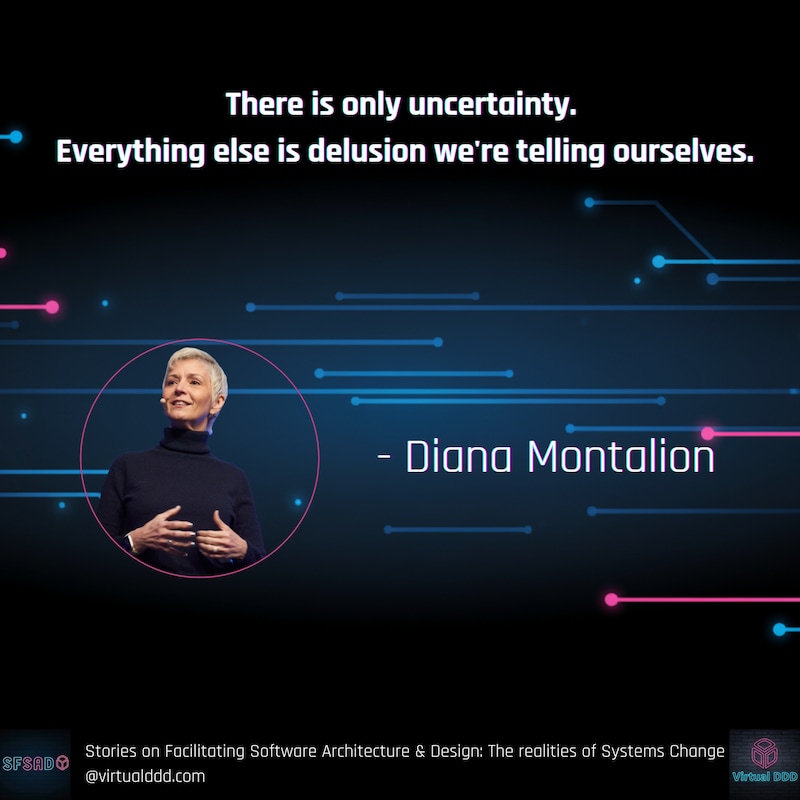
- [12:00] There Is Only Uncertainty: Diana's perspective on complexity, consent, and why promising important insight rather than solved problems is the honest deliverable
- [22:00] Flying with the Flock: The delicate balance between listening, facilitating, and nudging — knowing when to interrupt a cognitive pattern without simply steering people to your own answer
- [28:00] A Science and an Art: How facilitation is both deep listening and an energetic interruption of pattern — and why the hardest part is the work itself, once the friction is gone
Guest: Diana Montalion Hosts: Andrea Magnorsky, Kenny Schwegler
Part of the Stories on Facilitating Software Architecture and Design series from Virtual DDD.
Transcripts
welcome to stories of facilitating software
2
:design and architecture.
3
:Today we're here with Diana Monteon and
also with my usual co-conspirator Kenny.
4
:And so, Diana, please take
it away with your story.
5
:Diana: Okay, so, first of all, I love this
format because one of the things I'll say.
6
:not inherent in my story
is that storytelling
7
:one of the most powerful ways
to help an organization see
8
:a, a situation differently.
9
:And I just used it again.
10
:I wrote a Christmas story and
my current role that to try and
11
:just show that I was hearing what
people were saying and needing.
12
:Landed with so many more people than,
an architecture model would have.
13
:So I, I like that you've, it's very meta
that you've made this a story inside
14
:the experience because they both matter.
15
:so I guess this story that stands,
when you asked this, the thing
16
:that came screaming to mind is the,
17
:one of my.
18
:I'll say habits, not.
19
:Maybe The best habit is that when people
are confused or uncertain or when I
20
:don't really think they're hearing, I'm
trying to facilitate change and I don't,
21
:I feel like there's a lot of resistance.
22
:explain more.
23
:I think that what people need is more
words, more intake, more they need more.
24
:After 20 years, it was just exhausting.
25
:And also it felt like Sisyphus, I kept
pushing the same rock up the hill and
26
:it would roll back down and roll me
over and splat and I'd be a bug juice.
27
:And that's it.
28
:And why am I doing this?
29
:So I live near a place where, they do
like yoga, massage, stuff like that.
30
:And it's nice sometimes to take a drive
for an hour and go there and stay there
31
:for the day or stay there overnight.
32
:I was there just kind of resting
from a lot of work and I was
33
:in a little workshopy thing
34
:The facilitator said, oh yeah, you're not
here to think like, just you're quiet.
35
:Your brain, you're just
here to experience.
36
:I'm like, no, I'm, I'm, I'm
never, no, I'm never, I don't
37
:know how I don't have a button.
38
:If there's a button, let me know,
but I don't know where it is.
39
:but what I also noticed is that I was
having these experiences and it was.
40
:Predominantly people who, appear
to be or identify female and a few
41
:guys like people's partners go, or
individual guys, but that I work
42
:for 25 plus years in an environment.
43
:Exactly the opposite.
44
:know, for the first 10 or 15 years I
was often the only female in the room.
45
:And simultaneously when people.
46
:workshops or ways of learning.
47
:At k Palu is the name of the place there.
48
:It's very experiential.
49
:You're always experience something
moving through something.
50
:And in my day job, in my usual
life, in my system, science and,
51
:and software architect life.
52
:We don't have bodies really.
53
:We, we just, we just talk to,
we just talk to each other.
54
:Right?
55
:And we write code, like it
was, I just noticed how far
56
:apart these experiences were.
57
:Simultaneously, I had proposed
a talk for domain-driven
58
:design Europe, and I had said.
59
:I'd really like this to be a workshop.
60
:I think it would be a
much better workshop.
61
:And when I went back to my room after
having this enlightenment moment,
62
:literally the organizer of domain
driven design had pinged me while I
63
:was having this realization and said,
you said this talk could be a workshop.
64
:What would you do?
65
:What would you do?
66
:And I'm like, oh my gosh.
67
:I'm being asked the question
to actualize this, this in.
68
:Like, I'm not just realizing this.
69
:What would I do?
70
:And it's a place where I
tended to take risks Anyway.
71
:What I and my training partner decided
to do is we offered a workshop on.
72
:Understanding systems using
the iceberg model, right?
73
:The, mental models, the
structures and patterns that
74
:generate events in the system.
75
:We tend to focus on the events.
76
:There's a bug in production,
but not the fact that.
77
:Every system is designed
to get the results it gets.
78
:The call is coming from inside the
house and because of the, I usually work
79
:on digital, deep digital change with
organizations and architecting that.
80
:We have to be able to see how we are
generating the outcomes we don't want,
81
:and how do we generate the ones we do.
82
:And I'd really struggled
with how to do that.
83
:So we did is we used the iceberg
model, and we didn't call it this, but
84
:to model the patriarchy, meaning in
:
85
:90, well 92% of software developers
worldwide or male, but actually it's.
86
:91.88%.
87
:So not quite that bad.
88
:And if I had done a workshop to say, let's
talk about gender equality and like, first
89
:of all, who would've signed up for it?
90
:And secondly, people would bring all
their frames, their all their child.
91
:I would too.
92
:Like I would have ideas about that.
93
:It didn't do that.
94
:Instead, for the first half, we took
the iceberg model, the mental model
95
:structures and patterns and said,
okay, we're gonna work in groups.
96
:We're going to model a system
that generates that outcome.
97
:We want end up visibly male.
98
:That's what we want.
99
:And so we developed, we made stickies and
all the teams work together and did that.
100
:And then we said, okay, so let's flip it.
101
:want to design a system where you
can't tell if someone's a software
102
:engineer by looking at them like it.
103
:It looks just like the general population.
104
:I've since done that four times,
this workshop, four or five times.
105
:I learn so much every time I do it,
and people come up with all kinds of
106
:things that I never even thought of
before, and people have been very willing
107
:to engage in it it's experiential,
because we're having an experience.
108
:I'm not telling people what to think.
109
:I'm asking people to think together
about how something works and
110
:how it might work differently.
111
:So summarize now, the reason this state
really stayed with me, or the reason this
112
:idea came is that I'm in a role now where.
113
:I am with an organization that
I, I really, I really like and I
114
:really respect and I really like
the, the role that I'm doing.
115
:And part of that is getting from
a very crud based system and also
116
:practices to a system that can generate.
117
:Intelligence has the, has
temporal intelligence.
118
:All the things we think of with the
system, it's only been a few months, but
119
:I see myself making the same mistake of
like, if people don't really understand, I
120
:say more, I make more model I, I say more.
121
:This does not help.
122
:Also, when people are resisting,
they'll resist forever because they
123
:can find infinite ways I'm wrong or
they don't know whether I'm doing the
124
:right thing and I'm so much faster.
125
:Just instead designing an
experience, let's just try it.
126
:Let's do this.
127
:Let's just try it.
128
:And I have seen, I would say,
architectural Miracles in the last
129
:few months, or people who were very.
130
:resistant to a particular change for
reasons, but then they have an experience
131
:of it and they think it through for
themselves and then they go, wow, here
132
:are all the things I can do with this.
133
:And they pick up the ball and run with it.
134
:Now, that doesn't have to happen, but it's
a win if people have the experience and
135
:then say, this isn't gonna work, Diana,
and here are the reasons why that's great.
136
:Being wrong is wanna be wrong before I've.
137
:Cost a whole of time, energy, attention,
and money, banking on that, right?
138
:I want that.
139
:so this leadership as.
140
:I've come to think of it that this
type of leadership is facilitation
141
:and that facilitation is a type of
leadership that can be more effective,
142
:more impactful, and generate more
power in the sense of you have more
143
:impact, you have more positive impact.
144
:The legacy of the work.
145
:people for longer and wider, but it's
tricky to find because it doesn't look
146
:like it's supposed to look and you're
more vulnerable, like it leaves you
147
:in an unprotected space and you don't
know how people are going to react and
148
:that, that I think, is good for you to
have a bit of your feet on the ground.
149
:When you, when you try and do that,
like it's trickier in the beginning of
150
:a career to do that than it is later on.
151
:But you can always partner
with people who are doing it.
152
:And, and that's, that's another
thing, I guess, right, is
153
:pairing up, doing it together.
154
:Ha designing experiences, but
yeah, so facilitate experiences,
155
:especially if you feel like you
think you should explain more.
156
:Kenny Schwegler: Yeah, so recognizable
it, it reminds me a little bit of this,
157
:I talk about it often, some more, but it
reminds me of the Corporate Tribe Book
158
:of two Anthropologies in the Netherlands.
159
:It nothing to do in it,
but they say the same.
160
:they have this role called the Shaman
who creates experience or magic.
161
:Right?
162
:Whenever you're in such a workshop.
163
:And I think also Eric Evans mentioned,
right, the breakthrough and, and I
164
:think that's what you just mentioned.
165
:but what struck me is it's very uncertain.
166
:You're in an uncertain situation.
167
:How do you deal with that uncertainty?
168
:I think that's what scares well,
that scares me still to this day
169
:the most, stepping into that.
170
:Diana: I love that also that, it's
interesting you say that about,
171
:shaman or a tradition, right?
172
:Is that of the questions that
occurred to me around that time
173
:is like, what is at the core,
what our goal is, is wisdom like.
174
:Knowledge work.
175
:Wouldn't it be ideal if
knowledge work generates wisdom?
176
:And so this question of what is it to
be a wisdom teacher in this particular
177
:time of, of history the facilitation
aspect of what came to me as well.
178
:Like that I'm not sure I, you know,
have much to say about it, but it did.
179
:They like the points in this direction.
180
:I feel like if you have
that, so uncertainty.
181
:It's funny 'cause I was on a panel.
182
:One of the other speakers was
talking about the problem with
183
:uncertainty and, you know, complexity
and you know, and how you do.
184
:And I'm like, I don't get it.
185
:there is only
186
:That's all there is.
187
:Everything else is delusion.
188
:We're telling ourselves
we're making that up, right?
189
:Like, complexity.
190
:Uncertainty.
191
:This is the nature of everything.
192
:And so I think it's trying to discern
the difference between when you're
193
:trying to control that reality and
you can't, 'cause you really don't
194
:know what will happen as a result.
195
:when you are trying to act well
inside of uncertainty and complexity,
196
:like I definitely, it's not like,
oh, we're uncertain, but let's
197
:just leap off and see what happens.
198
:Like that's, you're not
architecting if you're doing that.
199
:But cons on the other side is also
not for me anyway, my work is often
200
:not going all the way to.
201
:a need for certainty because I,
I legitimately cannot, we can't,
202
:I can't facilitate us there.
203
:like the best thing we can become
certain of is this is the best possible
204
:idea, action, recommendation, direction
that we could come up with right now.
205
:And for me, that's enough.
206
:Like if we are like.
207
:There's like a 70% chance
this is a good direction.
208
:That's good.
209
:And this is the best we
could come up with right now.
210
:Yay.
211
:Kenny Schwegler: he, he always says
architecture is very easy if you are, if
212
:you have insight in the future, right?
213
:And, but it also reminds me a little bit.
214
:What, what, before we go to you, Andrea,
it always reminds me what you're saying
215
:about controlling the uncertainty.
216
:It's, it's like Avenger movie.
217
:You had the Hulk turn or Bruce Batter
turning into the Hulk, and him,
218
:how do you control not being angry?
219
:He says, I'm not.
220
:always angry.
221
:And I think that's what
you're explaining right?
222
:I'm always in uncertainty, so
I don't need to control it.
223
:Then it, then I can let it go
224
:Andrea Magnorsky: It is great
to know that Diana is the Hulk.
225
:I mean, it's like a, you know, an
interesting way to find out, but cool.
226
:Diana: I know from work, what's
the line from Thor, Ragnar?
227
:There's a friend from work.
228
:Kenny Schwegler: Yeah.
229
:Friend from
230
:Diana: yeah,
231
:Kenny Schwegler: Yeah.
232
:Diana: it's a friend from work.
233
:Andrea Magnorsky: Um, what
Dakota, I kind of was thinking
234
:that, that, yeah, definitely.
235
:I think uncertainty.
236
:Some organizations want to definitely
have the ideas that they are managing it.
237
:so actually my, my question to you
is like, how do you think people can.
238
:Get to like, you know, because
I understand how you can, like,
239
:for example, I do stuff my way
and can eat those stuff the way.
240
:And, but I think it's hard to, to kind
of try to think what is the, the, the,
241
:the pattern that is good so that we can
help organizations understand the fact
242
:that uncertainty is a fact of life.
243
:And that will be one question.
244
:And the second one is.
245
:I think if you talk to, to, some people
inside orgs and you say, Hey, let's do
246
:an experience, they'll will, like what?
247
:they will want some certainty of what
they will get out of the workshop
248
:and sometimes I say something
like, you will learn something.
249
:Um, so, so can you talk about those
kind of two areas when it comes to
250
:running this type of experiences?
251
:Diana: Yeah.
252
:And it, they go together and, and first
I think I wanna say, 'cause I know this
253
:is, this comes up, comes up a lot, this,
especially if I, when I do workshops and
254
:it's like, you cannot lead a horse to
water and you cannot make them drink.
255
:if, if somebody's like, no, and we
want this and we need this and we're
256
:not gonna take a risk and all of that.
257
:I personally don't know what to do in that
like, 'cause it involves consent, right?
258
:All facilitation involves consent.
259
:That's the difference between facilitation
and command and control, right?
260
:And I can get a smaller bit of consent.
261
:I can ask for consent for something.
262
:the person is willing to consent to,
but you can't do it trick or what?
263
:I mean you can, but
it's counterproductive.
264
:So part of my answer to that is if the
organization is like, I need to know like
265
:what the core deliverables are and what
we get and what's the measurable metric
266
:for the do this experiment all the time.
267
:I don't know that I could
necessarily be effectively
268
:experiment in that environment.
269
:I could try, but um.
270
:A little bit of willingness,
I think is part of the, is
271
:the doorway, but a little bit.
272
:So for me, where I focus is not to have
these conversations because no one, no.
273
:I mean, in tech, I could have
philosophical conversations all day,
274
:but no one wants to philosophical
conversations with me, and it's
275
:also not really what my point is.
276
:I focus on.
277
:the organization most wants.
278
:So in my current situation, for
example, when I listen to product, you
279
:know, strategizing vision and really
understanding the, the people that we
280
:serve, there are things that are really
clearly keep coming up for them, right?
281
:So the thing is.
282
:Nobody knows how I, I don't know
how to concretely describe exactly
283
:what we would make in tech to
give them the thing they want.
284
:They're not even sure that they understand
completely exactly how users will do
285
:things, exactly what it is they want.
286
:There is inherent uncertainty,
but there's also a tremendous
287
:desire to find out because they've
identified this as really important.
288
:So within that, I try to structure a, to
describe what it is we know, what is it
289
:that we're really comfortable with, and
what are the, like, if I'm gonna make
290
:a recommendation, what convinced me?
291
:What do we know?
292
:What, what data do we have?
293
:What, what certainty do we have?
294
:To back up the encouragement
to take one step.
295
:So we know this, we know that,
you know, this is really valuable
296
:and we want to take the stretch.
297
:then what could we try?
298
:What's the experience?
299
:What do we not know and how
would we, here's what I would
300
:suggest, how we find out.
301
:And the deliverable is valuable knowledge.
302
:Valuable information.
303
:You wanna go in this direction, but
we're not entirely sure how I can
304
:come back and give you something
concrete that doesn't totally answer
305
:it, but it does give you something.
306
:You know, you need some information,
you need to move forward.
307
:Most of the time I can make
something happen inside of that
308
:space, outside of that space.
309
:People have to already understand
the value of these approaches, or
310
:it'll just be an endless debate.
311
:So picking an area where there is already
acknowledgement of complexity and not
312
:promising to solve a problem, but instead
promising to deliver important insight.
313
:that to be the most
successful, the hard part is.
314
:don't know what to do.
315
:Like I, like I have to make
up an experience and I have
316
:to know what might help.
317
:That's not easy.
318
:So I guess I think I wanna
end with this idea that.
319
:Um, we think, we think for most of my
career, the hardest part has been this.
320
:How do you get an organization repeat?
321
:How do you lead a horse to water?
322
:How do you do this?
323
:I'm at the place in my career now and, and
with the organization I'm in where it's
324
:actually the work that's the hardest like.
325
:When there isn't friction, when you
can facilitate, you discover that
326
:facilitative leadership is way harder
than just telling people what to
327
:do because you are uncertain too.
328
:You are experimenting too.
329
:You are vulnerable right along with them.
330
:And I think that, that's where we
really grow our skillset is when we
331
:really have to take a risk and, and
figure out what would, what's the one,
332
:one thing we could do would give us
more confidence in a situation where
333
:there's a thousand things we could do.
334
:It's hard.
335
:Kenny Schwegler: I think you
said something interesting
336
:because I was at your session
at DDD Europe, by the way, and,
337
:Diana: were.
338
:Yeah, you were.
339
:Kenny Schwegler: afterwards,
I used the iceberg
340
:Diana: You said safe though.
341
:You, you said the solution
to the 91% is safe.
342
:That would fix it.
343
:Kenny Schwegler: I made it.
344
:Oh yeah, that was a joke.
345
:Uh, but I went to the company with
someone else, where I, where I'm currently
346
:still in, and I started mapping this.
347
:And you said something very interesting
because you saw a pattern arising
348
:just by modeling it out for yourself.
349
:I'm not sure if you did that, but
I did that and I saw the same thing
350
:happening and it reminded me of.
351
:DDD language and what you can get
out of that is use their language,
352
:use what they already know, use
what, what's repetitive, and if you
353
:can, merge the experience into that.
354
:Is that what you're saying?
355
:If I, in short did.
356
:Diana: Well, it's the,
it's the, um, it's the.
357
:It's the when we're do, when we're, when
we're starting having an experience,
358
:we're starting with all of our own.
359
:Like if our cognitive space is
just all the stuff we've put
360
:in our mental garage, right?
361
:This is all the stuff we
have that if people have to.
362
:abandon their garage and go into
a completely different space with
363
:tools that they don't recognize.
364
:It's, it's too, it's too, there's
too much going on to then.
365
:Use those tools to come up
with a new idea, like come up
366
:with, you know, with a frame.
367
:But if you can focus on something that we
generally all have at least some aspects
368
:of these in our garage and reshape them.
369
:But the trick is you can't
just move them around.
370
:That's just changing seats on the Titanic.
371
:You still have to build
something different.
372
:From those materials, right?
373
:So that's the tricky piece is the,
374
:the, if people can draw on their own
experience, you'll get more value out of
375
:doing it because you, it, everybody, it
brought valuable experience into the room.
376
:but.
377
:It's not just moving
that experience around.
378
:Right.
379
:My cat is, has decided to,
she joins every meeting, but
380
:Kenny Schwegler: an
381
:Diana: this one.
382
:Kenny Schwegler: in a
383
:Andrea Magnorsky: Yeah, she is definitely,
uh, what, what I'm, what I'm hearing
384
:also is that you are basically very
focused on listening on what the outcomes
385
:that they really value are and trying
to kind of share the common ground.
386
:I think you're kind of, uh, like
you, what I ex I understand by
387
:what you explained is that you.
388
:Listen to people and try to tell the, try
to replay, especially the parts that are
389
:common and kind of say, okay, these two,
you know, your experience, Kenny, of what
390
:is needed and what is the problem and
your experience there, and whoever else
391
:is in the room or the garage or whatever.
392
:And these are the bits that,
we are sharing and it seems
393
:like we're going over there.
394
:That's the outcome.
395
:Somewhere there is that, and you're kind
of iterating on that until you find it.
396
:That's what I'm getting.
397
:Is that what you're talking about?
398
:Diana: A, a little.
399
:A little.
400
:Yes, but all yes.
401
:definitely.
402
:So
403
:Andrea Magnorsky: I.
404
:Diana: wasn't doing that, nothing
good would be happening for sure.
405
:Right.
406
:Like and this is where like,
407
:I give talks very different now than
I did 20 years ago because my role
408
:in that room feels very different.
409
:And it's more in line with what
you're saying, like, we are here
410
:together to do a thing, as opposed
to I'm presenting something right?
411
:Like there's, that personas changed.
412
:also what I would add to that
though is that my role, the
413
:expertise that I am developing.
414
:Is, it's interesting 'cause we, we
started talking about wisdom, things
415
:like this, that these are, cognitive
patterns are energetic patterns, right?
416
:They're, we have an idea, a
belief, something we value.
417
:When we have an, when we think
of something, our minds will go.
418
:In a particular familiar direction.
419
:So for example, working with teams,
going from Cru, a mo, a crud, monolith
420
:to asynchronous and microservices,
it's very challenging because our
421
:thinking is very tightly coupled.
422
:So when we build the microservices, like
we architect them to be tightly coupled.
423
:So it is, it's listening and it's.
424
:Facilitating and going and
trying not to add friction,
425
:but there is definitely a very,
426
:I think, important, Nudging that,
that you're list energetically, you're
427
:looking for the places where this is
gonna go down the same path, right?
428
:Like the same.
429
:This will
430
:Andrea Magnorsky: No.
431
:Diana: thinking that even though
it seems like new thinking, we're
432
:going to end up in the same place.
433
:And the, the places where you can ask
a different question or do a different
434
:thing, but that also requires a little
bit of, thinking about what the change is.
435
:Like if people are going in a particular
direction and you're facilitating to
436
:nudge them in a different direction.
437
:If you have no idea where that
direction is, then you can't do that.
438
:Right?
439
:But at the same time.
440
:You don't know that you are just someone
else in the room with an, with a thought
441
:about what the right outcome is, right?
442
:And so if you're just gonna bring them
to your idea, you might as well just tell
443
:them your idea and tell 'em go do it.
444
:Like that's the honest, like that's
the intellectually honest thing.
445
:And every once in a while I am
like, 'cause I said so do this.
446
:'cause I, so every once in a very
great while, but it's very, very rare.
447
:So it is a little bit like a flock
of birds where you have to be.
448
:Grounded enough in, in the space, enough
to be flying with the, the, the flock of
449
:birds while you're facilitating, right?
450
:If you're trying to marshal it, it
won't work, and if you're trying
451
:to control it, it won't work.
452
:But also if you turn off your brain and
just flow with it to kind of go and you're
453
:not actually adding a little tension
where it should go, then, and sometimes
454
:that's exactly what you wanna do.
455
:Sometimes in facilitation, you are
just helping people articulate.
456
:What's going on?
457
:That's great.
458
:I'm not against that at all.
459
:for me it is more usual nowadays
that we're facilitating towards an
460
:insight that we haven't had yet.
461
:then, so it's looking for those
opportunities to open a window
462
:differently, might work, might not work.
463
:so it's, both a science and an art.
464
:I guess It's both listening and
also an energetic, Interruption of
465
:pattern in some way that is helpful
466
:Andrea Magnorsky: Yeah,
I think, I think that,
467
:Diana: when it
468
:Andrea Magnorsky: yeah.
469
:Yeah.
470
:I love that the, I see them
myself and I'm that, you know.
471
:People listening will see them too.
472
:I think that's a, that's a beautiful
place to, to, close this, story.
473
:thank you very much, Diana for
joining us, Kenny for wellbeing, here.
474
:So we are here together
and, well, that's it.
475
:Thank you very much.
476
:Bye bye.
