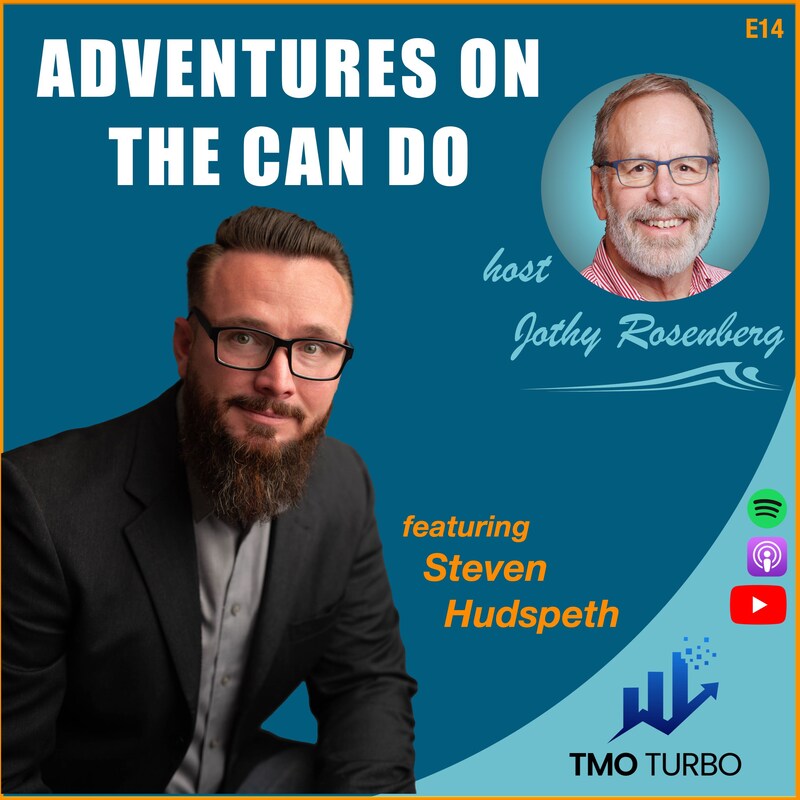
Shownotes
Summary
Steven Hudspeth shares his entrepreneurial journey, starting with his upbringing in Arkansas and his military experience. He discusses the importance of resilience and not quitting, which he learned from his family and military training. Steven then talks about his transition into the restaurant industry and his rapid rise to managing multiple restaurants. Eventually, he decided to start his own franchise in the painting industry. This led him to identify a need for better communication and automation in small businesses, which inspired him to create TMO Turbo, a software company that helps businesses streamline their processes and improve customer interactions. Steven's goal is to impact as many people as possible and give them back control of their lives and businesses.
Takeaways
Resilience and not quitting are important qualities for success in entrepreneurship.
Networking and building connections can lead to valuable opportunities.
Identifying a need in the market and creating a solution can lead to a successful business venture.
Automation and streamlining processes can save time and improve efficiency in small businesses.
Grit is developed through challenging oneself and pushing outside of the comfort zone.
Sound Bites
"TMO Turbo: Adding a Turbocharger to Your Business"
"Expanding Beyond Tulsa: TMO Turbo's Geographical Reach"
"The Impact of TMO Turbo: Doubling Revenues for Businesses"
Links
Steven's TMO Turbo site: https://tmoturbo.com/
Please leave us a review: https://www.podchaser.com/AdventuresOnTheCanDo
The book Think Like a Startup Founder (early access): https://www.manning.com/books/think-like-a-startup-founder
Jothy’s site for all podcast episodes: https://jothyrosenberg.com
Jothy’s non-profit foundation The Who Says I Can’t Foundation: https://whosaysicant.org
Jothy’s TEDx talk on why people with a disability over-achieve: https://www.youtube.com/watch?v=PNtOawXAx5A
Chapters
00:00 Introduction and Background
07:56 Transition into Entrepreneurship: Starting a Franchise
14:36 Creating TMO Turbo: Streamlining Processes for Small Businesses
25:12 The Impact of TMO Turbo: Doubling Revenues for Businesses
29:23 Developing Grit Through Challenges and Pushing Outside the Comfort Zone
Transcripts
And here's Stephen. Hi Stephen.
Steven Hudspeth (:Hello John Joth - I'm sorry, Jothree, how's it going?
Jothy Rosenberg (:Good, good. So I'm glad to be doing this with you. I love to start off by asking people where they're originally from and where they live now.
Steven Hudspeth (:Well, I grew up in Arkansas. I was born in Chicago, Illinois. My dad was military. So kind of moved around just a little bit my early years, but generally from about seven or eight years on to 18, I lived in Arkansas. I got up from Arkansas and realized that's not where I wanted to live the rest of my life. Love Arkansas, beautiful place. Opportunities are not as plentiful, at least where I grew up. So we, I uprooted myself to Tulsa, Oklahoma for aviation school. And it,
Tulsa just grew on me and so I am still in Tulsa since I was 18. I'm 38 now, so about 20 years. It's been a really lovely place.
Jothy Rosenberg (:That's great. That's great. And so it's, it's, it's, you know, really blossoming and spring right now there.
Steven Hudspeth (:it's gorgeous. Man, we just got trenchal rain after trenchal rain after trench rain. So now we are technically our slogan green country. It is green as green can be here right now.
Jothy Rosenberg (:Wow, that's cool. All right. Okay, so we're gonna get into your entrepreneurial journey in a minute, but sort of one of the things that would be nice to know, because you started to talk about your growing up years, is were there things that went on in your family and that sort of
taught you to be resilient and not to quit and to go for it.
Steven Hudspeth (:Absolutely. You know, I grew up in the country. So, you know, I actually, it's interesting when you go to high school, which is a third smallest school in the state where it's like K through 12 is the entire school is 91 people. So tiny, tiny, tiny, most people graduate with thousands or hundreds and our entire school 91. But one of the things that taught me was I get to be involved with everything, which was fantastic. But really what helped me not quit was my dad when I joined something like a sport.
requirement was if you joined something, whether it was chess club, whether it was basketball, baseball, did not matter. You had to finish your original commitment. Now after that, the season, the year, whatever's over, you know, you can reevaluate what you want to do, but quitting was not an option growing up for anything you committed to. So it was always taught to make sure that I was very, educated on what I committed to. If not, I was going to pay the price for my commitment because I was not allowed to quit.
Jothy Rosenberg (:Hehe.
Steven Hudspeth (:So I thought that I would say that probably gave me the most value in my younger years in that area. And then, you know, I got to enlist my dad and family let me enlist the military at 17. So that, you know, compounded that, that type of environment for me.
Jothy Rosenberg (:because you can't quit that.
Steven Hudspeth (:No, you really can't. And then like I always tell people in military actually helped me probably the most because I just seen so many people who either hated it or loved it, right? You didn't really ride the middle. And so it kind of made me go, it's what you make of it. Did you make the experience the best experience or did you go, I got to get up and do this every day. All that, you know, it is completely all mental and how you handle your mental mental paralysis, I guess I'd say is what you made of the environment.
So that's really helped me a lot.
Jothy Rosenberg (:So you chose the army, was that the same service your dad was in?
Steven Hudspeth (:Yes, so I was a third generation. My grandpa actually jumped out of airplanes. My dad was an aviation mechanic and my heart was set on flying the Apache because he worked on the Apache. So that was my heart, my intention when I got into the military. That's why I moved to Tulsa for aviation school. And, you know, it was my goal, but that's just not how it played out.
Jothy Rosenberg (:Was that a big disappointment?
Steven Hudspeth (:No, no.
part of it. definitely part of it was, and it went back to commitment and time and, and I would have definitely gone that route, but I had recently came back from Iraq. And then when I transferred back to Oklahoma, I was going to have to go back to Iraq. So it would have been like a two year stint overseas, which the overseas part didn't bother me. You know, it's all the stuff back home and being gone a year was such a difficult issue. And then, you know, there are different, different things that happen to family members while you're gone that you can't.
be a part of or control or do anything. So it was just, like I said, that long -term commitment decision I had to go, you know, I just didn't want to make that commitment to that another long stint. Like I thought I did because of what I felt like I was holding myself back of the rest of my life on that, possibly.
Jothy Rosenberg (:So what did you do when you got out of the army? How long were you in total? Four years? Was it four years?
Steven Hudspeth (:So I did six years in the reserves, two years in active. I did one year overseas in 2005. So right after high school, I went overseas.
Jothy Rosenberg (:That's a big commitment. That's a lot of years.
Steven Hudspeth (:It was, it was, it was a blast. I had a lot of fun with it and I love the military. And again, I would have stayed in without a question, but I just was not interested in going back overseas. I just felt like I was, I did my time there and if it had been six months, I would have been all about it. But a year is just a very, very long commitment, really long.
Jothy Rosenberg (:And so when it was time and you got out, what did you do then?
Steven Hudspeth (:So I went into the restaurant industry as a, started off as like a manager because I felt like my, my skillset, my attitude and demeanor was really good for that industry. And it really was because I didn't get ruffled or razzled as a lot of people do, even though I was younger than most because my experience and the feeling, I guess, of, of high pressured environment and going, well, you know, I could die over here any day, right? It's a, it's not, there's no guarantee for tomorrow.
So coming back into a more secure environment, more safe environment, even though, you know, somebody's burger got messed up, you know, it's like, look, it's a $5 burger. We're going to get you out. I'm going to take care of you. But I didn't let it bother me because I just had such a great experience of understanding what real pressure was like at a very young age. So it really kind of helped me grow in that industry and it really catalyzed. So, I mean, I had lots of opportunities as I moved up very quickly. So I went from at 20 years old being just a basic employee shift supervisor.
to by time I was 25, I was running seven restaurants for a company. So it really did give me the tools to be super successful in that environment. Because everybody just knew that when stuff was going wrong, I would just kind of, we just worked through it. That's just it, you just worked through it. Because this is not life or death. You just worked through it. If it's gonna be late, we'll fix it, make it happy and move on. It's not gonna be the end of their day. It really is not. So.
You know, that mentality really helped me shape the people around me.
Jothy Rosenberg (:So you were managing a number of restaurants, so food industry restaurants. And then something must have driven you to want to do your own franchise. And so tell us about what made you feel ready and you had the sort of desire, need to go.
You know, run one yourself. I mean, own one yourself.
Steven Hudspeth (:So I think it all started way before any of that. I read the book, Rich Dad Poor Dad when I was 19. And I say read to kind of put some age on myself, which would be funny for some people is I had the CD set, right? So I listened to it in my car with CDs. So I listened to Rich Dad Poor Dad and I was like, yes, I want assets in life. That's what I want to develop. And so I worked to get my college debt paid down. That's why I went and stayed in the restaurant industry because when I was getting ready to graduate, there were no aviation jobs.
the bubble just clashed:That was what spring born me into looking for a business. And so we started looking for something in the restaurant industry because I mean, I was really good at restaurant. My wife is really good at restaurants. We're like, yeah, that's what we're going to do. And that's not what we ended up doing. Life's about curves and interesting twists. And we were talking to a consultant and every restaurant we really wanted, they wanted a lot of cash. They want like 125 ,000, $150 ,000. And we only had 80.
e out how to get a painter in:There's really a lot of room for improvement in the service based part, which I know a lot about. And there's improvement in marketing because nobody can, nobody knows how to get one. And then there's nobody really known as the best in Tulsa. So I was like, there's three number one spots that I can fill with my business if I go out and do it.
Jothy Rosenberg (:So you had to come up with the, use some of your money to get into the franchise. So you made that, took that leap and you did that, right?
Steven Hudspeth (:Yep. And that kind of culminated into taking that was the most shocking thing. I think when I bought a business or franchise models, there's lots of great franchises. I love my franchise, but I came from a restaurant industry and restaurants. They know their stuff. That's the funny thing. Like if you don't know your stuff, you're out of business within six months because your food costs have to be in line. You know, your labor costs have to be in line. You have to have those things dialed in. If you don't, obviously you're going out of business because the margins are razor thin on food.
because it's mostly about volume. And so when I got to my franchise industry, there just wasn't the same data, the tools and stuff to bring all of it together wasn't there. And so that led me to all the development of processes and diving into books of like the E -Myth and, you know, the Entree leadership and how to really put all these, find these tools, build these tools that I was just gifted with in the restaurant industry. Now I'm like,
Okay, we're not measuring food costs here. So how do we need to measure what conversion rates, slippage rates, ROI's. Okay. How do I know was the guy's time on a job waste or not? You know, so it was just a whole bunch of stuff that I got had to figure out, but at least I had a background of how valuable that data was. And so I spent a lot of time figuring out how to track that stuff.
Jothy Rosenberg (:OK, and so you owned one store, right? Or one location. Yeah. And.
Steven Hudspeth (:Yes, one franchise location, the whole Tulsa area. Yeah, I tried to, but it didn't quite work out well.
Jothy Rosenberg (:Okay, so you focused on one and you grew it and how big did you grow it to be?
Steven Hudspeth (:So our biggest year was 98, 997 right around there. So just under a million dollars. And that came from, honestly, all the years experienced, but really the biggest value I learned was to meet people. And those are your best...
What's the word I'm looking for? I'm sorry. Lead generator or connections to better clients, more clients, more qualified clients. You know, a lot of times, you know, in the beginning I do all kinds of discounts and offers and stuff like that. Discounts and offers are fine, but sometimes you can really attract the, not the client you're quite looking for. If you're trying to be a pristine type company, you know, a lot of people who are affluent or kind of understand the concept of, you know, I don't want to.
Jothy Rosenberg (:Mm.
Steven Hudspeth (:I understand there's cheap, but there's a problem with cheap sometimes. And cheap can be real expensive if I have money too. So, you know, networking really built a lot of my, my business. And that's what I've really leveraged a lot in the, to grow it to that number. I, by the time I was, my last number we looked at was roughly $500 ,000 plus in just word of mouth, repeat and referrals. So it's all about the reputation, how we communicate with people, how we handle our situations, because stuff goes wrong on painting all the time. I mean, construction.
jobs. I mean, they break stuff all the time. And so it's really not what goes wrong. It's how do we handle it? How do we dissolve the situation, diffuse it, dissolve it, and then get somebody happy to come back or tell their friends about us. So that's kind of what I valued from the military, which kept me even killed through the
food industry and then into my other businesses that I have now. It's all about, you know, this is not life or death. We're going to get this taken care of. Let's make you happy if we can. And if not, I understand how do we leave this? So at the end of the day, you know, you don't hate me. And if you do, okay. I, at least I can look to myself in the mirror and go, I gave it all. They're not going to die. They're going to be fine. Their life's going to go on.
Jothy Rosenberg (:OK, so you have a your current company is one that you created out of your own head. But you had all this experience to kind of lead you to the need for this. And it's a software company, correct?
Steven Hudspeth (:Yes. So, this came out of, again, where we were talking earlier, where, you know, a lot of business owners, like I said, even a franchise business model, which I've learned going into this industry a lot that, you know, I mean, they don't have all the answers, which is, I just assumed, you know, we always put these people or these businesses on pedestals. They don't necessarily need to be on them because they're humans, just like we are, unless they've been around 50 years, they're still figuring stuff out. So, you know, as long as they're trying, that's really all that matters at the end of the day. And.
What I took from all that stuff I've learned is that, okay, well, what did I really struggle with and what did I want to improve upon? And so every year I improved. And then three years ago, I wanted to improve my communication with my clients, right? How do I not waste time on people who are not necessarily my clients, but give them the attention that they wanted at that particular time? And how do I amplify myself? So we developed our tool, which we use, which automates all that stuff.
And so what we did is we built all these packages and processes that most small businesses should have, but they don't. And so I was like, man, if I was a painter getting ready to launch my business, I would love to be able to focus on my business because you know, you start a business, you've got to learn how to market. You've got to go hire guys. You got to fire guys. You got to be on the job site. guess what? You've got to call leads. to get money, you got to follow up with leads and you got to work on your business. You got to think of other things. And so.
You know, all these things come at you as a small business owner. And one of the things that adds obviously the most value for us is chasing down leads because obviously that's our dollars coming in or chasing down followups of clients that we've committed to. Those are dollars to come into the business. So what we've done is we've automated all that outreach for people so that, you know what, you don't have to worry about it. If the client answers you, you can respond to the client and then interact with them when it's fit for them.
But since they've made that initial connection to you, you know they're interested. So let's maximize that interest. They might've not been interested in week one. It might be week three where they finally get to go schedule that appointment. Well, most small business owners don't try to reach out to people in the third week that they came into them as a lead. Once, twice, maybe three times, they might do it four or five in the first week. And then after that, they're done. So what we've helped business owners do is automate that process. Go.
Steven Hudspeth (:Here you go. Boom. They're going to get reached out to for a year. you've completed. great. They're going to get reached out to it for you for a year. and then you don't understand the process is a nurturing sequence. Well, you know, here are some ways you could look at that. And we kind of give them those processes that they kind of talk about in e -myth and stuff that most people don't sit there and write down and try to figure out, okay, this is what I want my client to do next, next to next. So we give them that tool to at least springboard their business into action, into life, you know? So it's that leg up.
that I would have killed for when I first started a franchise model myself. So that's kind of what led to it and the area that we saw as a fit.
Jothy Rosenberg (:OK, so classic good scenario of you're in a market, you understand the market well, then you see something that's a real need. You wish you'd had it. So essentially, in your head are a set of requirements for what this software had to do.
You're not a trained programmer. Where'd you find people who could build it for you?
Steven Hudspeth (:So my business partner is a programmer and we kind of went through it all together as kind of a, you know, a growing pain issue. So that was kind of where we got with it. I got the right person through again, the beauty networking, right? So I met this guy 2017 when I was in my painting business, I met him through my networking environment for my painting business. Five years later, you know, we're getting together on a business and you know, we're running, we're doing a business together in a whole different segment that five years ago.
Had I not done networking, marketing, connecting with people, I wouldn't even be able to leverage the connections and opportunity I had to make this happen.
Jothy Rosenberg (:So you're in it together and that partnership has been productive and it's continuing. You guys have been in business how long now?
Steven Hudspeth (:We're going on our third year now. So really, like I said, we didn't really, we didn't really actually like technically start the business business until like last year, because the first year was all development, right? Trying it out on ourselves. There was no resale. None of that. We were just focused on building it out to make it as great as possible so that it delivered the most value. I was at the most vertically integrated system because again, we call time the enemy. So if we save you even one second a day,
Jothy Rosenberg (:three years.
Steven Hudspeth (:You ended up with 356 days. That's a lot of time added to your time. So that is everything we focus on is okay. You know, even on other tools like, I need to go look at my Google analytics. I click on this button. I opened up this page and I've got to log in. Now I get to see my Google analytics. I got click here to get here. I mean, it's there, but it's not convenient. So when it's not convenient, we tend not to look at stuff when it takes too much time to oversee. And so that was our real big focus. What is the stuff that most businesses need?
or want and how do we make it simple to oversee and see.
Jothy Rosenberg (:So you've kept your role at the painting franchise, right? You still own that. And so you're kind of your first level of test customer. You're your own customer, right? You're the lighthouse customer, or maybe you're just the tester of it and you find all the bugs. I don't know. But.
Steven Hudspeth (:Yes.
Yes.
Steven Hudspeth (:Yes.
Jothy Rosenberg (:But you've expanded, I assume you've expanded in the two plus years to other franchise owners. Are they all in the same, are they all painting franchise owners or have you gone beyond painting now?
Steven Hudspeth (:So we've gone and gone beyond painting. We've got a dozen or so painting, I think 15 or 20 painting franchise models. We added dog training models. So we got several dog trainers that we kind of do. We're working on maids. So that's our new little target that we're building out with maids and using, they've got some really cool stuff where they don't necessarily want to go in and see somebody's house. They go off square footage. So we're actually working on some stuff of training GPTs for them to actually do the quoting, do the answering of the questions and stuff like that.
Jothy Rosenberg (:Hehe.
Steven Hudspeth (:And then they can really be as hands off as they need to be because it's, it's what a lot of clients actually technically want. They don't want to talk to somebody because they're, they don't want to feel sold. They don't want to get that pressure being sold. So if you can make it where it's more in their light or their want, you can actually get more clients who might be more interested right then. If you got a system that's going to answer questions and then they're done. So that's the other one. And then we were working with a financial planner.
building out models for the financial industry and stuff like that. So we got multiple different models we're working on verticals for. But the, that was the hurdle when you're working on models like that is trying to make sure you've got a good processes in place. And so some owners tend not to let you put good process in place. Why? I don't know, but you know, owners are owners and they do their own thing, but that's how we learn about those industries. And we can improve them even if that particular owner doesn't, you know, have all the.
doesn't really go with what we think would be a good fit for the industry. We at least can build a model that we can go, okay, hey, let's meet with somebody else. We can give them a discounted price. Let's get their knowledge and make their industry better. And so, you know, we, that's how we're building. We're finding one or two people we're, we're working with to build models for them, grade, whether the model is a good model or not, and then kind of stacking on that.
Jothy Rosenberg (:So you've expanded into other, what you're calling models, but it's other domains. And that's sort of, I think of that maybe as kind of scaling horizontally because you're covering painting and maids and financial planning. And so.
And then are you expanding geographically? Are you still really local in Tulsa or have you gone beyond that?
Steven Hudspeth (:We're well beyond Tulsa. We're in Florida, Colorado, Michigan, Ohio. I mean, that's the beauty. That's what I loved about the software industry and this type of environment was it's everywhere. And so now I can leverage and meet massive amounts of people versus being, you know, Tulsa was fantastic. I love building a paint company, knowing that connecting with people and learning about what they want and what their needs are.
helped me leverage my painting company. So I'm getting to do the same thing all over again in my software company. But the reach and scale is so much different and a lot funner, a lot funner.
Jothy Rosenberg (:And what are your ultimate goals for? and you know what? We haven't said the name of this. It's TMO Turbo.
Steven Hudspeth (:Yes. So it came from my partner's, he was like Tulsa marketing online type thing. And we're like, all right, so we'll just call it TMO for Tulsa and got some marketing into it and it's online. And then we just called it turbo. So it kind of turbos your business. It adds a lots of if done right and you amplify it, you know, it's like putting a turbo charger on your engine. Literally, if you've got a business, a prime example, we've got a case study on our YouTube channel where a business had a call center group of about five individuals who made calls and scheduled appointments.
they booked about 34 appointments a week. Well, when we put our turbo onto their business, those guys quit making those outbound calls and they were scheduling, the system was scheduling 84 appointments a week. No outbound calls, 84 appointments were already booked. So, you know, if you've got certain things, marketing and pieces in place, the tool actually kind of puts everything in a really tight funnel. And I mean, really spins up the energy of a business. So I mean, they'll grow.
They'll double, they'll, they'll more than probably double their revenue at minimum, at minimum, because they've already doubled their appointments with no extra marketing expense or anything else. And that was just one area that the system improved. There were others.
Jothy Rosenberg (:That'll give you some.
That'll give you some great testimonials when they double their revenues. And what are your goals for this and how long do you think it'll take to achieve those goals?
Steven Hudspeth (:yeah.
Steven Hudspeth (:so my goal, obviously like always people always kind of curious what I think, how I go about it. But my goal is to impact as many people as I can. That's, that's the biggest goal. I run a small business. I've owned a painting franchise. I know how the margins work. I know the stress level of, of what it, what it feels like to try to run that engine, get that going and handling all these different things. And you know, how a lot of these tools that are fantastic tool, Salesforce is a great tool.
but it doesn't add value. It adds data and data is valuable, but it's only valuable if you know how to use the data. So although they do great pieces, they're very complicated for a small business owner to use. And so, you know, for me in my life is how many people can I help simplify their life? How can we give them time to get back at home? Right. I mean, we were talking about my paint business, right? I did 900 and was it 97, $98 ,000, right? With myself and an admin.
So I went out and I was working six hours a week, eight hours a week, running six to 10 estimates a week. And, you know, the admin coordinated everything through my CRM. My guys did all their stuff, but, you know, I was able to do it completely part time. It was not, not a long -term commitment. So I want to be able to try to give that to other people. And the more people I can give that to the happier I'll be on that. I mean, it's cause money comes and goes, but if I can give people the ability to get back in control of their life and have an understanding of.
their business and know what's going on in their business that I know 99 % don't know 98 % don't know. I've seen so many people who fired estimators or staff because they didn't realize that the staff wasn't really responding to SMS is that we're sent to them. They just assume that the staff got SMS. They replied to it. They assume the call came in, they answered it. Well, when we rolled out the tool, that was not I mean, I got a safe.
At least 80 % fire somebody. It's not a good thing to say, but again, it is a business owner. I had my dog trainer friend who was like, Steve, I'm struggling on what's going on. So we go to the reporting section. I go, well, you had a thousand calls over the year and your admin answered 10 % of them. It was like a hundred calls for a whole year. You know, there's a big kick up, man. How do we, how do you fix it right here? So giving them that insight, which is painful to see it. I mean, it hurt my heart, man, to tell them that and show them that, but now he has it.
Steven Hudspeth (:He was able to make some corrections and guess what? Now he's enjoying life again. He's getting a little bit more traction and stuff's going his way. So, you know, that's my pride, my joy and the whole thing is, you know, how do I help enough people? You help enough people and man, it just feels good.
Jothy Rosenberg (:that's great. That's a great story. Well, we talked earlier about where some of your drive came from. But I always like to also just talk about grit a little bit, because anyone who just decides, I'm going to start this company, I see a problem, I'm going to fix it, I'm going to do this.
Or earlier when you said, OK, I'm going to make the leap and I'm going to own this painting franchise. And you were in the military. So there's always the discussion of grit can't leave out the experiences of being in the military, especially being overseas where there was a conflict going on. But don't let me.
put words in your mouth, where do you think your grit has come from?
Steven Hudspeth (:mean, the grit for me, I think comes from understanding. I mean, I've read a lot of books in psychology and mentally and stuff like that. And grit to me, and I even read the book grit was a great book, by the way, if you're not read it, it's a good book, which was written by a psychologist, I believe. Yeah, grit. Yeah, I believe that's it. Yeah, female psychologist. Again, I'm really good at parts of books, like I see stuff visually, but names don't come in visually. So I'm like,
Jothy Rosenberg (:Are you talking about Angela Duckworth's book? Is that the one you're talking about? Yeah.
Steven Hudspeth (:I remember the name of the book's grit and I remember it was really good. But, you know, I think if you ask me grit comes from always trying to challenge yourself. You know, people who, who don't push outside that comfort zone, they can't develop grit because coming from grit comes from failure or challenging yourself. You know, and one of the things I read in the book was, you know, just challenge yourself to brush your teeth with your opposite hand. How difficult is that to stay consistent with, right? Do you even do it the whole time?
I mean, it sounds simple, but it's an awkward experience and you really kind of training and teaching your body to be used to awkward experiences. That's.
Jothy Rosenberg (:I mean, yeah, I know because I had a bandage on my, I'm right -handed, I had a bandage on it and I use an electric toothbrush. So it really should be easy, but you're just not as coordinated. You're not used to it. You've got a pattern. So it's one of those challenges. Yeah, absolutely.
Steven Hudspeth (:And it's, it's, it's, that's a small challenge. And like I said, I embrace that challenge periodically in different times and different things. But again, that's on a small scale. You know, the bigger scale is, you know, going out and meeting somebody a challenge for me, like going outside of my comfort zone a little bit. we did a, in Tulsa is called city of the lights. And so last night we went out and, you know, we fed the homeless and, you know, not something I've done a lot of in my, in my time. And I really enjoyed the experience, but again, not my comfort zone, not my area of.
really knowledge or anything, got invited and say, Hey, you know what? This is something I've not done. This is going to be a challenge. I feel in my gut that I'm like, man, this feels like an awkward thing. I want to do it. It's awkward. It means I've, I've not challenged myself to make it a norm or even a process. So if we can, we look for even the small things to challenge ourselves. We start building a little bit more grit, a little more challenge. And then you really amplify, you know, going to the gym, finding, you know, routines and patterns that challenge you to be.
better each day than you were the other day. So grit's a complicated thing. And you know, you I believe in my opinion, you can develop it, but you've got to want to develop it, you got to take the small steps. Because it's you know, there's no giant leap to I can get through everything. Everything's just one little step after another just building blocks of life.
Jothy Rosenberg (:I couldn't agree more. Well, this has been great. And I think listeners are going to really enjoy getting to meet you and hearing your journey and your philosophies. This has been, I really appreciate your time. This has been great, Stephen.
Steven Hudspeth (:I appreciate you having me on. Like I said, when I reached out to you, like I said, it was, it was all the intentions of learning about you and it was phenomenal. And let me look where that brought me into a podcast that I didn't even know existed. So, you know, it's, it's that challenge. We were just talking about that grit and challenge. It wasn't like I just wanted to reach out to people and go, I hope this person answers me. they did. Now, man, I hope this meeting goes well. No, you just challenge yourself to get through those things. And so I want to thank you and tell you how much I appreciate it.
meeting you. I mean, like I said, that was a lot of value to my life of meeting people and seeing what they've gone through and the stuff we talked about. So I want to thank you, Ann.
Jothy Rosenberg (:Well, you're most welcome. And when my book comes out, I will be sending you a copy as a thank you for being on this podcast.
Steven Hudspeth (:I look forward to it. I love books, love them to death. And I will turn it into an audible just so you know, I'm a big, big listener guy, it sticks better. So I'll use my speechify and I'll take pictures of the page and I'll have it read it to me as I do other things. So I'm gonna turn it to my own audible, but I'm gonna read it. I look forward to it.
Jothy Rosenberg (:But
The publisher doesn't commit to turning it into an audible audiobook until they're sure it's reached some sales level. So I would like to see that as well. But you should definitely do it for yourself. And then the publisher will hopefully do it for everybody.

