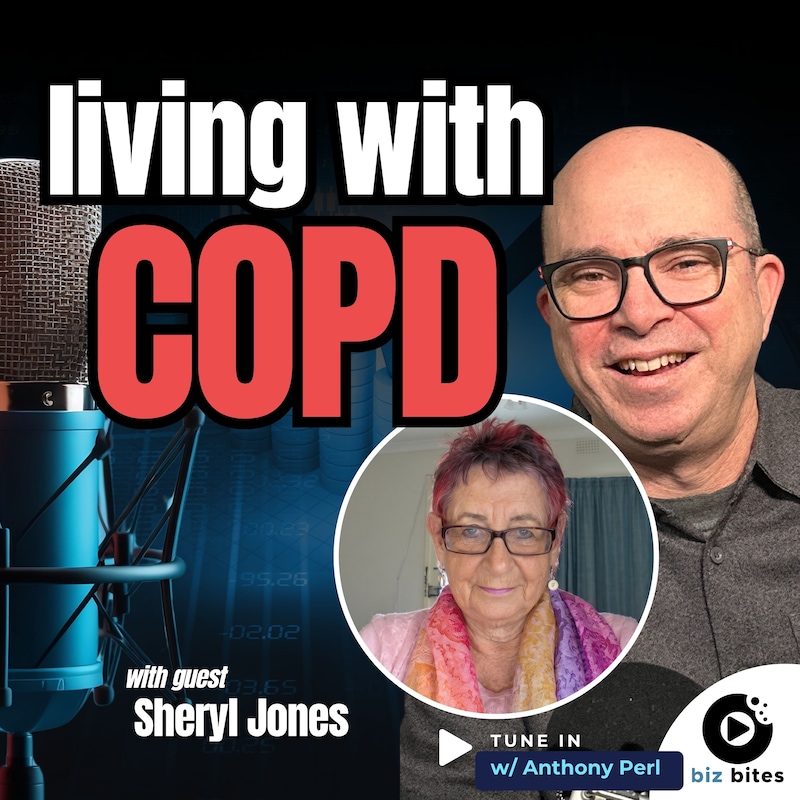
Shownotes
In this deeply moving episode of Biz Bites For Thought Leaders, Anthony Perl sits down with Sheryl Jones, a woman who has turned a frightening diagnosis into a powerful mission of awareness and hope.
Sheryl was diagnosed with emphysema, a form of COPD, and told she might have only 7 to 10 years to live. That prognosis could have defined her. Instead, she reached out to the Lung Foundation, learned to live mindfully, and discovered she could live well into her 90s and beyond. Now she is determined to help others walking the same path.
This is a different kind of thought leadership conversation. It is about leading with ideas, sharing lived experience, and creating awareness about a silent disease that affects 1 in 13 Australians over 40. Sheryl explains what COPD really feels like, why so many people go undiagnosed, the loneliness of living with an invisible illness, and her dream of launching her own podcast and running retreats for people living with lung disease.
Whether you live with a chronic condition, care for someone who does, or simply want to understand what real resilience looks like, this conversation will stay with you.
--
SHERYL JONES BIO:
Sheryl Jones is a COPD awareness advocate living in South Gippsland, Victoria. Born in Cardiff, Wales, she emigrated to Australia at 13 and has since travelled the country extensively, worked as a trainer, and spoken internationally on education, including an address to a committee in the House of Lords. Diagnosed with emphysema in 2014, Sheryl has become a passionate voice for people living with chronic lung disease. She works closely with the Lung Foundation Australia, has spoken at symposiums and to politicians in Canberra about the realities of living with COPD, and is now working towards launching her own podcast to create awareness and build a supportive community for others living with the condition.
CONNECT WITH SHERYL JONES:
Contact details available in the show notes. To support Sheryl's mission or discuss sponsorship of her upcoming podcast, please reach out through the show.
LUNG FOUNDATION AUSTRALIA:
If you or someone you know has a persistent cough, is often short of breath, or you hear them "sawing wood," please reach out to the Lung Foundation Australia. They offer a free risk-checklist questionnaire and access to nurses who can provide information and support.
Website: https://lungfoundation.com.au Information and Support Centre: 1800 654 301
DON'T FORGET...
------------------
Subscribe, like and comment wherever you are reading these show notes. Your support in this way ensures more people learn about the show.
------------------
Connect with Anthony Perl on LinkedIn: https://www.linkedin.com/in/adperl/
If you would like to be a guest on the program or you have a mentor that you think would be ideal, please reach out to us on LinkedIn so we can connect.
Learn more about all our guests in our easy-to-use directory: https://www.commtogether.com.au/biz-bites/
------------------
Interested in having your own podcast?
Anthony will co-host your branded show. Visit https://podcastsdoneforyou.com.au for more information, including free resources.
Our mission is to have brilliance heard. If you want to stand out as a Thought Leader, let us show you the power of podcasting. Book a free idea-sharing call here.
Ask us about our 'Podcasts Done for You' program.
------------------
#BizBitesForThoughtLeaders #COPD #LungHealth #ThoughtLeadership #PodcastingForBusiness #HealthAwareness #PodcastsDoneForYou #InvisibleIllness #AustralianStories
Transcripts
Anthony Perl: Welcome to a special
Speaker:edition of Biz Bites for Thought Leaders.
Speaker:Now, thought leadership is
Speaker:not always about being the most
Speaker:knowledgeable person in the room.
Speaker:Sometimes it's about being the
Speaker:bravest, and my guest today, Cheryl
Speaker:Jones, lives with a silent disease,
Speaker:and rather than stay quiet and just focus
Speaker:on her own health, she's chosen to
Speaker:speak up, to share her story, and ask
Speaker:for support to get her message out.
Speaker:There's a lesson in here for every
Speaker:thought leader.
Speaker:Be brave, put yourself out
Speaker:there, and share your journey, your
Speaker:insights, and your story, because you
Speaker:do not have to have all the answers now.
Speaker:Authenticity always wins.
Speaker:I'm your host, Anthony Pearl.
Speaker:Let's get into Biz Bites for
Speaker:Thought Leaders with the remarkable
Speaker:Cheryl Jones.
Speaker:Hello, everyone, and welcome to another
Speaker:episode of Biz Bites for Thought Leaders.
Speaker:I'm delighted to have Cheryl
Speaker:with me today.
Speaker:We're going to take you to a different
Speaker:kind of place for this program,
Speaker:because it's about thought leadership
Speaker:in a different way to what we normally
Speaker:cover, I would say, in the program,
Speaker:because this is really going to be
Speaker:get you thinking about your health.
Speaker:It's gonna get you thinking about the
Speaker:things that impact people, and how
Speaker:you need to make changes, and how
Speaker:you need to lead from the front even
Speaker:when you are the person at the center
Speaker:of what is causing some of the issues.
Speaker:So, that's probably a bit
Speaker:of a mysterious lead-in, but Cheryl,
Speaker:firstly, welcome to the program.
Speaker:Sheryl Jones: Thank you
Anthony Perl:Well, what we like to do
Anthony Perl:on the show always is allow you to
Anthony Perl:introduce yourself.
Anthony Perl:So Cheryl, why don't you explain
Anthony Perl:who you are and what you're about?
Sheryl Jones:Okay.
Sheryl Jones:My name, um, as you said, is Cheryl.
Sheryl Jones:I'm 67 years old.
Sheryl Jones:I am retired.
Sheryl Jones:I live down in South Gippsland.
Sheryl Jones:Um, I've been retired, well, sort
Sheryl Jones:of… I had to false retirement type
Sheryl Jones:thing because of, of what my health.
Sheryl Jones:Um, although I'm leading a very good
Sheryl Jones:life at the moment because I've been
Sheryl Jones:mindful, and I'm hopefully doing
Sheryl Jones:the right thing.
Sheryl Jones:I've been in Australia
Sheryl Jones:since I was 13.
Sheryl Jones:Um, we emigrated from Wales, from
Sheryl Jones:Cardiff, actually.
Sheryl Jones:Um, love Australia.
Sheryl Jones:I've been around Australia
Sheryl Jones:three times.
Sheryl Jones:Absolutely love it, and it's God's
Sheryl Jones:best-kept secret.
Sheryl Jones:I've done a variety of work.
Sheryl Jones:I've been a trainer.
Sheryl Jones:Um, I counted urea bags in
Sheryl Jones:Western Australia.
Sheryl Jones:I was Fred Bassett over there.
Sheryl Jones:So, um, I like to try things.
Sheryl Jones:Um, I've, uh, also spoken in the
Sheryl Jones:House of Lords.
Sheryl Jones:When I went over for a holiday on
Sheryl Jones:education, they found out that I was
Sheryl Jones:going over there.
Sheryl Jones:Um, I spoke in Baroness Cox's
Sheryl Jones:committee.
Sheryl Jones:Only supposed to speak for
Sheryl Jones:20 minutes.
Sheryl Jones:I spoke for 40, and I had them in tears.
Sheryl Jones:Um, that was the time back when we
Sheryl Jones:had Dr. David Kemp as federal minister.
Sheryl Jones:Um, he used to liaise with me.
Sheryl Jones:Um, it's not the teachers'
Sheryl Jones:fault, it's the teachers' teachers,
Sheryl Jones:so we found.
Sheryl Jones:And I did that for a number of
Sheryl Jones:years and then, of course, we had a
Sheryl Jones:marriage breakup, and then I moved
Sheryl Jones:to the mainland.
Sheryl Jones:Um, it seemed for health reasons
Sheryl Jones:that Queensland was better.
Sheryl Jones:Um, my son was also a chronic
Sheryl Jones:asthmatic when he was a child, and I
Sheryl Jones:had asthma when I was born, so I, I,
Sheryl Jones:I've grown with it.
Sheryl Jones:Um, so Queensland, because of the
Sheryl Jones:mild weath- well, the nice weather,
Sheryl Jones:um, was a lot more suitable for us
Sheryl Jones:to live, and we lived there for a
Sheryl Jones:number of years.
Sheryl Jones:Um, and then until, um, when was it?
Sheryl Jones:2014, um, I lost, um, my father
Sheryl Jones:and my mother, I lost her in 2009.
Sheryl Jones:So, um, you live a very different
Sheryl Jones:life when you, when you've lost
Sheryl Jones:your parents.
Sheryl Jones:You become really, really independent
Sheryl Jones:then, which is good.
Sheryl Jones:You have to.
Sheryl Jones:I also got diagnosed in 2014
Sheryl Jones:with emphysema.
Sheryl Jones:Um, though it did lay dormant for
Sheryl Jones:a number of years till 2020 and I
Sheryl Jones:came down here.
Sheryl Jones:I accidentally didn't know, but
Sheryl Jones:I was, um, putting bark into sacks,
Sheryl Jones:and I'm selling them because
Sheryl Jones:we had a couple of trees felled
Sheryl Jones:in the property and that caused
Sheryl Jones:brittle asthma.
Sheryl Jones:Uh, brittle asthma is very different.
Sheryl Jones:You can't walk two feet and
Sheryl Jones:you're puffed out.
Sheryl Jones:Um, it's not emphysema.
Sheryl Jones:It is literally brittle asthma.
Sheryl Jones:That was terrible, and had that for
Sheryl Jones:about 18 months, then that subsided.
Sheryl Jones:Kept on coughing.
Sheryl Jones:Had more tests.
Sheryl Jones:Emphysema had raised its head
Sheryl Jones:So I was really panicking then,
Sheryl Jones:um, 'cause where I come from, my
Sheryl Jones:grandfather died at 56 with emphysema.
Sheryl Jones:My mother was diagnosed with
Sheryl Jones:emphysema.
Sheryl Jones:Yes, they were both smokers.
Sheryl Jones:Even I was a smoker, but, um, gave up
Sheryl Jones:in 2014, mind you.
Sheryl Jones:They also say that because we were
Sheryl Jones:born with asthma, it can lead on to
Sheryl Jones:COPD and emphysema.
Sheryl Jones:So, um, of course, I was in panic
Sheryl Jones:mode because back then we were led
Sheryl Jones:to believe that if you were diagnosed
Sheryl Jones:with emphysema, you only had seven to
Sheryl Jones:10 years to live.
Sheryl Jones:So you can imagine what I went through,
Sheryl Jones:um, 'cause I'd just come down and my
Sheryl Jones:son was down here, had a grandson.
Sheryl Jones:Um, I was reconnecting with
Sheryl Jones:all my old friends because I used to
Sheryl Jones:live in Melbourne i- in the past,
Sheryl Jones:um, having a great time down here,
Sheryl Jones:and then all of a sudden this.
Sheryl Jones:Y- you don't know what to do.
Sheryl Jones:Um, you're scared you're going to die.
Sheryl Jones:Um, and I remember seeing what
Sheryl Jones:my grandfather went through.
Sheryl Jones:I do not want anybody to see
Sheryl Jones:what, um, myself in that position
Sheryl Jones:in, when it comes to the end times.
Sheryl Jones:So fortunately, I had a very good
Sheryl Jones:doctor, and she said, "Cheryl, you
Sheryl Jones:ring up the Lung Foundation." I
Sheryl Jones:rang up the Lung Foundation, and
Sheryl Jones:I can honestly say they saved my
Sheryl Jones:life, literally.
Sheryl Jones:Um, I was with the nurses for
Sheryl Jones:about 18 months.
Sheryl Jones:They used to call me.
Sheryl Jones:We would put plans in place.
Sheryl Jones:Um, they taught me how to be mindful,
Sheryl Jones:and no, it's not seven to 10 years.
Sheryl Jones:You can live till you're 90.
Sheryl Jones:You can live till you're 100.
Sheryl Jones:So that's what I intend to do,
Sheryl Jones:live way past 100
Anthony Perl:But there's so much to
Anthony Perl:unpack in, in all of that because
Anthony Perl:it's been quite a story, and I
Anthony Perl:love how you've summarized that,
Anthony Perl:uh, very quickly.
Anthony Perl:And, uh, I should tell everyone that,
Anthony Perl:uh, Cheryl and I have had a couple
Anthony Perl:of conversations, so this is…
Anthony Perl:uh, there's a lot to explore here
Anthony Perl:in what's, uh, been a, a very
Anthony Perl:interesting journey.
Anthony Perl:Uh, I want to start back to the
Anthony Perl:beginning, if I can, and talk about, you
Anthony Perl:know, that move, li- moving from,
Anthony Perl:uh, from Cardiff, from Wales, and
Anthony Perl:moving to Australia.
Anthony Perl:As a 13-year-old, it's kind of an
Anthony Perl:awkward age to be moving, right?
Anthony Perl:Because you've got friends
Anthony Perl:and everything.
Anthony Perl:You're settled there.
Anthony Perl:So it's a big move to come
Anthony Perl:to Australia.
Anthony Perl:What was that like and, and how
Anthony Perl:did that have an impact, do you
Anthony Perl:think, into, you know, for things in
Anthony Perl:the future for you?
Sheryl Jones:Um, it was very sad for
Sheryl Jones:me because I had to sell my horse.
Sheryl Jones:Um, we had to give the dog away
Sheryl Jones:because we didn't realize we could
Sheryl Jones:actually take dogs.
Sheryl Jones:Um, we gave all our records away.
Sheryl Jones:Um, so yeah, for me, I was doing
Sheryl Jones:so well at school.
Sheryl Jones:Um, I was in the 92 percentile, um,
Sheryl Jones:in high school.
Sheryl Jones:Um, it was devastating,
Sheryl Jones:absolutely devastating.
Sheryl Jones:Um, however, I did enjoy the
Sheryl Jones:time on the boat.
Sheryl Jones:Uh, we were on the boat for five weeks
Sheryl Jones:going over because the, all the staff
Sheryl Jones:went on strike in Tenerife Island.
Sheryl Jones:So we all had an absolute blast.
Sheryl Jones:Um, so the boat trip was really good.
Sheryl Jones:Uh, we ended up going to Tasmania
Sheryl Jones:'cause that's where a lot of my family
Sheryl Jones:were, had already moved to Tasmania.
Sheryl Jones:Um, for the first three, two, three
Sheryl Jones:years, um, I tried to stowaway on
Sheryl Jones:a couple of big ships, um, Japanese
Sheryl Jones:ships, to try and get back to Wales,
Sheryl Jones:and of course, I got caught.
Sheryl Jones:Um-
Sheryl Jones:Um, look, I, I didn't do drugs or
Sheryl Jones:anything back then.
Sheryl Jones:Um, we weren't drinkers, so I
Sheryl Jones:didn't get drunk, didn't do drugs.
Sheryl Jones:Yes, I might have smoked but,
Sheryl Jones:um, I was still reasonably sensible.
Sheryl Jones:Um, and I wanted to try everything,
Sheryl Jones:you know, first for everything.
Sheryl Jones:So going on the Japanese boat
Sheryl Jones:wasn't a good move.
Sheryl Jones:So my mother, um, sent me to…
Sheryl Jones:tried to send me to Western
Sheryl Jones:Australia, um, to be with my cousin.
Sheryl Jones:And from Tasmania, I got off in
Sheryl Jones:Melbourne, and instead of getting
Sheryl Jones:on the flight going from, um, Melbourne
Sheryl Jones:to Perth, I just walked out of the
Sheryl Jones:airport and had a great time for
Sheryl Jones:about two weeks.
Sheryl Jones:I went on trains and I went to try
Sheryl Jones:and find people from the boat.
Sheryl Jones:And back then it was safe.
Sheryl Jones:It's not as safe anymore.
Sheryl Jones:Um, so they did finally find me
Sheryl Jones:and I did have to go back to
Sheryl Jones:Western Australia unfortunately.
Sheryl Jones:Um, but then I did leave home a
Sheryl Jones:few years later.
Sheryl Jones:I just couldn't settle.
Sheryl Jones:So I ended up going around Australia.
Sheryl Jones:Um, I left Mum a Dear John letter
Sheryl Jones:and I put my thumb out, "Let's go."
Sheryl Jones:So that was fantastic.
Sheryl Jones:Um, however, I still did have asthma.
Sheryl Jones:Um, I always had to make sure that
Sheryl Jones:I had my Ventolin spray with me.
Sheryl Jones:Um, so that was really good.
Sheryl Jones:Um, didn't mean to… Sorry,
Sheryl Jones:I'll, I'll just go back a bit to
Sheryl Jones:the schooling.
Sheryl Jones:Um, my first year nobody could
Sheryl Jones:understand a thing I was saying
Sheryl Jones:because as Welsh we talk very fast.
Sheryl Jones:Um, they had to assign me with an
Sheryl Jones:English girl who said, you know,
Sheryl Jones:"Slow down and, you know, we'll
Sheryl Jones:get you to meet some friends." So
Sheryl Jones:the last two years of school was,
Sheryl Jones:um, interesting.
Sheryl Jones:I was put forward a, a year because
Sheryl Jones:in Great Britain, I don't know
Sheryl Jones:if we were more advanced but, um,
Sheryl Jones:well, we, well, we probably were.
Sheryl Jones:That's why I was put up into grade nine
Sheryl Jones:instead of grade eight, so I was very
Sheryl Jones:young for my age.
Sheryl Jones:But I was tall, so I managed to
Sheryl Jones:take that off.
Sheryl Jones:Um, so yeah, so okay if you go
Sheryl Jones:a bit forward.
Sheryl Jones:So I left, left home, went round
Sheryl Jones:Australia three times, ended up
Sheryl Jones:settling, um, and just sort of
Sheryl Jones:getting on with life basically, um, doing
Sheryl Jones:a variety of things.
Sheryl Jones:I can't just do one thing.
Sheryl Jones:I've got to do jack-of-all-trades
Sheryl Jones:type thing.
Sheryl Jones:Worked for Medibank Private.
Sheryl Jones:Um
Sheryl Jones:secretary Girl Friday back then.
Sheryl Jones:Loved horses.
Sheryl Jones:Um, although with asthma, I
Sheryl Jones:was allergic to everything, um,
Sheryl Jones:horses, dogs, cats, and I was
Sheryl Jones:a animal lover.
Sheryl Jones:Had four horses.
Sheryl Jones:Had to take Sudafed all the time, um,
Sheryl Jones:or be prepared to be on the nebulizer
Sheryl Jones:that night.
Sheryl Jones:I wasn't gonna give up my, my love for
Sheryl Jones:animals in any way, shape, or form.
Sheryl Jones:Um, so then we mo- I, um, met my,
Sheryl Jones:um, husband, moved back to Tasmania,
Sheryl Jones:um, had children, um, over there.
Sheryl Jones:Then we moved back to Melbourne
Sheryl Jones:because the work wasn't really all
Sheryl Jones:that good over there, so we moved
Sheryl Jones:back to Melbourne.
Sheryl Jones:And then my, uh, my son was really
Sheryl Jones:chronic with asthma.
Sheryl Jones:Uh, he had to have soy milk.
Sheryl Jones:You couldn't give him different
Sheryl Jones:colored cordial.
Sheryl Jones:He would have asthma straightaway.
Sheryl Jones:We used to sleep in our, um Uh,
Sheryl Jones:our tracky dacks, because we'd be
Sheryl Jones:calling ambulances all the time.
Sheryl Jones:So it was really q- quite sad.
Sheryl Jones:Um, I had to have all his teddies
Sheryl Jones:put in plastic bags so that
Sheryl Jones:there was no dust.
Sheryl Jones:Um, he couldn't go to many children's
Sheryl Jones:parties because twisties, Cokes,
Sheryl Jones:ice cream would set him off.
Sheryl Jones:That was really sad.
Sheryl Jones:But we did end up having an open home
Sheryl Jones:for him, and all his friends used to come
Sheryl Jones:and play with him, so that was fine.
Sheryl Jones:Um, he was born … When he was first
Sheryl Jones:born, um, I didn't see him for a couple
Sheryl Jones:of days 'cause he was a bit blue.
Sheryl Jones:And basically from a few months
Sheryl Jones:of age, he w- he was allergic
Sheryl Jones:to absolutely everything.
Sheryl Jones:So he was a little bit of a nightmare
Sheryl Jones:to bring up.
Sheryl Jones:Um, he also had sleep apnea, where
Sheryl Jones:he'd stop breathing.
Sheryl Jones:So that was, yes, that was very
Sheryl Jones:interesting time.
Sheryl Jones:I'd be driving along, and I'd look
Sheryl Jones:at him through the window, and oh,
Sheryl Jones:my God, no, he's stopped breathing.
Sheryl Jones:I'd have to scoot over, get him,
Sheryl Jones:shake him, lift him up, and he
Sheryl Jones:would come back.
Sheryl Jones:Um, we had tests and, yes, you know,
Sheryl Jones:when you sigh, you go, you get that
Sheryl Jones:really big sigh, you do stop breathing
Sheryl Jones:for a few seconds.
Sheryl Jones:Carl would stop breathing for 18
Sheryl Jones:seconds, which was 10 seconds too long.
Sheryl Jones:Um, so that was really interesting
Sheryl Jones:for the first few years.
Sheryl Jones:Um, fortunately, our German Shepherd
Sheryl Jones:would sleep underneath his cot
Sheryl Jones:and come and get me before the sleep
Sheryl Jones:apnea machine would go off, which was
Sheryl Jones:fantastic, so that was really good.
Sheryl Jones:Um, and then we moved back
Sheryl Jones:to Melbourne.
Sheryl Jones:Then I had my daughter, and
Sheryl Jones:she is as fit as a Mallee bull.
Sheryl Jones:Nothing wrong with her whatsoever.
Sheryl Jones:No asthma, no eczema, no allergic
Sheryl Jones:to anything.
Sheryl Jones:It was like, wow.
Sheryl Jones:You know?
Sheryl Jones:So two total opposites,
Sheryl Jones:total opposites.
Sheryl Jones:A- and to this day she is very
Sheryl Jones:healthy, very fit and healthy.
Sheryl Jones:Whereas my son, who's now 39,
Sheryl Jones:um, only has 40% of his lungs.
Sheryl Jones:He has chronic COPD, but he is
Sheryl Jones:very healthy.
Sheryl Jones:The only thing he can't do is run.
Sheryl Jones:Um, he eats superbly.
Sheryl Jones:He used to be a chef.
Sheryl Jones:Um, he used to … He's a trainer to
Sheryl Jones:go to the gym, but he's got other work.
Sheryl Jones:So he's very strict with his food,
Sheryl Jones:and because he's strict with his
Sheryl Jones:food, he is very healthy himself.
Sheryl Jones:Doesn't smoke, doesn't drink, so
Sheryl Jones:I'm really pleased with all of that.
Sheryl Jones:Um, so during my journey and doing
Sheryl Jones:a lot of things, there were a lot
Sheryl Jones:of people that I came across that
Sheryl Jones:did have asthma.
Sheryl Jones:Um, but it was sort of like the
Sheryl Jones:silent disease.
Sheryl Jones:You sort of stayed home when
Sheryl Jones:you had it all.
Sheryl Jones:So it's like, you know, that,
Sheryl Jones:that was fine.
Sheryl Jones:Um, you didn't know, people didn't
Sheryl Jones:know much about asthma, didn't know
Sheryl Jones:anything about COPD.
Sheryl Jones:Um, so a- as time went on, um, I
Sheryl Jones:did go back to uni when I was 39, then
Sheryl Jones:realized that my husband and I really
Sheryl Jones:weren't compatible, so there was a,
Sheryl Jones:a divorce there.
Sheryl Jones:Um, I was very strong, very
Sheryl Jones:independent again.
Sheryl Jones:Um- Got a number of positions, which
Sheryl Jones:was really good.
Sheryl Jones:In charge of quite a few telemarketers
Sheryl Jones:at the time.
Sheryl Jones:Became a trainer, then moved back
Sheryl Jones:up to Queensland because it was
Sheryl Jones:better for my son.
Sheryl Jones:Um, so what can I say from there?
Sheryl Jones:From there we all grew up, and
Sheryl Jones:we basically did our own thing.
Sheryl Jones:Um, and like I said, back in two, uh,
Sheryl Jones:2014, I actually, um, was diagnosed
Sheryl Jones:with, um, emphysema, which is COPD.
Sheryl Jones:COPD is actually a group of
Sheryl Jones:lung diseases.
Sheryl Jones:Um, there's, there's two of them.
Sheryl Jones:Um, one is emphysema and one is chronic
Sheryl Jones:bronchitis, but we can go into that
Sheryl Jones:a bit later on.
Sheryl Jones:Um, what I did notice was that
Sheryl Jones:there really wasn't much help
Sheryl Jones:for COPD or, you know, chronic
Sheryl Jones:lung disease.
Sheryl Jones:You were diagnosed with it, then
Sheryl Jones:that was it.
Sheryl Jones:Bye-bye.
Sheryl Jones:See you later type thing.
Sheryl Jones:You know, just keep on checking in
Sheryl Jones:with your doctor.
Sheryl Jones:Um, it didn't affect me too much
Sheryl Jones:in Queensland.
Sheryl Jones:It was great.
Sheryl Jones:I could still go out dancing.
Sheryl Jones:Um, very active person.
Sheryl Jones:Um, I used to do 10 kilometers a
Sheryl Jones:day with my dog.
Sheryl Jones:Um, had a few dogs back then.
Sheryl Jones:So the two dogs would stay home.
Sheryl Jones:They were small.
Sheryl Jones:They couldn't do the five kilometers,
Sheryl Jones:so, um, I would take my other dog,
Sheryl Jones:which was great.
Sheryl Jones:Um, and then like I said, I moved back
Sheryl Jones:down to Melbourne, and that's when
Sheryl Jones:the COPD rose its head again
Sheryl Jones:Anthony Perl: I think this is
Sheryl Jones:a really, uh, important point
Sheryl Jones:to maybe pause for a minute and tell
Sheryl Jones:everyone that part of the reason that
Sheryl Jones:Cheryl and I are talking is that
Sheryl Jones:we'd love to help Cheryl get, uh, an
Sheryl Jones:ongoing podcast of her own, because I
Sheryl Jones:think this is such a critical message
Sheryl Jones:to be sharing with people and to
Sheryl Jones:be understanding what it's like to
Sheryl Jones:be living with, uh, COPD, but
Sheryl Jones:also what the opportunities are.
Sheryl Jones:I think this is-- we're gonna touch on
Sheryl Jones:some of these things as we go through the
Sheryl Jones:podcast today, and I think to me, thought
Sheryl Jones:leadership isn't just about getting
Sheryl Jones:your business in front, it's about
Sheryl Jones:leading with ideas and simple things,
Sheryl Jones:and I think being able to share
Sheryl Jones:stories and learn, uh, from each other
Sheryl Jones:'cause I think one of the fascinating
Sheryl Jones:things that I just want to touch on
Sheryl Jones:that I know you spoke to me about
Sheryl Jones:off air, which is a- about the fact that
Sheryl Jones:there are, there's plenty of research
Sheryl Jones:and things going on, but there's a
Sheryl Jones:lot of the obvious stuff that perhaps
Sheryl Jones:doesn't get noticed.
Sheryl Jones:And so you've already been able to
Sheryl Jones:be at the forefront of bringing some
Sheryl Jones:of these things to people's attention.
Sheryl Jones:Uh, I know you told me y- you attended a
Sheryl Jones:symposium last year where, you know, you
Sheryl Jones:made them aware of some of these things
Sheryl Jones:that perhaps they're not aware of.
Sheryl Jones:Sheryl Jones: The symposium
Sheryl Jones:was in June.
Sheryl Jones:It was last November.
Sheryl Jones:I went up to Canberra, and I
Sheryl Jones:was-- I spoke to a few politicians and
Sheryl Jones:the main speaker on how, um, living
Sheryl Jones:with COPD, what it's like, 'cause
Sheryl Jones:people don't know.
Sheryl Jones:Because you see, look at me now.
Sheryl Jones:I look fine, don't I?
Sheryl Jones:You know?
Sheryl Jones:Absolutely.
Sheryl Jones:Nothing's wrong with me.
Sheryl Jones:Absolutely nothing's wrong with me.
Sheryl Jones:That's because I'm sitting down.
Sheryl Jones:Don't ask me to get up and walk
Sheryl Jones:into the bedroom.
Sheryl Jones:Don't ask me to make the bed.
Sheryl Jones:Don't ask me to sweep outside
Sheryl Jones:or vacuum.
Sheryl Jones:Um, definitely don't ask me to
Sheryl Jones:go walking in the shopping center.
Sheryl Jones:You know, that's a no.
Sheryl Jones:And we need to create
Sheryl Jones:this awareness because people
Sheryl Jones:do not realize what it's like.
Sheryl Jones:Um, also, also you've got to be
Sheryl Jones:very mindful of where you live,
Sheryl Jones:what you eat, what you do.
Sheryl Jones:I'm very mindful of things now
Sheryl Jones:because I want to live till I'm
Sheryl Jones:ninety, you know?
Sheryl Jones:So I've moved into the country.
Sheryl Jones:Um, and that's what I need to do is,
Sheryl Jones:is create awareness with people.
Sheryl Jones:So the symposium was in June, and what
Sheryl Jones:that was, there was a few of us that
Sheryl Jones:have the disease and we of course, went
Sheryl Jones:to the symposium.
Sheryl Jones:It was a lot of researchers getting
Sheryl Jones:together, telling us about or telling
Sheryl Jones:everybody about, um, their research.
Sheryl Jones:And through that, I found out about an
Sheryl Jones:injection, wait for it Drumroll, COPD.
Sheryl Jones:Could not believe my ears.
Sheryl Jones:Yes, there's actually an
Sheryl Jones:injection for COPD.
Sheryl Jones:I was so excited about that, so
Sheryl Jones:of course, on the breaks, I would go
Sheryl Jones:up to the professor from Western
Sheryl Jones:Australia and ask him all about it,
Sheryl Jones:which I got a fair bit of information.
Sheryl Jones:So research has come along so far.
Sheryl Jones:Oh, and by the way, I didn't actually
Sheryl Jones:tell you, I am on another injection
Sheryl Jones:at this point for asthma, and
Sheryl Jones:I've had it for four months now.
Sheryl Jones:Once a month you have it.
Sheryl Jones:The only thing is, though, it wanes
Sheryl Jones:off round about three weeks, and
Sheryl Jones:I hit the wall.
Sheryl Jones:Literally hit the wall.
Sheryl Jones:So I'm hoping in a couple of months'
Sheryl Jones:time to transgress or go onto this
Sheryl Jones:COPD injection.
Sheryl Jones:Fingers crossed.
Anthony Perl:I think, y- you know,
Anthony Perl:this is interesting that you, you have
Anthony Perl:to go to some of these things to
Anthony Perl:hear about some of these opportunities.
Anthony Perl:But equally, there's things that those
Anthony Perl:that are living with this are
Anthony Perl:able to inform the researchers on,
Anthony Perl:because they tend to look, I, I guess,
Anthony Perl:at, at higher level things and not get,
Anthony Perl:uh, not, maybe not aware of some of the
Anthony Perl:day-to-day symptoms and impacts that
Anthony Perl:people are having.
Sheryl Jones:Well, no, that's right.
Sheryl Jones:We've actually brought something
Sheryl Jones:up to that.
Sheryl Jones:Um, the group of us there, we
Sheryl Jones:all realize that when we're having
Sheryl Jones:flare-ups, um, even a small flare-up
Sheryl Jones:like maybe, um, you know, walking
Sheryl Jones:down the road, we start sweating.
Sheryl Jones:So you will see a few people going
Sheryl Jones:around with fans like this in the
Sheryl Jones:middle of winter.
Sheryl Jones:You know, my head is dripping with sweat.
Sheryl Jones:I just thought it was one of those
Sheryl Jones:things, but no, it actually gets worse.
Sheryl Jones:So this is called the silent disease.
Sheryl Jones:So people cannot see, u- unless
Sheryl Jones:you're literally sawing wood all the
Sheryl Jones:time, that's what I call it, it is
Sheryl Jones:very hard to see.
Sheryl Jones:So what the symposium did was
Sheryl Jones:actually show us there's m- uh,
Sheryl Jones:research out there which is excellent,
Sheryl Jones:and then we've asked a couple of people
Sheryl Jones:to look into how we sweat, and can there
Sheryl Jones:be some research done on that?
Sheryl Jones:Um, so that w- so that was absolutely
Sheryl Jones:excellent.
Sheryl Jones:Absolutely superb.
Anthony Perl:It's, we, we can't go
Anthony Perl:past this without explaining, tell us
Anthony Perl:what sawing wood is.
Sheryl Jones:Oh, saw- sawing wood.
Sheryl Jones:Um, when you've had an asthma attack,
Sheryl Jones:when you've got constant emphysema,
Sheryl Jones:that's what I call sawing wood.
Sheryl Jones:You can hear somebody all the
Sheryl Jones:time, so you know they've either
Sheryl Jones:got asthma, um, or they've got
Sheryl Jones:emphysema or chronic bronchitis,
Sheryl Jones:one of the two
Anthony Perl:I think the fact that
Anthony Perl:this is, as you've described it, is a
Anthony Perl:silent disability because people, you
Anthony Perl:know, can't see it so obviously, and
Anthony Perl:that makes it hard.
Anthony Perl:I mean, there are a number of these,
Anthony Perl:uh, things that fall into this category.
Anthony Perl:And I think we, we still as a society
Anthony Perl:still coming to terms with that and,
Anthony Perl:and understanding that, you know,
Anthony Perl:just because we see someone that
Anthony Perl:looks completely fine doesn't
Anthony Perl:mean that they actually are fine.
Anthony Perl:And, and, and h- and, and I guess
Anthony Perl:that's the case is, how do you
Anthony Perl:grapple with that?
Anthony Perl:Is it something where you feel
Anthony Perl:the need to tell people about it?
Anthony Perl:Uh, you know, at what point do you--
Anthony Perl:does that come into the equation?
Anthony Perl:Sheryl Jones: Um, no.
Anthony Perl:Um, I actually don't tell anybody,
Anthony Perl:only a few.
Anthony Perl:Well, I am now, um, because I
Anthony Perl:was on Facebook and did some, um,
Anthony Perl:promoting for the Lung Foundation to
Anthony Perl:generate some more money, so people
Anthony Perl:have seen me on the foundation.
Anthony Perl:They know I've got it now.
Anthony Perl:Um, but what I find is when I
Anthony Perl:do tell people, um, the majority
Anthony Perl:of people treat me differently.
Anthony Perl:"Oh, can't come here.
Anthony Perl:Don't invite her here.
Anthony Perl:Don't ask her to do this.
Anthony Perl:Don't ask her to…" No, no, no, no, no.
Anthony Perl:Do not do that.
Anthony Perl:Just treat… Just, okay, don't ask me
Anthony Perl:to run a marathon.
Anthony Perl:Um, don't ask me to do anything quickly.
Anthony Perl:Um, let me bide my time a bit, but just
Anthony Perl:treat us normal, because we are.
Anthony Perl:We- we, you know, we can hear, we
Anthony Perl:can, we can see.
Anthony Perl:We can still do things.
Anthony Perl:Like I said, when I'm sitting down,
Anthony Perl:everything is great.
Anthony Perl:Um, so there is a badge actually
Anthony Perl:out, and it's a sunflower, and,
Anthony Perl:um, it just says, "I have a silent
Anthony Perl:disease." Now, I'm gonna try and get
Anthony Perl:some of those so that I can actually
Anthony Perl:promote it, and people can see it.
Anthony Perl:They can either have the, um, the
Anthony Perl:sense to come up and say, "Well,
Anthony Perl:what type of disease do you have?" Um,
Anthony Perl:a- and sort of go from there.
Anthony Perl:Because, again, one of my main reasons
Anthony Perl:for hopefully doing these podcasts is
Anthony Perl:to create awareness.
Anthony Perl:Um, living with COPD is not a death toll.
Anthony Perl:Um, you can live till you're ninety
Anthony Perl:or a hundred.
Anthony Perl:You'll probably be taken out with
Anthony Perl:something else.
Anthony Perl:Well, that's fine, you know?
Anthony Perl:And there is now, there is now treat-
Anthony Perl:treatments, and it can be prevented.
Anthony Perl:So they've come that far in doing
Anthony Perl:things, which is just amazing.
Anthony Perl:So this is where we need more
Anthony Perl:research done.
Anthony Perl:Um, and the Lung Foundation are
Anthony Perl:absolutely superb.
Anthony Perl:Everybody that thinks they've
Anthony Perl:got it, their, their friends,
Anthony Perl:if they know of somebody, just get
Anthony Perl:them to go to the Lung Foundation.
Anthony Perl:There's a test, and then you can
Anthony Perl:actually ring them and talk to them
Anthony Perl:and talk to one of the nurses.
Anthony Perl:And like I said, they saved my life.
Anthony Perl:Literally saved my life.
Anthony Perl:I think what's, uh,
Anthony Perl:valuable for people to understand here
Anthony Perl:is that people are living sometimes
Anthony Perl:with this and don't recognize that there
Anthony Perl:is this, and even the doctors may
Anthony Perl:not have recognized that there is this.
Anthony Perl:I know you, you were telling me
Anthony Perl:off air about, uh, someone locally
Anthony Perl:that you've helped direct towards the
Anthony Perl:Lung Foundation as well, because you
Anthony Perl:recognized some of the symptoms.
Anthony Perl:So, so talk to me about, you know,
Anthony Perl:firstly that process of, of having
Anthony Perl:those conversations with someone and,
Anthony Perl:and bringing that up and turning
Anthony Perl:them towards, uh, getting help.
Sheryl Jones:Well, um, down where I
Sheryl Jones:live now, um, I have a shop, um, that
Sheryl Jones:I work voluntary in, um, three days
Sheryl Jones:a week 'cause it's a tourist area.
Sheryl Jones:And I start… I had this client come
Sheryl Jones:in regularly to buy some dog treats, and
Sheryl Jones:he was sawing wood.
Sheryl Jones:Any case, when I got to know him,
Sheryl Jones:I said, "How come you're sawing wood
Sheryl Jones:all the time?" And he sort of looked
Sheryl Jones:at me and he said, "Oh, it's just one
Sheryl Jones:of those things."
Sheryl Jones:I said, "No, it's not just one of
Sheryl Jones:those things." I said, "You're always
Sheryl Jones:out of breath." I said, "Please go to
Sheryl Jones:your doctor and ask him to test you.
Sheryl Jones:Ask him to take at, at least an X-ray.
Sheryl Jones:Um, go to the Lung Foundation and see
Sheryl Jones:what they say." So he ended up going
Sheryl Jones:to his doctor.
Sheryl Jones:Um, I did tell him about the,
Sheryl Jones:the yellow spray that I'm on
Sheryl Jones:for emphysema.
Sheryl Jones:Um, I take it twice a day and it helps.
Sheryl Jones:It helps, um, n- make, not things
Sheryl Jones:get so worse.
Sheryl Jones:So I told him about that, so he went
Sheryl Jones:to his doctor, he told him about that.
Sheryl Jones:The doctor did some tests or something,
Sheryl Jones:and he gave him the prescription for
Sheryl Jones:that medication.
Sheryl Jones:He came back and saw me the next
Sheryl Jones:week, and he said it's the best he's
Sheryl Jones:felt in 15 years.
Sheryl Jones:So I was so pleased that I was able to
Sheryl Jones:do something for somebody, and now
Sheryl Jones:he comes in the shop every week, week.
Sheryl Jones:And, and it's just amazing.
Sheryl Jones:I've seen him change in the last,
Sheryl Jones:uh, six months that he's been on
Sheryl Jones:the medication.
Sheryl Jones:He's not as, um, out of breath.
Sheryl Jones:Um, still sawing wood a little bit,
Sheryl Jones:but after sawing wood for 15 years,
Sheryl Jones:and only now having medication for
Sheryl Jones:it, he's doing pretty good.
Sheryl Jones:So, and, and look, he's 78.
Sheryl Jones:So if he can get to 78, I'm
Sheryl Jones:sure I can too.
Sheryl Jones:Maybe, no, actually older because I've
Sheryl Jones:got medication
Anthony Perl:You know, I, I think
Anthony Perl:there's, uh, it- there's so much
Anthony Perl:in there that's, you know, I think
Anthony Perl:this is the thing, isn't it, that, that
Anthony Perl:people are going around with this
Anthony Perl:kind of a disease not recognizing it,
Anthony Perl:and the fact that it takes someone like
Anthony Perl:yourself to be able to point that out,
Anthony Perl:I mean, he'd been living with it for
Anthony Perl:quite some period of time, and hopefully
Anthony Perl:now he's on a course to a much
Anthony Perl:better lifestyle as a result of it.
Anthony Perl:Uh, but it's almost opportunistic
Anthony Perl:that you saw it.
Anthony Perl:So I, I think, you know, obviously we
Anthony Perl:want doctors to be better educated,
Anthony Perl:but we want the, the public to be
Anthony Perl:better educated to recognize it
Anthony Perl:in themselves or recognize it in,
Anthony Perl:in other people.
Sheryl Jones:Well, well that's right.
Sheryl Jones:And, um, there are quite a few adverts
Sheryl Jones:at the moment, like if you've got a
Sheryl Jones:persistent cough, um, especially
Sheryl Jones:after three weeks, if it is still
Sheryl Jones:there, go to your doctor, ask the
Sheryl Jones:questions, or go to the Lung Foundation
Sheryl Jones:website, take the questionnaire
Sheryl Jones:there, ring up the nurses there.
Sheryl Jones:You need to do something because
Sheryl Jones:it's not only you, it is your family.
Sheryl Jones:'Cause believe you me, you don't
Sheryl Jones:want your family to see when you
Sheryl Jones:get really bad.
Sheryl Jones:If you can stop the progress of
Sheryl Jones:that, that is major because it is, it,
Sheryl Jones:it's so, oh, it's absolutely awful.
Sheryl Jones:Um, I remember seeing my
Sheryl Jones:grandfather and I was only seven, um,
Sheryl Jones:back in the days though, he used
Sheryl Jones:to smoke a lot and of course he was
Sheryl Jones:having his oxygen mask there and
Sheryl Jones:then a smoke there, oxygen, smoke.
Sheryl Jones:But he was still really bad.
Sheryl Jones:At 56, he shouldn't have gone.
Sheryl Jones:Should not have gone.
Sheryl Jones:Um, but he did and it was horrific.
Sheryl Jones:Absolutely horrific.
Sheryl Jones:Yes.
Sheryl Jones:So you don't want to get that far
Sheryl Jones:now that there is medication
Sheryl Jones:out there.
Sheryl Jones:Uh, what I actually find too is it's
Sheryl Jones:that a lot of people in the regional
Sheryl Jones:areas that don't have the support,
Sheryl Jones:um, doctors down here, if you want
Sheryl Jones:to see a doctor down here, unless
Sheryl Jones:your limbs are hanging off, there's
Sheryl Jones:a six-week wait.
Sheryl Jones:How can you wait six weeks?
Sheryl Jones:You have an asthma attack, you can die.
Sheryl Jones:I, I can't fathom that.
Sheryl Jones:I, I really can't.
Sheryl Jones:Six weeks to see a doctor.
Sheryl Jones:Fortunately, I still see my doctor who's
Sheryl Jones:two hours away, but we do eHealth.
Sheryl Jones:I would not leave her for
Sheryl Jones:all the world.
Sheryl Jones:So, um, I, I quite often have eHealth
Sheryl Jones:conversations with her and then when
Sheryl Jones:I go up, um, to Cranbourne and
Sheryl Jones:Carrum Downs, I then go and
Sheryl Jones:see her as well.
Sheryl Jones:So, um, but down here, six-week wait
Sheryl Jones:to see a doctor.
Sheryl Jones:My, that's w- that's way too far.
Sheryl Jones:We've got to do something about that
Anthony Perl:Yeah, it, it's look, a-
Anthony Perl:and it is, it's a massive problem
Anthony Perl:in Australia.
Anthony Perl:I think, uh, it's, you know, often
Anthony Perl:if you're living in the cities, you
Anthony Perl:don't tend to think about the, uh, more
Anthony Perl:remote areas of Australia, of which
Anthony Perl:there are many.
Anthony Perl:And, you know, even what you just said,
Anthony Perl:jumping in the car and, or, you know,
Anthony Perl:or public transport, whatever it is,
Anthony Perl:and spending two hours to get to a
Anthony Perl:doctor, that in and of itself is, uh,
Anthony Perl:hard to believe.
Anthony Perl:Yeah.
Anthony Perl:Uh, you know, a- a- and, and it's sad
Anthony Perl:that in this day and age that we still
Anthony Perl:have this issue.
Anthony Perl:So, you know, again, we're-- I, I, I love
Anthony Perl:what you're doing, um, Cheryl, because
Anthony Perl:I think this is about making people
Anthony Perl:aware of what it's like living it,
Anthony Perl:but making people aware about some
Anthony Perl:of the problems in the system and
Anthony Perl:the things that we need to change
Anthony Perl:and to need to get on top of.
Anthony Perl:And, you know, simply having
Anthony Perl:access to medical professionals in
Anthony Perl:your area and being able to get an
Anthony Perl:appointment, like ideally that day
Anthony Perl:or the next day.
Anthony Perl:You know, and I think that's one of
Anthony Perl:the things that we forget in, again,
Anthony Perl:if you live in a city-type area, that
Anthony Perl:there are 24-hour medical centers that
Anthony Perl:you can go to and pretty much get an
Anthony Perl:appointment whenever you want, so.
Anthony Perl:Sheryl Jones: Oh, that's right.
Anthony Perl:Um, but if I had to go somewhere in
Anthony Perl:the nighttime here, um, the closest
Anthony Perl:town that's only 20, uh, 20 minutes
Anthony Perl:away apparently is private run,
Anthony Perl:the emergency department, and
Anthony Perl:I would have to pay $150 before
Anthony Perl:they saw me.
Anthony Perl:I sort of think, um, how does that work?
Anthony Perl:Number one, it's 20 minutes away, would
Anthony Perl:I last 20 minutes?
Anthony Perl:Number two, I'm there, I cannot
Anthony Perl:breathe, you want me to go to the
Anthony Perl:bother of getting out my card and
Anthony Perl:paying you 150?
Anthony Perl:I can't breathe.
Anthony Perl:For, for goodness sake, see me first.
Anthony Perl:You know, $150?
Anthony Perl:Um, unless I then go to Wonthaggi or, or
Anthony Perl:Leongatha, which do have hospitals, but
Anthony Perl:that's a 40-minute drive, you know?
Anthony Perl:So something really has to be done
Anthony Perl:down here, because, um, there's over
Anthony Perl:50% of people with COPD symptoms that
Anthony Perl:do not know they actually have it.
Anthony Perl:50%. Now, now that's incredible.
Anthony Perl:Um, now I've got a whole heap of
Anthony Perl:figures here a- and it's incredible.
Anthony Perl:I'll give you one figure, which is
Anthony Perl:$24.98 billion.
Anthony Perl:That's a total annual cost,
Anthony Perl:including 4.85 billion in lost
Anthony Perl:productivity for people with COPD.
Anthony Perl:The, the amount of money is huge,
Anthony Perl:absolutely huge, so
Anthony Perl:surely we should have more research,
Anthony Perl:more clinicians, more care, more
Anthony Perl:awareness, and we can cut that
Anthony Perl:cost down, and then people will
Anthony Perl:be able to live.
Anthony Perl:Live a longer life
Anthony Perl:What are we talking
Anthony Perl:about, Cheryl, if you've got
Anthony Perl:them in hand?
Anthony Perl:What are the sort of numbers of people
Anthony Perl:that actually have been diagnosed
Anthony Perl:with, uh, with COPD, you know, uh,
Anthony Perl:whether you've got them in Australia
Anthony Perl:or globally?
Sheryl Jones:Well, Pritish, I, I've
Sheryl Jones:basically got, um, you know, how many
Sheryl Jones:people have it, not necessarily
Sheryl Jones:been diagnosed, because we need to
Sheryl Jones:bring a spotlight to COPD because
Sheryl Jones:it needs to be a case for change.
Sheryl Jones:Anthony Perl: Um- Yes
Sheryl Jones:… Sheryl Jones: people are beginning to
Sheryl Jones:recognize it, like I said, but it, it's
Sheryl Jones:still very hard.
Sheryl Jones:Like, within the Lung Foundation
Sheryl Jones:there is a peer group support,
Sheryl Jones:um, which is fantastic because,
Sheryl Jones:um, you need to find your tribe,
Sheryl Jones:um, if people know that terminology.
Sheryl Jones:You need to find a group so that
Sheryl Jones:you can speak to, and that has only
Sheryl Jones:just started, been going a- about
Sheryl Jones:12 months now.
Sheryl Jones:So therefore, we're still very new in
Sheryl Jones:actually getting treatment and
Sheryl Jones:people surviving better because
Sheryl Jones:all this research is being done.
Sheryl Jones:Um, I've been told that going to lung
Sheryl Jones:rehab is absolutely paramount to you
Sheryl Jones:getting, finding it easier to live with.
Sheryl Jones:I haven't been yet because I've got
Sheryl Jones:a psychological block with it.
Sheryl Jones:Um, I've been meaning to go
Sheryl Jones:for two years.
Sheryl Jones:I'm scared to go because I don't
Sheryl Jones:want to see somebody there that's
Sheryl Jones:really bad because it'll bring back
Sheryl Jones:the memories of my grandfather.
Sheryl Jones:So I've got a real psychological
Sheryl Jones:block with that.
Sheryl Jones:Um, but I'm, I'm being pushed, not
Sheryl Jones:pushed, I'm being supported, "Come
Sheryl Jones:on, you gotta go," and I've got three
Sheryl Jones:referrals to go and I haven't,
Sheryl Jones:and it's only 20 minutes away, so
Sheryl Jones:I've really got to do something within
Sheryl Jones:the next few months, I think, um, because
Sheryl Jones:it will help.
Sheryl Jones:Very much so.
Sheryl Jones:Um, physio helps.
Sheryl Jones:Um, there are a lot of things out
Sheryl Jones:there that help, but people don't
Sheryl Jones:know about them
Anthony Perl:Okay, just as we, before
Anthony Perl:we move on, I know I've just pulled up
Anthony Perl:a couple of figures here from, from out
Anthony Perl:of the Australian government, and,
Anthony Perl:and we're talking about half a
Anthony Perl:million people in Australia over,
Anthony Perl:over 45 that are, um, estimated to be
Anthony Perl:living with COPD.
Anthony Perl:And, and the costs are, as you say,
Anthony Perl:uh, 1.8 billion was spent on, um,
Anthony Perl:on the condition.
Anthony Perl:Uh, that was in '23, '24.
Anthony Perl:So, you know, and, and, and they
Anthony Perl:estimated something close to 7,500
Anthony Perl:deaths a year- Yeah … that are as a
Anthony Perl:result, uh, of this.
Anthony Perl:So this is something serious that, uh,
Anthony Perl:perhaps doesn't get the attention
Anthony Perl:that it deserves.
Anthony Perl:And I, I, I think, you know, what
Anthony Perl:I love about you is that you could
Anthony Perl:be just worry about yourself.
Sheryl Jones:Yeah.
Sheryl Jones:Anthony Perl: Definitely.
Sheryl Jones:But you've taken it upon yourself
Sheryl Jones:to, to do more, and as we said,
Sheryl Jones:we'd, we'd love to get a podcast
Sheryl Jones:up and running on a regular basis.
Sheryl Jones:So definitely looking for support
Sheryl Jones:and sponsors out there who can
Sheryl Jones:help with that, and we'll have
Sheryl Jones:contact information for Cheryl in
Sheryl Jones:the show notes.
Sheryl Jones:But tell me what's driving you to get
Sheryl Jones:help from other peop- to help other
Sheryl Jones:people as well?
Sheryl Jones:When I found out that I
Sheryl Jones:could live longer than seven to 10
Sheryl Jones:years, well, I said, "Right, I've got to
Sheryl Jones:do something about this." I love life.
Sheryl Jones:Um, I'm an optimist, so I really wanna
Sheryl Jones:help other people.
Sheryl Jones:I don't want them to be alone with
Sheryl Jones:it, because I, I live by myself.
Sheryl Jones:I've just got my dogs.
Sheryl Jones:It can be lonely.
Sheryl Jones:It can be scary.
Sheryl Jones:And I just want people to reach out,
Sheryl Jones:just to know there's somebody at the end
Sheryl Jones:of the phone that you can talk to.
Sheryl Jones:If you can't talk to them, okay,
Sheryl Jones:you can text them.
Sheryl Jones:Um, there'd be an email.
Sheryl Jones:You can text them because, okay, you
Sheryl Jones:may be having an attack, but there
Sheryl Jones:could be somebody there at the end
Sheryl Jones:of the phone.
Sheryl Jones:Do you know how, how hard it is when
Sheryl Jones:you're having an asthma attack or you
Sheryl Jones:have an emphysema flare-up and there's
Sheryl Jones:nobody around and nobody knows?
Sheryl Jones:It is horrific.
Sheryl Jones:Uh, you can't breathe.
Sheryl Jones:Like, you can't breathe.
Sheryl Jones:You've got nothing.
Sheryl Jones:You're dead.
Sheryl Jones:Like, hello?
Sheryl Jones:Um, unfortunately, I've actually had
Sheryl Jones:such a bad attack once, uh, many, many
Sheryl Jones:years ago, um, I actually collapsed.
Sheryl Jones:If my husband then hadn't performed
Sheryl Jones:CPR on me, I would be dead.
Sheryl Jones:Totally dead.
Sheryl Jones:And it was basically because I had a
Sheryl Jones:wood fire and it was … There was
Sheryl Jones:no air in the room, and I woke up and
Sheryl Jones:I couldn't breathe, and I didn't have
Sheryl Jones:the energy to take my asthma spray.
Sheryl Jones:So, um, it can be fatal.
Sheryl Jones:Just asthma in itself can be fatal.
Sheryl Jones:Flare-ups with COPD are very different
Sheryl Jones:to asthma because unfortunately
Sheryl Jones:with me, um, my asthma medication
Sheryl Jones:doesn't work.
Sheryl Jones:If I've got that, how many
Sheryl Jones:other people are like that?
Sheryl Jones:But guess what?
Sheryl Jones:I could ring up somebody from
Sheryl Jones:the peer support group because I've
Sheryl Jones:got their number.
Sheryl Jones:I'm going through a bad time.
Sheryl Jones:I can say, "Can you just be on the other
Sheryl Jones:end of that phone?
Sheryl Jones:Just sit with me." You know?
Sheryl Jones:Um, we're not alone.
Sheryl Jones:So we've got to be able to
Sheryl Jones:do something.
Sheryl Jones:And I just wanna reach out because,
Sheryl Jones:like I said, people wouldn't
Sheryl Jones:know I was sick.
Sheryl Jones:And you don't know who's got emphysema
Sheryl Jones:because they just might go out
Sheryl Jones:when they're not even sawing wood.
Sheryl Jones:You could be next, you know, standing
Sheryl Jones:next to them a- and they're going
Sheryl Jones:home to a lonely house and they're
Sheryl Jones:having a flare-up by themselves.
Sheryl Jones:How sad is that?
Sheryl Jones:I … No, not on my watch, that's
Sheryl Jones:not happening.
Sheryl Jones:Not happening.
Sheryl Jones:But what I want to be able to achieve
Sheryl Jones:with the podcast is not only living
Sheryl Jones:with COPD, is
Sheryl Jones:that- I want to get together enough
Sheryl Jones:money so that we can have retreats and,
Sheryl Jones:um, like respite, but people who've
Sheryl Jones:all got COPD or asthma, they can
Sheryl Jones:all join together in warmer weather,
Sheryl Jones:but not really hot weather, maybe
Sheryl Jones:Coffs Harbour or somewhere like that.
Sheryl Jones:To have something like that, it would
Sheryl Jones:just be, it would be a dream come true.
Sheryl Jones:People would relax, um, because like
Sheryl Jones:I said, we all found out when we
Sheryl Jones:all met, um, at the symposium, the
Sheryl Jones:ones that had, um, emphysema, that, um,
Sheryl Jones:we start sweating.
Sheryl Jones:Now, we didn't know that before until
Sheryl Jones:we all got together.
Sheryl Jones:Um, I also told them we'd be having
Sheryl Jones:a, um, um, a Zoom meeting that I
Sheryl Jones:always used to have peppermints on me.
Sheryl Jones:I used to give my son peppermints, and
Sheryl Jones:of course, as soon as you start having
Sheryl Jones:an attack, you put a peppermint there
Sheryl Jones:or a brown bag.
Sheryl Jones:Um, when I was six years old, my mother
Sheryl Jones:would put my head out the window and
Sheryl Jones:then give me a brown bag to breathe into
Sheryl Jones:because we didn't have the nebulizers
Sheryl Jones:back then, you know?
Sheryl Jones:So you, you really had to be careful.
Sheryl Jones:Now we do.
Sheryl Jones:We have all the help in the world.
Sheryl Jones:I've got a tiny little nebulizer
Sheryl Jones:that I can carry around.
Sheryl Jones:Absolutely magic.
Sheryl Jones:Um, but like I said, it doesn't
Sheryl Jones:work as well as what it used to.
Sheryl Jones:So on my watch, I want people to
Sheryl Jones:listen to this podcast, get in
Sheryl Jones:touch with the Lung Foundation, know
Sheryl Jones:that there is hope.
Sheryl Jones:It can be treated, and it can be
Sheryl Jones:prevented if you get there fast enough
Sheryl Jones:or soon enough.
Sheryl Jones:Don't get too fast because you're gonna
Sheryl Jones:be sick, but it can also be prevented.
Sheryl Jones:If that is the case, got to do
Sheryl Jones:something about it.
Anthony Perl:And just to emphasize
Anthony Perl:to people, it's one in 13, uh, people
Anthony Perl:over 40 in Australia that have this.
Anthony Perl:So it's a significant amount
Anthony Perl:of people, so the chances are
Anthony Perl:that we all know somebody that is
Anthony Perl:wrestling with this.
Anthony Perl:Correct.
Anthony Perl:And so the opportunity to get
Anthony Perl:more information out there is huge.
Anthony Perl:And I think what we want to get into
Anthony Perl:a little bit is, is, uh, a couple of
Anthony Perl:things about living with it, um, from
Anthony Perl:your perspective.
Anthony Perl:I mean, you've talked a little
Anthony Perl:bit about moving around, and how
Anthony Perl:much of a decision around environment,
Anthony Perl:you know, and, and, and moving out
Anthony Perl:of the city area, uh, was dictated
Anthony Perl:by, you know, living with this?
Anthony Perl:And, you know, what is the
Anthony Perl:ideal climate?
Anthony Perl:Is there an ideal climate to be in?
Sheryl Jones:Uh, well, put it this
Sheryl Jones:way, I've now found the ideal
Sheryl Jones:climate for me.
Sheryl Jones:People are different.
Sheryl Jones:Um, South Gippsland is fantastic.
Sheryl Jones:Even though it might get cold, uh, when
Sheryl Jones:you have the head sweats, might only
Sheryl Jones:be nine degrees and I'm walking
Sheryl Jones:around in a T-shirt.
Sheryl Jones:Um, it's fantastic.
Sheryl Jones:Whereas I found in Queensland
Sheryl Jones:the humidity was too much.
Sheryl Jones:Um, so I think probably, yes,
Sheryl Jones:um, everybody's different,
Sheryl Jones:but I found it great down here.
Sheryl Jones:I also found the country is better
Sheryl Jones:simply because you don't have the
Sheryl Jones:busyness of the city, the busyness
Sheryl Jones:of the cars.
Sheryl Jones:Um, 'cause one of the reasons why
Sheryl Jones:we actually do sweat is because
Sheryl Jones:we have to spend so much energy on
Sheryl Jones:breathing properly.
Sheryl Jones:And again, y- you're in, like, Dandenong,
Sheryl Jones:going to Dandenong markets, the people
Sheryl Jones:there, it's like, oh my God, it, it takes
Sheryl Jones:your breath away.
Sheryl Jones:So I've got to concentrate on
Sheryl Jones:breathing to get to where I want
Sheryl Jones:to go, and that is really hard because
Sheryl Jones:then I've also got to look at what's
Sheryl Jones:happening around me.
Sheryl Jones:Um, years ago that didn't matter, I
Sheryl Jones:could just drive.
Sheryl Jones:Now I think, "No.
Sheryl Jones:Where am I going?
Sheryl Jones:What am I doing?
Sheryl Jones:How long am I going there?
Sheryl Jones:Can I walk that far?"
Sheryl Jones:When I go to the airport to go
Sheryl Jones:home to Tasmania to see the rest
Sheryl Jones:of my family, I can't walk to the,
Sheryl Jones:to the airplane.
Sheryl Jones:I have to get one of those
Sheryl Jones:little buggies.
Sheryl Jones:Um, I don't want to be pushed in
Sheryl Jones:a, in a wheelchair because by the time
Sheryl Jones:I get down there, I would have had,
Sheryl Jones:you know, I couldn't breathe, you know,
Sheryl Jones:and they'd send me back home again.
Sheryl Jones:Um, even in hospitals, um,
Sheryl Jones:you've got to walk upstairs.
Sheryl Jones:It's, it- it's just too much.
Sheryl Jones:You know, you've got to find a lift
Sheryl Jones:and these people who design these
Sheryl Jones:supermarkets and hospitals, they
Sheryl Jones:put a florist right next to the canteen.
Sheryl Jones:I used to be so allergic to
Sheryl Jones:flowers and smells, I couldn't go
Sheryl Jones:to the canteen.
Sheryl Jones:I'd be going like, like that
Sheryl Jones:by the time I got to the canteen.
Sheryl Jones:It's like, hello.
Sheryl Jones:Supermarkets.
Sheryl Jones:You… A lot of supermarkets put
Sheryl Jones:the, the smelly things like the, um,
Sheryl Jones:for your clothes and everything down one
Sheryl Jones:aisle and exactly the s- opposite
Sheryl Jones:is the dog food.
Sheryl Jones:I've got dogs.
Sheryl Jones:I've got to run down, grab and,
Sheryl Jones:and run, come back because I can't
Sheryl Jones:handle the smell.
Sheryl Jones:That's gonna set off a flare-up.
Sheryl Jones:So living with CB- COPD is so hard,
Sheryl Jones:unless you wanna stay home all the
Sheryl Jones:time and basically do nothing, which
Sheryl Jones:you can't do, which is ridiculous.
Sheryl Jones:So it is a daily thing.
Sheryl Jones:Um, where are you going?
Sheryl Jones:What are you d- what is the weather like?
Sheryl Jones:Can't go out if it's cold weather.
Sheryl Jones:Um, cold weather's not too bad, but
Sheryl Jones:then it's, it's the, um, it's the
Sheryl Jones:wind that takes you back, you
Sheryl Jones:know, totally, um, which is not good.
Sheryl Jones:So you need to stay in a warm
Sheryl Jones:environment and something with
Sheryl Jones:no pollution.
Sheryl Jones:There's no pollution down here.
Sheryl Jones:So you need to be mindful,
Sheryl Jones:really mindful.
Sheryl Jones:If you can't get to the country,
Sheryl Jones:then at least look at your house.
Sheryl Jones:You know?
Sheryl Jones:Um, a- and be very mindful of
Sheryl Jones:where you live.
Sheryl Jones:Um, is there clutter around?
Sheryl Jones:I love clutter, I really do, but
Sheryl Jones:there could be too much clutter
Sheryl Jones:because who's gotta clean it?
Sheryl Jones:You know?
Sheryl Jones:And the dust it can create.
Sheryl Jones:So you've got to be mindful
Sheryl Jones:all the time.
Sheryl Jones:You can't just get up every morning
Sheryl Jones:a- a- and go.
Sheryl Jones:You sort of wake up, "Right, what
Sheryl Jones:is it like today?
Sheryl Jones:What's the weather gonna be like?
Sheryl Jones:What am I doing today?
Sheryl Jones:All right, let's get up first and
Sheryl Jones:see what's going on." So a totally
Sheryl Jones:different lifestyle.
Sheryl Jones:Totally different
Anthony Perl:Talk to me a little
Anthony Perl:bit about, um, uh, you know, the
Anthony Perl:loneliness of living with this because,
Anthony Perl:because it is, as you said, a silent
Anthony Perl:disease, and in many cases, people
Anthony Perl:don't, I guess, want to be a burden.
Anthony Perl:But that can make it quite lonely having
Anthony Perl:this, even if you are surrounded by
Anthony Perl:family and friends.
Sheryl Jones:Oh, it, it can because
Sheryl Jones:they don't know what it's like
Sheryl Jones:not to breathe.
Sheryl Jones:Um, I remember people in my family
Sheryl Jones:watching me on a nebulizer 'cause
Sheryl Jones:unfortunately I was the only
Sheryl Jones:one that had it.
Sheryl Jones:Um, and then afterwards they
Sheryl Jones:expect you to be okay and go and
Sheryl Jones:do everything.
Sheryl Jones:Well, no.
Sheryl Jones:Um, it, it can't happen like that.
Sheryl Jones:Um, it's lonely 'cause it's scary.
Sheryl Jones:Um, it's scary because you can't
Sheryl Jones:breathe, and there's nobody to give you
Sheryl Jones:that assurance to hold your hand.
Sheryl Jones:Um, there's nobody there like that.
Sheryl Jones:A- and that is … Yeah, look,
Sheryl Jones:sometimes I'm in tears because
Sheryl Jones:I'm lonely.
Sheryl Jones:Um, but then I, I can't ring up people
Sheryl Jones:then because I can't talk to them because
Sheryl Jones:I'm having an asthma attack or a
Sheryl Jones:flare-up, you know.
Sheryl Jones:Um, so I text.
Sheryl Jones:Um, I text and then, you know,
Sheryl Jones:um, somebody will ring me and, and
Sheryl Jones:they'll just stay on the phone with me.
Sheryl Jones:It doesn't happen very often, um, but
Sheryl Jones:I've got a plan.
Sheryl Jones:Uh, and a couple of my girlfriends,
Sheryl Jones:they know if they haven't heard, heard
Sheryl Jones:from me in a few days, they will call
Sheryl Jones:me, "Right, what's up? Have you had
Sheryl Jones:a flare-up or have you been doing?"
Sheryl Jones:Um, and I can, I can sort of talk
Sheryl Jones:to them like that.
Sheryl Jones:Fortunately, I live right across the
Sheryl Jones:road from a shop, so if I run out of
Sheryl Jones:food, I can just go across the road,
Sheryl Jones:which is fantastic.
Sheryl Jones:Um, so I reckon anybody should
Sheryl Jones:near live near a shop that's got,
Sheryl Jones:could got this because it's, I
Sheryl Jones:can still have my independence.
Sheryl Jones:I don't have to depend on people to
Sheryl Jones:go shopping for me.
Sheryl Jones:Um, sometimes they've had to come
Sheryl Jones:with me because I stand at the front
Sheryl Jones:of the aisle and I say, "Right, I
Sheryl Jones:need that, that, and that, and it's
Sheryl Jones:down that aisle." So I'll stand at the
Sheryl Jones:top while they go down there and get
Sheryl Jones:it for me because if you've seen how
Sheryl Jones:big those aisles are in the shopping
Sheryl Jones:center, you know, like in Woolworths
Sheryl Jones:or Coles, you look and then you
Sheryl Jones:say, "I can't walk down that aisle.
Sheryl Jones:You know, I got the trolley, but there's
Sheryl Jones:no way I can walk down that aisle."
Sheryl Jones:So, um, having help i- is good, but
Sheryl Jones:when you don't have help and you're
Sheryl Jones:standing there and people are looking
Sheryl Jones:at you thinking like, "Why is she
Sheryl Jones:standing there looking at that?" I
Sheryl Jones:say, "I haven't got time to tell you.
Sheryl Jones:Just leave me alone."
Sheryl Jones:You know?
Sheryl Jones:Um, it's hard.
Sheryl Jones:It, it's, it's not easy.
Sheryl Jones:So like I said, I'm gonna try and get
Sheryl Jones:some of those badges that says, "I have
Sheryl Jones:a silent disease." Um, but then again,
Sheryl Jones:I'll watch to see how many people will
Sheryl Jones:actually keep away from me, which is
Sheryl Jones:what I don't want.
Sheryl Jones:You know, sort of like, I don't
Sheryl Jones:have a dise- well, I don't have a
Sheryl Jones:contagious disease.
Sheryl Jones:It is not contagious.
Sheryl Jones:Um, another thing about it is that
Sheryl Jones:it's a disease that you know
Sheryl Jones:is going to kill you, which is sad.
Sheryl Jones:Um, yeah, that really brings tears
Sheryl Jones:to my eyes at times.
Sheryl Jones:Um, you've had my-
Sheryl Jones:You, you know.
Sheryl Jones:You know what's gonna happen.
Sheryl Jones:So I try to not to think about that too
Sheryl Jones:much, and to just sort of generate
Sheryl Jones:a- a- and make support workers,
Sheryl Jones:peer group workers.
Sheryl Jones:Um, I have a couple of people that come
Sheryl Jones:and help me in the house, um, which
Sheryl Jones:is really good.
Sheryl Jones:Um, but then again, um, I think in, in
Sheryl Jones:that area with NDIS, aged care, anything
Sheryl Jones:like that, the people that come to
Sheryl Jones:your house need to be trained on COPD.
Sheryl Jones:They, they can't come … If they
Sheryl Jones:don't know about COPD and they
Sheryl Jones:come in, they sort of think like,
Sheryl Jones:"Okay, why is she sitting there?"
Sheryl Jones:"Oh, do you wanna come help me
Sheryl Jones:do…" "Well, I, sorry, I can't.
Sheryl Jones:I can sit down and I can watch you, but I
Sheryl Jones:can't come and help you." A- and that is
Sheryl Jones:really hard to get through. They sort
Sheryl Jones:of think, "Well, she looks really good.
Sheryl Jones:Why can't she come and help me?"
Sheryl Jones:You know?
Sheryl Jones:So that in itself is frustrating,
Sheryl Jones:and it's hard.
Sheryl Jones:And then when they go, you think,
Sheryl Jones:"Oh God, they must think I'm stupid."
Sheryl Jones:You know?
Sheryl Jones:Um, how can I explain to them
Sheryl Jones:what I've got?
Sheryl Jones:And if I do go and help them, I could
Sheryl Jones:have a flare-up, and you've gone and
Sheryl Jones:I'm here by myself.
Sheryl Jones:You know?
Sheryl Jones:Are you gonna sit here with me while I
Sheryl Jones:have this flare-up?
Sheryl Jones:I don't know how long it's
Sheryl Jones:gonna last.
Sheryl Jones:Because flare-ups are different.
Sheryl Jones:You know, coming back f- from the
Sheryl Jones:symposium, um, for two weeks, all I was
Sheryl Jones:doing was coughing.
Sheryl Jones:I had to just cancel everything.
Sheryl Jones:I had a really bad flare-up.
Sheryl Jones:Why?
Sheryl Jones:I don't know.
Sheryl Jones:Maybe I caught something, because
Sheryl Jones:fortunately where I live, I have very
Sheryl Jones:little interaction with big groups of
Sheryl Jones:people, and that is another mindfulness
Sheryl Jones:that I've decided to myself.
Sheryl Jones:I can't go into big shopping centers.
Sheryl Jones:Um, can't go into big shopping centers
Sheryl Jones:and meet the girls for coffee, 'cause
Sheryl Jones:I don't have the breath to do it, but
Sheryl Jones:I also don't wanna pick up anything.
Sheryl Jones:Like my doctor once said to me, "You'd
Sheryl Jones:be really good with babies because
Sheryl Jones:you'd be one of the safest people
Sheryl Jones:that you, um, they could go, they could
Sheryl Jones:go with, because you don't catch
Sheryl Jones:anything 'cause you don't go anywhere."
Sheryl Jones:So, um, yeah, so it, it very hard.
Sheryl Jones:It is not easy.
Sheryl Jones:But I am very positive.
Sheryl Jones:I want this podcast to work.
Sheryl Jones:I want us all to go on retreats.
Sheryl Jones:If you're feeling lonely, I want
Sheryl Jones:you to pick up the phone.
Sheryl Jones:Okay, email.
Sheryl Jones:Don't always pick up the phone, 'cause
Sheryl Jones:I won't give you my phone number
Sheryl Jones:because I might not be able to answer
Sheryl Jones:it one day, and you'll wonder why.
Sheryl Jones:I'm fine.
Sheryl Jones:I, but I've got a bit of a flare-up
Sheryl Jones:and I can't talk.
Sheryl Jones:But email me, text me.
Sheryl Jones:You are not alone
Sheryl Jones:Anthony Perl: Cheryl, this has
Sheryl Jones:been a fascinating discussion.
Sheryl Jones:We've covered a lot of territory.
Sheryl Jones:Um, we're definitely going to include
Sheryl Jones:lots of information in the show notes
Sheryl Jones:for people to get in contact with
Sheryl Jones:you, uh, and to get in contact
Sheryl Jones:with the Lung Foundation as well.
Sheryl Jones:That's, uh, important that we do
Sheryl Jones:put that information there as well.
Sheryl Jones:Uh, just to wrap things up, there's
Sheryl Jones:normally a question that I ask my guests
Sheryl Jones:when they come on the show, but I'm
Sheryl Jones:gonna modify that question a little
Sheryl Jones:bit for, for you because you don't
Sheryl Jones:fall into the standard category
Sheryl Jones:that we have of people on the show.
Sheryl Jones:But I think nevertheless
Sheryl Jones:this has been an enlightening
Sheryl Jones:discussion from someone who actually
Sheryl Jones:is a thought leader, uh, in terms of
Sheryl Jones:what you're trying to do and achieve.
Sheryl Jones:So on that note, w- what is it
Sheryl Jones:that you want to try and achieve
Sheryl Jones:with the podcast?
Sheryl Jones:Sheryl Jones: Awareness.
Sheryl Jones:Create awareness.
Sheryl Jones:Um, I want to have two
Sheryl Jones:podcasts a month.
Sheryl Jones:It will be a subscription
Sheryl Jones:podcast, because with that money
Sheryl Jones:that we generate, I want to do the
Sheryl Jones:retreats for people to get together.
Sheryl Jones:Uh, people from South Australia or
Sheryl Jones:from West Australia, we all need to get
Sheryl Jones:together once every couple of years.
Sheryl Jones:Um, so two podcast, I, and
Sheryl Jones:I say two pod- only two podcasts
Sheryl Jones:because I don't have the energy
Sheryl Jones:to do any more.
Sheryl Jones:Um, so I've got to be very
Sheryl Jones:careful with that.
Sheryl Jones:But it's creating awareness in the
Sheryl Jones:country or regional, in the city.
Sheryl Jones:You might know somebody
Sheryl Jones:that's got it.
Sheryl Jones:Do you hear people sawing wood?
Sheryl Jones:That's a sign that they've
Sheryl Jones:got something.
Sheryl Jones:Um, so creating awareness because
Sheryl Jones:there is treatment, it is preventable,
Sheryl Jones:and you can live a long time.
Sheryl Jones:So creating awareness, um,
Sheryl Jones:is the biggest thing that I want
Sheryl Jones:to be able to do.
Sheryl Jones:Achieve, sorry.
Anthony Perl:I look forward to
Anthony Perl:trying to help you on this journey
Anthony Perl:together, uh, as part of Podcast
Anthony Perl:Done For You.
Anthony Perl:For now, Cheryl, thank you so
Anthony Perl:much for being part of the Biz
Anthony Perl:Bites for Thought Leaders program.
Anthony Perl:Really enjoyed your company and hearing
Anthony Perl:about your story.
Anthony Perl:I really appreciate you being so open
Anthony Perl:and sharing and, uh, we wish you
Anthony Perl:luck, and I know you and I are gonna
Anthony Perl:stay in contact for some time.
Anthony Perl:Sheryl Jones: Thank you.
Anthony Perl:And everybody, again,
Anthony Perl:don't forget to check the show
Anthony Perl:notes for details and information,
Anthony Perl:and don't forget to subscribe so
Anthony Perl:you never miss an episode of Biz Bites
Anthony Perl:for Thought Leaders.
Anthony Perl:We'll see you next time on the show.
Anthony Perl:Hey, thanks for listening
Anthony Perl:to Biz Bites.
Anthony Perl:We hope you enjoyed the program.
Anthony Perl:Don't forget to hit subscribe
Anthony Perl:so you never miss an episode.
Anthony Perl:Biz Bites is proudly brought to you by
Anthony Perl:Podcast Done For You, the service
Anthony Perl:where we will deliver a podcast
Anthony Perl:for you and expose your brilliance
Anthony Perl:to the world.
Anthony Perl:Contact us today for more information.
Anthony Perl:Details in the show notes.
Anthony Perl:We look forward to your company next
Anthony Perl:time on Biz Bites.
