Shownotes
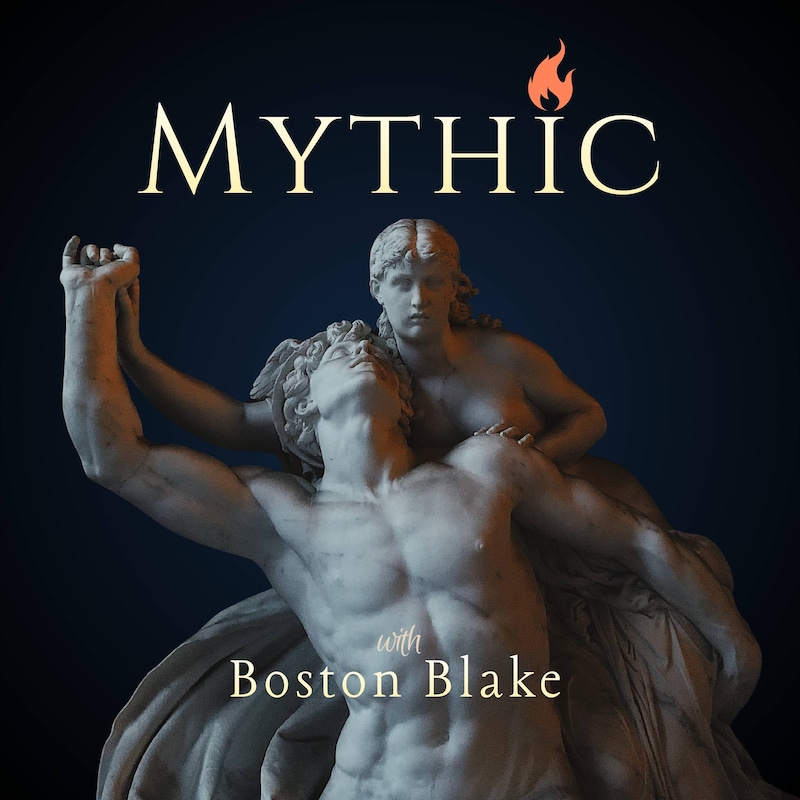
In an Instagram Reel, John Selig described this image — Mount Etna as a cosmological diagram: Typhon pinned underneath, his rage powering the volcano; Hephaestus at the forge above, that same rage transmuted into craft; Prometheus chained on the side, the fire bringer who suffered for giving us what the gods had kept for themselves; and Zeus at the crown, not a creator of fire but the one who directs it.
It set my imagination ablaze!
John’s handle is @stolenfires_. That name tells you everything about his approach: myth is Promethean fire, meaning held by the gods and waiting to be taken — not as belief, not as doctrine, but as a lens you can actually use. What he wants is for you to leave the conversation with something in your hands.
We spent this episode inside Greek myth as a living, working system. We examined the Theogony as three successive orders of creation — and why Zeus’s is the first one generative enough to let everything be born, even the monsters. We read the Odyssey as the story of a man who cannot go home yet because his unconscious won’t let him — the sailors as impulses that thwart the ego until it’s ready. We talked about what happens to a culture that runs entirely on Athena consciousness while Poseidon goes ignored. And we talked about creativity, perfectionism, and what myth can do for people who are stuck.
What We Cover
We use Prometheus — the fire-bringer who stole meaning from the gods and handed it to ordinary people — as the lens for this conversation. Along the way we explore:
Stolen Fires and What the Name Actually Means. The name is two things at once: a cosmological statement about myth as Promethean fire, and — as someone pointed out to John recently — an accidental description of a mythology hot-take platform. He didn't plan that second meaning. The Trickster did. The core idea: myth holds meaning the way the gods held fire. John's work is the theft.
Myth Doesn't Require You to Believe Anything. Myth and history are not the same category. Mythologizing history breaks it. Historicizing mythology breaks it too. One lives in the world of the imaginal; the other is the world of record. You can work with myth — let it illuminate your life, your psyche, your moment — without making a single metaphysical commitment.
Typhon, Hephaestus, and the Shape of Shadow Work. Zeus didn't destroy Typhon. He pinned him under Mount Etna, where his rage powers the volcano — and Hephaestus's forge sits at the top, transmuting that same rage into craft. Integration instead of obliteration. The energy doesn't disappear. It gets redirected. That's the shape of shadow work, and it's also the shape of the creative process.
Satan and the Cultural Shadow. Monotheism needed a bucket for everything that didn't make the approved list, and Satan is what it built. A lot of what ended up in there isn't all that bad — it's just human. The qualities most associated with the mythic Satan map cleanly onto basic features of human nature, and the Greco-Roman roots of the image run deeper than most people realize.
Three Orders of Creation. The Theogony gives us three successive cosmological regimes, each more generative than the last. Uranus won't let anything be born. Kronos swallows his children rather than risk displacement. Zeus frees everyone and starts an order in which everything gets to exist — including the monsters. The Greek pantheon is so crowded because Zeus's order requires it to be.
The Sailors as Unconscious Impulses. The sailors in the Odyssey aren't named or characterized because they're not really separate people — they're the unconscious impulses that keep thwarting what the ego says it wants. Odysseus doesn't reach Ithaca until they're all dead. The friction isn't always the enemy. The sailors may be telling him something he isn't ready to hear yet.
Athena Consciousness, Poseidon Consciousness, and What We've Left Out. Ian McGilchrist's hemisphere theory maps onto the Greek gods: Athena as the rational, ordering, left-brain mode; Poseidon as the holistic, oceanic, right-brain mode. We've built a civilization that runs almost entirely on Athena consciousness while Poseidon goes unaddressed — and John thinks the epidemic of depression among his generation follows directly from that.
Spirituality and the Brain. The part of the brain that activates depression is the same part that activates spirituality. When the spiritual mode is engaged, it becomes physiologically impossible to be depressed. This isn't a spiritual claim. It's neuroscience. And you don't have to believe in anything to get there.
The Tyranny of Heaven. Uranus and Gaia: heaven and earth, the ideal and the actual. Heaven wants the thing to be perfect. Earth wants the thing to exist. Any version of something is necessarily not every version of something — which is obvious, and is still the exact mistake most creatives make constantly, holding the work hostage to what it could be until it never becomes what it is.
Chapters
00:00 Welcome
00:03:49 The Name Stolen Fires
00:04:56 Myth Without Belief
00:05:42 Typhon, Prometheus, and the Volcano
00:06:53 Satan and the Cultural Shadow
00:08:30 How the Volcano Became a Map
00:10:17 Zeus as Air, Not Fire
00:11:30 Three Orders of Creation
00:18:29 Into the Odyssey
00:19:31 The Sailors as Unconscious Impulses
00:21:57 Odysseus Isn’t Ready for Ithaca
00:26:42 Myth Is Fractal
00:34:20 The Modern Mind and Its Limits
00:35:10 Meaning, Depression, and the Missing Lens
00:41:45 Spirituality and the Brain
00:48:05 The Myth and Creativity Course
00:49:05 The Tyranny of Heaven
00:50:10 Where to Find John
Memorable Quotes
“The trick with myths is to not take them literally and to turn them into lenses that you can then look at your own life through.” — John Selig
“Typhon is put underneath Mount Etna, and his fiery rage powers that volcano and then Hephaestus’s forge is at the top, turning that rage, alchemizing it into something beautiful.” — John Selig
“That’s how it feels to do shadow work, to channel your grief into something creative, to face a part of you that you don’t wanna face. All of those things are in that image and it’s cosmic and natural and personal all at the same time.” — John Selig
“Myth doesn’t require you to believe anything. These stories didn’t happen. Getting history and mythology confused is one of the biggest problems in our world today.” — Boston Blake
“Mythologizing history or historicizing mythology. It breaks it. One lives in the world of the imaginal and one is the world of the historical.” — Boston Blake
“If that spiritual part of your brain is activated, it becomes physiologically impossible to be depressed.” — John Selig
“Any version of something is necessarily not every version of something.” — John Selig
“Take the mess you’re working on and make it sacred.” — John Selig
Resources & Links
John Selig’s website: https://stolenfires.com
Stolen Fires on Instagram: @stolenfires_
Stolen Fires on YouTube: @stolenfires
Stolen Fires on TikTok: @stolenfires
Stolen Fires on Substack: https://stolenfires.substack.com
John’s Myth and Creativity Course (May 2026): https://stolenfires.com
Episode page: https://bostonblake.com/mythic-podcast/john-selig-stolen-fires
If this episode landed for you, feel free to add to the pot: https://bostonblake.com/contribute/
About the Guest
John Selig is a writer and educator specializing in the psychology of myth, symbol, and creativity. He has traveled the world visiting the sacred sites of many cultures and is currently writing a book investigating the deeper practical meanings hidden within the world’s myths and religious stories. A lifelong creative, John has worked in music, writing, game design, podcasting, and video, and coaches people in seeing their lives through mythic and symbolic lenses through his one-on-one Mythwork sessions. He has taught at Harvard, UCLA, and School of Rock. Learn more at https://stolenfires.com.
About Mythic
Mythic is a podcast about meaningful living through the power of myth, ancient lore, modern pop culture, and depth psychology. Hosted by Boston Blake — ICF Professional Certified Coach, and lifelong student of mythology and depth psychology — Mythic brings together the stories that have have something to teach us.
Topics
Greek mythology, depth psychology, Jungian psychology, archetypal psychology, practical mythology, myth and meaning, mythology podcast, Prometheus, Typhon, Hephaestus, Zeus, Theogony, Hesiod, Odyssey, Odysseus, shadow work, mythology and creativity, creative process, perfectionism and creativity, Uranus and Gaia, Ian McGilchrist brain hemispheres, Poseidon consciousness, Athena consciousness, modern meaning, existential depression, spirituality and neuroscience, John Selig, Stolen Fires, Mythwork coaching, myth as lens, Boston Blake, Mythic podcast
Transcripts
Hello and welcome to Mythic, a podcast where we explore meaningful
Boston Blake:living through the power of myth, depth, psychology, archetypes, and symbols in
Boston Blake:literature, in pop culture, in ancient stories, and in the world around us.
Boston Blake:If you're wondering what happened to the theme song, well, I scrapped it.
Boston Blake:Most people fast forward past it anyway, and I want to respect your time.
Boston Blake:It also makes editing a lot easier for me.
Boston Blake:My guest today is John Selig, who you may know as at stolen fires on Instagram.
Boston Blake:His Instagram has really blown up lately because he's been posting reels
Boston Blake:with some really insightful takes on mythology, specifically the Odyssey and
Boston Blake:the story of Prometheus among others.
Boston Blake:He's also making really great connections between Norse
Boston Blake:mythology and Greek mythology.
Boston Blake:We're not going to get into that in today's conversation.
Boston Blake:We are really focusing on myth as Promethean fire.
Boston Blake:Looking at myth through this lens starts to answer the question, what
Boston Blake:is the practical value of myth?
Boston Blake:How can I actually use it in my mortal daily life?
Boston Blake:John and I are really up to some of the same stuff.
Boston Blake:Our missions are very much aligned, and this conversation was just
Boston Blake:a mythic love fest, and I hope you enjoy it as much as I do.
Boston Blake:Without further ado, here is John Selig.
Boston Blake:I'm so excited to meet you.
John Selig:Me yeah.,, I've been following you since I started my account.
John Selig:You were one of the first five people I followed, I think, honestly.
John Selig:'Cause I was like, who's doing similar stuff?
John Selig:Who's out there talking about myth and meaning?
John Selig:Your path sounds kind of similar to what I'm trying to do, you know what I mean?
John Selig:I finally bit the bullet and started really putting my face out there
John Selig:and doing all these new posts and, knock on wood seems to be working.
John Selig:I want to help people with creativity and with, understanding their own
John Selig:life through mythic and symbolic lens.
John Selig:And that's a very specific offer that I think a lot of people need, but not a lot
John Selig:of people understand that they need it.
John Selig:So that's where I come in with the education.
John Selig:So hopefully it's gonna work, but I imagine you find that too,
John Selig:it's hard to find your people.
Boston Blake:Absolutely.
Boston Blake:And both my mom and my sister are graduates of Pacifica Graduate Institute.
Boston Blake:So myth and Jungian psychology are in my family, and I love that world.
Boston Blake:So the vision of this podcast specifically is, one, to make mythology useful, to be
Boston Blake:able to understand it as it relates to your own life and the world we live in.
Boston Blake:And then also to elevate mythic voices, people who are doing the academic work.
Boston Blake:You are the.
Boston Blake:I love your Instagram so much I can hardly stand it.
Boston Blake:Your take on things, the way you work with myth.
Boston Blake:There's always sort of esoterica in the background, but you bring it to
Boston Blake:the meat and the bones of things,
Boston Blake:I just, I think we are really, really aligned in a way that is unusual.
Boston Blake:We're not all under our heads with academia, but we're
Boston Blake:also not like super woo.
John Selig:I feel the same way I'm serious.
John Selig:I started this instagram four years ago before I really started going hard and you
John Selig:were one of the first people I followed.
John Selig:I was like, this guy gets it.
John Selig:I'm gonna talk to him someday.
John Selig:And then when you reached out, I was like, yes.
John Selig:This is amazing.
John Selig:So I'm so honored.
John Selig:Thank you.
Boston Blake:It's a pleasure.
Boston Blake:I remember when you appeared as Standup for the Gods, because I was reading.
Boston Blake:Was it?
Boston Blake:Na, not, was it Natalie Haynes who wrote Stand Up, Standing Up for the Gods,
Boston Blake:and I thought your channel was her.
Boston Blake:Stand Up for the Classics.
John Selig:why I ended up changing it.
John Selig:It was too close to her.
John Selig:I
Boston Blake:Ah.
John Selig:her.
Boston Blake:And.
Boston Blake:then you were doing still images there, you weren't doing reels yet?
Boston Blake:Or, I don't remember seeing any reels 'cause I hadn't seen your face.
Boston Blake:And then you rebranded as Stolen Fires.
Boston Blake:And I think we've gotta talk about that name.
Boston Blake:Stolen Fires.
John Selig:What did Prometheus do?
John Selig:against the will of the gods, he took the fire and gave it to us.
John Selig:And that's a powerful image.
John Selig:And I feel like maybe that's one of the things that myth can be
John Selig:when we properly understand it.
John Selig:It's like that meaning that the gods have for us.
John Selig:The gods in the abstract.
John Selig:Like they're part of the myth.
John Selig:I'm not saying we have to believe in anything literal, but I'm saying if
John Selig:we engage with these stories of the gods, there's meaning there, there's
John Selig:fire that we can take and apply to our lives, and one of the hashtag, I
John Selig:don't know anything about social media.
John Selig:I'm learning as I go, but one of the hashtags I started with was practical
John Selig:myth, because I think that's what we need.
John Selig:We need to look at these things, not just as silly old stories, but as like lenses
John Selig:we can apply to our life that builds on the wisdom of, 5,000 years of stories and
John Selig:tradition and, so that's a big part of it.
John Selig:The other part of the name that I must have done unconsciously, because someone
John Selig:just pointed out that my channel is all about mythology hot takes Hot.
John Selig:Takes.
John Selig:Stolen Fires.
John Selig:It's the same thing.
John Selig:And I just was like, I can't even believe I did that.
John Selig:Wow.
John Selig:So that's the longer story.
Boston Blake:You touched on something that I don't think gets enough
Boston Blake:airtime, and that is myth doesn't require you to believe anything.
Boston Blake:Myths.
Boston Blake:These stories didn't happen.
Boston Blake:Getting history and mythology confused is one of the biggest
Boston Blake:problems in our world today.
Boston Blake:Mythologizing history or historicizing mythology.
Boston Blake:It, it breaks it.
Boston Blake:One lives in the world of the imaginal and one is the world of the historical.
Boston Blake:But this idea of homo sapiens, storytelling animals, that this fire,
Boston Blake:this ability to tell a story, this ability to narrate our existence.
Boston Blake:That's what myth does.
Boston Blake:I love the idea of myth as fire.
Boston Blake:And you presented something on Instagram that I have just not
Boston Blake:been able to get out of my head.
Boston Blake:You presented this image of Mount Etna with Typhon buried underneath,
Boston Blake:with Prometheus chained to the side, with Hephaestus working the
Boston Blake:bellows of the volcano, and with Zeus sitting as the crown on top.
Boston Blake:And I have never heard anything like that.
Boston Blake:You used it as a metaphor for the alchemical creative
Boston Blake:process, and my mind went
Boston Blake:like a volcano.
John Selig:Oh, love to hear it.
Boston Blake:Let's play with it.
Boston Blake:Where did that come from?
Boston Blake:What was your thought process there?
John Selig:It's kind of a long story, At some point during the pandemic, I just
John Selig:leaned into all my weirdest interests, So I learned a ton about quantum
John Selig:physics and astrophysics and scientific metaphysics and all of that stuff.
John Selig:And I was like, wow, there's a lot here.
John Selig:it's also incredible how much science actually doesn't know.
John Selig:I love that.
John Selig:Now that doesn't mean that any woowoo mystical thing you can
John Selig:come up with can fill those blanks adequately, but I just like holding
John Selig:that tension of we don't know.
John Selig:And I've always loved myth.
John Selig:so I also went on a myth bender during the pandemic.
John Selig:I reread all the Norse myths.
John Selig:I reread a lot of the Greek myths.
John Selig:I got a book on runes.
John Selig:Like all these things just came together.
John Selig:And all the time we had during the pandemic just made it all fit.
John Selig:One of the things that I was fascinated by is Satan.
John Selig:And I, again, none of this has to be literal, guys.
John Selig:It's okay.
John Selig:Don't get scared.
John Selig:Satan is such a powerful image in our culture, The worst side of monotheistic
John Selig:culture is that we took everything that's not on the list and we pushed
John Selig:it down into this bucket called Satan.
John Selig:And a lot of stuff didn't make the list, So some of it's not all that bad, but
John Selig:to some people, anything that's not underlined in the Bible is just repressed.
John Selig:And I think a lot of the bugs in our culture that we're seeing come from
John Selig:this widespread long-term systematic repression of much of human nature.
John Selig:So I'm not a Satanist, I'm not defending Satan, but I'm saying as an image, it's
John Selig:something we need to sit with because it's very rich and has a lot to teach us.
John Selig:And the major qualities that we see in the mythic figure of Satan
John Selig:happen to correspond to a lot of the major qualities of human nature.
John Selig:Kind of interesting.
John Selig:And so that led me to start writing a book.
John Selig:I never quite finished the book, but I wrote this book on the history and
John Selig:the evolution of the image of Satan.
John Selig:And as I was writing this book, which is like 70% done, sitting on my hard drive.
John Selig:So someday maybe, but I had a chapter on the Greco-Roman
John Selig:influences on the Satan story.
John Selig:And Lucifer is first seen as the name of a Roman deity.
John Selig:Typhon is the adversarial archetype that we see a lot of that gets pulled in.
John Selig:Even Hephaestus is thrown down from Heaven by Zeus, It's
John Selig:similar to the Lucifer story.
John Selig:So there's all this crosstalk there.
John Selig:Long story short.
John Selig:I ended up writing like four chapters just on Greek myth, and I was
John Selig:like, oh, hey, I think maybe this is what I should be writing about.
John Selig:And that's where I started seeing those ideas.
John Selig:As someone trained in depth psychology, like Carl Jung's work, I heard about
John Selig:the way Zeus defeated Typhon, and I was fascinated because you would
John Selig:think in these cosmic stories of good and evil the good God would just
John Selig:obliterate the spirit of discord.
John Selig:But that's not what happens.
John Selig:Typhon is put underneath Mount Etna, and his fiery rage powers that
John Selig:volcano and then Hephaestus's forge is at the top, turning that rage,
John Selig:alchemizing it into something beautiful.
John Selig:And so I felt that in the myth as I was trying to write this book and work
John Selig:through these ideas and understand.
John Selig:I know these are trying to tell me something.
John Selig:What is it that they're trying to tell me?
John Selig:That's always my question.
John Selig:What does it mean?
John Selig:What does it mean if I hold it a little differently?
John Selig:And so that image of the volcano, And then working Prometheus into it too.
John Selig:I'm glad you connected to that image 'cause that's probably
John Selig:what started me on this path.
John Selig:That getting something out of that, that's how it feels to do shadow
John Selig:work, to channel your grief into something creative, to face a part
John Selig:of you that you don't wanna face.
John Selig:Like all of those things are in that image and it's both cosmic and natural
John Selig:and personal all at the same time.
John Selig:Yeah it's actually what put me on this path.
John Selig:So I'm really glad that one connected for you.
Boston Blake:And I wanna play with these images a little bit with you because
Boston Blake:the other things that connected for me.
Boston Blake:Now you bring in Lucifer you bring in the adversary.
Boston Blake:But then Prometheus is very much a Christ figure suffering for his actions.
Boston Blake:The image of him chained to Mount Etna's remarkably similar to Jesus
Boston Blake:on the cross even the pierced liver.
Boston Blake:And then Hephaestus
Boston Blake:is the one who forged Prometheus's chains, but under duress.
Boston Blake:So he's using the fire of Typhon to forge the chains of the light bringer.
Boston Blake:Of the fire bringer.
Boston Blake:Who gives fire to humanity.
Boston Blake:All of this is under Zeus's direction, and you identify Zeus as a fire god.
Boston Blake:I'm still thinking of him as an air figure.
Boston Blake:As an air god distant and a mental force that then places these other entities.
Boston Blake:He traps Typhon.
Boston Blake:He, in some stories, is the one who lames Hephaestus.
Boston Blake:He chains or orders the chaining of Prometheus.
Boston Blake:So he's not the creator of the fire.
Boston Blake:He's making sure the fire rises to him and then he can direct it as lightning bolts.
Boston Blake:So there's this whole creative force.
Boston Blake:And then you've got his shadow, which is the procreative force, his unbridled lust.
Boston Blake:And then there you have the downard motion.
Boston Blake:And this starts to connect to tantra and chakra cycles.
Boston Blake:This image seems to have no end.
John Selig:Yes.
John Selig:This is so great.
John Selig:I'm so glad we're talking because it's so wonderful to have that perspective.
John Selig:So yes, Zeus is absolutely an air god.
John Selig:But I think he's typically depicted as maybe both, There's certainly a
John Selig:mental aspect to Zeus and, the role he plays in our minds, our lives,
John Selig:our bodies the order of things.
John Selig:And we can come back to that.
John Selig:I think Zeus's order is something definitely worth talking
John Selig:about because there's a reason things are the way they are.
John Selig:But to your point that let's see, we said Hephaestus is chained, or no,
John Selig:Hephaestus is thrown down and lamed.
John Selig:And then Prometheus is chained and then Typhon is underneath.
John Selig:Zeus didn't destroy Typhon.
John Selig:Zeus integrates Typhon, And because Zeus's order is the most creative option, if
John Selig:we quickly zoom back to the Theogony, we have Father Uranus, The first father.
John Selig:And what does he do?
John Selig:He doesn't let anything be born.
John Selig:He says, oh, these Cyclops is gross.
John Selig:He puts 'em back into Gaia.
John Selig:He says, oh, these a hundred handed giants gross.
John Selig:He says, no, this cannot be born.
John Selig:Under Uranus's order, nothing can be born.
John Selig:Kronos castrates him and starts a new order.
John Selig:Now we have the Kronos Saturn order, and what does Kronos Saturn do?
John Selig:More things are allowed to be out and about, but not everything.
John Selig:It's very small list of things that are allowed.
John Selig:What does he do?
John Selig:He eats all his babies.
John Selig:He takes them within him, doesn't let them come out.
John Selig:It's another form of order that's too tight, too tyrannical, And so finally,
John Selig:when Zeus overthrows, Kronos Saturn and frees his siblings and starts a new
John Selig:order, it's the most generative order.
John Selig:This is where everything gets to be born.
John Selig:And that's why Gaia tolerates Zeus.
John Selig:'cause everyone gets to be born in zeus's order.
John Selig:And the good news is that means there's a place for everyone and everything.
John Selig:Even Typhon, the antithesis of Zeus.
John Selig:If we look at Zeus as like a vision at the top, bringing things together, Typhon
John Selig:is a vision at the bottom with no vision.
John Selig:Just discord pulling everything apart.
John Selig:A thousand snake heads, a thousand animal heads all screaming in disharmony.
John Selig:It's the absolute symbol of the opposite of what cosmic order is.
John Selig:I love it.
John Selig:And we have to have it this way where Zeus is out and about with all the ladies
John Selig:and out and about with all the animals.
John Selig:It's generative life force, right?
John Selig:It's a metaphor, guys.
John Selig:I know people don't like it sometimes the way they depict Zeus's encounters
John Selig:in Greek myth and fair enough.
John Selig:Some of it's pretty rough, but it's a metaphor for this, unstoppable life force.
John Selig:That means sometimes we get monsters.
John Selig:That's the trade off.
John Selig:If we want everything to be able to be born, that means everything has to be
John Selig:able to be born, does that make any sense?
John Selig:I feel like that's all part of this.
Boston Blake:Yeah it makes perfect sense.
Boston Blake:And something that I've thought about that you've expanded further
Boston Blake:is the idea of the Olympians.
Boston Blake:To go back to Ouranos or Uranus.
Boston Blake:No, he won't let anything be born.
Boston Blake:And I didn't think of it as a matter of perfection, although you can
Boston Blake:use that in the creative process.
Boston Blake:He won't let anything be born, including the Titans who are,
Boston Blake:supposedly, beautiful shined glow.
Boston Blake:But then you have but Gaia then enlists Kronos and says, yeah,
Boston Blake:no I need my children to be born.
Boston Blake:Also.
Boston Blake:This hurts.
Boston Blake:You gotta get outta here.
Boston Blake:And so he chops in, tosses his genitals, and then we get Aphrodite from that,
Boston Blake:which I think is really important.
Boston Blake:So now we have procreative force in the world.
Boston Blake:And then Kronos, he rules with his sickle, with his scythe, the iron
Boston Blake:fist and it's his rule and no other.
Boston Blake:Even though the titans are there, things are allowed to be born,
Boston Blake:but he won't risk his own power.
Boston Blake:This is different 'cause he has a concept of the future of his own power.
Boston Blake:And so he swallows his children instead of forcing them into the mother.
Boston Blake:He takes them in and presumably tries to carve them in his own image.
Boston Blake:Zeus frees them.
Boston Blake:But then he says, I'm doing this differently.
Boston Blake:I'm still the king, but everyone gets a seat at the table.
Boston Blake:So now you have the idea of the Olympians.
Boston Blake:I'm going to rule beside my brothers and sisters.
Boston Blake:And then that pantheon grows.
Boston Blake:And then to your point, everything gets to be born.
Boston Blake:There's a place for everything under the sun, including the monsters.
Boston Blake:And in a sort of theory of mind, if Typhon and Zeus are shadows of one another, Zeus
Boston Blake:can be this singular focus, the eagle eye, the lightning bolt specificity,
Boston Blake:Typhon with the thousand snakes and the many, the, the, it's madness.
Boston Blake:And so if Zeus is perfectly, is a perfectly ordered place for
Boston Blake:everything, Typhon is something where there is no order.
Boston Blake:It's madness.
Boston Blake:It's many, it's an, it's a million voices in your head.
Boston Blake:And I, what I think is true, I don't know exactly how well this holds up,
Boston Blake:but the reason Greek philosophy was so important to the culture is there
Boston Blake:was still some kind of living memory of not having an ordered psyche.
Boston Blake:Their minds were different.
Boston Blake:There was a, the fear of female orgasm was a big thing.
Boston Blake:The idea of giving over and losing yourself was a way to madness and
Boston Blake:that connects to a way to Typhon.
Boston Blake:I'm wondering, am I making sense?
Boston Blake:Does this click?
John Selig:It's absolutely very fascinating.
John Selig:I haven't thought of it in quite those terms.
John Selig:I know people talk about that the different theories of mind
John Selig:and, oh, there's a term for it.
John Selig:Like the modern mind as we know it is actually pretty young,
John Selig:maybe 3000 years old, instead of older, like many people think.
John Selig:But but that's an interesting take.
John Selig:I do think that Greek myth and philosophy is always in this
John Selig:constant dialogue of us versus the the forces within, And the mind.
John Selig:It evolved late.
John Selig:It's true.
John Selig:We're mostly animals.
John Selig:We're mostly unconscious.
John Selig:We have this little cherry on top that lets us think that
John Selig:we're in charge, but really.
John Selig:Come on.
John Selig:And so the forces underneath, that's monstrous.
John Selig:That's Poseidon, that's Typhon.
John Selig:That's all these things that we have to negotiate with and navigate.
John Selig:And the big Greek stories, it's always Athena versus Poseidon.
John Selig:Why?
John Selig:What's up with that?
John Selig:Poseidon's, the horse, Athena's the bridle and Athena's very young.
John Selig:So there's this always this like question of are we civilized?
John Selig:We're trying to civilize.
John Selig:Sometimes they overcorrect, and they become overly rational,
John Selig:cruel, Apollonian, Luciferian.
John Selig:Sometimes they're, it's just rational.
John Selig:But sometimes, we see, also in the Iliad and the Odyssey,
John Selig:people are weeping like 24 7.
John Selig:They were more in touch with their emotions in a way that our
John Selig:culture has completely shut off.
John Selig:So to me, I see this constant tension of opposites.
John Selig:We're so rational, but we have so many emotions, and so I think you're
John Selig:right, that kind of goes back to maybe an older way of being and
John Selig:feeling and experiencing the world.
John Selig:But it's endlessly rich, like you said, they're bottomless.
John Selig:You can just keep looking at it and applying it to different things.
John Selig:Everything from cosmic order to inner states, the psyche, the emotions.
John Selig:Every myth has something to say about most of those layers.
John Selig:It's wild.
Boston Blake:It is wild and I, you just brought in the Odyssey, which
Boston Blake:you've been posting a lot about lately.
Boston Blake:And you've given takes on the Odyssey that have never occurred to me.
Boston Blake:I've read the Odyssey seven or eight times in the last decade.
Boston Blake:And it's different every time I read it.
Boston Blake:The first time I read it, I was Telemachus, and now
Boston Blake:I'm closer to Odysseus.
Boston Blake:What's alive for you with the Odyssey right now?
Boston Blake:You read it, so I imagine it's still working on you.
John Selig:Oh yeah I'm in it big time, so I've read the Odyssey many
John Selig:times, right now I'm reading Daniel Mendelson's translation, and I
John Selig:recently read Steven Fry's retelling.
John Selig:I love Steven Fry.
John Selig:He's a great entry point for people who want to dive in.
John Selig:Very accessible, very readable.
John Selig:Not as dense as the, actual ancient texts, but still very thorough
John Selig:and symbolically, right on.
John Selig:So yeah, I, I absolutely love the Odyssey.
John Selig:I'm also working with Jason Hawley.
John Selig:He's an astrologer and he's running a course on the The
John Selig:Odyssey that I'm helping out with.
John Selig:It's like an experiential reading of The Odyssey.
John Selig:So we really go
Boston Blake:Beautiful.
John Selig:talk about what does this mean for us?
John Selig:What's the psychology of this, how do we feel into it, and that's been
John Selig:really rich and rewarding for me.
John Selig:'Cause I've thought about The Odyssey my whole life, but it's
John Selig:nice to revisit these ideas now from this different sort of lens.
John Selig:But yeah, the thing that's really alive for me in the Odyssey, it's a few things.
John Selig:Again, you can read it in a psychological way, a cultural way,
John Selig:a religious way, a ritual way.
John Selig:You can read it as the story of a culture finding its identity.
John Selig:You can read it as the story of one man grappling with impossible
John Selig:odds or dealing with his PTSD.
John Selig:There's endless ways to read it that are all applicable.
John Selig:I think good symbolism gives you a lens that's multipurpose.
John Selig:And I think the Odyssey is just so excellent at that.
John Selig:The big thing that I'm thinking about lately is that it's weird that, in the
John Selig:story of the Odyssey, it's Odysseus and his crew of sailors, and in so many of
John Selig:the scenes we have these sailors, but they're not really characterized at all.
John Selig:They're faceless.
John Selig:They're nameless.
John Selig:They just follow him around and they're almost like plot devices, and I've
John Selig:been really digging into this idea it really feels like Odysseus is something
John Selig:like the ego or the consciousness.
John Selig:Or the intellect.
John Selig:And he's trying to chart a course.
John Selig:He's trying to set a goal, he's trying to do something, and then these sailors
John Selig:keep showing up and doing exactly the opposite of what they're told.
John Selig:When we get to the bag of winds.
John Selig:Odysseus is don't touch it.
John Selig:It's all the winds that could knock them off course.
John Selig:By a deity, they're given this gift.
John Selig:It's contained in a bag.
John Selig:It's like the winds are contained.
John Selig:We're gonna make it home in a day or two.
John Selig:Just don't touch the wind bag.
John Selig:And then Odysseus, what does he do?
John Selig:He goes to sleep.
John Selig:And while he's asleep, the sailors take over and they do exactly
John Selig:what they were told not to.
John Selig:They open the bag and then all the bad winds blow them off course again.
John Selig:So there's tons of examples like this and again, trained in depth psychology, that
John Selig:really feels like the unconscious at work.
John Selig:You can look at the sailors as these unconscious impulses
John Selig:that challenge what we think we want, And we do this every day.
John Selig:Oh, I should really go to the gym.
John Selig:Oh, I didn't.
John Selig:What's up with that?
John Selig:We think we're rational creatures, but we do not act rationally,
John Selig:certainly not all the time.
John Selig:And so I look at the sailors, one of the ways, by the way, none of these
John Selig:interpretations of anything we're talking about are canonical, They're one angle
John Selig:on an endlessly interpretable thing.
John Selig:And but seeing it that way has been useful for me because there's two angles to this.
John Selig:One, yeah, it's frustrating for the ego.
John Selig:I want to do this, but my unconscious keeps putting up obstacles.
John Selig:What's up with that?
John Selig:Why?
John Selig:then if you look at it, if you flip it, what is it that the
John Selig:unconscious is trying to tell you?
John Selig:Is it that you don't actually want the thing?
John Selig:Is it that you're not ready for the thing?
John Selig:Is it that the thing would actually put you in a worse place?
John Selig:Is it fulfilling a different need in the wrong way?
John Selig:So for example, if I, everyone's trying to, lose weight, right?
John Selig:So let's say I eat a big old bowl of granola before bed every night, and I'm
John Selig:like, oh, I really gotta stop doing that, and then next night I do it again, right?
John Selig:So we might say oh what's going on there?
John Selig:The unconscious is I need more.
John Selig:The unconscious is there is a lack.
John Selig:The unconscious is I don't have enough.
John Selig:I don't have enough energy.
John Selig:I don't feel.
John Selig:Resourced.
John Selig:And maybe that's misplaced.
John Selig:Maybe what I really need is sleep, or maybe what I really
John Selig:need is a break or a vacation.
John Selig:But that's its way of rearing its head and saying, what you think
John Selig:you want is not what we need.
John Selig:And so there's this tension there.
John Selig:Again, like in the Odyssey, Odyssey is never gets back to Ithaca
John Selig:until all the sailors are dead.
John Selig:That's a powerful image, Like in some ways Odysseus is the worst captain of all time,
John Selig:He's the only survivor.
John Selig:But I think if we look at that less literally and more like a metaphor
John Selig:or pointing toward a deeper layer of understanding that's maybe necessary.
John Selig:Because as the sailors die off, it's Odysseus facing all these different
John Selig:things that he needs to face in order to become the person who can get to Ithaca.
John Selig:And all in the background, there's this tension this feud with Poseidon.
John Selig:Odysseus.
John Selig:He's a veteran of war.
John Selig:He's been away for 20 years.
John Selig:He didn't see his kid grow up.
John Selig:Everyone he knows has died.
John Selig:They did horrible things in the war.
John Selig:He's dealing with a lot.
John Selig:And I think every time the sailors thwart his progress, it's because
John Selig:there's something he needs to face before he's ready to go back to Ithaca.
John Selig:And Poseidon is the one maybe orchestrating this, not literally, but
John Selig:the things that Poseidon represents emotion, instinct, unconscious,
John Selig:All those things are rearing their heads because he needs to deal with this.
John Selig:Even the cyclops, it's a child of Poseidon, we can interpret that as it's
John Selig:something put in front of Odysseus because it's in that realm, that trauma, emotion,
John Selig:sticky, unconscious realm that he needs to face in order to take the next step.
John Selig:This is a lot, but I feel like they all give you different angles
John Selig:and images to work with here, because it's very psychological.
John Selig:And if you start to see it that way, not it becomes like a guidepost.
John Selig:Where's that happening in my life?
John Selig:What are my sailors doing?
John Selig:Which gods have I wronged?
John Selig:That's a question that is always useful.
John Selig:Again, don't take it literally, but which gods have I wronged?
John Selig:Which Gods am I ignoring?
John Selig:We all do it.
Boston Blake:Absolutely.
Boston Blake:And yeah to ignore a God or to challenge one head on is
Boston Blake:generally a recipe for disaster.
Boston Blake:Hubris in the face of one is, it's gonna get you.
Boston Blake:It's these immortal forces are within us.
Boston Blake:I love this take of the sailors, like of these being the impulses
Boston Blake:that he has to overcome.
Boston Blake:You pointed out in another one of your videos we're getting Odysseus's
Boston Blake:story from Odysseus, the story of the monsters, the story of the goddesses.
Boston Blake:The story of every supernatural encounter is Odysseus relating
Boston Blake:that story to someone else.
Boston Blake:We get, Calypso and when you.
Boston Blake:When you go to the etymology, you start and start thinking
Boston Blake:about it psychologically.
Boston Blake:Philosophically, this text is it's hard for me not to read it as a story of PTSD.
Boston Blake:It's very difficult to avoid that construct because the man who leaves Troy
Boston Blake:has no business being in polite society.
Boston Blake:He cannot rule, he cannot rule Ithaca.
Boston Blake:He cannot rule himself.
Boston Blake:He has been taken so far from his center and the Iliad, Peter
Boston Blake:Struck university of Pennsylvania.
Boston Blake:He has an online mythology course, so you can take up Penn's
Boston Blake:course, and he talks about the Iliad as being a cautionary tale.
Boston Blake:Like this is the Greeks talking about war, like the horrors that it can create.
Boston Blake:It has gone too far and we must never give over to that again.
Boston Blake:We must be a better society.
Boston Blake:And even then, it's a story of ancient history.
Boston Blake:Or it's ancient myth.
Boston Blake:One thing that's difficult to get my head around is when we talk
Boston Blake:about ancient mythology, 600 BC, these stories were already ancient.
John Selig:Yes.
John Selig:Yeah.
Boston Blake:oral stories that this tradition this Homeric tradition
Boston Blake:wrote down and sang recorded, but they were already ancient stories
Boston Blake:and the reason they're relevant, the reason we can interpret them
Boston Blake:in an infinite number of ways is because they are infinitely relevant,
Boston Blake:personally, socially, cosmologically.
Boston Blake:I want to get back to this idea of this image of the sailors.
Boston Blake:It's when he goes to sleep, Odysseus says, don't do this.
Boston Blake:And then he goes unconscious.
Boston Blake:And while the prefrontal cortexes is offline restoring itself,
Boston Blake:the basic impulses come and say
Boston Blake:he's keeping it for himself.
Boston Blake:There's gold in that bag.
Boston Blake:All of the things that the sailors start telling each other and
Boston Blake:then it blows them off course.
Boston Blake:But some part of Odysseus is not ready to go home.
Boston Blake:Knows he cannot go home yet.
John Selig:Yeah.
Boston Blake:this.
Boston Blake:I love this take.
John Selig:that up.
John Selig:It's wild.
John Selig:And I think it's, I think it's applicable.
John Selig:I think it is actually a useful lens.
John Selig:The trick with myths is to not take them literally and to turn
John Selig:them into lenses that you can then look at your own life through.
John Selig:And that's when it starts to really open up.
John Selig:The way the sailors function in this interpretation at least, is a lot
John Selig:like dwarves in Germanic mythology.
John Selig:These little guys that come out when you go to sleep, and some of them will play
John Selig:tricks on you, or some of them will fix your problems while you're sleeping.
John Selig:Or some of them will, help you create, an artifact There's a similarity there.
John Selig:You go offline and the dwarves come out.
John Selig:It's something like that.
John Selig:There's another take though that I think is actually mind blowing is
John Selig:Greek mythology is often fractal.
John Selig:So Odysseus goes to sleep and then the sailors take over
John Selig:and they set them off course.
John Selig:There's another myth where on a different level, maybe a more cosmic
John Selig:level, Zeus goes to sleep, and Hera and Poseidon try to take over,
John Selig:So it's the same concept playing out at a higher octave or a different
John Selig:level of reality in the cosmos.
John Selig:The natural forces, the patterns.
John Selig:Again, let's not take it literally, but let's think about what that might mean,
John Selig:whether in terms of the human psyche, The ordering thing goes to sleep and
John Selig:then, what else desire comes up and tries to take over and become the ruler.
John Selig:There's so many ways to interpret that Natural Forces You can hold
John Selig:it in lots of different ways, but I love that there's just this clear
John Selig:parallel, like Zeus lets his guard down and then hera, Poseidon, and I
John Selig:think Athena come and try to take over.
John Selig:It's very interesting.
John Selig:And that's exactly,
Boston Blake:I don't know that story.
John Selig:Yeah.
John Selig:It's only in two or three sources.
John Selig:But yeah, you can and then I think Thetis is the one who helps.
John Selig:She goes and gets Briareus one of the hundred handers, our buddies,
John Selig:the Hekatonchires, and he comes and he like menaces, Hera and Poseidon
John Selig:and makes them back down, and it's so interesting, Because these ancient
John Selig:things like that Zeus-- He allied himself with them during the Titanomachy.
John Selig:like that's playing into it in some way.
John Selig:It's very, Some myths.
John Selig:You're like, yeah, that's what that means.
John Selig:Other myths.
John Selig:You're like, whoa, I gotta sit with that.
John Selig:They're not always clear.
John Selig:It's a very powerful myth, I'll try and find the source
John Selig:for you, but it's out there.
John Selig:If you search for, it'll find it.
Boston Blake:I will find it.
Boston Blake:when you brought that in, given where our conversation started with
Boston Blake:this idea of Typhon and Zeus placing Typhon, Typhon being something
Boston Blake:that he he found a use for it.
Boston Blake:He found a way to channel Typhon's struggle into creativity.
Boston Blake:And breus, the Hekatonchire.
Boston Blake:He he finds a use for that.
Boston Blake:He allies himself with a more, with a primitive way of fighting.
Boston Blake:I don't know what this might represent in, in martial context, I am thinking
Boston Blake:he rallied either, either a cult, some group that he had an agreement with
Boston Blake:or or some primal part of the self.
Boston Blake:Zeus leads from above, but Zeus is perfectly willing to get down and
Boston Blake:dirty, to protect the power to identify with the primal unformed forces.
Boston Blake:And now I'm imagining in this pre-history that there's some tribe out there
Boston Blake:of, men who fight from the shadows.
Boston Blake:Who, who fight with a hundred hands coming out of the darkness.
Boston Blake:That, that would be
John Selig:Yeah, that's so right.
John Selig:A great
Boston Blake:gorilla warfare or something.
John Selig:It's not, it's not one thing.
John Selig:Maybe it's a multiplicity, and I think that's what they represent.
John Selig:You have, what do you have?
John Selig:You have the cyclops the hekatonchires.
John Selig:Those are the first children of Uranus and Gaia.
John Selig:You have Cyclops one eye, heavenly, they're all named for lightning thunder
John Selig:flashing, They're all this idea of the top of the pyramid, The very point.
John Selig:The eye.
John Selig:Monovision.
John Selig:N o depth.
John Selig:They're just, this is it.
John Selig:That's, there's one option.
John Selig:Then the flip of that, the next thing that gets born is this just like
John Selig:seething multiplicity of a hundred hands and waving arms and 50 heads.
John Selig:And so we're seeing this like navigation, this mediation of extremes
John Selig:and polarity as the world starts to come into focus during the creation.
John Selig:I love that.
John Selig:I think your take, that's another beautiful take on what the hekatonchires
John Selig:might mean, could mean a group.
John Selig:the king who allies himself with the natives to beat a rival.
John Selig:That's absolutely something.
John Selig:There's, there are plenty of fruitful historical interpretations
John Selig:too, and I love that we're just blending them all together.
John Selig:Your images are great.
Boston Blake:You.
Boston Blake:So are yours.
Boston Blake:and that is the beauty of this is being able to try on all of these different
Boston Blake:lenses and we're still looking at something ineffable through all of
Boston Blake:these lenses and somehow doing this.
Boston Blake:This conversation that I am in with you, I'm going to think about for
Boston Blake:hours, days, and probably weeks.
John Selig:Yeah.
Boston Blake:Things are going to keep going click.
Boston Blake:And this is what myth does that nothing has ever been able
Boston Blake:to do for me other than myth.
Boston Blake:We're spending a lot of time in Greek mythology, which is my realm.
Boston Blake:It's what I know very well.
Boston Blake:You also seem to be really versed in Norse mythology.
Boston Blake:You've made connections between the Norse myths and the Greek
Boston Blake:myths that I have never considered.
Boston Blake:How did you get there?
Boston Blake:What was the journey to, to learning these stories?
John Selig:there's one little itch I wanna say before we
John Selig:totally leave Greek myth.
John Selig:You mentioned Zeus defeating Typhon again.
John Selig:And how does he do it?
John Selig:He integrates him.
John Selig:He subdues and integrates him into the order.
John Selig:We mentioned that Greek mythology is fractal.
John Selig:These stories repeat at different levels.
John Selig:If we look at Hercules.
John Selig:Hercules is a son of Zeus.
John Selig:And what does he do first?
John Selig:He defeats the lion.
John Selig:It's always said, interestingly that the lion is a son of Typhon, And so here
John Selig:we have Zeus's son, subduing the lion turning him into armor, integrating the
John Selig:lion, and making it part of the order where he then goes on to defeat other
John Selig:monsters and build more of society.
John Selig:And so that's a
John Selig:fractal
John Selig:recapitulation
John Selig:of Zeus defeating Typhon and so these structures are there, these the
John Selig:functional interpretation of myth, I don't really know what to call
John Selig:it, but these patterns are there.
John Selig:And when you start to see them, you're like, holy cow.
Boston Blake:Yeah.
John Selig:deeper than everyone thinks.
Boston Blake:I love how you're taking this.
Boston Blake:You've have killing The Nemean Lion, integrating the lion.
Boston Blake:That's happening at the mortal level.
Boston Blake:Zeus is integrating Typhon.
Boston Blake:The primordial didn't have that.
Boston Blake:That's what Zeus began.
Boston Blake:That was the new introduction, is integration instead of
Boston Blake:separation, instead of castration.
Boston Blake:Hermes was the grandfather of Odysseus.
Boston Blake:So you have this liar, you have the mortal liar.
Boston Blake:And then you have the immortal liar who is also the messenger.
Boston Blake:The different shapes of creation.
Boston Blake:We've talked about that also.
Boston Blake:Then once you get into the hi the heroes you have the same
Boston Blake:theme show up again and again.
Boston Blake:Very often the killing of an animal, whether it's the boar or the lion.
Boston Blake:Sorry, I'm just you've given, now my mind is going on a is going on a quest to find
Boston Blake:parallels.
John Selig:fun with it because there it's I'm so glad to be talking
John Selig:to you Boston, because this is I, like I said, I saw you online.
John Selig:I was like, this guy gets it.
John Selig:And now this conversation is like everything I hoped
John Selig:and more so I'm loving this.
John Selig:We're doing it.
Boston Blake:Right on.
Boston Blake:Same, yeah, I wanna shift this conversation to a more about you
Boston Blake:and what this work is for you.
Boston Blake:You talked a little bit about your background and the, 2020 and pursuing
Boston Blake:all of your wonderfully weird interests.
Boston Blake:Which, that's also where this began, this part of the work began for me.
Boston Blake:I suddenly had a bunch of time to write, so I wrote a bunch of articles about myth.
Boston Blake:The videos that you produce is a lot of work.
Boston Blake:It may not look like it on the completion end, but I know what it takes to put
Boston Blake:those out, to edit them, to put them out, almost every day, Why are you doing this?
Boston Blake:What is possessing you to bring this to the world when I'm sure you have
Boston Blake:other things in life to do as well.
John Selig:That's a really wonderful question.
John Selig:It's almost like a challenge, it's like, why?
John Selig:There are a lot of reasons.
John Selig:Where to start.
John Selig:I think most people have a lack of meaning in their life, and I think
John Selig:it comes from taking everything super literally, super scientifically.
John Selig:Science is amazing.
John Selig:I love science.
John Selig:I love science just as much.
John Selig:I'm not saying that myth and woo is good and science is bad.
John Selig:No, science is incredible.
John Selig:But each one is a lens.
John Selig:And each one can give us meaning.
John Selig:The work of Ian McGilchrist describing the differences in brain hemispheres.
John Selig:It fits perfectly.
John Selig:You can map his theory onto the fall of Lucifer myth perfectly.
John Selig:I'm gonna do a video on that someday.
John Selig:Like it's just, it's right there in front of us.
John Selig:Our culture just pushes us to one style of being that isn't
John Selig:bad, but it's excessive now.
John Selig:It maps really well to Athena consciousness versus
John Selig:Poseidon consciousness.
John Selig:But, Poseidon is the lower, the holistic, the what is the ocean?
John Selig:It's just one big thing.
John Selig:Made of waves.
John Selig:Made of drops.
John Selig:It's one big thing all at once.
John Selig:Whereas the rational Athena is the polis, the civilization the craft.
John Selig:It's like that, that left brain.
John Selig:And there's nothing wrong with that.
John Selig:It's important and it's beautiful.
John Selig:It's done so much.
John Selig:But our balance is a little off.
John Selig:I I'm 38 and.
John Selig:I gotta say a lot of my friends are really depressed.
John Selig:And I think it comes from a lack of meaning and a lack of being able to orient
John Selig:your life or look through a lens that doesn't just end with, it doesn't matter.
John Selig:We're just a speck on a speck and a speck near a speck.
John Selig:That's a, that is true.
John Selig:And it's also
John Selig:not
John Selig:true because we
John Selig:have multiple ways to look at it, So if you only have one
John Selig:way, that's your only option.
John Selig:But if you have other lenses, then you can start to interpret things.
John Selig:You can, your life can be symbolic.
John Selig:I know it probably sounds really woo, but I don't mean it in that way.
John Selig:But if you learn to see your life a little bit, like you can see myth,
John Selig:you start to see patterns, you start to ask different questions, and then
John Selig:that can help you grow, so I think that's what keeps me coming back.
John Selig:And I think, from my first band when I was 14, I called it Animus because I was
John Selig:into Carl Jung, so I've been drinking the Kool-Aid for a long time, I've always
John Selig:thought about these things and I've always had this intuition that there's more here.
John Selig:Even religion take apart the religious part.
John Selig:I'm not saying you need to have any dogma or belief, but Genesis is awesome.
John Selig:Symbolically,
John Selig:you can read that myth a zillion different ways and apply it to your life a zillion
John Selig:different ways and learn so much more about yourself by using that as a lens.
John Selig:We got Adam and Eve in the serpent.
John Selig:That story is endless, You don't have to believe anything.
John Selig:You don't have to dogma anything.
John Selig:You can just play with the story and look at it in this they're like gems
John Selig:with facets, We depth psychology people say that a lot, so true, and
John Selig:you can look at your life through that.
John Selig:And so yeah, so I, I have found it to just be like, not only just endlessly
John Selig:interesting like you mentioned, like we, you can just keep going.
John Selig:They seem to be endless.
John Selig:There's not like a limit oh, I figured it out.
John Selig:That doesn't happen.
John Selig:So this is just so interesting.
John Selig:It's so enlivening, it's oh, I get excited about it.
John Selig:Wow, that just happened.
John Selig:Or wow, your pattern is playing out just like freaking Odysseus.
John Selig:That's incredible.
John Selig:You start to see it and it makes life more alive, more meaningful, and if.
John Selig:I do can help people be a little more meaningful in their own
John Selig:life or a little more creative.
John Selig:Creativity is a big part of what I do, and I think it's the same idea.
John Selig:Creativity is our one big way to install meaning in our life as well.
John Selig:And so I, I connect these and that's part of what I do in like
John Selig:my consulting and things like that, but I think it's really important.
John Selig:At the end of the day, it's like it lights me up.
John Selig:I think it's so fun to think about all the time and I think it helps make life better
John Selig:and more interesting and more meaningful.
John Selig:So I don't think I could stop if I wanted to,
Boston Blake:Your model where you started with Poseidon and Athena as
Boston Blake:the hemispheres is really, is a really interesting juxtaposition or or balance.
Boston Blake:One way I think about it using McGilchrist because there's something about myth
Boston Blake:that satisfies both hemispheres.
Boston Blake:It can be applying a rational, a rationalist viewpoint
Boston Blake:to a non-rational story.
Boston Blake:It's like it sits at the corpus callosum instead of it being left or right.
Boston Blake:It's like a gateway to.
Boston Blake:To the right hemisphere in my way of thinking.
Boston Blake:You put a myth and it's that creative spark, and you use that word vitalizing.
Boston Blake:There's the vitality available through myth, through this Promethean fire,
Boston Blake:and it sits there and it's this thing that most people pass by a myth and
Boston Blake:they go, oh, there's a story I'm not interested, it's a fairytale, it's
Boston Blake:fiction, blah, blah, blah, blah.
Boston Blake:It's a myth.
Boston Blake:It's a lie like myth.
Boston Blake:The irony of the word myth meaning both a lie, a falsehood, and also
Boston Blake:something that contains truth.
Boston Blake:That is so perfect.
Boston Blake:That is such a perfect description of a myth.
Boston Blake:And I forget Jean Shinoda Bolen quotes Jung, I think, and she's saying that a
Boston Blake:myth is a story that's never happened, but is always happening and so when we stop
Boston Blake:and we look at a myth and we go, wait, oh wait, this story is happening now.
Boston Blake:How is it in my life?
Boston Blake:How is it in the world around me?
Boston Blake:It activates that, need, that, ability to make connections that are non-rational.
Boston Blake:It opens us into the realm of interconnectivity comprehension
Boston Blake:instead of apprehension.
Boston Blake:And
John Selig:Yeah.
Boston Blake:The fire of myth is vitalizing.
Boston Blake:And this is why I started using it in my coaching, is being able to share a
Boston Blake:story, a myth with someone, and they see themselves in the myth and suddenly
Boston Blake:they're a part of something bigger.
Boston Blake:Suddenly a story from 3000 years ago is resonant with them and
Boston Blake:it's not part of their religion.
Boston Blake:So they're, they don't have a bunch of preconceived stuff around it,
Boston Blake:and they can, there's no baggage.
Boston Blake:They just get to be with the story.
Boston Blake:So I guess this is a lot of words to say.
Boston Blake:I shared your mission.
Boston Blake:Like that's what this can do in its cleanest form.
John Selig:Yeah.
John Selig:No, it's so well said.
John Selig:Thank you.
John Selig:And that's exactly, I think what we're both trying to do, and it's,
John Selig:it is deeply therapeutic, Just think about it for two seconds.
John Selig:We are animals who evolved.
John Selig:To do this, we
John Selig:To assemble in rituals, We don't have to take ritual, literally,
John Selig:it's a tool for interfacing with the non-lingual parts of our psyche,
John Selig:which by the way is most of it.
John Selig:'Cause language evolved very late.
John Selig:So only the cherry on top can handle language.
John Selig:So the ritual image symbol, they're all techniques for
John Selig:getting to the lower parts of us.
John Selig:Because if you notice, all of our symbolism goes back to nature.
John Selig:That's what we evolved in.
John Selig:That's what made us what we are.
John Selig:They, it works for a reason.
John Selig:It actually is very coherent and you don't have to take any of it literally.
John Selig:there's that.
John Selig:And you reminded me of a different Jung quote.
John Selig:It's a called or not the gods are always present, And so that is what we're doing.
John Selig:There's a therapeutic aspect to this because you can deny the meaning
John Selig:of myth, you can deny that these stories have anything of value.
John Selig:you're still going to act in the patterns that the myths describe,
John Selig:even if you don't realize it.
John Selig:And so I really think that's worth people, meditating on.
John Selig:'cause it's really true.
John Selig:You can see, there's a reason all of the great psychoanalysts are
John Selig:got a lot of their ideas from myth.
John Selig:It's because it describes human patterns.
John Selig:And so yeah I could go on forever.
John Selig:I love this stuff and I think it is important.
John Selig:And there's, anything that gets you a little bit outta your left brain, a little
John Selig:bit more into your right brain is healing.
John Selig:I'm sure you're familiar with Lisa Miller.
John Selig:She wrote that book oh, what is it called?
John Selig:I dunno.
John Selig:She wrote a book on how basically the part of your brain that turns on
John Selig:depression is the same part of the brain that turns on spirituality.
John Selig:And so
Boston Blake:I am not familiar with this.
Boston Blake:No, this is new.
John Selig:yeah, it's The Awakened Brain, Lisa Miller.
John Selig:And so it, again, it doesn't mean religious, it doesn't mean dogma.
John Selig:It doesn't mean literal believing, but if that spiritual part of your brain is
John Selig:activated, it becomes physiologically impossible to be depressed.
John Selig:How mind blowing is that?
John Selig:And how sad is that?
John Selig:Because people hear that and they're like, yeah, it must be nice,
John Selig:but I don't believe in anything.
John Selig:You don't have to, you just have to shift your perspective a little tiny bit.
John Selig:And it's fun.
John Selig:this is actually useful.
John Selig:So yeah.
John Selig:So that's my soapbox.
John Selig:Sorry.
Boston Blake:I love your soapbox, and I just read Martha Beck's
Boston Blake:Beyond Anxiety and she's talking about anxiety and creativity.
Boston Blake:It is impossible for anxiety to exist in the presence of being creative that
Boston Blake:one mechanism shuts off the other.
Boston Blake:And that maps perfectly.
Boston Blake:Spirituality and creativity go together.
Boston Blake:creative thinking.
Boston Blake:Like thinking, isn't it?
Boston Blake:It's creative experience.
Boston Blake:It's creative exploration, it's spiritual experience.
Boston Blake:The idea of spirituality as a reconstruction of the world in a
Boston Blake:non-rational way, that there's something, and may non-rational may not be exactly
Boston Blake:it, but it's not about solving a problem.
Boston Blake:It's not about breaking things apart.
Boston Blake:It's about seeing things in a new way,
John Selig:I almost like a rational, like it's not even, it's
John Selig:not rational, it's not irrational.
John Selig:It's just like a different, it's apples and oranges,
Boston Blake:a rational.
Boston Blake:Oh, I like that.
John Selig:I don't know if that's correct, but that's what I say.
John Selig:That might not be a
Boston Blake:I've used non-rational to, to avoid irrational,
Boston Blake:This has to be experiential.
John Selig:Yeah.
Boston Blake:This work has to be experiential.
Boston Blake:It has to happen in conversation.
Boston Blake:It has to happen in the freedom to be wrong.
Boston Blake:'Cause you can't be, you just have to be willing to go and Oh, that.
Boston Blake:And what we end up with is, oh, I've never thought of that before.
Boston Blake:It's not wrong.
Boston Blake:It might not be as resonant for me as it is for somebody else.
Boston Blake:That's not my business.
Boston Blake:If it brings you alive, that's the point.
Boston Blake:That's the point.
John Selig:And like you say, it may not even be resonant, But again, are
John Selig:we Odysseus or are we the sailors?
John Selig:Like the sailors are, they're going against Odysseus's will, but I
John Selig:think Odysseus has to do all the things that the sailors cause.
John Selig:In order to actually get where he is going.
John Selig:So I'm not anyone a pass to just do whatever their impulses say,
John Selig:but there's a wrestling there, there's a dialogue happening.
John Selig:So I think you're spot on.
John Selig:You're right in.
John Selig:You're right in it.
Boston Blake:Your point too, like those are both different parts of the psyche.
Boston Blake:It's not about what one is doing and another is not like
Boston Blake:the psyche is doing this.
Boston Blake:This is a wrestling match that's happening between layers
Boston Blake:and levels of consciousness.
Boston Blake:In one of your videos, you talk about Odysseus getting off the island of Calypso
Boston Blake:and that Calypso, he's not with a woman.
Boston Blake:He's in the arms of the goddess.
Boston Blake:He's sleeping with death.
Boston Blake:He is sleeping.
Boston Blake:This is depression.
Boston Blake:He's deep in depression and he cannot get himself to move.
Boston Blake:And so Zeus sends Hermes to say, Calypso, you gotta let him go.
Boston Blake:Like it's time, like he, he needs to get on the road.
Boston Blake:This is his psychic process.
Boston Blake:It's okay, I've done all of this I can do, I still can't go home,
Boston Blake:but I can get off this island.
Boston Blake:And what does he do?
Boston Blake:He builds a boat.
Boston Blake:He gets busy with his hands.
Boston Blake:Creativity, he's a craftsman, and he starts making something, and
Boston Blake:that's how he gets off the shore.
Boston Blake:The way off the island is through creativity.
John Selig:I fully believe that.
John Selig:That is, that, that's probably 50% of what I do is creative
John Selig:work and creative consulting.
John Selig:And it's, I don't see it as different from this work, depending on the
John Selig:receptivity of the person I'm working with, I'll bring in more or less of the
John Selig:archetypal or the mythic or the occult.
John Selig:But I think it's it doesn't matter.
John Selig:They're playing from the same thing.
John Selig:What's the core message of Genesis?
John Selig:We create, like God creates, because we are in God's image.
John Selig:We are the only animals that have a say in our own nature.
John Selig:That's pretty significant.
John Selig:We are creative beings.
John Selig:. Boston Blake: Here, Here.
John Selig:If somebody comes to you if somebody goes to your website and they hire you as a
John Selig:coach, what might an engagement look like?
John Selig:What does it look like to be coached by you?
John Selig:What's really important to me is meeting someone where they are.
John Selig:So if they come to me and say, Hey, I've been really depressed.
John Selig:That's a totally different process when they say, Hey, I'm blocked creatively,
John Selig:If they come to me, under the hood, those things might actually be the
John Selig:same, but you have to meet it where the person is ready to talk about it.
John Selig:I used to work in Salem as a tarot reader because it was one way to get people who
John Selig:wanted to look at the symbolic, again, you don't have to take it literally.
John Selig:It's, it's, the cards don't have to be magic for them to be useful
John Selig:lenses to apply to your life.
John Selig:So I really will try to meet the person and understand who they are.
John Selig:One angle I like to take is myth work.
John Selig:Okay, what is your personal myth?
John Selig:And a lot of people are like, oh I don't know.
John Selig:And that's fine.
John Selig:So tell me about some of the major episodes of your life.
John Selig:What are the three best things that ever happened to you?
John Selig:What are the three worst?
John Selig:What's a story from your childhood that you like, cannot let go?
John Selig:So with this work, it takes a while.
John Selig:It can be in depth, but I help, I try to help people see aspects of
John Selig:their self and their lives in a more mythic, symbolic lens, and then.
John Selig:Then we apply it to whatever they're going through, Oh, I've been depressed.
John Selig:Oh, I'm looking for a job.
John Selig:Oh, I wanna finish this album.
John Selig:Oh, I want to redo my website.
John Selig:I've seen people with all sorts of stuff.
John Selig:Oh, I want to leave my husband, oh, I'm trying to get pregnant.
John Selig:I've helped people with not literally that last one.
John Selig:I did not help them get pregnant in that sense.
John Selig:But maybe in a, in the other sense.
John Selig:Yeah.
John Selig:Yeah.
John Selig:So we really, I just try to like Hey, like there's a whole way of seeing that
John Selig:we have together in this container.
John Selig:Let's apply it to what's important to you.
John Selig:Let's help you learn a little more about yourself, see the world a little
John Selig:differently, and then tackle your problem or your goal a little differently.
John Selig:It's been really fun.
John Selig:It's really fruitful when it works, and in my personal life, I'm a creative,
John Selig:I teach at a college for game design.
John Selig:I am a lifelong rock musician, so I'm very tapped into the creative process and
John Selig:all the good and bad that comes with it.
John Selig:Talk about anxiety and creativity occupying the same circuit.
John Selig:I've never heard it said literally, but I'm sure as heck felt it.
John Selig:And so I yeah.
John Selig:So any way I can be creative or more importantly, help other people bring
John Selig:that creativity into their lives in a way that's, and therapeutic, let's do it,
Boston Blake:And you have a course coming up that's focused on this in May.
Boston Blake:What is it that you're doing in May?
John Selig:So I am doing a course on mythology and creativity, So we
John Selig:talked about some of these today.
John Selig:There's patterns and myth if you learn to see it And if you learn
John Selig:to pick them out in the right way, they can give you a leg up.
John Selig:Or new lens to look at your life.
John Selig:So what the course does is it goes through eight different myths.
John Selig:It's an eight week course, So we do one myth a week and
John Selig:we interpret it as a group.
John Selig:I offer a few suggestions, and then the group kind of runs and we discuss
John Selig:it, we pick out the patterns that can apply to the creative process,
John Selig:A good example is the Theogony, Uranus and Gaia, the tension
John Selig:between heaven and Earth.
John Selig:Heaven wants things to be perfect.
John Selig:Earth wants things to be what they are, The idea and the actual, the theory and
John Selig:the practice, you can do it a million different ways, but there's always
John Selig:this tension and the perfection of what heaven wants has to be cut off in order
John Selig:for the thing itself to come forward,
John Selig:And I don't know about you, but in my creative work, perfectionism is
John Selig:a constant thing I have to navigate, And that's the tyranny of heaven.
John Selig:That's heaven wanting it to be so perfect.
John Selig:It can't actually exist and so it has to get cut off so that the thing
John Selig:can actually come into being, any version of something is necessarily
John Selig:not every version of something.
John Selig:And that sounds so obvious as to almost be a throwaway, but it's exactly the
John Selig:mistake we make as creatives all the time.
John Selig:So that's one example of what we might do week one.
John Selig:And then so we have a discussion about that and everyone is encouraged to bring
John Selig:something they're working on, In any state of idea or draft or just total chaos mess,
John Selig:Because I'm trying to, for myself just as much as, students as
John Selig:well, but I'm trying to normalize this idea of creativity is messy.
John Selig:It's gross.
John Selig:You don't want anyone to see it, What's therapeutic, letting them see it.
John Selig:So this like idea of taking the mess you're working on and making it sacred.
John Selig:So the second half of the classes will be sharing the creative work and offering
John Selig:different angles and seeing, opportunities for people to request feedback.
John Selig:It's a very helpful, supportive environment where we ask
John Selig:questions and give reflections and tie it back into the myth.
John Selig:I'm really excited about it.
John Selig:I'm working on a book At this rate, it'll be done in 2029.
John Selig:But I'm working on a book about this very thing.
John Selig:Like looking at the myths and interpreting them deeply and
John Selig:putting it in practical terms for your life and your creative work.
John Selig:So it's very alive to me right now, and I'm trying to put it into practice as I,
John Selig:I try to finish an album, so I'm right there in the trenches with everyone else.
Boston Blake:Right on.
Boston Blake:And if somebody wants to get a hold of you and learn more about the
Boston Blake:course or more about working with you, what's the way to do that?
John Selig:Yeah, my website is stolenfires.com.
John Selig:And so every link you need is there.
John Selig:You can sign up for the mailing list and I'll be updating about the course there.
John Selig:And I've got YouTube and Instagram and TikTok and all the things.
John Selig:I would love
Boston Blake:Cool.
John Selig:people there and chat about this stuff.
Boston Blake:Obviously all of those will be in the YouTube
Boston Blake:description and in the show notes.
Boston Blake:to make it really easy for people to find, I love the work that you're doing.
Boston Blake:I truly depths of my soul.
Boston Blake:I appreciate what you are bringing to the mythic conversation.
Boston Blake:I think while we've been talking, your Instagram has
Boston Blake:gained another 150 followers.
Boston Blake:It is it's a thousand new people a day right now.
Boston Blake:It's really exciting to see you growing like this.
John Selig:Thank you.. you're not kidding.
John Selig:And it's a very weird, overwhelming feeling, and I'm really grateful
John Selig:and excited and, I'm just like, okay, let's keep this momentum.
John Selig:I gotta keep the hot takes coming,
Boston Blake:Is there anything we haven't hit today?
Boston Blake:We are definitely going to have more conversations.
Boston Blake:This is ex, this is a truly extraordinary chemistry, I feel.
Boston Blake:And I want to, I wanna talk so much more with you but at least for this
Boston Blake:one, what have we not hit on that you really wanna bring to the table?
John Selig:I dunno.
John Selig:I feel like that was pretty good.
John Selig:I think we landed it, there's, it's endless.
John Selig:We, the whole point is that this stuff is life giving and it's endless.
John Selig:So we I really do hope we have many more conversations because, we almost
John Selig:talked about the Norse myths and I think, you know what we'll do that next time.
John Selig:Maybe that could be our starting point for the next one.
John Selig:'Cause
Boston Blake:Here.
John Selig:So much there.
Boston Blake:Thank you so much for spending the afternoon with me.
Boston Blake:Morning with me.
Boston Blake:Afternoon for you.
Boston Blake:This has been to say it's been a delight understates it.
Boston Blake:Thank you for your time.
John Selig:you.
John Selig:Thank you so much Boston.
John Selig:I truly, again I've been excited about this for a long time, so I'm
John Selig:really glad we finally made it happen.
John Selig:And it's great to just speak with a like-minded, kindred, archetypal spirit.
John Selig:So we're here.







