Shownotes
Episode #46 Season 25: Shaun Boyce & Justin Yeo
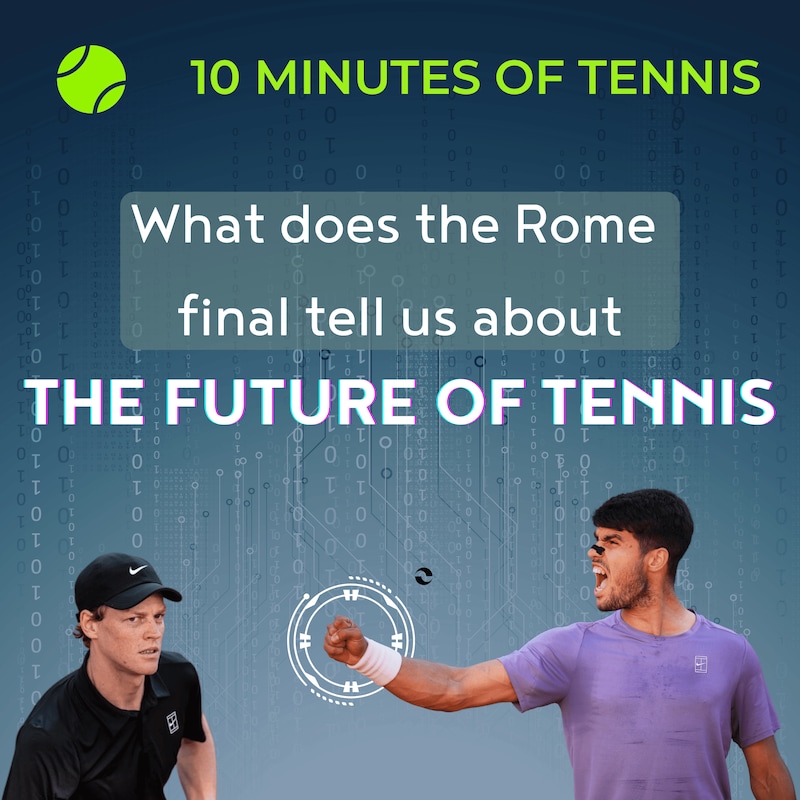
On this episode of 10 Minutes of Tennis, Shaun talks to world renowned tennis coach, Australian in Puerto Rico, Justin Yeo, about the final of the Masters 1000 ATP event in Rome, Italy, between Carlos Alcaraz and Jannik Sinner, and what it can tell us about the future of tennis.
For more 10 Minutes of Tennis episodes: https://www.youtube.com/playlist?list=PLKLIP3Zrp28TLg1nCs4E-2PzkRcjyePEM
Be Our Next Guest
You can also share your actionable insights. If you are a racket sports coach, club manager, technology expert, industry insider, athlete, or just a tennis enthusiast who has some interesting tennis stories to share, we’re welcoming you! Maybe you have actionable tennis tips for beginners or pickleball tips for advanced players. You could be on one of the best tennis podcasts online. It's possible you have tennis news, pickleball news, or want to share a tennis product or pickleball paddle with our audience. You can visit https://americanracketsportsassociation.com/ and complete the podcast guest form.
Shaun Boyce USPTA: shaun@tennisforchildren.com
https://tennisforchildren.com/
Justin Yeo: https://www.instagram.com/yeocoach/
Bobby Schindler USPTA: schindlerb@comcast.net
https://windermerecommunity.net/
Geovanna Boyce: geovy@regeovinate.com
This podcast is powered by GoTennis! Atlanta: Membership has its privileges
https://letsgotennis.com/join/
https://shop.letsgotennis.com/
https://letsgotennis.com/podcast/
https://www.facebook.com/gotennisatlanta
https://www.instagram.com/gotennisatlanta/
https://www.youtube.com/@gotennispodcast
Do you want to read about some good things going on in the world of tennis?
https://letsgotennis.com/stories/
Check out our GoTennis! Atlanta Facebook page for deals, updates, events, podcasts, news, stories, coach profiles, club information, and more
https://bit.ly/gt_facebook_page
Also, you can support this show (and save some $) by shopping at
https://letsgotennis.com/deals/
Or, donate directly HERE
Want to get into crypto? This is easy: https://www.coinbase.com/join/boyce_3s?src=ios-link
Want donate with Bitcoin? Here's the address: 3EqTU1gQBLoieMeFLC1BQgCUajPpPMCgwB
Considering your own podcast? We (obviously) recommend Captivate: This podcast is hosted by Captivate, try it yourself for free.
Transcripts
Hey, hey, this is Shaun with the GoTennis Podcast powered by Signature Tennis.
Speaker:While you're here, please hit that follow button.
Speaker:And after you listen, please share with your friends and teammates.
Speaker:Also, let us know if you have questions or topics you'd like us to discuss and we'll
Speaker:add them to our schedule.
Speaker:With that said, let's get started with 10 minutes of tennis.
Speaker:Today is 10 minutes of tennis with World Renowned Tennis Coach Australian in Puerto Rico
Speaker:Justin Yeo.
Speaker:We are continuing our path talking about the future of tennis and Justin.
Speaker:We're going to be like, we're going to be like weathermen and try to predict the future
Speaker:which is impossible.
Speaker:We know.
Speaker:But, you know, maybe we get lucky and it's right.
Speaker:But we're looking at trends.
Speaker:We're looking at what's coming next today.
Speaker:We want to look at the Rome final.
Speaker:So we're going to look at this past Sunday's final between center and Alcaraz.
Speaker:So if I just say the generic question, I want to see where you start with this.
Speaker:So Justin, what does the Rome final tell us about the future of tennis?
Speaker:Short term.
Speaker:Welcome to Carlos Alcaraz.
Speaker:The man held his composure, he stuck to a game plan.
Speaker:He didn't get too creative.
Speaker:He used the shots when he was supposed to play.
Speaker:He played a pitch of perfect game.
Speaker:And I think center got a big shake up because the interesting thought was that how first
Speaker:of percentage of Carlos wasn't as strong as it was in the first set.
Speaker:Second set was stronger.
Speaker:But first set wasn't as strong.
Speaker:Unlike his new technique, he is definitely penetrating on the first serve, but he didn't
Speaker:get enough of him.
Speaker:But what's interesting is because of his new first serve or new serve technique, his second
Speaker:serve was very penetrating.
Speaker:And he went for the lines, which kept center at bay.
Speaker:And I thought that was probably one of the biggest elements.
Speaker:The two elements I thought it stood out the most was his serve and his spin.
Speaker:He was getting incredible spin, especially back and end for him.
Speaker:So anyway, I thought those two elements were amazing.
Speaker:But he played a pitch of perfect game, which I think is really the biggest standout for
Speaker:that tournament.
Speaker:If he can stick with this, welcome Carlos Alcarez, because we're going to see a very steady player
Speaker:now.
Speaker:And I've been waiting for this.
Speaker:I've been saying, look, he's just not mature enough yet.
Speaker:So he sort of wants to have fun.
Speaker:He wants to play.
Speaker:And it's like, hey man, you want to win titles?
Speaker:You've got to be the machine.
Speaker:It's been the last couple of years that we've watched him.
Speaker:We said, wow, he's amazing.
Speaker:He hits drop shots.
Speaker:He's having fun.
Speaker:He's hitting tweeners.
Speaker:He's got a big smile on his face and he's likable.
Speaker:And that took him for a while.
Speaker:But then he realized over the last couple of years, or he was coached to realize that he needs
Speaker:to get it together.
Speaker:He needs to get focused.
Speaker:He needs to be a professional stick to the game plan.
Speaker:Having fun is fun.
Speaker:But you want to be the guy like center.
Speaker:You got to do what you got to do.
Speaker:And it's less fun.
Speaker:Is that true?
Speaker:No, because I mean, I used to when I ran my large academy as serious tennis in Melbourne,
Speaker:Australia, what I would say to the kids is, isn't it fun winning?
Speaker:I thought winning is fun, right?
Speaker:It was fun.
Speaker:Wasn't that?
Speaker:I could swan.
Speaker:They say winners are winners and people feel really happy and joyful and feel amazing when
Speaker:they win.
Speaker:So I would say that's having fun.
Speaker:So how about we just stick to being a little more focused, a little more mature, a little
Speaker:more composed and work on the game plan to then get the fun at the end?
Speaker:And that's where I think that's where I'm seeing Carlos play now as he's starting to look
Speaker:like he's going to be a serious professional and a serious contender, I should say.
Speaker:And that's probably the best match I'd seen him play hands down, especially against a
Speaker:very good opponent who's playing well.
Speaker:He's going to serve better in the final than in the semi-final.
Speaker:Cedar wasn't looking injured as he did in the semi-final.
Speaker:And he just got, I guess he got what we call dominated or dictated and second set was
Speaker:all over.
Speaker:So very interesting.
Speaker:We'll be different times on a how-cord or a grass court.
Speaker:Well, that's a direction I want to take this because I see a huge weakness in Cineer's
Speaker:game and he's number one in the world by 1200 points and he's stayed number one in the world
Speaker:having to take 90 day vacation.
Speaker:So this guy can't volley.
Speaker:Now I say can't volley, he's number one in the world, he's better than I am at volleying.
Speaker:Don't get me wrong.
Speaker:The guy's a good volleyer but he doesn't slice, he's 95, 96 percent, if not 98 percent
Speaker:topspin.
Speaker:It's reminding me of one of the Australian opens where we watched Novak and Rafa just
Speaker:hit the ball back and forth for six hours and I don't know that that's a good long-term
Speaker:plan for him.
Speaker:Are they going to have to teach him out of volley at some point?
Speaker:Oh, sorry, I have a lot of, because he has a great volley.
Speaker:He does practice volley.
Speaker:It was one.
Speaker:And over two in the match, come on.
Speaker:He coached and he's coached Darren Cale is always making him play volley.
Speaker:So then why does he still suck at it?
Speaker:Why does he, he's got no net game, he can't come forward but my point being and he's still
Speaker:number one in the world.
Speaker:He doesn't have that all around game or maybe just doesn't need it.
Speaker:So okay, so let's put, let's put Sverev and Sino together because that height, it's
Speaker:not as quick as it is from outside the baseline on a clay court to get to the net when there's
Speaker:so far back.
Speaker:Sverev's got three inches on center.
Speaker:Yeah, yeah, yeah, right, but he's still very tall center.
Speaker:Tennis very tall.
Speaker:He's a very tall six too.
Speaker:I think if there was anything that would work on his foot speed getting forward so that
Speaker:he could get there quicker.
Speaker:He also has to what we call take the risk and go forward when he sees the right shot and
Speaker:he hasn't done that yet either.
Speaker:The shots that he missed volleys, he came in not necessarily the wrong time but didn't, his
Speaker:preparation coming in is where I would work on things.
Speaker:I wouldn't work on his volleys.
Speaker:His volleys, his stroke is good.
Speaker:From my perspective, we might never know if he can volley because he's never at the net
Speaker:so we don't have to worry about it and we don't know if he's got a slice either because
Speaker:he never does it and I don't compare him to Sverev in the way that I still thinks
Speaker:Sverev's net game is garbage too.
Speaker:But my question is the future.
Speaker:Are these players still capable?
Speaker:Are they just bigger, faster, stronger because center can win from the baseline still when
Speaker:we think of the all around game as being the next great idea?
Speaker:Yeah, okay, so that's a good point.
Speaker:If center is to shut down Alcharez, he's going to have to find his way in.
Speaker:Simple as that because if I go baseline to baseline with the amount of spin Alcharez is
Speaker:shorter, he's got more stroke variation.
Speaker:He's definitely an amazing defender and so I would be cautious to go toe to toe all day
Speaker:and long and you would have to find your way in.
Speaker:I hope so but again, my question always goes back to in this series, the future of tennis
Speaker:and that's why I bring up this question.
Speaker:We still seem to see the latent hewitt style.
Speaker:I can just hang out back here and bang away and there's nothing you can do about it and
Speaker:you it was even able to win a win.
Speaker:Yeah, well I guess I mean you can go all the way back to Matt's Volanda.
Speaker:I mean Matt's Volanda was one of the first that would just stay on the baseline.
Speaker:Then you can go all the way back to Vyn Lendel.
Speaker:Vyn Lendel very rarely volleied.
Speaker:He volleied on serve but he very rarely came forward to volley and he didn't serve volley.
Speaker:He stayed off the baseline so yes the baseline game still exists and it always has existed.
Speaker:I think we're seeing more variety and more variation and definitely if I had a little
Speaker:child I'd be teaching every grip, every grip.
Speaker:Even an Eastern backhand for a forehand drop shot.
Speaker:I have a look at these guys that are on the run.
Speaker:They're grippers the complete other side of the racket to be able to get over the net and
Speaker:hit and the drop shot and the touch is just incredible and that does not happen late in
Speaker:a career.
Speaker:That happens at a very early age to be able to learn every side of the bevel and learning
Speaker:how to use the hands and use the racket face.
Speaker:So I've said that from many years.
Speaker:The game is old about your hands.
Speaker:It's actually more obvious now than ever.
Speaker:Ossies would like to think that but center would disagree.
Speaker:That guy is just banging away and it seems to work.
Speaker:Even though he's got an Ossie as a coach so maybe that's the direction he's going to go.
Speaker:Next week what I want to do is I want to talk about the upcoming rolling garros, French
Speaker:Open and bring in some of the external scenarios that players today have to deal with.
Speaker:Like the mental fortitude of what you've got to do with everything going on around you,
Speaker:with the coaching, with the tweets, with the trolls, with the world around them and the
Speaker:press conferences and how everything is.
Speaker:Things are just different and tougher reminder of the conversation we had with Murphy
Speaker:Jensen.
Speaker:So next week I want to follow up with that but I will keep hammering this.
Speaker:If we're talking about the future of tennis, why is center still winning just banging away
Speaker:at the baseline?
Speaker:That's going to be a theme of questions coming from me.
Speaker:Well I'm going to throw it at you to finish then is the drop shot to drop shot beating
Speaker:Alcharez drop shot to drop shot.
Speaker:If he didn't have the hands there's no way he'd be able to do that.
Speaker:And if you would line out of seven times.
Speaker:One time he had a great drop shot.
Speaker:Throughout the tournament it was amazing but anyway.
Speaker:The future of tennis also if I were had a young kid is starting to focus on data.
Speaker:It was amazing how many data points they were showing velocity of spin, velocity of racket,
Speaker:velocity of ball pace, the depth, the change up.
Speaker:The only thing I think they don't do enough showing is the difference between someone
Speaker:three to six to eight to nine feet back and when they start to dictate how much they
Speaker:are sitting up on that baseline.
Speaker:So I think next week.
Speaker:Two in the next week for what we've got a lot of future to talk about.
Speaker:Yeah and then a lot of people fall asleep.
Speaker:Just don't understand either is why we see in place so many with tape and injuries.
Speaker:I don't have a memory scene that in my days.
Speaker:I don't remember seeing Sam Perez.
Speaker:I don't remember seeing so much tape and so many injuries.
Speaker:So that's an interesting one.
Speaker:All right.
Speaker:Two in and three weeks from now when we have that conversation.
Speaker:I appreciate it.
Speaker:This has been 10 minutes of tennis with Justin Yo, Australian and Puerto Rico.
Speaker:Thank you, Sarah.
Speaker:We'll see you next week.
Speaker:Cheers, mate.
Speaker:See ya.
Speaker:Well, there you have it.
Speaker:We want to thank reGeovinate.com for use of the studio and signature tennis for their
Speaker:support and be sure to give us a review in your podcast app.
Speaker:We can't give you a direct link, but I'm sure you can find it.
Speaker:For more racket sports content, you can go to LetsGoTennis.com.
Speaker:And while you're there, check out our calendar of events, great deals on racket sports products,
Speaker:apparel, and more.
Speaker:If you're a coach, director of any racket sports, or just someone who wants to utilize
Speaker:our online shop, contact us about setting up your own shop collection to offer your branded
Speaker:merchandise to the Atlanta Racket Sports World.
Speaker:And with that, we're out.
Speaker:See you next time.
Speaker:[MUSIC PLAYING]
Speaker:[MUSIC PLAYING]
Speaker:[MUSIC PLAYING]
Speaker:(upbeat music)
Speaker:[Music]






