Shownotes
What if the greatest shift in how you lead, work, and live isn't about learning another skill, but about changing the way your brain experiences the world?
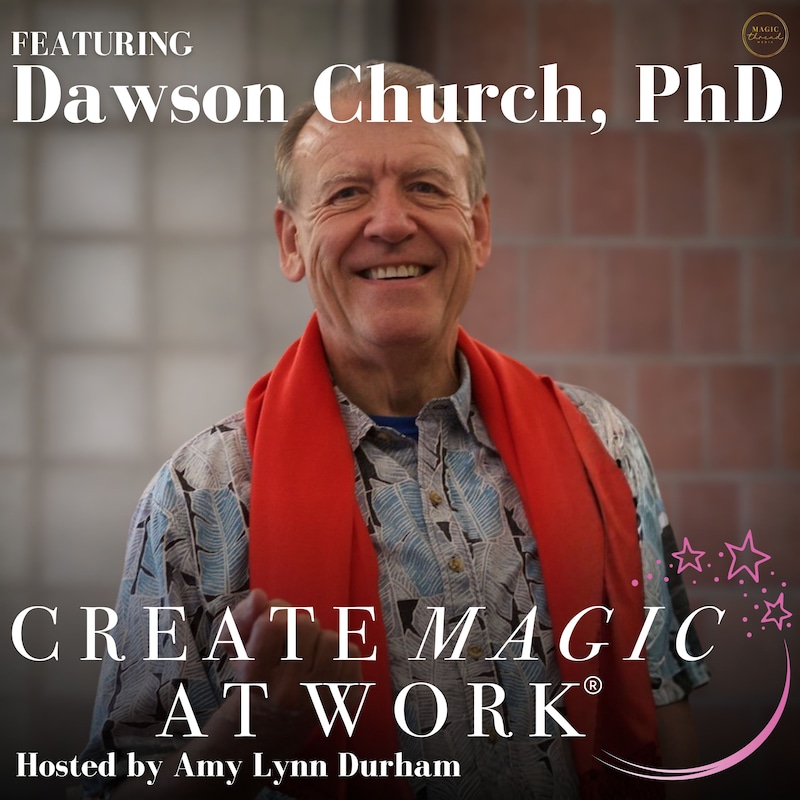
Amy sits down with Dr. Dawson Church, award-winning science writer, researcher, and author of Spiritual Intelligence, to explore the growing body of neuroscience revealing that emotional regulation, attention, compassion, and presence are not fixed personality traits. They are trainable capacities that reshape the brain over time.
For years, spirituality has often been dismissed as something personal, abstract, or impossible to measure. Dawson challenges that assumption by sharing the research behind the four neural circuits that support spiritual intelligence and why strengthening them can transform everything from workplace performance to relationships and overall wellbeing. Together, Amy and Dawson also unpack why traditional meditation doesn't work for everyone, how evidence-based practices like EFT tapping and Eco Meditation accelerate change, and why cultivating inner awareness may be one of the most practical leadership skills available today.
If you've ever wondered whether there's a science behind feeling calmer under pressure, responding with greater compassion, or unlocking more creativity without pushing harder, this conversation offers a compelling new perspective on what becomes possible when we intentionally train the brain that shapes every experience of our lives.
Download your free copy of Dr. Dawson Church’s The EFT Mini-Manual and bonus EcoMeditation at https://dawsongift.com/
Moments That Create Momentum:
- The Brain You Practice Becomes the Life You Experience: Discover why spiritual intelligence isn't a personality trait you're born with, but a set of neural pathways you can intentionally strengthen.
- The Four Circuits Behind Calm Under Pressure: Explore how emotional regulation, attention, compassion, and self-awareness shape the way you lead, respond, and connect long before a stressful moment arrives.
- Why Meditation Doesn't Work for Everyone: Learn why quieting your mind isn't the goal, and how science-backed practices can make inner transformation more accessible.
- Performance Begins Long Before Productivity: Understand why your greatest breakthroughs may come from changing your internal state instead of pushing yourself to work harder.
- Training the Brain for Something Bigger Than Success: See how developing spiritual intelligence can shift not only how you perform at work, but how you experience your relationships, purpose, and everyday life.
About the Guest:
Dr. Dawson Church is an award-winning science writer, researcher, and bestselling author whose work explores the intersection of neuroscience, psychology, and human potential. Through more than 100 published clinical studies and collaborations with researchers from institutions including Harvard Medical School, Duke, Emory, and Columbia, his research has examined how meditation, emotional regulation, and self-transcendent experiences can reshape the brain and improve wellbeing. He is the author of The Genie in Your Genes, Mind to Matter, Bliss Brain, and Spiritual Intelligence.
Beyond his research and writing, Dawson is the founder of the National Institute for Integrative Healthcare and the Veterans Stress Solution, a nonprofit initiative that has provided free PTSD treatment to more than 22,000 veterans and their family members. He also developed EcoMeditation, an evidence-based practice designed to make meditation accessible to beginners, and continues to share research-backed approaches that help people reduce stress, cultivate resilience, and unlock their full potential.
https://www.facebook.com/dawsonchurch
https://www.youtube.com/@EftuniverseEFT
https://twitter.com/EFTUniverse
https://www.linkedin.com/in/dawson-church-68b4a8/
https://www.instagram.com/theeftuniverse/
About Amy:
Amy Lynn Durham, known by her clients as the Corporate Mystic, is the founder of the Executive Coaching Firm, Create Magic At Work®, where they help leaders build workplaces rooted in creativity, collaboration, and fulfillment. A former corporate executive turned Executive Coach, Amy blends practical leadership strategies with spiritual intelligence to unlock human potential at work.
She’s a certified Executive Coach through UC Berkeley & the International Coaching Federation (ICF) In addition, Amy holds coaching certifications in Spiritual Intelligence (SQ21), the Edgewalker Profile, and the Archetypes of Change . In addition to being the host of the Create Magic At Work® podcast, Amy is the author of Create Magic At Work®, Creating Career Magic: A Daily Prompt Journal and the founder of Magic Thread Media™. Through her work, she inspires intentional leadership for thriving workplaces and lives where “magic” becomes reality.
Connect with Amy:
https://createmagicatwork.net/
https://www.linkedin.com/company/create-magic-at-work
https://www.facebook.com/112951637095427
https://www.instagram.com/createmagicatwork
https://www.youtube.com/channel/UCnEm4h3fUgaq8qgvZpz6dGg
Thanks for listening!
Thanks so much for listening to our podcast! If you enjoyed this episode and think that others could benefit from listening, please share it using the social media buttons on this page.
Do you have some feedback or questions about this episode? Leave a comment in the section below!
Subscribe to the podcast
If you would like to get automatic updates of new podcast episodes, you can follow the podcast on Apple Podcasts or your favorite podcast app.
Leave us an Apple Podcasts review
Ratings and reviews from our listeners are extremely valuable to us and greatly appreciated. They help our podcast rank higher on Apple Podcasts, which exposes our show to more awesome listeners like you. If you are enjoying the show, please leave us a review on Apple Podcasts.
Mentioned in this episode:
This show was brought to you in part by the Magic Thread Media Network. To learn more visit: https://magicthreadmedia.com/
Transcripts
Dr. Dawson Church: What we find is that when we hook up monks, nuns, meditators to EEGs and MRIs, certain parts of the brain are very active. When we utilize those parts of the brain, they start growing, and then in people with high levels of spiritual intelligence, these parts of the brain are dramatically larger and more capable of signaling, and they just make your life incredibly more smooth and easy. So that's the the neuroscience of this. I then had to rewrite the book around the neuroscience and the the hardware of the brain rather than the software. So the software is there in the book, but there are four essential circuits that I talk about because those are what we find people with high spiritual intelligence have have developed. They're trainable. They get bigger in time. Some of them get bigger really, really quickly. And so this ability called spiritual intelligence is actually literally hardwired into four circuits of our brain, which get bigger with practice.
Speaker:Amy Lynn Durham: Hey. it's Amy. Welcome to Create Magic at Work, where we cast visions for a future of work where business decisions ripple outward to our teams, our communities, the planet, and humanity as a whole. If you're ready to edge walk instead of sleepwalk through your leadership, you're in the right place. So let's start making magic at work.
Speaker:Hey, everyone in the Create Magic at Work community, it's Amy here. You know that we talk about spiritual intelligence quite a bit on this show. If you're a longtime listener and as a certified SQ21 coach, that's the 21 skills of spiritual intelligence. It's a faith-neutral system. You know that I like to talk to people about spiritual intelligence, and we always like to look for ways to access our higher self and operate from our higher self, even during times of great stress. Today, we are gonna step into the hard science of that, and our guest today has the actual brain scans to prove that shifting your consciousness isn't just a nice idea; that it literally remodels your biology. Dr. Dawson Church is a powerhouse researcher and the author of groundbreaking books like *The Genie in Your Genes* and *Bliss Brain* He's collaborated on over 100 clinical trials with institutions like Harvard Medical School to study how we rewire our neural networks. He's here today to walk us through
Speaker:his newest work, spiritual intelligence activating the four circuits of the awakened brain. We are going to look at the exact neural mechanics required to pull our brains out of corporate survival mode, so we can activate what neuroscientists call the enlightened network. So, if you are ever curious or wanted to hear more hard scientific data behind how spiritual intelligence creates a resilient, high-performing workplace? This is your episode. Stay focused because Dr. Dawson really hits us with all of it. Dr. Dawson Church, welcome to Create magic at work.
Speaker:Dr. Dawson Church: It is such a pleasure to join you, Amy. I am so grateful for your work, literally showing people how to create magic at work and shift everything about the workplace with these skills. So thank you.
Speaker:Amy Lynn Durham: Thank you. Yeah, it's actually really fun to talk about. When I first started talking about spiritual intelligence in the workplace in 2021, people were like, "How are you talking about this with companies, and what's the response you're getting when you're talking about spirituality at work? I think it's really interesting that you bring this neuro sort of brain perspective to it. Right? When I saw your book, I was like, "Oh my gosh! Somebody wrote a book on spiritual intelligence I haven't ran across yet, and it's about activating the four circuits of the awakened brain. Tell us a little bit about what these four circuits are.
Speaker:Dr. Dawson Church: When I first began writing the book, I thought the book would be much more about meditation. I thought it would be much more about mindset. I thought it much more about transcendent experiences, and all of those things factor in. But I actually had to, as a science writer, at a certain point, actually discard about half my precious book, ditch it, delete it. Amy, very painful for a writer, because it turned out that spiritual intelligence is highly neurologically based, and it's a lot like working out your muscles at the gym. So you show up at the gym, you're working out your deltoids and triceps and biceps and various other muscle groups, and what we find is under that stimulation. Our muscles grow; they get bigger, so our bodies look visibly different after a while. And we've all heard of neuroplasticity. We can't see it the way we can see the results from the gym, but actually, in parts of our brain, neurons are growing way faster than our muscles grow. Like in one
Speaker:part of the memory, emotion, and regulation part of the brain. In one of the case histories in my book, Spiritual Intelligence, a guy who was a real skeptic about meditation went into a neuroscience lab, and a team examined every single part of his cognitive abilities and measured down to the last neuron the volume of every single part of his brain. Then he began a meditation practice, mindfulness, and within two or three weeks, his attitude had changed, his stress level had changed, his way he related people at work had changed dramatically. All his teammates were saying, "You're a different guy. After two months, he went back into the lab. They hooked him up to the same MRIs, detailed brain maps, and they found that the core emotion regulation part of his brain, the structure called the dentate gyrus, had grown by 20-2.8% in eight weeks. Now think about that. Think about if you went and began working out of the gym, and your muscles grew 20-2.8% in two months. Okay, you'd
Speaker:look like the Incredible Hulk within a year. That's how fast parts of our brain begin growing. And what we find is that when we hook up monks, nuns, meditators to EEGs and MRIs. Certain parts of the brain are very active. When we utilize those parts of the brain, they start growing, and then in people with high levels of spiritual intelligence, these parts of the brain are dramatically larger and more capable of signaling, and they just make your life incredibly more smooth and easy. So that's the neuroscience of this. I then had to rewrite the book around the neuroscience and the hardware of the brain rather than the software. So the software is there in the book, but there are four essential circuits that I talk about because those are what we find people with high spiritual intelligence have developed. They're trainable. They get bigger in time. Some of them get bigger really, really quickly. And so, this ability called spiritual intelligence is actually literally hardwired into four
Speaker:circuits of our brain, which get bigger with practice.
Speaker:Amy Lynn Durham: What is your definition of spiritual intelligence?
Speaker:Dr. Dawson Church: It's a very simple, non-academic one. So, the old model of consciousness that most neuroscientists would have talked about, and in fact, a few of them who maybe were trained a long time ago might still talk about, is the belief common in various branches of science, evolutionary biology, neuroscience, that consciousness is an epiphenomenon of a conscious brain. That as brains began to get bigger, as they evolved over the last 3 billion years, they got larger and larger and larger, and eventually threw out this field called consciousness. And so that is the way consciousness studies have been conducted for many decades. What the new theories of consciousness have discovered is that a there's no experimental evidence showing that consciousness resides in the brain. There's plenty of experimental evidence showing that consciousness resides in information fields beyond the brain, and the brain functions as a transceiver of information from those fields and
Speaker:a projector of the information in those fields into the world around us, after which we call it objective reality, but it's actually coming from information fields. And mystics, for 1000s of years, 10s of 1000s of years, have been traveling to those fields. Their their conscious minds, their sense of who they are, their sense of self, in deep meditation, loses its fixation on the here and now. I am this body. I am this mind. I am this local, time-bound human being, and they report. And this is mystics of every part: the Judeo-Christian tradition, the Eastern mystics, Taoism, Sufism. We find this everywhere. They report these experiences of transcending that local self and becoming one with the all that is. Abraham Maslow talked about this. He talked about self-actualization. So Western psychology has a rich tradition. William James, Abraham Maslow, talking about our ability to reach these self-transcendent states, so mystics, advanced psychologists are realizing that we as human
Speaker:beings have the ability to become one, as the Buddhists say, become one with everything, become one with the universe. In meditation, you lose your sense of being a small, isolated human local being. And to become one with the all that is, and that is spiritual intelligence-the ability to connect with and interact with those fields. And my definition is also bidirectional, so it's not just that you're tuning out there and having this blissful experience. Now, it certainly is blissful to tune up into the all that is and hang out there in what the Hindu tradition calls samadhi-it's just wonderful to go into samadhi and be in this state of utter bliss. What the Buddhists call nirvana-it's a wonderful space to be in, but it's actually bidirectional. Not only do we receive information, we receive insight, do we receive emotion from that experience, but we project who we are into that experience. There is a sense in which we emanate that sense of who we are into these information
Speaker:fields, and that's what's called the psychosphere or the noosphere, the sphere of human consciousness. So, spiritual intelligence is the ability of human local consciousness to interact with these fields of non-local consciousness, either in meditation, and then in the fourth and fifth chapters of my book, Spiritual Intelligence, it's about how they do it elsewhere. So, for example, chapter five is called Enlightenment without spirituality, and it's people who have enlightenment experiences and they don't think of themselves as spiritual. They are athletes. They are business people. They are medical professionals, and they're reporting these transcendent states in which they have genius ideas. Albert Einstein said that every great scientific discovery is made from that state. So, in these states of spiritual experience, they don't just predispose us to wonderful states of bliss where we transcend our borders of who we think we are, but they also produce extraordinary gains in
Speaker:creativity, in productivity, in emotion regulation, and all kinds of other abilities that are highly relevant, so our lives become-they don't become perfect. I have to testify that 70 years old, and there are still plenty of bumps in the road, but they become way smoother when you're acting in concert with these great cycles. And toward the end of the book, I cover the research, and this is very advanced research using very large, very expensive geomagnetic arrays placed around the planet, but there are lots of fields in the cosmos. There are fields that we use sunspots.
Speaker:There are fields around the Earth, and the body of evidence now that has been built up is really interesting, showing that when you're in tune with these states of higher consciousness, you're in tune with natural cycles, and so not only do we feel that sense of connection with something larger than ourselves, we're literally in sync. And so, in in one graph near the end of the book, we have the brain wave patterns and heart coherence patterns of a meditator, a person deep in heart coherence for 30 days. Then we have a graph of geomagnetic activity in the Earth superimposed on that, and the two track each other day after day for 30 days. So we're we're literally more in tune with nature and the planet and the cosmos.
Speaker:Amy Lynn Durham: Interesting for the create magic at Work community that has been listening to the show for quite some time, I've often referenced the definition from the SQ21 because I'm an SQ21 certified coach for spiritual intelligence, which is the ability to make wise and compassionate decisions while maintaining inner and outer peace, even when you're under great stress, and all of the skills sort of roll up to that overarching definition. And one of the skills that you're talking a lot about is the experience of transcendent oneness, a connection to something bigger than ourselves. For longtime listeners, they're familiar with this, and for newer listeners, I wanted to recap that this is create magic at work. So there's a lot of people listening in the workplace. There's a lot of courses, workshops, certification. certifications surrounding EQ, emotional intelligence. At least in the SQ teachings and in my certification, you get to SQ by way of EQ. In the adult development
Speaker:theory, your brain is starting to be able to experience compassion in your 20s at a newer level, and then those are the teachings. And then in your 30s, you sort of have this capacity to go beyond EQ into SQ. What are your thoughts on that?
Speaker:Dr. Dawson Church: All those three components of. That wonderful definition by Sydney Wigglesworth, SQ21, are powerful. And what I do is I translate those into which brain regions are active. And for example, the compassion you mentioned that is the insula. So that is a lobe of the brain, a very large lobe of the brain. There are four lobes of the outer brain, and then tucked inside of them is the insula. The insula is a large lobe, and it is active in all of our prosocial emotions, especially compassion. But it's also it also plays a role in emotions like gratitude or pleasure from physical touch, insight, gratitude, optimism-all of these positive emotions are mediated by the insula. So, in my book, Spiritual Intelligence, I discuss those outer experiences and behaviors, but I tie them back to the neuroscience because what I'm incredibly curious about is can we build these neural pathways bigger and how do we do that quickly and efficiently? Some of the the paths like you know I
Speaker:joined a spiritual community when I was 15 years old. That was you know almost 60 years ago for me, and I made some progress there, but not a lot. I then got into psychology after that in my 20s, and I made some progress there, not a lot. So you want to find the most efficient ways of making progress in your life, and the way to do it is neuroscience. You have to figure out what regions of the brain are active, a, and then how to build them quickly. B, it's like working out in the gym. You'll get a lot of advice from people about saying do this, do that. These sets are good, but that may have worked for them. Does it work for everybody? It might not. And science is wonderful because it gives you the evidence, and you pair away all the opinion. And there are a lot of well-meaning people and a lot of pods. And I really respect the well-meaning people who try to teach me meditation when I was 15 years old and psychology when I was 20, but when you get to the neuroscience and you
Speaker:have this basic philosophy of what builds neurons quickest, okay, what stimulates the insula and generates neuroplastic change in the insula quickest, that is what I'm super interested in, and so I'm a lot less interested in the beliefs and the theory, a lot more interested in what can I measure in a lab, in an MRI. If I park someone in an MRI six months later, what does their brain look like? In chapter two, I talk about brain shrinkage and brain growth, and just as there is brain growth in people who are using spiritual intelligence, I mean, there's remarkable growth. Like that guy with a 22.8 percent increase in the emotion regulation circuit in only eight weeks. Spectacular brain growth is happening in people who are using their spiritual intelligence in these key areas, and then I also, as a counterpoint in chapter two of the book, I talk about brain shrinkage because brain shrinkage is a fact, and between the ages of 40 and the ages of 80-five, the average human brain shrinks
Speaker:by 20-5% That's a lot. So big brain shrinkage. We see people then start to have symptoms of cognitive decline that may show up as dementia, Alzheimer's, and other forms of brain loss, and and that produces more brain loss. So people who are, for example, Alzheimer's brains. I have a I have an image in chapter two of spiritual intelligence of a postmortem normal brain and a post-normal Alzheimer's brain, and at the same age, the Alzheimer's brain has shrunk 70% That's serious tissue loss before that person dies. So there's brain growth, and then there's brain loss, and so we study what helps people preserve brain mass. And some of the most striking studies in chapter two of the book are those with Alzheimer's patients. And we know that there are all these. There's been this massive effort over the last 40 or 50 years to develop drugs to treat Alzheimer's. They've been generally unsuccessful.
Speaker:They carry a lot of side effects, and what is overlooked is that meditation and the meditation studies that have been done with Alzheimer's patients show that not only do those Alzheimer's patients who are taught to meditate in certain very specific ways stop losing brain mass, they start to regain brain mass. So it actually starts to grow our brain again. That's really what I'm focused on in spiritual intelligence: is the what is the quickest way to grow the insula? What's the quickest way to grow the emotion regulation circuit? I talk about four key circuits in the brain, which have been well understood in neuroscience for many, many years now. The emotion regulation circuit number one. You have to learn to not get pissed off. If things piss you off at work, if things annoy you and trigger you on the news, if things trigger you about your family, about your body, about money, your whole life is going to be dramatically worse. Your chances of happiness are much lower because that
Speaker:emotional triggering is going to affect your whole worldview. So this first circuit is a very simple circuit. We've known about it for a long time. It runs from the front of the brain, the frontal lobes, into the limbic system, the emotional brain. The main part of it is called the ventromedial prefrontal cortex, and we focus on making that tissue bigger. And there's stuff you can do that, within a few weeks, will make your ventromedial prefrontal cortex larger and larger and larger. Now you have more hardware to do with emotion regulation. So you want to develop that skill first. Another skill you want to develop is attention. People with spiritual intelligence, can pay attention. You say, go sit there and sit by the waterfall and immerse yourself in the the rhythm of the water, and they can do that for a while. You tell them to go work on that report. They do it without distractions. You tell them to go work out in the gym. They do that effectively. You tell them to
Speaker:pay attention to your teenage son, when he comes back from school and is not having is not having a very good day, you pay attention to him. You've learned to pay attention. Your life gets a lot better, Sunny. Now, not only are you not reactive because you've grown your emotion regulation circuit, you're actually paying attention to your body, your money, your life, the people around you, and that bringing up bringing presence into your life is incredibly important. The third circuit is to do with narcissism. We are all inherently focused on our own survival, our own well-being, but excessive focus on that draws us out of the present moment, makes us not available to other people. So you want to grow that circuit that dials down your degree of self-absorption, and then that fourth circuit is compassion. So that lights up, and along with compassion comes gratitude, awe, joy, optimism, and all those other positive characteristics. So those are the four circuits, and using
Speaker:the right tools, we can grow them really, really quickly. And again, they make our experience at work dramatically better because somebody says something annoying, and everyone else in the room gets annoyed, and we don't. We still breathe. We know how to work with ourselves. We know how to pay attention and get our tasks done. We have compassion for people. Some people are having a bad day. Somebody does something mean or thoughtless to you, and you just take a deep breath and say, "I'm sorry. I imagine they were having a very difficult time that day. You don't take it personally when that happens. Now, yesterday, I, my wife and I were visiting a park, and the driver next to us was just the passenger in this vehicle next to us. Just says something pretty nasty to us, and was out of out of the blue. And then the her husband, the driver, said something as well, and we were just like, "Wow, those people here they are in this beautiful park! And we're so sad for them that they
Speaker:aren't having a wonderful experience. So suddenly, your frame becomes compassion rather than defensiveness, blame, any other kind of quality. So all your life at work starts to change a lot.
Speaker:You have emotional intelligence because you have your compassion circuit turned on, and it's bigger. It's really literally larger than would otherwise be. So spiritual intelligence is the foundation of this. Intellectual intelligence. People with spiritual intelligence solve problems. I'm way better at solving problems than people without. So it produces gains in social intelligence, and emotional intelligence, and intellectual intelligence. Whatever level you were at before, you become a much better performer. And one of my studies, I asked myself. You know, I said to myself after doing meditation trials for many years. I said, we know we're good at getting people out there and into transcendent states, and they feel wonderful. They feel one with the universe. And I then thought, well, you know, I've worked with quite a few companies, and we've worked with their executives and their leadership teams, and they've all felt better after they've done this. Let's do a
Speaker:study and see how people are doing at work after they inhabit these transcendent states for a while. And we found, to our amazement, that within three weeks of these practices, they had a 20% increase in productivity. 20% increase in only three weeks-that's like getting an extra day a week every week in your week. It's just amazing. And after six months, the effect was even more pronounced. So they're in flow states more. They're much better with other people. Their stress levels drop way down. Neurochemicals like cortisol drop way down their level of. Inflammation in their bodies goes down, their immunity rises. All kinds of positive things happen, and the effects do not take 10,000 hours to accrue; they begin right away. So, spiritual intelligence is the foundation for all these other intelligences.
Speaker:Amy Lynn Durham: What are some of the practices that you recommend to build the four circuits. We've talked a lot about the benefits and meditation as one of the things. I do feel like meditation is constantly prescribed to people, and then they just kind of go off. Well, meditate more. It's all over social media, and everybody's told to meditate, and then they're like, "Okay, thanks. Is it meditation? Is that the thing, or are there other practices that we can do to skill build these parts of our brain in spiritual intelligence? That's I have a two part question. That's the first part. The second part is, you've talked about MRIs, brain mapping. I know there's also spect scans people can get. How does this affect the brain after you share these practices, or maybe a couple of tips for us? How does this affect the traumatically injured brain, whether it's from physical damage or from trauma.
Speaker:Dr. Dawson Church: Yeah, so we'll take the second one first. Our brains are highly neuroplastic. In the 1990 s, the first clinical trials were published showing that stroke victims, for example, will regrow tissue around the injured parts of the brain, a lot more brain regrowth is possible than we realize, and we're adding neurons in parts of the brain like the hippocampus for the day we die. So our brains are regrowing, and even if our brains have been traumatized, they can regain part of their function, and sometimes a surprising amount of function. Also, bear in mind that there are these information fields, and the brain is very neuroplastic, and it is again a transceiver of these fields. So even those with traumatized brains can regain part, and sometimes a surprisingly large amount of their previous function. As far as what you do, the practices you do, we emphasize EFT tapping first and foremost, because EFT tapping isn't a spiritual practice; it's a mechanical one to reduce
Speaker:stress. And we have a method called clinical EFT. We've done over 300 clinical trials over the last 30 years, and they show that EFT rapidly reduces PTSD, physical pain, anxiety, and depression. So that is where emotion regulation comes in. Learn EFT tapping; it takes only a few moments. You simply think about the bad stuff in your life, and you stimulate acupressure points by applying finger to pressure or tapping to them, and it just works very very rapidly. And there are so many stories of people that use EFT and very quickly. Very first time I ever used EFT was 2000 and I was in the process of selling a commercial building I own, and it was falling out of escrow, and I was really anxious about it. And I hadn't ever tapped before, hadn't used EFT before. I found a page of instructions someone had given me on EFT tapping. Did the tapping while I thought about my high anxiety, and my anxiety just melted away in about two minutes, so I was very intrigued by that.
Speaker:Eventually, became a researcher into EFT. But there are 1000s of stories on my website of people who have used EFT, and again, hundreds of clinical trials for PTSD, pain, diabetic levels, blood sugar, post-surgical complications. I did a study of melanoma cancer survivors. There are lots of groups that really benefit from the stress reduction in EFT.
Speaker:The other practice of meditation, you have to be very, very careful about what you call meditation and what the kind of meditation you use, because what I was taught at 15 when I joined a spiritual community, learned to meditate, was what many people are taught was sit still, notice your breathing, and allow your thoughts to dissipate. Just be in this this quiet place, physically and mentally, and that advice has, I think, turned more people off of meditation than anything else. Because you try and close your eyes and follow your breath and have a quiet mind, and the mind is inherently not made to be quiet. The mind is built to scan. Environment all the time, and so when we close our eyes, we cut off that out of stimulation. There are about 9 million pieces of information going through our optic nerves into our occipital cortex of our brains every second. So you cut off that flow of information by closing your eyes, and then the mind starts to generate its own information in the
Speaker:form of worry. So that kind of meditation usually is either useless or worse than useless. You have to use a a meditation form that regulates the body, and so there are several of these. The one that we use in clinical trials is called Eco Meditation. It's free on the web. You can get it on Insight Timer, a bunch of other apps, ECO meditation. Use eco meditation. It uses physiological cues to calm down the body in order to quiet your mind. So when you're doing meditation, you got to pick a form of meditation that really works for you and that's evidence based. What most people think of as meditation is often not very effective and hard, and then you're likely to give up. And like I did for many years, think myself as a failed meditator. It's just that I wasn't using science. So you need to use a science-based technique like eco meditation in those studies of Alzheimer's patients.
Speaker:Amy Lynn Durham: What is the meditation eco? I just want to
Speaker:Dr. Dawson Church: UCO eco meditation.
Speaker:Amy Lynn Durham: Okay,
Speaker:Dr. Dawson Church: just go to eco meditation.com Download the free track. Those Alzheimer's studies, Alzheimer's patients regrowing their brain. They were using physiological cues like eco meditation. In one eco meditation study, we found that these parts of the brain began to respond in 30 days. It took only 30 days of using eco meditation, 20 minutes a day, and we could see changes in the physical structures of the brain. The insula became highly active, and that narcissistic circuit became quiet. So it happens really quickly when using an effective science-based meditation. So those are the two things. Learn to tap. Very simple to learn to tap. Download the free tapping manual. I wrote the basic tapping text decades ago. Learn to tap, and then also meditate using an effective science-based technique like eco meditation. And those two things alone are going to put you way ahead of the game. Is that all there is? No, it's not. You have to focus on diet, exercise, social
Speaker:connection, time in nature. There are many other things you have to do as well to have a healthy, balanced lifestyle, including proper medical care. So you want to have all these things going for you, but those two self-regulation practices are so potent and the foundation for a happy life,
Speaker:Amy Lynn Durham: eco meditation, and tapping EFT. Those are available on your website, right? Tell everyone what your website is.
Speaker:Dr. Dawson Church: On website, and each each chapter of the book ends with a section called Deepening Practices, where for free you click through and you get free eco meditation tracks. You get free tapping scripts. You get all kinds of resources at the end of each chapter. So you aren't just reading about spiritual intelligence. You are developing spiritual intelligence chapter by chapter across all seven chapters of the book.
Speaker:Amy Lynn Durham: Very interesting the perspective you have brought us today. I marvel at that. These are mostly free techniques that we can do, and we still end up going to the doctor looking for something that's a pill or a quick fix. I think it's just habit or robotics. So hopefully we can break that pattern today. At the end of every episode, I pull a card for all of us listening from the universe, and I was going to pull a card from the Edge Walker card deck that Dr. Judy Neal and I authored, and we were talking about focus, which that's one of the skills of an edge walker being present, focusing, especially in this, you talked about it with your brain. You know, learning how to pay attention-that's a huge thing right now because of social media, because of all of these 30-second clicks that pull our attention that we go through. And I know I found myself having a hard time being able to read a whole lengthy book and like, oh my gosh, what's happening? I think when
Speaker:the Wuthering Heights movie came out, there were different people that were literary experts saying, "I went back to read the book, and I found myself not having the same experience that I had reading the book when I was in my 20s or a teen, because our brains have experienced social media now and all of these other things, so highlighting focus. I was looking for the focus card, and this is the first one that came up. And this is just the message for everyone listening, and for us, you and I today, Dawson is focus. The ability to be very centered and to give all your attention to an action or project that has significance and importance-that's the definition. And the affirmation for all of us is: we're talking about spiritual intelligence. My spiritual practices help me to be centered and focused. My spiritual practices help me to be centered and focused, and maybe we can incorporate the eco meditation and the EFT tapping into these spiritual practices and see how our lives and
Speaker:brains might transform from some simple accessible things. So, Dawson, if people want to learn more about your work, Dr. Dawson Church, where can they find you?
Speaker:Dr. Dawson Church: The best things to do are to download the free tapping manual and a free eco meditation, and you get that through the website Dawson. It's my name. D a w s o n gift g i f t dawsong gift.com And when you go there and download those two things, you'll also get a link to the book Spiritual Intelligence. You can go ahead and order the book. Please, if you read the book and like it, leave it a five star review on Amazon. There are dozens of those already, and it's just remarkable. You read the book; those reviews on Amazon, and these are people who just have bought the book out of the blue. It's completely shaken the foundations of their lives. Please leave reviews for books you like, and so DawsonGift.com is the place you can get everything in a pretty compact way, and then focus on what is highest leverage for you, and I think the two basic practices are tapping for instant stress relief, and then meditation for daily regulation. So you begin your day with that
Speaker:framework of meditation that regulates everything else going on in your day, but then find a suite of practices, a group of practices that really work for you. Maybe you're an urban dweller and you're living in the middle of Chicago or New York or Boston or San Francisco, but you can find a park. You can find a patch of land where you can go and ground yourself and reconnect with the earth. Research shows that epigenetically, that's going to have many of the same effects as being out in the forest. So, find a way of having time in nature. Find a way of connecting with people who you really feel close to and nurtured by. And I'm going to say something that is a little maybe sounds a little uncharitable, but disconnect from people who aren't. If there are people in your life who are toxic, let them go. Don't feel you have to hang on to people who aren't helping your well-being. Find people who are, spend time with them, and get touch, get love, get connection, get
Speaker:conversation with people. So have a group of practices that's non-negotiable. Like I have a busy day today, but my host was saying, "Well, you know, you have this busy day, and yet I noticed you went out exercising twice a day. Well, it's just a non-negotiable for me exercising a day, no matter how busy the day. So find those things that work for you, and then just stick to them. But make sure you have that baseline of meditation and use that evidence-based technique, life eco meditation, and then use tapping to dissipate your stress. It is so easy, and then again, everything else moves from that point on. You'll find your life opening up in absolutely stunning ways, and your potential moving through you in unforeseen ways when you are loving yourself enough to give yourself this baseline of spiritual intelligence, and that is a game changer. That changes everything else. Suddenly starts to shift around you, and we find as we study people doing this long term that they go from an
Speaker:immensely better internal state, that state of samadhi, that state of nirvana, what the Buddha called natural mind, empty mind, still mind, to a sense of love around them. And you walk into the room. Ah, people have been doing this and have developed their spiritual intelligence for years or decades. And the whole room is full of love, Amy. So you want to find people like that. You want to be a person like that. You are the change agent, a forceful good in the entire world, and you have no idea what the repercussions will be of you making that commitment. So it starts within you feel better, but it's going to shift the world around you in these powerful, surprising, and positive ways. And millions of people are now doing this. So you're now this part of this forceful good in the entire world, which is again changing the whole trajectory of our civilization.
Speaker:Amy Lynn Durham: Thank you, Dawson Gifford. That's another podcast
Speaker:Dr. Dawson Church: episode, a different yes, yes.
Speaker:Amy Lynn Durham: Thank you for coming on to create magic at work and sharing this perspective of spiritual intelligence from a brain perspective. I think it was super interesting, and we appreciate you sending some magic to the community today. Thank you for being a guest. It's a joy.
Speaker:Dr. Dawson Church: Thank you for having me.




