Shownotes
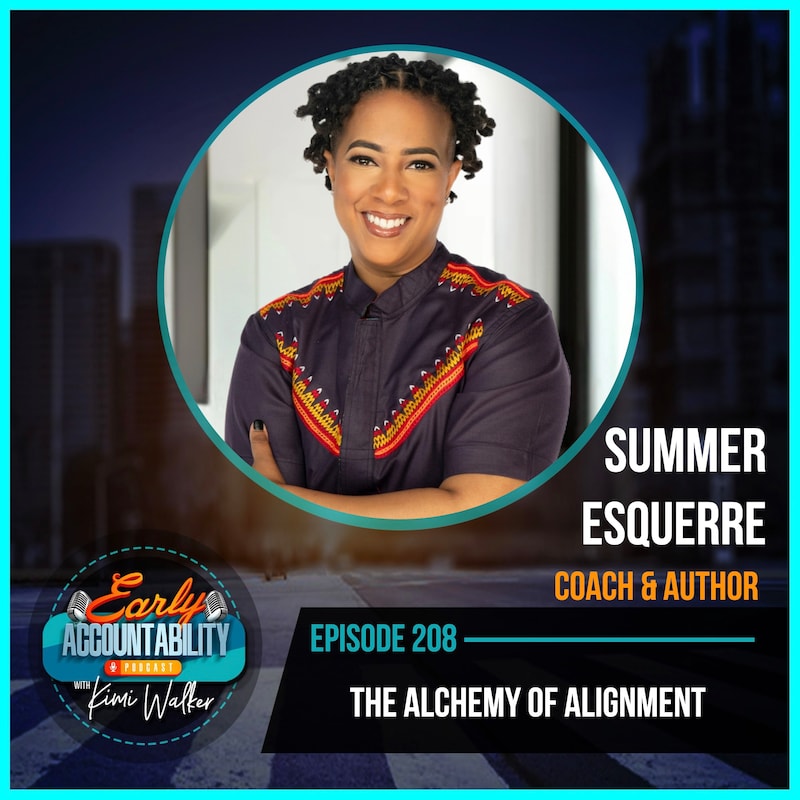
In this inspiring episode of the Early Accountability Podcast, host Kimi Walker welcomes Summer, Certified Somatic Leadership Coach and co-founder of SMART Wellness, to discuss what it truly means to thrive as a high-achieving, gifted professional. Drawing from her unique journey as a Black, queer woman in the cybersecurity industry and her expertise in somatic leadership, Summer shares how her experiences of being “othered” shaped her vision for wellness and authentic leadership.
Together, Kimi and Summer delve into the critical topics of nervous system repair, authentic leadership, and the role of community in wellness. Summer offers practical strategies for moving beyond “going through the motions,” emphasizing the importance of understanding your values, setting manageable goals, and building supportive communities. Listeners will leave with not only new tools, but also a motivating reminder that true transformation happens in small, intentional steps, and honoring yourself is the foundation for all sustainable success.
Topics Covered in This Episode:
- Shifting from “masking” and survival to authentic, aligned leadership
- The SMART Wellness framework (Sleep, Movement, Awareness, Recognition of identity, Tailored inputs)
- Practical somatic strategies for nervous system repair and emotional clarity
- How to begin transformative change and stay consistent without overwhelm
- Overcoming guilt and self-betrayal while redefining success on your own terms
- The power of accountability and community in making wellness a lifestyle
About Summer Esquerre
Summer Esquerre is the co-founder of SMART Wellness, an organization helping gifted and high-achieving Black professionals repair their nervous systems, reclaim emotional clarity, and stop merely surviving success. An ICF PCC-certified somatic leadership coach and former corporate executive with over 20 years of experience, Summer combines science, culture, and nervous system strategy to guide clients toward authentic transformation. Having learned firsthand how to stop over-functioning and start honoring her own needs, she is passionate about helping others move beyond performance and embrace true well-being.
Connect with Summer Esquerre
- Website: https://smartwellnessglobal.com/home
- Email: [email protected]
Connect with Kimi Walker:
- Visit: earlyaccountability.com
- LinkedIn: Kimi Walker
- Facebook: Kimi Walker
- Instagram: Kimi Walker
- YouTube: Kimi Walker
Transcripts
All right, Kimi Walker here and welcome back to the next episode of
Speaker:the Early Accountability Podcast today.
Speaker:I am so happy and lucky to have Summer here.
Speaker:Summer is the co-founder of Smart Wellness.
Speaker:A company dedicated to helping gifted and high achieving black professionals repair
Speaker:their nervous systems, reclaim emotional clarity and stop surviving their success.
Speaker:It's grounded in science, culture, and nervous system strategy.
Speaker:Her work.
Speaker:Guides clients from simply going through the motions to
Speaker:experiencing true transformation.
Speaker:Summer is also a certified somatic leadership coach with over 20
Speaker:years of corporate experience.
Speaker:So she is, I know, gonna give us so many gems today on the show.
Speaker:So Summer, first off, thank you for being on the show.
Speaker:Hey, Kimi, thank you for having me.
Speaker:I'm excited to be here.
Speaker:Great.
Speaker:We're so happy to have you.
Speaker:You have.
Speaker:Having personally navigated the, the masking in corporate.
Speaker:Why don't you start just by telling the audience a little bit about who you are,
Speaker:telling them about, like what started, smart wellness, what made you wanna be
Speaker:a leadership coach, all of those things.
Speaker:Yes.
Speaker:Thank you.
Speaker:So where do I begin?
Speaker:I think the biggest thing is that I have always been somebody
Speaker:who has been an outlier.
Speaker:So based on the way I was raised Jehovah's Witness, and so I was never really in.
Speaker:Spaces with the collective.
Speaker:Growing up as a kid I was identified as gifted as well.
Speaker:So I was pulled out and I was separated from folks even growing up.
Speaker:I was a speck of pepper in the sea of salt, so I was always
Speaker:in spaces where I felt othered.
Speaker:And that kind of took me.
Speaker:And a lot of different places professionally.
Speaker:So my formal training is in cybersecurity, governance, risk and compliance.
Speaker:And so I got into cybersecurity in the early two thousands, and the
Speaker:purpose of that was because I knew that there was the digital divide and.
Speaker:United States with folks, particularly black folks, having access and
Speaker:understanding what was going on.
Speaker:And so very early on I made a decision to get into cybersecurity,
Speaker:which is like a really rare thing.
Speaker:There are very few black people, there are very few women.
Speaker:And so I have typically been in, historically have been in mostly
Speaker:conservative kind of military based.
Speaker:White male spaces.
Speaker:So that is part of what shaped me.
Speaker:I think the other thing to kind of name is that I am unapologetically black.
Speaker:I'm also unapologetically queer.
Speaker:And so to have that dichotomy in these spaces was very difficult
Speaker:because I didn't have a roadmap.
Speaker:I didn't have folks who shared any of my challenges, history,
Speaker:any of the shared identity other than maybe being a bit nerdy.
Speaker:And male nerdiness versus my nerdiness was a bit different.
Speaker:I also have been somebody who has always excelled.
Speaker:And that's not from a place of arrogance.
Speaker:It's really from a place of experience and because of excelling,
Speaker:I early on, got into leadership.
Speaker:And I was leading folks who, again, did not look like me, who were much older than
Speaker:me, who were questioning why is it you?
Speaker:And so part of my leadership journey was really, it was really important for
Speaker:me to understand how to lead people.
Speaker:And just because you know how to do a thing technically does not mean
Speaker:that you know how to manage, lead, and inspire and support other people.
Speaker:And so it was really important to me for not only just the.
Speaker:Leading people, but what is the methodology?
Speaker:What is the approach so that I'm not inflicting harm like I had
Speaker:other leaders inflict upon me.
Speaker:And so it was like a lot of growing pains to get there, and
Speaker:that really led me to somatics.
Speaker:And so somatics is really about being in the body and not just being in the head.
Speaker:I started taking somatic leadership coaches.
Speaker:I actually found it through some folks who I'm friends with within the social justice
Speaker:spaces of how to relate from a human perspective and how to be in the body.
Speaker:So that's really what brought me here and brought me to co-found
Speaker:Smart Wellness with Dr. Reba Peoples.
Speaker:And we can get into more of that in a bit if you like.
Speaker:Okay.
Speaker:Okay.
Speaker:You kinda let right in.
Speaker:So you have described smart wellness as a place where going through the motions
Speaker:just ends in transformation begins.
Speaker:So what inspired you to create that vision?
Speaker:Part of it was that, you wish to create things that you wish that you had.
Speaker:So being somebody who is gifted and not realizing that, Hey, my giftedness
Speaker:didn't stop in middle school, right?
Speaker:There's a shaping there's a neurodivergence and being gifted and
Speaker:that shapes who you are in the world.
Speaker:That piece plus the.
Speaker:Being in leadership circles and not having other folks that I
Speaker:felt like it was safe to talk to.
Speaker:There was not a roadmap.
Speaker:There were a lot of experiences that I had that I went through the growing pains of.
Speaker:And I'm also somebody who is very, I nerd out on relationships and
Speaker:relationship building regardless of the type of relationship.
Speaker:And so this was really a space that I co-created with Dr. Reba Peoples
Speaker:so that folks like us had a place to be seen, a place to be heard, a place
Speaker:where there's language that can help you relate further to who you are
Speaker:and a community where you can do it.
Speaker:Where there's not judgment, but there's support.
Speaker:There's accountability and there's really a blueprint on how to be successful in
Speaker:a authentic way and not one on paper.
Speaker:'cause you're making six figures and you're this person in the
Speaker:community and you have 2.5 kids and you have a spouse and a dog.
Speaker:Like all of that stuff is very flat and very capitalistic.
Speaker:But how do we really help folks who are like us?
Speaker:Be successful on their own terms and do it in a sustainable way.
Speaker:Okay.
Speaker:Okay.
Speaker:That's awesome.
Speaker:It's a lot and that's a lot I think too, to unpack and process for most
Speaker:people, especially processing it when, like you say, you mask and.
Speaker:You've been taught or socialized to go about things a certain way, right?
Speaker:Or not go about them or not address them.
Speaker:So as a leadership coach you had decades of corporate experience, right?
Speaker:How do you help like high achievers balance being authentic with the demands
Speaker:of performance and even to perception.
Speaker:That's a great question and part of what we need to do is start at
Speaker:the beginning and the first part of starting at the beginning is twofold.
Speaker:One, what are your values and your principles?
Speaker:A lot of people don't know what their internal value system is.
Speaker:They don't know the words that they really identify with.
Speaker:Oftentimes it's words that they were, that they received from their family of origin
Speaker:or their spiritual spaces or the corporate space, but they've never taken the time
Speaker:to actually say what are the words?
Speaker:Relate and resonate to me.
Speaker:So that's the first piece of understanding that and helping people get that language.
Speaker:The second piece is really understanding your history and
Speaker:what has shaped you in community.
Speaker:What has shaped you in your family?
Speaker:What has shaped you in a regional perspective, a timing perspective,
Speaker:because if you don't know that historical.
Speaker:Framework.
Speaker:If you don't know that lineage and you don't know what your principles are,
Speaker:then what are you chasing for success?
Speaker:What are you basing your success on?
Speaker:So we start foundationally with that, and we do it not in a,
Speaker:mindset kind of intellectual way.
Speaker:We really do it with the mind, the brain, and the body.
Speaker:And so part of the coaching and part of it is noticing what comes up for
Speaker:you as you're exploring these things.
Speaker:Noticing where you might feel tight, noticing where there might
Speaker:be an impulse or you feel that.
Speaker:Fart racing.
Speaker:So it's really getting into multiple dimensions of a person in a way
Speaker:that is sustainable that is from a curious lens, and one that does not
Speaker:blow out a person's nervous system.
Speaker:Okay.
Speaker:That's really good.
Speaker:That's really good.
Speaker:And you came right into what I was gonna ask.
Speaker:We're gonna talk about the nervous system.
Speaker:So you talk about nervous system repair as a way that people
Speaker:can get clarity and resilience.
Speaker:How we here on the early accountability show, we're where people are
Speaker:at the beginning of a change, a shift, a movement, a pivot.
Speaker:What would you say for people when it does come to, Hey, this is something
Speaker:I wanna focus on and I'm always talking about this 'cause this show
Speaker:is wellness, so you have a perfect name because everybody knows it's like
Speaker:early accountability plus wellness.
Speaker:So what advice would you give people as far as early accountability in the early
Speaker:stages, in the beginning stages as far as, staying consistent and getting on this
Speaker:journey and making it more of a lifestyle and not like a fad or one thing I try,
Speaker:yeah, that is a hard thing.
Speaker:Transformation, if you think about it, it feels overwhelming
Speaker:and it could feel laborious and it can feel really what do I do?
Speaker:I'm in the middle of the ocean and I'm lost and I have no idea.
Speaker:So I think there are two things, real simple things that we
Speaker:could do, but we don't consider.
Speaker:I think the first is naming out loud to yourself and others that
Speaker:you are at the beginning stages of wanting to change, right?
Speaker:And those people are the ones who support you.
Speaker:Those are those people who are confidants, those are people that have a certain
Speaker:level of trust and safety to say.
Speaker:Hey, I am about this thing.
Speaker:I don't know what it's gonna look like.
Speaker:You're gonna see some change in me, but what I'm hoping for and
Speaker:what I'm asking is, as you see this change, check in with me or ask me
Speaker:how I'm doing or ask in this time.
Speaker:How you could support me, and I'm happy to do the same, but I'm just
Speaker:letting you know what I'm up to.
Speaker:A lot of times we don't verbalize that, and so when people outside of
Speaker:us externally see us change and they comment on it, there's like a shame or
Speaker:there's an embarrassment, or there's this thing of who do you think you are?
Speaker:Which could stop that whole process.
Speaker:So we can just blunt that in saying, again, to the people that we trust,
Speaker:this is what I'm up to, and this is what accountability looks like.
Speaker:I think the other thing is just taking it one little bite at a time.
Speaker:I will say that I am somebody who just historically is one of extremes, right?
Speaker:So if I'm gonna do a thing, I'm gonna do a full tilt and I'm gonna get the
Speaker:gear and I'm gonna do everything.
Speaker:And you're so busy doing all of that stuff.
Speaker:You burn it out and then you wind up doing none of it.
Speaker:And so it's really taking.
Speaker:Just that one little piece at a time.
Speaker:And so if it's, I wanna shift and change, it could be as simple as
Speaker:for two minutes, twice a week, I'm gonna try to just be quiet.
Speaker:And I don't know what that is gonna look like.
Speaker:It's gonna be monkey mind and all these other kind of
Speaker:things, but it's just two days.
Speaker:A week for two minutes.
Speaker:So we just slowly do a thing and then as we build that into like
Speaker:our muscle memory, we add to it.
Speaker:And so it really is a lifestyle change, but a lifestyle change that
Speaker:requires taking it bit by bit, right?
Speaker:If you wanna be healthy and you wanna change, let's say you wanna
Speaker:to run a marathon, you are not gonna go out there and the first time you
Speaker:start running, you run at 13 miles.
Speaker:Correct.
Speaker:That's not gonna happen.
Speaker:But what you will do is the little things you might learn about
Speaker:tweaking, how to change what you eat and what you put in your body.
Speaker:You might change how you rest, right?
Speaker:You might start with running and walking or like a light, there's all these
Speaker:different things, but again, the whole purpose is just the piecemeal and the
Speaker:tweaking it step by step as a take as opposed to taking everything all at once.
Speaker:So looking back on your own journey, what.
Speaker:Your own career, your own personal evolution, what would you say has been the
Speaker:most powerful lesson you've had as far as honoring your need to, just honoring your
Speaker:needs in general without, with excellence, without sacrificing your excellence,
Speaker:but also to not sacrificing your peace.
Speaker:What is.
Speaker:Lesson.
Speaker:Lesson?
Speaker:That's a great question.
Speaker:I think the biggest lesson is that if I try to do this for other people
Speaker:one, it's not gonna be sustainable.
Speaker:Two, it's really not gonna be authentic and our organic,
Speaker:And three, it's gonna be performative.
Speaker:And so the biggest lesson that I've learned, and this has been in my
Speaker:forties so this, and it's something that I have to keep practicing, is
Speaker:that to do it for myself and to honor myself is a way to be selfish and a
Speaker:generative, compassionate and loving way.
Speaker:That's good.
Speaker:And that's been really hard.
Speaker:Yes, EAs much easier said than done.
Speaker:Absolutely.
Speaker:And I think that's too hard, especially when you know the power of it and
Speaker:you know what it can do, but it has to be something that person.
Speaker:Wants or wants to do no matter how you see it or what you view it
Speaker:or what, the benefits of it are, it has to be like there for them.
Speaker:And you can, I think you bring up, up an important point too,
Speaker:just about like on the airplane, put your mask on first, right?
Speaker:You have to like, take care of yourself first and be whole before
Speaker:we can give out to anybody else, before we can support anyone.
Speaker:And there is a lot of work in doing that.
Speaker:I think the other thing, in addition to putting the.
Speaker:Ask on first.
Speaker:I had a challenge of if I do it for other people, then surely
Speaker:it's going to be reciprocated.
Speaker:Like they'll know that me doing it for them is because this is what I
Speaker:need and I need them to do it for me.
Speaker:And building achievement or building again, your principles or the things
Speaker:that are important to you externally.
Speaker:That is not a loving and kind thing to do and what is going to happen, or at
Speaker:least in my experience, what happened was that one, the other people didn't get it.
Speaker:Two, it was taken advantage of.
Speaker:And three, it created resentment because it's looking at look
Speaker:at all that I've done for you.
Speaker:Can't you do the same for me?
Speaker:And the person who I betrayed in all of that, Kimi was me.
Speaker:Like I betrayed me and asking other people to do it because if I
Speaker:could do it for other people, then why wasn't I doing it for myself?
Speaker:Ooh.
Speaker:And that's the biggest lesson.
Speaker:I think to say su succinctly is to not self betray.
Speaker:Ooh, that's deep.
Speaker:That's deep.
Speaker:That's a, I that's a powerful lesson.
Speaker:Let me think.
Speaker:Ooh, where do we go from there?
Speaker:So let's talk about sur surviving success, right?
Speaker:If there's a listener today who feels like I'm just barely above water
Speaker:what is one, one actionable step, one small, simple, actionable step
Speaker:you think they can do or implement in order to reclaim their sense of peace?
Speaker:This might be really hard because we are in a society of people
Speaker:who are lonely and siloed.
Speaker:But it's really looking for other people to affirm and to
Speaker:be on that journey with you.
Speaker:Can you find community?
Speaker:I think the other thing that we can do, and it's based on
Speaker:everybody's spiritual practice, but prayerfully put that out there.
Speaker:Whatever your spiritual guidepost looks like, regardless to put out there that I
Speaker:actually want to shift because everything is based on intention and attention.
Speaker:And if you have intention to do something, then your attention is
Speaker:going to be based on those things.
Speaker:And so that shift is not external.
Speaker:It's not out here.
Speaker:It's really inside to start that and have the curiosity and the humility
Speaker:to go on that path because you don't know what that you don't know what
Speaker:that journey's gonna look like.
Speaker:So for me, I know that I got to a point and I said it out loud, I can't
Speaker:keep doing things this way anymore.
Speaker:And I honestly did not know what the shift and the difference was gonna be.
Speaker:But what I knew was that it was not sustainable, my own success,
Speaker:I felt guilty Kimi because.
Speaker:I was successful on paper, right?
Speaker:Like I was the highest the highest level within my organization.
Speaker:It was a Fortune 200 organization as a queer, black,
Speaker:androgynous presenting person.
Speaker:And I had a beautiful looking family.
Speaker:I made great money, right?
Speaker:And everything was well put together.
Speaker:I was so unhappy,
Speaker:And I remember I would have days where I would drive into work and I
Speaker:would call my best friend in tears, and then I would also feel guilty
Speaker:because I'm like you have a good life.
Speaker:Good life.
Speaker:What?
Speaker:How dare you, the audacity.
Speaker:Of feeling guilty about your current circumstances, but what I didn't
Speaker:understand and what I didn't appreciate is that I have an internal drive and an
Speaker:internal need to understand myself in a deep way to have my values aligned, right?
Speaker:Integrity and character and consistency, those types of things
Speaker:are like really important to me.
Speaker:They were misaligned.
Speaker:Like it was all of these things that were misaligned based
Speaker:on what success meant for me.
Speaker:And so for people who are feeling unhappy and they're successful, I
Speaker:think it's also to give themselves permission and to forgive
Speaker:themselves for being unhappy, right?
Speaker:Like that guilt, that weird kind of bind that we get into ourselves
Speaker:in, you are not ungrateful.
Speaker:You are just misaligned and misattuned to.
Speaker:What is important to you?
Speaker:And so that kind of, again, saying, I want that alignment.
Speaker:I want that attunement.
Speaker:I don't know what that means.
Speaker:That's really the shift and to hold that as compassionately as possible.
Speaker:That's great.
Speaker:And you know what, honestly a lot of what you're saying too is a lot of really what
Speaker:we stand for here at early accountability.
Speaker:Always preaching to people.
Speaker:Find groups, go around people who have similar goals as you go around, people who
Speaker:are trying to do similar things, like you said, if you're trying to run a marathon,
Speaker:you have a group of people who are also trying to train for a marathon too, right?
Speaker:Sometimes your family, they can be supportive and friends like
Speaker:you said, but you get a different feeling of understanding when you're
Speaker:around somebody else who's training for the same things that you are.
Speaker:So it, they understand the ebbs and the flows too.
Speaker:And I think too, it helps us alleviate putting the pressure on maybe those
Speaker:around us to be everything to us.
Speaker:What you said with the whole higher power or so sometimes we'll get upset when a
Speaker:significant other or a child or whoever just doesn't understand and we think they
Speaker:should, but that maybe just their role at that, in that area, it isn't a good fit.
Speaker:And that's okay.
Speaker:But it also too, I think.
Speaker:Can strengthen relationships.
Speaker:How you said too, you're with relationships can strengthen
Speaker:relationships because you do, you put less of that pressure on them
Speaker:that they feel that they have to be everything or fulfill everything.
Speaker:Or like you said, being in that as well, like I have healthy boundaries,
Speaker:I have healthy relationships.
Speaker:I have different people who I may be cool with or talk with about this thing or that
Speaker:thing, or who support me too in addition.
Speaker:But just understanding that their support and level of understanding
Speaker:just might be different.
Speaker:So I think that's.
Speaker:Great.
Speaker:That's really great.
Speaker:Now talk more, I know you said about community why don't you tell the audience,
Speaker:I know you all are building a community.
Speaker:Why don't you talk more about what the community looks like for you all and
Speaker:any other offerings that you all have right now, and where the audience can go
Speaker:to find out more information about you.
Speaker:Yeah, thank you.
Speaker:So we have a community at Smart Wellness.
Speaker:There's three different tiers, right?
Speaker:So the first tier is for free.
Speaker:Anybody can join and really.
Speaker:That community is a couple of different there's a couple of different goals.
Speaker:One is to understand from the smart wellness framework, where do you need
Speaker:the most support coming in there?
Speaker:And I haven't described what smart means.
Speaker:I'll just go into that really quickly.
Speaker:SMART is a acronym and it means sleep movement awareness, recognition
Speaker:of identity, and tailored inputs.
Speaker:And so our framework is really saying if you attend to these five
Speaker:things in an experiential way and in relationship, you will help to redesign
Speaker:your life that is more authentic to you and what is purposeful for you.
Speaker:So that first community, that first coming in for the free tier is getting
Speaker:to be around other folks who are gifted and high achieving and black, right?
Speaker:There's dialogue in there.
Speaker:There's some training in there for you to start to have the language
Speaker:to understand where you're at.
Speaker:That's really hard.
Speaker:A lot of us don't have the words, and that's frustrating,
Speaker:and the English language is very limited, so we're trying to help.
Speaker:Folks with meaning making second tier goes much deeper.
Speaker:And in that second tier, which is, a cost, there's some additional
Speaker:training, there's live training that you have with us, there's additional
Speaker:information, and then there's.
Speaker:Discounts to, we have intensives and we have retreats, so it's really getting into
Speaker:the ecosystem saying, Hey, I know that I need to start changing, and what is the
Speaker:foundational things that I need for that?
Speaker:And then the last tier is really about like I am in the implementation game.
Speaker:So in addition to what I had discussed in the other two tiers you have an
Speaker:opportunity to have a one-on-one coaching session with me or Dr. Reba.
Speaker:In addition, there's biweekly group laser coaching, right?
Speaker:So in real time as you're going through the transformation, you're
Speaker:gonna have questions, you're gonna wanna understand well.
Speaker:Based on this scenario or this experience, how do I navigate that?
Speaker:And we really have a sacred, safe space to group coach, to have other
Speaker:folks in there where you can bring in your questions, we can give you
Speaker:the mentoring, we can give you the guidance, we can give you the support.
Speaker:And in this tier also we include one of our kind of signature.
Speaker:Gift boxes and the purpose of our gift boxes is to really have a
Speaker:tangible thing to help you with your rituals and your implementation.
Speaker:So folks who are in the Premier Tier.
Speaker:Also get the smart wellness gift box the focus of sleep.
Speaker:And so all of the items in there are curated from Dr. Reba, myself.
Speaker:They're sustainable and each of them help with the senses.
Speaker:They're tactile.
Speaker:They address taste and smell and touch to really help you ritualize and get
Speaker:into the practice of having sustainable and helpful and restorative rest.
Speaker:And then the last thing is for this tier, there are discounts and
Speaker:early access to our retreats and then to our intensives for that
Speaker:deeper learning and implementation.
Speaker:That's awesome.
Speaker:Awesome.
Speaker:So where do people go to visit you all on the web?
Speaker:Where can they go to find out more information?
Speaker:Absolutely.
Speaker:So we are at www.smartwellnessglobal.com.
Speaker:Okay, so Summer why don't you tell us what's one of your mantras?
Speaker:What are some words that you live by?
Speaker:Some of the words that I live by, I said a couple of them.
Speaker:Integrity is huge.
Speaker:Integrity is huge.
Speaker:And when I say integrity, I mean that internally who you are is the same as what
Speaker:you present out into the world, right?
Speaker:It also means your say do is high in alignment integrity also means that
Speaker:I'm aligned to what is important for me, as opposed to externalizing
Speaker:it and performing it for others.
Speaker:Joy is another word, which for a long time I didn't realize how much I did
Speaker:not incorporate and practice joy in my life or I was very serious and I
Speaker:was very committed and like I said, like high achieving and exceptional.
Speaker:And what.
Speaker:What's gone from that was joy for the sake of living and
Speaker:finding those moments in pockets.
Speaker:It doesn't have to be demonstrative.
Speaker:It's like I love seeing how my mint is growing and sprouting
Speaker:and spending time growing my, it's something as simple as that.
Speaker:But joy I think another word for me is humor.
Speaker:And life.
Speaker:Life is hard
Speaker:There's so much irony, there's so much contradiction.
Speaker:There's so much in there that if you take everything so seriously.
Speaker:It's just gonna bog you down.
Speaker:And especially for a black woman, there's so much weight that we
Speaker:carry from our lineages, from our ancestry, from our families of
Speaker:origin today, the expectations of us.
Speaker:And so where is the humor?
Speaker:And then I think the last one is spirituality, right?
Speaker:And that everything to me is spiritual.
Speaker:Relationships are spiritual because that's where you test
Speaker:what you say is important, right?
Speaker:That's what.
Speaker:That's the place and the space that you rub up against, okay,
Speaker:this thing matters to me.
Speaker:Does it, let's see how it is when you interacting with
Speaker:another person or people, right?
Speaker:And so those are some of the words, relationship as well are those
Speaker:words that I hold really near and dear and that I am pretty much
Speaker:nerd out on a pretty regular basis.
Speaker:I'm a big nerd.
Speaker:Ain't nothing wrong with that.
Speaker:Ain't nothing wrong with that.
Speaker:Summer, thank you so much.
Speaker:We are so lucky to have had you on the show to the audience.
Speaker:Make sure to check out the show notes and we will have everything there where people
Speaker:can go link, learn about your groups and the different tiers and get a smart box.
Speaker:So they call smart boxes.
Speaker:What's the box called?
Speaker:Actually I what they
Speaker:It's a smart wellness.
Speaker:This first one is a smart wellness sleep box.
Speaker:Sleep box.
Speaker:Okay.
Speaker:The first one, the sleep box, which looks phenomenal.
Speaker:We'll have pictures of that in the show notes too, so people can go
Speaker:ahead and support especially at this time when it's gonna come out.
Speaker:We're gonna be close to the holidays when this episode comes out for publication.
Speaker:So Summer, thank you again for being on the show and to the audience.
Speaker:Until next time.

