Shownotes
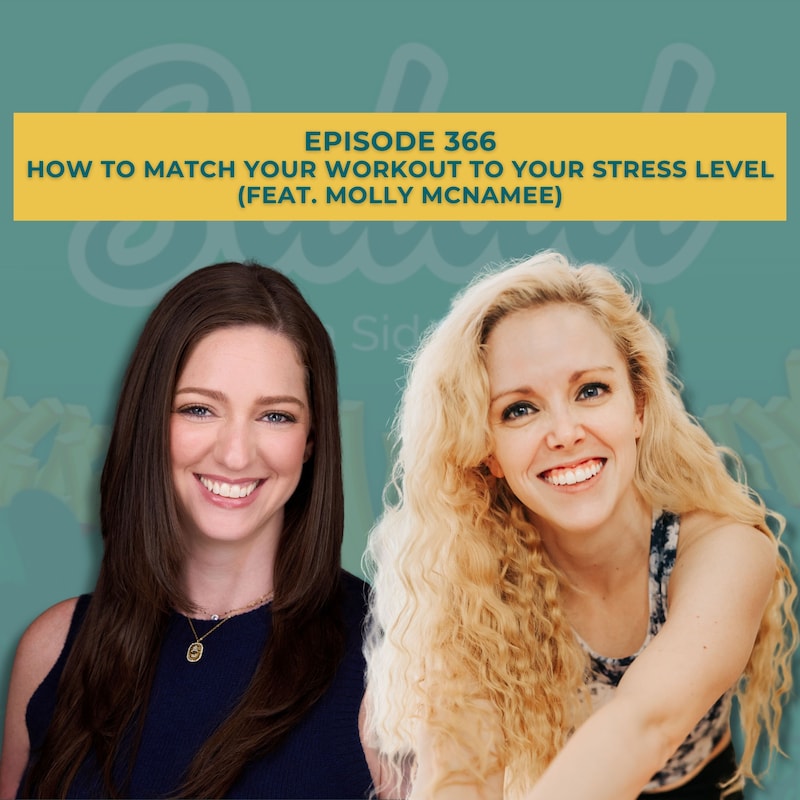
Chasing harder workouts when you're already stressed or exhausted might be the exact thing sabotaging your weight loss journey. This episode of Salad with a Side of Fries digs into why pushing through chronic stress with intense training backfires, and what truly helps your body recover.
Jenn Trepeck and guest Molly McNamee, founder of MFit Workouts, explore how hormone balance, cortisol, and simple daily tracking habits can help you match your movement to your stress and finally break the overtraining cycle.
What You Will Learn in This Episode:
✅ How chronic stress and cortisol overload can stall weight loss even with a perfect diet and workout routine
✅ The physical warning signs, like bloating, bruising, and getting sick often, that signal your body is overstressed
✅ How to use a daily "vibe check" and warm-up test to decide whether to push hard or dial back your workout
✅ Why cool downs and restorative movement like Pilates and yoga are essential tools for calming an overstressed nervous system
The Salad With a Side of Fries podcast, hosted by Jenn Trepeck, explores real-life wellness and weight-loss topics, debunking myths, misinformation, and flawed science surrounding nutrition and the food industry. Let’s dive into real-life wellness and weight loss, including drinking, eating out, and skipping the grocery store.
TIMESTAMPS:
00:00 Why stress sabotages workouts (and vice versa) which creates a vicious training cycle
04:45 Molly McNamee, a fitness and hormone coach, shares how a concussion revealed her own chronic stress and burnout
08:06 Physical symptoms that signal stress is affecting your body and hormones
10:18 The biggest overtraining mistakes people make when stressed and stuck
13:14 Shifting the mindset that more (or more intense) workouts always means better results
19:34 Why tracking your cycle and symptoms reveals hidden stress patterns
23:31 Using a daily "vibe check" to match workout intensity to your energy
26:22 Building a Plan A and Plan B for workouts based on stress levels
31:20 The importance of the cool down
42:49 Molly hopes to see a continued pattern of coming back to the fundamentals of wellness
KEY TAKEAWAYS:
💎 Overtraining during periods of high stress can stall fat loss instead of accelerating it
💎 Small physical cues, like poor sleep, bruising easily, or getting sick often, often point back to unmanaged stress
💎 Adjusting workout intensity daily, rather than pushing through, supports better hormone balance long term
💎 Building in cool down time and pauses throughout the day helps shift the body out of a stressed state
ABOUT THE GUEST:
Molly is a fitness and stress-focused hormone coach and the founder of MFit Workouts. She helps busy, high-achieving women understand why their workouts stop working during periods of chronic stress. And how to restore fat loss, energy, and hormonal balance without burnout.
RESOURCES:
Today's Episode Sponsor: BetterHelp
Become a Happy Healthy Hub Member
A Salad With A Side Of Fries Merch
A Salad With a Side of Fries Instagram
Text ‘Book’ to 833-801-0500
GUEST RESOURCES:
QUOTES:
10:53 “I'm a big advocate for the idea that to fix an extreme, you don't fix it with another extreme.” – Molly McNamee
12:37 "When you're working out, you raise your cortisol. I'm in the camp of evaluating each day how your body is feeling and adjusting your workout accordingly." – Molly McNamee
17:28 "Ignoring our stress signals and pushing through anyway, even pushing through workouts, we tell ourselves it's discipline. Spoiler, it's a boundary issue with ourselves." – Jenn Trepeck
18:20 "Our objective now is to put the pieces together, understanding what state our body is in, and then match the movement to that." – Jenn Trepeck
38:05 "Your body is constantly talking to you. For women, your period is like the biggest report card of how you're feeling." – Molly McNamee
46:19 "Remember, more is not always more. Harder is not always better." – Jenn Trepeck
SEO KEYWORDS:
Jenn Trepeck, Salad With A Side Of Fries, Nutrition Nugget, Health Coach, Weight Loss For Real Life, Stress, Cortisol, Weight Loss, Hormone Balance, Fitness Coach, High-intensity Training, Concussion Recovery, Chronic Stress, Burnout, Fat Loss, Energy, Sleep Issues, Anxiety, Bloating, Insomnia, Overtraining, Cardio, Strength Training, Pilates, Yoga, Cool Down, Warmup, Restorative Workouts, Mobility, Stretching, Menstrual Cycle, Cycle Syncing, Stress Syncing, Basal Body Temperature, Cervical Mucus, Perimenopause, Post-menopause, Sympathetic Nervous System, Parasympathetic Nervous System, Immune System, Environmental Stressors, Digital Stressors, Gut Imbalance, Electrolytes, Health Coach, Nutrition Coaching, How to match workouts to stress levels, Signs stress is affecting your hormones
Transcripts
How to Match Your Workout to Your Stress Level feat. Molly McNamee (FULL EP)
[:[00:00:15] But then those workouts stress your body out even more. So it's kind of a vicious cycle that people go through here. They already have a underlying level of stress that is upsetting their body, and then they throw the most stressful possible workouts at their body to try and help them.
[:[00:00:38] I'm your host Jenn Trepeck talking wellness and weight loss for real life. We're here to clear up the myths, misinformation, fad science, and marketing to teach you how to eat and how to cheat. Are you ready? I'm having salad with a side of fries. Hey, friend. Welcome back to Salad with a Side of Fries. I'm Jenn Trepeck, your host and health coach here with you every week for [00:01:00] wellness without the weirdness, and it's been a minute since we focused on the fitness or movement aspect of our wellness.
[:[00:01:50] So let me introduce you to our featured guest. She's a fitness and stress-focused hormone coach, and the founder of M Fit Workouts. [00:02:00] She helps busy, high-achieving women understand why their workouts stop working during periods of chronic stress, and how to restore fat loss, energy, and hormonal balance without burnout.
[:[00:02:14] Molly McNamee: Hello. Thank you for having me. That was such a fun intro. I feel like a rock star.
[:[00:02:24] Molly McNamee: Yeah, like boo, boo, boo, boo ... you know. Yeah.
[:[00:02:29] So- Yes. Well, welcome officially to Salad with a Side of Fries, and since we didn't get too much of your story and your bio, we're gonna start there, and then kinda use that as our jumping-off point.
[:[00:02:44] Jenn Trepeck: Awesome. Really quick, though, we have to tell our members what they're getting this week. So friends, join us in the Happy Healthy Hub.
[:[00:03:13] So all of this is yours for just $12 a month, or if you pay for a year at once, you get two months free, so that's a whole year for 120 bucks. Like, we've spent more money on less. So your recipe this week is for summer chicken Parmesan. Actually pretty fitting for today's conversation. I think chicken parm can be one of those, like, comfort foods that maybe you crave with stress.
[:[00:04:07] From there you'll click subscribe now, follow the prompts to enter your payment info, create your login to access the hub and all of your benefits. Remember, you're going to asaladwithasideoffries.com/membership. This shows your support for this podcast and of course, your health Okay, Molly. You've been a stress and fitness coach for 15 years.
[:[00:04:44] Molly McNamee: Yeah. Okay, that's fun. Let's rewind it back a little bit to see how it all connects. So I have been working in the fitness industry for the last 15 years or so, but I didn't actually always have this focus on stress and hormones that I have now.
[:[00:05:18] But I realized I was wrong when that stopped working for me in my mid-20s. So at that time, I was working out so much, every single day, multiple hours a day, and I was also eating ridiculously healthy. But I was feeling worse than I had ever felt before. So I was gaining weight. I was struggling to build muscle.
[:[00:06:02] And what makes me a little frustrated when I share my story is I think I would have continued feeling really, really bad if I hadn't gone on a hiking trip and suffered a concussion. So I went hiking alone, tried to be Tarzan, hit my head on a rock, and then had a pretty bad concussion recovery. But while recover- Oh, my goodness
[:[00:06:41] But when I started resting more, I realized, huh, I'm not as bloated. I'm sleeping better, actually. I'm not as anxious. And then my weight started evening out, and that's when I went into what I like to call Detective Molly mode. I was like, "Okay, I don't think this concussion magically healed me, [00:07:00] so what's going on?"
[:[00:07:29] And even though that concussion was not fun for me, I'm really happy that it happened because now it allowed me to heal myself and it's allowing me to help so many other people.
[:[00:07:52] You were having trouble really sleeping, relaxing. You had the bloating. What else might somebody be experiencing [00:08:00] that's an indication that stress is the thing keeping them stuck?
[:[00:08:18] I actually have a huge symptom checklist on my website that kind of allows you to see, is stress affecting me? But some big things and some niche things that people may experience are definitely sleep issues. If you're struggling to fall asleep or if you're waking up in the middle of the night feeling your heart racing or your mind racing, that's definitely a big indicator that stress is affecting you in a big way.
[:[00:09:09] But on top of that, your immune system may be weak, so you may be getting sick a lot or having recurrent infections. At that time, I was getting recurrent UTIs, and I didn't know why, and I thought that it was just my body hating me for some reason, but it was actually my body crying out for help. So getting sick a lot, your body feeling really sensitive.
[:[00:09:46] There are a bunch, but I feel like those are some that people often don't think about necessarily as being connected to their stress. Like getting sick, you're like, "Ah, something else is going on," but it could just be your body's stressed.
[:[00:10:04] So I see this a lot with people What do you see as some of the biggest mistakes that people are making when it comes to the fitness side, given their stress and given some of these other symptoms that you mentioned?
[:[00:10:39] And I fall right in the middle, where I think both camps need to calm down. Because the biggest mistakes I see are people doing just simply too much, and that can be too much of either end. So something I'm a big advocate for as a coach is that to fix an extreme, you don't fix it with [00:11:00] another extreme.
[:[00:11:18] It's like, "Why can't I lose weight?" And that's frustrating them. So they think, "I need to do more cardio. I need to do more high-intensity training because I've been told that that helps me burn fat." But then those workouts stress your body out even more. So it's kind of a vicious cycle that people go through here.
[:[00:11:58] So a lot of people are like, "Okay, [00:12:00] I'm working out an hour four days a week, and that's not working. So let me add another day. Actually, let me make these workouts even longer. Okay, let me do even more cardio after I hit the gym." Doing too much is keeping your body stressed, and that's definitely a mistake that I made myself.
[:[00:12:35] It's amazing when you're working out and you raise your cortisol. I'm in the camp of evaluate each day how your body is feeling and adjust your workout accordingly. But it is so valuable to work out because it can be stress relief for a lot of people, and it is definitely valuable to have that intentional rise of your cortisol instead of just, you know, stressing about a meeting.
[:[00:13:11] Jenn Trepeck: Exactly. So that's really gonna be the focus of our conversation.
[:[00:13:35] Molly McNamee: Yeah. And it is not a quick process to switch your mindset there. A lot of people, I think, kind of hope that they'll wake up being like, "Ah, this is the way, and I've accepted this is the way, and now I feel so much better."
[:[00:14:19] 'Cause initially, that mindset is gonna feel like, "Ugh, no, this feels so wrong." But if you start setting up your lifestyle so that you do have moments to pause, you can slow down, you can do a little bit less, and then you start feeling the positive benefits from that, then it's much easier to switch your mindset.
[:[00:15:06] I don't trust you." And then I just ask for trust. I'm like, "Look, trust me for two weeks, and let's see if your body starts to feel even a little bit better by adjusting your workouts this way." And then it usually starts to feel a little bit better, and they say, "Okay, you've gained my trust. I still don't fully believe it, but I'll keep going."
[:[00:15:39] Molly McNamee: Yeah. The first things you might see would be more energy. You may feel not as drained all day. You may have a little bit better sleep, where you're able to fall asleep a little bit more easily, or you stay asleep at night.
[:[00:16:16] That's usually not the first thing. You're not instantly gonna feel your body change physically like that, but you are going to feel, uh, "I feel some relief." I have had people tell me before that it just feels like they can stop and take a breath, and that's a huge win. So if you feel like you've finally been able to relax for once in your body, then that's a really significant change that you will experience.
[:[00:17:08] Jenn Trepeck: Absolutely. And I think this gives us the foundation for then putting the pieces together. Yes. So we'll come back for that after we highlight our sponsor for this episode, BetterHelp. Ignoring our stress signals and pushing through anyway, even pushing through workouts, we tell ourselves it's discipline.
[:[00:17:53] If the therapist isn't a fit, you can switch at no extra cost. Over six million people have gotten help through BetterHelp. They've [00:18:00] earned 4.8 out of five rating on the App Store. Go to betterhelp.com/sideoffries for 10% off your first month. That's betterhelp.com/sideoffries. And we'll put the link in the episode notes because remember, boundaries with yourself are just as important as the boundaries with other people.
[:[00:18:46] Molly McNamee: Yes.
[:[00:19:16] Molly McNamee: I love that analogy, and of course I hear that all the time, too, where people are like, "My life used to be stressful, but it's so much better now," or they're not really realizing that they're stressed now is really the answer.
[:[00:19:29] Molly McNamee: But how do we understand how stressed we are was your question, yes?
[:[00:19:34] Molly McNamee: So there are a few things I want to say here. The first I started to touch on before, but it is tracking how you feel and also tracking your menstrual cycle. These things can be super, super valuable because your body may be crying out for help, and you may not be hearing it because you're just simply not aware of your symptoms or anything like that.
[:[00:20:21] And if your hormones are telling you something, that can also point you to stress. So we track all of these things so that we have some data that we can look at to be like, "Oh, wait. My body actually isn't functioning optimally, so why is that happening, and what am I supposed to do about it?" That is the base of what I do with all of my clients.
[:[00:21:19] My relationship is stressful. I just had a conversation that was frustrating. I was stuck in traffic." Like, we're all very aware of that stress piece, but there are so many other things that can create a stress problem in your body. So there are those environmental stressors, like toxins in the air and in the products that you're using.
[:[00:22:04] So I like to point that out because a lot of people are, who are saying, "Stress isn't a big deal for me," aren't actually aware that all of this other stuff could be impacting them. I was working with a woman recently who literally told me exactly what you said, where she said, "My life isn't very stressful right now," but then she pointed out that she just had to have knee surgery, and then she also pointed out that she had a really tough childhood.
[:[00:22:54] Sometimes it's simply my body feels stressed, and that's why tracking those [00:23:00] things, like your cycle and your symptoms, can be super valuable because, again, your body could be telling you something that your mind isn't registering.
[:[00:23:18] So help us make these matches. What are the movements that would go with various observations in terms of when we wake up or how we feel throughout the day or, you know, walk us through it.
[:[00:23:39] How's my mood? How did I sleep? X, Y, Z. And if you're feeling good, like you're feeling really great, that's your sign you can probably push in your workout. If you're feeling really tired, you didn't sleep well, then maybe you need something that's a little bit more restorative. If you're feeling really moody and [00:24:00] anxious and you're not sure why, there's a middle ground you need to find where your workout is maybe not the hardest push because you're not feeling your best, but maybe not nothing because you're not necessarily tired.
[:[00:24:35] And if you feel worse, that's a sign to dial it back. If you're feeling so much better, that's your sign to maybe push a little bit harder. If you're feeling totally the same, find some middle ground. So there are, like, a lot of obviously bigger cues that we could look at, but I think that that's a more approachable way to look at this versus being like, "Okay, I slept exactly this many hours.
[:[00:25:16] But there are a few things that I think everyone should be doing if they believe at all that stress is a problem in their body, and one of those things is don't ever neglect your cool down. Okay? Your body, workouts are always going to be a stressor. They're always gonna stress out your body a little bit, but one of the mistakes, going back to the mistakes that I see people making is they jump from one stressor to the next, and they do that with their workout, where they finish their workout, they rush their cool down, they hop right into the next thing that they have to do in their day, and their body remains stressed.
[:[00:26:15] I mean, really you should be doing it always. But definitely if you think stress is a problem in your life, I would highly encourage you to do that. And then also something that I do with my clients is we like to have a plan A and a plan B for your workouts depending on how you're feeling that day. So you can have that, "I'm feeling the best.
[:[00:27:02] But if you already have a plan, a totally acceptable plan B, then that feels a little bit better because you're still doing what you planned to do. It's just not, you know, the ideal one that you wanted to do. Did that answer your question? I kind of went on a tangent there. Yes,
[:[00:27:18] And I wanna get even more granular and specific because it's funny, so as you were talking about the warmup thing, I didn't even realize that that's essentially what I do. You know? That's good. I, I tend to do a handful of the s- kind of the same workouts. Like, I work out with a, a handful of instructors, and we sort of do more or less a similar kind of thing most days of the week.
[:[00:28:07] And so I think for some people, having a completely different movement pattern or activity might be helpful. So what are some examples of some of the things of how you sort of create the plan A versus the plan B, or examples of some of the movement that still, and I say this phrase in air quotes, still counts and gives us the options to choose from?
[:[00:29:03] We have those workouts that are raising our heart rate, maybe things like you were planning to run Now you're walking. You were planning to run up a hill, you're running on flat surface. Like, just figuring out how to adapt that way. But specific workout types, because I have thousands of workouts on my website, so when I'm working with clients, I'm literally assigning them workouts to do.
[:[00:29:47] So if someone is dealing with a lot of stress, what I'm probably gonna do is I'm going to assign them those more Pilates style strength workouts, some more yoga and restorative and stretching workouts, as [00:30:00] well as just in general shorter workouts. So if they're usually working out, say, like, 40 minutes, we're now gonna drop that down to, like, 20 minutes.
[:[00:30:30] Those big exercises, squat to a shoulder press. Maybe instead now we're just doing a shoulder press. We're just doing a squat. Like, we're separating things so that it feels less intense to your body. Or we're doing more stretching, more mobility, as opposed to doing those strength workouts and doing those cardio workouts.
[:[00:31:09] That includes stretching, mobility, breathing, yoga, Pilates. That's the two big differences in the workouts that I'm using with my clients.
[:[00:31:41] Is it just as important there as other times when the workout maybe is a little bit heavier or faster-paced or longer or whatever?
[:[00:32:02] And I think that needs to be at the end of every single workout, even those ones that are like, "This was a slower Pilates-style workout. I didn't even get off the ground. It couldn't have stressed out my body that much." It's still important just because it's giving your body a literal break to be like, "Okay, we're pausing before we get back into the next thing."
[:[00:32:43] Just giving your body a chance to pause as often throughout the day as you can is so beneficial because we're constantly surrounded by stress, so we constantly need to have something going on to combat that stress. So while the workout is [00:33:00] more restorative and it's probably not stressing you out as much, it's still so valuable to lie down and breathe or to sit and breathe after you finish your workout instead of just jumping into the next thing.
[:[00:33:23] Jenn Trepeck: Right, like we stay stuck in that cycle. So you started to bring something up there that it's like you're reading my mind, exactly where I wanted to go, which is this idea of stress sinking our lifestyle.
[:[00:34:00] Molly McNamee: Yeah. And so this is the one thing, like you mentioned before, cycle syncing is trendy. This is similar but very different. But one piece of cycle syncing that some people expand into is like, "Okay, what am I gonna eat at this phase of my cycle? What habits am I gonna create at this phase of my cycle?" And my approach with stress syncing is exactly the same, but just with stress.
[:[00:34:44] Maybe you start drinking electrolytes. Maybe you start drinking more water. Maybe you fix your posture a little bit more frequently throughout the day. It can look like physical habits like that, where it's like, "Okay, I'm actually taking a deep breath. I'm [00:35:00] actually closing my eyes. I'm actually sitting up a little taller."
[:[00:35:25] Which is why we're tracking things. And you may be like, "Okay, I'm stressed, and I've noticed that I get a little weird this stage of my cycle. I get really bloated." And it's like, okay, where can we incorporate a specific supplement? Where can we incorporate more water? Where can we incorporate more fiber?
[:[00:36:05] And not everything has to be supportive of your stress, but finding those key places where either you can incorporate a habit like a posture check or a deep breath or a slight meditation. That's one end of it, or you could be like, "Okay, I'm feeling more stressed, so how am I gonna tweak how I eat this week to support that stress?"
[:[00:36:49] Molly McNamee: Yeah.
[:[00:36:58] Molly McNamee: It does feel totally [00:37:00] counterintuitive to do that, but that's exactly what I'm talking about, is things exactly like that where you become more aware. And I think one problem that a lot of people face is the not knowing they're stressed, right?
[:[00:37:34] And it's actually counterintuitive to be like, "My body needs this thing, so I'm specifically not gonna give it to it." Like, once you're aware, it's easier to then be like, "Okay, I'm gonna do what it's asking for." So it is... I feel like the knowledge and the awareness of your body makes that easier- Absolutely
[:[00:37:55] Jenn Trepeck: Agreed. All right, well, a final thought to wrap this up. [00:38:00]
[:[00:38:01] Jenn Trepeck: Yeah.
[:[00:38:15] So if you just can pay attention to even your period every single month, that can give you so much data about your stress, about your hormones, about everything that is going on. Just listening to your body, paying attention to those indicators, that can help you start to put the puzzle pieces together of why you don't feel your best.
[:[00:39:05] Tell me why." And looking for coaches who, you know, have that knowledge of that holistic health versus just trying to rely on a medication or an answer that you found on Instagram.
[:[00:39:29] I get it. It's- Yeah ... still communicating with us, and we still have tools, and we can still understand it.
[:[00:39:52] And stress is definitely a big thing that you'll wanna focus on if you are in perimenopause, because stress is only gonna make that process [00:40:00] harder for you.
[:[00:40:06] Molly McNamee: I'm so ready.
[:[00:40:10] What's the naughtiest thing you've done related to your health this week? You know, like the salad and fries of your week.
[:[00:40:29] So I downloaded it, but then I can't stop playing it, so my screen time has gone way up, and it's- Wait,
[:[00:40:36] Molly McNamee: It's... What is the f- name of this game? I will tell you right now. It is called Travel Town
[:[00:40:43] Molly McNamee: don't download it. It'll ruin your life. I'm kidding. So I've been playing that a lot.
[:[00:41:04] I think that's the best thing I've done for my health because I don't have central AC, and we're going through a heat wave, and when it's hot in my apartment, I cannot sleep. So just simply having that fan has helped me sleep better this week.
[:[00:41:21] Molly McNamee: Okay. Well, my first dream was to be a fashion designer, so maybe I'd go back to that dream, 'cause that still sounds so fun to me because I crave doing creative things like that, and I do, I do miss creativity in that sense. So let's say that.
[:[00:41:43] Molly McNamee: To be honest, I do read a lot of trashy fiction books Love it ... uh, just because I like to turn my brain off. But to actually recommend a book that I love that's not turn off your mind, it's actually How to Heal Your Drained Brain. That was the first book that I read that, like, really helped [00:42:00] me understand stress and anxiety in a way that, like, blew my mind because I've dealt with anxiety my whole life, and it helped me really find a new perspective on mental health.
[:[00:42:14] Molly McNamee: Cancer. I would choose cancer. I know that's not adjacent to the work I do, but if I had a magic wand, that's going away
[:[00:42:23] Molly McNamee: I would wanna teleport. I hate flying, but I love traveling, so I need to be able to teleport.
[:[00:42:31] Molly McNamee: There's probably a lot, but the first one that popped into my mind was loud eaters or, like, people who eat really loud or drink really loud. I'm one of those people who mouth noises, like, really makes me stressed, so probably that.
[:[00:42:49] Molly McNamee: That is a really good question. I wanna say, and maybe this is just a hope and a wish, but I have seen a pattern of this online. It's people coming back to the [00:43:00] fundamentals of health. Feel like my entire life, people have been chasing trends, like the newest diets, the newest workout fads, the newest pills.
[:[00:43:28] Jenn Trepeck: I see it. I talk about it.
[:[00:43:38] Molly McNamee: Yeah. So I am all over the internet, so if you simply just search my name, Molly McNamee, you will find my website, which has all of my resources. But I would actually love to give your listeners a special gift, if that's okay.
[:[00:43:51] Molly McNamee: So if you listen to this conversation and you really related to it and you're like, "Okay, stress is a part of my life. I don't know what to do about it," I want to gift your listeners the first [00:44:00] step that I take every single one of my clients through, which is all focused on stress. So they're gonna get a free training that's going to help them figure out what their biggest stressors are, where they're coming from, what to do about it, and what the first habit you should build to help stress feel a little bit better in your body and in your life is.
[:[00:44:37] Jenn Trepeck: Awesome, and we'll put that link in the episode notes with everything.
[:[00:44:45] Molly McNamee: Thank you so much.
[:[00:45:07] And it's funny too, because I see Cool Whip in so many summer recipes that w- we just have to talk about it. So we're gonna look at it together on Friday in this week's bite-sized bonus episode. So be sure wherever you're listening, click the plus sign or the follow button, and then your app will alert you when it goes live on Friday morning.
[:[00:45:46] Molly McNamee, thank you one more time for joining us this week.
[:[00:45:53] Jenn Trepeck: Oh, good. I'm so glad. And friends, if you are not already a member, join us in the Happy Healthy Hub. You'll go to [00:46:00] asaladwithasideoffries.com/membership. This shows your support for this podcast, this community, and above all, your health.
[:[00:46:36] Well, friends, that's it for today's episode of Salad with a Side of Fries. Congratulations for making yourself and your health a priority. Thanks so much for joining us. Be sure to click subscribe or follow on your favorite podcast platform. Share us with a friend, and we'll be back next week. Always remember, you deserve it and you are worth it.
[: