Shownotes
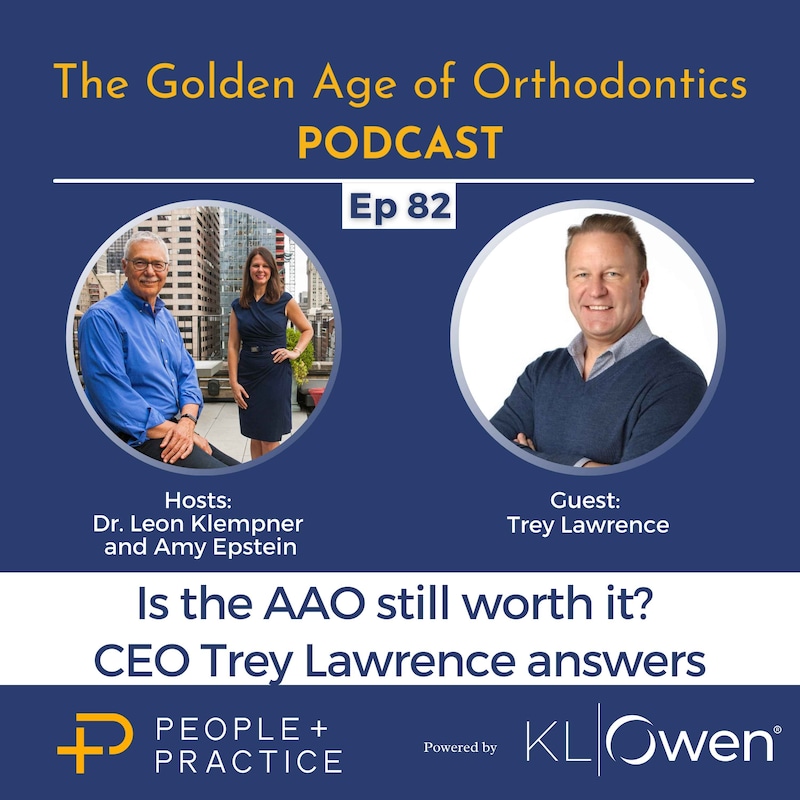
AAO membership delivers far more than most orthodontists realize, and the CEO of the American Association of Orthodontists, Trey Lawrence, is here to prove it. In this episode of the Golden Age of Orthodontics, Dr. Leon Klempner and Amy Epstein sit down with Trey to explore how the American Association of Orthodontists is evolving to meet today's most pressing challenges. From a powerful legal toolkit for new orthodontists to exclusive buying group benefits for 19,000 members, the AAO is fighting hard on multiple fronts. Trey breaks down the association's bold stance on AI in orthodontic treatment planning and why keeping the human in command is non-negotiable as technology reshapes the specialty.
What You Will Learn In This Episode:
- AAO membership benefits extend well beyond continuing education. Trey walks through the new legal toolkit for orthodontists, including a contract guide designed to protect recent graduates from dangerous rookie mistakes in their first associate employment agreements.
- The AAO's human-in-command framework establishes that no AI treatment-planning tool should operate without a licensed clinician holding ultimate responsibility, thereby protecting both patient safety and the doctor-patient relationship.
- The AAO's consumer awareness program is actively shaping how AI-powered search and large language models like ChatGPT answer patient questions, ensuring that searches about orthodontic care consistently point toward board-certified orthodontists.
Subscribe to the Golden Age of Orthodontics and our sister podcast, Practice Talk, hosted by Lacie Ellis, wherever you listen to stay updated on orthodontic innovation and real-world practice strategies. Visit People in Practice for more insights and to connect with our team for practice growth solutions.
TIMESTAMPS:
- 00:00 Is AAO membership still worth the dues? Introduction of Trey Lawrence, CEO of the American Association of Orthodontists
- 05:03 Trey details the AAO's new legal toolkit for orthodontists and how the associate contract guide protects new grads
- 11:14 How the AAO is tackling rising orthodontic practice overhead through endorsed partnerships, cybersecurity, and 401 (k) benefits
- 18:07 Trey explains the AAO's human-in-command policy and its AI in orthodontic treatment planning position paper
- 24:30 The AAO's consumer awareness program and how it is influencing AI search engines to direct patients to orthodontists
- 29:52 Trey addresses what orthodontists are telling him: concerns over general dentist competition and the state of orthodontic practice management
- 36:54 A preview of the AAO annual session in Orlando, including the Universal Studios buyout and what members can expect from world-class CE and networking
KEY TAKEAWAYS:
- Signing an orthodontic associate employment agreement without fully understanding it is one of the costliest mistakes new graduates make. The AAO's contract guide provides critical commentary on every clause, including the warning that verbal promises from employers mean nothing once ownership changes hands.
- The AAO is proactively engaging with the FDA and state dental boards through a formal white paper on AI in orthodontics, ensuring regulators view the association as a trusted authority before harmful policies are enacted.
- General dentist competition in orthodontics is real, but Trey argues that orthodontists who embrace smart pricing strategies, remote monitoring, and digital efficiency will make choosing a specialist an obvious decision for the vast majority of patients.
ABOUT THE GUEST:
Trey Lawrence currently serves as Chief Executive Officer for the American Association of Orthodontists. Before assuming the CEO role in March 2024, Trey led the AAO’s Legal and Advocacy teams as General Counsel for several years. Trey frequently discusses legal issues for orthodontic practices in podcast appearances, interviews, and articles, and he has conducted the AAO’s Resident Legal Course at residency programs throughout the nation for the past five years. Trey has also shared legal information and resources with orthodontists and practices through his Instagram account, @theorthattorney. Before joining the AAO in 2018, Trey spent nearly 20 years in law practice with Thompson Coburn LLP, a law firm of approximately 600 attorneys based in St. Louis with offices across the United States. Trey received his law degree from Washington University in St. Louis and a master’s degree from Harvard University.
RESOURCES MENTIONED:
Transcripts
[00:00:33] Stay with me.
[:[00:00:39] Dr. Leon Klempner: Orthodontics.
[:[00:01:14] You can get more information as well as a special offer on our website. Just go to ppl practice.com and click our partner tab. Welcome to the Golden Age of Orthodontics. You don't already know me. And by the way, this is year seven that we've done this on a monthly basis with over 2 million views. You should know me by now, but for those that are just joining, I am Leon Klempner, retired board certified orthodontist, director of ortho at Mount Sinai Hospital, part-time faculty in the ortho programs at both Harvard and Montefiore.
[:[00:02:11] Amy Epstein: Thank you. Um, it was really your idea that orthodontists deserve.
[:[00:02:39] 'cause they're not. Different, uh, than than other local businesses are. So anyway, it's been a, a fantastic ride and we're, yeah, we're seven years into the podcast and 15 years into people in practice, and it's still fun and interesting every day. And one of the most interesting things we get to do is talk to interesting people [00:03:00] on this podcast.
[:[00:03:37] He's an expert. On the intersection of healthcare, law and technology dedicated to ensuring the AAO acts as a proactive partner for orthodontists in this, as we know, very rapidly evolving market. Trey, thank you so much for being here. We appreciate it. Always good to see you.
[:[00:03:58] Amy Epstein: Thanks.
[:[00:04:22] Residents and recent grads could use some additional training. And you know, here in New York State, we're gonna develop a series of webinars to kind of help orient them from a business perspective. But I know that the AAO's been working on a new member legal starting kit, which I think would be really important.
[:[00:05:03] Trey Lawrence: No, of course. HIPAA protected or whatever the applicable was. Just bad
[:[00:05:10] Trey Lawrence: No, I'm, I'm so excited that you asked about that because to me, I continue to think that the legal resources, the AO offers are one of the most valuable member benefits that we have and perhaps still a little underutilized.
[:[00:05:51] So there's one in there in particular that I'm always telling residents. Specifically about, and it is a, let me make sure I get the title right. It's the [00:06:00] AAO contract guide. So basically what this is the AAO has a template associate agreement, basically. So an employment agreement between a practice and a and an associate.
[:[00:06:26] Amy Epstein: oh, I
[:[00:06:27] Yeah, the yellow. Yellow booklets. The Cliff notes. Yeah. So this is the Cliff's Notes version of the AAO Associate Agreement that has commentary under each section. So whether you are talking with an employer that's actually using the A EO contractor, many times, most of the language. It is essentially the same in a lot of those agreements, so you can even find similar language in your agreement, but that commentary underneath each section will tell you what that section means, what the intent is, all of those kind of things.
[:[00:07:16] I think the problem is you get a job offer, you're super excited, you just wanna get it locked down as quick as possible. So, you know, all this legal stuff, blah, blah, blah, whatever. Let's just get my signature on here. And you don't wanna do that. The biggest problem in particular that I've seen are residents who enter into employment arrangements with people that they already have some kind of a relationship with.
[:[00:07:56] You probably not thinking through the long-term implications of a [00:08:00] lot of it. And I've talked to several residents who ask questions and say, Hey, I, you know, I was a little curious. This doesn't sound good to me. You know, can you tell me what you're thinking here? And the doctor inevitably says, don't worry about all that stuff.
[:[00:08:31] Number one, as lawyers, we're trained to just assume the worst of humanity and everybody, and just assume that even though somebody says. They're never going to enforce that. They still could, but I think more importantly is a situation where there's been a transition in practice ownership while that contract is still binding and all of a sudden the person who told you, don't worry about it, I'm never going to enforce that has gone.
[:[00:09:14] And so that's where I think something like that contract guide with the commentary is so useful because it can help raise those red flags that you maybe not have. You know, thinking about some concern in an area, and then the lawyer advice is if it's in the contract, if it stays in the contract, you've gotta make sure you can live with it no matter what happens in, in your relationship with that practice in the future.
[:[00:09:42] Amy Epstein: Where, so Trey? Yeah. Well, where can we find that? That's my question. Same question. Where is that?
[:[00:09:57] And one of the, the items on there will be legal [00:10:00] resource center. So all of our legal resources live under that heading. But I believe the new member, um, toolkit is specifically listed as one of the items in that dropdown menu.
[:[00:10:15] Yeah. And point to it. We'll put a link and make sure we shortcut to the, uh, key things we talk about today.
[:[00:10:22] Amy Epstein: Uh, so we talked to a lot of, uh, new orthos and orthos who are sort of in the early stages. They're starting their practices, they're buying into practices, they are buying.
[:[00:11:02] How. Is the AAO changing its strategy to be able to match up with the needs of the orthos whose whole world is shifting around them?
[:[00:11:27] Side. So on the, on the stuff that you need for your practice to run ao, we, we've had endorsed partnerships for a long time and those are really intended to get a, a o, um, exclusive pricing or other arrangements for members from companies that they use. Over the past couple of years, I think we've really stepped up the, the.
[:[00:12:10] We are, we have had partnerships for several years. A couple that are newer for us. One is in the cybersecurity area. Unfortunately, that's something that. Everybody has to worry about, you know, it's the old joke about how many of you have experienced a data breach in your practice and half their hands in the room go up and then the speaker says, the other half of you just don't know that you've had one.
[:[00:12:32] know.
[:[00:13:04] There, a company that can help get you set up with 401k or other options like that for your staff. And again. Exclusive to AAO members, uh, on this pricing and some of the other services there. So I really feel like, you know, we're not quite that there yet, but within the next year or two, I really think that we'll have a full spectrum of essentially every business need that a practice owner will have that will have those kind of arrangements on.
[:[00:13:49] Uh. Only, or show specific deals that companies will have when they're exhibiting at the AOS annual session. I think that's a really, can be a really strategic time for a practice to [00:14:00] get some savings that they wouldn't otherwise by intentionally looking for and taking advantage of some of the values.
[:[00:14:27] And so there are a number of states where, I mean mean employment. You know, finding workers is tough anywhere in any business if in orthodontics in particular, there are certain states that either because the requirements for somebody to be an orthodontic assistant are so unreasonably high that it almost makes it not economically feasible for somebody who's interested.
[:[00:15:10] Michigan, I, I almost hesitate to list the states because there's been so many that have been active New York, uh, where Dr. Klempner is certainly one of them because, um, uh, an orthodontic assistant has to have a degree from a program and in the New York City area, I forget the numbers. It's basically no possible way that the very small handful.
[:[00:15:48] And then in other places. Ontario is a good one. That's some new territory for us being up in Canada, but where the scope of practice for the assistance was so limited that we're working to try to allow them to do [00:16:00] more duties under the, the direct supervision of an orthodontist. And so we're hoping that that can, has been and will continue to benefit practices as well on the economics.
[:[00:16:11] Dr. Leon Klempner: That's a big deal for us here in New York. I can tell you, and you know, it, it, it's, it's hard enough attracting people into the office and, and it's impossible to, to get them trained. And as a result, uh, you know, a lot of orthodontists are, are forced to, you know, hire, um, dental hygienists for example, because they have the license to do work that generally doesn't require a dental hygienist level of expertise, but.
[:[00:17:05] I gave a lecture at the A a L last year about AI, and I put up a slide that emphasized that AI plus, hi, what I would consider human. Intelligence is better than either one by themselves. Um, but I know that the AAO has introduced something and I think it was called human in command, HHIC. I'm not sure, but I wanna know what concerns me.
[:[00:18:08] Trey Lawrence: That's a great, yeah. How, how many podcast episodes do we have scheduled for just this topic? Um, this is one we could talk about for a while, but, you know, we, I think we learned very well from the direct to consumer era, which we're still in, but that when it's, it's the perpetual challenge with technology, where technology can be used in many good ways.
[:[00:18:50] So when you, when you set to draft model legislation or policy, all of those kind of things, you have to do it in a way. That can account for the things, the [00:19:00] bad things that you don't even know are gonna be out there yet. So what I am really proud about is that the AAO, again, having learned a little bit from direct to consumer is that we're on top of it.
[:[00:19:37] I'm really hopeful that in the next. Four or five months, maybe we'll get to the point where that will be able to be published in the A-J-O-D-O and, and start circulating it widely. But as you mentioned, Dr. Klempner, really the touchstone for us there is that human and command concept. And basically what that is, is not allowing the AI to run on kind of an [00:20:00] autonomous self-governing way where it doesn't have, where only the AI itself has oversight over the results.
[:[00:20:34] Again, having learned a little bit from the direct to consumer era is to get ahead of this. And so as soon as that position paper, uh, those last couple of touches are put on it, we're going to begin creating a relationship with state dental boards, with the Food and Drug Administration, with some other federal agencies to let them know that we've been working on this, to provide that paper to them.
[:[00:21:18] A couple of meetings with federal regulators based on the assumption that we'll be able to share that position paper with them and get started on it. Mm-hmm. So, a lot of unknowns, but I feel very confident that to the extent that you could plan for the unknowns, that by assembling this group of all of these great minds who put all their input together in this paper, we've created this paper and will now start introducing it.
[:[00:22:06] At the end of the day, if something goes wrong. And that's another thing that we saw with Direct to Consumer, where a patient gets online orders, these aligners, they come in and then they have a bad experience and then they don't know who they can go to. They go to the dental board and the dental board says, well, we regulate licensees.
[:[00:22:42] Yeah. I think that's another important aspect of the human in command is so that when, if there are misuses or things go wrong, there's somebody that ultimately can be held responsible and the patient get the, the recourse that they need to address the problem that they've had.
[:[00:23:09] They're, they're in, is that. The, the searches are changing for the information that they're looking for, right? So you, you ha have a need or have a child, or you're, you're interested in, in orthodontics. And it's not just Google anymore. You've got large language models like chat, BT and Claude and AI search.
[:[00:23:55] And so how. How, then on the sort of [00:24:00] patient oriented side, does the AAO get involved in that sort of education of the large language models and the ai and then ultimately the patient? So that when they're asking for advice or asking about orthodontics, um, they get the right information that points them in the right direction and not kind of like, well, you can do this yourself, just, uh, you know, rubber bands and or, and that's the worst case scenario, right?
[:[00:24:30] Trey Lawrence: No, I am so excited that you all asked about this. So this is one of my favorite things to talk about these days because it's another example where I really feel like the AO is kind of on the cutting edge of, of our efforts here. So, uh, hopefully every AO member knows that the AO has a consumer awareness program.
[:[00:25:13] But that consumer awareness program has really taken on a new. Level of importance over the last year or two as, as you said, Amy, with the growth of patients' use of Chad GPT, and other generative AI as a part of their process. So about, oh, it's probably been six months ago or so. I just, on a whim I thought, you know, I'm going to pretend like, and I wasn't signed in on Chad GBT, uh, it was a random browser, so I didn't know who I was and I thought, I'm gonna pretend that I'm a parent who's looking for.
[:[00:26:06] And then I asked a couple of follow up questions as to why. And it again, all of the answers that we always give on the two and a half to three years of specialized. Education and orthodontics and the fact that an orthodontist focuses on only orthodontic treatment, make them truly the expert. So, and then I even asked a couple of follow up questions, trying to push it still to say, you know, a GPS okay too.
[:[00:26:44] I did it a few months later. It was the same answers again. So the second time I did it, I then I kind of let the curtain down at the end of it and I told Jack Chad, GPT, I said, okay. The reason I'm asking this is because I'm the CEO for the American Association of Orthodontists, and I'm curious about the [00:27:00] answers that you gave me.
[:[00:27:11] Dr. Leon Klempner: Yeah,
[:[00:27:22] It's a not-for-profit. Um, it's a professional association. Uh, you know, so that was one big piece was the credibility side. The other big piece was because of the traffic. Mm-hmm. Two, the aaos consumer website and Yep. And chat GPT uses how much traffic a website gets. Yep. As an indicator of how credible that website is.
[:[00:27:42] Amy Epstein: so are others. There are other factors too. I mean, the, the, you know, the number of links that are pointing back shows authority, like, you know, a lot of ortho websites point back to the AAO and they're referencing seven and up, and as you know, all of that, um, you have, so sorry to cut you off.
[:[00:28:07] Dr. Leon Klempner: And there are lessons here, lessons here for our, for our listeners about your website and about your digital presence because the game's changing and you need to adapt.
[:[00:28:46] Time is of the essence and, uh, and we don't want to take up all of your day, but, uh, you know, you have, um, given me your email and your phone number, and you've told me that you know, you're, you're [00:29:00] easily accessible, which made me feel great until I heard that you do that with everybody. So. But that's okay because, you know, I mean, that's what we want reader.
[:[00:29:11] Amy Epstein: special.
[:[00:29:31] There's so much changing in our profession right now. There's so many things coming our way. You know, things are kind of flat in terms of the growth of, of the industry. Overhead's up, technology's expensive. The p and l, you know, I'm hearing it, so I'm curious what, what are you hearing and what's going on with the specialty?
[:[00:30:14] And what we do, uh, either a survey or personal outreach to them and ask why they didn't renew their membership. They also give the same answer. And it all really comes down to concern over. GPS doing orthodontic treatment and the perception of how that is, uh, impacting orthodontist bottom line. And so on the, on the membership side, we frequently hear, you know, why did you not renew your membership well?
[:[00:30:55] So it's obviously, it's a little unfortunate when somebody cancels their membership [00:31:00] over something that they think you should be doing that you just couldn't be doing. But what I do also tell orthodontists, anytime that I have this conversation with them, I push it back on them a little bit because certainly there are a lot of gps out there who are doing orthodontic treatment, orthodontic treatment.
[:[00:31:40] And I can. Almost guarantee anytime if somebody goes to, uh, an orthodontist or a GP for orthodontic treatment, they're going to be thrilled with the treatment that they get from an orthodontist. So that's a great place to start from. I mean, that's a, that's a. Great position to be working from. I think the challenge just has to be that with that being the case, that our members can't [00:32:00] make orthodontic treatment so expensive or so inconvenient, that it almost forces somebody to consider a GP who's maybe offering to do it cheaper or is offering to do it.
[:[00:32:31] Um, looking at things, incorporating remote monitoring and other things that can cut down on the number of office visits because if I, if I have two value propositions and one is a treatment by a GP and one's treatment by the true expert, and it's. Almost as inexpensive and almost as convenient as the treatment the GP offers.
[:[00:33:08] But I also think. Just a, a little creativity, a a little better marketing, a little better pricing strategy, a little better. Remote monitoring utilization, some things like that that orthodontists could really make it to where it's a no-brainer when a patient looks at both options and chooses one. Yep.
[:[00:33:47] And so we, we also, we talk about that too, in addition to everything you're talking about when we work with our clients and, you know, make the down payment. Reasonable for them and, and stretch out the payments so that it fits into [00:34:00] their budget. And then again, it's comparing the, you know, apples to apples.
[:[00:34:24] Um,
[:[00:34:45] Some sort of customized appliance, KLO, and thank you for sponsoring excellent option or some clear align of therapy. But these are the efficiencies that I believe will allow us to tap in to the [00:35:00] demand. We are, there's room for everybody here. You know, I'm not advocating that that GPS do ortho, but there's.
[:[00:35:29] So the future is. Great for those orthodontists that understand the marketplace, utilize the marketing, utilize the technology. So, you know, that's the frustration that I have, uh, when I talk toss. Mm-hmm.
[:[00:35:54] And it was the, you know, the sky is falling and this is going to, you know, shut my practice [00:36:00] down, is taking food off my children's table, you know, all of those kind of gloom and doom scenarios. And I really tried to push back on the time, at the time and similar, similar kind of. Uh, speech to what I just gave here that, you know, I know, I think the quality of the product, the quality of the services that only the orthodontist can provide will eventually win out.
[:[00:36:35] Amy Epstein: Yeah.
[:[00:36:54] Trey Lawrence: So I'm hopeful that anybody who was in annual session last year came away saying, huh, that was a little different.
[:[00:37:19] We have the. Universal Studios Park buyout. It would be only AAO attendees in the park for the evening. Uh, we have Joey Fatone and Lance Bass for those who fall on the right demographic there. They get thrilled about that. I know some of our older members say, who the heck is that? But there are lots of people that are very excited about that.
[:[00:37:58] But that fun [00:38:00] party piece of it, um, look for even more this year.
[:[00:38:15] Trey Lawrence: Yep. Absolutely.
[:[00:38:19] Amy Epstein: we'd like to Yes. Thank you, Trey, for being here.
[:[00:38:23] Trey Lawrence: Of course. Of course.
[:[00:38:50] For more information about people in practice, you can visit our [email protected].
[:[00:39:13] Uh, and I wanna thank our sponsors, as Amy did, we couldn't do this. This is, as I mentioned in the opening seven years. Wanna thank KKL Owen for sponsoring this podcast and remember for forward thinking orthos. As Trey said, it's never been a better time to be an orthodontist. We are in the golden age. Take advantage of it.
[:[00:39:45] Thank you for listening to the Golden Age of Orthodontics podcast. Subscribe to our podcast on YouTube, apple Podcast, Spotify. Or visit our [email protected].


