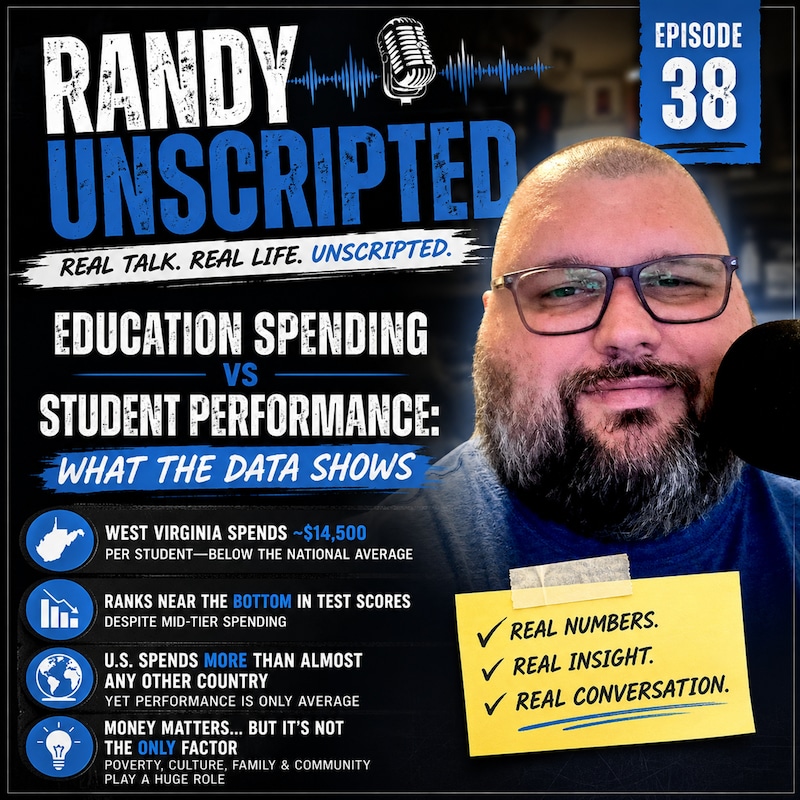
In this episode of Randy Unscripted, Randy examines public education funding in West Virginia and asks whether the state is seeing meaningful academic results from its educational spending. Using publicly available statistics and national assessment data, he compares West Virginia’s per-student spending against national averages while also looking at student performance rankings in subjects like reading and mathematics.
The conversation explores the complex relationship between school funding, poverty, educational outcomes, teacher support, and community challenges. Rather than placing blame on a single issue, Randy reflects on the broader realities affecting education in Appalachia and encourages listeners to think critically about how success in education should actually be measured beyond simple rankings and test scores.
Transcripts
Speaker:
Randy Black.
Speaker:
Randy Black.
Speaker:
Randy Black.
Speaker:
Randy Black.
Speaker:
Randy Black.
Speaker:
Randy Black.
Speaker:
Randy Black.
Speaker:
Randy Black.
Speaker:
He's a troublemaker.
Speaker:
Welcome back to Randy Unscripted.
Speaker:
I'm Randy Black, and this is the podcast where I just kind of talk about whatever it is that
Speaker:
comes across my mind.
Speaker:
And today I want to talk about something that comes up constantly in discussions about education.
Speaker:
Money.
Speaker:
Specifically, the question that people ask is this, how much are we spending on education?
Speaker:
And are we getting results for that investment?
Speaker:
Well, since I live in West Virginia and I work in education in West Virginia, I wanted
Speaker:
to dig into the numbers and see how my home state compares, not just nationally, but also
Speaker:
internationally.
Speaker:
So let's start with the basic question here.
Speaker:
How much do we spend per student in education?
Speaker:
Well, the most recent available data shows that West Virginia spends roughly $14,500 per student per year in public education.
Speaker:
If you include certain capital costs and additional expenditures into that, that number climbs a little bit closer to $16,000 per student.
Speaker:
The national average, by comparison, is about $16,500 per student.
Speaker:
So West Virginia, it's not drastically underfunded when compared to the rest of the country.
Speaker:
But we do fall a little bit below the national average.
Speaker:
Depending on the data set and the year you're looking at,
Speaker:
West Virginia typically ranks somewhere between 32nd and 35th in the nation
Speaker:
for per pupil spending, somewhere between 32 and 35.
Speaker:
That places us roughly in the lower middle tier of the states
Speaker:
when it comes to educational funding.
Speaker:
Now, here's where things kind of get interesting.
Speaker:
When you look at student performance,
Speaker:
particularly on standardized measurements
Speaker:
like the National Association of Educational Progress,
Speaker:
often called the nation's report card, the NAEP,
Speaker:
West Virginia's performance,
Speaker:
well, it's significantly lower than its spending rank.
Speaker:
For example, recent results show West Virginia ranks near the bottom nationally in several key categories.
Speaker:
Fourth grade reading comes in at about 42nd in the nation.
Speaker:
Fourth grade math sets around 38th.
Speaker:
Eighth grade reading, roughly 47th.
Speaker:
and eighth grade math is around 46th.
Speaker:
In some categories, more than 70% of students
Speaker:
are performing below the proficient level on these national benchmarks.
Speaker:
In other words, if we compare where we rank in spending
Speaker:
versus where we rank in performance,
Speaker:
the gap there becomes really, really clear.
Speaker:
West Virginia spends somewhere in the middle of the pack, but our test results land much closer to the bottom quartile of states.
Speaker:
But this comparison, it becomes even more interesting when we look at other states.
Speaker:
Some states spend less per student than West Virginia, but achieve much higher academic results.
Speaker:
For example, Utah spends around $9,500 per student, which is among the lowest in the nation.
Speaker:
Yet, their academic performance is generally above the national average.
Speaker:
Florida also spends less per student than West Virginia.
Speaker:
But their students tend to score higher on national assessments.
Speaker:
Even Mississippi, historically one of the lowest performing states academically, has made significant gains over the past decade, despite spending less per student than West Virginia.
Speaker:
So that raises an obvious question.
Speaker:
If spending more money automatically produced better outcomes,
Speaker:
we would expect states that spend more to consistently perform better.
Speaker:
But when research comparing funding, when researchers look at the funding
Speaker:
and at the performance across all 50 states,
Speaker:
The correlation that exists between spending and academic achievement is surprisingly weak
Speaker:
once basic funding levels are met.
Speaker:
In other words, money, it certainly matters.
Speaker:
Schools need resources.
Speaker:
Teachers need salaries.
Speaker:
Buildings need maintenance.
Speaker:
But beyond a certain point, simply spending more money doesn't guarantee better educational outcomes.
Speaker:
Now let's zoom out even further and let's look at the international picture here.
Speaker:
Globally, the United States spends more money per student than almost any other country in the world.
Speaker:
American schools average around $16,000 per student, depending on the calculation method.
Speaker:
By contrast, the average among developed countries in the OECD, which includes much of Europe
Speaker:
and other advanced economies, is closer to $12,000 per student.
Speaker:
So the United States spends significantly more on education than many of its peers.
Speaker:
But when we look at international test results from assessments like the Program for International
Speaker:
Student Assessment or the PISA, the PISA, depends on how you want to say it, the results are even
Speaker:
more mixed. American students typically perform above the international average in reading and
Speaker:
science, but around average or slightly below average in mathematics. Countries like Estonia,
Speaker:
Finland, Poland, Singapore consistently outperform the United States academically.
Speaker:
And here's the key point. Many of those countries actually spend less per student than the United
Speaker:
States. For example, Estonia spends roughly $10,000 per student, but ranks among the top
Speaker:
educational systems in the entire world. Poland spends less the United States, but also scores
Speaker:
above the OECD average. Singapore, one of the top performing educational systems globally,
Speaker:
spends roughly the same or sometimes less per student than the United States, depending on how
Speaker:
those costs are calculated. So internationally, we see a pattern that looks similar to what we see
Speaker:
within the United States. Higher spending does not automatically translate into higher performance.
Speaker:
Now, that doesn't mean funding isn't important.
Speaker:
It absolutely is.
Speaker:
But research repeatedly shows that many of the strongest influences on educational outcomes,
Speaker:
they exist outside the classroom.
Speaker:
Things like poverty levels, family stability, parental education, literacy culture in the home,
Speaker:
student attendance, and community expectations all play major roles in academic success.
Speaker:
In states like West Virginia, those broader socioeconomic challenges can have a significant
Speaker:
impact on what happens in schools. When you combine higher poverty rates, rural geography,
Speaker:
transportation challenges, and a declining population in some, actually most, communities,
Speaker:
The educational system is often dealing with factors that go far beyond classroom instruction.
Speaker:
So what does all of this tell us?
Speaker:
First, West Virginia is not the absolute lowest spender in education, but we do spend slightly below the national average.
Speaker:
Second, our academic performance ranks lower than our spending rank, which suggests there are factors beyond funding influencing the outcomes.
Speaker:
Third, even the United States as a whole spends far more per student than most countries in the world
Speaker:
Yet our performance internationally, it's closer to the middle of the pack
Speaker:
Finally, perhaps the biggest takeaway is that education outcomes
Speaker:
Are influenced by a complex mix of funding, culture, policy, family environment, and community conditions
Speaker:
money matters, but it isn't the only variable. Understanding that complexity is important
Speaker:
if we want to have honest conversations about how to improve education, whether in West Virginia,
Speaker:
across the United States, or around the world. We have to grasp that.
Speaker:
And that's something worth thinking about the next time we hear the question,
Speaker:
are we spending enough on education?
Speaker:
Thank you for listening to this episode of Randy Unscripted.
Speaker:
I appreciate the time that you've taken out of your day
Speaker:
to hear my thoughts today on education and spending that we have.
Speaker:
Be sure to follow the show if you can.
Speaker:
Check out the website.
Speaker:
We've launched a new website at randyunscripted.com,