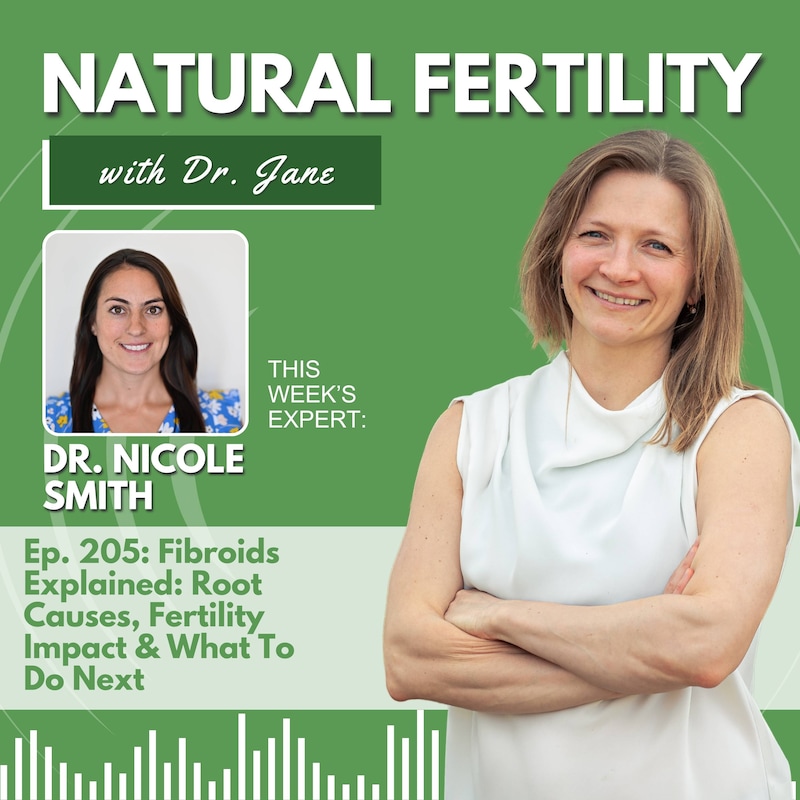
Shownotes
If you’ve been trying to conceive for over a year and want this level of detective work on your case, apply to work with me and my team here: drjanelevesque.com/application.
It takes about 5–7 minutes to complete. If we can help, we’ll invite you to a free Fertility Clarity Call with one of my team members. On that call, we’ll go through your story, see what’s been missed, and walk you through our simple 3‑step Clarify → Correct → Conceive process that’s helped over 70% of our clients finally bring home a healthy baby.
Episode Summary
In this episode, I sit down with one of my practitioners, Dr. Nicole, to talk about fibroids and what they really mean for your fertility. We break down how fibroids are not just something to ignore, but a signal of deeper imbalances in hormones, inflammation, immune function, and the microbiome. If you’ve been told your fibroids “don’t matter,” this conversation will help you understand what your body is actually trying to tell you and what to do next
In this episode, you’ll learn:
- Fibroids impact fertility indirectly through various pathways.
- Treating root causes is crucial for addressing fibroids.
- Fibroids are often overlooked but provide important health clues.
- Location and size of fibroids affect fertility differently.
- Environmental and genetic factors influence fibroid development.
- Microbiome imbalances can lead to fibroid growth.
- Surgery isn't always necessary; holistic approaches can help.
About Dr. Jane’s Practice
I’m a Naturopathic Doctor and Natural Fertility Expert. My team and I work 1:1 with couples who’ve been struggling with infertility for 1+ years to get to the root cause of their fertility issues so they can conceive and bring a healthy baby home, using advanced lab testing and personalized protocols.
Our mission is to make science-backed, natural fertility care the standard so more couples can build healthy, thriving families.
If you want this level of support on your own case, apply here: drjanelevesque.com/application
Transcripts
Hi guys, welcome to another episode of Natural Fertility with Dr. Jane. Of course, I'm Dr. Jane and today I'm joined by Dr. Nicole and we are back and we are going to talk about fibroids today. We've been learning lots about fibroids.
Nicole (:Hi everyone.
Nicole (:Yes, yeah, I'm really excited for us to dive in. We have, it's come up quite a bit with clients and just as we navigated, I noticed the conversations are, they tend to trend the same way. And I think there's a lot of gaps in the understanding around fibroids or like you and I were discussing earlier, like the way that we should be thinking about them is really important. And if we can create a shift there and have a different type of understanding, then there's so much more.
can do to be able to address why they're having fibroids or their potentials of fibroids.
Jane Levesque (:Yeah, in treating the root cause, think the narrative is that fibroids don't impact fertility, period. And that's not true. It doesn't impact fertility directly, but indirectly, there's a lot of different pathways that it impacts the quality of the egg, the uterine environment, the immunology, the inflammation, the signaling from different hormones. And it tells us so much more about the woman when she has fibroids.
that I think is completely being overlooked. So I genuinely want to treat the root cause of the problem always. And just because you have a diagnosis that is not the root cause. You and I were just talking again where all the endometriosis now is exploding. Maybe that's just exploding because those are the people that we're following, right? And we're in the fertility space, but everybody's just talking about this is like, I have this and that's what's causing the infertility.
but what about why you have this thing and whether that's the PCOS or the fibroids or the endometriosis or the autoimmune condition, why are we not asking that deeper question? And then just kind of writing it off as genetics. which genetics obviously play a role, they absolutely do.
but we all know that epigenetics is a real thing where it's the environment that's dictating which genes get to be turned on and which ones get to be turned off. So, you know, let's break it down. Let's go into the location and the size and, you know, what fibroids are and just kind of help people understand how to approach it. Do you need to do surgery? Do you not need to do surgery? How is it really impacting your fertility?
Nicole (:Yeah, really, one thing you said that I just really love is the fact that it teaches us so much about the woman and what's going on. And so I do think that when someone says they have a fibroid, like there's pieces we need to identify of how it may be impacting their fertility, but then it's also this massive clue on the table of like, okay, what is this body doing that it needs to be able to get to that conception?
And I think that's one thing that's often overlooked where it's like, you have a fibroid. If it's not bleeding or causing you pain, then let's just leave it versus remove it. But that question of like, well, why is that tissue developing that way? then, so if that kind of brings us to, okay, we have a fibroid, first step is determining, where is that fibroid and what kind of impact is it having structurally? Because that's going to play a big role in the ability for...
implantation to happen before pregnancy to come to term or even for progression of endometriosis, right?
Jane Levesque (:Or progression of like the pain throughout the cycle. Like my question is always, where's the fiber fibroid? How many do you have? How big are they? What kind of fibroid it is? And then we can start to understand that gives us one piece of information. And then what about everything else that's going on?
because it's rarely just, I just have fibroids. That's what you are told by the conventional doctor. But as we know, and we start digging, it's like you don't just have a fibroid. You have immune signaling that's dysregulated. You have inflammation, you have growth, other hormone signaling that's dysregulated that is causing that fibre to be there. And we'll connect it to cancer down the road. And it doesn't mean that just...
because you have a fibroid, you're gonna develop cancer, but we have to understand that the fibroid is a tumor. It's just a benign tumor. And a lot of the times people just kind of leave it and they say, well, it's benign, there's no issues. But it tells us right away that there's some kind of, there's things that are wrong with the signaling.
Nicole (:Thank
Jane Levesque (:And so if it's this cancer arm, if you will, in terms of how the fibroid is formed versus something like endometriosis is a little bit more autoimmune component to it. And we're gonna start to see these things being classified differently.
because it's not what we originally thought. And that really excites me. Like PCOS being classified now as a metabolic disease versus just a reproductive disease, that's really great. And we're gonna see the declassification of endometriosis, I think in the next year for sure. Definitely five years, but hopefully in the next year.
And then fibroids, you we just want to build some more understanding around why they are forming in the first place. And then how is it in our world? How is it impacting fertility? And is it something that we need to touch? And if we do, what is the prep work we need to do before surgery? And then what do we need to do to support proper healing after surgery? So then a conception can happen.
Nicole (:Yeah, absolutely. So I think if we kind of start with the basics, so the locations, right? So there's three different areas where you can have the fibroids show up. So you have submucosal, that's going to be inside the uterine cavity. And then you have your intramural. And so if you think, you know, mural for muscle, but essentially you can have it within the muscle or within the myometrium, which is the type of muscle tissue that's there. And then you have your
sub-sarosal and that's going to be the ones that are on that outside surface. And so each one has different ways that it can essentially affect fertility or affect the comfort and the ease, right? So sub-mucosal, it's going to really distort the lining and that can interfere with implantation. The one that's intramural where it's sitting in the muscle, that can affect the contractibility, but it can also affect the blood flow. It can physically change the architecture of the uterus. And then you have the sub-sarosal.
Sarosal and those can impact more comfort, but if they're very large enough it can be something that's blocking and it can be putting pressure on the uterine cavity or the fallopian tubes that's gonna make it a bit more difficult for that conception to occur or for follicles to be able to travel and then implant the way that they need to. The other piece of it is like it's a very highly vascularized area and so when you have a mass that's growing
that's going to interfere with the vascularity of the area, but it's potentially taking away from the vascularization that the uterus needs to have.
Jane Levesque (:Yeah, and the uterus needs to have high vascularization because that's where you need nutrients to grow a baby. And blood flow is nutrients. That's how the body gets nutrients through the body. I always say, if you want to look at healing as two simple things is one, we need blood flow and two, you need nutrients in that blood. So if you don't get blood flow to an area, it will literally die. But if you don't have the right nutrients in...
the blood, it's going to take a really long time for the body to heal. And it's going to start to break down itself in order to do that. So we see it, for example, in osteoporosis where it's like, if calcium is needed, the body will just break down calcium from the bones. And I mean, that happens during pregnancy. Literally calcium gets leached from the bones with breastfeeding. You could see the rib cages of the women. If you run the x-rays, they're literally will get thinner.
to feed the baby. And that's why we want to make sure that we have the nutrients that we need. So yeah, I love that. Those are the three types. Depends obviously on the size. If it's a two millimeter fibroid versus 10 centimeter fibroid, that's a big difference. know, so.
and I've had women who said they didn't even know they had fibroids and they literally removed them and they were like the size of oranges. I am concerned about that woman's connection to her body.
when she says, didn't even know I had these. And I don't ever blame the woman. It just tells me how much disconnect there has been from her body. And usually she's had painful periods, she's had bloating, she's had all of these things. And she went to the doctor and she gave her concerns and her doctor said it's nothing and put her on birth control, which further disconnected her from her system. And if I think about pregnancy and what needs to happen is actually this deep, deep, deep connection to yourself.
Nicole (:Yes.
Jane Levesque (:to actually trust your body to do what it's quote unquote, designed to do. But like, how can we trust it to do what it's designed to do when you never actually even spend any time in it? Like you're so disconnected from it. So I think the size really matters and obviously the location because some fibroids are not gonna, they're not gonna impact anything. And then other times they're gonna be detrimental and definitely need to be removed.
Nicole (:Yeah, yeah, I do. I love that piece of it. The connection to self in my head was kind of thinking the same thing as you said it. I think for those who are listening and you're like, well, I don't know if I'm connected to my body or not. Some of the simple things that you can do and I've done this before is like, I will lay flat on the ground.
and take a breath in and just feel what areas of my body feel tense. The other thing I would encourage you to do is to actually feel, like physically feel your body and try to feel, you know, different bones, different tissues, different certain organs you could probably reach and feel like a little bit tension around the tissues, but start getting into the discovery of it. And so if you're putting pressure on your lower abdomen where the uterus should be, it's like you should feel a relatively taut,
fibers like it should feel almost like a fist size really kind of hot Fiber to push down, but if you're pushing down, it's like I feel nothing but fluff fluff And I feel inflamed all the time It's like that's a sure sign that there might be something going on that you want to look into a little bit more It may not necessarily be a fibroid, but just that there's there's inflammation in the tissue. That's there
Jane Levesque (:Yep, for sure. I love it. Let's talk about the connection between estrogen, how it is hormone driven, and it's not necessarily just estrogen, although that is common. Some fibroids can be driven by progesterone. So if you have fibroids, you do want to be careful with supplementing progesterone, and you want to understand what is driving the fibroid growth.
easier said than done. But essentially, you want to make sure that you don't just blindly give hormones to someone who has fibroids, and we don't just assume that it's driven by estrogen. And because it is this, you know, benign smooth muscle tumor, it is made of collagen, there is, you know, an extracellular matrix, there's smooth muscle proliferation. What I want women to know is that
And this is something that Dr. Leah said on her podcast is like one of the first things is that the uterus is the heart of the reproductive system. And it is so, so, so, so smart. It has its own immune system signaling and like it's an organ that connects not just the reproductive system, but it's also listening to everything else that's going on. So if you're thinking about the peritoneal cavity and that's, know, our abdomen and how everything is connected and communicating with one another through this fluid.
The uterus is a very intelligent muscular organ and it has many different layers in terms of the muscle fibers and how they're supposed to be. And this is what we are evaluating when we're looking at ultrasounds and looking at the lining of the uterus and what the muscle tissue looks like and is it healthy versus not, because it tells us a lot about the health of the uterus and the uterus is the home for the baby is going to be growing. So if the uterus is struggling, then
We know that you're going to either A, have a hard time conceiving or hard time carrying that pregnancy. And whatever's happening in the uterus is going to be reflected into the ovaries. We can't just look at the uterus independently. So when...
Jane Levesque (:we start to see the fibroid, it just tells me that there's some connective tissue remodeling that's happening and it's dysregulated. And I wanna understand why that's happening. So of course, estrogen plays a role, but there's a couple other components and I don't know if you wanna, I'll pass the baton, talk about the other components.
Nicole (:Yeah, absolutely. It's really important because a lot of times there is that connection that's made where it's like, it's just estrogen driven, so I must have high estrogen. that's not necessarily...
Jane Levesque (:It might be, it 100 % might be, but, but.
Nicole (:Yeah, but not the only option. And then you have to also think, well, OK, if I have high estrogen, well, why? Right? I don't want to say estrogen is just a hormone, but it's like it's a responsive hormone.
So it's going to respond to other things that are happening within the body that are going to drive it to either be high or to be low or to, you know, be stored or recycled. And so there's always other layers that you have to peel back. And some of those layers are going to be, you know, the genetic component, like we said earlier, it definitely plays a role, but to what extent the epigenetics. So what choices are you making? What are your environmental choices? What are you consuming? What are you putting into your body?
Jane Levesque (:And what are you not aware of? Like I think so many people are still not aware of the fact that they're like the environment is really toxic. And it's not just about what you're putting into your mouth, but like what are you putting on your skin? What are you washing your clothes with? What kind of clothes are you wearing? Like are you still literally covered in plastic day to day?
you know, what's the environment in the office, what you're breathing. People are like, we definitely have mold in the office. I'm like, great, so you're sitting there for eight hours a day, like, what are we gonna do about that? That's a really inflammatory environment.
Nicole (:Yeah, absolutely. And people, don't think about it enough. But I also think sometimes a lot of people just don't know what they don't know, right? And so they don't recognize that they're in an office that has mold and has a musty smell because they're in it every day. And it's not until, and same thing with a home. I think we've talked about this in the past where it's like, you just get used to the scent of your home until somebody else walks in and it's like, there's a smell here. It kind of smells musty or it kind of smells moldy or.
You know, I have one client who's super sensitive to mold. It's like she walks in a building and she'll get a rash. And so it's like until she comes walking into your building, you might not realize that there's mold there, right? And, uh, but it's always worth checking. But all of those things, so all of those epigenetic factors really, they're either going to turn on or shut off those genes. Like we talked about, it's that, that quote, I don't know who said it, but I always love it of genetics loads the gun, but epigenetics pulls a trigger or your environment.
Jane Levesque (:You
Nicole (:pulls the trigger, but all of those things that you are exposing yourself to, what it's ultimately doing is affecting your immune system. And so when you have that type of kind of chaos, for lack of a better term, like chaos or noise for the immune system, it's going to create inflammation, but it's also going to have really distorted signaling that happens throughout the body. And it's that distortion and signaling that can then cause things like estrogen to be high or recycled or
you know, your immune system is starting to put tissue where it shouldn't be putting tissue because it's getting those mixed signals and it's not very clear and it's trying to solve a problem that it doesn't know how to solve.
Jane Levesque (:Yeah, absolutely. And I mean, this is where inflammation is going to be a component and the environment, like we said, and then the genetics is just going to, hey, if when I'm in this environment, this is what I'm going to do. And so I wish for people to stop blaming things on genetics because I think we can essentially just say, oh, I guess that's just the way that I am. And I watched my grandma be very sick.
for a lot of different reasons and my mom, know, it's starting to express the same things. And I see the lifestyle and the things that got passed down. And I don't worry about getting any of those things because I know exactly what's going on in my body, you know? And I'm doing a lot of work with my mom as well, but I think it's this like, can we rewrite what it actually means to have the genetic component? If I change my environment to...
drinking unfiltered water, eating whatever I want, which to be honest, I want to eat the things that I do. But let's just say eating processed foods and whatever, not moving my body, not sleeping properly. I will absolutely develop all of the things that my grandma had and what my mom is, you know, trying to fight off. Absolutely. And if fibroids was in my family, I would absolutely develop those things. So we just want to be aware of the fact that, yes, there's a genetic component that's going to turn it on, but your environment.
we need to shift it. And there's the big in-unit microbiome connection that I love to talk about because it's, you know, it always comes back to the microbes, to our biome.
Nicole (:Yeah, it really does. so looking at like the different pieces and especially trying to determine if there's infection there or if there's imbalances, right? So pH imbalances, whether it's in the gut or in the vaginal microbiome are going to be really important. They also tell you a lot. Like we often will run.
the vaginal microbiome and sometimes it'll come back and it's like you see the pH shifted and you see the beneficial bacteria is low but not necessarily a flag on a specific type of bacteria or parasite or candida, so to speak. But it doesn't tell you that there's nothing there. Like those are your hints and your clues that there's something deeper. Maybe it's not right there in the vaginal microbiome. Maybe it's in the bladder or maybe it's in another area or it's downstream from the gut. But you can start to see the signs that there's something at play here.
and that's going to be shifting the immune system. And so it's like, I picture the immune system in the microbiome almost like the seesaw, where you really need to find that balance between the two so that one isn't being thrown essentially too high in one direction where it's either an overactive immune system and now you're looking at autoimmune concerns, or it's a really exhausted and burnt out immune system and now you have big bacterial overgrowth because your body doesn't have the capability.
to fight it and so you have to really balance out that scale on that seesaw.
Jane Levesque (:Yeah, I love it. think everyone is, we're gonna get better at talking about this and explaining it because at the end of the day, I think everything is gonna come down to a microbial.
some kind of microbiome imbalance and some kind of infection. Now, when we think infection, you're thinking about a raging infection and an outbreak, whether it's chlamydia or some other STI and STD. And it's like, no, it doesn't have to be a raging infection, but it can be a microbiome imbalance. And we just started testing the vaginal microbiome not that long ago. The gut is the most studied and there is still so much that
We don't, we can't capture yet because we don't know yet. So there's trillions of bugs in.
even if the panels that we use, that we love, they test a lot. They're still not capturing the entirety of what's actually going on in the microbiome. And truthfully, don't think we know, like research doesn't know yet the entirety of what's going on. But now you look at like the uterine microbiome, who are the people that are getting tested? Well, these are people usually who've been struggling with infertility for a long time because a uterine biopsy is not exactly a pleasant procedure to get done. So unless you need to get it done, you're not really going to.
And a uterine microbiome is not going to be a reflection of the vaginal microbiome 100%. You can test the menstrual cycle microbiome, the vaginal microbiome, and the uterine microbiome. You'll get three different answers. And it's not a right or a wrong. It's just we're still very much learning and trying to understand what's going on. Bottom line, though, is there is always a microbial imbalance. So for all of our people, I'll say, I know that there is an infection, and I'm going to find out where it is and what
Jane Levesque (:what it's doing and where it's sitting primarily. Now it might be very subtle, but it's in there and it's creating the growth that we're talking about in terms of the fibroid. Because what is an infection? Well, it's a low grade inflammation. And if the immune system is tired, like you were saying, it's probably just not gonna create a big response.
So then that inflammation is just kind of there all the time. Or in the autoimmune case, it's just going to create lots of responses all the time. So you have no idea what's what in either way, there's an microbial imbalance that's causing low grade inflammation, which then leads to this kind of altered collagen disposition. And then now you have these growth patterns that are quote unquote different than what they should be. And that uterus is not able to reset itself the way that it should every cycle, because that's what it's doing with the menstrual cycle.
and then we have the formation of the fibroid. So then, you know, then we're asking about what do we do with this? Are we going to, is surgery the thing to do it? Do we need to remove it? Why are we removing it?
Is it safer to remove it versus not? Because let's face it, some of the intramuscular ones, you're going to leave because they're so embedded into the muscle tissue, you are essentially having to remove some of the uterus. And if you want to conceive, that's going to be a problem. and how many times do fibroids come back after surgery? So we can kind of talk into talking to that for a little bit.
Nicole (:Yeah, absolutely. do think order of operations, right? So if you've identified, OK, where is it? What's the size of it? And then the next step is identifying the cause behind it, right? So if you know what the infection is but then aren't treating the infection, your chances of that fibroid coming back or other fibroids coming back post-surgery are going to be higher because it's like you're just removing the symptom, but you're not.
handling the thing that's causing it and so then you get on this cycle and then you have to start worrying about things like scar tissue that can come after the surgery and so this is where you know it can be really hard for you to discern this decision on your own or navigate it on your own and so having a practitioner or having someone you can work through with it will be helpful so then you can kind of understand the timeline of
you know, is this large enough and obstructive enough that I do need to get it removed? Is it something that needs to be removed right this second? Or do we need to work through the infection and then we can remove it and reevaluate from there as the body has gone through something else?
Jane Levesque (:Or can the body shrink it on its own? Because it can, but what you will need to do will be quite drastic in terms of depending on the size and how much time you have. And I think the belief that you have in yourself, in your body, if it's capable of doing that, because we, the conventional system will always just say, no, your body, no, they don't shrink or, oh, they shrunk, what a fluke. Whereas,
Nicole (:I don't know.
Jane Levesque (:You you'll look at someone like Dr. Leah, who's been doing this for 30 years and she's like, I shrink fibroids all the time. What are you talking about? Do you know what I mean? So it's like, yeah, we can shrink fibroids, but there's so much more around understanding the hormone dysregulation, understanding what the immune system is doing, understanding your inflammatory load, the toxic load, the pathogen load, the lymphatic system and how it's moving. And then...
Nicole (:Yep.
Jane Levesque (:if we're looking at it from this, like, it's a benign tumor. And so then if we kind of branch out onto the oncology treatment and what do they recommend on the holistic side, and there's a lot of fabulous practitioners who are literally treating cancer with natural medicine, while there's a lot of fasting, there's high dose vitamin C, there's, you know, like it's very aggressive in terms of what they do. And they're not,
from like an oncology, I'm definitely not a specialist in oncology, but what they do to help shrink the cancer in the body is very drastic. And for fibroids, if you can do some of that, we can see really good results in terms of the actual shrinking. And in our world, in the fertility space, usually depending on the age of the person and what else is going on, what we have to sit down and...
assess with our patients is what is the timeframe that we're working with here? Like how much time do we really have? Is this person sitting in front of me capable of doing the protocol that I'm going to write out for them, financially, physically, emotionally, mentally, because it's going to be a lot, or is it easier to just A, remove this fiber, but then B, do all the prep work beforehand and decrease the inflammation, treat the infection, do that, and then support post versus trying to shrink the fiber naturally because
I don't know if you've seen this, but so many people say, I tried to do it naturally and it didn't work. And it's like they did 2 % of what they needed to do. And that's why it didn't work. I think most people don't realize how much they need to do if they want to unblock the tubes, get rid of their endometriosis, get rid of their PCOS, get rid of the fibroids. It's like, it's so, so, so much more. And I just say that to like the body has an incredible capacity to heal, but you, because you are quote unquote sick.
you have no idea, like the body has signaling that has been off and you have to be really drastic to essentially retrain it.
Nicole (:Yeah, you're doing reparative work versus preventative work. And it's like, both are hard, but different levels of hard and the reparative is even more difficult because now you've had something that's already developed that you're trying to remove. And I love the tie into cancer because it is, it's almost like a...
It's like you almost want to live as if you have cancer to avoid getting it. And in a sense, it's like that's the way to be to really avoid a lot of different things that even aren't as severe as cancer, but just things that show up when you start to...
reached out to me December of: Jane Levesque (:Yeah.
Nicole (:the first thing about it, but just from like, you're my general health client, here's what I'm gonna recommend for you. And granted with her, like we went a little more aggressive, she was on, I think at one point it was like 35 supplements that she was taking and it was a lot, but it was like, this is everything that you're testing is showing that you need and here's everything else that I need you to be doing. And so from January until...
end of April, I believe it was mid or end of April, she had a follow-up and her doctor was like, my gosh, they haven't grown. They weren't eliminated, but they hadn't grown. And so was like, whatever we did, and we did what her body was asking for, it stopped the growth. And then we found her a cancer center or holistic providers who are focused on cancer. So it's like, okay, we passed the baton to them.
Jane Levesque (:stops the growth.
Nicole (:But it just goes to show you the type of cancer she had is one of the most aggressive types. with a timeline like that, but if you're, we're talking about fibroids where again, it can be benign. But if we're thinking about the progression that it could go into a cancer, it's like, well then let's treat it with that type of.
like being that specific, yeah, intensive and specific, right? Like you want to be very specific so that either A, you are getting rid of it naturally, helping it shrink in size or go away, or B, you're working on it so intensely that if you do do the surgery, you're not looking at it coming back or more coming back. And so...
Jane Levesque (:intensity.
Jane Levesque (:Mm-hmm.
Nicole (:Think a lot of times with fibroids even when they're small. It's very much written off like they're just there I know being in the chiropractic clinic and like taking x-rays if we saw our fibroid We would always just ask is it causing you pain or are you bleeding? No, okay Great, you probably don't need to do anything about it And it's like why didn't they you know, they're teaching us about health and nutrition how to support our clients and all the best ways But why wasn't there a continuation of that training around fibroids of you know, okay if you were seeing somebody coming
in with low back pain but then they have fibroids but the fibroids aren't causing the pain it's like there's still inflammation there exactly it's like well there is a very clear connection but we were you know trained to just kind of overlook it it's not in our our lane so pass it off to the next person but it is yeah it's like i'm going to care for your fibroid as aggressively as i would care for your disc injury and your low back so that you can walk out the door right
Jane Levesque (:How do you know it's not causing the pain? might be very well causing the pain. It's just the way that it's sitting.
Jane Levesque (:Yeah, I love this and I want to like, this is what I'd love to wrap up with. You get to decide how painful these symptoms are to you. So what I mean by that is you can say, it's just fibroids and doesn't really matter. Or we can start to treat our body like the wisest machinery there is on this planet.
and that every symptoms means something. So you get to decide how important is the symptom. And if you don't think it's that important, and I think the reason that you think it's not important is because you've been told it's not important. I don't think that you actually think it's not important because, you know, someone asked me the other day, what do do? I'm an atch path. what is an atch path? And it's like, you know.
natural medicine and I specialize in fertility. How did you get into that? Well, just like everybody else. I had a doctor told me my symptoms were normal and I just decided not to believe him. Do you know what mean? Like that was the, that's the whole reason that we get into functional holistic medicine. Cause you're like, I don't think what this person sitting in front of me is true.
But I think that there has been so much time passed now in generations of brainwashing that, it's normal, it's normal, it's normal. But now we have this really low standard of health for ourselves. So when we have fibroids, we just go, I just have fibroids, it's just genetic. And I think about if I had fibroids,
there would be a lot of stuff that I would be doing to get rid of that because I know that my body is really smart and it's always on my team and it's trying to tell me that something is out of balance and I should listen to that and I don't care if that fibroid is 0.2 centimeters or 10 centimeters that's a tissue growth that's happening that shouldn't be happening in the first place and that's my mentality and that's you know obviously your mentality and our mentality as a clinic and my hope is with you know these podcasts and education and obviously our test
Jane Levesque (:testimonies and the cases that we share is to go, this person was just like you, where they thought they were told all of their symptoms were normal, but they decided not to believe that. And so they kept searching until someone told until they found, you know, us and went, my God, this is the first time I felt heard. This is the first time I felt validated. I am not crazy. I thought that this was a problem, but my doctor kept telling me it wasn't. So I just want to tell you that you're not crazy.
and your symptoms, you get to decide if this is a big deal to you or not. You can say it's not a big deal and ignore it and wait until it does become a big deal or you can say this is a big deal and I wanna solve it.
Nicole (:Absolutely. Yeah, I I really hope that those who are listening hold on to that staple that the body can definitely heal and so if it's given the right tools in the right nutrients in the right direction it can heal and it can navigate and You know, I think of a client who she didn't tell me this when we first started working together We've been working together for about five months now, and she told me this week that
they had gone to look into IVF before finding us, the husband on his sperm analysis had the sperm just wasn't moving, right? He just had a bunch of dead sperm. And so the doctor had him look under the microscope at it and was like, what's going on? Nothing's moving. And he was like, I don't think IVF is an option for you. You guys are going to have to do donors. And he's like, you can't fix that. And she's like, we were so devastated. We were heartbroken. We thought we'd never be able to have a baby because you can't fix it. And it's like, he can fix that.
there's a reason all that sperm is dead and it just needs to be looked into and evaluated and then handled so that he can have sperm that's moving inactive. And lo and behold, that clinic actually I think is in, I don't know if they're in a lawsuit or what, but they had this big, you probably saw them on the news, but this big transfer where somebody's embryo was implanted into a different person. And...
Jane Levesque (:Just a hot mess, man. That's a hot mess.
Nicole (:Yeah, it is, but it also just goes to show where it's like, you know, there's misinformation that's definitely out there and the body's incredible. I mean, if your body can grow and develop a human baby from an embryo that's not even yours, why do you, why could it not reduce the size of a fibroid or why could it not create sperm that's going to be motile even if one point it had sperm that wasn't motile, you know? And so again, it's like what we were saying earlier with the fibroid.
The body is trying to solve a problem and that's why the tissue is now being re-signaled and developing somewhere other than where it should be because there's something else going on that it's trying to solve and figure out. And so we just have to redirect that signaling once we can identify what those factors are.
Jane Levesque (:Yeah, I love that. Thank you. We broke it down. Fibroids. There you have it, you guys. We know it was a lot. Yeah, and I think, you know, if this message resonates for you and you are looking for that holistic approach, please fill out an application. Our team will reach out and we're happy to see if we can help. If we can, we'll show you what that looks like. And if we can't, we'll always make sure to point you in the right direction. And I...
Nicole (:Yeah, this was really good. It was a lot.
Jane Levesque (:If you feel connected to your body, it's easier for you to make decisions and you don't feel like, you know, when you're sitting in front of a practitioner, if you tune in to how you feel around that practitioner, you will know if this is the right person to help you or not. And we see this all the time where women just disconnect from themselves and they just are, I just do what my doctor told me because the belief is that the doctor knows you better than you know yourself. And I'd love for that.
to be flipped on its head, because it's not true. know, nobody knows you better than you. And if something feels fishy, if something feels ick in the appointment, if you feel small in the appointment, if you feel confused, if you feel lost, if you don't understand something, those are all signs that...
you need more clarity and maybe that doctor in front of you can provide it but if not then you need to go and find somebody else. I think that's really really important we need to change that in the women's health care like this is how we're going to change health care is by demanding more and better. Thanks so much for tuning in you guys and we'll see you next week.
Nicole (:Absolutely.
Nicole (:Bye everyone.




