Shownotes
*** Help shape the next season of Made For Us! Please share your feedback in our 4-minute listener survey for the chance to win a $25 Amazon Gift Card and get instant access to our curated reading list of every book ever recommended on the show: https://forms.gle/pNyrCooa23oYsaVk7
---
In this episode:
What happens when AI doesn’t understand you?
For millions of people across Africa, speaking a language that AI doesn’t recognise can be a barrier to accessing services like healthcare and participating in the digital economy.
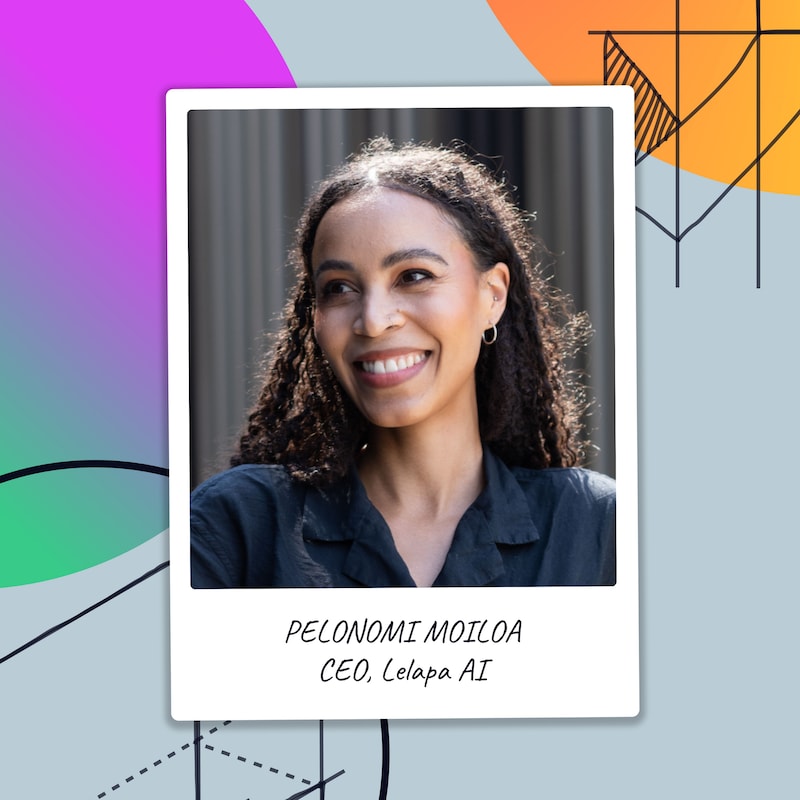
Pelonomi Moiloa is CEO of Lelapa AI, a research and product lab building language AI for a continent with 2,000+ languages. Named one of TIME's 100 Most Influential People in AI in 2023, Pelonomi unpacks the technical and linguistic challenges she and her team are up against - from the data collection hurdles unique to oral cultures, to the compute constraints on the African continent.
In this episode, we discuss:
- Why mainstream AI struggles with African languages
- The creative approaches Lelapa AI is pioneering since scraping the internet or the archives isn't an option
- What Pelonomi really thinks about being called one of the most influential people in AI
About Pelonomi Moiloa
Pelonomi Moiloa is CEO of Lelapa AI, a socially-grounded research and product lab driving AI for Africans by Africans. A biomedical and electrical engineer by training, Pelonomi has spent almost a decade deriving insights from data to address complex problems.
Learn more about Lelapa AI: https://lelapa.ai
Follow Lelapa AI on LinkedIn: https://www.linkedin.com/company/lelapa-ai/
Follow Pelonomi Moiloa on LinkedIn: https://www.linkedin.com/in/pelonomi-moiloa
---
Love what you heard? Leave us a rating or review on Apple Podcasts or Spotify. It makes our day (and helps others find the show).
Other episodes you might like:
What's in a name? When your device thinks you're a typo
---
Connect with Made for Us
- Show notes and transcripts: https://made-for-us.captivate.fm/
- LinkedIn: https://www.linkedin.com/company/madeforuspodcast
- Instagram: https://www.instagram.com/madeforuspodcast/
- Newsletter: https://madeforuspodcast.beehiiv.com/
Transcripts
TS 0:00
In twenty twenty-three, you were named one of Time Magazine's most influential people in AI. What was the first thought that came to your head when you found out?
PM:This is spam.
TS:Welcome to Made For Us, the show where we explore how intentional design can help create a world that works better for everyone. I'm Tosin Sulaiman. Today, we're asking what happens when you speak a language that tech doesn't understand? As you'll hear, for much of the world, that's a daily reality.
My guest today is Pelonomi Moiloa, CEO of the Lelapa AI, a research and product lab building African language AI for a continent where more than two thousand languages are spoken. It's a huge challenge because many of those languages come from oral traditions and have a limited internet footprint. So the standard playbook for building AI doesn't apply. In this episode, Pelonomi shares why this work is personal. Her own name, she says, is a reminder of just how hard it is to teach machines to recognize African names. And she also tells me why she has complicated feelings about being named one of Time magazine's most influential people in AI. Here's our conversation.
PM:So my name is Pelonomi Moiloa and I am CEO and co-founder of Lelapa AI and we're building the most efficient language AI in the world.
TS:I wanted to start with childhood ambitions. I heard you say that as a child you wanted to be a cartoon voiceover artist. Tell us why that was appealing to you and what would your younger self think about what you're doing now?
PM:Ha ha ha. That's so funny. Yeah, I think it was one of my first ideas. I don't know, I guess I didn't have that much access to cartoons and I found them such a joy when I did manage to watch them. And I'm the youngest child in my family and I was a bit of a clown. And I suppose actually at that stage, it was a little bit language connected because doing accents and expressing things through voice was something I was really interested in. So even now, mimicking accents from around the world is a thing that I sometimes do. And yeah, just understanding how people express themselves in different ways. And even if they're doing the same language, it's sounding different, was something I found interesting. But yeah, it wasn't a long-lived dream. I just remember that being the first thing that I wanted to do as like a five-year-old.
Yeah, what would they think about what I'm doing now? I would like to think that Little Pelonomi is proud of where I've come and thinks what I'm doing is quite cool. Yeah.
TS:So you had this ambition as a child, but you eventually ended up with three engineering degrees. What made you decide to double down on engineering? And at what point did you realize that AI was a passion?
PM:Good question. So I thoroughly enjoyed school and I thoroughly enjoyed learning. And I particularly liked the subjects that were a little bit more challenging, especially in how they just helped me understand the world I was navigating a little bit better from a fundamental perspective. So maths and science and biology were always things I was highly interested in. My mum was a doctor, so I was also really interested just by proxy of assimilation to her in health and how the body works in my family. So understanding the fundamentals of how those things manifested was also of interest to me as a high school student.
And yeah, I think it was grade 11, where I was choosing the potential degree or career paths that I wanted to pursue. And at that stage, I was kind of figuring out whether I wanted to go like a science route or a medical route or the engineering route.
PM:I went to an all girls high school and it was quite enabling in the sense that because there were only girls there, there weren't any limitations around the dreams that you could have for your life. We were in a little bit of a bubble that said that just because you're a girl doesn't mean you couldn't be interested in like computers or engineering. So yeah, somebody came to the school and they were like, biomedical engineering is basically a merge of electrical engineering and medicine. And you are studying to learn how to make like artificial organs and artificial limbs and imaging machines. And that for me was just so cool. I was like, yeah, I want to make a cyborg. That sounds cool.
PM:And I went into biomedical engineering and in my third year, I applied for this program, which was called Decide.
And it was data science for decision enablement and did my first machine learning courses through that program and was inspired to learn a lot further. And eventually it came the time to do my masters. And at that stage, deep learning was kind of like, people had only really started experimenting with the very basic neural networks. And I was like, I'm not going to do this. Like nobody's doing it. It doesn't actually work. And then a year later enrolled in my master's degree in biomedical engineering, utilizing deep neural networks to do image processing for a low resource medical problem. And then deep learning took off first within the imaging space, which is kind of where I was, and then later on into the language space. So it's kind of just a natural progression of like pursuing my curiosity and interest of understanding how the world works and how we can capture information to derive a little bit more insight into what we could see about the world.
TS:Right. And it sounds like great timing as well.
PM:Often seems like absolutely divine timing, like literally being introduced to the world of AI just before it takes off and takes over the world. And then when we decided to start Lelapa and focus on NLP, I think two months or three months later, ChatGPT came out and we were like, oh, okay. So we're just ahead of the curve. I've been just ahead of the curve each time. And yeah, almost divinely guided to follow this path of global interest.
TS:So let's talk about Lelapa and how it all came about. The goal is essentially to close the digital language divide and develop AI tools for African contexts. Can you give a sense of the scale of this? You how big is this gap that you're trying to close? What are the tangible real world impacts for someone whose language isn't represented?
PM:Yeah, when I'm talking about this, I often use like some frivolous examples to help hone in. So for example, I studied in Japan and for me it was quite an interesting moment to understand language as a barrier to access. I couldn't speak Japanese when I got there and there was very limited English support. So it was small things that made life very hard. Like I would get my gas bill and my electricity bill and I couldn't read it and I didn't know how to pay. So I had to go find people who could help me interpret what these bills were so that my electricity and gas didn't turn off. I would go to a hospital. I had a skiing accident and it hit my head. And I figured I should check that out. And going to the hospital, trying to explain to the medical provider what was going on, they took an x-ray of my neck, like completely missed what was going on.
In my school environment, the lectures were mostly in Japanese and I just sat there trying to, as much as I could, defer what was happening from the pictures and my previous knowledge, but it was a complete barrier to me being able to, like, learn new information for me to complete my degree well. And then at the same time in that lab, my Japanese colleagues couldn't speak English, so they couldn't read all the research papers that could aid them with their development and what they were working on.
PM:And it was a significant grounding for me because that for me was a temporary experience. I was only there to learn my masters and then I would go home. And I would then be in this English environment in which I speak English. And I would have access to all the things I needed to access again. But I realized that actually for the majority of the African continent or emerging markets in the global South as a whole, that is the lived everyday experience of people in their own countries. It's not like they can pack up their things and go back to a place where they can be understood. Because primarily the institutions that provide these public services and products are ones that have decided to operate in singular languages, often a historically colonial one, but they are not serving the majority of people because majority of people actually don't speak the language.
PM:So for example, in South Africa, I think about 8 percent of the population speaks English at home. So that means 90 percent of the people who are having to engage with these systems are either having to learn a new language in order to access opportunity or are having to navigate with whatever little language that they know and having these experiences with their electricity, their water, their grant applications, they're going to the hospital, getting healthcare.
And that's not just the case in South Africa, right? It's the case all over Africa. Sure, in West Africa, it may be French, but we have two thousand languages, you know. East Africa maybe is a little bit better because there's a homogenisation of Swahili, but Swahili is still a collective and there are multiple tribes, multiple people underneath who are struggling to access things through that. And then that problem scales out to South America, to Southeast Asia. It's everywhere that this problem is prevalent.
So in terms of that, and opportunity, I mean, there are some studies that show that localization in terms of language can increase revenues for business by up to 40%. And with that, we've kind of estimated that there's three hundred billion dollars of revenue just sitting on the table because these larger enterprises and even the smaller businesses aren't able to engage with their customers in local languages. I think that contextualizes like the impact of that opportunity on the ground as well as economic opportunity.
TS:The example that you gave of living and studying in Japan, I mean, I think that really helps people to understand the impact. Did you know that your course was going to be in Japanese? I was just wondering like, how come you decided to study in Japan?
PM:It wasn't supposed to be. Two weeks before I started, they told me, yeah, about that. So it's not going to be in English anymore. I figured because I was the only English speaking person in the class, so, you know, made sense. Just sacrifices once so that others could do well. But yeah, no, it was a shock. It was a shock.
TS:Okay, but you still passed, you graduated and you're here today.
PM:I mean, I think so. I can't really read the certificate very well to confirm, but I'm pretty sure I have a Master's.
TS:One concrete example of where AI often falls short is African names. And you were telling me about your name earlier before the interview started. So I know this is something that you're passionate about and you've spoken about how African names get butchered quite badly to the point of non-recognition. So is it fair to say that you've lived the problem that you were trying to solve?
PM:Yeah, absolutely. I mean, I've had to let go of this personal issue a little bit to focus on the bigger picture. My name is a perfect example. I often, well, when I was younger, I would cut it into two and introduce myself as Nomi. And if I'm tired, even now, I will just say my name is Nomi because it just becomes this like point of contention where I say my name is Nomi and then people will be like, er, what, then it's like two minutes of like trying to get my name right.
And it's a little bit of like a tension because getting the name right is nice, but it just feels like such an inconvenience to be called by my name, which is not so nice. But yeah, the Roman alphabet has been retrofitted to a lot of African languages as a result of us not having our own writing systems because we're more of an oral culture.
PM:So my name, even though it has two O's in it, the two O's are pronounced differently. I only realized this actually last year. I went on a date with somebody and they were like, the two O's in your name are pronounced differently. So it manifests itself in names. But for example, when you're trading a machine learning algorithm, it has to understand so much context to be able to then understand the nuance of when an O is like a U sound versus an O sound. I think languages like Yoruba have diacritics, which are super helpful, but most African languages do not, which makes the interpretation of the written language very difficult. So yeah, my name is, I guess, a colonial legacy and a perfect example of how it can be difficult to then overcome these structural limitations and then teach it to a machine.
TS:And what does your name mean?
PM:My name means kind-hearted. And I think it's also a bit of a spell because like, since I was three years old, people ask you who you are and you basically walk around going, I am kind-hearted. I would like to think that I exhibit the meaning of my name as well.
TS:And so let's talk some more about where the leading language models fall short when it comes to African languages. So there's the name issue, but what are the other tasks they struggle with the most?
PM:So the problem that we're actually working on right now, which is a really big one that we're excited about tracking, we're almost there, is the idea that because the languages that we're dealing with exist within such intensely multicultural, multilingual contexts, when we are processing language, we're never actually just processing a single language because of a phenomenon that we called code mixing or code switching.
Code mixing is when people switch from explicitly one language in one sentence to another language in another sentence. And code switching is when people just mix languages together in a single sentence. So in South Africa, this is very much true. Last year at some point we were analyzing a soapie that is played at like prime time. So ideally should be able to appeal to many different people in the population. And there were eight different languages in that single episode.
PM:And on the ground, so many people are multilingual, not me, that people just speak to each other in different languages constantly. That's how they communicate. But typically speaking, Western trained models, and I mean, I say Western, but I'm pretty sure Chinese models are similar, is that they're not used to this multicultural mixing context. So the model itself is unable to realize that it's dealing with more than one language in when you're dealing with the type of code mixing and code switching that we do, even if it's a multilingual model.
So we've looked inside them and through interpretability techniques like our models, you can see that it says, this language is changing because this word is from a different language than the next word. But the typical models aren't able to do that.
So that's one of the problems that we see that is quite interesting to unpack and get right. The other complexity that we're dealing with is actually in the structure of the language. The language we're quite interested in is a language called isiZulu from South Africa. And it's what you call an agglutinative language. Another example is Turkish, where a single word is made by merging multiple prefixes, suffixes and root words together.
17:07
So, for example, Ndiyafunda in isiZulu is a single word, but it's a full sentence. And that full sentence would change depending on what else you want to say, like I am learning versus they are learning or whatever else. But when it is fed into a Western model, which, ideally, you need to break up the words to then be able to understand the structure of the sentence. English models, you can just break up words based off of space, because there's never two words that are put together. I mean, there may be, like ‘don't,’ you know, it's two words, but it signifies that it's two words that have been merged together. And in other languages, you can't just break it on a space because then you're essentially saying a single word has a single meaning when really it's a full sentence. So those are the kind of low level model challenges that we're having to change so that it's able to understand the complexity of the context in which the languages we are studying exist.
TS:That is fascinating. Other things that make this a really difficult problem to solve is just access to the data.
PM:Yeah. So those we talk about as like foreign infrastructure challenges, right? So Africa, many other places in emerging markets and global south are primarily oral history places. That's number one. Number two, also mostly colonial contexts, right? And in those contexts, people were prevented from speaking their languages. It was like made illegal. People weren't allowed to record those languages. If people did record the languages, it was often by the colonial authorities. So for example, there's archives all over Europe around African languages that the states themselves from which those languages come from don't have access to. So from that perspective, there are these major historical challenges of actually accessing historical data for these languages in a way that isn't the same for other languages in the world.
PM:At the same time, then you have this digital barrier access where, for example, I think only 22 percent of the people on the African continent actually access the internet through their mobile devices, don't have computers, which means that then people actually contributing to the internet as a body of knowledge or record of languages is very low as well. So the techniques that Western model development have used of just scraping the internet is just not an option. So we can't scrape the archives, we can't scrape the internet. So we're having to come up with more creative ways to collect the data.
And you know, some would say that it's an incredible disadvantage that we don't have this data available, but at Lelapa we see it really as an opportunity to then make sure we are curating and creating data that is really relevant which actually makes the models better. They perform a lot better and they fully capture the context that we care about. And they are less likely to like hallucinate in strange ways because we're able to actually guide the knowledge it learns.
PM:I don't know. It's kind of like having your small child go out into the streets and learn their vocabulary from what they find there versus in a protected environment where they won't learn bad words or bad ways of engaging things kind of thing. Like people talk about using Twitter to train language models and I'm like, do you really want bigots in the models that you build? Yeah. So that is a huge challenge to data side. The other side is compute. So I stand to be corrected, but I think at the moment there's only one data center on African continent that commercially offers compute for things like machine learning models on a commercial scale, AWS in Cape Town. I think there's a Teraco as well. But essentially, if you're acquiring GPU compute to serve these models, you're having to do so in regions outside of the African continent, which has issues with regards to data sovereignty and if places have certain laws about data not leaving the country, that's a huge problem. That is changing. There are GPU clusters popping up around the continent, but they are just not as fully online yet.
PM:So that fundamentally then prevents people from being able to train models, develop models in the way that is being done in the rest of the world. And then outside of that, I mean, there's like this larger layer of infrastructure that is an issue around power. Cause even if we don't have the GPUs, how would we power them? I'm from Johannesburg in South Africa. And until recently, maybe a year ago, we were having regular scheduled power cuts. But I mean, that's South Africa, the rest of the African continent also struggles with things like power and yeah.
So, those two are the major more mainstream challenges that people think of when they think about developing machine learning on the African continent. But I'm of the opinion that they provide a type of constraint that then becomes the canvas to build technology from fundamentally a better perspective that is more sustainable and more scalable in the long run.
TS:Those are significant challenges, but you mentioned creativity earlier. So can you talk about some of the unconventional and creative ways that you're trying to tackle this challenge?
PM:Yeah, so maybe I can dive into the data one a bit more. So Masakane did some experiments around data creation. Masakane is a grassroots research movement that was actually founded by my co-founder Jade Abbott that basically got the African continent to start doing research in NLP. And of course, the first step was the data part. And we're like, OK, there's no data, what do we do about that? And they started creating data and they have really lovely ways of creating data. So for example, you bring a group or a community together and you give them prompts about their lives and get them to talk about their lives. Like you can transcribe that and then you have data for transcription models, you can translate it. And then you have data for translation models.
PM:And in that way, you're not just creating data for data sake, but ensuring that it encapsulates like what people actually care about. On the GPU side, we've just been really focused on ensuring that our models are not as big as everyone else's, which from a compute perspective is super helpful because we just spend less time and money training them. And then if you have less data, then you're spending even less time and money training them. So it's a win-win situation in that way.
TS:And stepping away from the tech for a moment, how much of a struggle is it to find the right talent in Africa? Because the brain drain is a real challenge and I imagine that businesses like yours must feel that.
PM:So in terms of talent, we can't compete with salaries from Google or Apple or wherever else. That's just not possible. What is quite incredible about the talent on the continent, though, is that people are genuinely interested in being involved with projects where they can make an impact on their communities and the people that they care about. So from that perspective, I think the talent is very cool.
They don't just want to build things. They want to build things that matter. And that makes finding talent a little bit easier because they aren't expecting to have a Google salary if they know that they can then work on something that they care about.
PM:But yeah, from an engineering perspective, I think the African continent is actually really incredible. You have these people developing in these resource constrained environments. So a lot of the time they're just so much more skilled actually than if they would have been in a very comfortable place where nothing breaks or never goes out or things like that, they're quite robust in that sense. From the research side of things, there are so many incredibly talented researchers. I would say though that they are a little bit more difficult to hold because they want to do their PhDs at the fancy places and Africa doesn't quite have that reputation just yet.
TS:Right, and one of the, I guess the goals of Lelapa is to reverse the brain drain or to do something to stem the brain drain.
PM:Yeah, exactly. So I think all but one of our employees is African. We have Africans from eight different countries and a lot of them are still on the continent. So that's really cool for us. That's just the main win. If you can stay in your home city or hometown or home country or another African country even and work remotely for us, that for us is a huge win.
TS:So let's turn to the products that you're building. Can you tell us about what you've launched so far? Which languages are you focusing on?
PM:Yeah. So I'll start on the language focus. The main language we're focused on at the moment is isiZulu actually. It's one of the most difficult languages for machines to get their heads around. Do machines have heads? You know what I mean. In the world, because it's such a tricky language and then has a code switching issue. And once we fully crack that language, we know that we'll be able to scale to whatever language is needed quite efficiently and effectively.
So in terms of what we offer, if you're getting our isiZulu models, they are world-class. There's nothing that'll beat them. But outside of that, we do actually offer eight languages. We have like base first iterations of Swahili, Hausa, Yoruba, West African French, Sesotho, Afrikaans, South African English. That's the base that we're covering at the moment, which when it works really well, we'll cover about half the African population in terms of speakers.
PM:So at the moment we're focused on transcription and translation and our product offering is kind of split into two categories. The first category is what happens to an audio call after it's been recorded. So we call that post-call processing. And the second product offering that we're working on is around live interactions. And typically these two streams feed into the call center space, that's where we're focused at the moment. So all of these enterprises and businesses who are having to communicate with their customers and can't quite do so at the moment because the technology just does not support the languages of their callers and their users. That's the one that we're focused on for now.
TS:Can you talk about some of the other domains in which you see big opportunities? And is there anything that clients are asking you for that's maybe a bit surprising?
PM:We're quite interested in getting into like the media domain, so things like subtitling. Healthcare is a big one. It's high risk that has so much impact. I think a lot of places in Africa, doctors are sent through to rural areas and don't necessarily speak the local language. And I can't, I can't imagine being in an appointment. Actually I can because it happened to me, but being in an appointment and trying to like describe your pain so that you can get help and somebody can't understand you.
So yeah, in the medical field, there's a lot there. Things like agriculture, there are really cool systems to assist farmers with risk prevention and yield estimations. But a lot of that information is inhibited by the fact that if it's initially being run through an LLM, getting it into a local language is challenging. The social services space in terms of like government services would be really cool. Like if a government is able to communicate better with its people in both directions, getting feedback, also information, dissemination. Yeah, mean, language such as everything, it's everywhere. Education is a huge one. So yeah, those are some of the places we're interested in.
PM:I think what has been surprising is how excited and desperate enterprises are to have this functionality or like just people in general are quite keen for this to be happening already. We're a small startup. We're not that old. And yet we have some of the biggest players on the continent reaching out to us to get started. There are these huge, huge, huge, huge conglomerates sending emails to our mailbox. That part is crazy.
TS:And also in twenty twenty-three, you were named one of Time Magazine's most influential people in AI. And I believe this happened quite soon after the company was founded. Can you take us back to that moment? What was the first thought that came to your head when you found out?
PM:This is spam. Yeah, I was pretty sure it was spam. I think they sent another email. was like, okay, maybe it's not spam because I ignored the first one. And then it was actually pretty terrible because the person who interviewed me was yawning throughout the whole interview. So I was like, this can't be serious. Like, I'm still not sure that this is not spam. So when the magazine came out, and then even worse, I was one of the faces on the cover, I didn't quite clock what was happening. Yeah, it was a bit confusing. Yeah, and we also hadn't done so much at that point. So yeah, I have complex feelings about that.
TS:So let's dig into the complex feelings a little bit, because I heard you say in an interview that you feel a huge responsibility to make this thing succeed. Is that part of it? I just, wonder how come you feel that pressure and what you feel is at stake?
PM:Yeah, mean, InstaDeep has done an incredible job of demonstrating that technological advancement can come out of the African continent and be really impressive and world first. People say you shouldn't be afraid to fail as a startup. But for us, it's not just, I think because of the nature of our mission and our vision, we're not just trying out a cool new thing. If this works, there is incredible opportunity and potential for life to be a bit better for millions of people. And the lost opportunity of that is so great. So there's the responsibility there.
But at the same time, I mean, with all of that press that we got as we came out and press we continue to get, the excitement around like this alternative of a technical future, with the eyes on us, it is a little bit scary. We don't necessarily feel like we have the same kind of space to fail, especially from an African representative perspective, right? So that pressure is there as well. I mean, part of the issue is that we're solving an incredibly complex issue that has never been solved before, you know? And that part is super exciting, but we need time to do that.
TS:You gave a talk with the intriguing title, Protecting Machines from Us. And you seem to be optimistic about the potential of machines, but somewhat skeptical about the quest to make them more like us. Could you elaborate a little bit on that title? What are your concerns about the goal of human-like AI and what gives you the most hope?
PM:Yeah, I really enjoyed that series of talks that I gave in the initial start of my career. I was one of those ethics people. And yeah, the protecting machines from mass premise was that like machines inherently at the stage don't have any will to subject the world and what is it next to anything really. And that's if what machines are doing impacts the world negatively, it's because it's been designed in that way, either intentionally or unintentionally. And really, if we want machines to represent our best intentions, then there needs to be a lot of efforts to ensuring that it is doing so. And the way to do that would be to protect it from the bad characteristics of humanity that we don't want to replicate at scale.
PM:And other sides of that were then like diving into bias and ethics questions that at that stage were not so popular to look at. I think people are a lot more aware and a lot more careful about that these days. And actually the negative consequences of the AI we're seeing now is a little bit more subtle. So we actually need to hone in on that skill and iterate to make it a bit better. But yes, you are correct. I'm an optimist. I'm a desperate optimist. I think living in this world, not as an optimist must be a bit of a miserable existence because then what are you working towards? And how do you believe that what you do and how you show up is going to make the world a better place if you think it's not going to be worthwhile.
PM:So yeah, I think at the end of the day, technology, at the core of its being, has been created because people want the future to be a little bit nicer, a little bit easier for groups of people. And it gets lost along the way. I think power and money then corrupts those views in different ways. But, and I mean, I think the thing that excites me about AI is this opportunity to scale things at a lower cost. It's predominantly the excuse that some people get more and some people get less is because there isn't enough to go around easily or be distributed easily. But with AI there really is this opportunity to provide products and services at lower costs to more people.
PM:I'm quite excited about getting to the personalization phase, like going back to my medical background of…there's just so much information going on in the body and people just have such awful medical experiences of just not understanding what's going on. And if you have AI that is able to absorb that information about yourself in a very private way and give you and your medical provider insights to what's going on so that people can live healthier lives, that'll be really cool.
And I think that can scale out to different domains, but there's just a couple of challenges we need to overcome before we get there. Make sure it's not reserved for a few elite who can afford it. Make sure that it's not capitalized by companies and monopolies that have the funds to sustain these really large systems, and figure out a different way. Ultimately, figuring out how more of us can be part of writing what that future looks like so that it captures a bit of a broader imagination that covers more people.
TS:Well, I'm glad that we could end on a note of desperate optimism as you put it. love that phrase. Pelonomi, thank you very much for joining me. It's been an absolute pleasure. I really enjoyed this conversation.
PM:Thank you so much for opportunity.
TS:That was Pelonomi Moiloa, CEO of Lelapa AI. Thank you for listening to this episode of Made For Us. If you liked it, let us know by leaving a rating or review on Apple Podcasts or Spotify. And don't forget to text a friend or colleague who hasn't discovered this show yet. I'm Tosin Sulaiman, see you next time.







