Shownotes
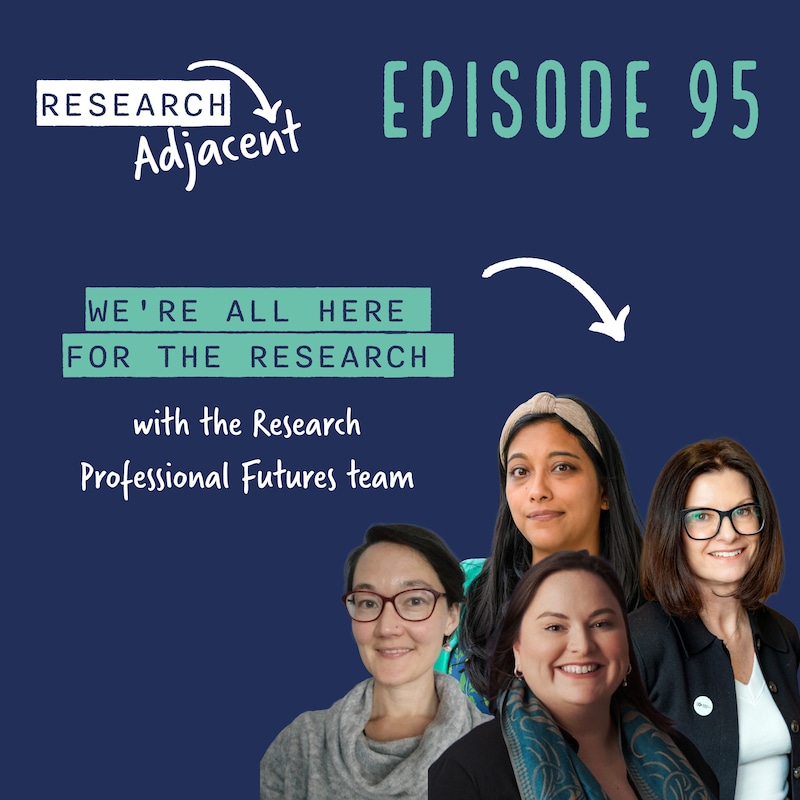
Research Professional Futures is a major UK-wide programme focused on improving recognition, opportunities and support for the research professional workforce. For this episode Sarah is joined by the project co-leads – Lorna Wilson (Durham University), Steph Bales (Teesside University), Isabella von Holstein (Kings College London) and Rika Nair (University of Warwick).
Sarah and the team talk about
- The career challenges facing research professionals and why this project is needed
- Why simply gathering reliable data on UK research professionals is an essential starting point
- What they are planning and how listeners can get involved
- How they hope to catalyse change and realise the full potential of the research professional workforce
Find out more
- Find show notes and transcript on the episode webpage
- Join the Research Professional Futures LinkedIn group and sign up to the mailing list via their website
- Connect via LinkedIn with Isabella von Holstein, Rika Nair, Lorna Wilson and Steph Bales
- Listen to related episodes of Research Adjacent including Lorna Wilson’s interview, Anja Roeding talking about why she founded the PRISM Network and the episode recorded at the 2025 International Research Culture Conference which features Rika Nair.
About Research Adjacent
- Follow Research Adjacent on LinkedIn
- Email a comment, question or suggestion
- Leave a voice note
- Post a review on Podchaser
- Sign up to the Research Adjacent newsletter
Mentioned in this episode:
Helping you have conversations that move research forwards
When she's not hosting Research Adjacent, Sarah McLusky organises, facilitates and trains people to run events, workshops and meetings that get people talking about research. To find out more about working with Sarah and to book a free call go to https://sarahmclusky.com/
Transcripts
There's a real lack of understanding about the workforce itself.
Speaker:There's no data that exists about us.
Speaker:There's an awful lot of RPs say that they got into the business accidentally.
Speaker:And now with waves of redundancies going on, people are going to get
Speaker:out of the business accidentally.
Speaker:And I think it will have real credibility because of its scale, and then I think
Speaker:the fact that it's informed by incredible research delivery partners, Oxford,
Speaker:Research Consulting and ARMA, and then it's led by research professionals,
Speaker:which I think we, we haven't seen before.
Speaker:So we didn't want, at the end of the project, to have created another
Speaker:toolkit that sits on a shelf or another concordat or something that
Speaker:doesn't get used or isn't practical.
Speaker:Hello there.
Speaker:I'm Sarah McLusky, and this is Research Adjacent.
Speaker:Each episode, I talk to amazing research adjacent professionals about what
Speaker:they do and why it makes a difference.
Speaker:Keep listening to find out why we think the research adjacent space
Speaker:is where the real magic happens.
Speaker:Hello and welcome to Research Adjacent.
Speaker:Today, I'm gonna invite you behind the scenes of Research Professional
Speaker:Futures with project leads Lorna Wilson, Steph Bales, Rika
Speaker:Nair, and Isabella von Holstein.
Speaker:I don't think it's an understatement to say that Research Professional Futures
Speaker:marks a turning point in the recognition of research-adjacent professionals
Speaker:and the value that they bring.
Speaker:As you'll hear, the program is all about understanding, recognizing, and supporting
Speaker:all kinds of research professionals.
Speaker:The project will cover everything from the basics, like just knowing
Speaker:the data of how many of us there are out there, to creating professional
Speaker:development frameworks, and from trialing projects to embedding change.
Speaker:My guests are something of a dream team in this department, with a deep understanding
Speaker:of the world of research professionals.
Speaker:Lorna Wilson is the managing director of Research and Innovation
Speaker:Services at Durham University.
Speaker:She is also the chair of ARMA and a previous guest on this podcast.
Speaker:Steph Bales is director of Research and Enterprise at Teesside University, soon
Speaker:to take up a role at Sterling University, and Steph is also a former chair of ARMA.
Speaker:Isabella von Holstein is senior project manager at King's College
Speaker:London and leads the PRISM Network, which you can hear all about from the
Speaker:founder, Anya Roeding, in episode 18.
Speaker:And last, but by no means least, is Rika Nair, who is the research culture
Speaker:manager at the University of Warwick, and Rika also leads the Research Culture
Speaker:Enablers Network, and Rika features in a previous episode as well, episode 77.
Speaker:In our conversation, you'll hear all about how the project came about, why it's
Speaker:needed, what they hope it will achieve, and why it is truly groundbreaking
Speaker:for all sorts of different reasons.
Speaker:Listen on to hear all about Research Professional Futures.
Speaker:Welcome along to the podcast.
Speaker:I think this is the most guests I've ever had on all in one Zoom
Speaker:room, so let's see how it goes.
Speaker:We have got the team today with us from the Research Professional Futures
Speaker:programme, who are gonna be telling us all about what that programme involves, and
Speaker:it's really exciting project for anybody who is research adjacent who is listening.
Speaker:So with us in the room today, we've got Rika Nair, we've got Lorna
Speaker:Wilson, we've got Steph Bales, and we've got Isabella Von Holstein.
Speaker:I'm gonna ask each of you to introduce yourselves and tell us a little bit about
Speaker:what you do in your day job, and then a little bit about what you're doing
Speaker:with the project, and we'll find out more about the project in due course.
Speaker:So Lorna, I'm gonna come to you first.
Speaker:Thanks, Sarah, and thank you so much for having us on.
Speaker:I'm Lorna Wilson.
Speaker:I'm Managing Director of Research and Innovation Services at Durham
Speaker:University, and I'm also chair of the Association of Research
Speaker:Managers and Administrators, ARMA UK.
Speaker:And I'm one of the co-leads of the RPF project.
Speaker:I lead work package one.
Speaker:Fantastic.
Speaker:Thanks, Lorna.
Speaker:We shall hear more about work package one in due course.
Speaker:Steph, could you introduce yourself?
Speaker:Hi, I'm Steph Bales.
Speaker:I'm Director of Research and Enterprise at Teesside University.
Speaker:I've quite a broad role developing research and knowledge exchange
Speaker:strategy and making sure that I deliver professional services across
Speaker:research and innovation, knowledge exchange and commercialization,
Speaker:business, civic and public engagement, and student and graduate enterprise.
Speaker:On the RPF, I am co-lead for work package two, which is focused on developing a
Speaker:comprehensive professional development framework and interactive digital
Speaker:platform, and I'll expand on that later.
Speaker:Okay, thanks very much, Steph.
Speaker:Isabella.
Speaker:So I'm Isabella von Holstein.
Speaker:I'm a senior project manager at King's College London, and
Speaker:I lead the third work package.
Speaker:I also lead the PRISM network for the last three and a half years.
Speaker:Fantastic.
Speaker:For anybody who doesn't know what PRISM stands for, do you want to
Speaker:just give us a little explanation?
Speaker:Yes.
Speaker:So PRISM stands for Professional Research Investment and Strategy Manager.
Speaker:There is… If you're curious, there is a previous podcast on this series with
Speaker:Anja Roeding that you recorded a number of years ago, so go and find out more.
Speaker:She founded the network.
Speaker:Yeah, definitely.
Speaker:We'll put a link to that in the show notes.
Speaker:And finally, Rika.
Speaker:Welcome.
Speaker:I'm Rika Nair.
Speaker:I'm research culture manager at the University of Warwick,
Speaker:where I'm trying to make Warwick a better place to do research.
Speaker:I also lead the Research Culture Enablers Network, which brings together
Speaker:colleagues trying to do the same at their institutions, and I'm a co-lead on
Speaker:Research Professional Futures, leading the work package four, which is around culture
Speaker:So thanks very much, all of you, for being here to tell us all about the project.
Speaker:And I think the first thing that people listening I'm sure will want to know is
Speaker:what is Research Professional Futures?
Speaker:Lorna, could you give us a bit of an overview of what you're doing and why?
Speaker:Of course.
Speaker:Research Professional Futures is a £4.5 million funded project by
Speaker:Research England, which aims to shape how research is delivered in the UK.
Speaker:So we seek to achieve this by focusing on research professionals who are
Speaker:professional colleagues who work across a really broad spectrum of
Speaker:increasingly specialized roles, who are core but often under utilized
Speaker:contributors to research success.
Speaker:So we're not part of the academic community or the technical community.
Speaker:We bring specialist professional expertise to research to make sure
Speaker:that it is delivered in the most effective, robust, and ethical way.
Speaker:So RPF is co-led between the four of us as we introduced ourselves with
Speaker:four work packages around context, competencies, concepts, and culture, with
Speaker:a number of key colleagues, including Oxford University Research Consulting,
Speaker:the PRISM Network, ARMA, and also the National Centre for Research Culture too.
Speaker:That sounds like a lot to keep a handle on.
Speaker:So yeah, a lot of stuff going on.
Speaker:And, Rika, you were tell- gonna tell us a little bit more
Speaker:about the programme as well.
Speaker:One thing to flag that's quite special about this project is that I think
Speaker:it's one of its kind being led by research professionals, but then it
Speaker:was really important for us for this project to be collaborative and to be
Speaker:research informed as well, which is while we've got these partners at the
Speaker:University of Oxford, Department for Education, and while we've got research
Speaker:consulting as well, helping to provide more qualitative and quantitative
Speaker:evidence so that we can better understand the landscape for research
Speaker:professionals and how it can be improved.
Speaker:So we've put a lot of thought into how to design this project.
Speaker:Yeah.
Speaker:And certainly tell us… I mean, you, you say that a lot of thought's gone into it.
Speaker:How did it even come about?
Speaker:How did it start?
Speaker:Why do we need a project like this?
Speaker:I feel like in some way, most people listening to this podcast
Speaker:are probably already sold on why we need something like this, but why
Speaker:do we need a programme like this?
Speaker:So, Steph, were you gonna take that one?
Speaker:Yeah, so, well, originally we were working on two very separate bids, so
Speaker:one for the PRISM network, that Rika and Isabella were leading and another for
Speaker:research managers and administrators.
Speaker:But they were both focused on similar themes, so recognition,
Speaker:visibility, professionalization.
Speaker:And I think PRISM's especially sort of focusing on precarity because it was
Speaker:much more of an issue for those roles.
Speaker:But we both submitted our bids separately and then Research England came back to
Speaker:us and said, "Actually, these projects have got quite a lot in common." And
Speaker:then when we sat down and had a meeting together, we sort of picked these four
Speaker:strands where we felt there was real connectivity across the two projects,
Speaker:and they became the four work packages.
Speaker:So then we spent probably another year working together to develop the bid
Speaker:and really think about things, and it was a fantastic process actually.
Speaker:I think we all really enjoyed it, and it made a better, much stronger, more
Speaker:comprehensive bid as a result of that.
Speaker:And so what are you hoping will be different as a result
Speaker:of having this programme?
Speaker:I think that the programme at the moment is probably more important now
Speaker:than ever, particularly in light of the sort of financial crisis that we're in.
Speaker:So I think we're seeing universities being restructured, and a lot of that
Speaker:is being driven by rounds of voluntary severance and compulsory redundancies.
Speaker:And it's reshaping research offices in a really unplanned and ad hoc way.
Speaker:So I think the blueprint in particular that we're developing will help
Speaker:institutions and the sector have an idea of the skills and the roles
Speaker:that are needed, the structures that are optimal to support universities.
Speaker:And I think particularly the pilot projects that we're gonna talk about
Speaker:that will be in work package three will provide an opportunity for colleagues
Speaker:to really think about ways of addressing some of those, contracting research
Speaker:officers and the changes to our roles through exploring things like shared
Speaker:services, the use of AI, in quite a safe space, and then think about how
Speaker:we can roll that out across the sector.
Speaker:And then just I think, you know, to sort of reiterate what Rika has just said,
Speaker:I think the fact that we're doing this, activity at such a national scale and
Speaker:the volume of stakeholder engagement that we're gonna have through work package one
Speaker:and four, amplified by the commission that we've set up, I think will just really
Speaker:raise the visibility and recognition of research professionals and the value
Speaker:that we bring to the research endeavor.
Speaker:And I think it will have real credibility because of its scale, and then I think
Speaker:the fact that it's informed by incredible research delivery partners, Oxford,
Speaker:Research Consulting and ARMA, and then it's led by research professionals,
Speaker:which I think we, we haven't seen before.
Speaker:No, I think I, I thought that when Rika said it before, that it is unusual
Speaker:to see a project of this scale being led by research professionals rather
Speaker:than researchers, than academics.
Speaker:Is that something that was always intended and something that was important?
Speaker:Yeah, everybody's nodding about that.
Speaker:I think that people, when you said there about raising the visibility, as
Speaker:I said, I think anybody listening to this podcast is probably already sold
Speaker:on the fact that people who are working in these kind of roles don't always
Speaker:get the recognition that they need.
Speaker:But I think, as you say, the backing of Research England is just gonna add that
Speaker:level of credibility as well, isn't it?
Speaker:And help to raise the profile as well.
Speaker:Yeah, definitely.
Speaker:Isabella, did you want to add something to this?
Speaker:Yeah.
Speaker:Can I come in and, and add another little dimension to this?
Speaker:And that's the whole sort of accidental career aspect to this.
Speaker:There's an awful lot of RPs say that they got into the business accidentally.
Speaker:And now with waves of redundancies going on, people are going to get
Speaker:out of the business accidentally.
Speaker:Well, what do you do then?
Speaker:How do you build a career if you don't actually know what
Speaker:your career could lead to?
Speaker:And this I think is the, one of the, the real advantages to the PRISM network
Speaker:to partnering with ARMA because we can now look at a much, much wider
Speaker:range of job types, not just PRISMs.
Speaker:And this is where this new concept of an RP, a research professional, came from,
Speaker:so that you can plan a career not just up the little ladder that you happen to
Speaker:be on, but you can sort of spot sideways moves that you could make onto somebody
Speaker:else's ladder, or you have to work out where you could go down a few steps and
Speaker:then climb something else and, but you've got much more of a holistic sense of,
Speaker:well, okay, I've got this set of skills.
Speaker:Where could I go with this?
Speaker:What am I missing?
Speaker:And what's actually feasible-
Speaker:Yeah
Speaker:… at a national scale.
Speaker:And I think that's new and that, really valuable, very comforting.
Speaker:Yeah.
Speaker:I think that it's, uh, you're, it's so true when you say about accidental
Speaker:careers, 'cause so many people that I've interviewed on this podcast have,
Speaker:yeah, they've just done something and then they went to the next
Speaker:thing, and then a job came up, and they went and did that, and it just
Speaker:seemed like a good idea at the time.
Speaker:So lots of squiggly careers, yeah.
Speaker:And for people who can't see, Isabella's doing a little squiggly,
Speaker:a little squiggly hand gesture.
Speaker:And, yeah, very squiggly careers.
Speaker:But also, I often talk to people just exactly like you were saying, is that
Speaker:research professional careers are a bit like going up a scramble net, where
Speaker:there's lots of different ways you can get to the top, unlike other professions
Speaker:where it might be more like a ladder and you go to the next step and the next step.
Speaker:So seeing those sideways moves.
Speaker:And I think a lot of these, something I talk about a lot as
Speaker:well, is the fact that a lot of these jobs just didn't even exist.
Speaker:So I've been working broadly in this area for over 25 years, but when I
Speaker:started, you know, I remember when I, there, in a research department there
Speaker:was maybe an administrator, and then there would be kind of the research
Speaker:office who helped funding a bit.
Speaker:But the, so many of these jobs are new jobs.
Speaker:And so for that reason there's just not that history there.
Speaker:Steph, yeah, did you want to come in?
Speaker:Yeah, that was a real key strand of the bid that we put in, that we said actually
Speaker:there's been this proliferation of new roles created, driven by policy, a lot
Speaker:of it developed by Research England that universities are responding to.
Speaker:So you've seen this the sector has really expanded, and those
Speaker:new roles have come about.
Speaker:But then what we haven't seen is the kind of concordat or support that we're
Speaker:seeing for other parts of the sector.
Speaker:Yeah.
Speaker:It, it's not getting any less.
Speaker:You know, with these recent changes from UKRI, with the focus on partnerships
Speaker:and on creating value for the nation, there's an awful lot of specialist
Speaker:knowledge that goes into connecting your academic who's got their really, really
Speaker:deep knowledge of their research into well, might be training them to be a good
Speaker:entrepreneur, or it might be actually providing entrepreneurship services for
Speaker:them, or public engagement services, or partnership services, or project
Speaker:management services, or whatever it is.
Speaker:And all of that is now part of research.
Speaker:And in the old days, we didn't have to define research to
Speaker:include all of that complexity.
Speaker:And these days It's different.
Speaker:We're all here for the research.
Speaker:Yes.
Speaker:Absolutely.
Speaker:Absolutely.
Speaker:And so, yeah, tell us then a bit more about the project.
Speaker:You've talked about all these different work packages that you've got and what's
Speaker:actually happened with each of them.
Speaker:So, maybe if we can go through them in turn, and you can tell us a bit
Speaker:about what each, what that means by work package one, two, three, four.
Speaker:So Lorna, I think you're coming in first for this one.
Speaker:Yeah.
Speaker:And I think it picks up on the discussion we've just been having
Speaker:about the proliferation of roles and how these have changed.
Speaker:So work package one is all about context.
Speaker:So one of the things we talked about is there's a real lack of
Speaker:understanding about the workforce itself.
Speaker:There's no data that exists about us.
Speaker:exists about us Um, you know, yes, we can speak to colleagues from other
Speaker:institutions and get kind of anecdotal view on, "Well, we've got these types
Speaker:of roles and structures, et cetera."
Speaker:But often the s- kind of the way these roles are kind of constructed is very
Speaker:particular for their institutional context, meaning what type of
Speaker:university they're in, for example.
Speaker:But then even within the same university, you know, if you have
Speaker:lots of devolved structures and lots of different things going on, it's
Speaker:very hard to get a picture of that.
Speaker:So we thought there was real value in kind of creating an almost audit of
Speaker:the research professional landscape to think about, okay, well, these are the
Speaker:types of roles in UK universities that help to support research, so that we
Speaker:can think about then what does a vision
Speaker:for our future look like with, you know, working with stakeholders.
Speaker:The thing I would really emphasize is this
Speaker:is a project not just that research professionals are here to deliver.
Speaker:We absolutely rely on working with our academic and our technical
Speaker:allies, and also with colleagues in other types of institutions.
Speaker:So we are focusing mainly on, research professionals in UK universities,
Speaker:but we're very aware there are lots of other research professionals
Speaker:that work in industry, that work in research funders, that work in
Speaker:independent research organizations.
Speaker:We had to give ourselves a little bit of a boundary because we- Yeah.
Speaker:You can't cover everything
Speaker:… I don't think, yeah, and Research England weren't gonna give us £20 million.
Speaker:Yeah.
Speaker:So, you know, we gave ourself a bit of a boundary to, you know, to do this.
Speaker:So we're doing, work package one is all about understanding what the workforce
Speaker:looks like, and that's where our fantastic research partners from Oxford and Research
Speaker:Consulting are delivering activity.
Speaker:But the main mechanism we're using to think about this data is the
Speaker:introduction of a national commission.
Speaker:So this is chaired by Shearer West and has colleagues from across the UK
Speaker:involved, and including our international representative, I should say.
Speaker:And it's, the best way to think about a commission is it operates almost
Speaker:like a national government inquiry.
Speaker:So the evidence that is collected through the data collection work will be presented
Speaker:to the commission, who then kind of look at that and think, "Okay, as a sector, you
Speaker:know, what are the recommendations that we want to look to make to support the
Speaker:development of the research professional workforce?" Now, we reckon there's
Speaker:at least 20,000 of us across the UK.
Speaker:So what, you know, what's happening right now in terms of our roles, but
Speaker:what's gonna happen about the future?
Speaker:And Steph's already spoken a little bit to some of the things that are changing, but
Speaker:it's thinking about, you know, what does research need from us further down the
Speaker:line, and kind of really understanding it.
Speaker:Now, the Oxford team are leading on our qualitative data work,
Speaker:so they're doing interviews.
Speaker:They have a Delphi panel set up.
Speaker:They're doing focus groups.
Speaker:Research Consulting are leading on our quantitative data work,
Speaker:so we will have institutional surveys and individual surveys.
Speaker:And we're really hoping all of that data and evidence, I think the really important
Speaker:word there is evidence, is gonna really help with the visibility of our workforce,
Speaker:but more importantly, it helps to inform the recommendations as we move forward.
Speaker:And that's really important in terms of work packages.
Speaker:Whilst they're separate, they're all interconnected and feed into each other,
Speaker:and that's a really important thing that we work hard with the project on.
Speaker:So National Commission, we're really excited because the colleagues that are
Speaker:part of it are so unbelievably passionate.
Speaker:We had our first commission meeting, and it was just, of course we thought
Speaker:Isabella, Steph, and myself were absolutely mad about the project . But,
Speaker:you know, hearing the passion coming from colleagues, including academic
Speaker:leaders in the room, is really important.
Speaker:And I think that's also something that's different about this project to
Speaker:any other kind of these projects that have run before on a smaller scale,
Speaker:which is we have academic colleagues as part of the project helping to
Speaker:deliver it, which is really, really important, operating as our allies.
Speaker:But so yeah, there's lots happening in work package one.
Speaker:Lots of data collection that feeds the rest of the project,
Speaker:And the data collection piece, I think people might be surprised the extent
Speaker:to which that hasn't been done before.
Speaker:'Cause I understand that there's most of the data collected, I now can't remember
Speaker:the name of the system that they use to collect data about what's going on
Speaker:in universities, doesn't even include, like, a category to record the people
Speaker:who are doing these kind of roles.
Speaker:Yeah, so he- that's HESA.
Speaker:HESA.
Speaker:Yeah.
Speaker:And they've been looking at how they expand and diversify
Speaker:the data that's collected.
Speaker:But I think one of the things about how our research has been designed
Speaker:at Oxford Research Consulting teams, it's been informed by us as
Speaker:research professionals as part of, obviously, the leadership team.
Speaker:And I think it's thinking about how do we extract really rich data.
Speaker:So not just the numbers game, but also understanding, okay,
Speaker:well, this is actually over time how things have changed.
Speaker:One of the things I haven't mentioned as part of this is we're looking at the
Speaker:last eight years of data from jobs.ac.uk that are gonna show and demonstrate lots
Speaker:of interesting trends around how roles have changed, what are some of the, you
Speaker:know, things we see quite frequently in terms of roles being advertised, and
Speaker:seniority, and all these different things.
Speaker:But it's the richness of that data not just those basic figures.
Speaker:So- Yeah … we're excited to see what comes out of it.
Speaker:But it's a, a challenge as well.
Speaker:We really rely on communities coming together and engaging with us so that
Speaker:we can collect really great data.
Speaker:We can't just do that ourselves.
Speaker:Steph, you're leading on work package two.
Speaker:Could you tell us a bit about what that entails?
Speaker:Yeah.
Speaker:So work package two is focused on competencies and developing
Speaker:this comprehensive professional development framework and an
Speaker:interactive digital platform.
Speaker:It's important to say that although work package one has started, work
Speaker:package two is yet to start, but it will be very much shaped by the
Speaker:outcomes from work package one.
Speaker:In fact, if- you can't see here, but we have a diagram which shows how
Speaker:work package one and the intelligence that comes in from that informs
Speaker:all of the other work packages.
Speaker:But specifically from work package one, there's a, there's a systematic
Speaker:review of what exists already in terms of professional development frameworks
Speaker:from the UK and internationally and across similar adjacent professions
Speaker:such as the key professionals.
Speaker:There's this typology of research professional roles that they're
Speaker:trying to develop, and some of that is, Lorna just mentioned, that'll
Speaker:be informed by this data mining that they're doing of jobs.ac.uk.
Speaker:And then there's all the findings from the interviews, both institutional and
Speaker:individual surveys as well, about research professional roles, the skills that they
Speaker:think they need to undertake the job, and that they-- what they see as their
Speaker:future needs, because this is really important as well, sort of thinking about
Speaker:what the future needs are for the sector.
Speaker:And then when work package two will kick in, based on that, there'll be
Speaker:sort of a series of co-production workshops focused on that evidence base,
Speaker:and that will inform the competencies framework or the professional development
Speaker:framework and what that will look like and how it will be structured.
Speaker:We'll also be developing an interactive digital platform to support that, to make
Speaker:that more of a dynamic interactive tool, and that scope, is still being developed,
Speaker:and we'll be asking research professionals what they would find most useful through
Speaker:interviews and surveys and when we sort of hit the ARMA conference as well next week.
Speaker:So we're really keen to sort of get an idea from people, and, I mean, Isabella
Speaker:and I have had, with sort of Oxford and Research Consulting as well, quite
Speaker:long conversations, and we're now starting to speak to sort of AI digital
Speaker:academics as well on, on the scope of that and what it might look like.
Speaker:Yeah.
Speaker:Oh, it's good to hear that there… It sounds like, I know we'll come to this
Speaker:in a little bit, but it sounds like
Speaker:there
Speaker:there's lots of opportunities for people from the community, people who
Speaker:are actually doing these roles, to get involved and actually contribute to the
Speaker:research as well, which is fantastic.
Speaker:Practicing, practicing what we preach, as they say.
Speaker:Yeah.
Speaker:Yeah.
Speaker:Excellent.
Speaker:So Isabella, you're leading work package three.
Speaker:Tell us a bit about that.
Speaker:That's right.
Speaker:Work package three is called Concepts, and it's the money package.
Speaker:So this is the pilot project.
Speaker:So this is going to be an opportunity for people to pilot institutional and
Speaker:also regional initiatives either to enhance an RP role, to future proof an
Speaker:RP role, to explore a new technology, or to provide community support.
Speaker:There's an evaluation element to that.
Speaker:It's not just delivery.
Speaker:We'll also be evaluating how it worked.
Speaker:So it might be something like a regional shared service, whatever
Speaker:that looks like, whatever would be useful to you, wherever you are.
Speaker:An AI tool.
Speaker:It might be some sort of community building.
Speaker:But we also hope to, we were going to put together a national community
Speaker:of practice and then the results will also go on the digital platform.
Speaker:So are those projects already decided, or is that-
Speaker:Nope
Speaker:… no, there's gonna be a process
Speaker:so exactly how this is going to work is also dependent on the outcom-
Speaker:outcomes of work package one.
Speaker:Because we need to know more about what people are actually doing and what
Speaker:they're actually struggling with in order to be able to design a programme
Speaker:that would actually be useful to them.
Speaker:Sothe intention is for that to run not next year, but the year after, so 2028.
Speaker:So look for news for that next year.
Speaker:Okay.
Speaker:Yeah, interesting.
Speaker:Thank you.
Speaker:And Rika, tell us about work package four.
Speaker:Sure.
Speaker:So work package four is culture, and it's essentially its own work package
Speaker:because it's about what we want to avoid.
Speaker:So we didn't want, at the end of the project, to have created another
Speaker:toolkit that sits on a shelf or another concordat or something that
Speaker:doesn't get used or isn't practical.
Speaker:And so what we're hoping to do with this work package is really to embed
Speaker:co-creation from the start so that we can enrich the work that we're
Speaker:doing and also amplify the work of the different work packages.
Speaker:And we've also included some time within this work package so that whatever we come
Speaker:up with, we've got some time to test it, embed it in a few institutions, refine it.
Speaker:So it's really here to support the legacy of the project, and it's also here to
Speaker:make sure that we include some of the voices that are, might be easy to avoid.
Speaker:So we're definitely gonna have the champions included in work package
Speaker:one, but we do have some dedicated planning in work package four
Speaker:to consider other stakeholders, including those who don't yet see
Speaker:the value of research professionals.
Speaker:And what we're hoping to do with this work package eventually is to bring everything
Speaker:together into what we're calling the Research Professional Blueprint.
Speaker:Exactly what that looks like hasn't been decided because it's something
Speaker:we're gonna create with the sector.
Speaker:Yeah.
Speaker:Excellent.
Speaker:And how do you see, 'cause obviously your role is looking at research culture
Speaker:a- across a whole university, how do you think those two things are gonna
Speaker:dovetail together, so the broader research culture initiatives and then the research
Speaker:culture element of this specific project?
Speaker:I think they're gonna inform each other.
Speaker:I think what I've learnt from my work as a research culture manager, and
Speaker:I think we've done some work through the Research Culture Enablers Network
Speaker:as well, is a lot of what our role is about is surfacing the missing voices.
Speaker:So that approach that we've got to how we improve our institutions,
Speaker:we're gonna apply here.
Speaker:And actually, as part of this work package, we do have a dedicated
Speaker:research culture manager, Dr. Katie Reynolds, who's joined the team.
Speaker:So we're really taking this as being integral to the success of the project.
Speaker:Yeah.
Speaker:Excellent.
Speaker:Excellent.
Speaker:Oh, well, it sounds like from what you've said there, there are gonna
Speaker:be…there's lots still to be decided, and so lots of opportunities
Speaker:for people to get involved and to influence and be part of this project.
Speaker:How can people get involved?
Speaker:What are the opportunities?
Speaker:So work package one is running at the moment, and there are a number of
Speaker:opportunities to get involved there.
Speaker:There's an individual survey coming out in the next month.
Speaker:So I think we want 700 responses to that.
Speaker:So we would like to hear from you if you are an RP or if you have been an RP.
Speaker:There's also an institutional survey coming out shortly after
Speaker:that where we want 70 responses.
Speaker:So if you are in a position to persuade your institution to take
Speaker:part in this, please do so if you can.
Speaker:And we would- we're very keen to make sure that we get input, not
Speaker:just from the whole of the British Isles, despite the fact that this is
Speaker:Research England funded, we do want data from the devolved administrations.
Speaker:And also very much to reflect different types of institutions
Speaker:with different research profiles.
Speaker:That's really important to us.
Speaker:There's also a Delphi expert panel survey that has already begun.
Speaker:That's quite a small group.
Speaker:There will be focus groups that are part of work package two,
Speaker:that's the competencies work.
Speaker:That's being set up.
Speaker:That'll be mostly next year.
Speaker:And then of course there's the funding round, which will be
Speaker:mostly the year after that.
Speaker:And then of course there is the ongoing comms work.
Speaker:Rika can cover that.
Speaker:Yes.
Speaker:So just to say, as I mentioned, we are really keen with the culture work
Speaker:package to be engaging the community and feeding in any changes or any of
Speaker:those voices that are harder to reach.
Speaker:And so, we have a LinkedIn group that has launched and, my colleague that I
Speaker:mentioned, Katie, is also leading on a series which is gonna be looking at
Speaker:what matters to research professionals and also what matters to those who
Speaker:work with research professionals.
Speaker:So you could probably join the LinkedIn group as the best way to
Speaker:stay up to date, connect on the website, get in touch with Katie.
Speaker:We've just recently been to Cardiff to test out some of our engagement techniques
Speaker:for the What Matters series, and we'd be happy to go to other institutions
Speaker:as well if people are interested.
Speaker:Fantastic.
Speaker:We can get a link to that and put that into the show notes.
Speaker:And then are there other ways that people can find out more and
Speaker:stay in touch with the project?
Speaker:Yeah, so there's a, we've got a new website which is rpfutures.co.uk, and
Speaker:if you go to the Get Involved page on there, you can sign up for updates on
Speaker:the project, and then all of the things that Isabella and Rika have just talked
Speaker:about, you can sign up for those as well.
Speaker:So that's, that's a really good way in for people.
Speaker:Also Isabella just mentioned the devolved nations, so I am actually moving from
Speaker:Teesside and joining the University of Stirling as their exec director
Speaker:for research innovation and business engagement from the 1st of August.
Speaker:So although Scotland can't benefit financially from these projects
Speaker:they're still interested in views from the devolved nations, so I
Speaker:still will stay involved, so I'll be able to share some of those views
Speaker:from Scottish colleagues as well.
Speaker:Fantastic.
Speaker:So it's amazing to hear about how much work there is gonna be happening,
Speaker:and it's clear this is gonna be something to keep an eye on over the
Speaker:next four- four years it is in total?
Speaker:Yes, we're already kind of part of the way into it, but yeah, four years in total.
Speaker:And yeah, it is amazing, particularly the reason that I started this project,
Speaker:I know I wasn't the only one, 'cause obviously it's the story behind the
Speaker:PRISM Network and everything as well, but the reason I started this podcast
Speaker:was because I felt that people who were in these roles weren't getting enough
Speaker:acknowledgement and enough recognition.
Speaker:So it is amazing to see something tangible actually happening and going
Speaker:forward, and I'm really looking forward to seeing the difference that it makes to
Speaker:people in research professional careers.
Speaker:So I do like to end all of my episodes with asking my guests of if they had
Speaker:a magic wand, what they would change about the world that they work in.
Speaker:Rika, perhaps I'll come to you first.
Speaker:Sure.
Speaker:So to me, I think it's all about visibility.
Speaker:So if I had a magic wand, I would like more people to know that research
Speaker:professional roles exist, and that they can be exciting routes into research.
Speaker:And that can be either for colleagues and students already at the universities,
Speaker:the research students, the post-docs, but equally for colleagues from other sectors.
Speaker:This is a really exciting route into research.
Speaker:Yeah.
Speaker:Excellent use of the magic wand.
Speaker:Lorna, what would you like to do?
Speaker:Uh, I think I would love to hear someone say that they grew up wanting to be a
Speaker:research professional because I think it would show that, you know, to pick
Speaker:up on Isabella's comments earlier, that we don't come here by accident.
Speaker:That, you know, the visibility of this as an opportunity increases, and that
Speaker:we have people working towards building careers in research professionals, not
Speaker:just seeing them accidentally happen.
Speaker:Yeah.
Speaker:That is definitely something that would be a big change.
Speaker:Steph, what would you like to do with your magic wand?
Speaker:I think I would like colleagues to accept advice from research professionals.
Speaker:In fact, even seek out their opinion and accept it first time.
Speaker:I think that people need to think about the impact it has when you're
Speaker:second-guessing or think you know better than someone who's been doing that job for
Speaker:a long time and has real expertise in it.
Speaker:Yeah.
Speaker:Definitely that would be a real evidence of a real shift in mindset as
Speaker:well, wouldn't it- if that happened.
Speaker:Yeah.
Speaker:Yeah.
Speaker:I do… it does happen in some places, but perhaps not as much as it could.
Speaker:Yeah.
Speaker:And Isabella?
Speaker:I would like universities to understand that keeping professional staff, research
Speaker:professionals in-house long-term, that doesn't mean in the same role,
Speaker:is an advantage, that all of that institutional knowledge, all of that
Speaker:sectoral knowledge, all of that network capital that they have built up, it's
Speaker:worth building structures to keep them.
Speaker:It's worth building structures so that they can go off and do
Speaker:other things and acquire all of those networks and institutional
Speaker:knowledge and perspective and so on.
Speaker:But
Speaker:there just seems to be such a huge difference between the very, very long
Speaker:academic career ladders where there's this acceptance that some- that somebody's
Speaker:going to be building expertise over the very long term, and that that's
Speaker:something the university is prepared to support, and then the complete absence
Speaker:of that on the professional side.
Speaker:I'm not saying we need exactly that.
Speaker:I'm just saying you don't want the churn.
Speaker:When you lose people like that, you lose really valuable knowledge.
Speaker:Yeah.
Speaker:Yeah.
Speaker:That's definitely true.
Speaker:Definitely true.
Speaker:Oh, well, all excellent uses of the magic wand, and I feel like maybe some of
Speaker:those will come out of of this project.
Speaker:We shall see.
Speaker:We shall see.
Speaker:So before we finish, is there anything that any of you want to bring in
Speaker:that maybe you haven't mentioned, you haven't had a chance to say?
Speaker:Yes, Steph.
Speaker:I was just gonna say, we mentioned the brilliant work of Katie earlier, but we
Speaker:also have Karen O'Riordan as well, who is providing all of our project support at
Speaker:the moment and makes a huge difference.
Speaker:So she actually is at the, in the engine room making all of this project
Speaker:happen, so I just wanted to mention her.
Speaker:Fantastic.
Speaker:So thanks, thanks Karen as well.
Speaker:You're getting a thumbs up from Isabella.
Speaker:So it just remains to say then, thank you so much to all of you for taking
Speaker:the time to come along, tell us all about this project, and it is very
Speaker:much a case of watch this space.
Speaker:So we'll put all the links and everything in the show notes, including how people
Speaker:can get in touch with the project, how they can get in touch with you personally.
Speaker:But for now, thank you so much.
Speaker:Thanks for listening to Research Adjacent.
Speaker:If you're listening in a podcast app, please check you're subscribed and
Speaker:then use the links in the episode description to find full show notes
Speaker:and to follow the podcast on LinkedIn.
Speaker:You can also find all the links and other episodes at www.researchadjacent.com.
Speaker:Research Adjacent is presented and produced by Sarah McLusky,
Speaker:and the theme music is by Lemon Music Studios on Pixabay.
Speaker:And you, yes you, get a big gold star for listening right to the end.
Speaker:See you next time.
